📺 Watch the Full Video Analysis
This article was automatically generated by the NFC Market Live AI analysis system. (Updated: 2026-08-31 21:42 JST)
📄 Primary Source
Banco Central do Brasil
https://www.bcb.gov.br/content/focus/focusmarketreadout/R20260828.pdf
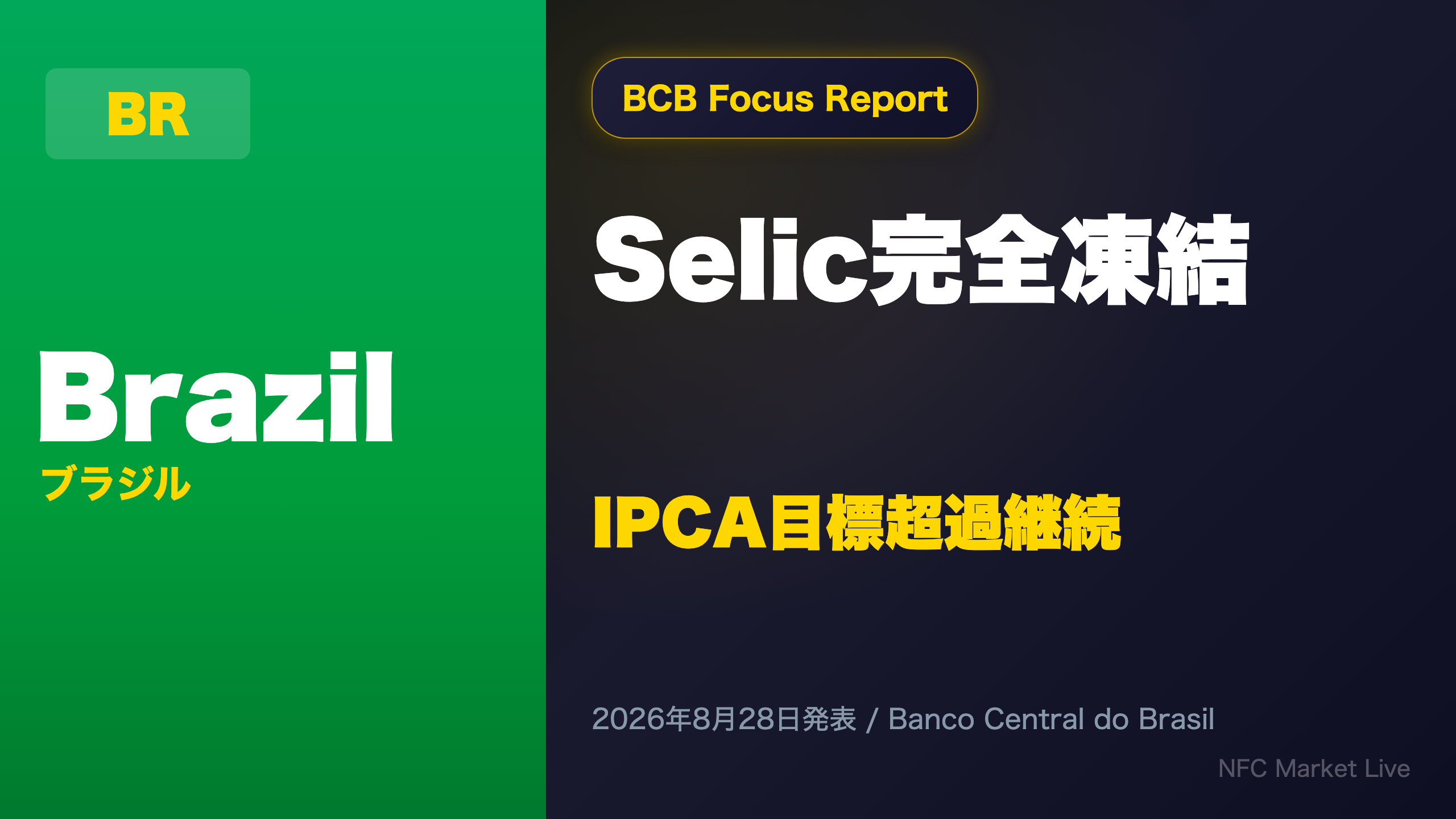
📊 Deep dive into Brazil’s weekly Focus Market Readout survey (data as of Aug 28, 2026).
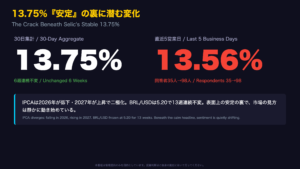
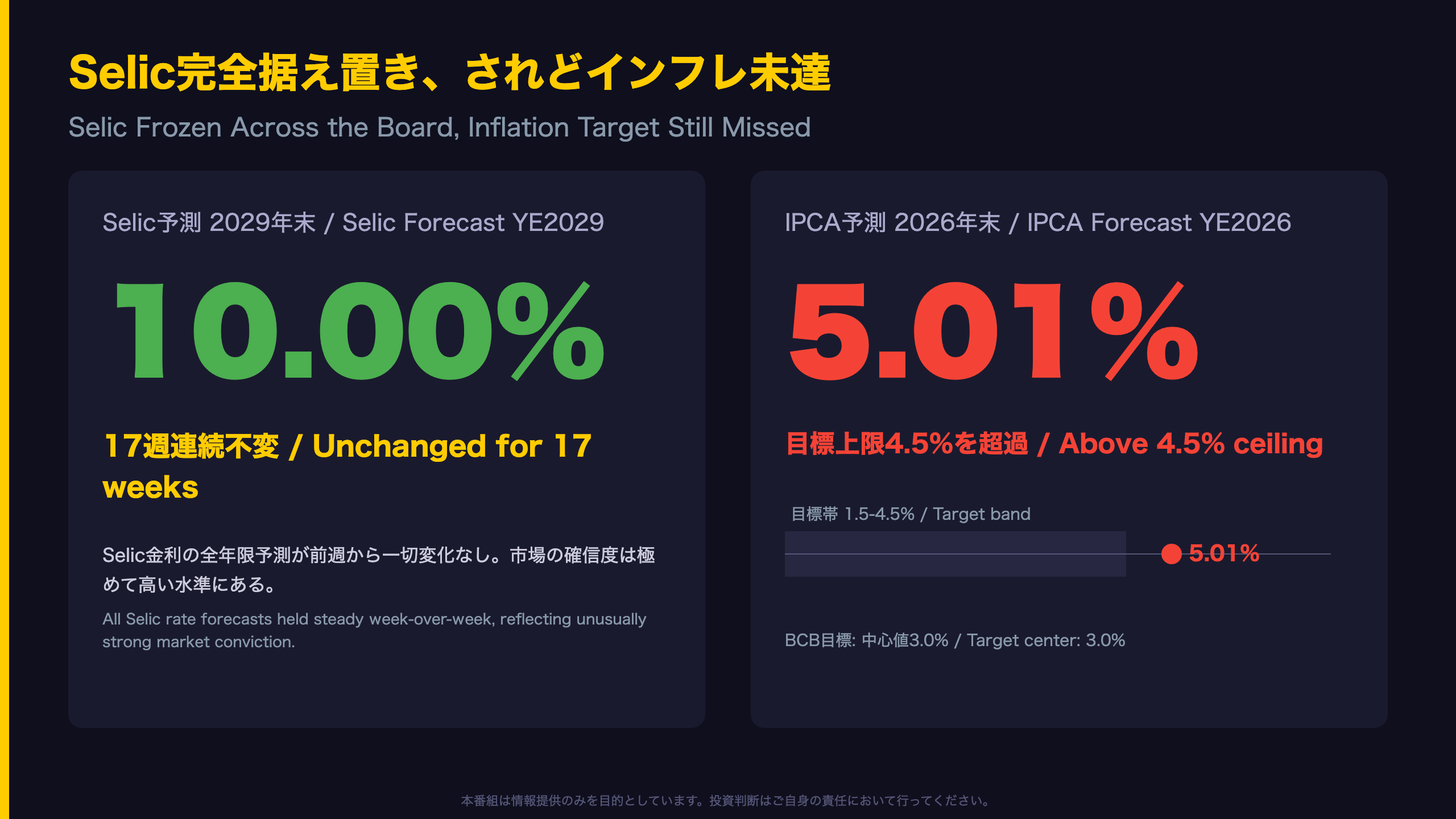
Selic rate forecasts are unchanged across every horizon, with the 2029 estimate flat at 10.00% for 17 straight weeks.
📉 Yet the 2026 IPCA inflation forecast remains at 5.01%, still above the BCB’s 4.5% tolerance ceiling.
GDP growth was cut for a second week, and fiscal deficit forecasts widened too.
💹 We break down what this means for BRL/JPY carry trades and risks for Japanese investors.
Selic完全据え置き、されどインフレ未達 / Selic Frozen, Inflation Target Still Missed
Why the Focus Report’s “Stillness” Matters
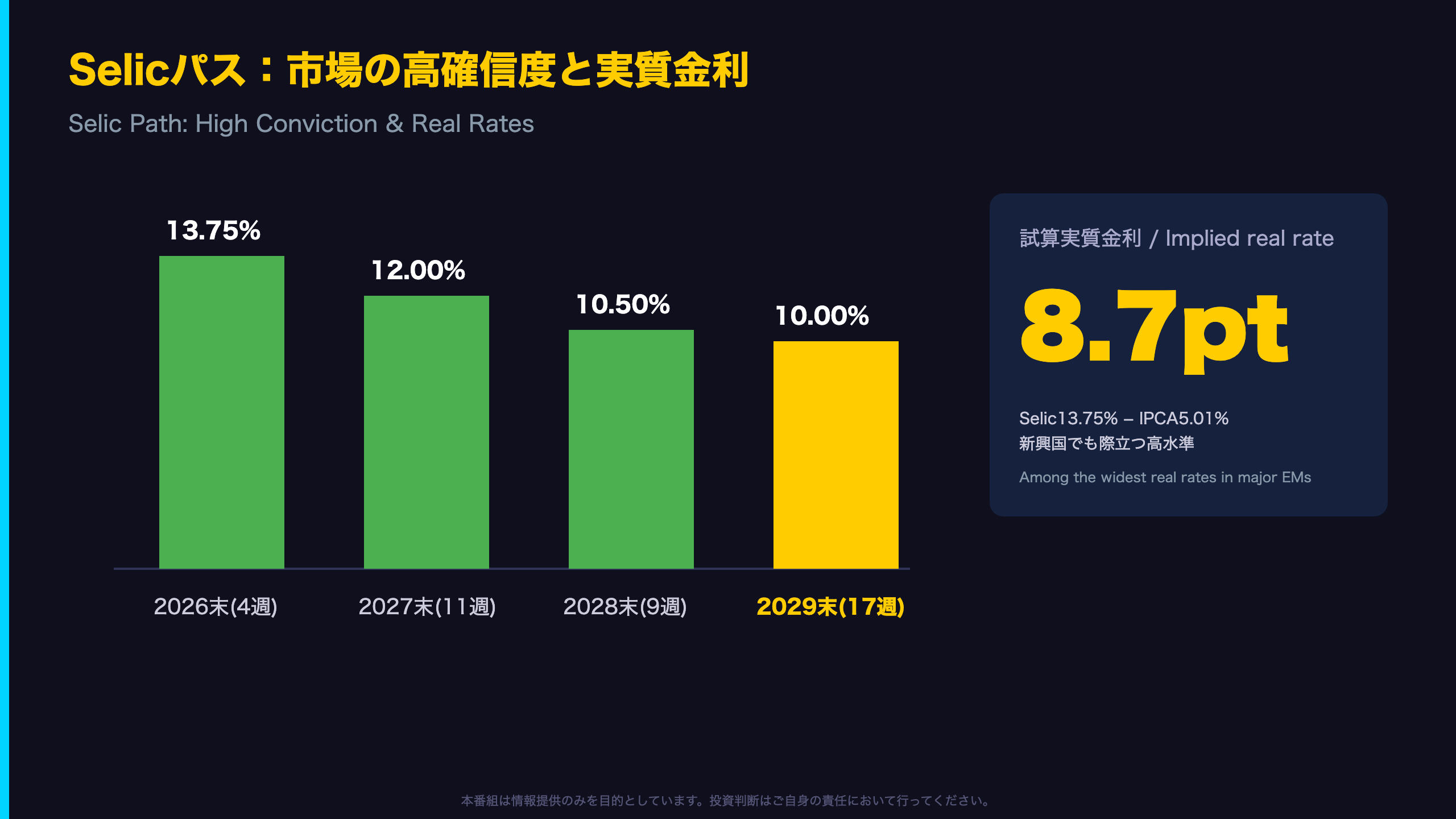
The most striking feature of this week’s Focus Market Readout (data as of August 28, 2026) is not what changed, but what didn’t. Selic rate forecasts were unchanged across every horizon: 13.75% for year-end 2026, 12.00% for 2027, 10.50% for 2028, and 10.00% for 2029.
Context for international readers: The Focus Report is a weekly survey published by the Banco Central do Brasil (BCB), aggregating median forecasts from over 130 financial institutions. Unlike the U.S. Federal Reserve’s dot plot (published quarterly), Focus is updated every Monday, making it one of the most granular real-time gauges of market expectations available for any major emerging-market central bank.
What stands out is the persistence of these forecasts. The 2029 year-end Selic estimate has now remained at 10.00% for 17 consecutive weeks. The 2027 estimate has held at 12.00% for 11 weeks. This level of consensus stability suggests markets have a high degree of conviction in BCB’s projected easing trajectory, a sharp contrast to the volatility often seen in Fed funds futures pricing.
Yet stability in rate expectations doesn’t equal confidence in disinflation. The 2026 IPCA (Brazil’s benchmark CPI) forecast sits at 5.01%, still above the BCB’s tolerance ceiling of 4.5% (target: 3.0% +/-1.5pp). For context, this would be roughly equivalent to the Fed’s target band being breached on the upside for a full calendar year with no clear resolution in sight.
Market implication: This combination, anchored rate-path expectations plus an unresolved inflation overshoot, tends to support real interest rate carry strategies in BRL, since nominal rates stay high for longer even as growth forecasts soften (see Slide 4). The next Focus Market Readout is due September 7, 2026.
Selicパス:市場の高確信度と実質金利 / Selic Path: High Conviction & Real Rates
What an 8.7-Point Real Rate Signals
Sorting the Selic forecasts by “weeks unchanged” reveals just how anchored market expectations have become.
| Horizon | Forecast | Weeks Unchanged |
|---|---|---|
| YE 2026 | 13.75% | 4 |
| YE 2027 | 12.00% | 11 |
| YE 2028 | 10.50% | 9 |
| YE 2029 | 10.00% | 17 |
Counterintuitively, longer-dated forecasts show longer stability streaks. One reading: distant-horizon rate expectations converge toward a structural neutral-rate view, making them less sensitive to short-term data noise than near-term forecasts, which react to each incoming CPI print.
Subtracting the 2026 IPCA forecast (5.01%) from the 2026 Selic forecast (13.75%) yields an approximate ex-ante real rate of 8.7 percentage points, among the highest of any major emerging market, and dramatically wider than Japan’s near-zero real rate environment (BOJ policy rate: 0.84% as of June 2026, source: FRED IRSTCI01JPM156N). This wide differential is the structural engine behind BRL carry trade strategies favored by yield-seeking investors, including many in Japan’s retail FX community.
The other side of the coin: sustained high real rates also raise Brazil’s debt-servicing costs, a factor already visible in the slow upward creep in the 2027 net public debt/GDP forecast (see Slide 4). The next inflection point to watch is the upcoming COPOM meeting, where markets will test whether this multi-week Selic consensus holds.
インフレ:IPCA高止まり vs IGP-M急低下 / Inflation: Sticky IPCA vs Falling IGP-M
Two Inflation Gauges, Two Different Stories
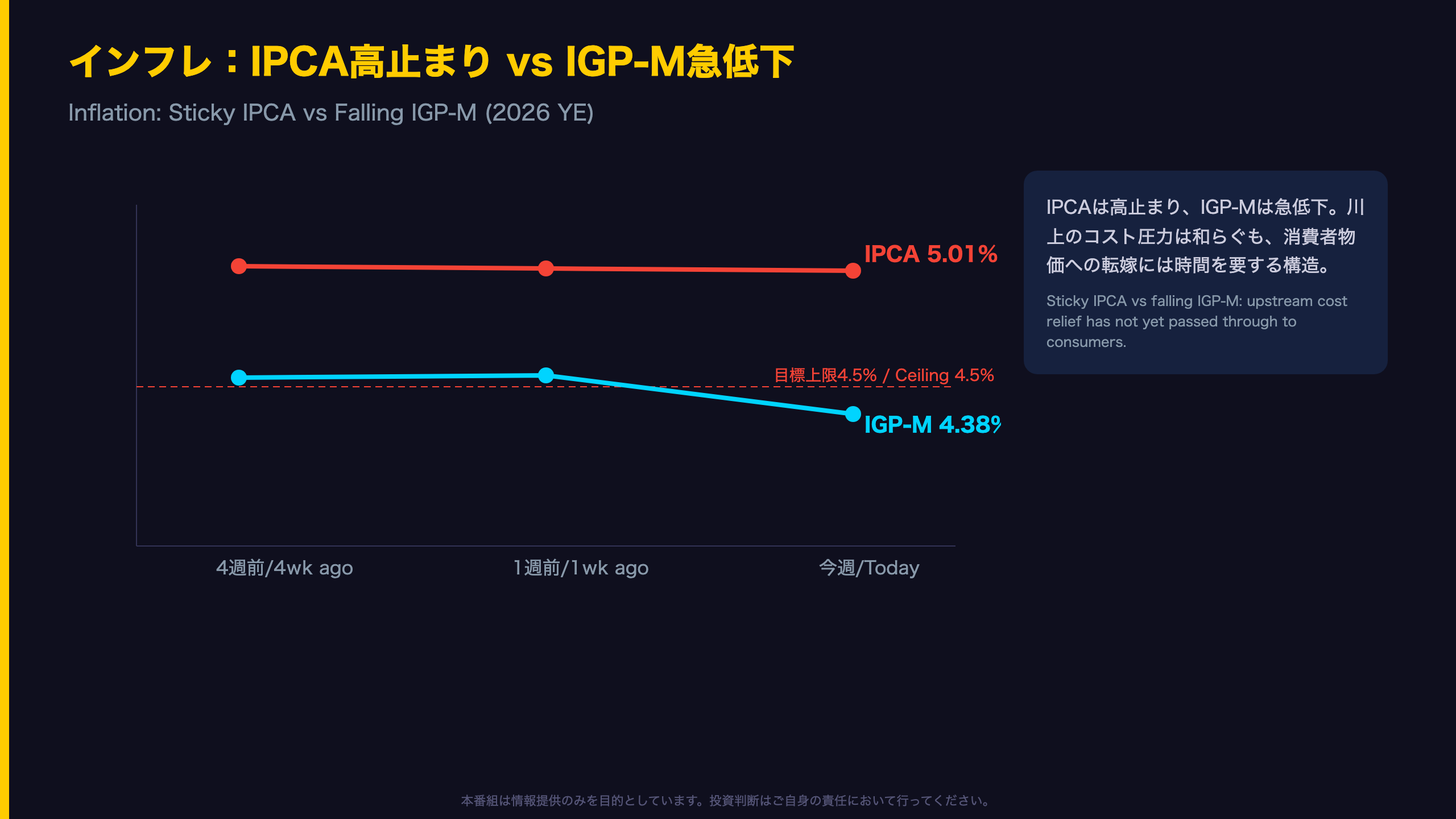
The most interesting divergence in this week’s data is between IPCA (Brazil’s headline CPI, the BCB’s official inflation target metric) and IGP-M, a broader “general price index” that behaves more like a wholesale/producer price gauge, heavily influenced by FX and commodity swings.
IPCA (consumer-level)
– YE 2026: 5.02% -> 5.01% (down, first week of a new declining trend)
– YE 2027: 4.22% -> 4.25% -> 4.28% (up for 3 straight weeks)
– YE 2028: 3.80%, stable for 5 weeks
– YE 2029: 3.50%, stable for 52 consecutive weeks, a full year
IGP-M (wholesale/producer-adjacent)
– YE 2026: 4.71% -> 4.55% -> 4.38% (down 2 straight weeks, -33bps total)
– YE 2027: 4.09% -> 4.10% (tentative reversal upward)
For context: IPCA is Brazil’s equivalent of U.S. CPI, the metric the BCB actually targets (3.0% +/-1.5pp band), similar in function to the Fed’s PCE target. IGP-M is closer to a blend of the U.S. PPI and import price index, capturing upstream cost pressures before they reach consumers.
The fact that the 2029 IPCA forecast hasn’t moved in 52 weeks suggests markets have anchored their long-run inflation expectations at 3.50%, a full half-point above BCB’s 3.0% center target. This is a soft form of credibility discount: not a crisis, but a persistent skepticism that BCB will fully hit its target even at the multi-year horizon.
Meanwhile, IGP-M’s sharp two-week decline hints that upstream cost pressures, likely FX-related given BRL’s own stability, are easing. However, pass-through from wholesale to consumer prices typically takes several months, so it would be premature to conclude consumer inflation is about to follow suit based on just one to two weeks of data.
成長減速の芽と財政の緩やかな悪化 / Growth Slowdown Signs & Slow Fiscal Drift
Near-Term Softening, Long-Run Resilience
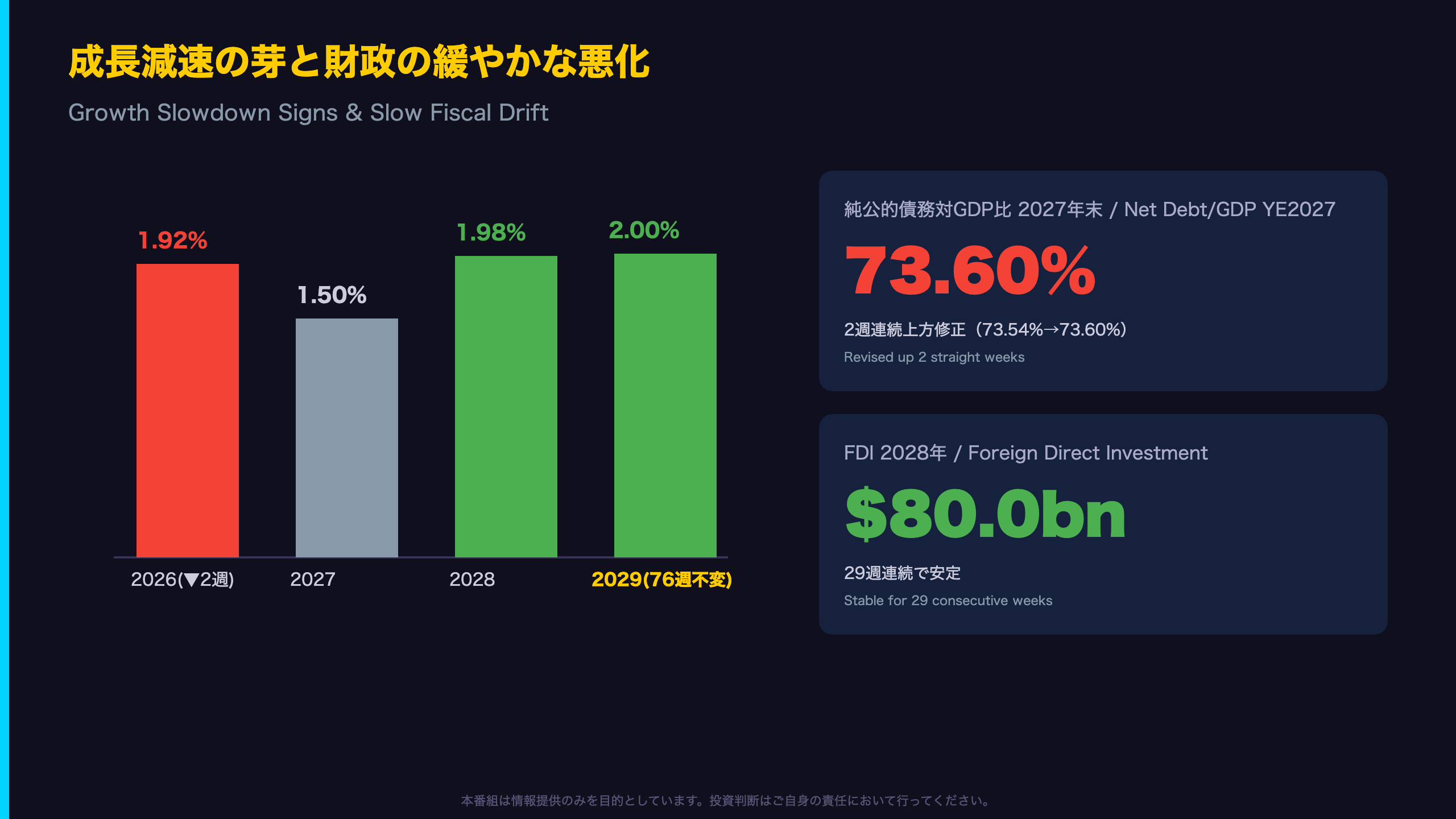
The 2026 GDP growth forecast was cut for a second straight week (1.95% -> 1.92%). The magnitude, just 0.03 percentage points, is too small to read as a structural recession signal from a single week of data, but the direction is worth monitoring going forward.
By contrast, growth forecasts for 2028 (1.98%) and 2029 (2.00%) remain remarkably stable, with the 2029 estimate unchanged for 76 consecutive weeks. This suggests market participants are cleanly separating a near-term cyclical deceleration, likely a lagged effect of Brazil’s tight monetary policy, from their view of the country’s longer-run potential growth rate, a distinction similar to how U.S. economists separate a single quarter’s GDP print from the Fed’s estimate of long-run potential GDP.
On the fiscal side, the 2027 net public debt-to-GDP forecast rose for a second consecutive week (73.54% -> 73.60%), and the projected 2027 nominal fiscal deficit widened from -8.30% to -8.50% of GDP, marked with a downward-revision arrow in the original report, indicating a worsening fiscal trajectory. One plausible contributing factor: Brazil’s prolonged high-real-rate environment (see Slide 2) raises government interest expenses. This dynamic is broadly comparable to how elevated Fed rates raised U.S. federal interest costs in 2023-24.
External accounts, however, remain a source of stability. The 2026 trade balance forecast was revised up slightly ($77.75bn -> $78.00bn), and FDI projections for 2028 have held near $80 billion for 29 consecutive weeks. The current account deficit forecast for 2026 has also stayed flat at -$60 billion for eight weeks. The takeaway: Brazil’s fiscal drift and its external-sector resilience are, for now, running on separate tracks.
BRL/JPYキャリーと日本人投資家への含意 / BRL/JPY Carry Trade & Implications for Japanese Investors
The Carry Trade Appeal, and What It Doesn’t Tell You
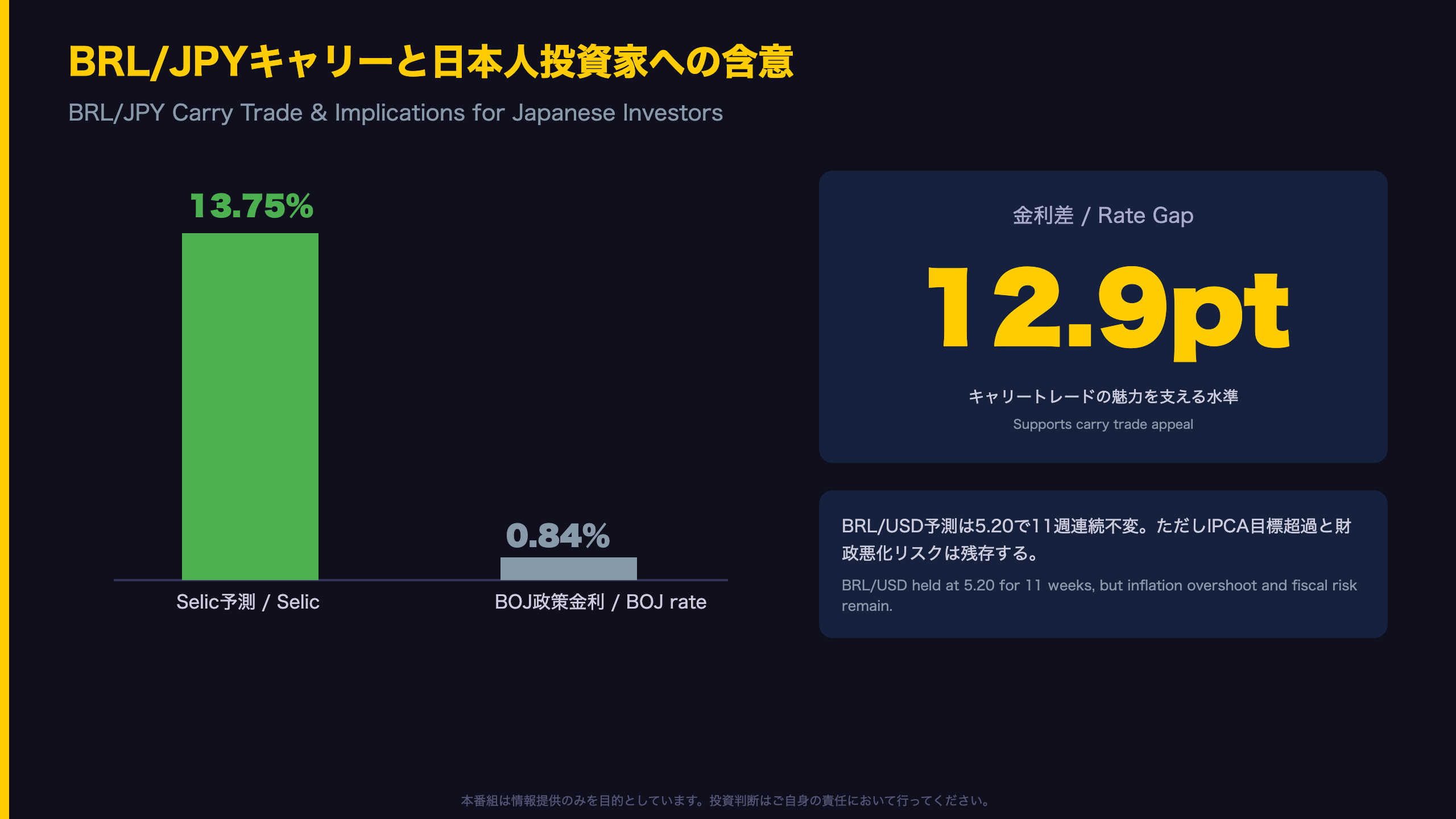
The fact that the BRL/USD forecast for year-end 2026 has held at 5.20 for eleven consecutive weeks is itself a data point: it suggests market participants currently see limited near-term FX volatility risk in Brazil, at least based on consensus forecasts.
The rate differential (fact-based)
– Brazil Selic forecast (YE 2026): 13.75%
– Bank of Japan policy rate: 0.84% (June 2026, FRED series IRSTCI01JPM156N)
– Nominal rate gap: approximately 12.9 percentage points
This is one of the widest rate differentials among major emerging-market currencies against the yen, and it’s the core reason BRL/JPY carry trades remain a topic of interest for Japan’s large retail FX trading community, historically associated with AUD/JPY, TRY/JPY, and MXN/JPY carry strategies as well.
But three risk factors deserve equal weight
- Sticky inflation: The 2026 IPCA forecast (5.01%) remains above the BCB’s 4.5% tolerance ceiling. While the implied real rate (~8.7 points) is currently generous, a prolonged target miss could eventually alter the BCB’s rate-cut trajectory.
- Slow fiscal drift: The 2027 net public debt-to-GDP forecast rose for a second straight week (73.54% -> 73.60%). Persistent fiscal deterioration is the type of slow-burn risk that can eventually trigger a sovereign risk repricing and a sharp BRL selloff, a pattern seen historically in Brazil (e.g., 2015-16).
- Consensus stability is not a guarantee: Eleven weeks of unchanged FX forecasts reflects the recent past, not a forward guarantee. A political or fiscal shock could unwind this consensus quickly, as has happened before in Brazilian markets.
For Japanese investors considering Brazilian government bonds, BRL-denominated assets, or BRL/JPY FX positions, the wide interest-rate cushion should be weighed against these structural inflation and fiscal risks, not viewed as a risk-free yield pickup. The next Focus Market Readout is due September 7, 2026; watch whether the 2026 IPCA forecast dips below 5.0% and whether the debt-to-GDP uptrend continues.
Disclaimer: This article is for informational purposes only. All investment decisions are made solely at your own risk.