📺 Watch the Full Video Analysis
This article was automatically generated by the NFC Market Live AI analysis system. (Updated: 2026-09-13 08:39 JST)
This week’s global data revealed a common thread: an energy-driven split between headline and core inflation.
📊 US CPI & PPI headlines accelerated while core measures cooled
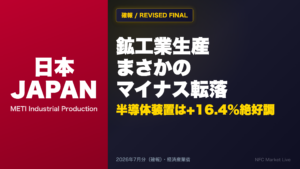
📊 Japan’s PPI hit +7.6% YoY but fell MoM for the first time in 11 months
⚡ ECB delivered a rare hike against a supply shock (deposit rate to 2.50%)
💰 Japan’s GDP was revised up, though capex stayed negative for a 2nd straight quarter
💡 Oracle’s cloud revenue surged 121%, but free cash flow turned negative on AI capex
Next week’s FOMC (Sep 16) is the key event — how the Fed reads this inflation split will move rates and FX.
オープニング / Opening
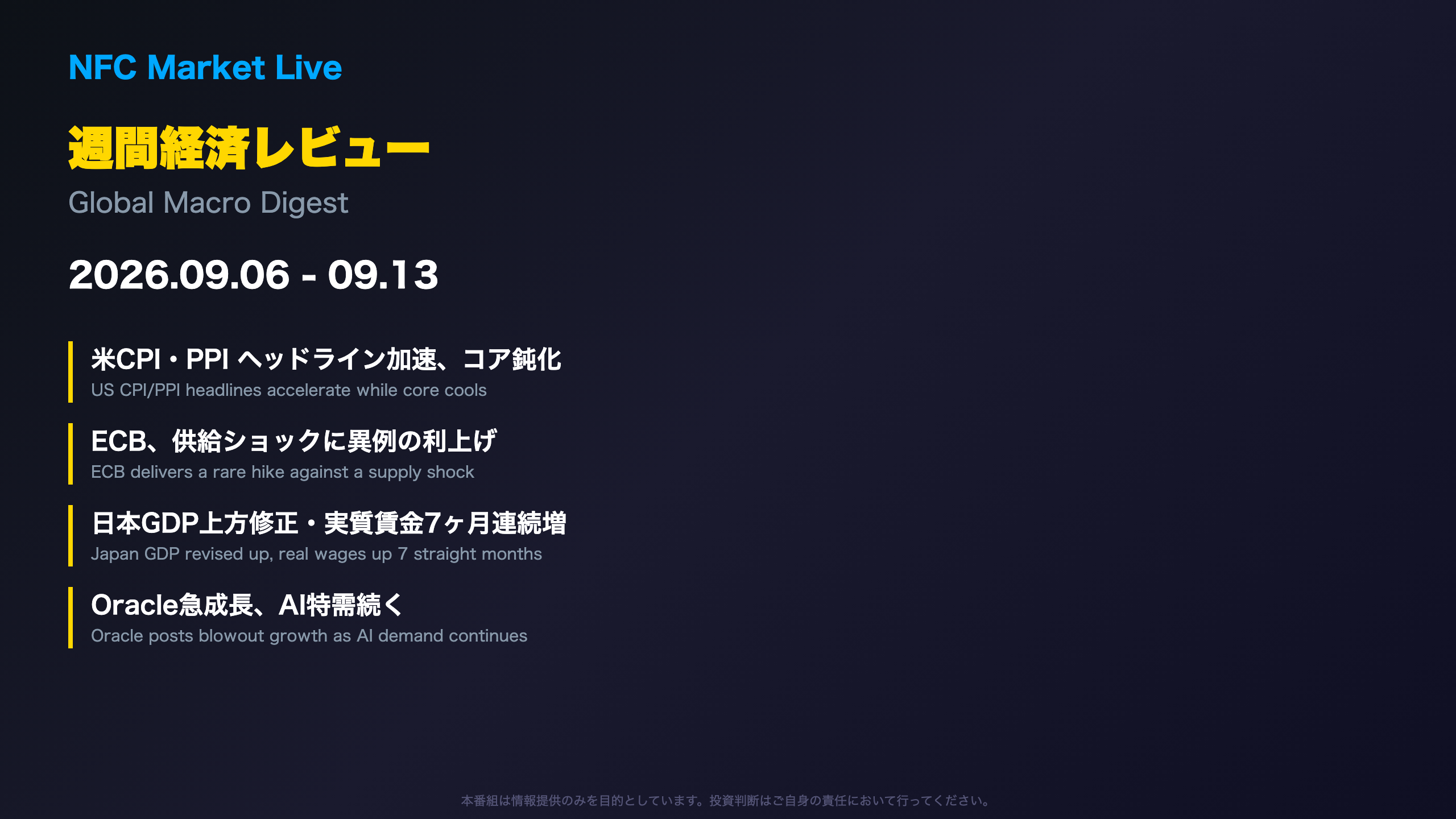
This Week at a Glance
The week of September 6-13, 2026 revealed a common thread across major economies: an energy-driven split between headline and core inflation. US CPI and PPI both accelerated on the headline while their core measures cooled, and Japan’s Producer Price Index (CGPI) accelerated year-over-year even as it posted its first monthly decline in 11 months.
The European Central Bank (ECB) — the eurozone’s monetary authority, akin to the Federal Reserve for the euro area — hiked rates specifically citing “Middle East tensions continuing to generate inflationary pressure,” an unusual move against a supply shock rather than demand overheating.
Meanwhile, the real economy showed resilience: Japan’s GDP second preliminary estimate was revised upward, real wages extended a seven-month streak of gains, and US jobless claims fell double-digits year-over-year.
This review unpacks both threads — the inflation split and underlying economic resilience — by cross-referencing data from the US, Japan, the eurozone, and Brazil.
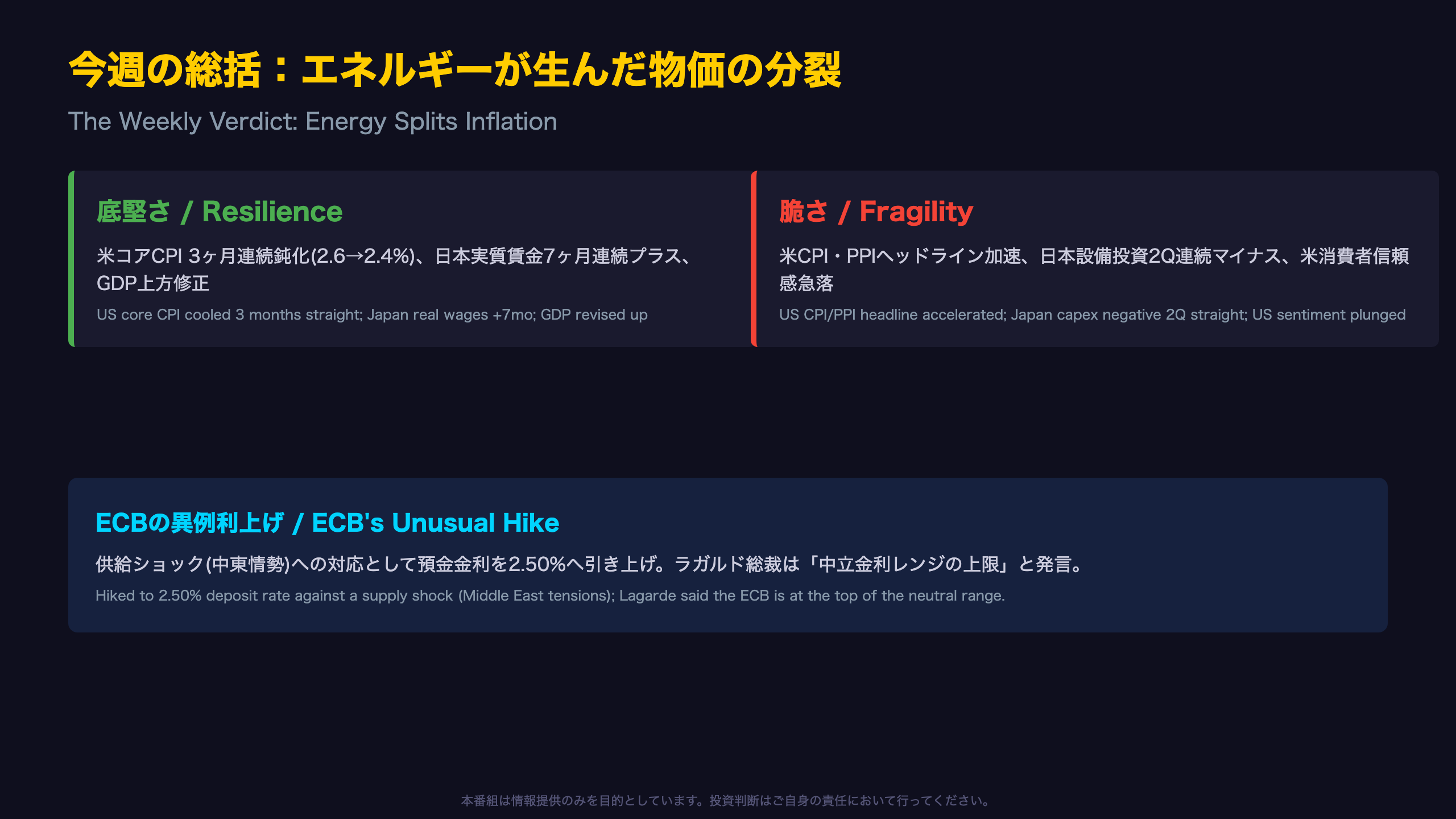
今週の総括:エネルギーが生んだ物価の分裂 / The Weekly Verdict
Surprise vs. Consensus
This week’s biggest surprise wasn’t the ECB hike itself, but its rationale. Typical hikes respond to demand overheating; this one targeted a supply shock — energy pressure from Middle East tensions — with President Lagarde acknowledging the ECB is “at the top of the neutral rate range,” an unusual admission for a hiking central bank.
Other data landed close to consensus. US weekly jobless claims stayed within the range markets expected, and Japan’s Coincident Index (CI), a composite gauge tracked by Japan’s Cabinet Office (similar to the US Conference Board’s Leading Economic Index but focused on current conditions), posted a second straight monthly rise.
Strength/Weakness Scorecard
| Item | Read |
|---|---|
| US headline inflation | Soft (accelerating) |
| US core inflation | Resilient (cooling) |
| Japan wages/GDP | Resilient (revised up) |
| Japan capex | Soft (2nd straight quarterly decline) |
| US consumer sentiment | Soft (sharp drop) |
This mixed scorecard is a preview of the dilemma the Fed faces at next week’s FOMC meeting.
物価の分裂を解剖する / Anatomy of the Inflation Split
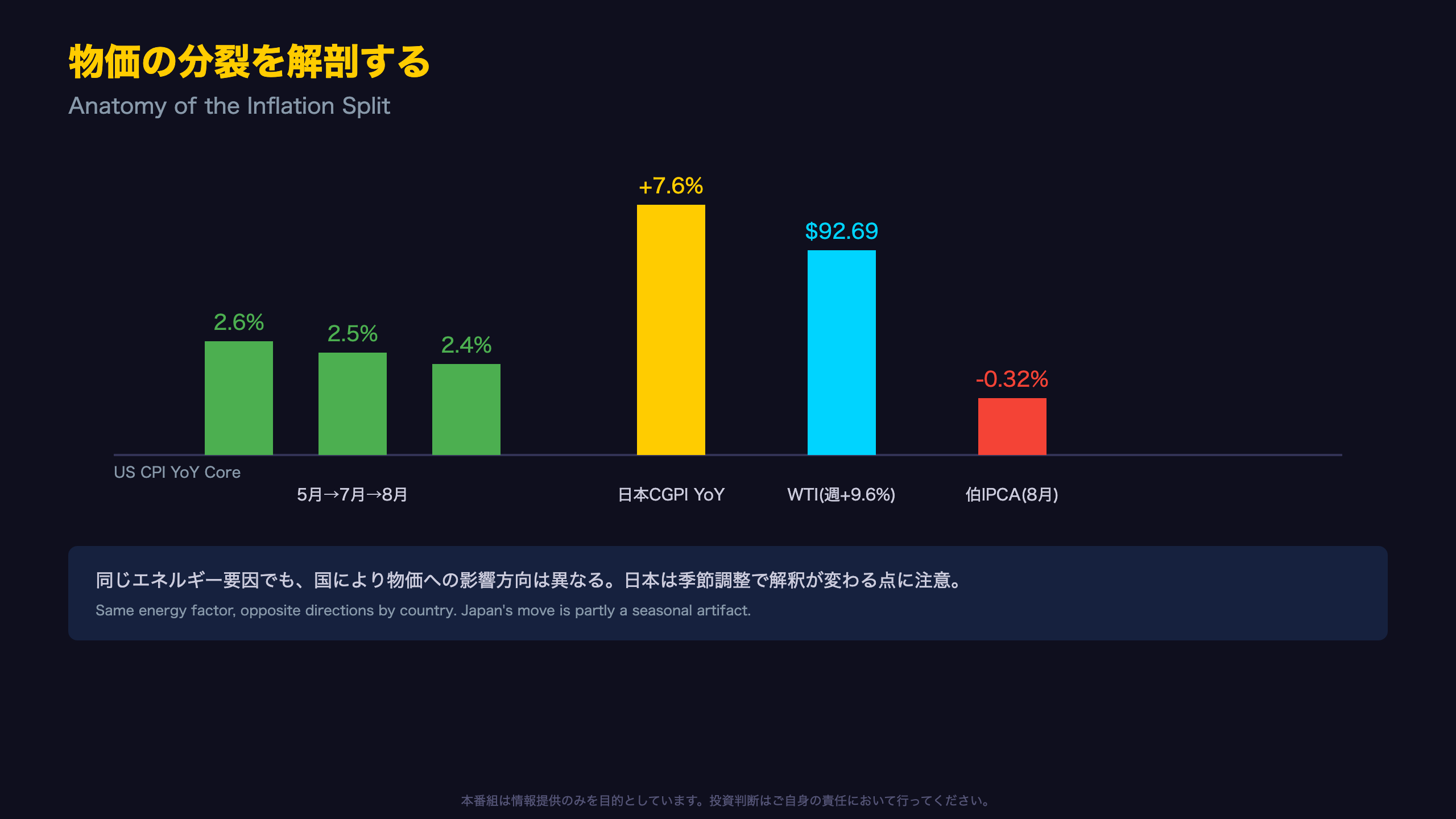
Three Indicators, One Energy Story
The most striking finding this week is that energy prices pushed inflation in opposite directions across three different economies.
United States: Gasoline Takes the Blame
The Bureau of Labor Statistics (BLS) explicitly stated gasoline rose 3.9% in August, “accounting for over one third of the monthly all items increase,” with a 27.4% year-over-year gain. This single component drove much of the CPI headline’s acceleration.
Japan: The Seasonal Adjustment Trap
The Bank of Japan (BOJ) publishes a supplementary index adjusted for summer electricity tariffs — a seasonal surcharge applied every July-September. On this adjusted basis, August’s month-over-month change was only -0.1% versus the headline -0.2%, meaning roughly half of the “first decline in 11 months” narrative is a seasonal artifact, not a genuine trend reversal.
Brazil: The Mirror Image
Brazil’s statistics agency IBGE attributed a 7.63% drop in electricity costs to the “Itaipu Bonus” — a one-off credit tied to the binational Itaipu hydroelectric dam, unrelated to global oil markets. This shows energy-driven inflation swings are not universal; local fiscal mechanics can push the same category in the opposite direction.
Bull vs. Bear Read
A hawkish read: energy is lifting prices across multiple economies simultaneously, suggesting a broader supply-shock theme. A dovish read: Brazil’s case shows energy effects can reverse quickly via temporary policy or seasonal factors, arguing against over-extrapolating any single month.
The next US CPI release is due October 14 — watch whether gasoline’s contribution fades.
実体経済の底堅さ / The Resilience Case
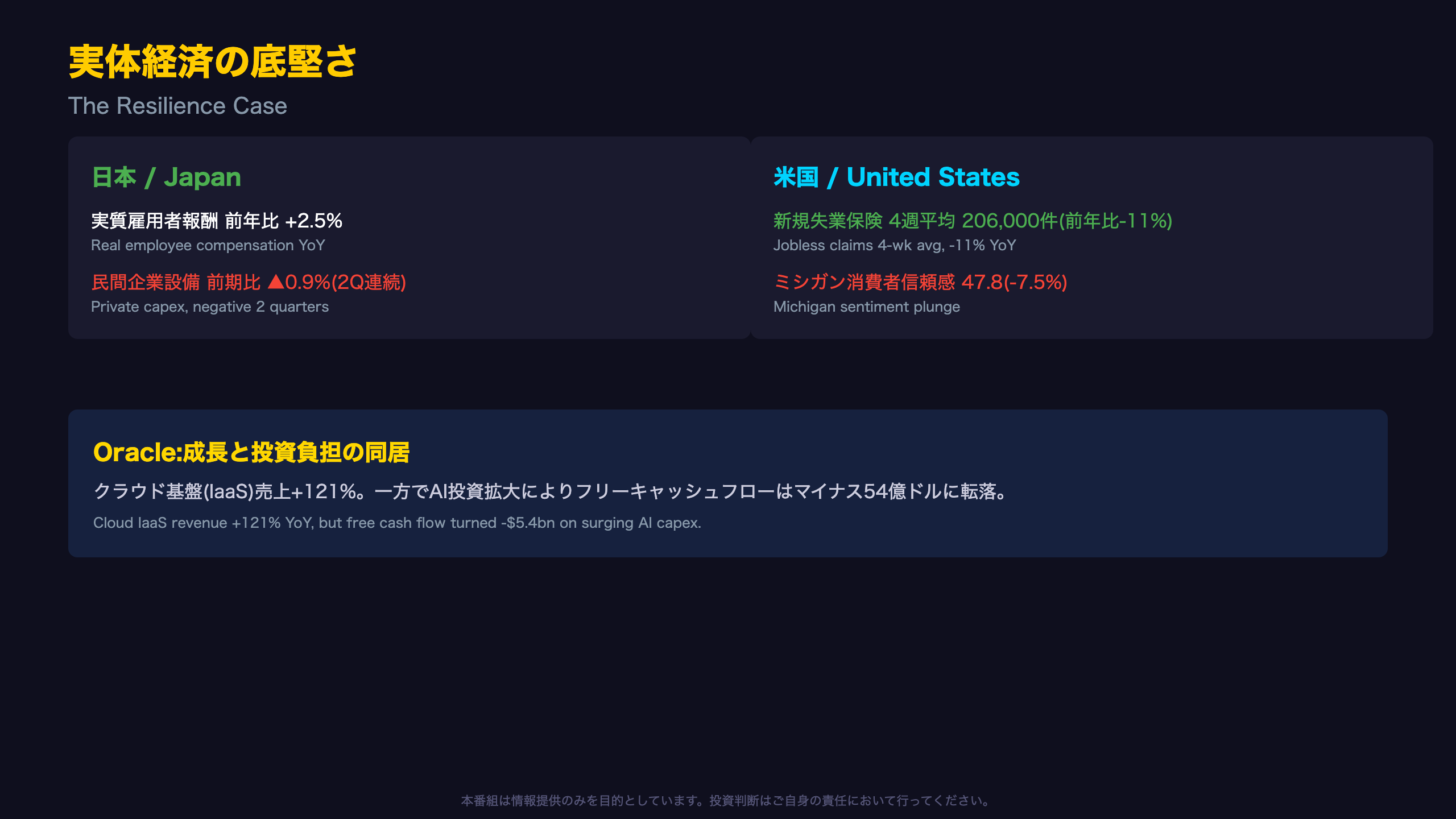
Wages Up, Investment Down — A Structural Tension
The standout revision in Japan’s Q2 GDP was real employee compensation, upgraded from +0.8% to +1.0% quarter-over-quarter (and +1.4% to +2.5% year-over-year) — key evidence for the Bank of Japan’s (BOJ) closely-watched “wage-price virtuous cycle,” a central theme in its rate-hike deliberations.
Yet gross fixed capital formation stayed deeply negative at -0.8% (revised from -0.9%). Private capex fell for a second straight quarter, decelerating sharply from +3.9% year-over-year in Q4 2025 to -0.9% now.
The US Counterpoint
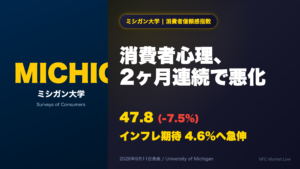
The University of Michigan’s Consumer Sentiment survey — a benchmark gauge similar to the Conference Board’s Consumer Confidence Index but run by academic economists — noted sentiment “receded less than 4 index points for the second consecutive month.” But the Expectations sub-index fell 11.1% month-over-month, far worse than the 1.9% drop in Current Conditions.
Oracle: The Corporate Face of AI Capex
Oracle’s press release cited “delivery of 850MW additional datacenter capacity,” with cloud infrastructure (IaaS) revenue up 121% year-over-year — accelerating for a fifth straight quarter. Yet free cash flow swung to -$5.4 billion, illustrating how profits are being plowed straight back into AI infrastructure.
Bull vs. Bear
Bullish: rising wages and resilient jobs should underpin consumption. Bearish: weakening investment sentiment — in both Japanese capex and US consumer psychology — could still spill into the real economy in coming months.
中央銀行の現在地 / Central Bank Stances
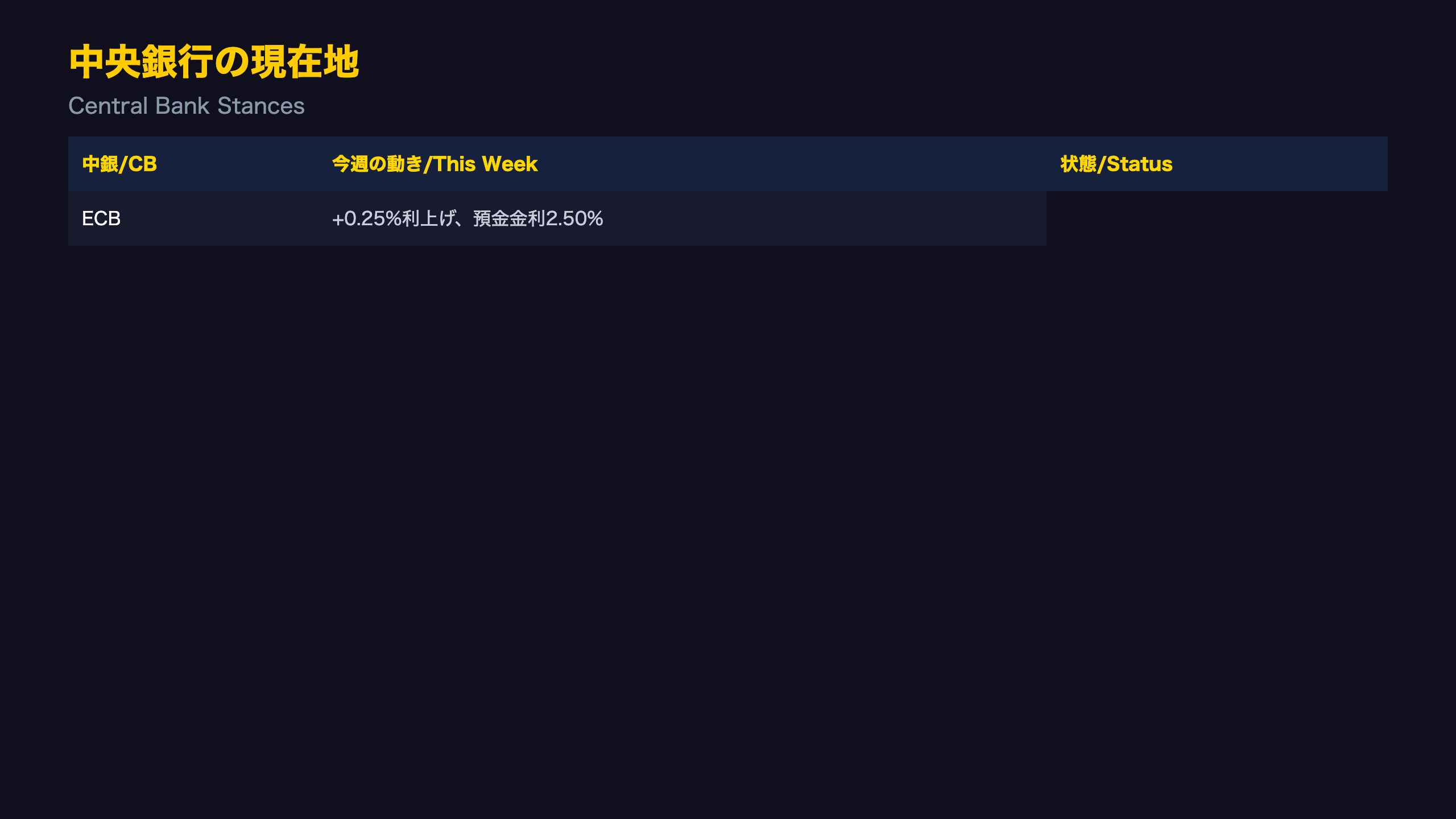
Three Central Banks, Three Different Postures
The sharpest line this week came from ECB President Christine Lagarde: “the market does what markets do, and we do what we do — providing price stability.” Asked about markets pricing roughly three more hikes, she explicitly rejected following market-implied forward guidance.
ECB’s Updated Projections
Compared to June, the ECB’s 2027 inflation forecast was raised to 2.5% and 2028 to 2.1%. Growth forecasts were also lifted across the board (2026: 0.9%
Analysis
Analysis
今週の番組制作費 / Production Cost Corner
Transparency in Cost Reporting
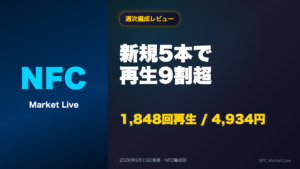
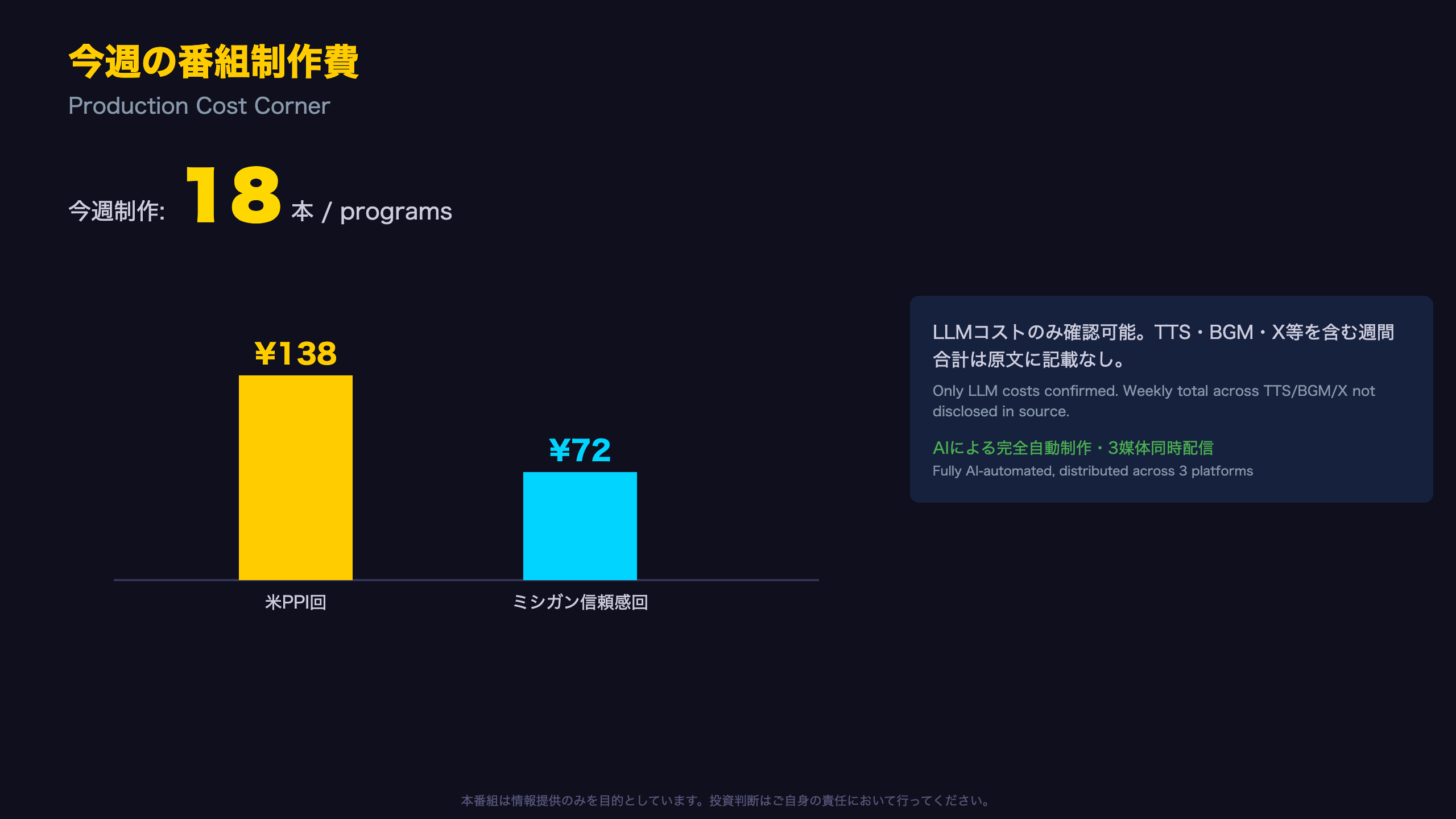
This review only reports cost figures that are explicitly confirmable in the source data. At least 18 programs were produced this week, covering topics from GDP and CPI to PPI and Brazil’s IPCA.
Confirmed Costs
| Program | LLM Cost |
|---|---|
| US PPI (Producer Price Index) | ¥138 |
| University of Michigan Consumer Sentiment | ¥72 |
Exchange rate: 1 USD = 153.6 JPY (as noted in the PPI episode’s cost table).
The cost gap (¥138 vs ¥72) likely reflects differing input token volumes — the PPI episode processed roughly 295,700 input tokens, a notably longer source document than the Michigan episode.
Data Limitations
Other episodes (US CPI, wholesale trade) included similar “production cost” sections in the source data, but the tables were truncated before a final cost figure appeared. Rather than estimate missing figures — which would violate our no-fabrication policy — we report them as “not available in the source.” A full weekly aggregate across LLM, TTS, BGM, and social media (X) categories is likewise unavailable this week.
Why This Matters
For context, US-based financial media production costs (anchor salaries, studio time, editing) typically run into the thousands of dollars per segment. NFC Market Live’s AI-automated pipeline — producing and distributing across video, X, and blog simultaneously at a confirmed cost of well under $1 per program in LLM fees alone — illustrates a fundamentally different cost structure for financial news production.
来週の注目イベント / Next Week’s Calendar
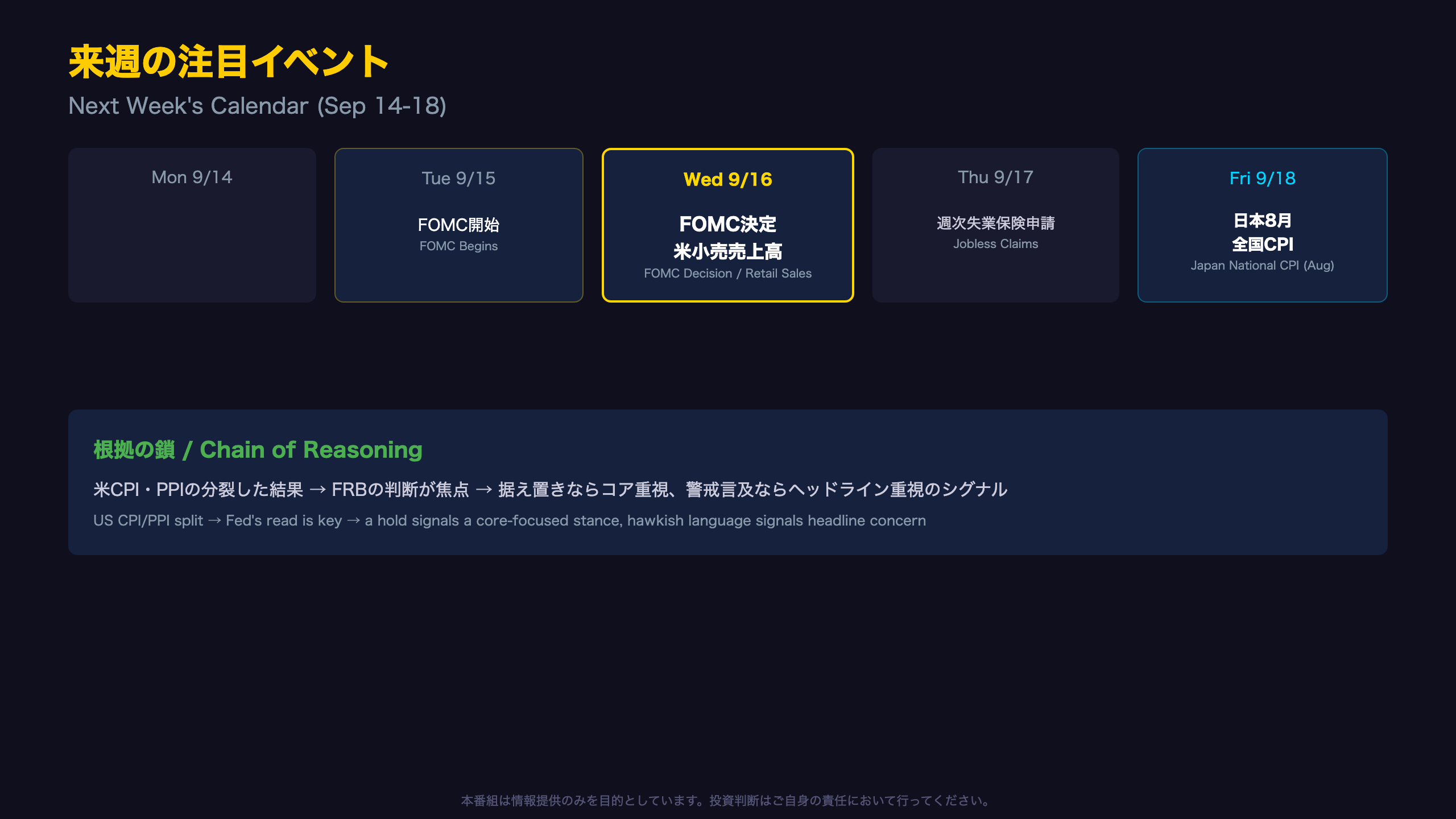
Chain of Reasoning: Three Lenses on Next Week
1. FOMC Meeting (Wednesday, Sep 16)
Fact: This week’s CPI accelerated to 0.4% month-over-month; PPI accelerated to 5.4% year-over-year. Both cores, however, continued cooling.
Mechanism: The Federal Open Market Committee (FOMC) — the Fed’s rate-setting body — must weigh transitory headline drivers (gasoline) against a more structural core deceleration.
Implication: A hold, with language emphasizing core trends, would likely weigh on the dollar and support equities. Hawkish language flagging headline risk would do the opposite.
2. US Retail Sales (around Sep 16-17)
Fact: University of Michigan sentiment plunged to 47.8, with the Expectations sub-index down 11.1% month-over-month.
Mechanism: Sentiment deterioration typically feeds into actual spending with a lag of one to several months.
Implication: Resilient retail sales would extend the “sentiment-reality gap” story; a weak print would validate consumer slowdown fears.
3. Japan National CPI, August (Sep 18)
Fact: Japan’s Corporate Goods Price Index (CGPI), a leading indicator of consumer inflation, accelerated to +7.6% year-over-year.
Mechanism: Upstream producer price pressure typically passes through to consumer prices (CPI) with a lag of a few months.
Implication: An accelerating national CPI would bolster BOJ policy normalization bets, a potential yen-positive, yield-positive catalyst.
We’ll revisit all three outcomes in next week’s Weekly Macro Digest.
Disclaimer: This article is for informational purposes only. All investment decisions are made solely at your own risk.