📺 Watch the Full Video Analysis
This article was automatically generated by the NFC Market Live AI analysis system. (Updated: 2026-09-11 21:59 JST)
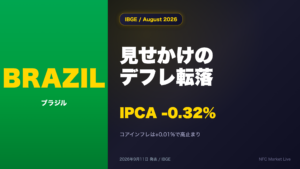
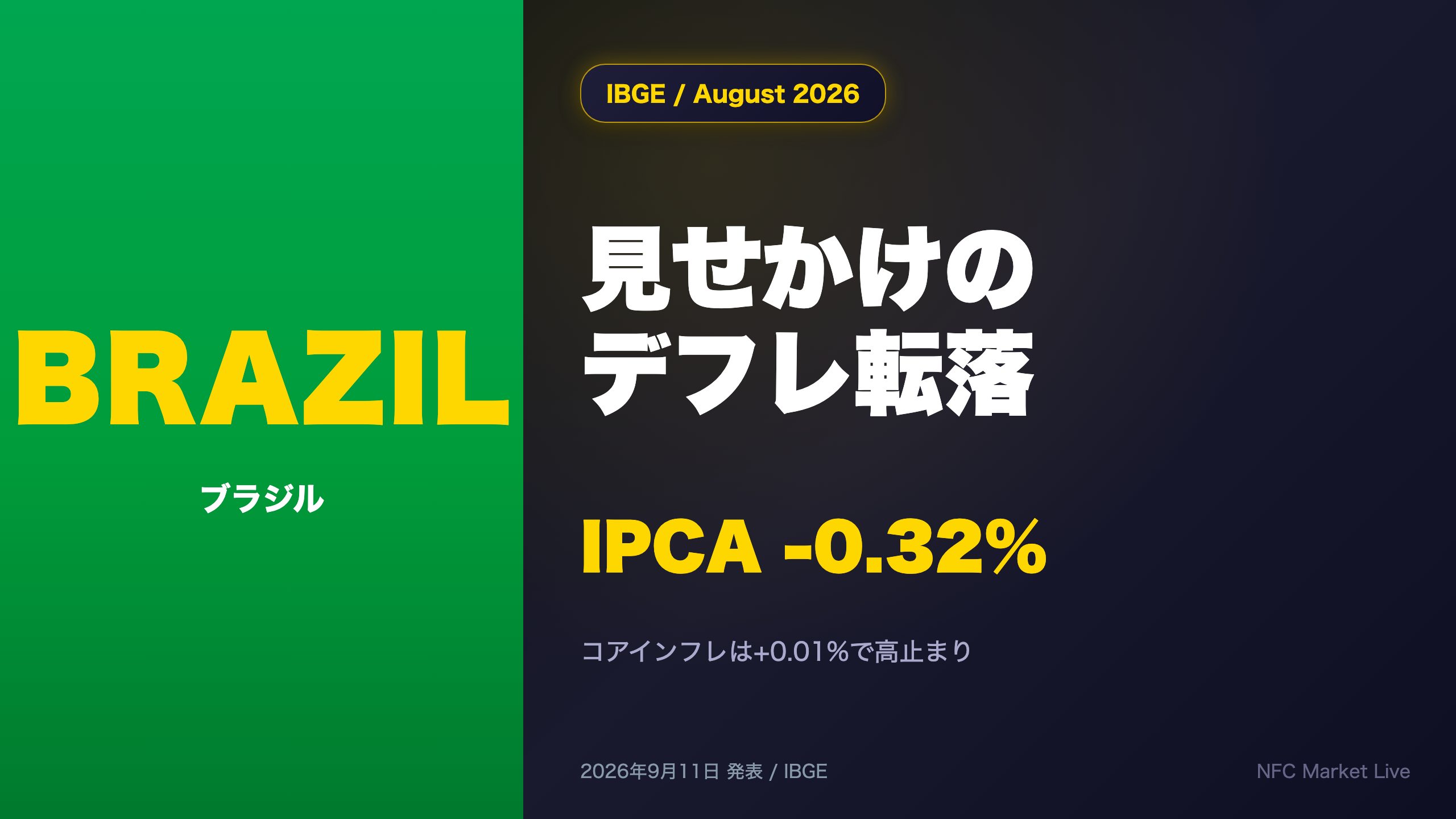
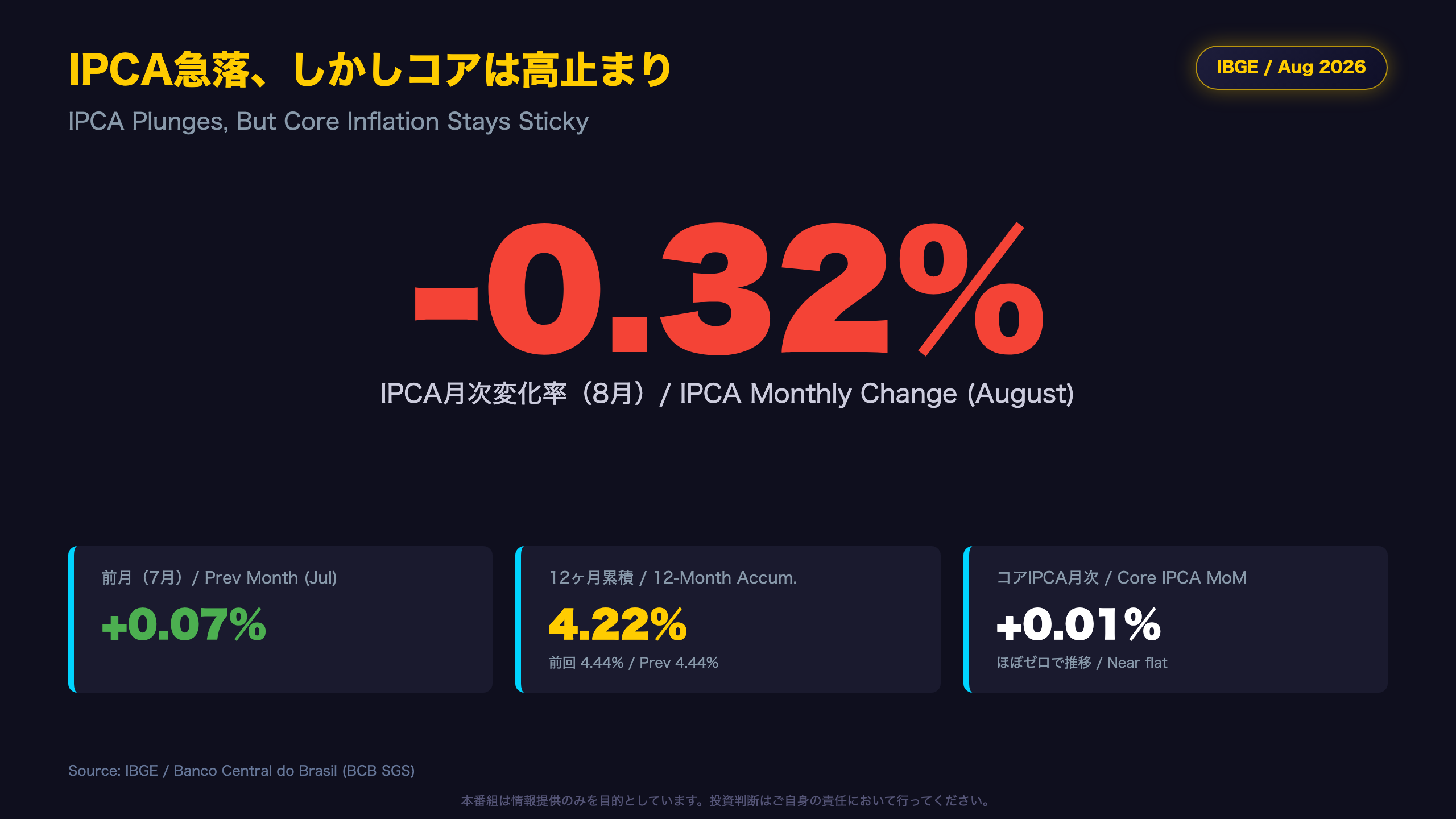
📊 Brazil’s IBGE reported August IPCA at -0.32% MoM, a sharp reversal from July’s +0.07% and the only negative reading in the past 13 months.
📉 The decline was driven by temporary factors: a 7.63% drop in electricity (Itaipu bonus credit) and a 13.17% fall in airfares.
💡 Yet core inflation (ex food & energy) held near flat at +0.01%, while cigarette prices jumped 19.59%. The underlying picture is more complex than the headline suggests.
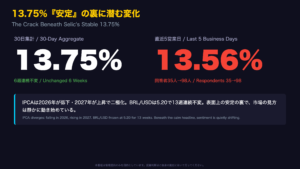
⚠️ 12-month inflation eased to 4.22% (from 4.44%), with the real interest rate versus Selic’s 14.00% at roughly 9.8 points. We break down what this means for Copom’s next move.
IPCA急落、しかしコアは高止まり
Context: IBGE and Brazil’s Inflation Framework
The IBGE (Brazilian Institute of Geography and Statistics) is Brazil’s official statistics agency, and the IPCA (Índice Nacional de Preços ao Consumidor Amplo) is its flagship consumer price index — functionally equivalent to the US CPI or Japan’s CPI, and the primary gauge used by the Banco Central do Brasil (BCB) for its inflation-targeting regime.
August’s -0.32% print stands out as the only negative monthly reading in the trailing 13 months. Notably, August 2025 also came in negative (-0.11%), raising the possibility — though not a confirmed pattern given only two data points — that annual electricity tariff adjustments (the Itaipu dam bonus credit) create a recurring seasonal dip each August.
International Comparison
Unlike the US Fed’s 2% PCE target or the BOJ’s 2% CPI target, Brazil’s central bank targets a notably higher 3.0% (±1.5 points), reflecting its emerging-market inflation history. A single month of deflation in Brazil carries less signal value than it would in a low-inflation developed economy.
Market Implications
A sharply negative headline print, if taken at face value, could fuel speculation about earlier Selic rate cuts — a dynamic that typically pressures the Brazilian real (BRL) lower. However, as later slides show, core inflation remained near flat, meaning the disinflation signal may be weaker than headline optics suggest.
6ヶ月連続の鈍化トレンド
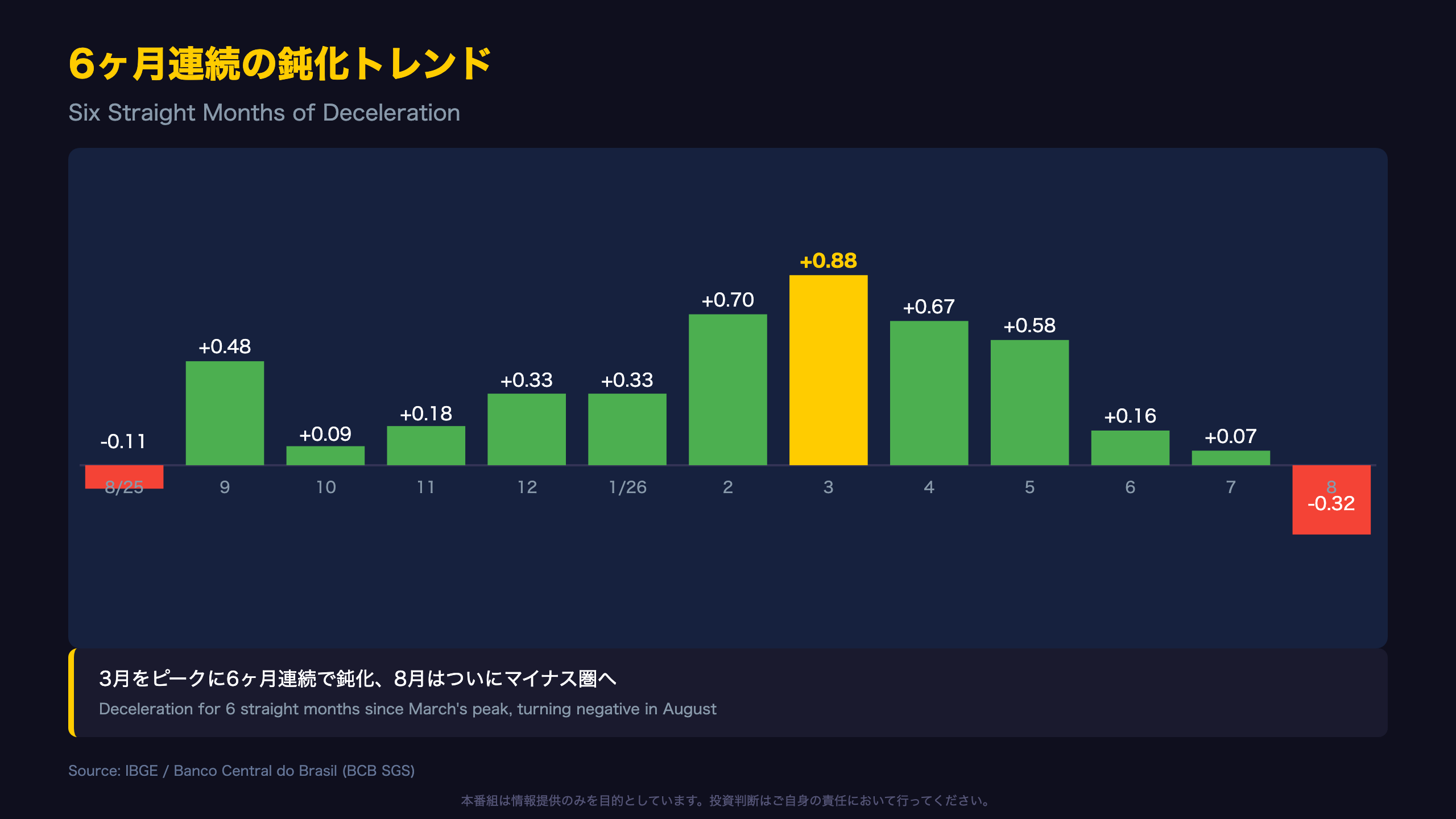
Reading the Trend, Not Just the Print
Brazil’s monthly IPCA has decelerated for six consecutive months: March (+0.88%), April (+0.67%), May (+0.58%), June (+0.16%), July (+0.07%), and August (-0.32%). This is a materially different story from a simple one-month deflation headline.
Decomposing the Deceleration
The June-to-July slowdown was modest (-0.09 percentage points), but the July-to-August drop accelerated sharply to -0.39 points — suggesting August combined the ongoing trend with an additional one-off shock (the electricity and airfare effects covered in later slides).
Cross-Checking with INPC
The INPC, which tracks lower-income households (1-5 minimum wages), showed an almost identical deceleration path: +0.14% in June, -0.01% in July, -0.32% in August. This consistency across income segments suggests the deceleration stems from broad-based cost items (utilities, fuel) rather than segment-specific demand shifts — a useful cross-check largely absent from typical headline coverage.
Compared to Developed-Market CPI Cycles
For context, six consecutive months of MoM deceleration would be unusually persistent even by Fed or ECB disinflation standards — though Brazil’s much higher starting base (target 3.0% vs. Fed’s 2%) means the absolute inflation trajectory remains structurally different from developed markets.
The next print (September data, due early October) will be critical in distinguishing genuine disinflation from a temporary utility-driven dip.
マイナスの正体は「一時的要因」
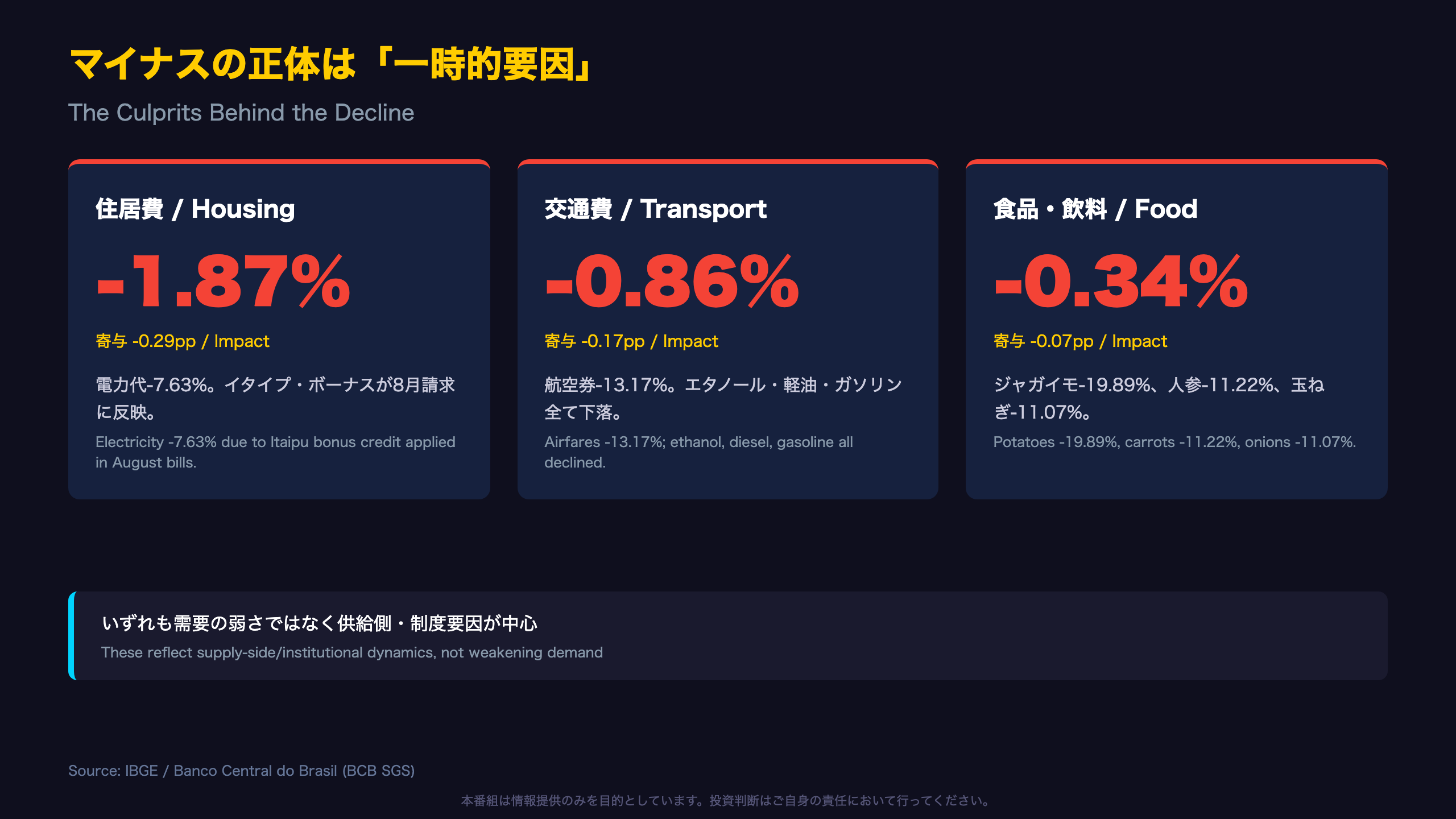
Beyond the Headline: A Patchwork of Regional Tariff Changes
The 7.63% drop in residential electricity — the single largest contributor to August’s deflation — was not a uniform nationwide cut. According to IBGE, it resulted from the Itaipu Bonus (Bônus de Itaipu), an annual credit tied to the binational Itaipu hydroelectric dam shared with Paraguay, applied to August billing cycles.
Critically, several regions saw tariff increases during the same period: one utility in São Paulo raised rates 8.85% (effective July 4), Vitória rose 6.89% (effective August 7), and São Luís rose 5.42% (effective August 28). Meanwhile, Fortaleza and Rio Branco saw cuts of 6.65% and 5.20%, respectively (effective August 26). The Itaipu bonus credit was large enough to override these regional increases in the national aggregate — a nuance easily missed by headline readers.
Transportation: A Data Quirk Worth Noting
Ride-hailing fares fell 4.57%, but IBGE’s own correction notice (“Erramos”) indicates this figure partly reflects a July measurement error carried into August — meaning the true month-on-month change is somewhat distorted.
Why This Matters for Investors
Investors reading only the -1.87% housing figure might assume broad utility deflation. In reality, this is a one-off credit effect layered on top of ongoing regional tariff increases — a distinction that matters when projecting September’s inflation trajectory once the bonus effect fades.
個人支出は逆に急騰
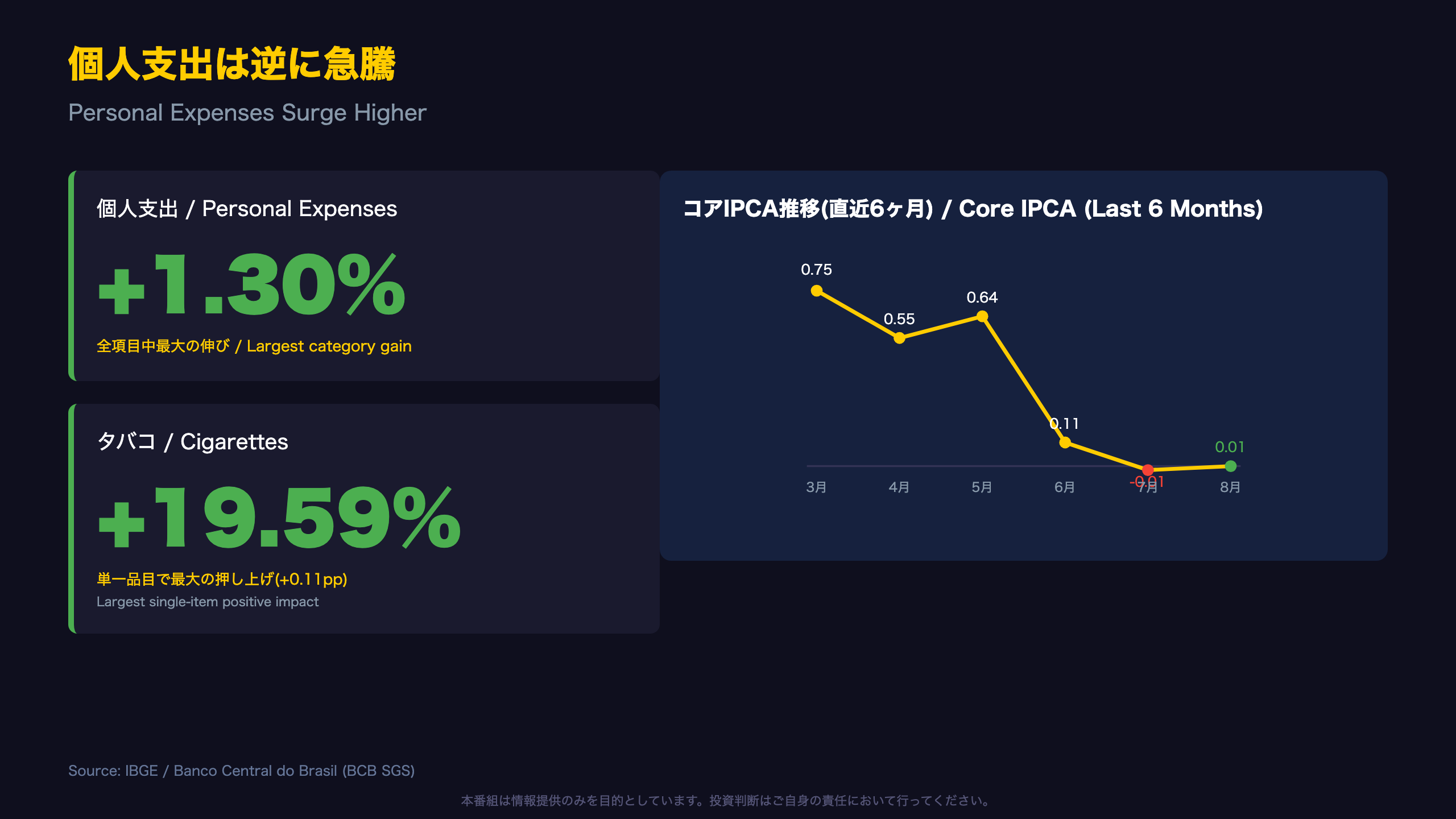
Core Inflation: The Real Story Behind the Headline
While Brazil’s headline IPCA plunged, core inflation (ex food & energy) told a very different story, holding essentially flat for three straight months:
| Month | Core MoM |
|---|---|
| March | +0.75% |
| April | +0.55% |
| May | +0.64% |
| June | +0.11% |
| July | -0.01% |
| August | +0.01% |
This pattern — decelerating from a March peak but stabilizing near zero rather than turning meaningfully negative — is a materially different signal than the -0.32% headline suggests. For context, US core CPI or core PCE readings near zero MoM would typically be read as a strong disinflation signal by the Fed; in Brazil’s case, given a much higher policy rate (Selic 14.00% vs. Fed funds around 4-5%), a flat core print is consistent with, but does not confirm, disinflation taking hold.
The Cigarette Price Puzzle
IBGE’s report does not specify why cigarette prices jumped 19.59% — whether from excise tax changes, manufacturer pricing, or other factors. Absent explicit sourcing, this should be treated as an unexplained single-item shock rather than a broader consumption trend.
Sticky Services Prices
Health & personal care (+0.23%) and education (+0.47%) both remained positive, consistent with the well-documented global pattern of “sticky” services inflation persisting even as goods prices (electricity, food, transport) swing more sharply. This divergence between goods deflation and services stickiness is a dynamic familiar to investors who have tracked post-pandemic inflation cycles in the US and Europe.
実質金利9.8ptの重み
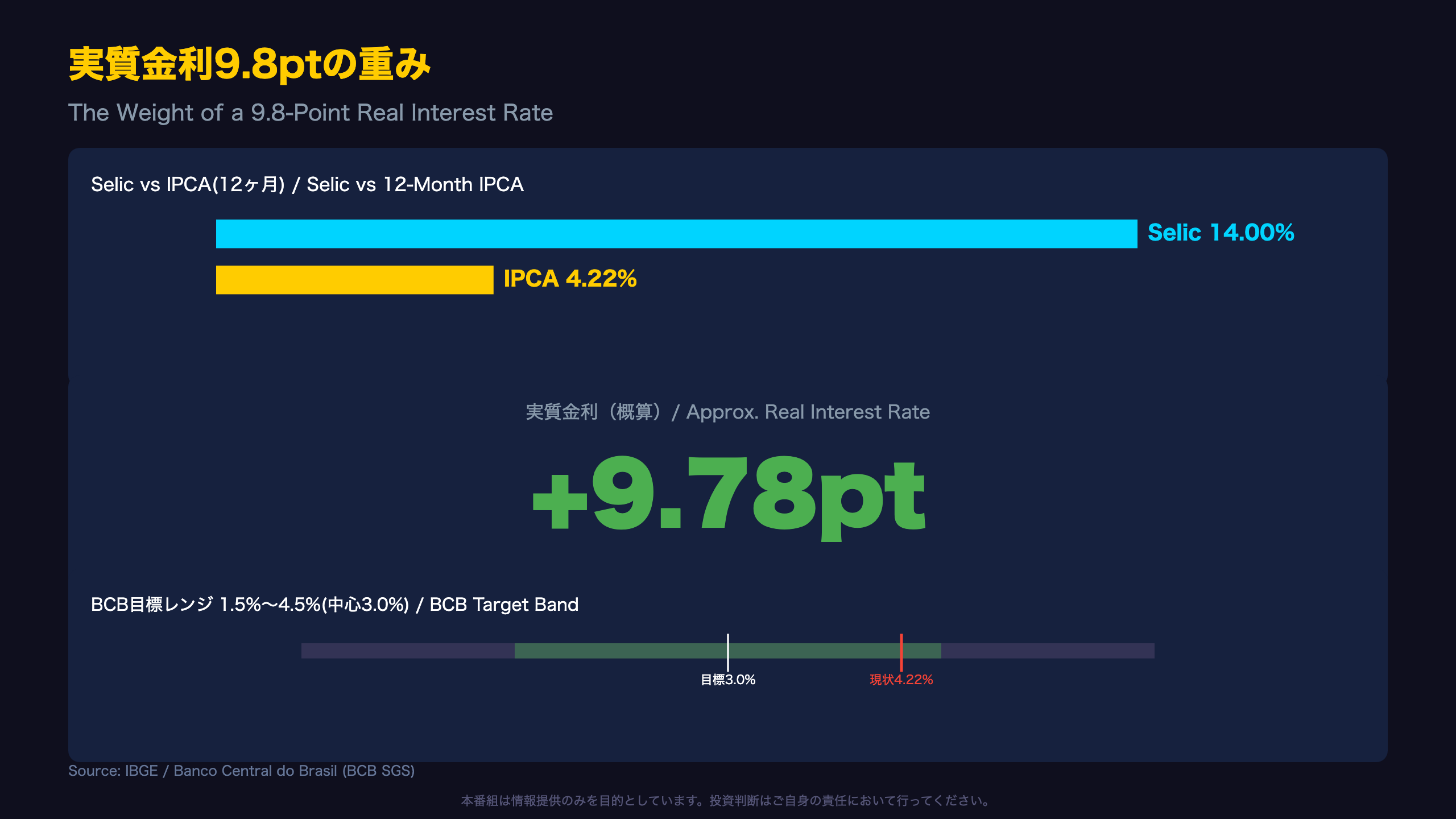
Understanding Copom and Brazil’s Inflation-Targeting Regime
The Comitê de Política Monetária (Copom) is the monetary policy committee of the Banco Central do Brasil (BCB), functionally analogous to the US Federal Open Market Committee (FOMC) or the Bank of Japan’s Policy Board. Since 2025, Brazil’s inflation target has been set at 3.0%, with a tolerance band of ±1.5 points (1.5%-4.5%) — notably higher than the Fed’s 2% PCE target or the BOJ’s 2% CPI target, reflecting Brazil’s structurally higher inflation baseline as an emerging market.
The Real Rate Math
A simple real interest rate calculation — Selic (14.00%) minus 12-month IPCA (4.22%) — yields approximately 9.78 percentage points. While this is a simplified approximation rather than a Fisher-equation-adjusted real rate, it nonetheless places Brazil among the highest real-rate economies globally, far exceeding real rates in the US, Eurozone, or Japan.
Two Ways to Read This
- Hawkish lens: Three straight months of near-zero core inflation suggest Selic’s restrictive stance is successfully transmitting into the real economy, supporting a “higher for longer” stance from Copom.
- Dovish lens: The sharp headline deceleration could be read as evidence that policy is already sufficiently restrictive, opening a case for Copom to begin signaling eventual rate cuts.
Market Implications
For USD/BRL and BRL/JPY watchers, a sustained high real interest rate has historically supported carry-trade demand for the Brazilian real, while any signal of premature easing tends to compress that yield advantage. The BCB has not published a specific date for its next Copom meeting in this release; the next IPCA print (September data) is due in early October.
地域差とレアルへの含意
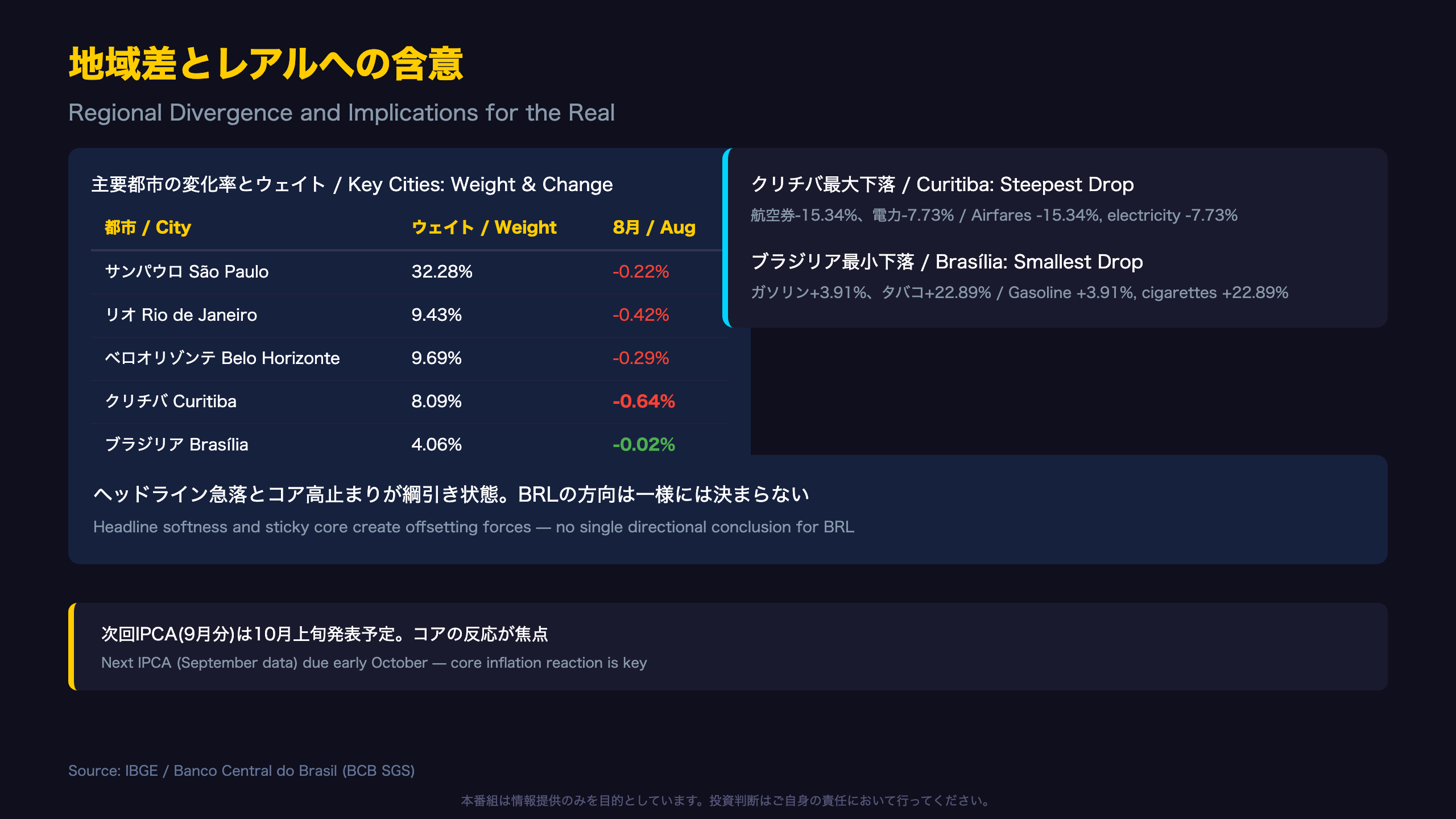
Why São Paulo’s Weight Matters for the National Number
Unlike a simple average, Brazil’s IPCA is a weighted composite across metropolitan regions based on population and consumption patterns. São Paulo alone carries a 32.28% weight — nearly a third of the entire index — meaning its relatively modest -0.22% decline anchored the national figure, preventing an even sharper headline drop.
Regional Snapshot
| City | Weight | August Change |
|---|---|---|
| São Paulo | 32.28% | -0.22% |
| Rio de Janeiro | 9.43% | -0.42% |
| Belo Horizonte | 9.69% | -0.29% |
| Porto Alegre | 8.61% | -0.27% |
| Curitiba | 8.09% | -0.64% |
| Brasília | 4.06% | -0.02% |
Curitiba’s -0.64% was the steepest decline nationally, but its modest 8.09% weight limited its drag on the national aggregate — a structural nuance often overlooked when reading single-city headlines.
Implications for BRL (Cautious Framing)
A sharply negative headline print could, in isolation, fuel speculation about earlier Copom rate cuts — a dynamic that has historically pressured carry-trade currencies like the BRL lower. However, persistently near-zero core inflation and a real interest rate near 9.8 points could just as plausibly support continued hawkish messaging from the central bank, which tends to underpin BRL demand. Given these offsetting forces, no single directional conclusion is warranted from this release alone.
What to Watch Next
The next IPCA release, covering September data, is due in early October. The key question: does core inflation remain anchored near zero once the Itaipu electricity credit and airfare base effects roll off, or does it reaccelerate — a distinction that will meaningfully shape Copom’s policy path into year-end.
Disclaimer: This article is for informational purposes only. All investment decisions are made solely at your own risk.