📺 Watch the Full Video Analysis
This article was automatically generated by the NFC Market Live AI analysis system. (Updated: 2026-09-14 20:41 JST)
📄 Primary Source
Banco Central do Brasil
https://www.bcb.gov.br/content/focus/focusmarketreadout/R20260911.pdf
📊 A deep dive into the BCB’s latest Focus Market Readout (Sep 11, 2026).
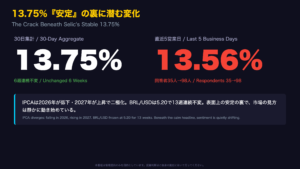
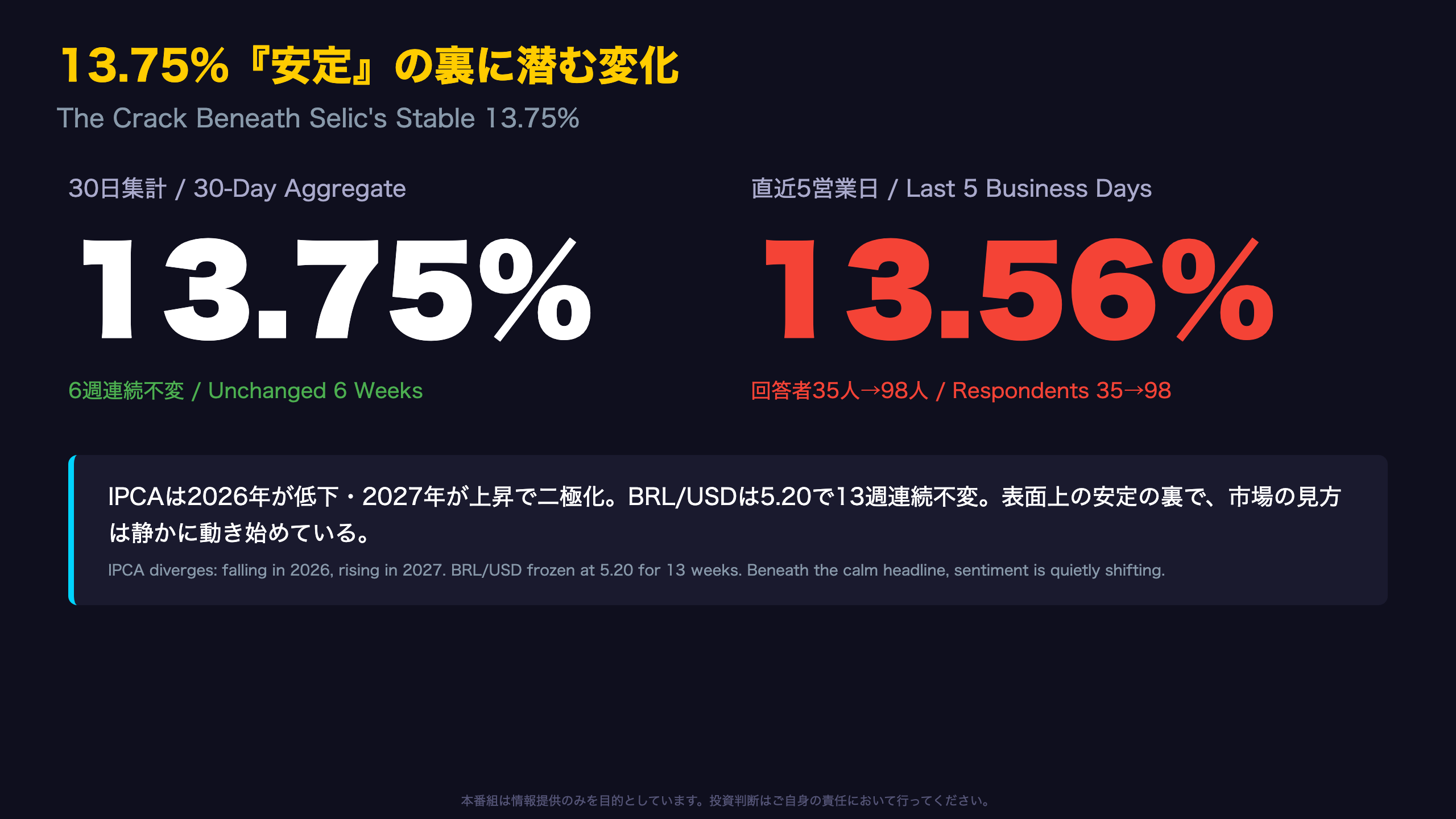
The 2026 year-end Selic forecast has held at 13.75% for six straight weeks — but the freshest 5-day data already shows 13.56%, with respondents surging from 35 to 98.
📈 IPCA forecasts are diverging: falling for 2026, rising for 2027, still above BCB’s 4.5% ceiling.
💡 We break down what this means for BRL/JPY carry trades and Japanese investors holding Brazilian assets.
⚠️ Next release: Sep 21, 2026.
サマリー:13.75%『安定』の裏の異変
Surface Calm, Undercurrent Shift
The BCB’s Focus Market Readout aggregates weekly median forecasts from more than 130 Brazilian economists and financial institutions — not an outside poll, but data the central bank’s own Monetary Policy Committee (COPOM) references when setting the Selic rate, Brazil’s benchmark policy rate.
This week’s standout signal is a “two-speed” pattern in the year-end 2026 Selic forecast. The 30-day rolling median has held at 13.75% for six consecutive weeks — the picture of stability. But narrow the lens to just the last five business days of submissions, and the median drops to 13.56%. Crucially, the number of respondents in that five-day window nearly tripled, from 35 in the prior report to 98 now, suggesting this isn’t a thin, noisy sample but a broader wave of forecast revisions.
For context, U.S. Fed watchers are familiar with how CME FedWatch probabilities shift ahead of official dot-plot updates — this five-day BCB subset plays a similar “leading indicator” role within the Focus framework.
One week’s divergence does not confirm a trend reversal. Whether this dovish tilt feeds into the 30-day aggregate will be the key test at the next release, due September 21, 2026.
Selic金利パスの深掘り:凍結の中の異変
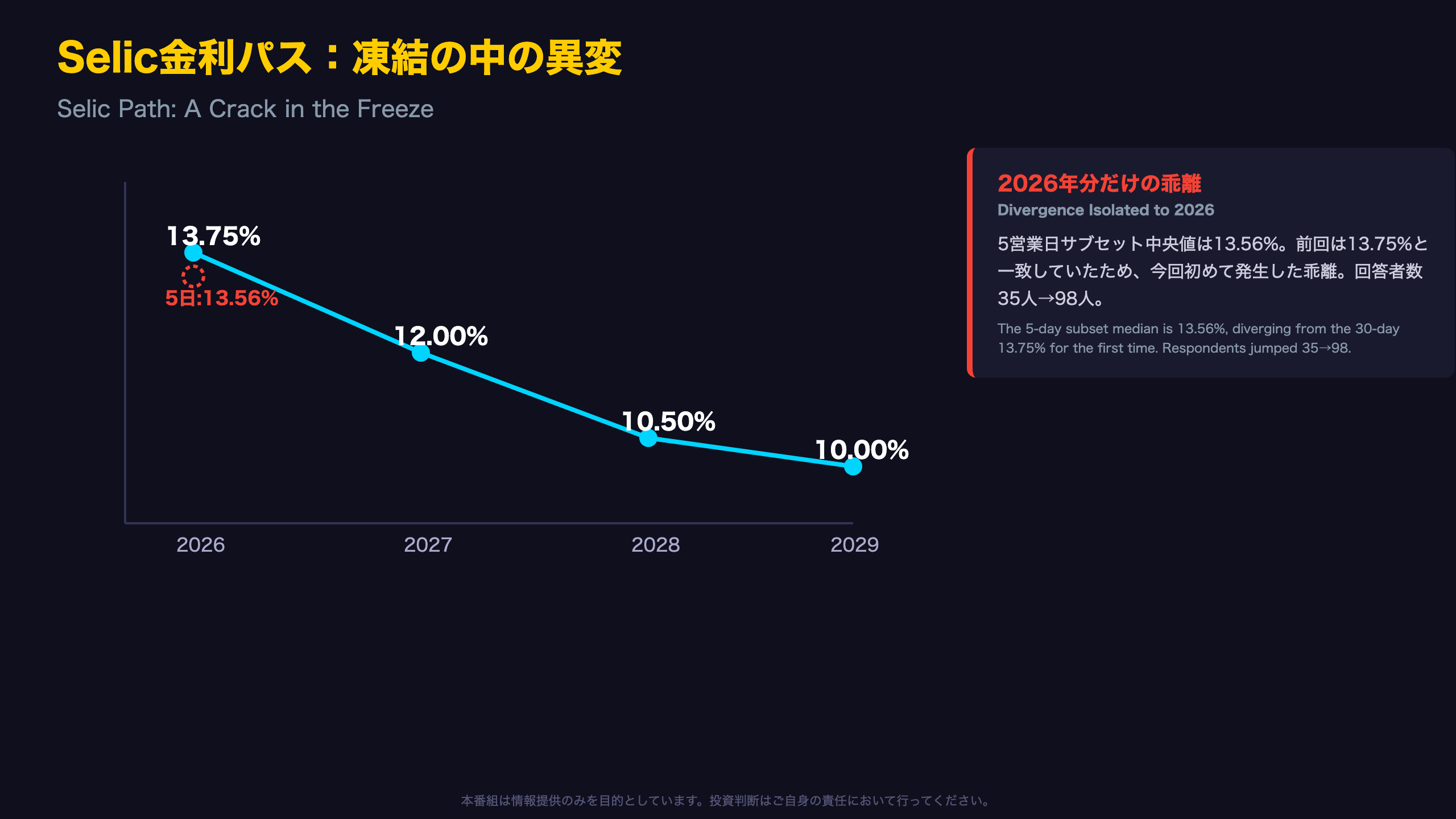
What a “Frozen” Rate Path Reveals
The year-end Selic forecasts — 13.75% for 2026, 12.00% for 2027, 10.50% for 2028, and 10.00% for 2029 — have barely moved for weeks. The 2027 figure has held for 13 consecutive weeks, and 2029 for 19.
For readers unfamiliar with Selic: it is Brazil’s benchmark policy rate, set by COPOM (Brazil’s equivalent of the FOMC), and at 13.75%+ it sits among the highest real policy rates of any major economy — far above the Fed’s or BOJ’s levels.
This near-total freeze suggests the market has converged strongly around a base-case gradual easing cycle through 2029. What stands out is a subtle divergence isolated to the 2026 figure: the five-business-day subset median of 13.56% sits 0.19 points below the 30-day aggregate of 13.75%. In the prior report, that same subset matched the 30-day figure exactly — meaning this gap just emerged.
Notably, respondents in that five-day window jumped from 35 to 98 — a near-tripling that adds weight to the signal, though a single week’s divergence should not yet be read as a decisive dovish pivot. The next report, due September 21, 2026, will show whether it persists.
IPCA二極化:目標との長い距離
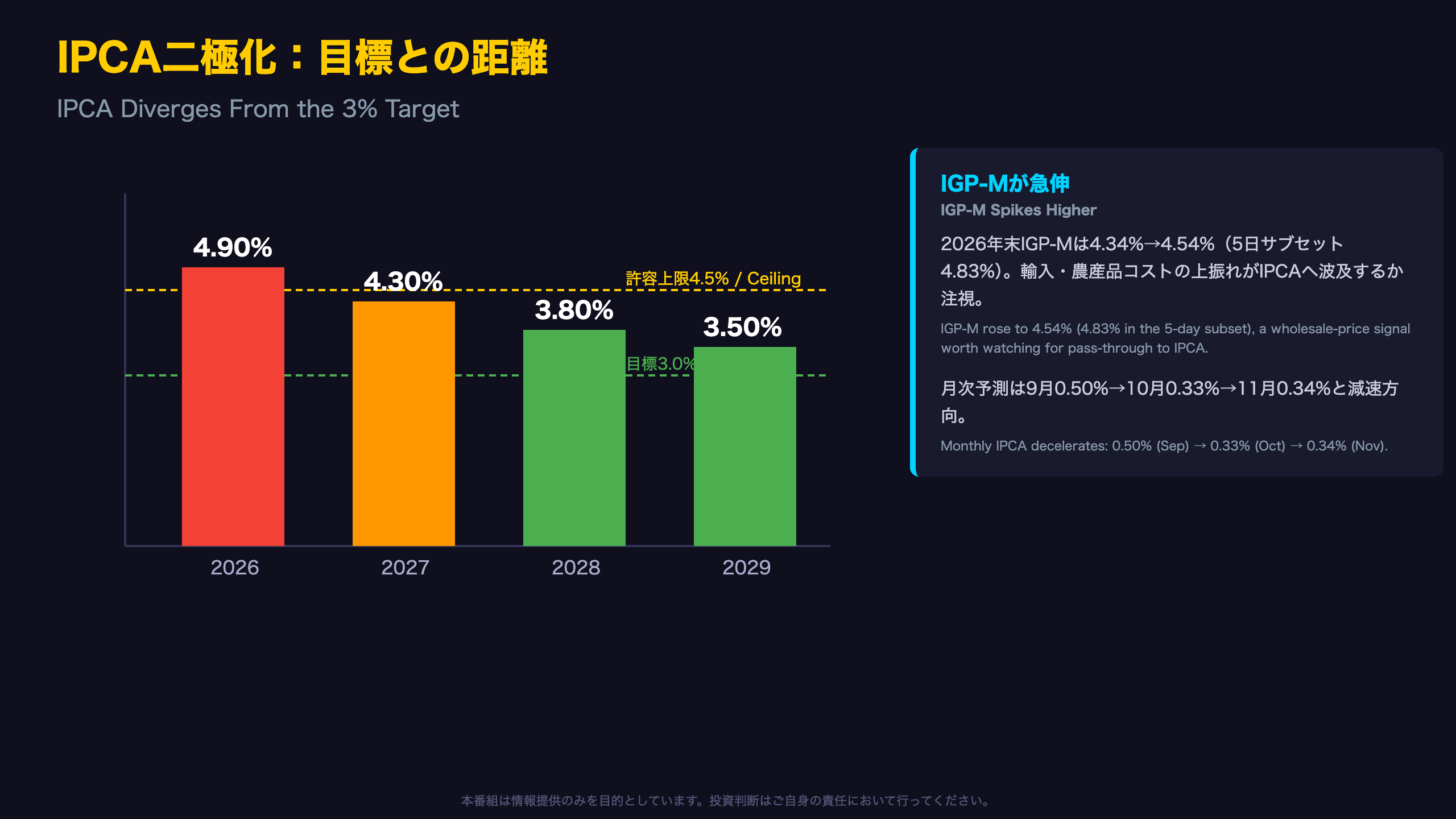
The Long Road Back to a 3% Target
Context for international readers: BCB’s inflation target is 3.0%, with a tolerance band of 1.5% to 4.5% — comparable in structure to inflation-targeting frameworks used by the Fed (2% target) or the ECB (2% target), though Brazil’s band is wider given its history of higher structural inflation.
The 2026 year-end IPCA forecast of 4.90% sits above even the upper edge of that tolerance band. By contrast, the Fed’s preferred PCE measure running 0.5 points over its 2% target would be treated as a meaningful overshoot — Brazil’s gap is proportionally larger.
Meanwhile 2027 has climbed to 4.30%, its fifth straight weekly increase, showing investors remain split on convergence speed. Near-term monthly forecasts (0.50% in September, easing to 0.33%-0.34% in October-November) point to deceleration in the immediate pace of price gains.
However, the IGP-M — a broader wholesale-linked index sensitive to import costs and commodity prices, often watched as a leading signal for consumer inflation — jumped from 4.34% to 4.54% for 2026, and to 4.83% in the freshest five-day data. Whether this upstream pressure feeds into IPCA over coming weeks bears close watching.
成長減速と財政のきしみ
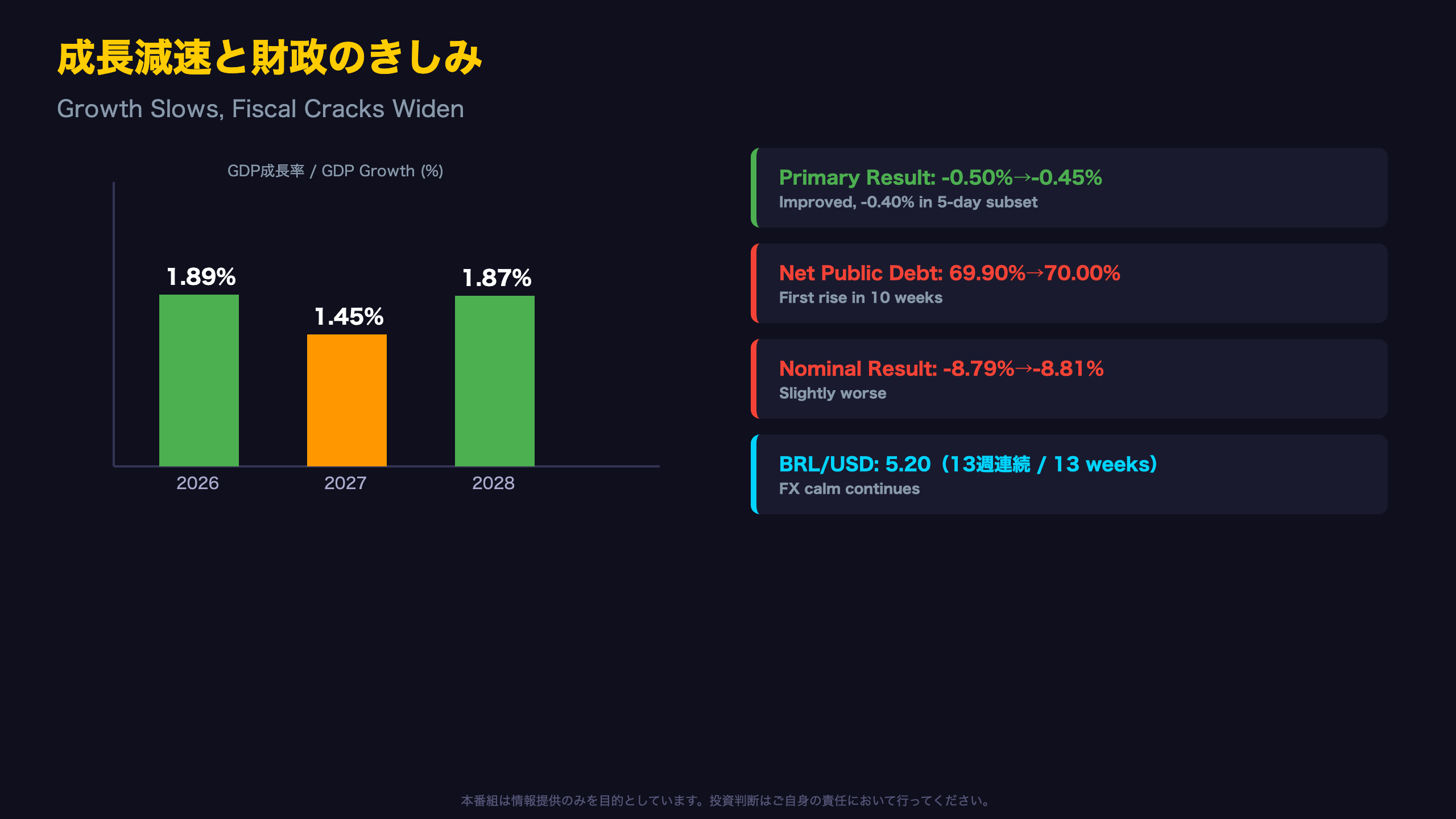
Growth Deceleration Meets Fiscal Strain
GDP growth forecasts have drifted lower across the curve: 1.89% for 2026, 1.45% for 2027, and 1.87% for 2028 — the latter down for a second consecutive week. This gradual downgrade may reflect growing awareness that Brazil’s high policy rate is starting to weigh on the real economy.
On the fiscal side, the picture is more nuanced. The primary result — Brazil’s fiscal balance excluding interest payments, roughly analogous to the U.S. “primary deficit” concept — improved to -0.45% of GDP for 2026 from -0.50%, and to -0.40% in the freshest five-day data, suggesting markets see some fiscal discipline taking hold.
Yet net public sector debt (government debt as a share of GDP) ticked up from 69.90% to 70.00% — its first increase in ten weeks — while the nominal result worsened slightly to -8.81% from -8.79%. For comparison, Brazil’s debt-to-GDP ratio near 70% for 2026 sits well above the roughly 60% threshold often cited as a fiscal sustainability benchmark for emerging markets.
Despite these crosscurrents, the exchange rate has stayed pinned at 5.20 reais per dollar for 13 straight weeks — the market is not currently pricing meaningful near-term BRL volatility from either the growth slowdown or fiscal wobble.
BRL/JPYキャリーと日本人投資家への含意
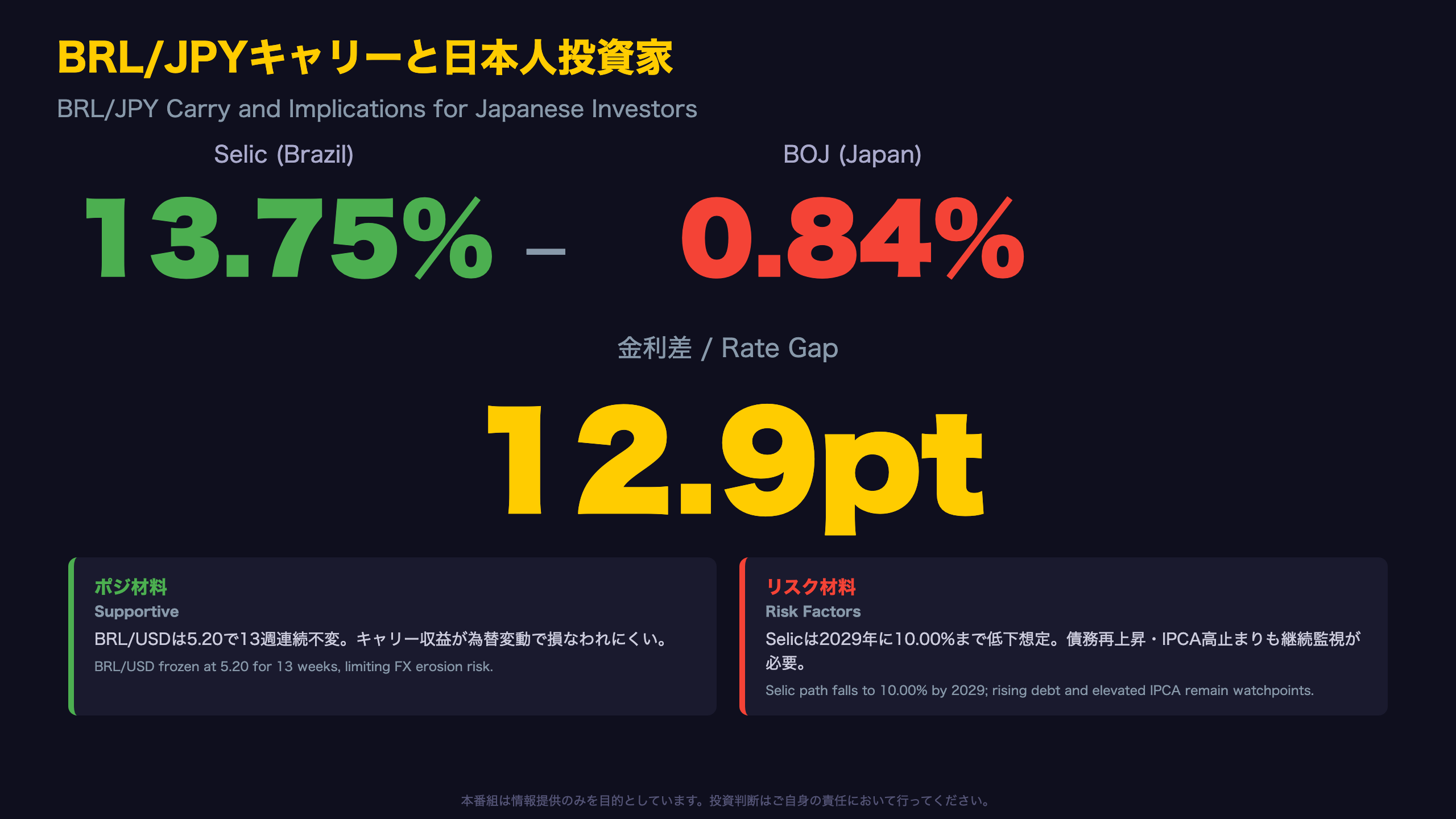
What Japanese Investors Should Watch
For Japanese retail investors holding BRL-denominated assets — Brazilian government bonds (like NTN-Bs) or high-yield BRL funds — the key question from this report is the trajectory of the Selic-BOJ rate gap.
The current year-end 2026 Selic forecast of 13.75% versus Japan’s policy rate of 0.84% (June 2026, FRED data) implies a spread of roughly 12.9 percentage points — Selic sits at more than 16 times the BOJ’s rate, the structural source of BRL/JPY carry trade appeal that has drawn Japanese “Mrs. Watanabe” retail flows into Brazilian assets for years.
However, the priced-in Selic path shows gradual normalization: 12.00% for 2027, 10.50% for 2028, and 10.00% for 2029. If the BOJ also continues its own gradual normalization, this spread could compress meaningfully over a multi-year horizon — a dynamic carry-trade investors should model explicitly rather than assume static.
In the near term, the exchange rate’s remarkable stability — pinned at 5.20 reais per dollar for 13 straight weeks — suggests limited FX-driven carry erosion risk immediately. But the fresh uptick in net public sector debt and IPCA’s persistence above BCB’s tolerance ceiling remain medium-term sovereign risk factors that BRL asset holders should continue to monitor alongside the pace of rate convergence.
Disclaimer: This article is for informational purposes only. All investment decisions are made solely at your own risk.