📺 Watch the Full Video Analysis
This article was automatically generated by the NFC Market Live AI analysis system. (Updated: 2026-09-30 16:54 JST)
📄 Primary Source
Sveriges Riksbank
https://www.riksbank.se/en-gb/press-and-published/notices-and-press-releases/press-releases/2026/minutes-of-the-monetary-policy-meeting-on-23-september-2026/
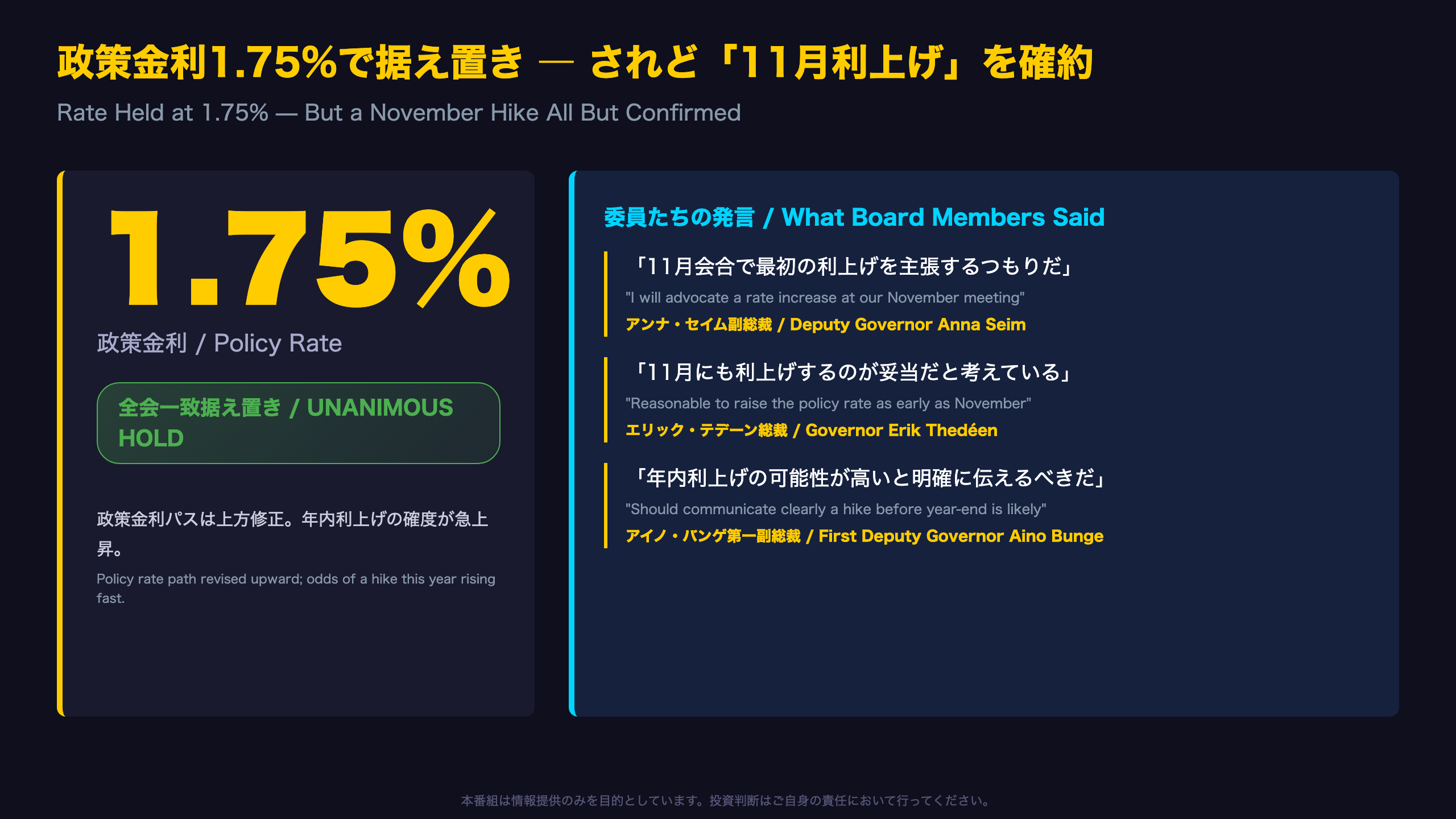
📊 Sweden’s Riksbank held its policy rate unchanged at 1.75%, with all five board members in agreement.
But the minutes reveal something markets may have missed: three of five members explicitly named November as the likely month for the first hike — unusually concrete forward guidance.
📈 Q2 GDP revised up to 3.3% YoY, confirming solid domestic demand.
⚠️ Meanwhile, oil surged past $100/barrel and the krona weakened against both the euro and dollar.
💡 One dissenting voice, Göran Hjelm, invokes sacrifice-ratio theory to argue for patience.
We break down exactly what to watch before the November decision.
政策金利1.75%で据え置き ― されど「11月利上げ」を確約
What the Minutes Really Reveal
On the surface, September 23rd looked like a repeat of August: a unanimous vote to hold at 1.75%. But look closer, and the tone has shifted markedly.
“I will therefore advocate a first policy rate increase at our meeting in November” — Deputy Governor Anna Seim
“My assessment today is that it is reasonable to raise the policy rate as early as in November” — Governor Erik Thedéen
In August, the language was vaguer — “the probability of a rate increase remains.” By September, two of five board members named the month explicitly. This is a meaningful escalation in specificity and conviction.
Context for international readers: The Riksbank is Sweden’s central bank, one of the world’s oldest, and known for publishing detailed named-attribution meeting minutes (unlike the Fed’s anonymized minutes). Sweden’s rate discussions echo the ECB’s own recent hike (Sept 10) and the Fed’s first hike since 2023 (Sept 16) — suggesting a broader global synchronization toward tighter policy.
Market implication: A confirmed November hike would mark Sweden’s first tightening move since the 2022-23 inflation fight, potentially supporting the krona (SEK) after months of depreciation against both the EUR and USD. Not every board member is equally convinced, however — dissent exists, as later slides explore.
タカ派シフト ― 「11月利上げ」を名指しした2人
Not Unanimous in Urgency, But Unified in Direction
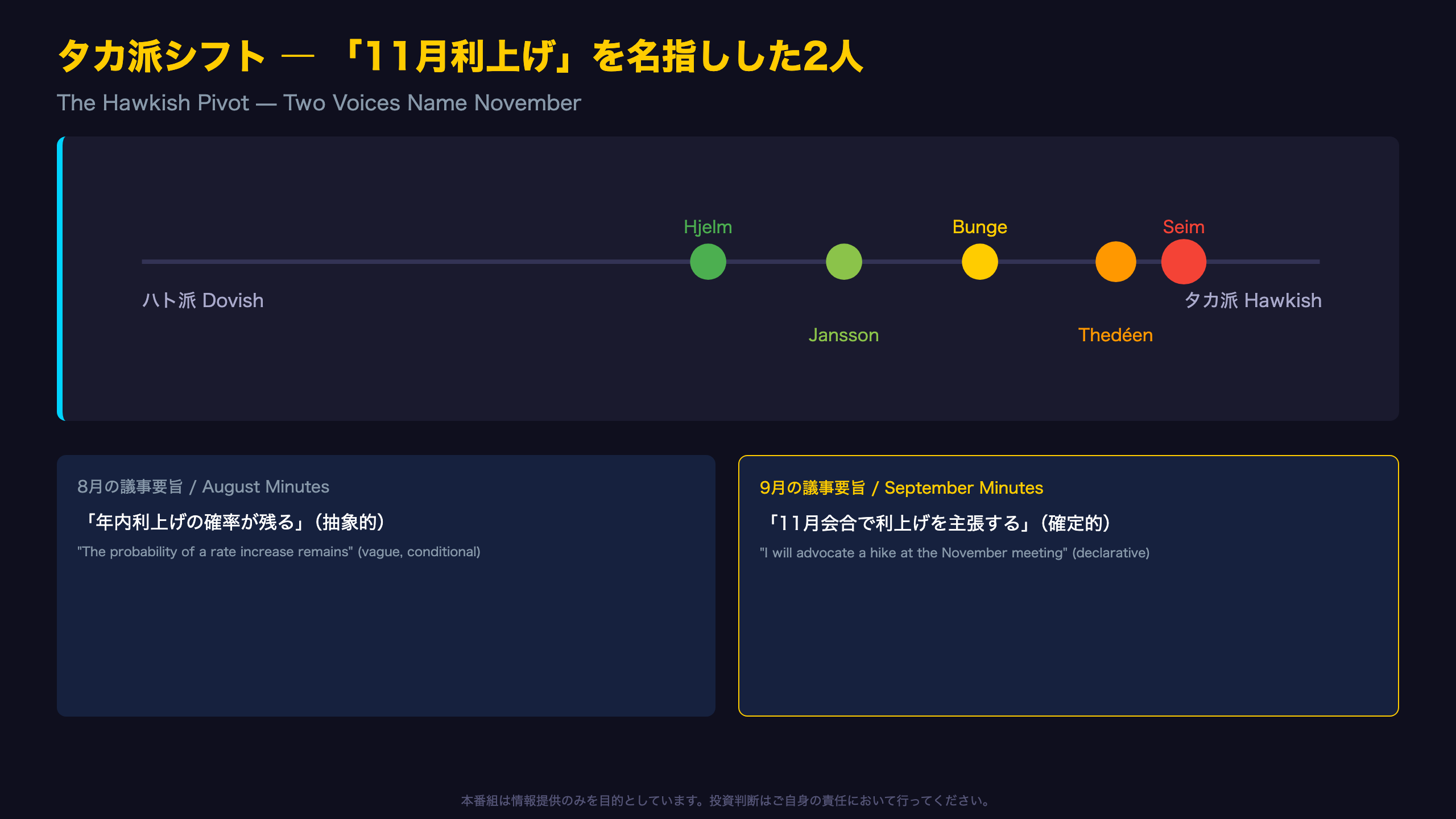
All five members backed holding rates, but their views on timing diverge meaningfully.
| Member | Stance | Key Quote |
|---|---|---|
| Seim | Most hawkish | “I will advocate a rate increase at the November meeting” |
| Thedéen (Governor) | Hawkish | “Reasonable to raise as early as November” |
| Bunge | Hawkish | Backs communicating a hike before year-end is “likely” |
| Jansson | Moderate hawk | Supports the upward path revision but remains skeptical of “insurance hikes” |
| Hjelm | Relative dove | Views the policy rate path as “slightly high” |
Jansson specifically quantified the shift: the upward revision to the policy rate path is largest for the second half of 2027, at “just under 0.5 percentage points higher than in the June forecast” — a rare instance of a board member citing a precise magnitude.
Context: Unlike the Fed, the Riksbank attributes each comment to a named board member, giving outside observers unusually granular insight into internal disagreement. The shift from August’s conditional language (“may be necessary”) to September’s declarative commitments (“I will advocate”) is the clearest tell that consensus has hardened toward a near-term hike.
上方修正されるGDP ― 正常化に近づく実体経済
A Recovery That Keeps Surprising to the Upside
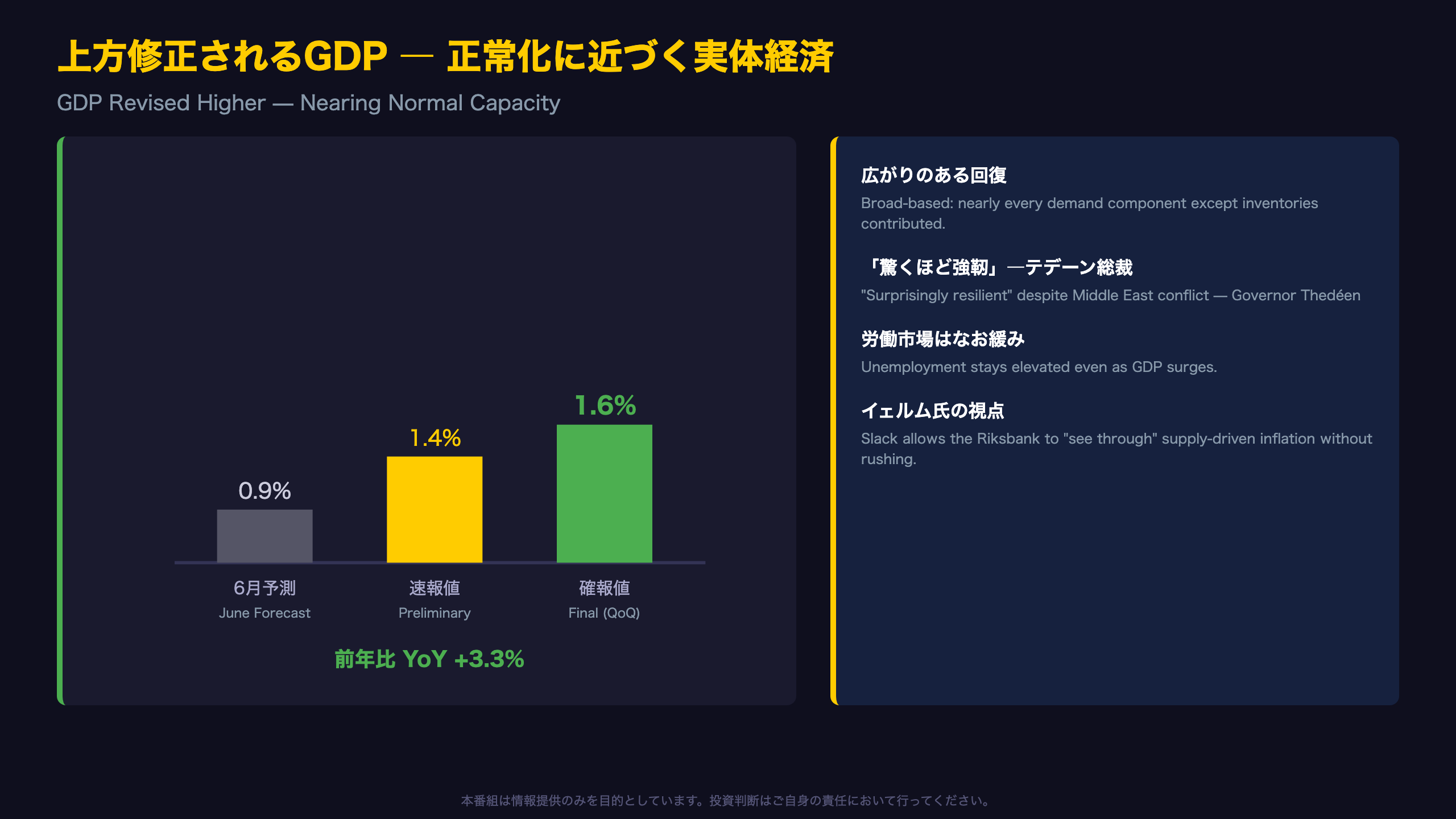
Second-quarter GDP was first reported at 1.4% quarter-on-quarter in monthly statistics, then revised up further to 1.6% in the full National Accounts — well above the Riksbank’s own June forecast of 0.9%. In year-on-year terms, growth came in at 3.3%.
Jansson noted that “all expenditure components of GDP, apart from inventory investment, contributed” to the upturn — a sign of breadth rather than a narrow, one-off bounce. Several board members attribute part of this strength to structural demand drivers beyond the typical business cycle: AI-related investment, expanded defense spending, and green-transition-related public and private investment.
The labor market exception: Despite the GDP surge, unemployment remains stubbornly elevated. Bunge specifically flagged “spare capacity in the economy, especially in the labor market” as a reason she is not yet ready to support a rate hike, citing the Riksbank’s own Business Survey showing continued hiring caution among firms.
Two readings of the same data: Seim and Thedéen interpret strong demand as a rising inflation risk requiring a near-term hike. Hjelm draws a different conclusion: as long as labor market slack persists, the “sacrifice ratio” of using higher unemployment to fight supply-driven inflation remains high, so the Riksbank can afford patience — the crux of the internal debate.
For international context: A 3.3% annualized growth rate would be exceptionally strong for a mature European economy, especially set against an ongoing Middle East conflict pushing oil above $100/barrel.
原油100ドル超えとクローナ安 ― インフレの上振れ経路
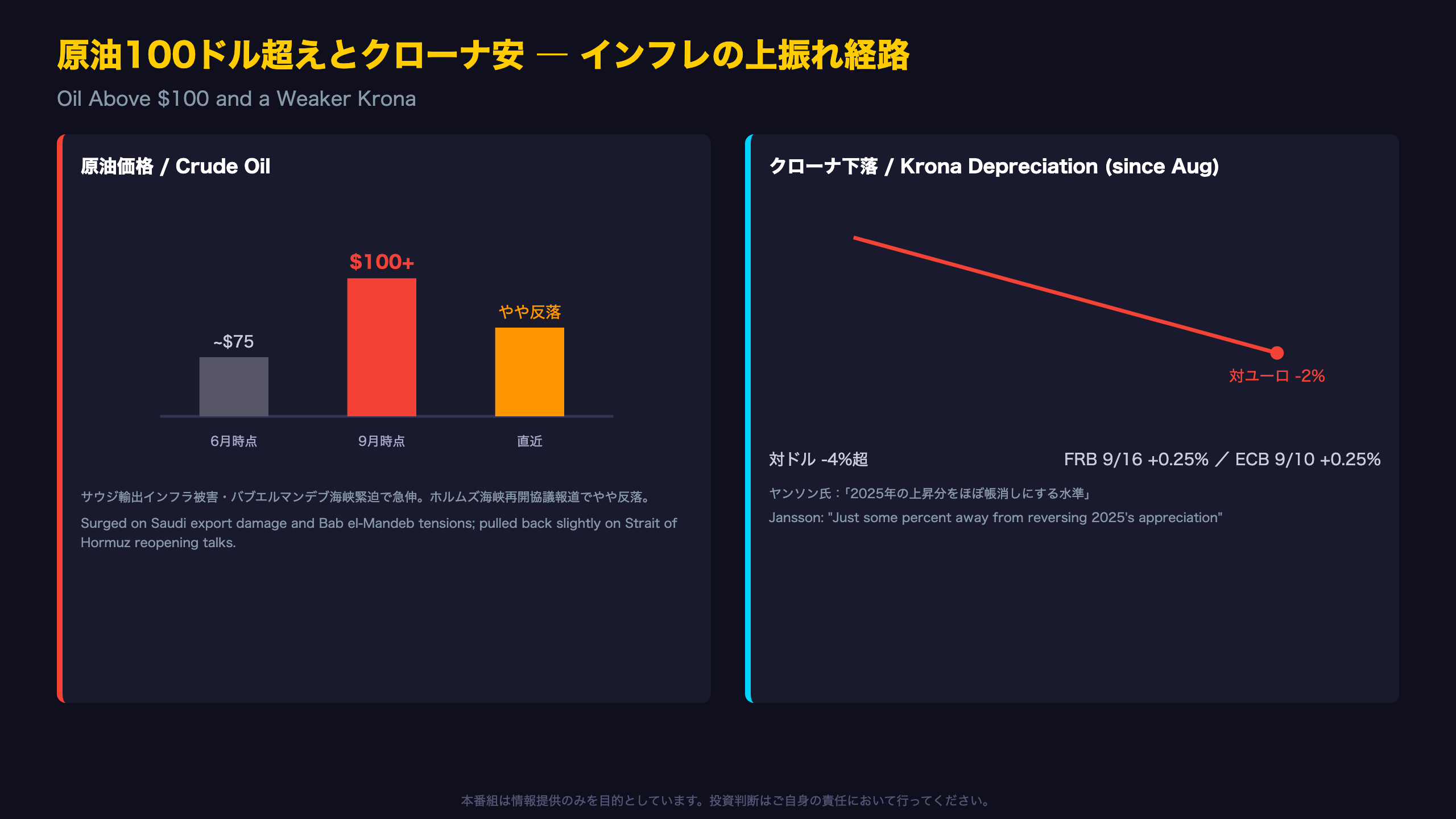
Two Channels of Imported Inflation, Converging at Once
This set of minutes is notable for how explicitly board members link two separate imported-inflation channels — oil and the exchange rate — as compounding risks.
Channel 1 — Oil: Damage to Saudi export infrastructure and rising tension around the Bab el-Mandeb Strait pushed crude above $100/barrel. Diplomatically, though, there’s a silver lining: reports at the UN meeting suggest Iran is prepared to reopen the Strait of Hormuz within seven days if the U.S. eases military pressure — and oil prices have pulled back somewhat on that news, though they remain elevated.
Channel 2 — The Krona: Bunge noted that “more than half of the krona strengthening that we saw in 2025 has now been reversed.” Jansson went further, warning the currency is “just some percent away from reversing the entire appreciation from 2025” against the euro.
Global Policy Synchronization
The Fed delivered a unanimous 25bp hike on September 16 — its first since 2023 — with the dot plot signaling further hikes in 2026. The ECB followed with a 25bp hike on September 10, alongside upward revisions to growth and inflation forecasts.
For context: This dynamic mirrors the classic “imported inflation via depreciation” playbook, but here it’s playing out in a G10, AAA-rated economy — underscoring how geopolitically-driven energy shocks have globalized inflation risk even for historically low-inflation Nordic economies.
The actual inflation print: Underlying inflation (CPIF excluding energy and temporary tax measures) held at 1.6% in August, exactly in line with the June forecast. Still, the three-month annualized pace remains near 3%.
唯一の慎重論 ― イェルム氏の「犠牲比率」ロジック
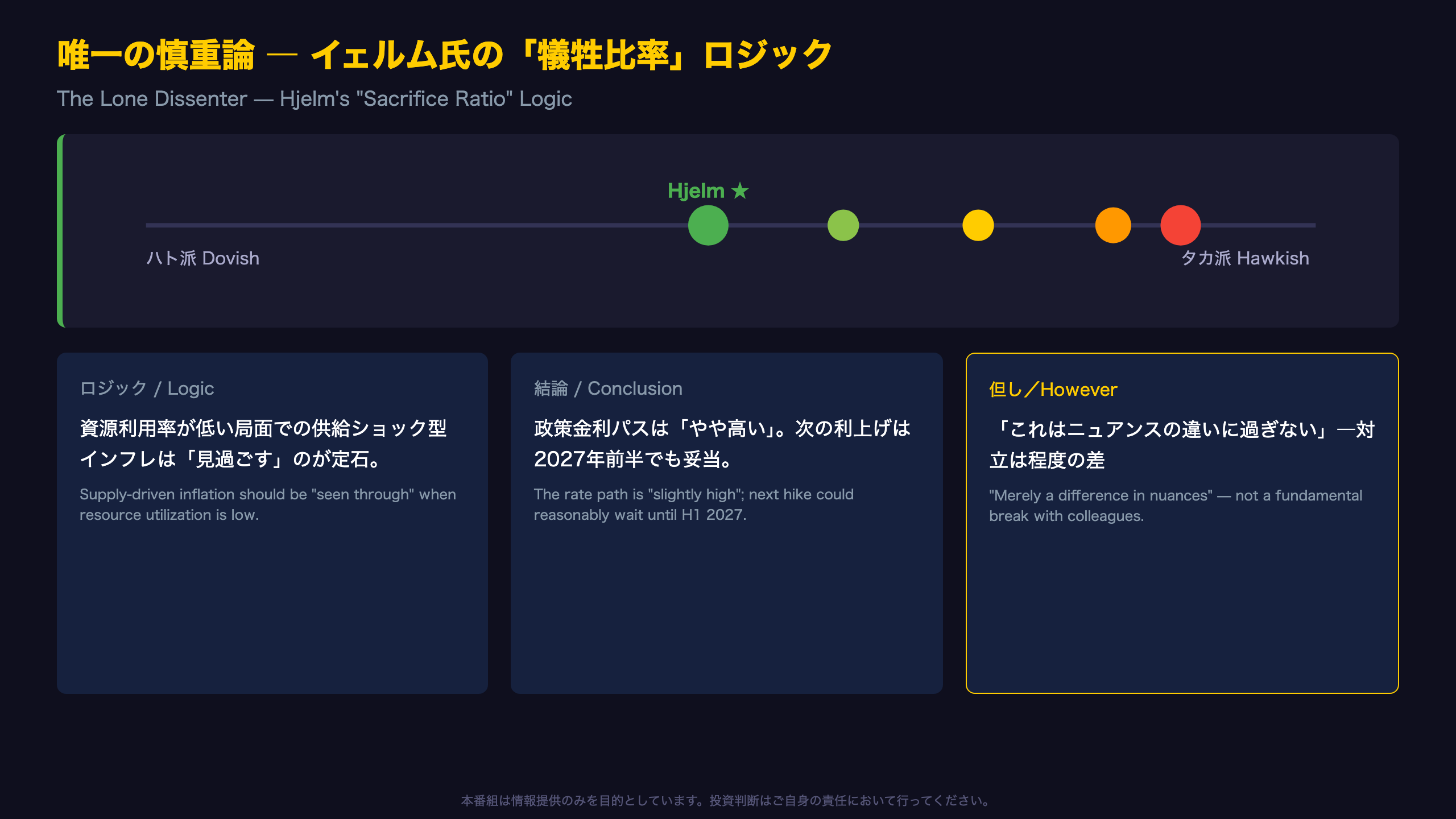
An Economic Framework, Not Just a Gut Feeling
What distinguishes Hjelm’s dissent is that it rests on an explicit macroeconomic framework rather than intuition alone.
Citing his own earlier speeches, Hjelm argues that “when an economy is affected by negative supply shocks that lead to elevated inflation and poorer economic developments, the standard recipe is to see through the higher inflation if well-established conditions are met.” The rationale: tightening policy when resource utilization is already low carries a high sacrifice ratio — a large cost in lost output and jobs for each percentage point of inflation reduced. When resource utilization is high, that same tightening becomes comparatively cheap.
Context for readers unfamiliar with the term: “Sacrifice ratio” is a standard concept in monetary economics, and Hjelm’s citation of ECB board member Isabel Schnabel’s speech is a notable instance of a small open economy’s central banker directly engaging with the broader European monetary policy debate.
The practical conclusion: Hjelm assesses the current policy rate path as “slightly high” and suggests the next hike might reasonably arrive in the first half of 2027 rather than before year-end — a timeline gap of six months or more versus Seim’s and Thedéen’s explicit November target.
But not a real schism: Crucially, Hjelm frames this as “merely a difference in nuances,” not a fundamental break with colleagues. He fully supports today’s hold decision. The board’s internal debate centers not on whether to hike, but on how urgently.
次の焦点 ― 11月会合とクローナ・労働市場の行方
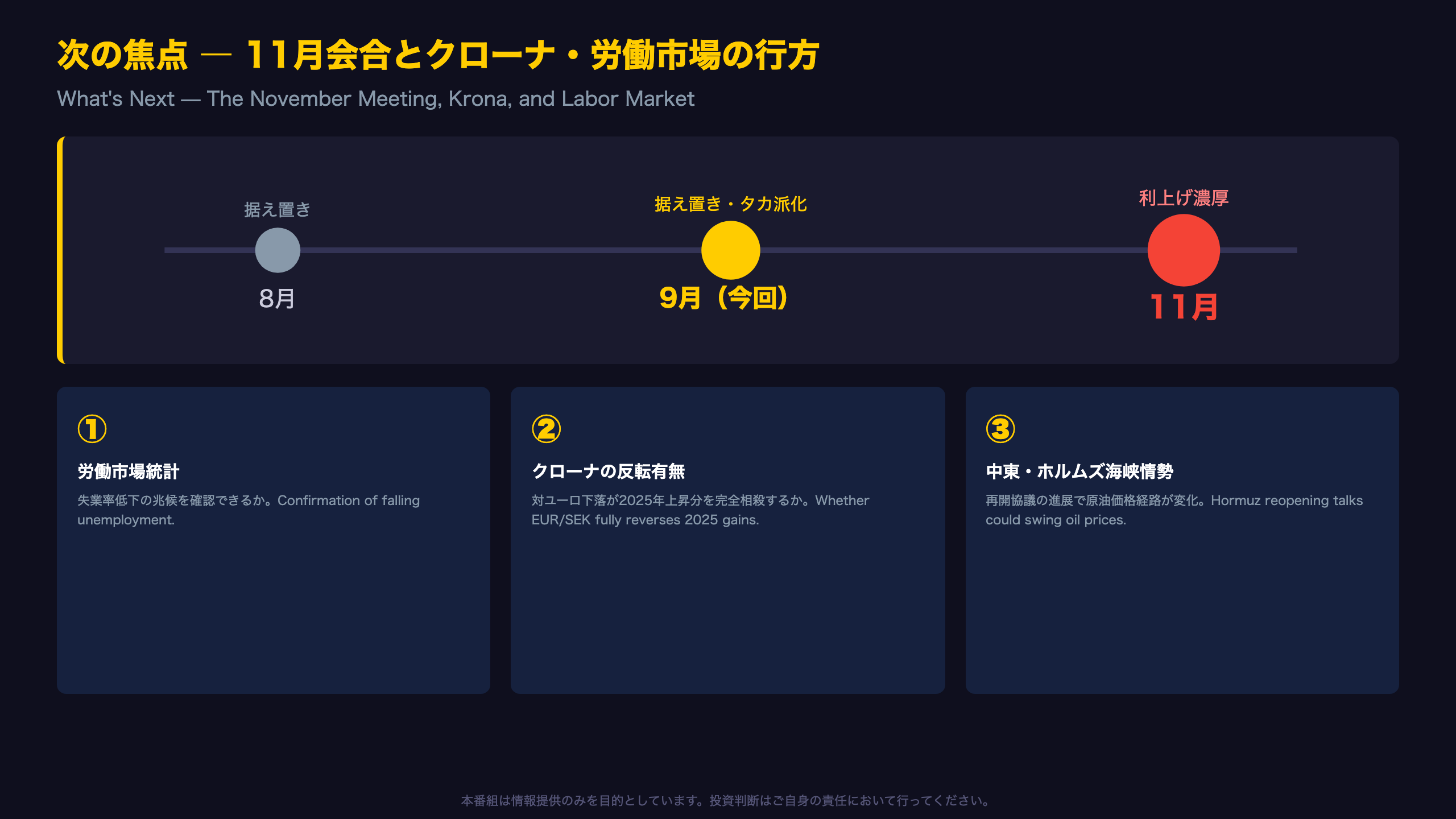
Unusually Specific Forward Guidance
Central bank minutes rarely have multiple board members name a specific future meeting by month. Here, both Seim and Thedéen explicitly said “November” — a strong signal to markets that goes well beyond typical hedge language.
Three Things to Watch Before November
- Labor market data — Both Bunge and Thedéen said they’re watching for clearer signs of falling unemployment. The two most recent Labour Force Survey releases showed employment and labor supply both rising together, leaving unemployment stubbornly elevated.
- The krona’s depreciation trend — Whether the currency’s slide against the euro fully erases 2025’s appreciation is a key inflection point for the inflation outlook.
- Middle East diplomacy — Progress in reported US-Iran talks on reopening the Strait of Hormuz could swing the oil price path significantly.
Not a One-Way Bet
The accompanying Monetary Policy Report lays out two alternative scenarios: one where the interaction of strong demand and supply constraints pushes inflation higher, requiring tighter policy; another where a pullback in AI-related risk appetite triggers a broader risk-off move, potentially requiring easier policy instead. This two-sided framing signals the board isn’t monolithically committed to tightening.
Bottom line for markets: A November hike is now the base case implied by the minutes, but it is conditional — on labor market confirmation and krona stabilization — rather than a certainty. The next monetary policy meeting is scheduled for November 2026, and whether labor market indicators firm up alongside a stabilizing krona will determine if the signaled hike actually materializes.
Disclaimer: This article is for informational purposes only. All investment decisions are made solely at your own risk.