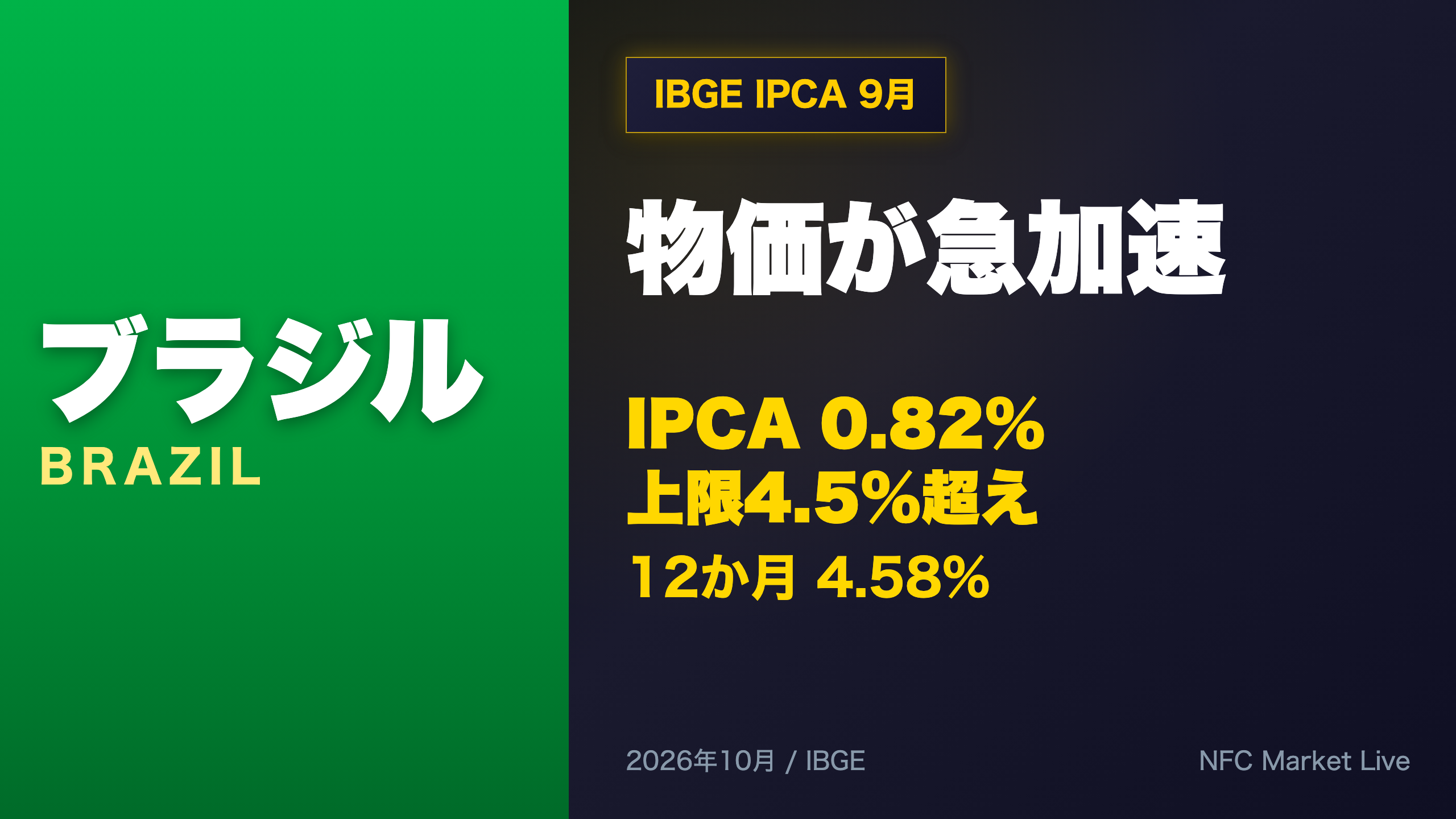
📺 Watch the Full Video Analysis
This article was automatically generated by the NFC Market Live AI analysis system. (Updated: 2026-10-10 01:17 JST)
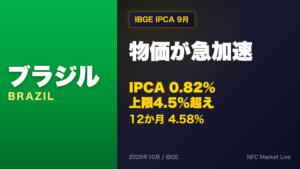
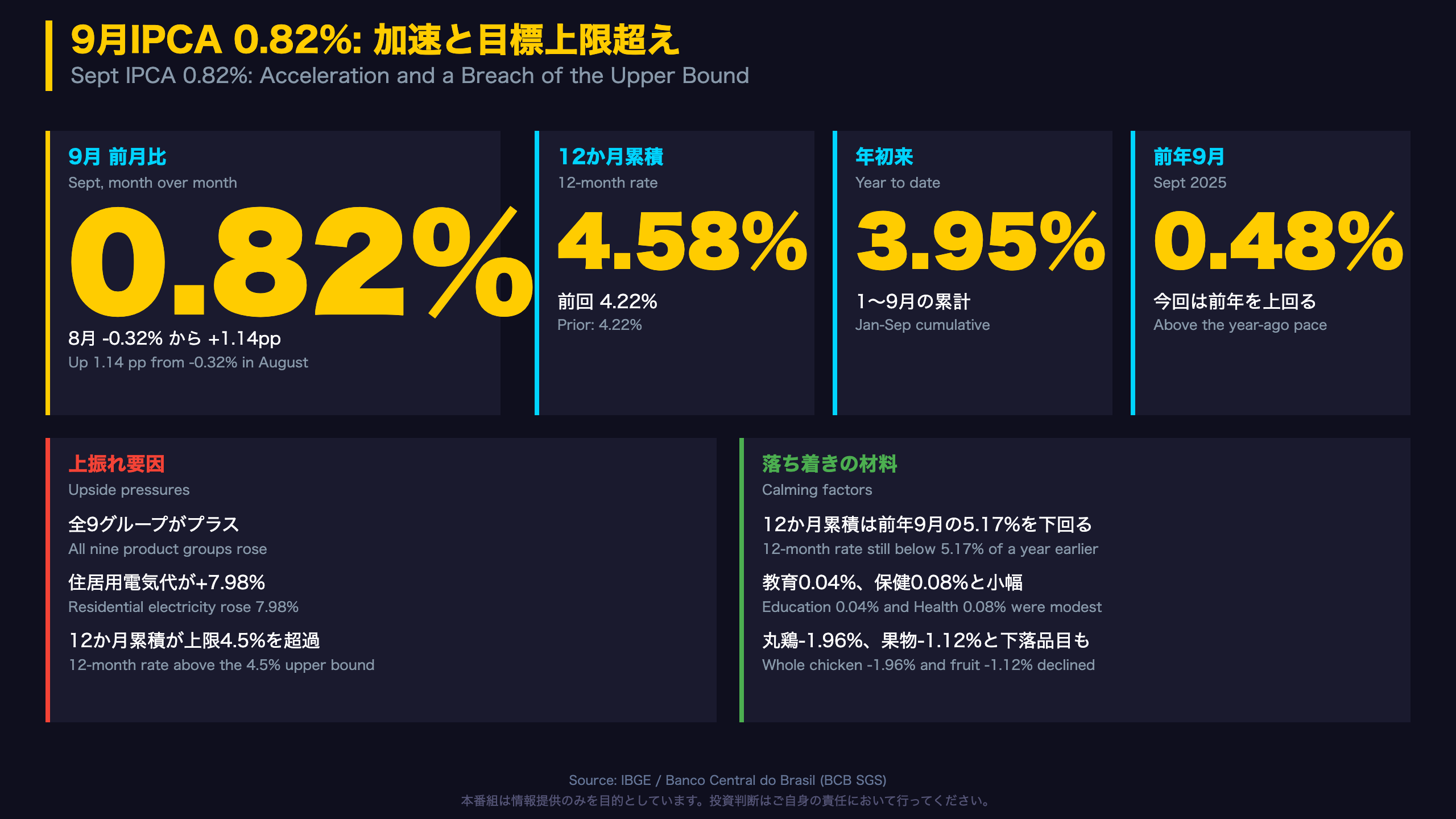
📊 Brazil’s September IPCA rose 0.82% month over month (August: -0.32%). The 12-month rate climbed from 4.22% to 4.58%, above the 4.5% upper bound of the inflation target band.
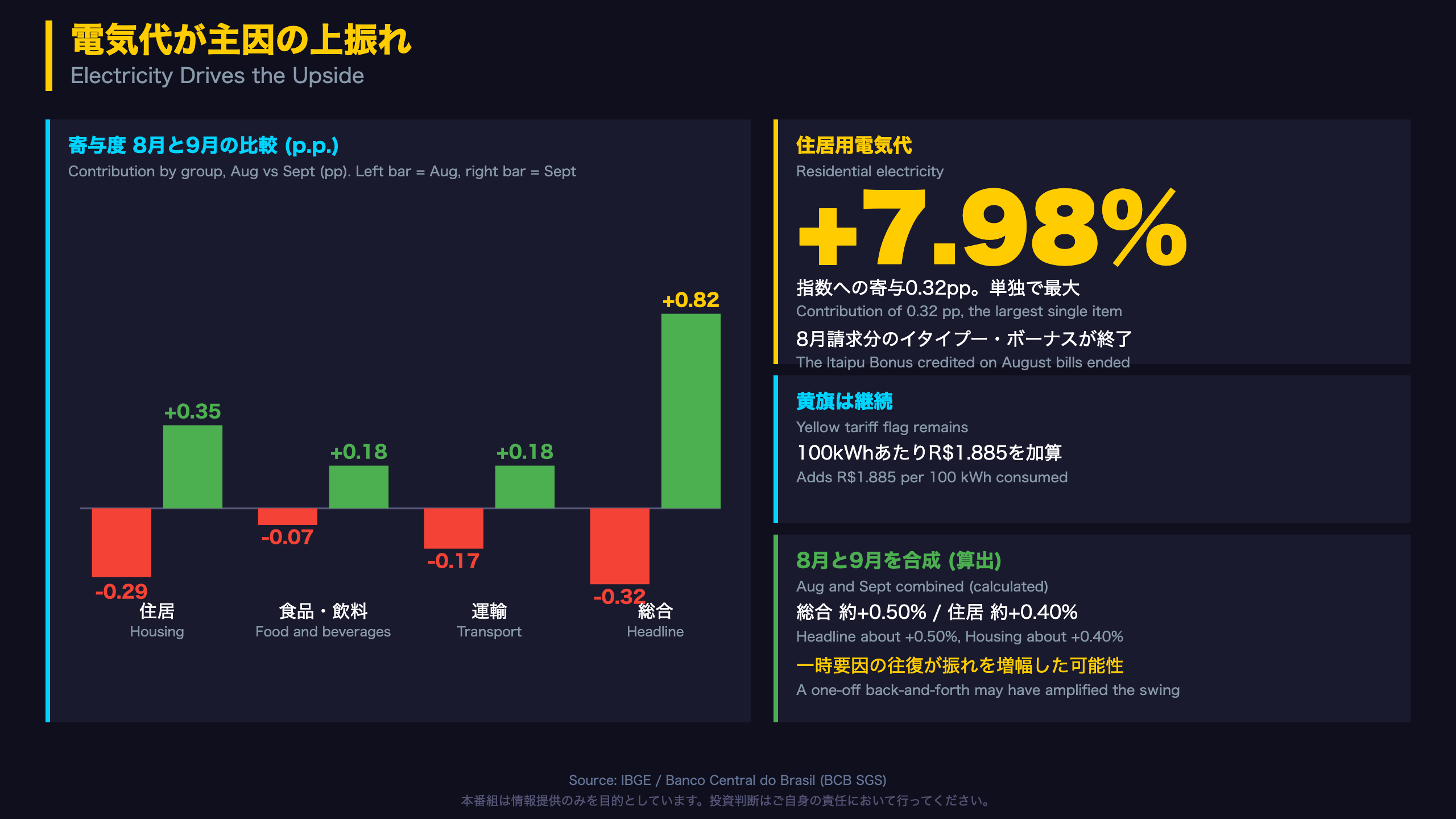
⚡ Residential electricity (+7.98%, 0.32 pp contribution) was the largest single driver after the Itaipu Bonus ended; the yellow tariff flag remains in force.
📉 On the other hand, the 12-month rate is still below the 5.17% of a year earlier, and chicken and fruit prices fell.
💡 The core series accelerated from 0.01% to 0.55%. The Selic target is 13.75%, a simple gap of 9.17 points versus 12-month IPCA.
🔎 Next: October IPCA, with tariff flags and vegetable prices in focus.
9月IPCA 0.82%: 加速と目標上限超え
Reading Brazil’s September IPCA in context
What is IPCA? The IPCA is Brazil’s official consumer price index, compiled by IBGE (the national statistics agency) since 1980. The Central Bank of Brazil (BCB) targets 3.0% with a tolerance of plus or minus 1.5 points, so the upper bound is 4.5%. It plays a role similar to the US CPI for the Fed or Japan’s CPI for the Bank of Japan, but Brazil’s target band is considerably wider.
Key readings
- Monthly change: +0.82%, the highest since March 2026 (0.88%) and the highest September since 2021 (1.16%).
- 12-month rate: 4.58% versus 4.22% in August, now 0.08 points above the 4.5% ceiling.
- Year to date: 3.95%. All nine product groups rose.
Why the monthly swing looks so large
August printed -0.32%, driven mainly by Housing (-1.87%). The monthly path in 2026 was 0.33, 0.70, 0.88, 0.67, 0.58, 0.16, 0.07, -0.32 and 0.82, so September follows a steep three-month slowdown.
Two readings
- Upside view: broad-based gains and a 12-month rate above the band.
- Calming view: the 12-month rate is still below 5.17% a year earlier, and 2026 has ranged between 3.81% and 4.72%.
Why it matters for global investors
The BCB’s Selic target stands at 13.75% in the source data. Inflation prints relative to the band are one input into how the central bank is perceived, a channel through which BRL could be affected. The source itself offers no forecast, and a single month cannot establish a trend.
Next: October IPCA; the release date is not stated in the source.
電気代が主因の上振れ
Electricity: the single biggest swing factor
Context. Brazil’s electricity bills are affected by the ANEEL tariff-flag system, which adds a surcharge per 100 kWh when generation costs rise. The yellow flag currently adds 1.885 reais per 100 kWh. This differs from the US CPI, where utilities are a smaller and less administratively driven component, and from Japan, where fuel-cost adjustment schemes work differently.
What happened
- The Itaipu Bonus, a credit applied to bills issued in August, ended. Residential electricity therefore rose 7.98% in September, adding 0.32 points to the headline index.
- Housing moved from -1.87% (August) to +2.31% (September). Its contribution swung from -0.29 to +0.35 points, more than half of the 1.14-point change in the headline.
- Local tariff adjustments: Belem +6.63%, Sao Luis +5.42%, Vitoria +6.89%. Reductions: Rio Branco -5.20% and Fortaleza -6.65%, reflecting funds from the UBP renegotiation approved by ANEEL.
Two interpretations
- One-off view: compounding August and September gives roughly +0.50% for the headline and +0.40% for Housing (our calculation), suggesting the swing is partly a credit being granted and then removed.
- Persistence view: the continuing yellow flag and several regional tariff increases suggest upward pressure on power bills remains after the credit’s end.
What to watch
How the tariff flag is set for the October reading. Note that these are single-month data points, and the source offers no forecast.
運輸・食品・コア系列の広がり
Beyond electricity: transport, food and the core series
Background. Brazil’s IPCA covers households earning 1 to 40 minimum wages across metropolitan regions and several cities. Food carries a larger weight in Brazilian household budgets than in Japan or the US, which is why vegetable swings can move the headline.
Transport (+0.89%, 0.18 pp)
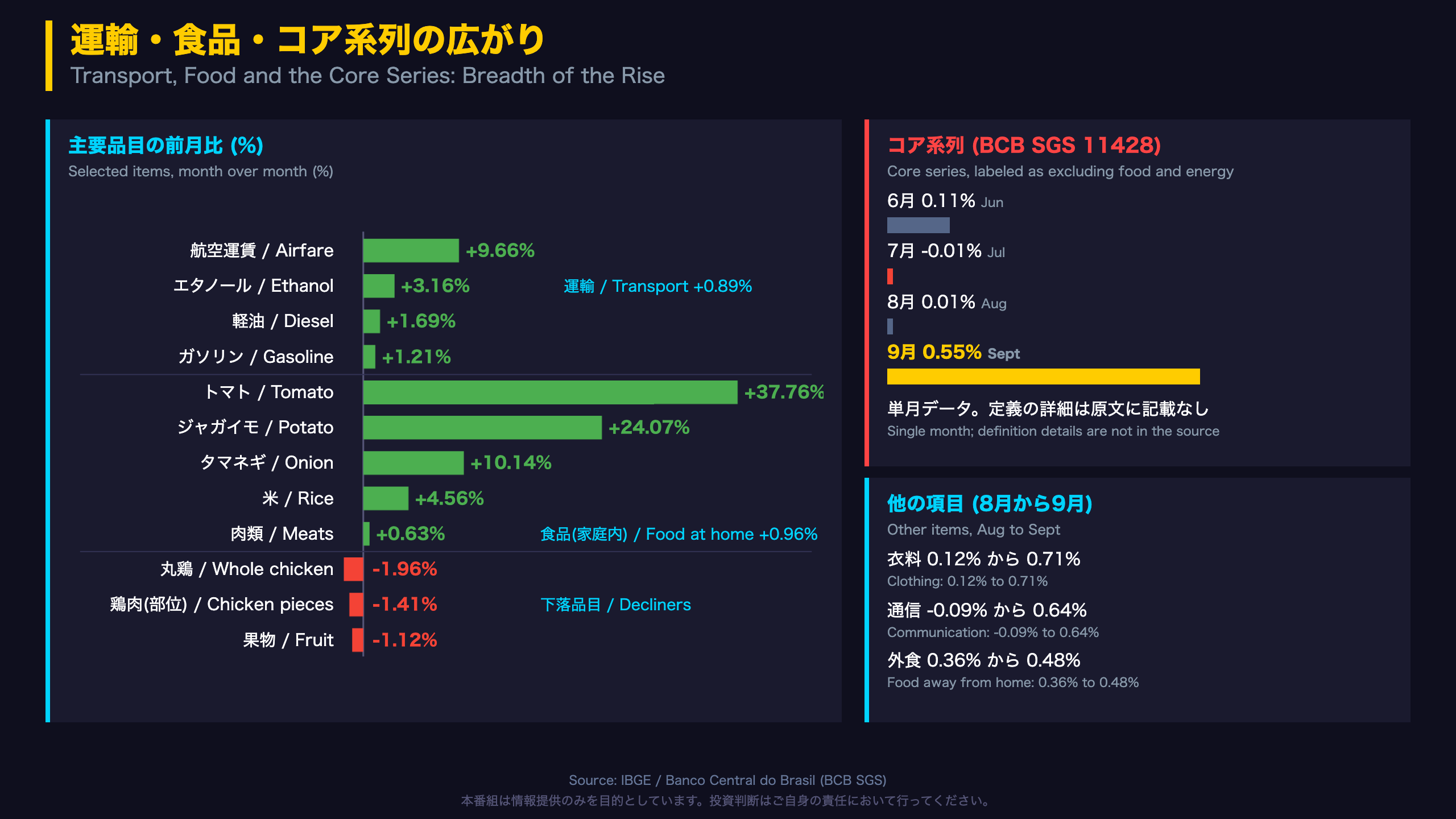
Airfares +9.66% and fuels +1.41% (ethanol +3.16%, diesel +1.69%, gasoline +1.21%) led. Transport had fallen 0.86% in August, so September is a reversal.
Food and beverages (+0.83%)
This is the first rise after three consecutive declines. Food at home rose 0.96%: tomatoes +37.76%, potatoes +24.07%, onions +10.14%, rice +4.56%. Whole chicken (-1.96%), chicken pieces (-1.41%) and fruit (-1.12%) fell. Food away from home rose 0.48% (August: 0.36%).
Other groups, August to September
- Clothing: 0.12% to 0.71%
- Communication: -0.09% to 0.64%
- Personal expenses: 1.30% to 0.26%
- Education: 0.47% to 0.04%
The core series
The BCB SGS series 11428, labeled as excluding food and energy, went 0.11%, -0.01%, 0.01% and 0.55% from June to September. Central banks typically watch core measures for persistence, whereas headline figures include one-off items. Here, the jump hints at a broader base, but it is one month, and the source does not detail the series methodology.
Counterpoint
Several groups decelerated, and vegetable moves are large but may reverse. The source offers no forecast.
12か月累積と目標レンジ
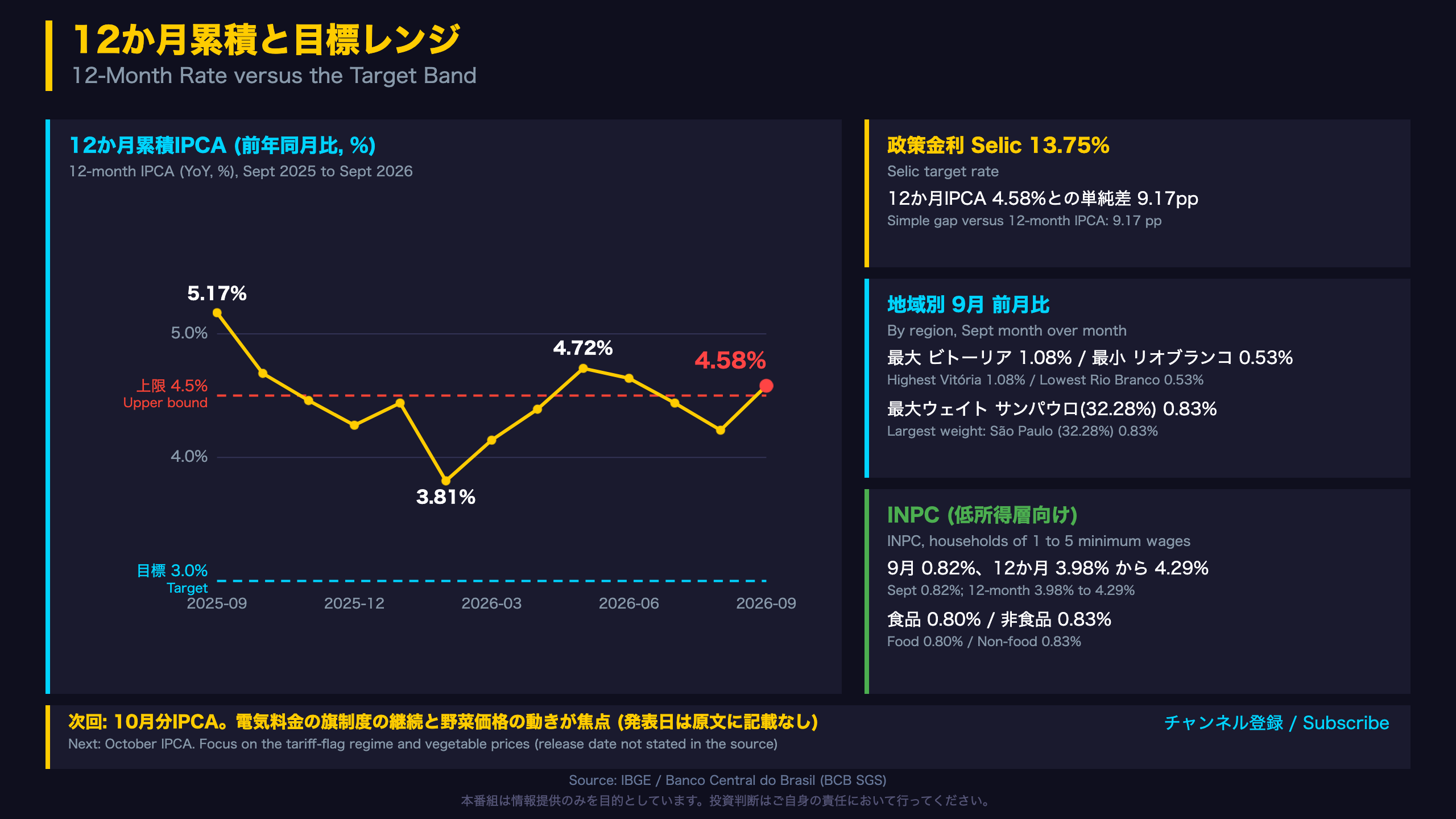
The 12-month rate, the target band and the Selic
Framework. Brazil uses an inflation target of 3.0% with a tolerance of plus or minus 1.5 points, giving a 4.5% ceiling. The Fed targets 2% PCE inflation and the Bank of Japan targets 2% CPI, so Brazil’s nominal target and policy rate (Selic 13.75% in the source data) sit in a much higher regime.
The path
- 12-month IPCA: 5.53% (April 2025), 5.17% (September 2025), 4.26% (December 2025), 3.81% (February 2026), 4.72% (May 2026), 4.22% (August), 4.58% (September).
- September is 0.08 points above the ceiling and 1.58 points above target (our calculation). The rise from 4.22% reflects September 2025’s 0.48% rolling out and this year’s 0.82% rolling in.
Simple real-rate gap
Selic 13.75% minus 12-month IPCA 4.58% equals 9.17 points. This is a simple difference that ignores inflation expectations.
Regional dispersion
Vitoria (+1.08%), Goiania (+1.07%) and Belo Horizonte (+1.05%) led; Rio Branco (+0.53%) was lowest. Sao Paulo, the largest weight at 32.28%, rose 0.83%. On a 12-month basis Goiania is at 6.08% versus Curitiba at 2.72%.
INPC
The INPC, covering households earning 1 to 5 minimum wages with a salaried head, rose 0.82% (12-month: 4.29% versus 3.98%).
Two views
- Above-ceiling view: a continued 0.8% monthly pace would push the 12-month rate higher.
- Within-range view: the rate remains inside its 2026 range and below a year ago.
Implications for BRL-linked investors depend on how the central bank reads this data, and the source makes no forecast. Next: October IPCA.
Disclaimer: This article is for informational purposes only. All investment decisions are made solely at your own risk.