📺 Watch the Full Video Analysis
This article was automatically generated by the NFC Market Live AI analysis system. (Updated: 2026-10-28 10:16 JST)
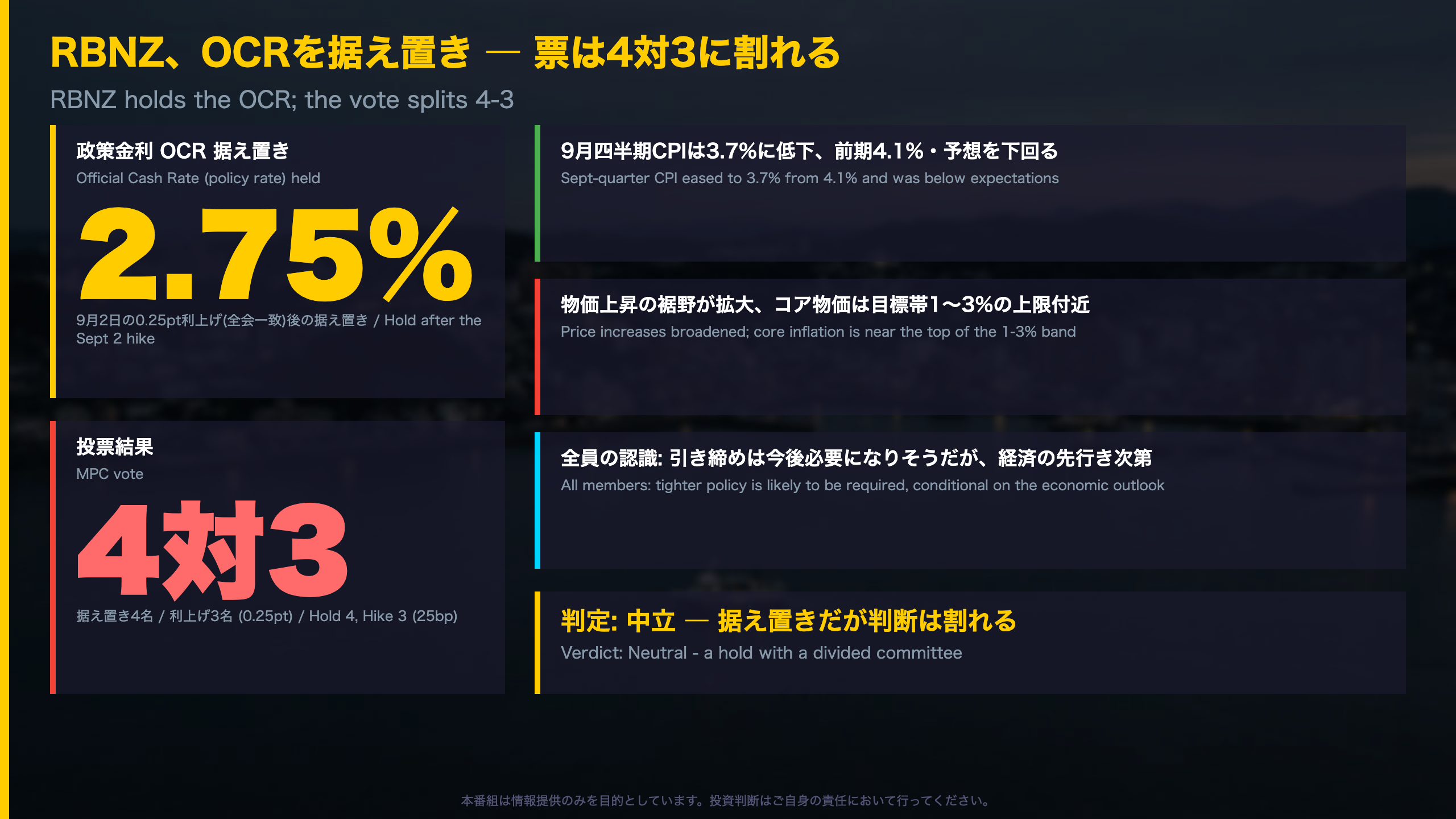
📊 The RBNZ held the OCR at 2.75% on Oct 28, but the vote was 4-3, with three members favoring a 25bp hike.
📉 Sept-quarter CPI eased to 3.7% from 4.1% and came in below expectations.
⚠️ Core inflation is near the top of the 1-3% band and price increases have broadened.
💡 All members agreed tighter policy is likely to be required, conditional on the outlook. Next: the December MPS.
NFC Market Live explains US and Japan data with AI. Subscribe to the channel.
サマリー:OCR据え置き、票は4対3
Context: A Pause After Two Hikes
The Reserve Bank of New Zealand (RBNZ) targets annual CPI inflation of 1-3%, aiming for the 2% midpoint. Its policy rate is the Official Cash Rate (OCR), set by a seven-member Monetary Policy Committee (MPC). The RBNZ also publishes a Record of Meeting that names which members argued which side.
What changed since September 2
– Decision: consensus 25bp hike to 2.75% -> 4-3 hold at 2.75%
– Headline CPI: 4.1% (June qtr) -> 3.7% (Sept qtr), below expectations
– Guidance: the OCR “may need to increase further” -> tighter policy “is likely to be required, but remains conditional on the economic outlook”
Both sides of the ledger. Supportive: inflation undershot, wage growth is subdued, medium-term expectations are stable, and GDP growth in the first half was stronger than expected. Cautionary: core inflation is near the top of the band, price rises are broader, and the trade-weighted NZ dollar is down about 3% since early September, adding to imported inflation.
Why it matters for global readers. New Zealand is a small, open, commodity-exporting economy, so imported fuel costs and the exchange rate feed quickly into CPI. The December Monetary Policy Statement is the next decision point (exact date not stated in the source).
深掘り1:票の割れ方(4対3)
Reading the 4-3 Vote
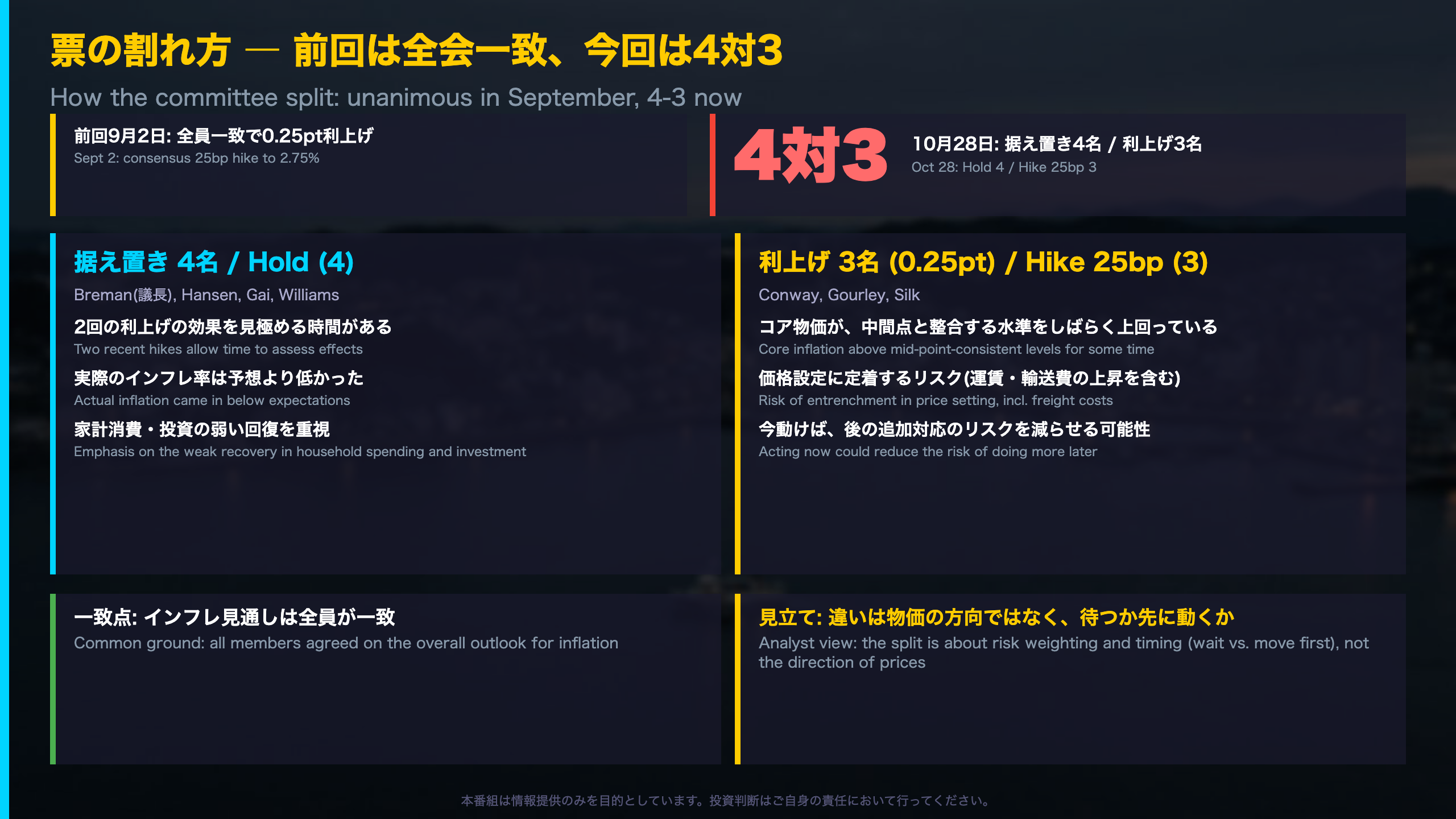
The RBNZ’s Monetary Policy Committee has seven members, and its Record of Meeting names who argued for what. That transparency matters here: it shows the split is about timing and risk weighting, since “all members agreed on the overall outlook for inflation.”
Hold (4): Breman (chair), Hansen, Gai, Williams
– Two recent hikes allow time to assess their effects
– Inflation was lower than expected; indirect fuel effects were smaller
– Whether firms are widening margins is the key question, and it “does not appear to be the case so far”
– Greater weight on weak household consumption and investment
Hike 25bp (3): Conway, Gourley, Silk
– Core inflation has been above levels consistent with the 2% midpoint for some time
– Risk of entrenchment as the conflict persists, including higher freight costs
– Aggregate growth is resilient; acting now could reduce the risk of doing more later, and they favored moving to around the midpoint of the neutral range
Neutral-rate caveat. The committee noted a wide range of plausible neutral-rate estimates. Gai and Breman argued the stance should allow for an abrupt global shift rather than rely on midpoint estimates.
Cross-border read. The split reflects two-sided risks: an imported fuel-cost shock on one side, weak household demand on the other. The December Monetary Policy Statement is the next decision point.
深掘り2:物価の中身 ― 低下と広がり
Inside the Inflation Print
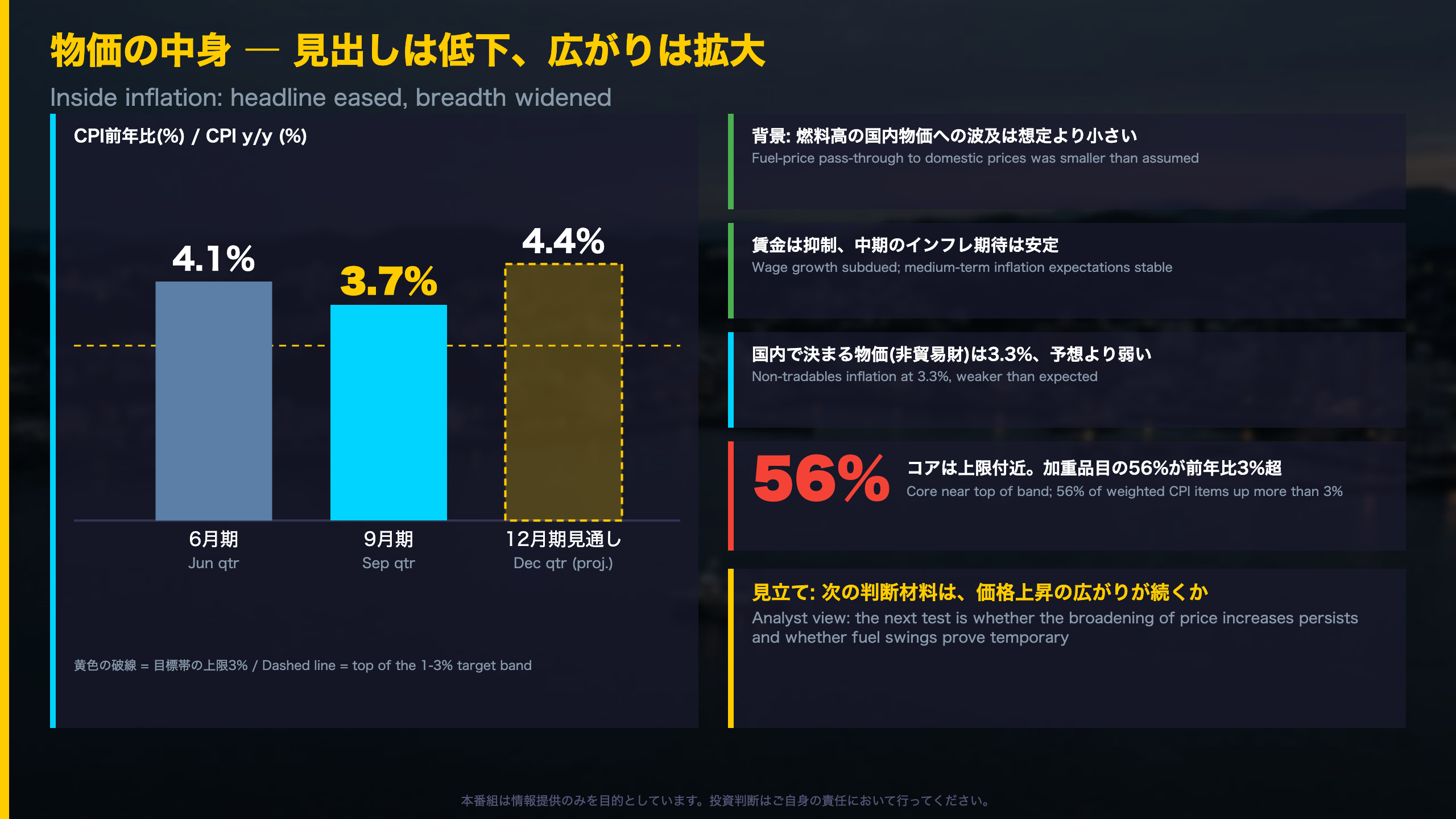
New Zealand’s CPI is reported quarterly, unlike the monthly US and Japan prints, so each release moves the debate sharply. Headline CPI was 3.7% y/y in the September quarter (4.1% in June, below expectations).
| Component | Sept qtr | Note |
|---|---|---|
| Tradables | 4.3% | 4.9% prior; slightly above forecast |
| Non-tradables | 3.3% | Weaker than expected; elevated government charges |
| CPI ex vehicle fuels | 3.0% | 2.9% prior |
| Dec qtr projection | 4.4% | Based on current fuel futures; high uncertainty |
Breadth matters. On a weighted basis, 56% of CPI basket items rose more than 3% y/y. The committee said this was largely expected, but it is the reason core measures now sit near the top of the 1-3% band.
Mitigating signals. Wage growth is subdued, medium-term expectations are anchored, and the September business survey showed fewer firms raising prices than in June, though levels are still elevated.
Exchange rate. The NZD trade-weighted index fell about 3% since the September MPS, which adds to imported inflation. The statement attributes it to a confluence of factors rather than a single cause.
Comparison. Like the US, the question is persistence rather than the headline: energy-driven inflation can fade mechanically, while broad core pressure is stickier. The statement says pass-through is state-dependent and weak demand could limit it.
質疑で深める:利上げの打ち止めか、次の注目点
The Statement’s Three-Way Fork
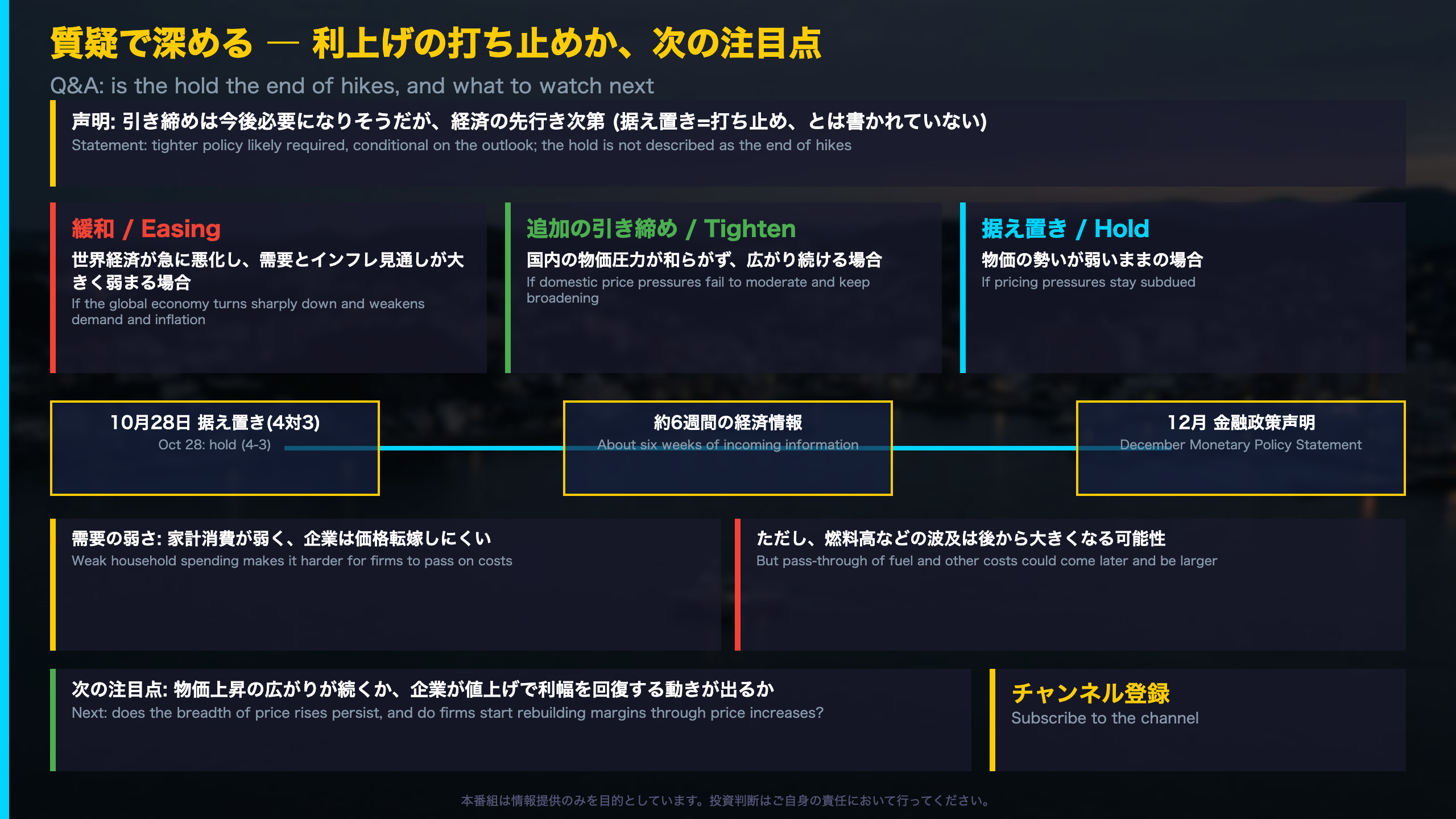
The Record of Meeting is unusually explicit that the next move could go in any direction:
- Further tightening if domestic pricing pressures fail to moderate, or broaden beyond what costs and normal pass-through can explain
- Holding if pricing pressures stay subdued
- Easing if the global economy turns sharply down and materially weakens demand and the inflation outlook
Global risk backdrop. Since the September MPS, financial stability risks have increased because of high indebtedness and opaque, complex financing arrangements for some AI investments. Global long-term yields have risen, which may partly signal a higher global neutral rate, yet higher yields could also bring forward a downturn. The committee noted that a global downturn could occur abruptly.
Domestic demand. The household saving rate is estimated at 3.7% versus a 10-year average of 1%, house prices keep falling, and employment intentions remain weak. Business investment is resilient but aimed at productivity and cost cutting. Early signs of a residential investment recovery have appeared, including in Auckland.
For international investors. The RBNZ is signalling conditionality rather than a fixed path: the decision hinges on about six weeks of data before the December Monetary Policy Statement (exact date not given in the source). Watch breadth of price increases, firms’ margins, fuel prices and the NZ dollar.
Disclaimer: This article is for informational purposes only. All investment decisions are made solely at your own risk.