📺 Watch the Full Video Analysis
This article was automatically generated by the NFC Market Live AI analysis system. (Updated: 2026-10-30 17:13 JST)
📄 Primary Source
NFC Market Live
https://www.youtube.com/watch?v=7BHDgrGTQqI
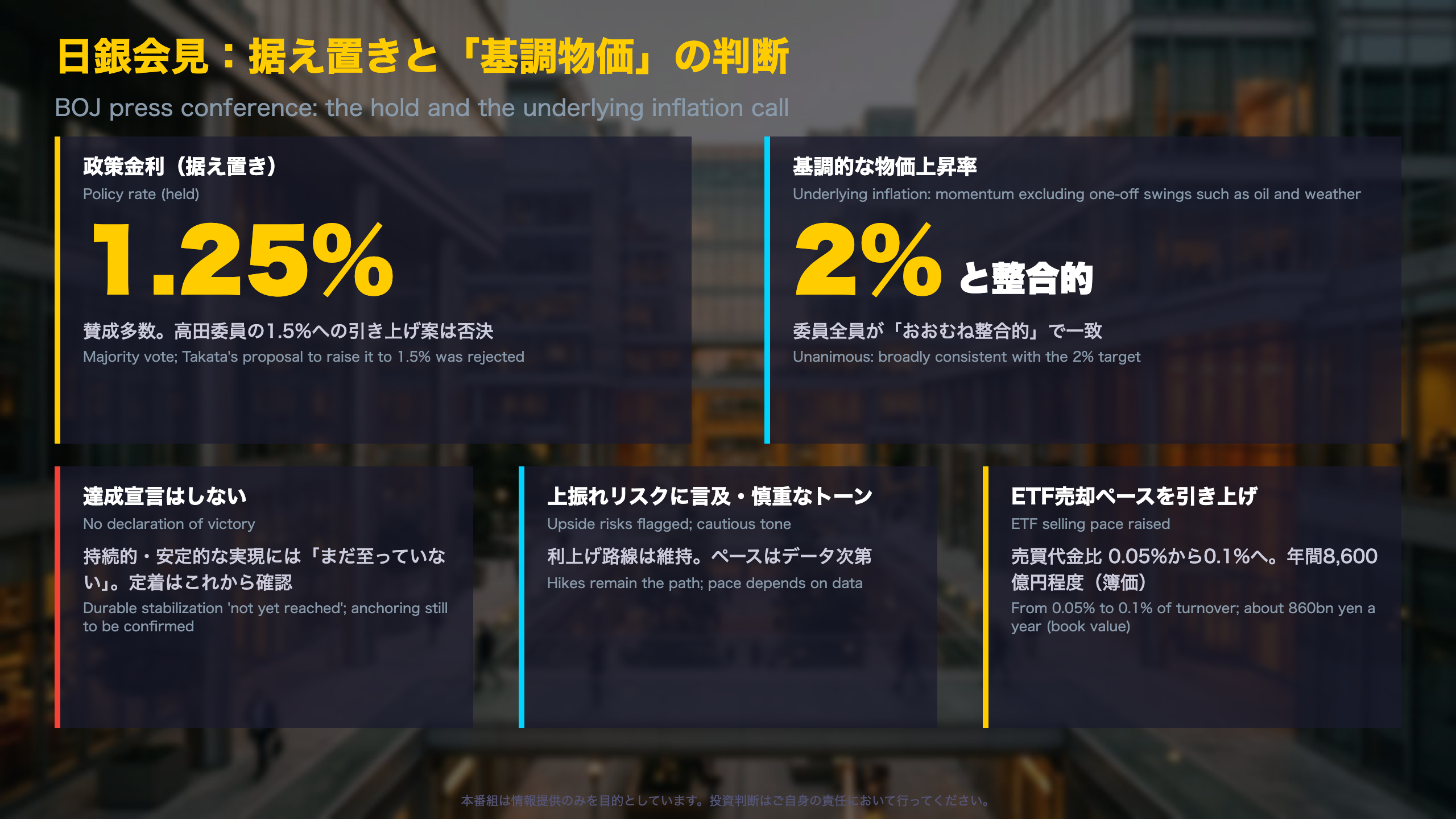
🏦 The Bank of Japan held its policy rate at about 1.25% on Oct 30.
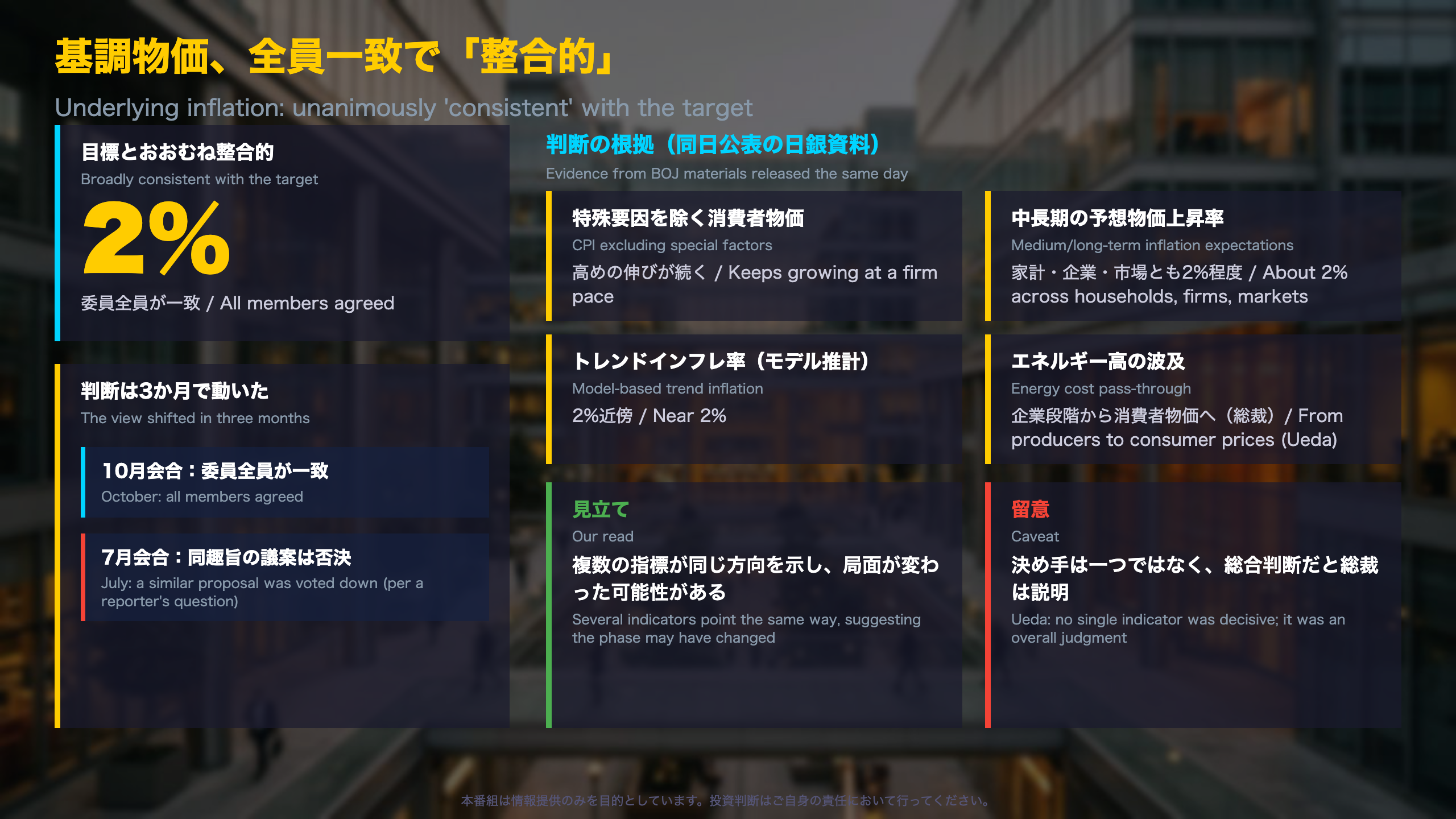
📊 All members judged underlying inflation broadly consistent with the 2% target, while Takata’s proposal to hike to 1.5% was rejected.
💡 Governor Ueda declined to declare the target achieved, stressing that durable stabilization at 2% is still to be confirmed. He flagged upside risks to prices and kept the direction of further hikes, with the pace dependent on data.
⚠️ The BOJ also raised its ETF selling pace to about 860 billion yen a year at book value.
We break down the tone of the press conference, weighing both strengths and risks.
据え置きと「基調物価」の判断
What the BOJ decided
The Bank of Japan (BOJ) kept its guideline for the uncollateralized overnight call rate at about 1.25% by majority vote. Board member Takata proposed lifting it to about 1.5%, but the motion was voted down. The Outlook Report (the BOJ’s economic and price projections, updated quarterly) and the decision to speed up ETF sales were both unanimous.
Why ‘underlying inflation’ is the headline
Japan’s headline CPI is swayed by energy subsidies and free-education measures. The BOJ therefore watches underlying inflation: a judgment drawn from several indicators (price pressure passed from companies to consumers, inflation expectations, and a model-based trend rate) rather than one published number such as US core PCE. All nine members judged it ‘broadly consistent’ with the 2% target.
Tone: firm diagnosis, careful label
Governor Ueda declined to announce that the target has been achieved, saying that realizing 2% in a sustained and stable manner is what matters. That is a more cautious message than the diagnosis alone suggests.
Balance of the outlook
- Supports: global AI-related demand, government measures, accommodative financial conditions, wage-to-price pass-through
- Drags: higher energy and raw material prices linked to the Middle East
- Risk balance: roughly balanced for growth, skewed to the upside for prices
What to watch
Ueda said the timing and pace of further hikes will depend on how likely the central outlook is to materialize and on risks including the Middle East, AI demand and the yen.
基調物価、全員一致で「整合的」
The July-to-October shift
According to a reporter’s question, in July two board members (Tamura and Takata) proposed wording that underlying inflation had already reached 2%; it was voted down. This time all nine members agreed on ‘broadly consistent’. Ueda said no single indicator drove the change, adding that energy and raw material costs linked to the Middle East, already visible at the corporate level in July, spread to consumer prices in September and October.
The BOJ’s evidence set
A same-day document, ‘Indicators related to underlying inflation’, showed:
– CPI excluding special factors (energy subsidies, free education) still growing at a firm pace
– Medium- to long-term expectations of households, firms and economists, and market-implied inflation from inflation-linked bonds, at about 2%
– Model-estimated trend inflation near 2%
Comparison with the US
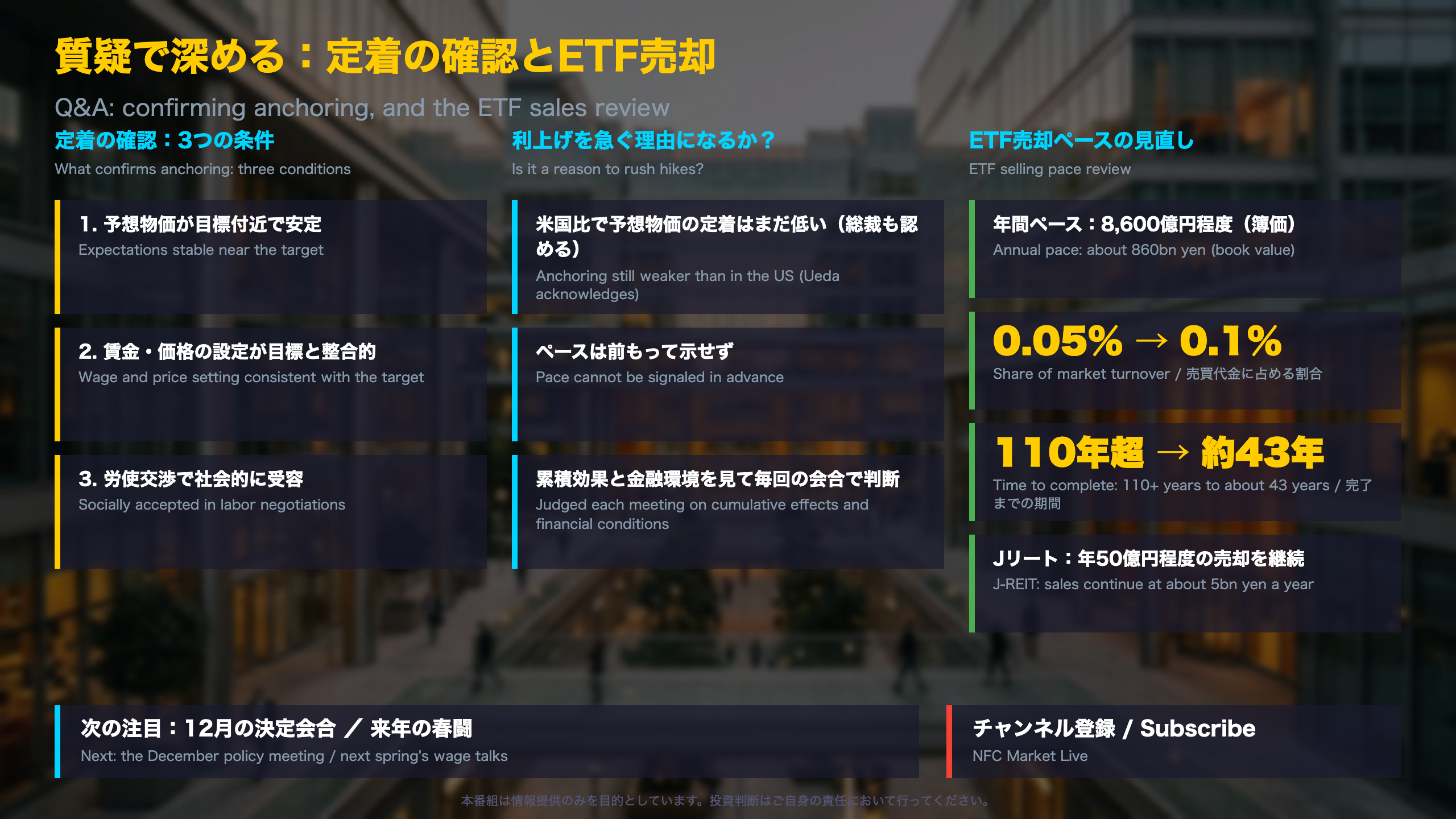
Ueda later said inflation expectations in Japan are still far less firmly anchored at 2% than in the United States, because they only recently climbed from well below 2%. That is why the BOJ wants to watch anchoring, not just the level.
Two readings
- Constructive: several independent gauges converging near 2% suggests a genuine shift in price-setting behavior.
- Cautious: a reporter noted some expectation measures sit slightly below July levels, and Ueda acknowledged household strain from food and energy costs, partly relative-price changes.
Why it matters
This diagnosis is the precondition for the BOJ’s change of framing: from raising underlying inflation toward 2% to holding it around 2%.
据え置きの中身:警戒と慎重さの併存
The dissent
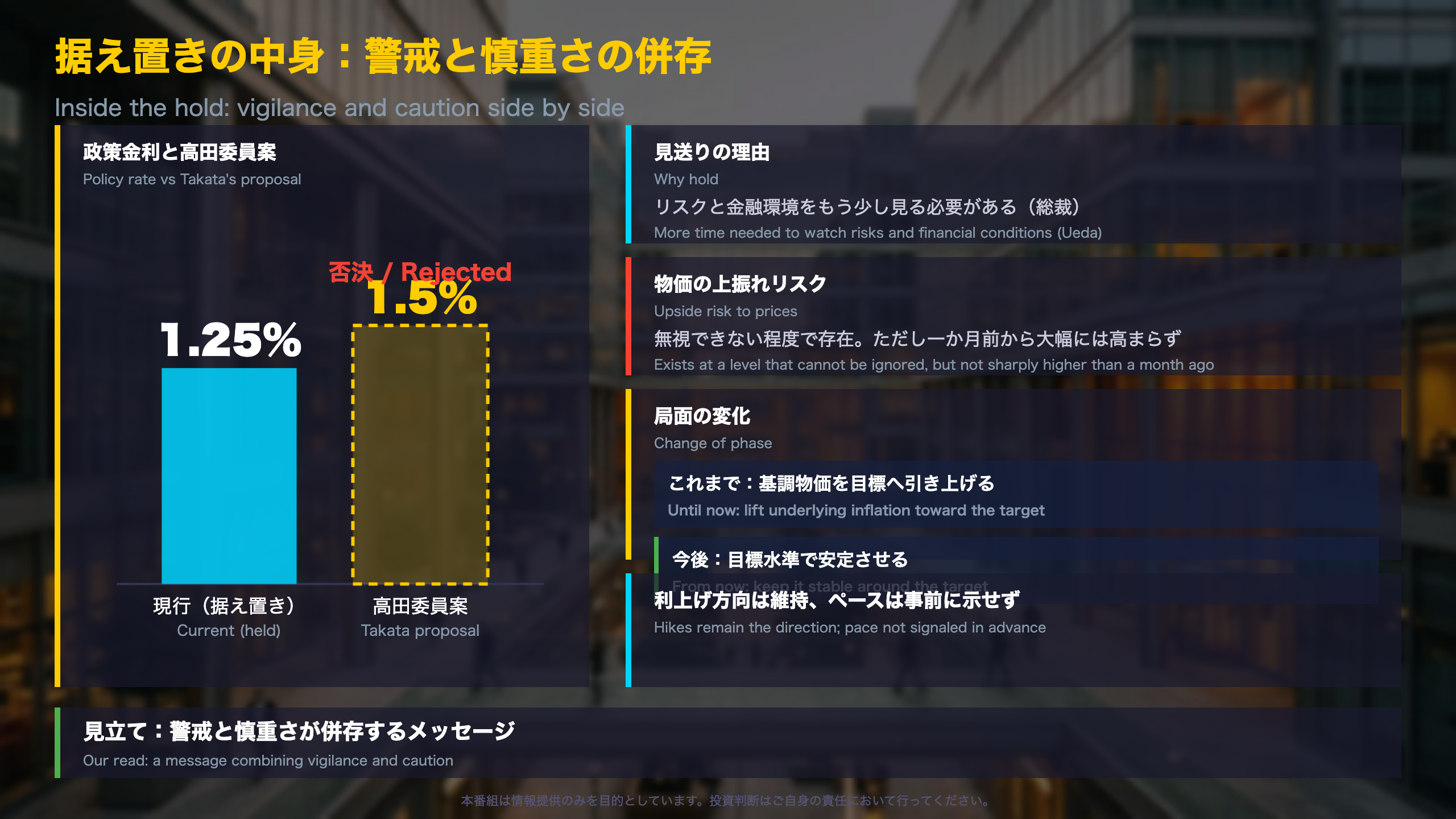
According to Ueda, board member Takata argued that with underlying inflation at target, the Bank had entered a new phase of speeding up its move toward the neutral rate (the level at which policy can respond flexibly to shocks in either direction), and proposed about 1.5%. The motion failed.
Why the majority held
Ueda said the Board wanted to watch risks and financial conditions a bit longer. Financial conditions remain accommodative: surveys of lenders and borrowers show funding is generally not a problem, and bank lending is still growing. But interviews through BOJ branches show funds getting tighter at some mid-sized and smaller firms, which he will watch closely.
The real-rate challenge
A freelance reporter argued that real policy rates are still deeply negative and asked why the BOJ does not hike if upside risks are larger. Ueda replied that financial conditions are accommodative, that the BOJ has been gradually reducing the degree of easing, and that its central projection keeps underlying inflation around 2%, with the upside as a risk to be managed.
Neutral rate and pace
Ueda said it is hard to judge when policy is ‘well positioned’, the phrase used by some Western central banks, and that the policy rate is probably below neutral. The pace cannot be set in advance; it will be judged meeting by meeting, including the next one.
What to watch
The cumulative effects of past hikes, bank lending surveys, and any widening of funding strain among smaller firms.
質疑で深める:定着の確認とETF売却
ETF sales: the details
The BOJ lifted its annual ETF sales pace to about 0.1% of total market turnover (from 0.05%), or roughly 860 billion yen a year at book value (8,600 oku yen). That equates to about 43 years to unwind versus more than 110 years previously. J-REIT sales continue at about 5 billion yen a year. Ueda said sales since January ran below the planned 0.05% over the summer, as share prices rose about 20% year to date and trading volumes surged.
Holdings keep growing?
Asked by Nikkei why holdings have risen rather than fallen, Ueda said market value mainly follows share prices and is hard to predict, but the number of shares held falls steadily.
Other threads
- AI demand: capital spending remains very strong. The open question is whether the huge investment produces profits, and expectations may overshoot and correct repeatedly.
- Government coordination: declaring an end to deflation is the government’s decision; he declined to comment on the joint statement with the government.
- Global rates: hikes by Western central banks could transmit through bond markets and FX, so he will watch several channels.
- Goal definition: even after a shock pushes inflation off target, the test is whether it returns to 2% quickly.
Tone summary
Neutral to cautious: Ueda acknowledged strengths but repeatedly stressed that durable anchoring is unproven. Next checks are the December policy meeting and next spring’s wage talks.
Disclaimer: This article is for informational purposes only. All investment decisions are made solely at your own risk.