📺 Watch the Full Video Analysis
This article was automatically generated by the NFC Market Live AI analysis system. (Updated: 2026-08-31 21:40 JST)
📊 This week’s global bond markets showed a striking divergence.
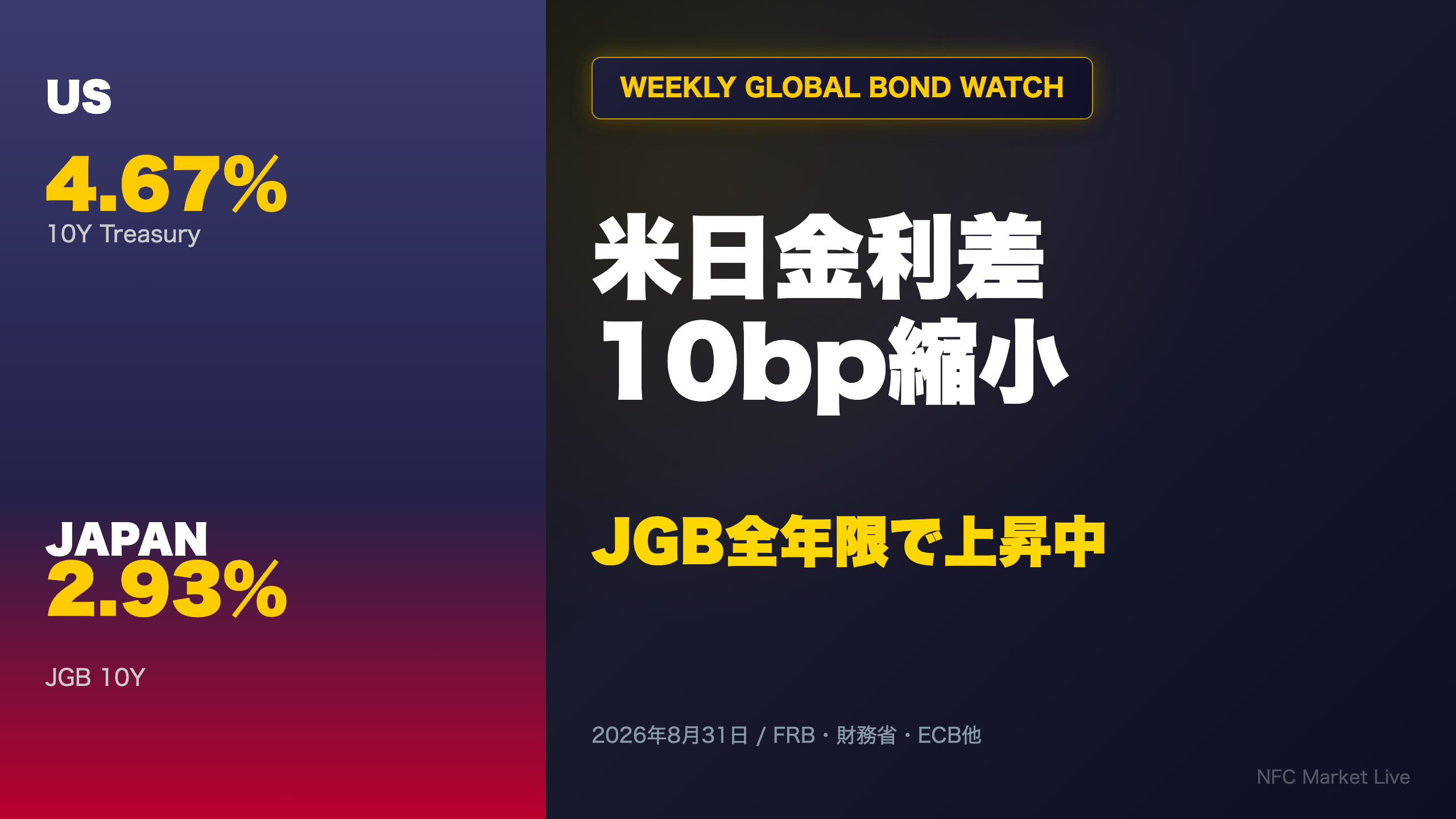
The US 10-year yield fell to 4.67%, while JGB yields rose across the 2Y, 10Y, and 30Y tenors.
💹 The US-Japan 10-year spread narrowed 10bp (1.84% → 1.74%), a key signal for yen carry trade dynamics.
📉 JGB auction bid-to-cover ratios softened across 2Y, 10Y, and 20Y tenors, with the 10Y tail widening to 6bp.
🇪🇺 European Bund and Gilt yields moved modestly, while OAT-Bund and BTP-Bund spreads tightened slightly.
⚠️ Full analysis includes NFC HMM regime cross-checks. Watch now.
グローバル金利スナップショット / Global Rate Snapshot
The Week’s Biggest Divergence
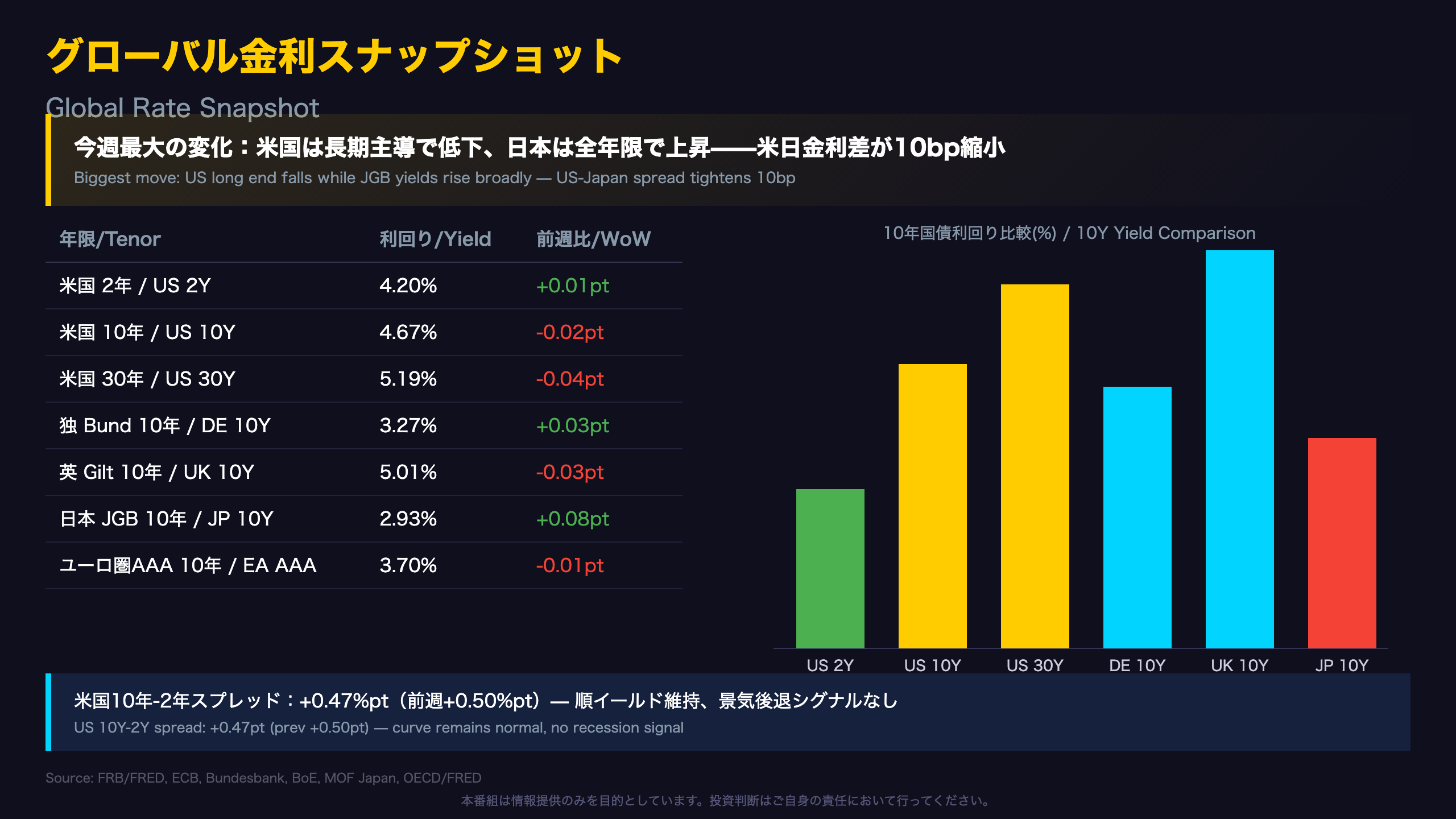
US and Japanese rates moved in opposite directions this week. Per Federal Reserve H.15 data (via FRED), the US 10-year yield eased from 4.69% to 4.67% (as of Aug 27, 2026), with the 30-year falling more sharply from 5.23% to 5.19%. Meanwhile, Japan’s Ministry of Finance daily data show JGB yields rising across the curve — the 10-year climbed from 2.85% to 2.93% (as of Aug 28, 2026), a notable 8bp weekly move.
Spread Dynamics
- US 10Y-2Y spread: +0.50pt → +0.47pt (3bp tighter)
- JGB 10Y-2Y spread: +1.17pt → +1.21pt (4bp wider)
- US-Japan 10Y spread: +1.84pt → +1.74pt (10bp tighter)
For US investors unfamiliar with JGBs: Japan’s government bond market has historically been anchored near zero by the Bank of Japan’s yield curve control legacy, so an 8bp weekly move in the 10-year is meaningful by JGB standards, even though it looks small next to Treasury volatility.
Market Implications
A narrowing US-Japan spread reduces the yield pickup investors earn holding dollar assets funded in yen, a dynamic directly relevant to USD/JPY carry positioning. That said, one week of divergence does not confirm a trend reversal — multiple weeks of confirmation would be needed before drawing structural conclusions.
米国債入札 Deep Dive / US Treasury Auction Deep Dive
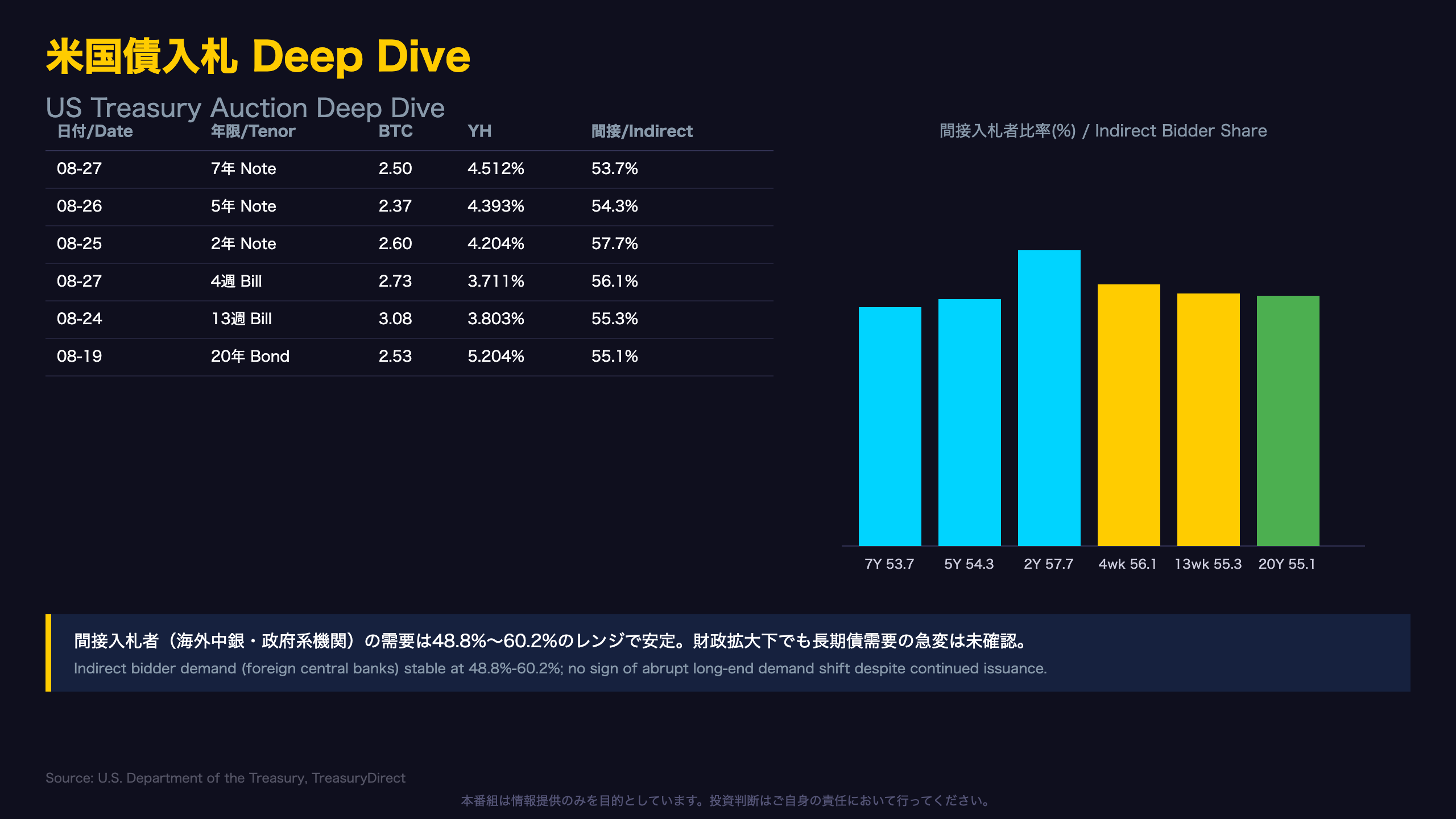
Deep Dive: Bills vs. Notes Demand Gap
Across the past three weeks, short-term bills (4-week, 13-week, 26-week, 52-week) posted bid-to-cover ratios of 2.71-3.08, notably firmer than coupon notes (2-, 5-, 7-year) at 2.37-2.60. This is a normal pattern — bills attract steady demand from money-market funds and institutions for liquidity and collateral purposes, so the gap is not itself a red flag.
What “Indirect Bidders” Tell Us
For readers unfamiliar with Treasury auction mechanics: “indirect bidders” are a proxy for foreign official and private demand, including foreign central banks purchasing through primary dealers. Over the last 12 auctions, this metric ranged from a low of 48.8% (13-week bill, Aug 17) to a high of 60.2% (26-week bill, Aug 25) — a fairly narrow and stable band by historical standards.
Fiscal Sustainability Angle
With the 4-week bill alone raising $100 billion and the 7-year note $44 billion, issuance volumes remain large. Yet there is no evidence in this data of a sudden demand air-pocket — bid-to-cover and indirect bidder shares held within normal ranges. Note that the current three-week window does not include a 10-year or 30-year auction, so a direct comparison to the prior week’s 10-year sale (Aug 12: BTC 2.53, indirect 61.0%) will require next week’s data.
Looking Ahead
The next 10-year and 30-year auctions will be the key test of whether long-end demand is holding at similarly stable levels.
ヨーロッパ債券市場 / European Bond Markets
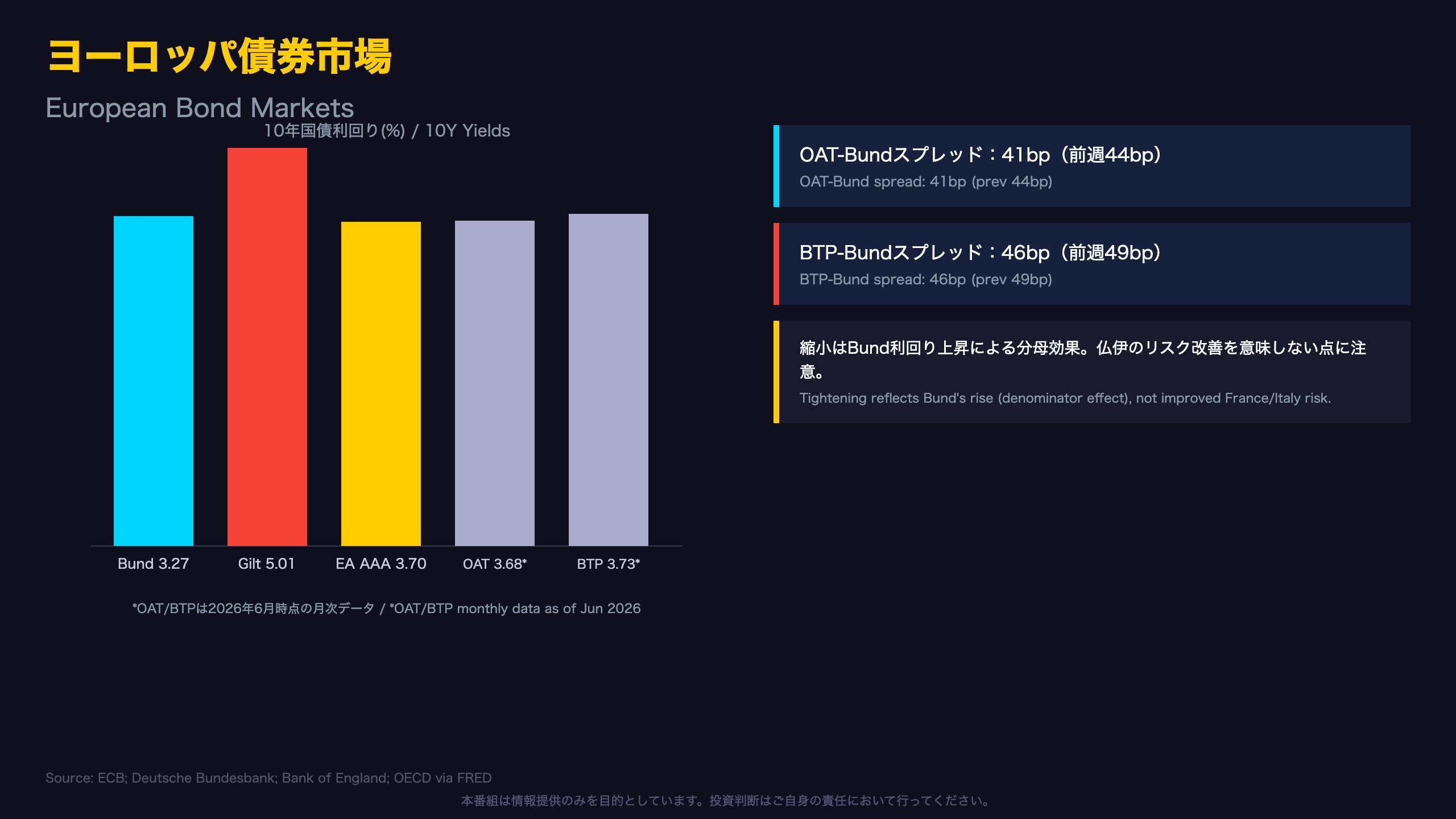
Reading Through the Monthly Lag
Both the OAT-Bund spread (44bp → 41bp) and BTP-Bund spread (49bp → 46bp) tightened 3bp this week — but this does not signal improving French or Italian credit conditions. France’s OAT (3.68%) and Italy’s BTP (3.73%) remain frozen at their June 2026 monthly readings; the entire spread move stems from the Bund yield rising in the denominator (3.24% → 3.27%).
Context for International Readers
Unlike the US Treasury market where daily data is standard, French OAT and Italian BTP yields in this dataset are sourced from OECD via FRED on a monthly basis, introducing up to a one-month lag. This matters for anyone using these spreads as a real-time barometer of eurozone political or fiscal risk — the current “tightening” is a statistical artifact of Bund movement, not fresh evidence about Paris or Rome.
Daily Data That Did Move
- Eurozone AAA composite 10Y: 3.71% → 3.70% (roughly flat)
- German Bund 10Y: 3.24% → 3.27% (+3bp)
- UK Gilt 10Y: 5.04% → 5.01% (-3bp), a partial reversal after last week’s sharper +10bp jump tied to broader reports of a global gilt sell-off
Market Implications
For EUR/USD watchers, the US-Germany 10-year spread narrowed slightly to 1.40pt from 1.45pt, driven mainly by the Bund’s rise rather than a shift in US yields. As with all cross-market spread analysis, one should avoid treating a single week’s move as a directional signal, particularly when key inputs are stale.
日本国債・日銀政策金利 / JGB & BOJ
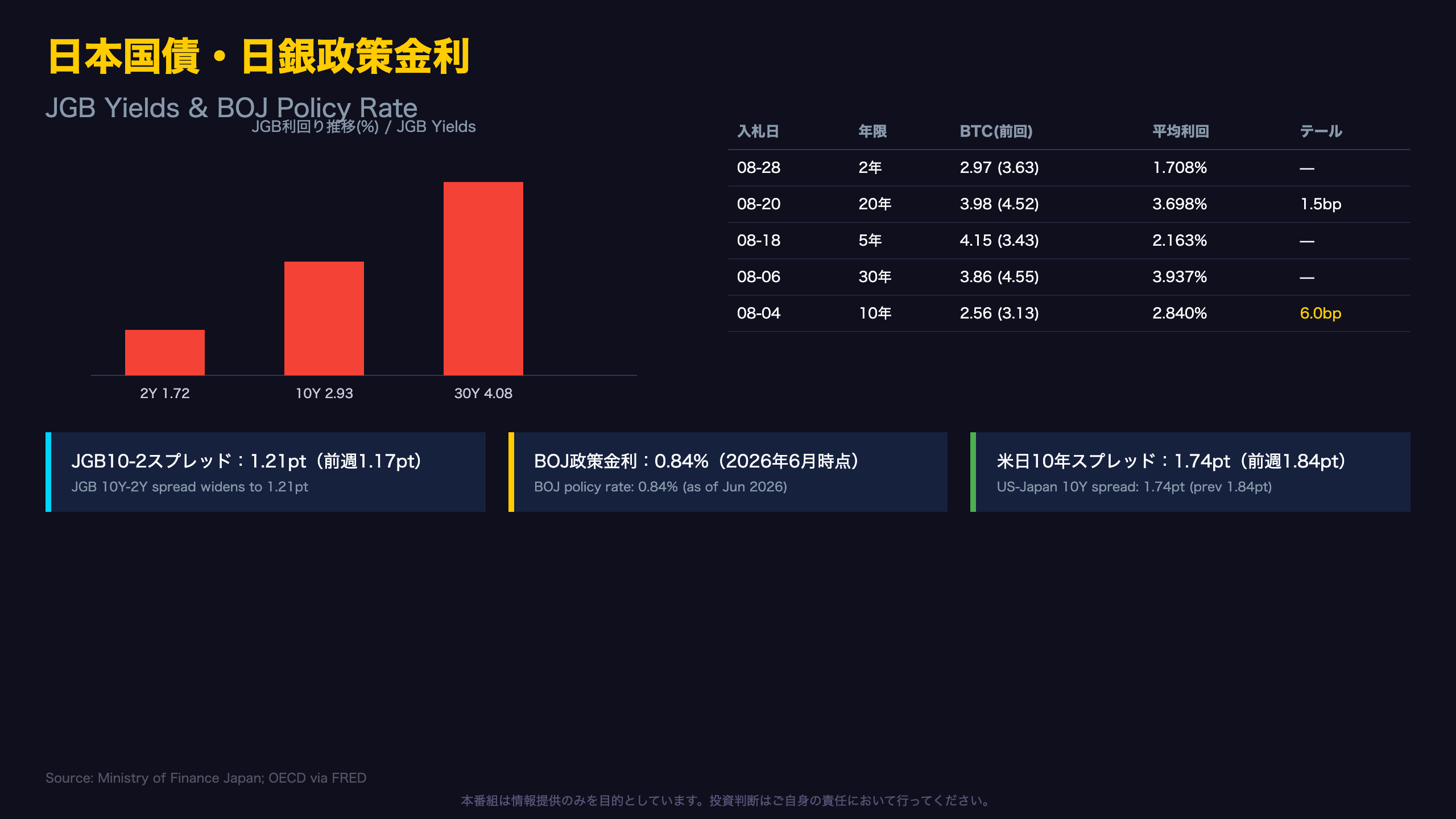
Auction Demand: A Mixed Picture Across Maturities
According to Japan’s Ministry of Finance data, recent benchmark auctions show:
| Auction Date | Tenor | BTC (prior) | Avg Yield | Tail |
|---|---|---|---|---|
| Aug 28 | 2Y | 2.97 (3.63) | 1.708% | — |
| Aug 20 | 20Y | 3.98 (4.52) | 3.698% | 1.5bp |
| Aug 18 | 5Y | 4.15 (3.43) | 2.163% | — |
| Aug 6 | 30Y | 3.86 (4.55) | 3.937% | — |
| Aug 4 | 10Y | 2.56 (3.13) | 2.840% | 6.0bp |
Four of five benchmark auctions saw bid-to-cover ratios decline from their prior rounds, with the 10-year tail more than doubling from 2.6bp to 6.0bp — a sign of wider dispersion among winning bids, often an early indicator of softening demand.
Context: What is the JGB Market?
For readers unfamiliar with Japan’s bond market: the Bank of Japan (BOJ) maintained a near-zero rate policy and yield curve control for years, making JGBs historically low-volatility compared to Treasuries. The BOJ’s policy rate stands at just 0.84% (as of June 2026, OECD data), a fraction of the Fed’s or ECB’s benchmark rates. Recent JGB yield increases therefore represent a meaningful shift for a market accustomed to suppressed volatility.
Comparing to the Fed and ECB
Unlike the Fed, which publishes explicit forward guidance after each FOMC meeting, the BOJ’s rate path is inferred largely from yield curve behavior. The widening JGB 10Y-2Y spread (1.17pt → 1.21pt) is one such signal, consistent with market expectations that the BOJ will continue gradually normalizing policy.
Market Implications
The US-Japan 10-year spread compression (1.84pt → 1.74pt) is partly a function of rising JGB yields. This modestly increases the relative appeal of yen-denominated assets versus dollar assets, though it remains one data point rather than a confirmed structural shift.
FX・CFDへの含意 / Trade Implications
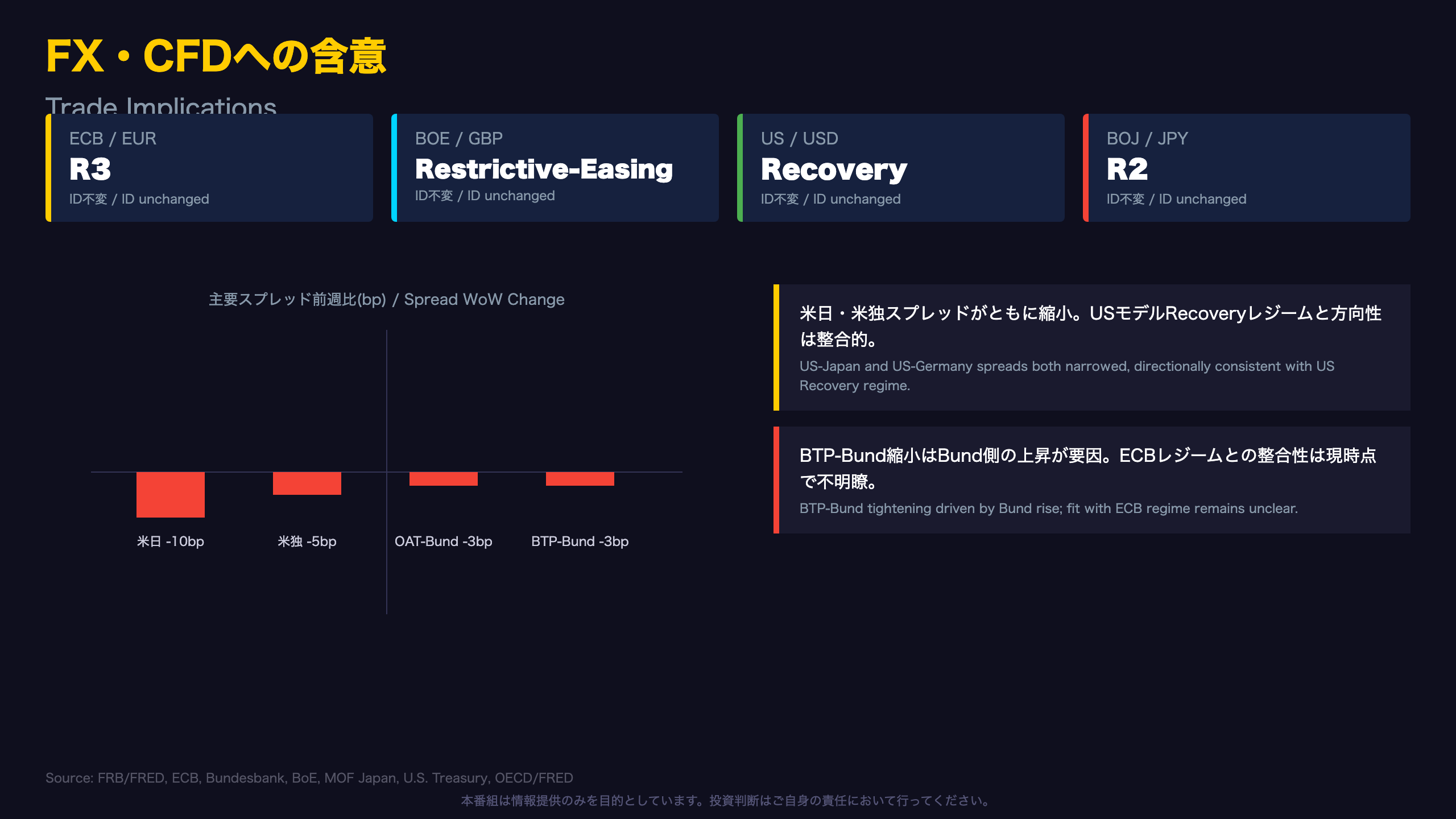
Cross-Checking HMM Regimes Against Yield Spreads
This week’s NFC HMM regime readings (regime IDs unchanged from last week):
| Model | Currency | Regime (This Week) | Regime (Last Week) | ID |
|---|---|---|---|---|
| ECB | EUR | R3 | Cost Pressure | 3 |
| BOE | GBP | Restrictive-Easing | R2 | 2 |
| US | USD | Recovery | R2 | 2 |
| BOJ | JPY | R2 | Hawkish | 2 |
For readers new to this framework: NFC’s Hidden Markov Model (HMM) system classifies each central bank’s policy stance into discrete statistical regimes based on rate and macro data patterns, distinct from the Fed’s or ECB’s own forward guidance language. All four regime IDs held steady week-over-week; only the descriptive labels changed, indicating regime continuity rather than a fresh policy shift.
Matching Spreads to Regimes
- US-Germany spread (1.45pt → 1.40pt): consistent with the US model’s Recovery regime, reflecting a gradual softening in dollar yields relative to German Bunds.
- BTP-Bund spread (49bp → 46bp): the ECB model remains in Regime 3. Since this tightening is largely a denominator effect from the Bund’s rise rather than fresh Italian risk repricing, the read-through to the ECB regime is inconclusive this week.
- Rising JGB yields: align with the BOJ model’s continued Regime 2, consistent with a gradual policy normalization narrative rather than an abrupt hawkish pivot.
A Note of Caution for International Investors
The BOE’s label shift to “Restrictive-Easing” could suggest an emerging transition from tight to easier policy expectations, yet the Gilt yield itself only eased 3bp this week — a modest move relative to the label change. Whether this labeling update is a leading indicator or simply a taxonomy refinement will become clearer with further data.
Bottom Line for FX/CFD Traders
Narrowing US-Japan and US-Germany spreads are generally consistent with reduced yield-based support for the dollar versus yen and euro, though this reflects a directional tendency rather than a forecast. The next Global Bond Watch Weekly, ahead of September’s major central bank meetings, will be key to confirming whether these regime and spread dynamics persist.
Disclaimer: This article is for informational purposes only. All investment decisions are made solely at your own risk.