📺 Watch the Full Video Analysis
This article was automatically generated by the NFC Market Live AI analysis system. (Updated: 2026-10-28 16:21 JST)
📄 Primary Source
Statistics Norway
https://www.ssb.no/en/bank-og-finansmarked/finansielle-indikatorer/statistikk/pengemengde
📊 Statistics Norway’s September monetary aggregates, released on October 28.
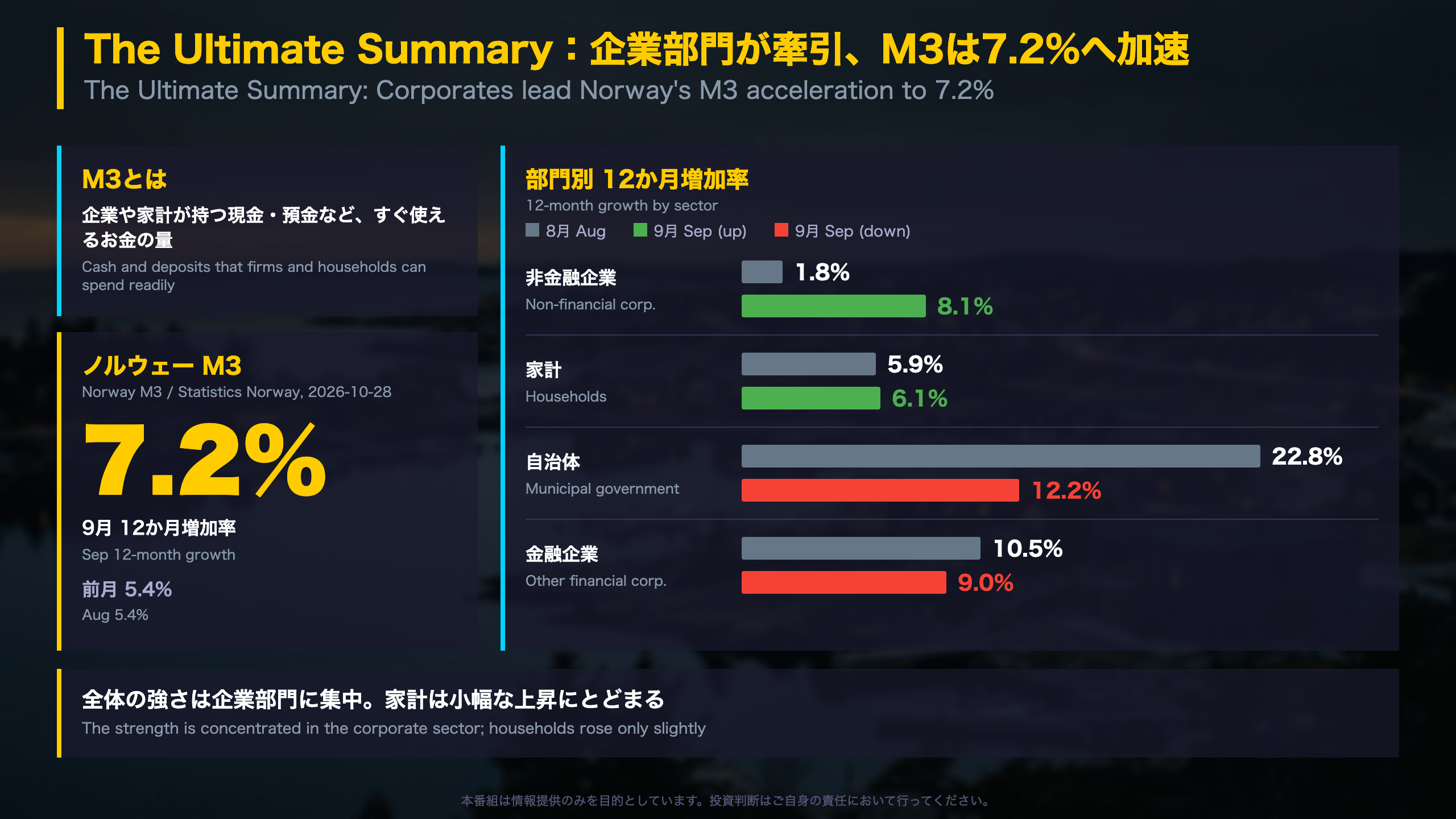
📈 M3 twelve-month growth accelerated to 7.2% from 5.4% in August, with non-financial corporations jumping from 1.8% to 8.1%.
⚖️ Households edged up only slightly (5.9% to 6.1%), while municipal (22.8% to 12.2%) and other financial corporations (10.5% to 9.0%) slowed.
💡 The strength is concentrated in the corporate sector; the release gives no explanation, and it is a single month.
📅 Next release: November 24 (October data).
The Ultimate Summary:企業部門が牽引、M3は7.2%へ加速
Norway’s M3 in context
Statistics Norway (SSB), the national statistics office, published the September monetary aggregates on 28 October 2026. M3 is broad money: currency, transaction and other deposits, plus marketable instruments issued by banks and mortgage companies, such as repurchase agreements and debt securities with an original maturity of up to two years. SSB states the statistics serve as a basis for monetary policy; Norges Bank, the central bank, is among the main users.
The five-month picture
| May | Jun | Jul | Aug | Sep | |
|---|---|---|---|---|---|
| M3 growth, 12-month (%) | 7.1 | 6.9 | 5.9 | 5.4 | 7.2 |
Growth slowed from May through August and then reversed in September. August was identical in the previous and current releases, so no visible revision.
International comparison
The ECB publishes euro area M3 and the US Federal Reserve focuses on M2, so the definitions are not interchangeable. SSB’s growth rates are transaction-based: they are adjusted for exchange-rate valuation changes and series breaks, which makes them a cleaner read of underlying flows than simple stock changes.
How to read this release
The headline acceleration is real in the data, but the composition matters more than the total: the jump came from non-financial corporations, not households. The release contains no policy guidance and no explanation of sector moves, and the figures are preliminary. The next release, covering October, is due on 24 November 2026.
深掘り1:非金融企業が1か月で急加速
Non-financial corporations: from four months of slowing to a sharp reversal
Non-financial corporations are the businesses outside the financial sector, such as manufacturers, retailers and service firms. Their M3 holdings, which include cash, deposits and short-dated bank-issued instruments, grew at the following twelve-month rates:
| May | Jun | Jul | Aug | Sep | |
|---|---|---|---|---|---|
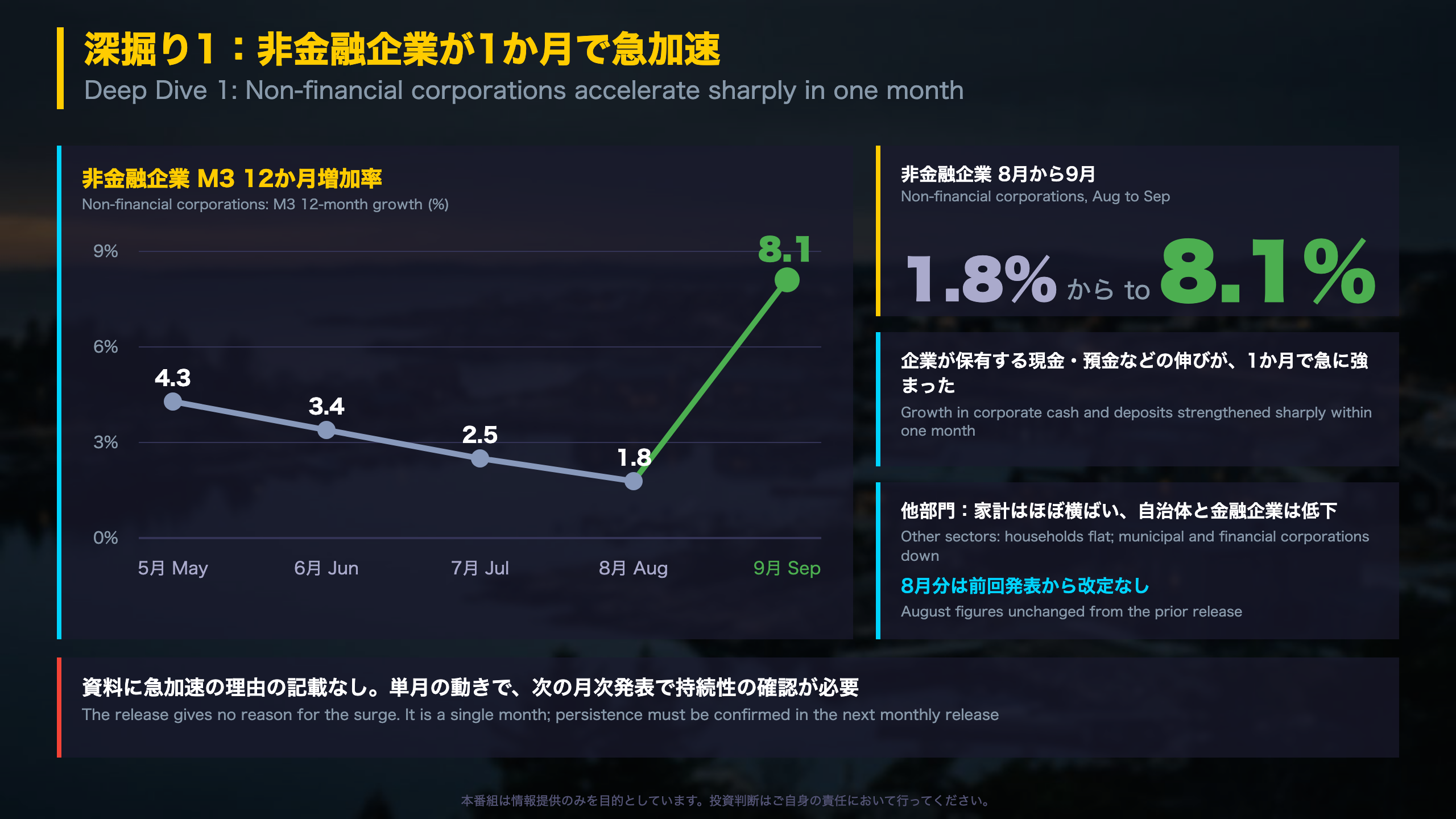
| Non-financial corp. (%) | 4.3 | 3.4 | 2.5 | 1.8 | 8.1 |
Growth fell in each month from May to August, then jumped to 8.1% in September, the highest reading in this window and above the 7.2% for the economy-wide M3.
Methodology matters
SSB says growth rates are adjusted for exchange-rate valuation changes and non-transactional breaks. That makes it less likely that the jump is a pure currency-valuation effect, although the release does not break down the drivers.
Two readings
- Constructive: corporate liquidity growth improved sharply and led the aggregate higher.
- Cautious: August was unusually low at 1.8%, so a rebound effect is possible; this is a single, preliminary data point.
What to watch
The October data, due 24 November 2026, will show whether corporate growth stays near 8% or falls back toward the 1.8% to 3.4% range seen from June to August. For context, comparable corporate deposit data in other economies are often read alongside credit and investment data; this release stands alone and offers no explanation of its own.
深掘り2:企業以外の部門と、振れの大きい自治体
Households, municipalities and financial corporations
| Sector (%) | May | Jun | Jul | Aug | Sep |
|---|---|---|---|---|---|
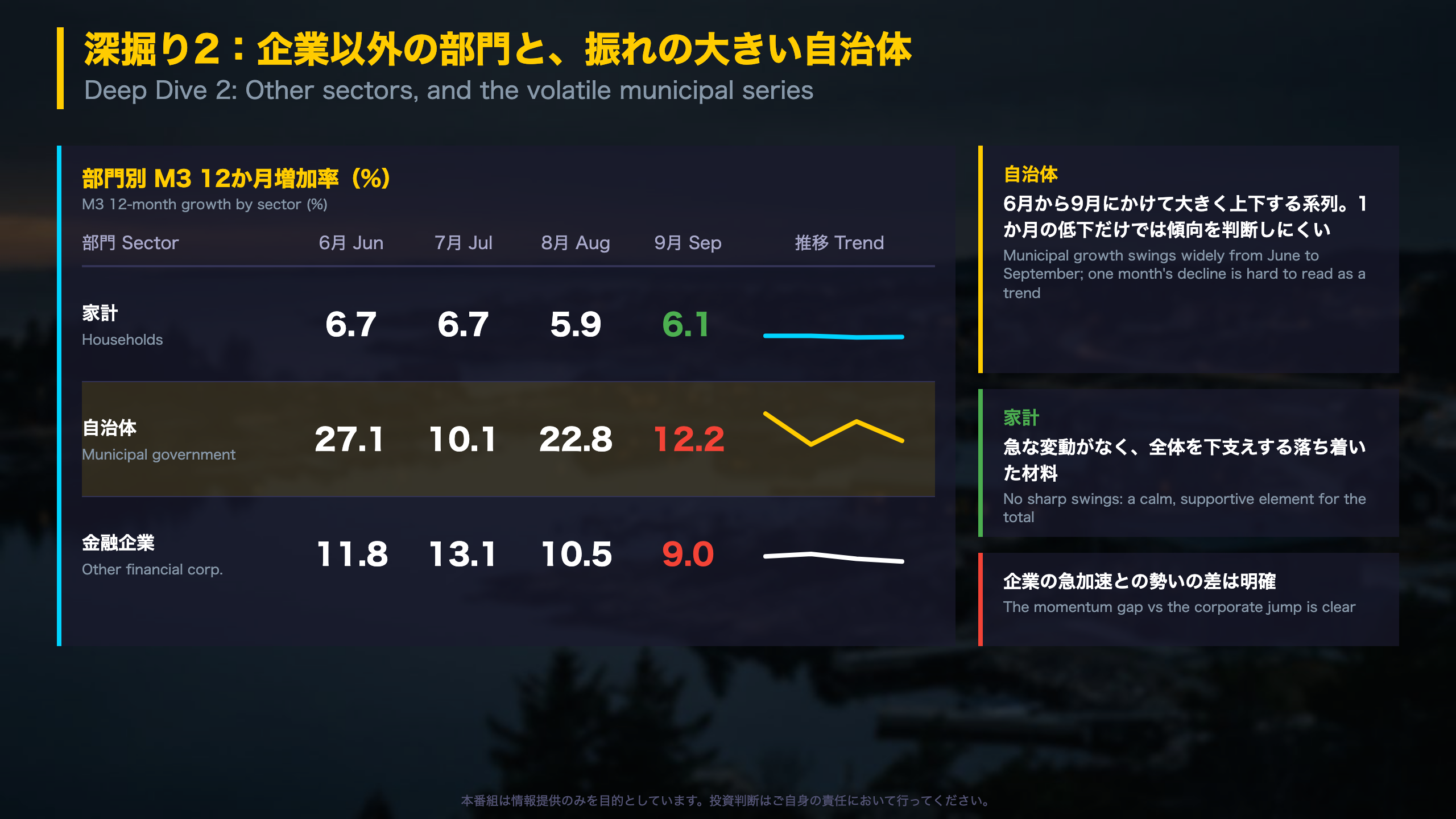
| Households etc. | 7.2 | 6.7 | 6.7 | 5.9 | 6.1 |
| Municipal government | 20.8 | 27.1 | 10.1 | 22.8 | 12.2 |
| Other financial corp. | 11.3 | 11.8 | 13.1 | 10.5 | 9.0 |
Sector by sector
- Households: slowed from 7.2% in May to 5.9% in August and ticked up to 6.1% in September. The narrow range shows a steady series.
- Municipal government: swings between 10.1% and 27.1%. The release does not give sector weights, so its contribution to the total M3 cannot be judged here. Treat single-month moves with caution.
- Other financial corporations: non-bank financial firms (those outside the money-issuing sector of the central bank, banks and mortgage companies). Growth peaked at 13.1% in July and slowed to 10.5% and then 9.0%, though it remains above the 7.2% headline.
Definitions
The money-holding sector covers households, non-profit organisations, non-financial corporations, municipalities and financial corporations other than monetary financial institutions. SSB seasonally adjusts each sector separately and sums them to the M3 total.
Balanced reading
The stability of household growth is a calm element in the picture, but its level is lower than in May and the momentum gap versus the corporate jump is clear. The release offers no causal explanation for any sector’s move. The next release is due 24 November 2026.
質疑で深める:この加速は強いと言えるのか
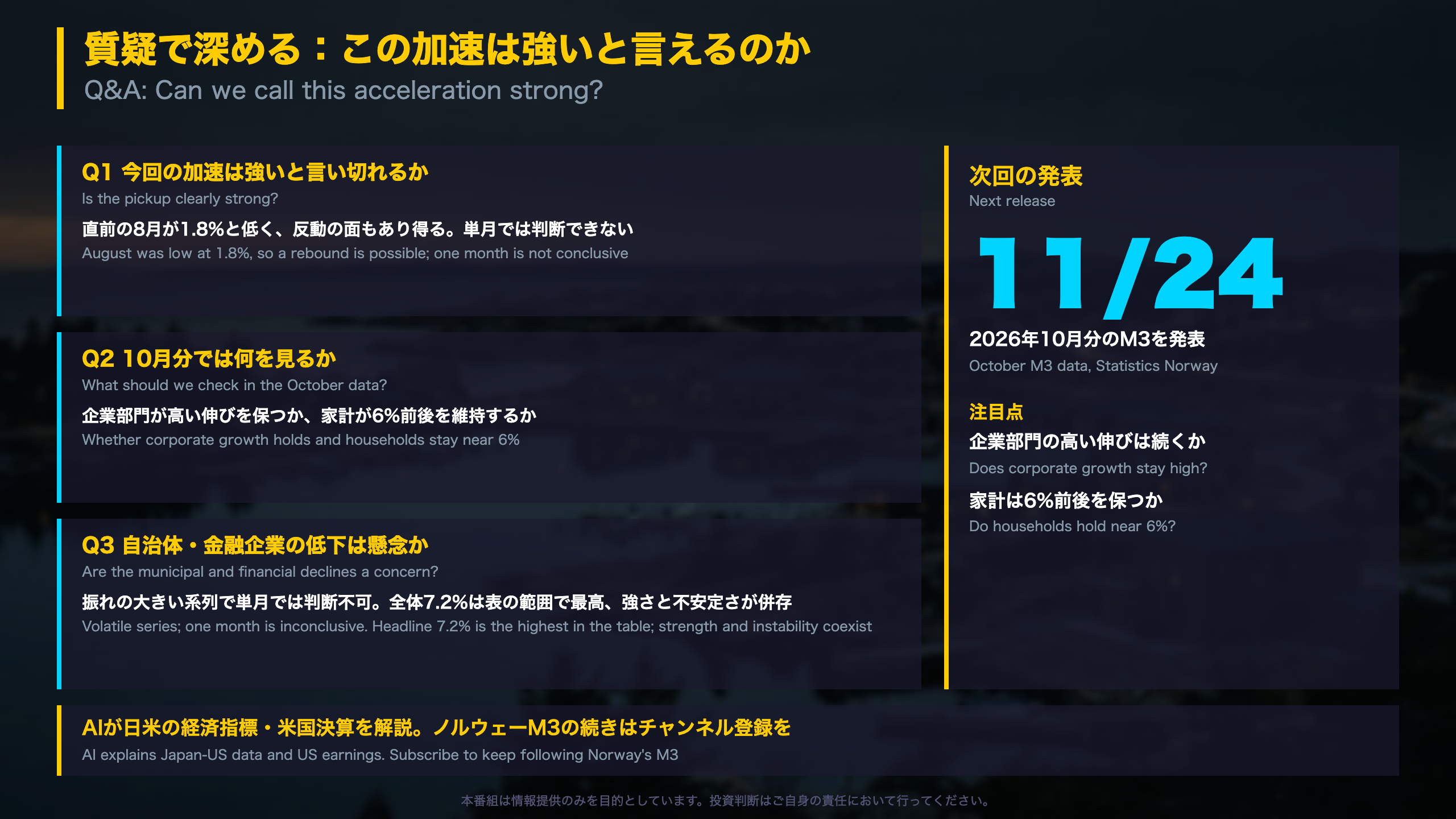
Q&A addendum: data limits and what to check next
How the statistics are updated
SSB publishes M3 roughly 22 days after the reference month. Its stated editing policy is to publish corrections to the previous month together with the current month’s data. Stock series for the latest 25 periods and transaction and growth series for the latest 13 periods are updated at each release. The data are a full census with a 100% response rate, yet the published figures are explicitly preliminary.
Reference levels for the next release
| Item | Current | Reference points |
|---|---|---|
| Non-financial corp. | 8.1% | Jun-Aug: 3.4%, 2.5%, 1.8% |
| Households | 6.1% | Aug 5.9%, May 7.2% |
| Total M3 | 7.2% | Aug 5.4%, May 7.1% |
Whether October shows corporate growth holding near 8% or returning to the June to August range will determine how September is ultimately read.
Balancing the evidence
- Supportive: the headline is the highest in five months, households are stable, and corporate growth rebounded sharply.
- Cautionary: the corporate surge is unexplained and based on one month, municipal and financial growth slowed, and the figures are preliminary.
For international readers: unlike a central bank statement, this release carries no policy guidance. SSB describes monetary aggregates as a basis for monetary policy, but interpretation is left to users. The next release is due on 24 November 2026.
Disclaimer: This article is for informational purposes only. All investment decisions are made solely at your own risk.