📺 Watch the Full Video Analysis
This article was automatically generated by the NFC Market Live AI analysis system. (Updated: 2026-09-16 15:10 JST)
📄 Primary Source
Office for National Statistics
https://www.ons.gov.uk/economy/inflationandpriceindices/bulletins/consumerpriceinflation/august2026
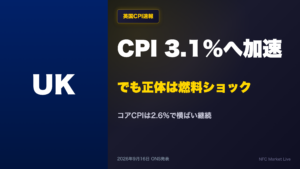
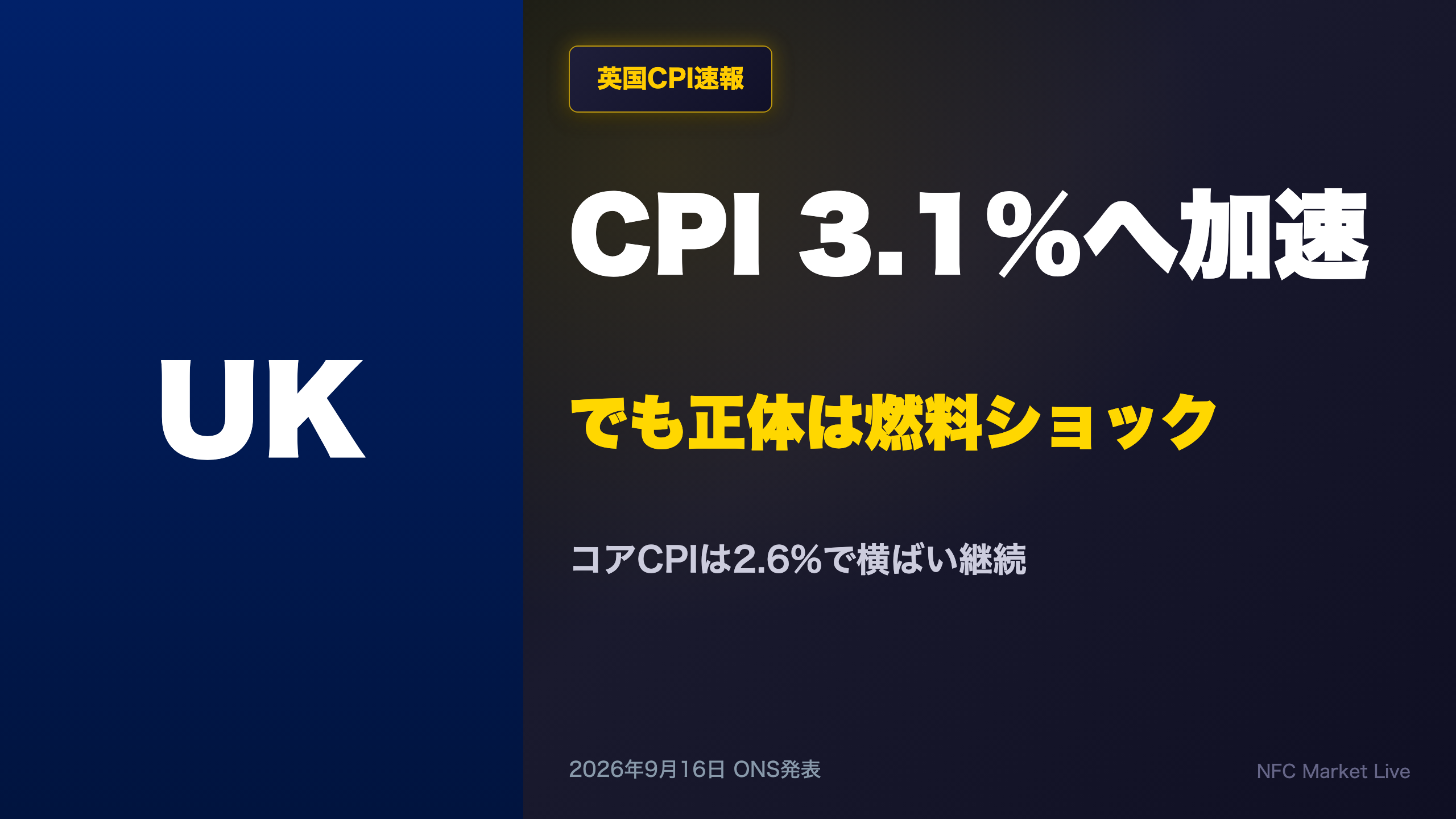
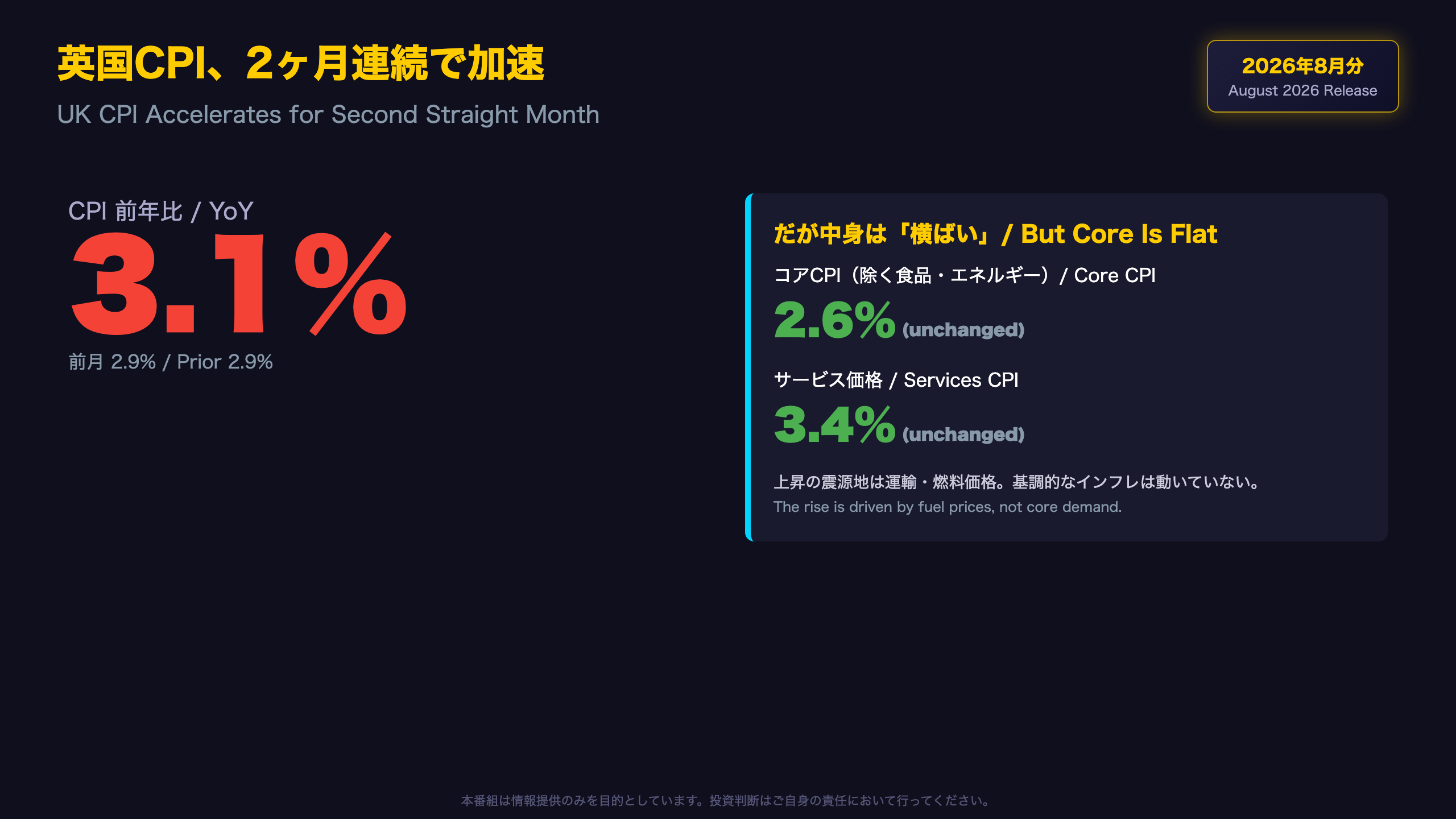
📊 UK CPI accelerated to +3.1% YoY in August 2026, up from +2.9% in July — a second straight monthly rise.
⚠️ But the driver is a fuel shock: petrol and diesel prices surged. Transport inflation jumped from 3.6% to 4.6%, and motor fuel inflation hit +23.0% YoY.
📈 Meanwhile core CPI held at +2.6% and services inflation stayed flat at +3.4%. Underlying price pressure did NOT accelerate.
💡 The Bank of England had pre-release access to this data ahead of its Sep 14 MPC meeting. The headline-core divergence is now the key focus for GBP and UK gilts.
英国CPI、2ヶ月連続で加速 / UK CPI Accelerates for Second Month
Headline vs. Core: A Critical Divergence
For international readers unfamiliar with UK inflation metrics: the CPI (Consumer Prices Index) is the Bank of England’s (BOE) official target measure, harmonized with EU methodology for cross-country comparison. The CPIH is the ONS’s broader preferred measure, adding owner-occupied housing costs and Council Tax — costs the CPI excludes.
August’s CPI print of 3.1% (up from 2.9%) marks the second consecutive monthly acceleration, reversing a downtrend that began after March’s local peak of 3.3%. This keeps UK inflation more than 50% above the BOE’s 2% target.
Why this matters for global investors: Unlike US CPI, which the Fed watches alongside PCE, the UK’s CPI is the sole statutory target metric for the BOE’s Monetary Policy Committee (MPC). A sustained overshoot has direct policy consequences.
However, core CPI (excluding energy, food, alcohol, tobacco) held flat at 2.6%, and services inflation was unchanged at 3.4%. This decoupling — headline rising, core flat — is the central tension for GBP and gilt markets this month, echoing patterns seen when energy shocks temporarily distort headline readings without broad-based demand-pull inflation.
震源地は運輸部門、燃料価格が急騰 / Epicenter: Transport & Fuel
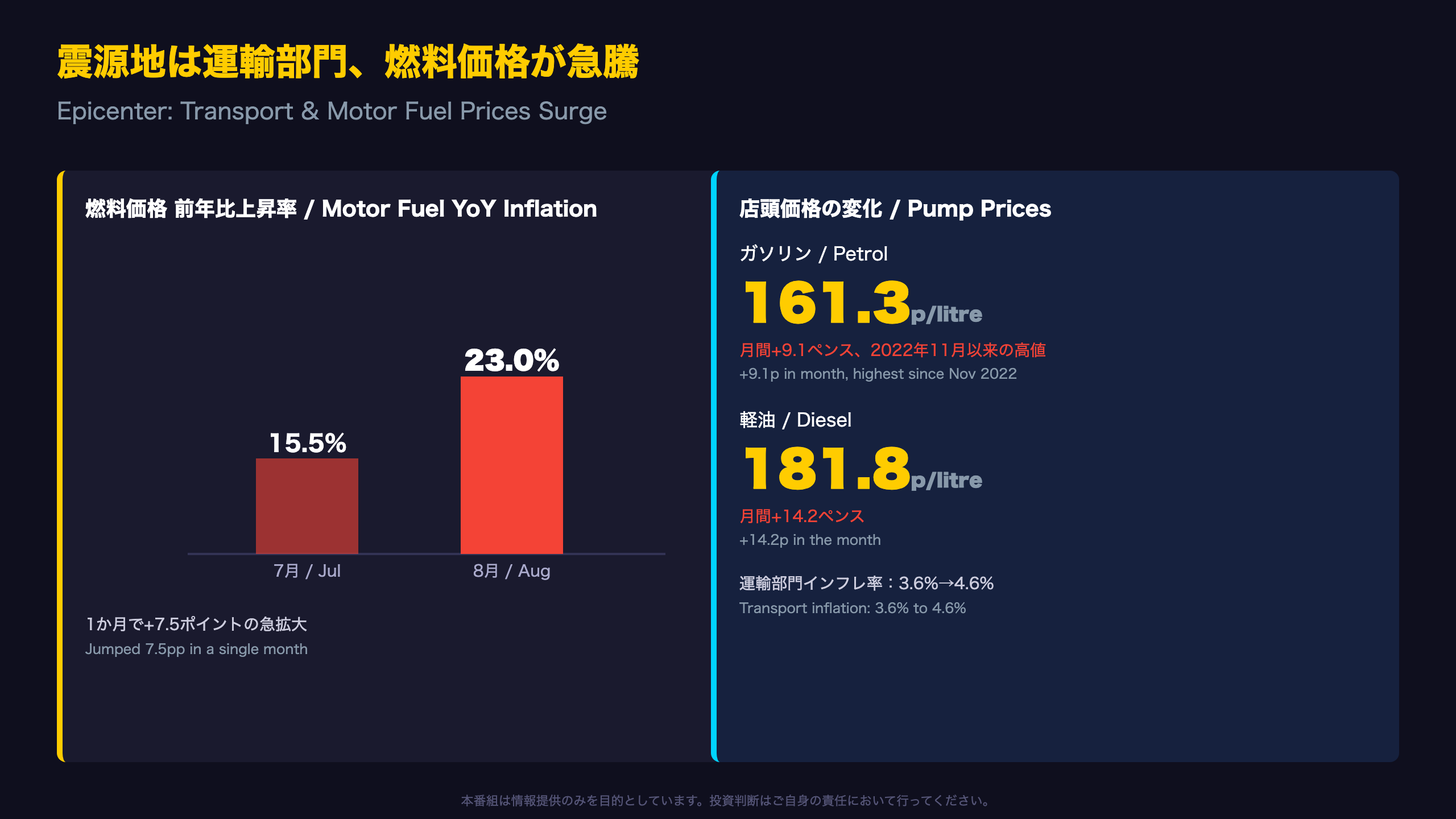
Fuel Shock: Connecting the Dots to Middle East Tensions
The UK imports a significant share of refined petroleum products, making pump prices highly sensitive to global crude benchmarks and shipping-route disruptions. The ONS bulletin explicitly names motor fuels as the single largest contributor to August’s acceleration.
Why the magnitude matters: Petrol’s move to 161.3 pence per litre is the highest since November 2022 — a level last seen during the peak of the European energy crisis following Russia’s invasion of Ukraine. The report notes petrol rose 9.1p in the month versus just 0.3p a year earlier, an asymmetry signaling an external shock rather than routine seasonal drift.
International parallel: This mirrors US CPI gasoline components during 2022, where energy-driven headline spikes did not necessarily track core PCE. Traders watching sterling and UK gilts should note that fuel-driven CPI prints are typically viewed by central banks as “supply shocks” with limited direct policy leverage — unless second-round effects into wages emerge.
Bear case: Persistent Middle East disruption could keep fuel costs elevated, feeding into freight and food distribution costs.
Bull case: Fuel demand is historically elastic; diesel prices have shown month-on-month declines before, suggesting the August spike could partially reverse.
財は加速、サービスは横ばい / Goods Accelerate, Services Flat
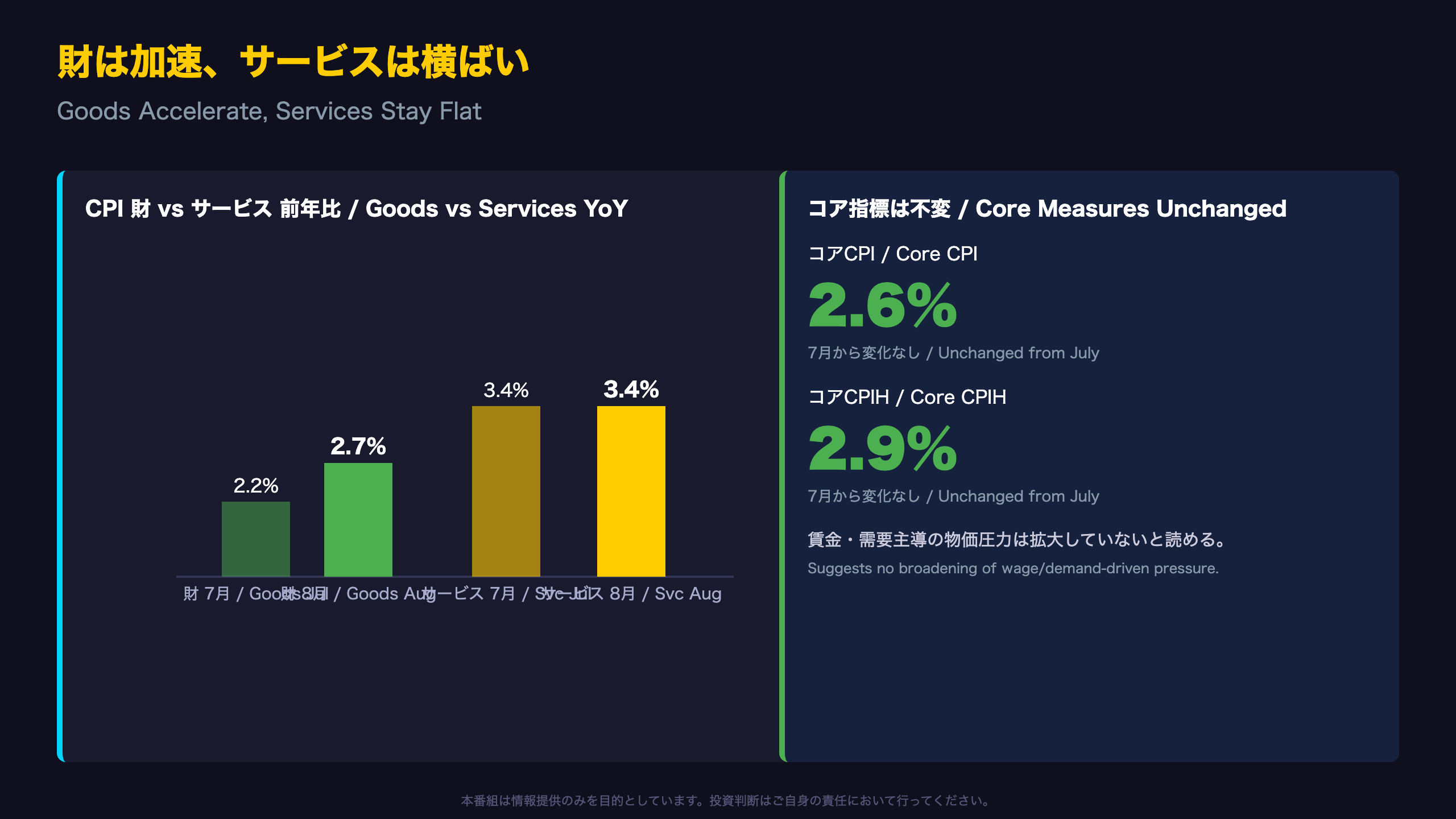
What Flat Core Tells Us About Wage-Price Dynamics
Services CPI is often treated by central banks as the best proxy for domestically-generated, wage-driven inflation, since services are labor-intensive (hospitality, leisure, professional services). This month, UK services CPI held exactly at 3.4%, identical to July — a signal that wage-cost pass-through into prices has not intensified.
Context for international readers: This mirrors how the US Federal Reserve watches “supercore” services inflation as a wage-pressure gauge, or how the ECB tracks services HICP for second-round effects. In the UK’s case, a flat services reading alongside a rising headline print is analytically significant — it isolates the source of inflation to goods/energy rather than the labor market.
Goods inflation, meanwhile, rose from 2.2% to 2.7%, the highest since September 2025 — largely a mechanical reflection of the fuel shock discussed in the prior segment.
Bull case: No visible wage-price spiral; the BOE may have room to look through the headline uptick.
Bear case: If elevated goods/fuel costs persist for several more months, businesses may eventually pass costs into service pricing, delaying disinflation.
住宅コスト、16か月ぶりの反転 / Housing Costs Reverse
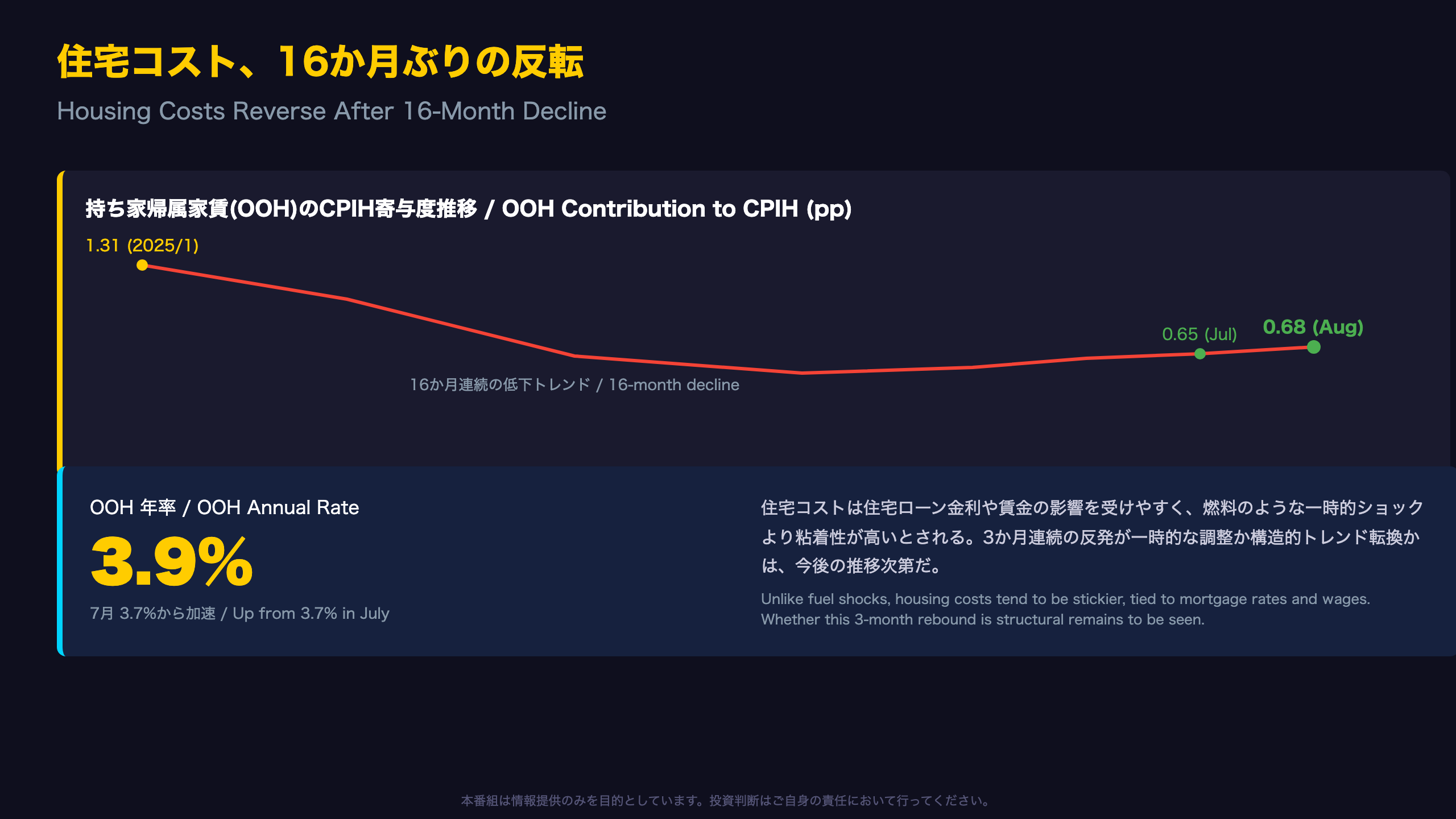
Is the OOH Reversal Temporary or Structural?
Owner-occupiers’ housing (OOH) costs are a unique UK statistical construct: an imputed value representing the housing services owner-occupiers “consume” by living in a home they own, even though no rent is actually paid. This concept — absent from the headline CPI used for the BOE’s target — makes up roughly 18% of CPIH, the ONS’s preferred broader measure.
International comparison: This is conceptually similar to the US Bureau of Labor Statistics’ “owners’ equivalent rent” (OER) within CPI, likewise a major driver of divergence between different US inflation measures.
OOH’s contribution to CPIH peaked at 1.31 percentage points in January 2025, then fell for 16 consecutive months as earlier rate cuts fed through. August marked the third consecutive monthly rise, reaching 0.68 points.
Structural risk case: A renewed uptick in mortgage rates or a tightening rental market could keep pushing OOH costs higher, providing a persistent floor under CPIH even as fuel effects fade.
Noise case: Three months of increases remains a small sample; this could still be within normal month-to-month volatility rather than a genuine trend reversal.
Because OOH explains most of the gap between CPI and CPIH, its trajectory is a key variable for anyone tracking the divergence between the BOE’s target measure and the ONS’s preferred gauge.
国際比較とBOEの分岐点 / International Comparison & BOE’s Dilemma
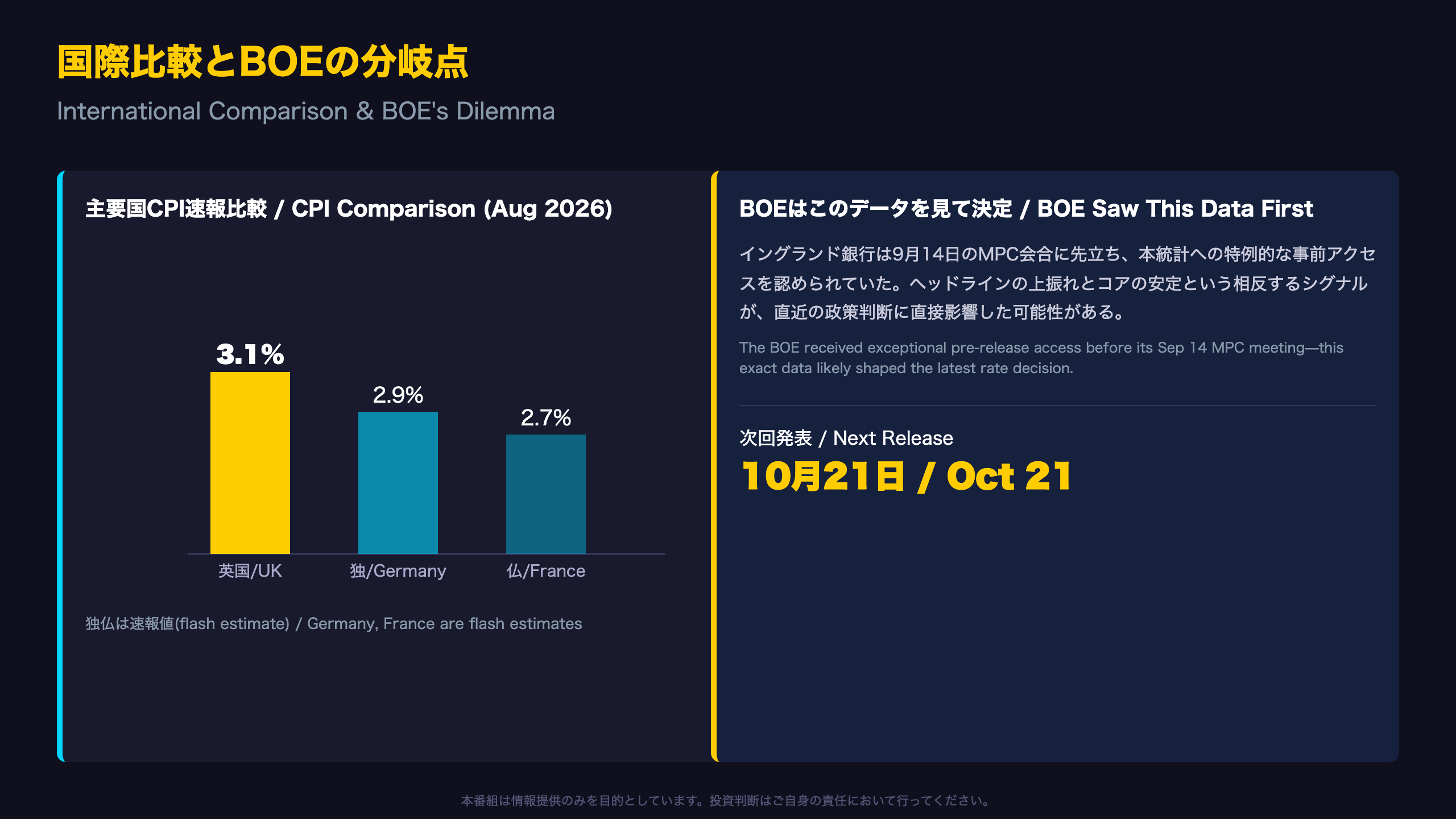
Pre-Release Access: A Direct Line to Policy
An overlooked institutional detail matters here: the Bank of England was granted exceptional pre-release access to this exact CPI estimate at 10:00am on Monday, September 14, 2026 — hours before that day’s Monetary Policy Committee (MPC) meeting.
This is a formal arrangement under UK statistical governance, distinct from how the US Federal Reserve receives CPI data (published simultaneously to all market participants by the Bureau of Labor Statistics, with no special pre-release access). It means the “accelerating headline, flat core” pattern discussed in this report was not merely retrospective commentary — it was literally the dataset the MPC used in its most recent rate decision.
International comparison: UK’s 3.1% CPI now runs hotter than the flash estimates for France (2.7%) and Germany (2.9%), though these Eurozone figures are provisional; the final harmonized HICP data, including the EU27 aggregate, was due September 17.
What to watch next: The October 21 release will be pivotal for two reasons: (1) whether the fuel-driven spike in motor prices begins to fade, given fuel’s historical price elasticity, and (2) whether OOH and services inflation extend their recent firming, which would suggest the disinflation process has genuinely stalled rather than being distorted by a one-off shock.
Disclaimer: This article is for informational purposes only. All investment decisions are made solely at your own risk.