📺 Watch the Full Video Analysis
This article was automatically generated by the NFC Market Live AI analysis system. (Updated: 2026-09-16 15:08 JST)
📄 Primary Source
Banque de France
https://www.banque-france.fr/fr/publications-et-statistiques/publications/enquete-mensuelle-de-conjoncture-debut-septembre-2026
Deep dive into the Banque de France’s September monthly business survey.
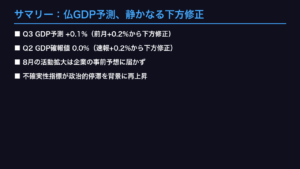
📊 Q3 GDP forecast cut to +0.1% from +0.2%
📉 Q2 GDP finalized at 0.0%, down from preliminary +0.2%
🏭 August industrial activity improved but missed firms’ own expectations
⚠️ Uncertainty indicator ticked up on political stagnation and e-invoicing reform concerns
💶 Price pass-through continues to slow, supporting the case for continued ECB easing
We break down what this means for EUR/JPY and the BOJ-ECB rate differential from a Japanese investor’s perspective.
サマリー:仏GDP予測、静かなる下方修正
Two Consecutive Downward Revisions to French GDP
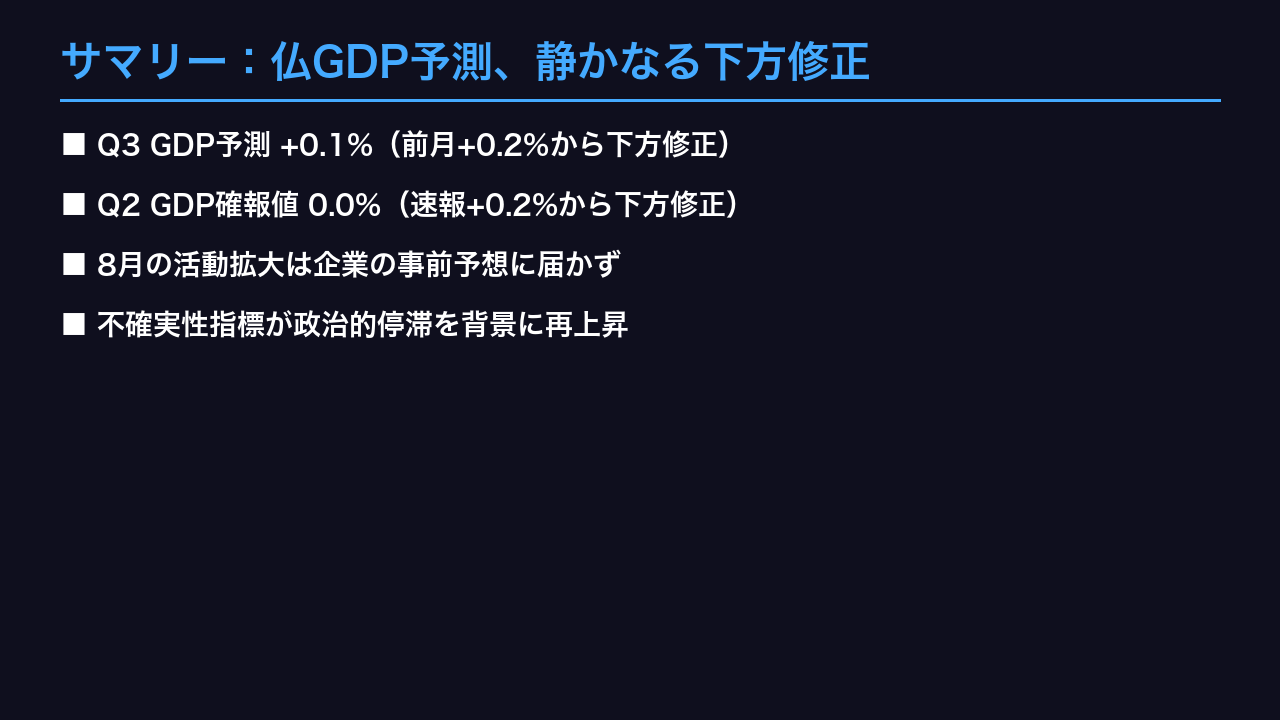
The Banque de France’s Q3 GDP estimate was cut to +0.1% from +0.2% in the prior month’s survey. This follows INSEE’s downward revision of Q2 GDP from a preliminary +0.2% to a final 0.0%—meaning France has now seen two consecutive quarters where growth estimates moved lower rather than higher.
The report states plainly: “we estimate that GDP would grow by around 0.1% in the third quarter.”
Quantifying the Heatwave Drag
Notably, the Banque de France explicitly quantifies the economic cost of summer heatwaves—estimating a drag of roughly 0.05 percentage points on Q3 GDP (excluding agriculture) and -0.1 point on full-year 2026 growth. This is a rare instance of a central bank survey converting weather disruption into a specific growth-accounting figure, useful context for readers unfamiliar with how French institutions incorporate climate shocks into official forecasting.
The Case for Resilience
On the other hand, the industrial activity balance improved to +5 points in August from +2 in July, and firms expect further acceleration in September. If the anticipated catch-up from summer disruptions materializes, the downgrade could prove temporary rather than structural.
Why This Matters for International Readers
Unlike the US ISM or Germany’s ifo Business Climate Index, the Banque de France survey directly feeds the Eurosystem’s macroeconomic assessment, making it a closely watched precursor to ECB staff projections. A slowdown in the eurozone’s second-largest economy adds to the broader case for continued ECB accommodation, though the bank itself has not signaled this explicitly.
The next monthly survey is due in October. Watch whether September’s expected acceleration materializes and whether the heatwave drag proves transitory.
8月の実績:産業・サービス・建設
A Modest but Notable Dip in Capacity Utilization
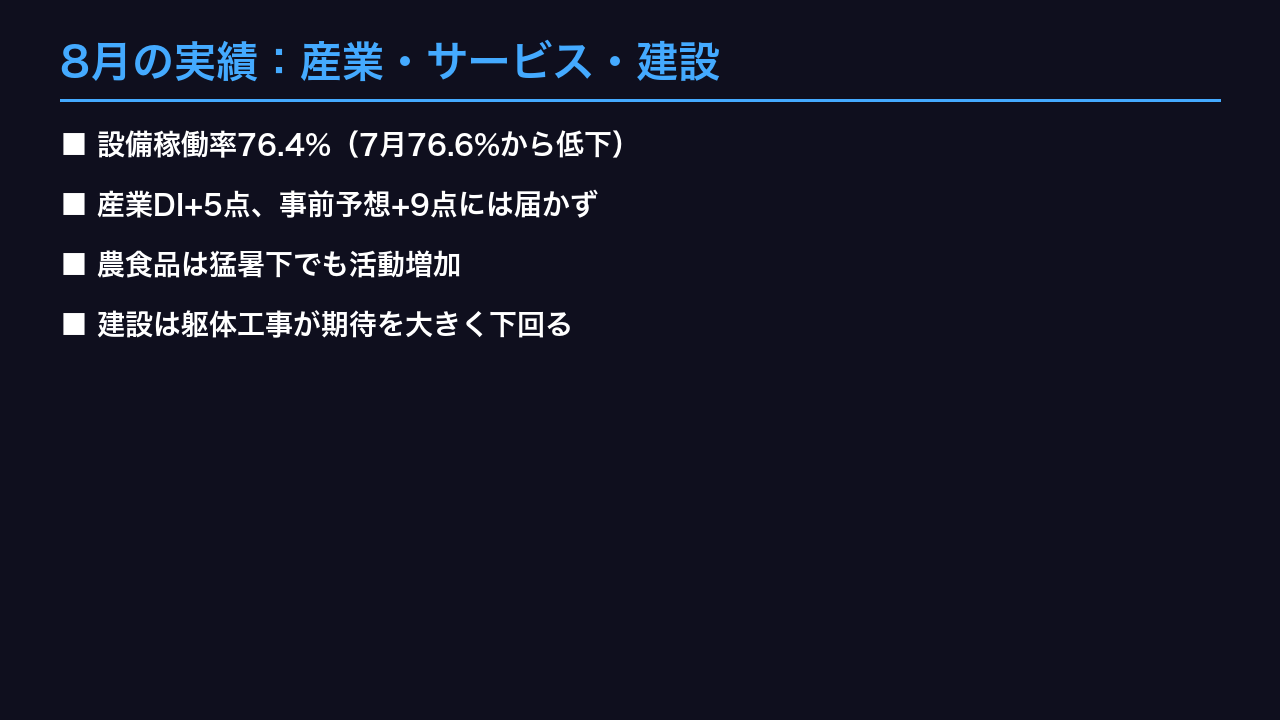
The capacity utilization rate (TUC) edged down to 76.4%. The report attributes this specifically to “wood-paper-printing and other manufacturing”—suggesting a sector-specific issue rather than broad-based demand weakness (interpretive level: single-indicator caution warranted).
Inventories remain “stable, still above normal levels.” Non-metallic minerals, aerospace, and metallurgy saw stock declines, while computer/electronics/optics and electrical equipment saw builds. For electrical equipment, the report notes this reflects “a rebuilding process after July’s significant destocking”—implying timing mismatches between production and shipment rather than genuine demand softness.
Sector Divergence Worth Noting
The original text states: “despite input price tensions linked to heatwaves, overall activity in the agri-food sector is progressing.” This is a useful counterpoint to any narrative that heatwaves are uniformly negative for output—agri-food actually benefited from demand for ready-to-eat, no-cook summer products. By contrast, chemicals, other manufacturing, and wood-paper-printing all declined, showing that weather effects are highly sector-specific rather than economy-wide.
Construction’s Two-Speed Story
In construction, core building work (gros œuvre) fell well short of expectations, while renovation-related work (second œuvre)—air conditioning and heat protection installations—continued to provide support, particularly in public buildings.
What to Watch Next
For investors benchmarking against eurozone peers, France’s TUC of 76.4% compares with historically tighter German capacity utilization readings in some cycles, though direct comparison requires care given differing survey methodologies. The next release will clarify whether the utilization dip is a one-off adjustment or an early signal of structural demand softening.
9月の見通し:加速期待と経営者の慎重論
An Unusual Admission: “Harder to Forecast”
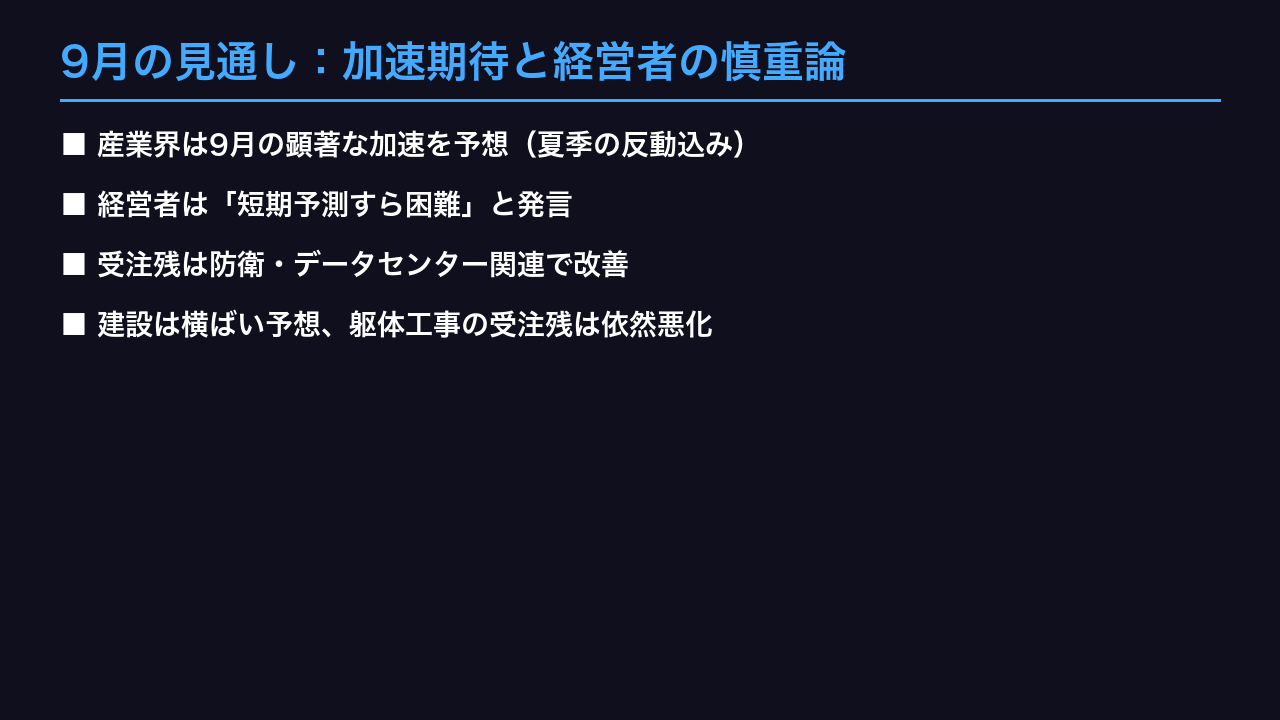
The most noteworthy element of this month’s release isn’t the numbers themselves but a shift in tone. The original French states executives are “having more difficulty than usual anticipating their activity, even in the short term.” Such an explicit admission of forecasting difficulty is unusual for a monthly survey and suggests elevated business-sentiment fog (a level-B inference, since it draws on qualitative commentary rather than a single hard number).
A Two-Speed Order Book
Order books (carnets de commandes) are described as “slightly above normal” overall, yet simultaneously “well below the long-term average”—a nuance that matters. Electronics, electrical equipment, and aerospace (linked to defense spending and data-center construction) continue to strengthen, while metallurgy, non-metallic minerals, agri-food, and wood-paper-printing remain “very degraded.” This bifurcation echoes patterns seen in German manufacturing, where defense- and tech-linked capex has diverged sharply from traditional heavy industry.
Services: Broad Improvement, Pockets of Stagnation
Services firms expect hospitality (catch-up from summer disruption) and temporary staffing (firms avoiding permanent hires) to lead gains. Leisure, personal services, and advertising, however, are expected to see little change—worth watching for any read-through to French consumer confidence.
Construction: Order Books Still Empty
Construction is expected to stay flat in both core building and renovation segments, with core-building order books remaining “very degraded”—a signal that structural demand weakness in French housing and public works may persist beyond the summer slowdown.
The key question for the October release will be whether this anticipated acceleration actually materializes, or whether the executives’ own caution proves prescient.
価格動向:原材料圧力と鈍化する転嫁
A Patchy Pass-Through Picture
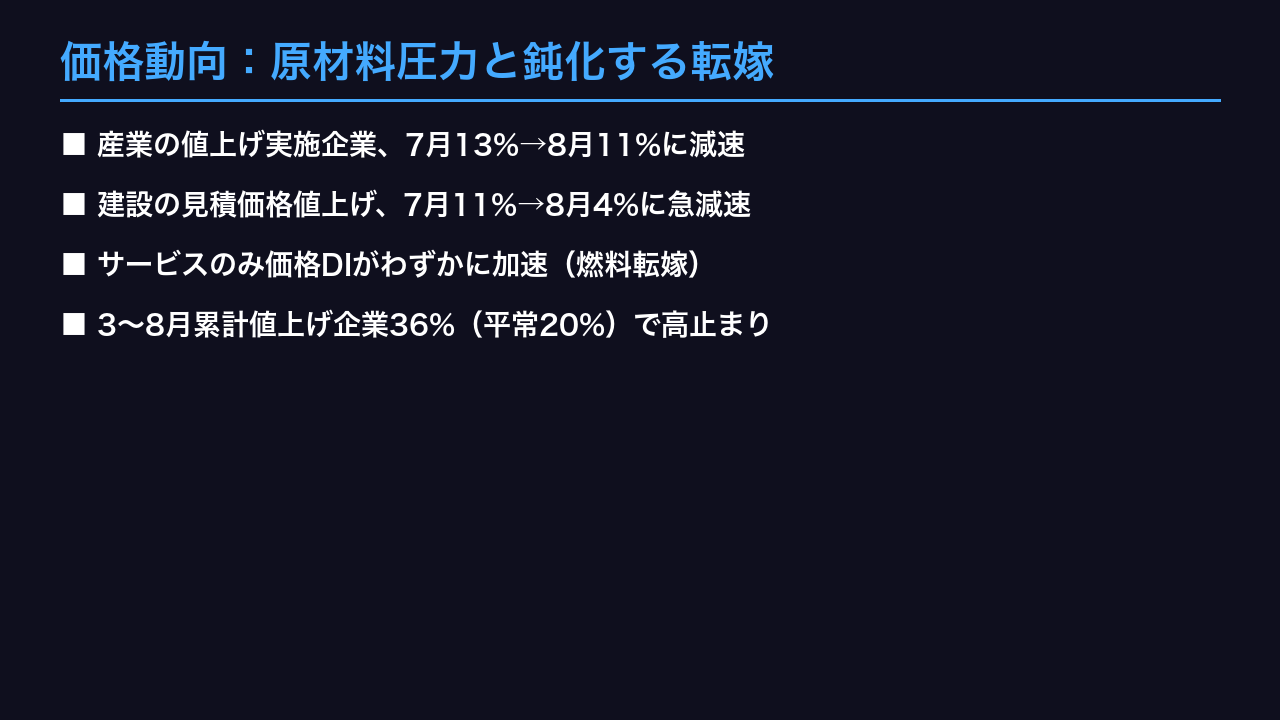
The standout figure this month is the deceleration in industrial firms raising prices—from 13% in July to 11% in August. The September forecast, also 11%, is close to the historical average of 9%. The report states explicitly: “they are not, at this stage, anticipating a new generalized wave of pass-through of input cost increases linked to the Middle East conflict”—meaning that despite renewed geopolitical tension, firms themselves don’t expect broad-based price transmission.
Construction’s Sharp Deceleration
Construction quote-price increases decelerated sharply, from 11% in July to just 4% in August. The report cites “persistently weak demand combined with a highly competitive environment” as the reason—indicating that cost increases are only partially being passed on to clients.
Services: The Lone Exception
Services prices ticked up slightly, with 8% of firms planning increases in September versus a 6% historical average. This is “mainly driven by the transport and warehousing sector, which passes on fuel price increases without delay”—a straightforward cost pass-through story rather than a demand-driven one.
The Bigger Picture Remains Elevated
Across all three sectors, 36% of firms raised prices at least once between March and August, versus a 20% normal rate—unchanged from the prior month’s March-to-July reading. This tells us pricing pressure, while decelerating at the margin, remains structurally elevated compared to historical norms.
Why This Matters for the ECB
For investors accustomed to watching US CPI or the Fed’s PCE target, this survey offers a more granular, forward-looking read on eurozone pricing power at the firm level—arguably more useful for anticipating disinflation than aggregate CPI alone. The combination of decelerating pass-through with still-elevated pricing frequency supports continued ECB caution rather than an all-clear signal.
資金繰り・採用難・供給制約
The Puzzle: Improving Activity, Worsening Cash Flow
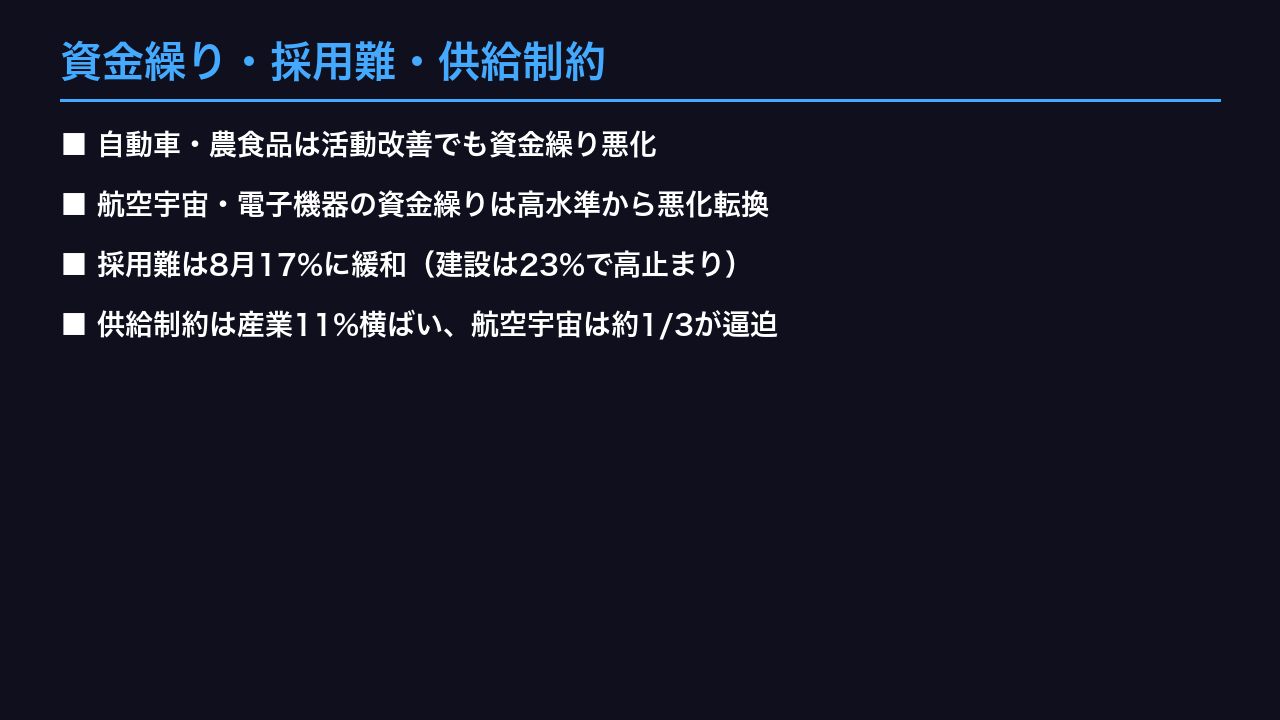
The most striking detail this month is that cash flow is deteriorating in automotive and agri-food—sectors where activity is simultaneously improving. The report explicitly notes this happens “despite more favorable activity in both sectors,” underscoring that operational improvement doesn’t automatically translate into balance-sheet health (a level-B inference drawn from the divergence between two indicators).
Automotive cites timing mismatches between supplier and customer payments, while agri-food points to rising input costs. This kind of working-capital squeeze can constrain firms’ capacity to invest even as order books improve—a nuance easily missed by readers focused only on headline activity balances.
Aerospace: A Reversal From a High Base
Aerospace cash flow is described as remaining “very comfortable” but is now trending downward. A similar reversal appears in computer/electronics/optics—sectors that have been consistent bright spots tied to defense spending and data-center construction. Any softening here is worth monitoring, given these have been among the strongest pillars of French industrial output all year.
Labor Market: Modest Loosening
Recruitment difficulties eased slightly to 17% in August from 18% in July. However, construction remains elevated at 23%, highlighting persistent sectoral divergence. For context, this labor-tightness gauge functions similarly to the “hard to fill positions” metrics tracked by the US NFIB survey, and its gradual easing offers the ECB a modest data point supporting reduced wage-inflation risk.
Supply Bottlenecks: Aerospace the Outlier
Industry-wide supply difficulties held flat at 11%, but aerospace remains an outlier, with roughly a third of firms citing constraints on critical components and subcontracting capacity. Construction bottlenecks improved from 9% to 6%, though insulation materials remain a persistent pinch point. Overall, the supply-side picture continues to normalize outside of aerospace’s structural constraints.
GDP:確報値の下方修正と第3四半期予測
The Irony: Stronger Prices, Weaker Real Growth
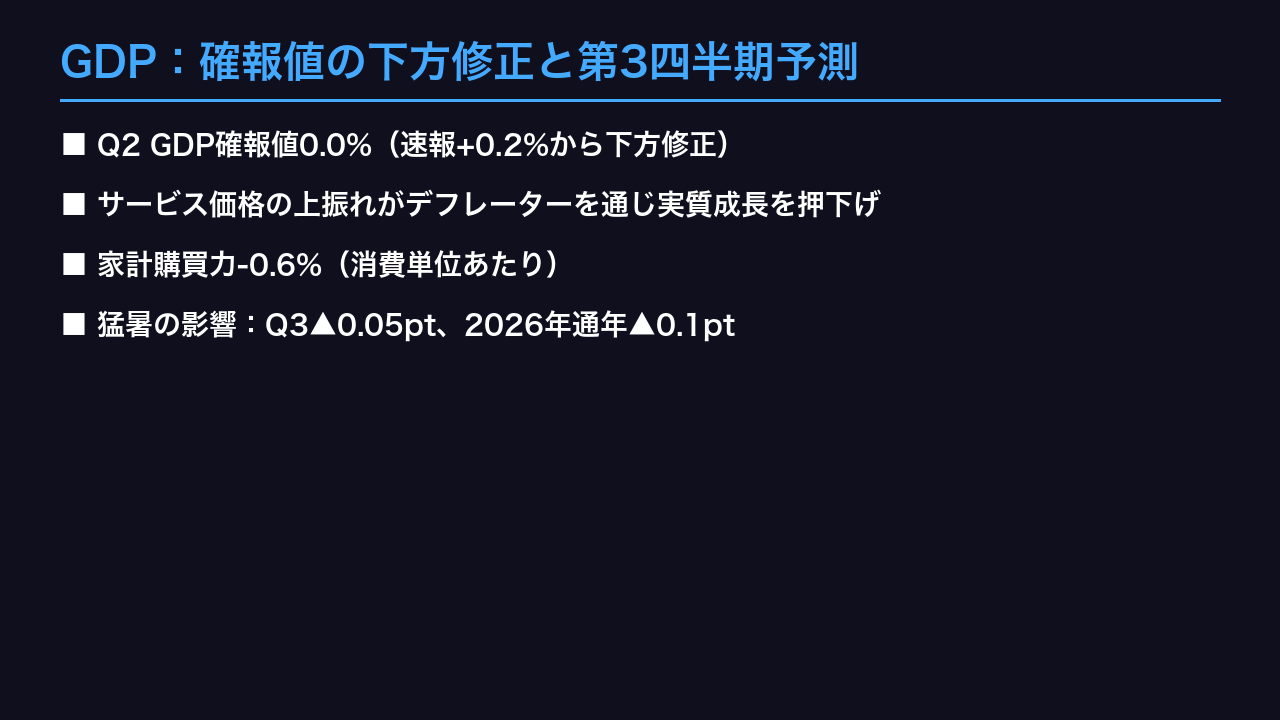
The most technically interesting aspect of this quarter’s downward revision is its mechanism. The report explains the revision stems from “the integration of services price data, more dynamic than expected, which lowered the real (volume) value added of these services.” In plain terms: because services prices came in hotter than assumed, the deflator used to convert nominal output into real GDP rose, mechanically dragging down measured real growth.
This is a useful nuance for readers used to US GDP reporting, where the price/volume split works similarly via the GDP deflator. It also carries an indirect signal for the ECB: stickier-than-expected services inflation was, paradoxically, one reason real growth looked weaker—suggesting price pressures in services haven’t fully faded (a level-B inference based on the interaction between two metrics).
Purchasing Power Under Pressure
INSEE’s own release states household purchasing power “declined markedly (-0.6% per consumption unit).” With GDP essentially flat, this sharp drop in real household purchasing power raises questions about the durability of French consumer spending—a dynamic somewhat comparable to how US real disposable income trends are watched as a lead indicator for consumption.
Quantifying the Heatwave
The Banque de France estimates the heatwave shaved roughly 0.05 percentage points off Q3 growth (excluding agriculture) and -0.1 point off full-year 2026 growth, primarily via reduced agricultural value added. It’s relatively unusual for a central bank survey to convert a weather event into an explicit growth-accounting adjustment rather than treating it as generic noise—this level of granularity is worth flagging for readers used to less quantified weather commentary in, say, Fed Beige Book releases.
What Comes Next
The next data point to watch is INSEE’s preliminary Q3 GDP release, alongside whether the anticipated energy-consumption boost from summer heat (which lifted energy sector value added) proves durable into autumn.
ECB政策とEUR/JPYへの含意
From France to the Eurozone: A Transmission Channel
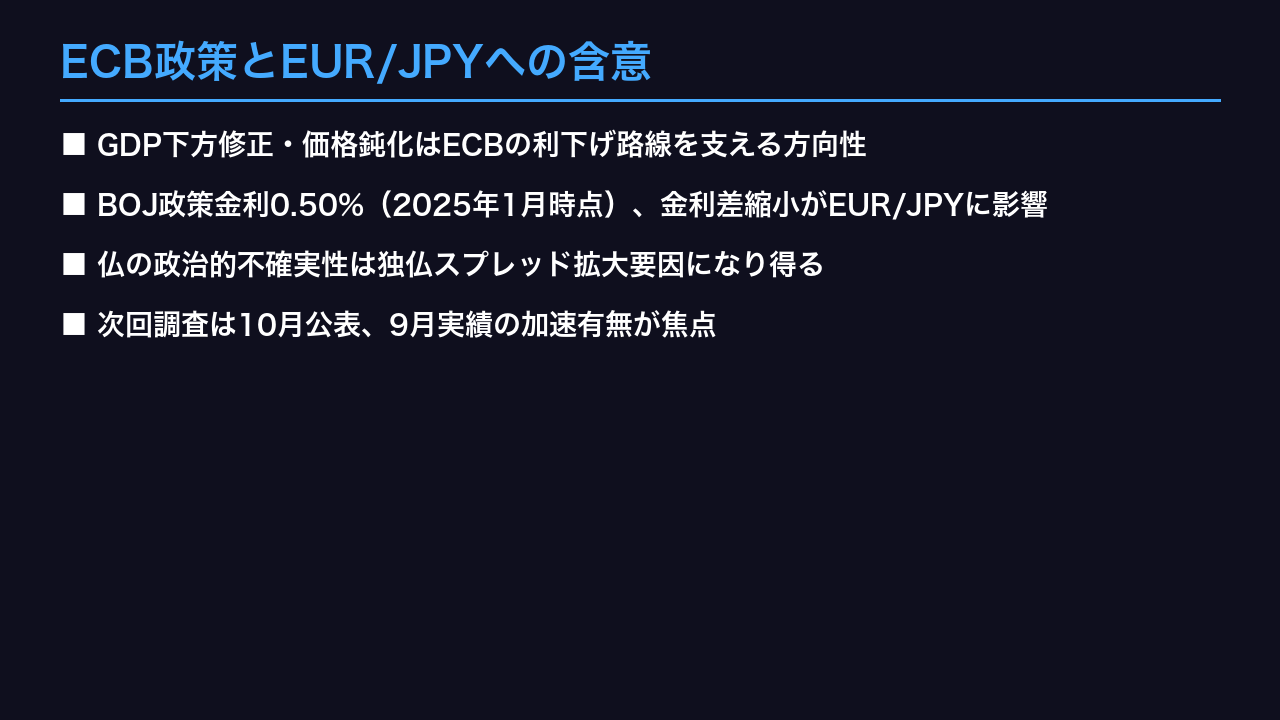
As the eurozone’s second-largest economy, France’s monthly business survey is one of the primary data inputs the ECB’s Governing Council references when assessing the currency bloc’s growth and inflation trajectory. This month’s GDP downgrade (+0.2% to +0.1%) combined with decelerating price pass-through (fewer firms raising prices) may, on their own, seem like marginal moves—but together they lean toward supporting a continued dovish ECB stance (a level-C inference, since it draws on a single national survey rather than confirmed ECB communication).
The BOJ-ECB Rate Gap
The Bank of Japan raised its policy rate to 0.50% at its January 2025 meeting—the most recent confirmed data point available. If the ECB continues its easing cycle while the BOJ holds steady or tightens further, the EUR-JPY interest rate differential would narrow. For readers less familiar with FX carry dynamics: investors have historically borrowed in low-yielding yen to fund higher-yielding euro assets (the “carry trade”), and a narrowing rate gap tends to erode the profitability of this strategy, potentially triggering unwinding pressure on EUR/JPY. That said, actual currency moves depend on far more than rate differentials alone—risk sentiment and central bank communication also matter, so this should be read as a directional consideration rather than a forecast.
The Franco-German Spread Angle
The report explicitly attributes rising uncertainty in services and construction to France’s own “political context favoring a wait-and-see approach” and concerns over the rollout of e-invoicing reform—both idiosyncratically French issues rather than eurozone-wide phenomena. If this sentiment gap versus Germany, the bloc’s largest economy, becomes more pronounced, it could feed into the French-German government bond yield spread (OAT-Bund spread), a metric closely tracked by European fixed-income investors as a barometer of eurozone political risk premium.
Looking Ahead
The next monthly survey is due in October. Key questions: does the industry-anticipated September acceleration materialize, and does the quantified heatwave drag (-0.05pt on Q3, -0.1pt on full-year 2026) reverse as expected? Both will feed directly into the next round of ECB and Banque de France growth assessments.
Disclaimer: This article is for informational purposes only. All investment decisions are made solely at your own risk.