📺 Watch the Full Video Analysis
This article was automatically generated by the NFC Market Live AI analysis system. (Updated: 2026-09-10 22:48 JST)
📄 Primary Source
NFC Market Live
https://www.ecb.europa.eu//press/pr/date/2026/html/ecb.mp260910~314e508016.en.html
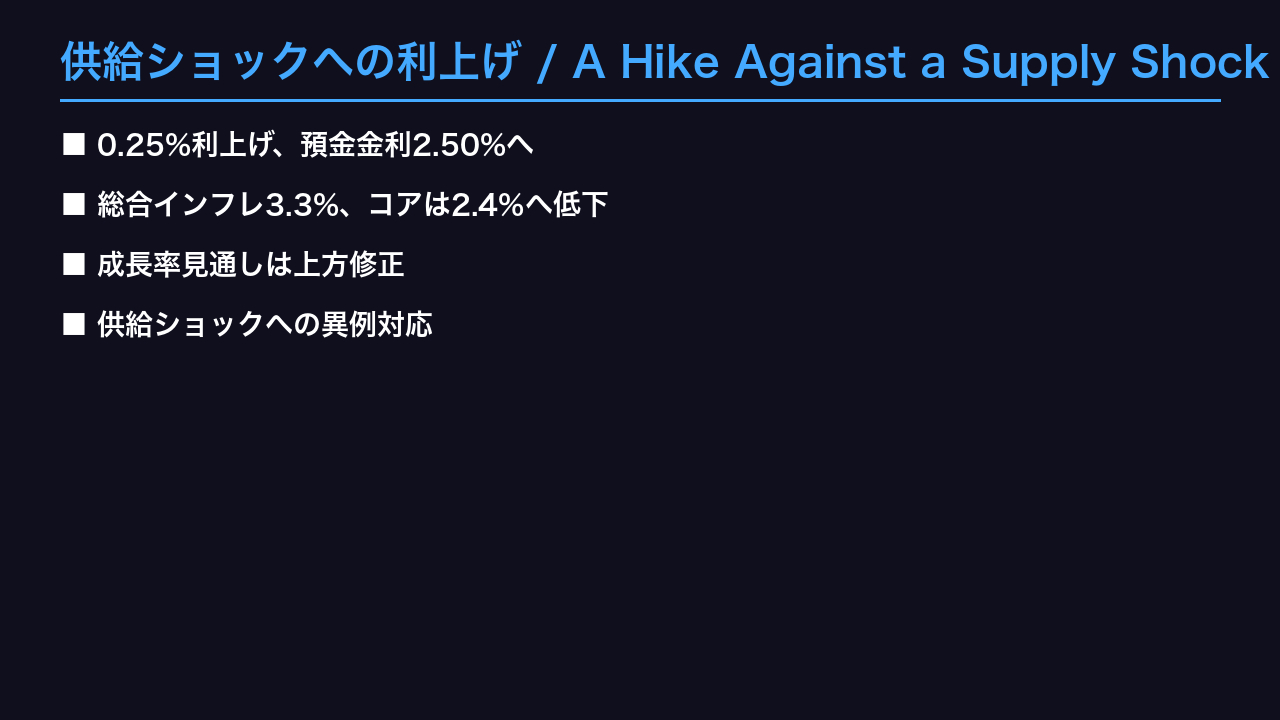
On September 10, 2026, the ECB raised its key rates by 25 basis points, lifting the deposit facility rate to 2.50%.
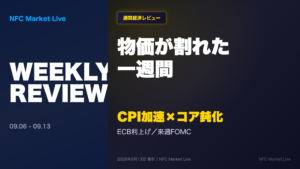
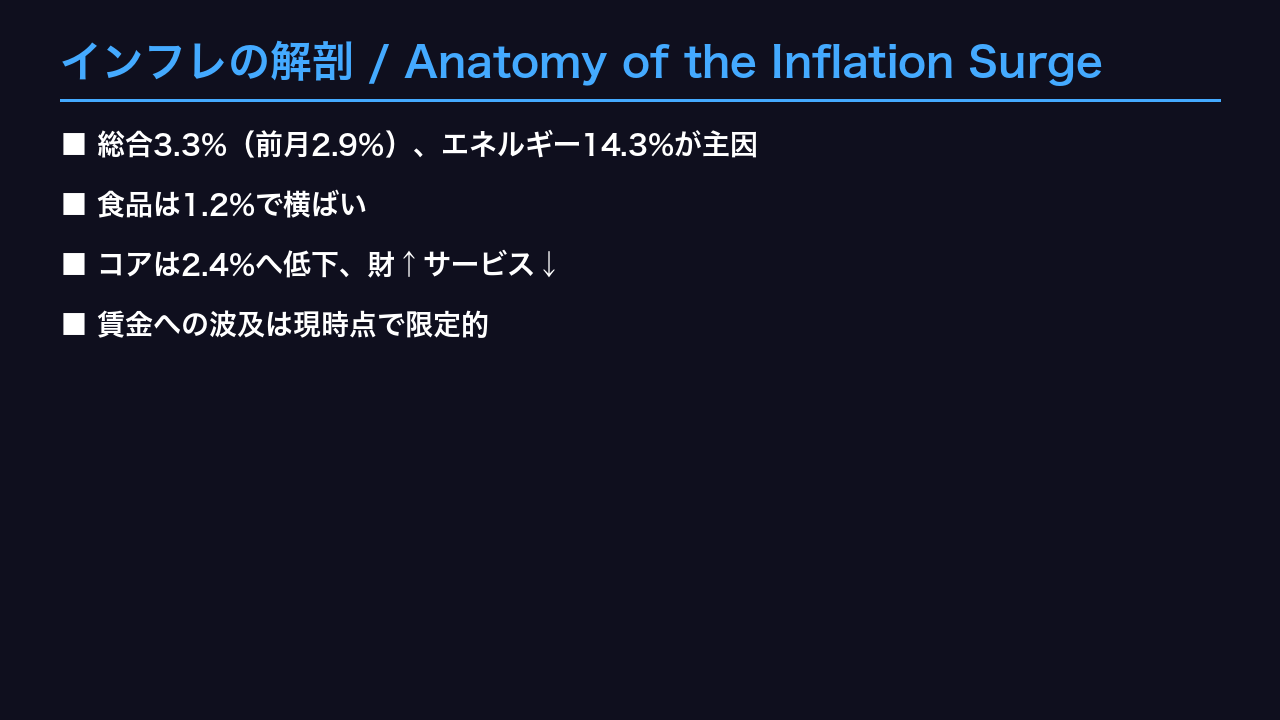
📊 Headline inflation accelerated to 3.3% in August (energy +14.3%)
📉 Core inflation eased to 2.4%, services inflation cooling too
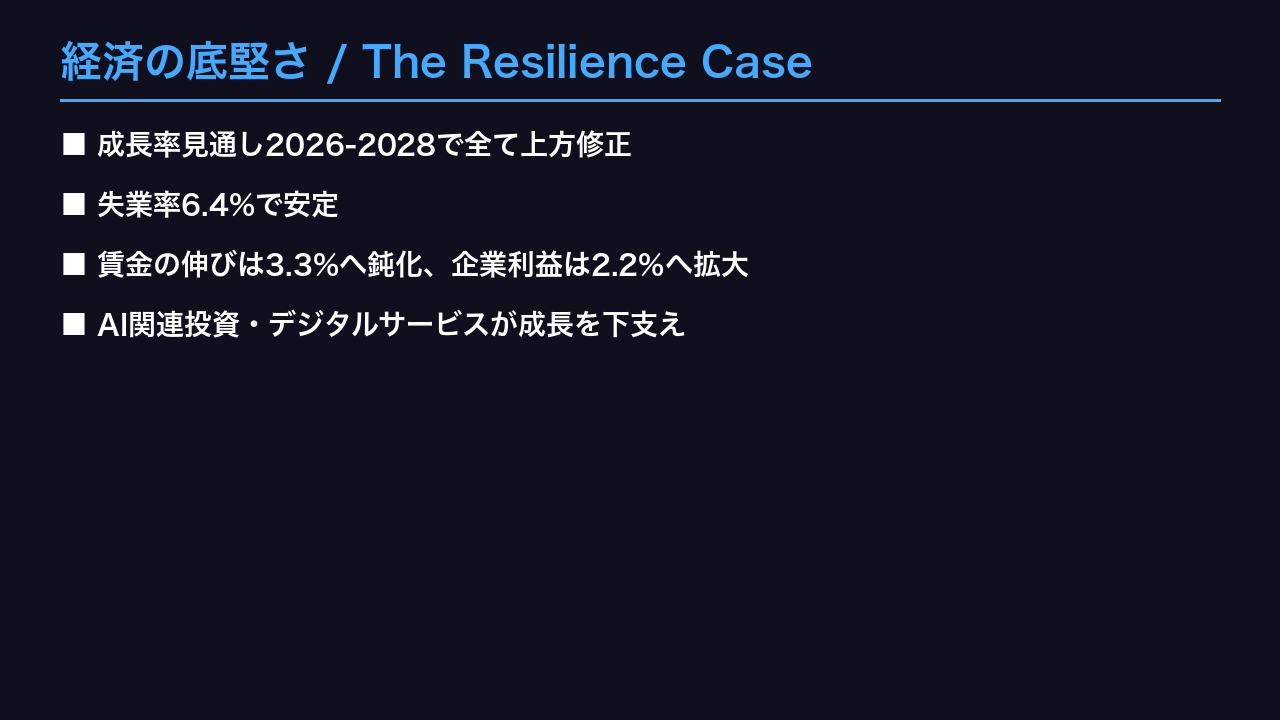
📈 Growth forecasts revised upward for 2026-2028
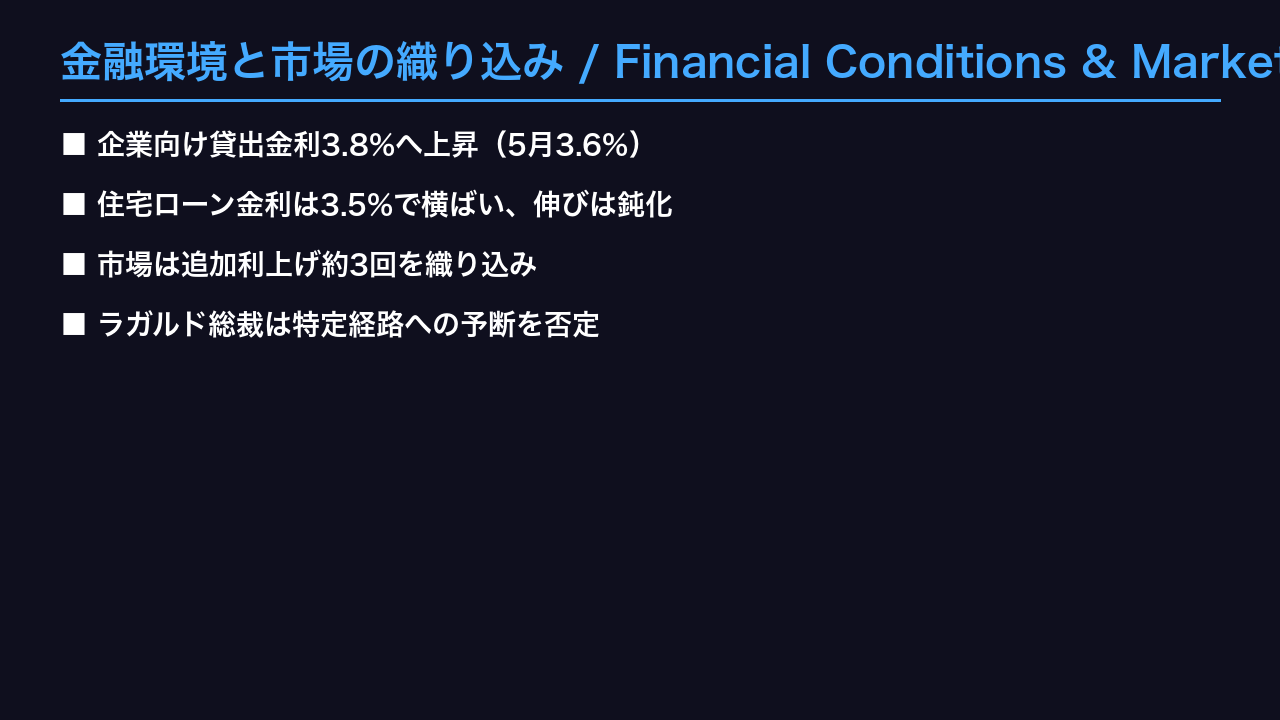
⚠️ Markets pricing more hikes; financing conditions tightening
President Lagarde repeatedly stressed the Council is “not pre-committing to a particular rate path,” maintaining a strict data-dependent stance. We break down the numbers and the press conference behind this unusual hike into a supply shock.
供給ショックへの利上げ / A Hike Against a Supply Shock
A Central Bank Hiking Into a Supply Shock
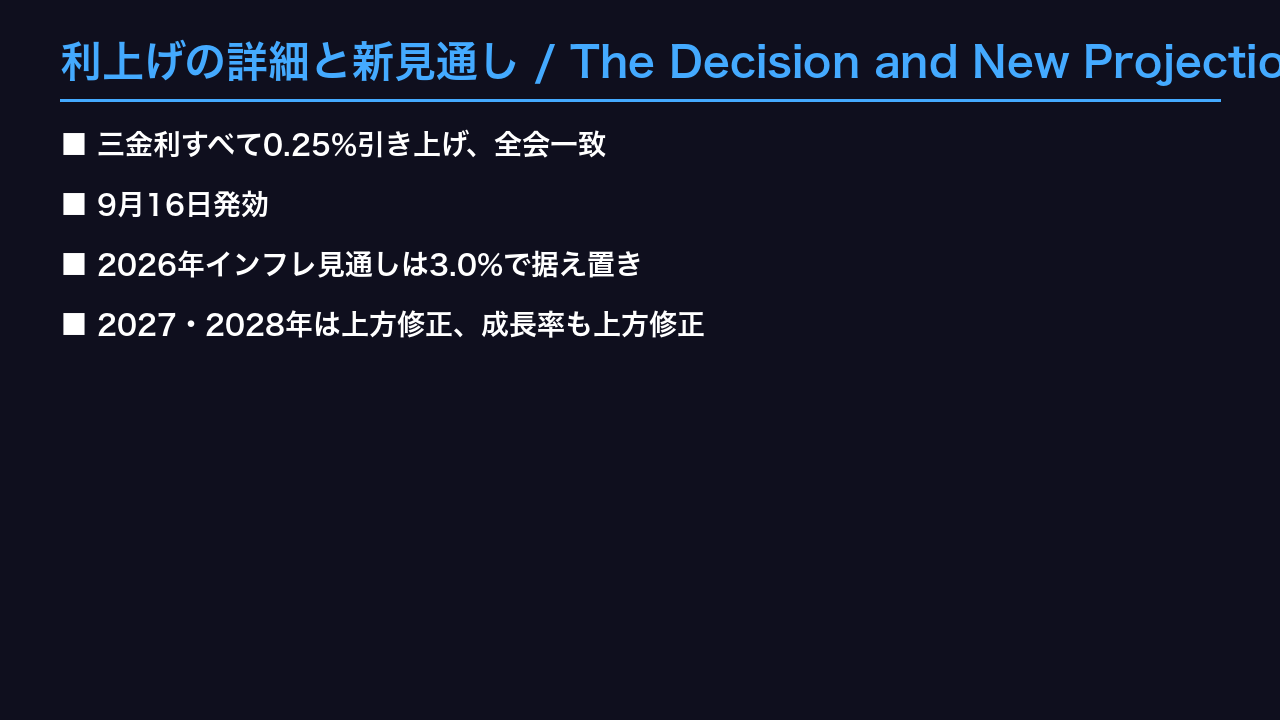
On September 10, 2026, the ECB’s Governing Council unanimously raised its three key interest rates by 25 basis points, lifting the deposit facility rate to 2.50%. What makes this decision unusual is that it targets a supply-side inflation shock—driven by Middle East conflict-related energy prices—rather than classic demand overheating.
“The conflict in the Middle East continues to generate inflation pressures, and inflation is set to remain well above target for an extended period,” the ECB stated.
Context for international readers
Unlike the U.S. Federal Reserve, which targets a single federal funds rate, the ECB manages three separate rates: the deposit facility (what banks earn on ECB deposits), the main refinancing rate, and the marginal lending facility. All three moved in lockstep here.
Bull vs. bear read
Hawks will note inflation projections for 2027-2028 were revised higher, implying room for further tightening—markets are pricing nearly three more hikes. Doves counter that core inflation, at 2.4%, is actually falling, suggesting this could be closer to a peak-rate moment than the start of a new tightening campaign. Lagarde herself declined to signal either direction, reinforcing a strictly data-dependent stance.
利上げの詳細と新見通し / The Decision and New Projections
Three Rates, Moving in Lockstep
Unlike the Federal Reserve’s single fed funds rate, the ECB manages three key rates simultaneously. All three rose by 25bp this meeting.
| Rate | Before | After |
|---|---|---|
| Deposit Facility | 2.25% | 2.50% |
| Main Refinancing (MRO) | 2.40% | 2.65% |
| Marginal Lending | 2.65% | 2.90% |
The change takes effect September 16, 2026, and the vote was unanimous—no visible dissent within the Governing Council.
Inside the staff projections
Compared with June, the 2026 headline inflation forecast of 3.0% was left unchanged, but 2027 (2.5%) and 2028 (2.1%) were revised higher. Core inflation projections (excluding energy and food) were also lifted to 2.5%, 2.6%, and 2.3% across the same horizon—implying inflation stays above target longer than previously expected.
Growth forecasts were revised up across the board: 0.9% (2026), 1.4% (2027), 1.5% (2028), which the ECB attributed to “greater than expected resilience of the euro area economy.”
What to watch next
The APP and PEPP bond portfolios continue shrinking as the Eurosystem no longer reinvests principal from maturing securities—ongoing quantitative tightening running alongside the rate hike.
インフレの解剖 / Anatomy of the Inflation Surge
The “Refining Margin” Nobody Saw Coming
During the press conference, Lagarde offered an unusually candid explanation for the energy price spike:
“If I had talked to you about refining margins six months ago, we wouldn’t have known what we were really talking about,” she said, referring to the so-called “crack spread”—the price gap between crude oil and refined products.
This suggests the energy shock is propagating through channels (like refining capacity and supply chain reorganization) that are genuinely difficult for policymakers to forecast in real time.
A goods-services role reversal
Notably, goods inflation rose (0.9% to 1.2%) while services inflation fell (3.3% to 3.0%). Services prices are typically “stickier” because they closely track wages, so this divergence suggests the current inflation episode is being pushed by energy cost pass-through into goods, not by broad-based demand pressure or wage-price spirals.
Limited wage pass-through so far
Lagarde noted that “wages do not show a material response to the energy shock at this stage,” and that indirect and second-round effects remain “contained” as of July. For U.S. readers: this is analogous to the Fed watching “supercore” services inflation for signs of a wage-price spiral—so far, the ECB sees none. That said, officials cautioned this could shift if energy cost pass-through persists longer than expected.
経済の底堅さ / The Resilience Case
A Shift Toward Profit-Led Inflation?
The most intriguing detail here is the divergence between wage costs and corporate profits. Unit labor cost growth slowed to 2.6%, while unit profit growth surged from 0.3% to 2.2%.
This suggests firms are passing through energy cost increases into prices at a pace that outstrips wage growth—fueling debate around so-called “greedflation.” However, with only one quarter of data, this should be read as a possible trend rather than a confirmed structural shift.
Consumer confidence rebounding
The ECB noted that “consumer confidence has rebounded from low levels, helping services recover from the initial energy shock,” and that “increased AI-related activity is visible in digital services, business investment and exports”—hinting that technology investment may be emerging as a new growth pillar for the bloc, somewhat analogous to the AI capex boom driving parts of the U.S. economy.
A qualitative labor market shift
While employment and labor force growth are slowing, productivity has “gradually picked up”—a potential sign of the labor market shifting from quantity-driven to quality/productivity-driven expansion.
“Consumption should be supported by gradually falling energy prices and a strong labor market,” the ECB stated, offering a constructive medium-term outlook for European consumer spending—relevant for investors tracking euro-area retail and consumer discretionary equities.
金融環境と市場の織り込み / Financial Conditions & Market Pricing Gap
“Markets Do What They Have to Do”
One of the sharpest exchanges at the press conference centered on a journalist’s observation that markets are pricing in roughly three more hikes beyond today’s move.
“Markets do what they have to do, and we do what we have to do, which is to provide price stability,” Lagarde responded.
This is a clear rejection of market-following forward guidance—the ECB is signaling it will not validate or anchor market pricing, sticking instead to a strict data-dependent, meeting-by-meeting framework, similar in spirit to the Fed’s post-2023 communication style.
A global bond yield story
Another reporter raised concerns about a synchronized rise in government bond yields across the U.S., Japan, and Europe. Lagarde characterized this as “not a euro-specific issue,” attributing it partly to elevated fiscal financing needs and surging AI-related investment demand globally. A separate question referenced unannounced U.S. currency-market intervention involving euro sales, highlighting friction in transatlantic policy coordination worth monitoring for FX traders.
A data caveat worth noting
The original transcript contained internally inconsistent figures for bank lending growth to firms (values that reversed month-over-month in illogical ways, likely a transcription artifact). This article therefore reports only the figures that were unambiguous in the source text: lending rates, bond issuance growth, and mortgage metrics.
リスクと政策哲学 / Risk Landscape & Policy Philosophy
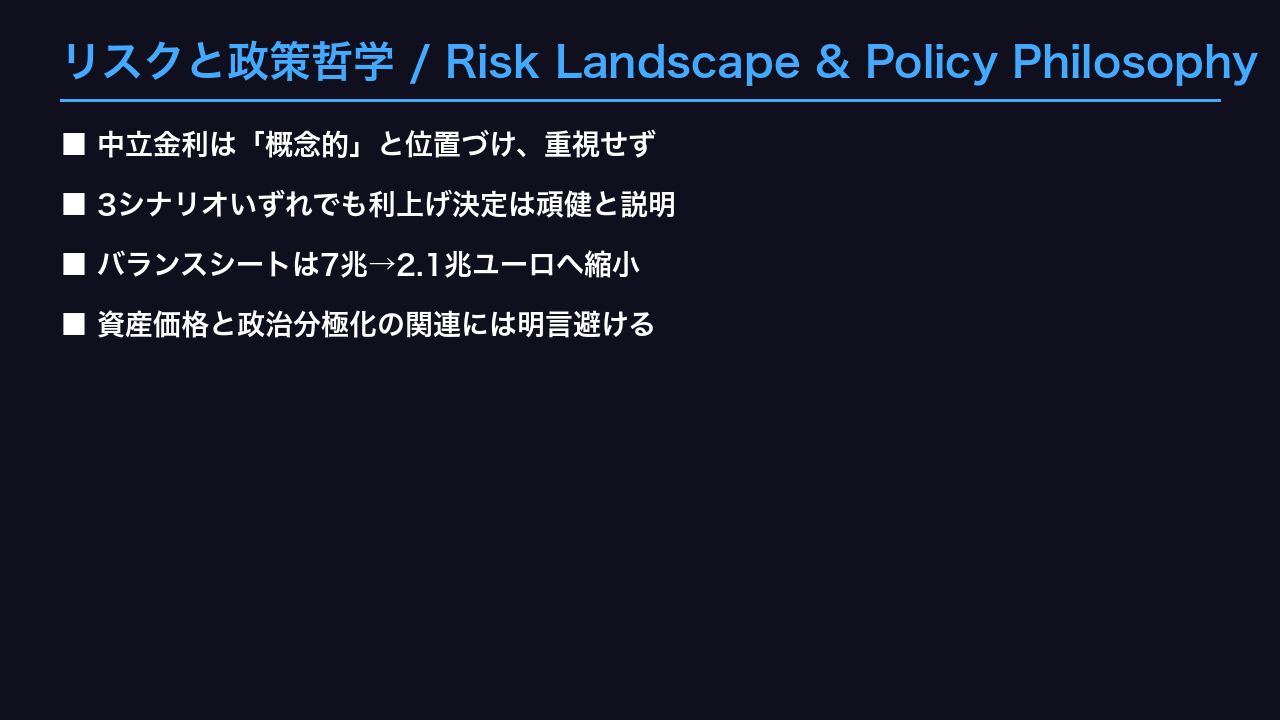
The Neutral Rate Is “Highly Conceptual”
When pressed on whether the ECB has moved into the upper end of its estimated neutral rate range, Lagarde offered a notably philosophical response:
“The neutral rate is highly conceptual, because you cannot actually pinpoint it—it’s a factor of multiple variables that change over time, and it’s supposed to be defined in times of no shock. We are constantly under shocks,” she said.
This suggests the ECB is deliberately downweighting the traditional “distance from neutral” framework that many analysts—and the Fed, in its own communications—often use to gauge how restrictive policy is.
Scenario robustness
ECB staff produce three standard scenarios—benign, adverse, and severe—largely built around energy price assumptions (to be published within days, per Lagarde). She stated the 25bp hike decision is “robust on all three accounts,” a notable claim of confidence in the decision’s resilience to a wide range of outcomes.
The balance sheet as a quiet tightening force
The Eurosystem’s balance sheet has already shrunk from a peak of roughly €7 trillion to €2.1 trillion, as APP and PEPP holdings run off without reinvestment. This quantitative tightening operates as a structural background force compounding the effect of rate hikes—a dynamic U.S. investors will recognize from the Fed’s own balance sheet runoff.
An unresolved political question
A journalist raised whether ECB-driven asset price appreciation has fueled political polarization (rising support for both far-right and far-left parties). Lagarde did not directly address this, leaving an open and politically sensitive question for future press conferences.
The exact date of the ECB’s next Governing Council meeting was not specified in the available material. Going forward, investors should watch how far energy cost pass-through extends into core inflation, and whether market pricing of further hikes converges with or diverges from the Council’s data-dependent stance.
Disclaimer: This article is for informational purposes only. All investment decisions are made solely at your own risk.