📺 Watch the Full Video Analysis
This article was automatically generated by the NFC Market Live AI analysis system. (Updated: 2026-09-03 10:19 JST)
📊 A deep dive into Japan’s weekly MOF portfolio flow data (International Transactions in Securities).
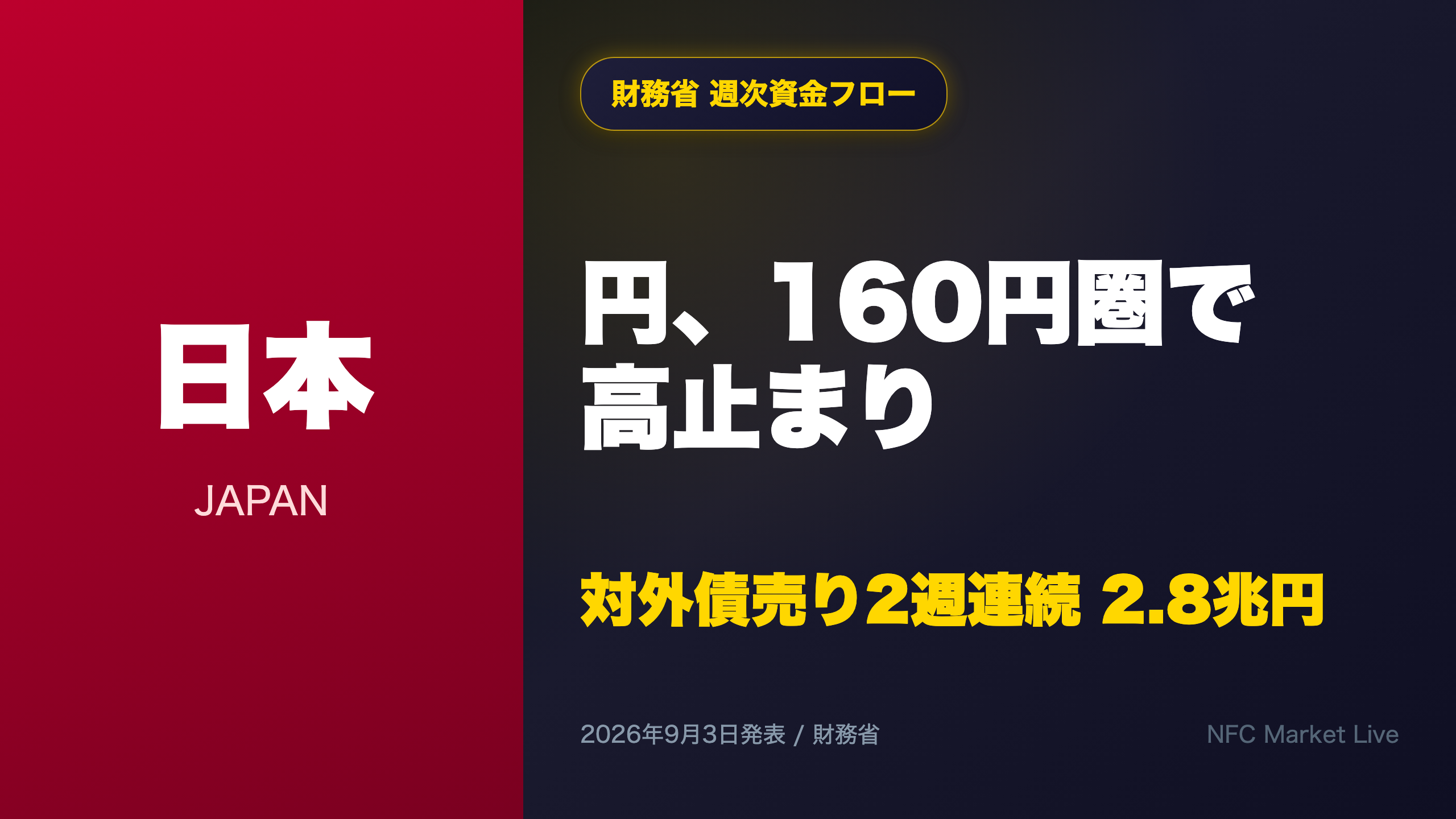
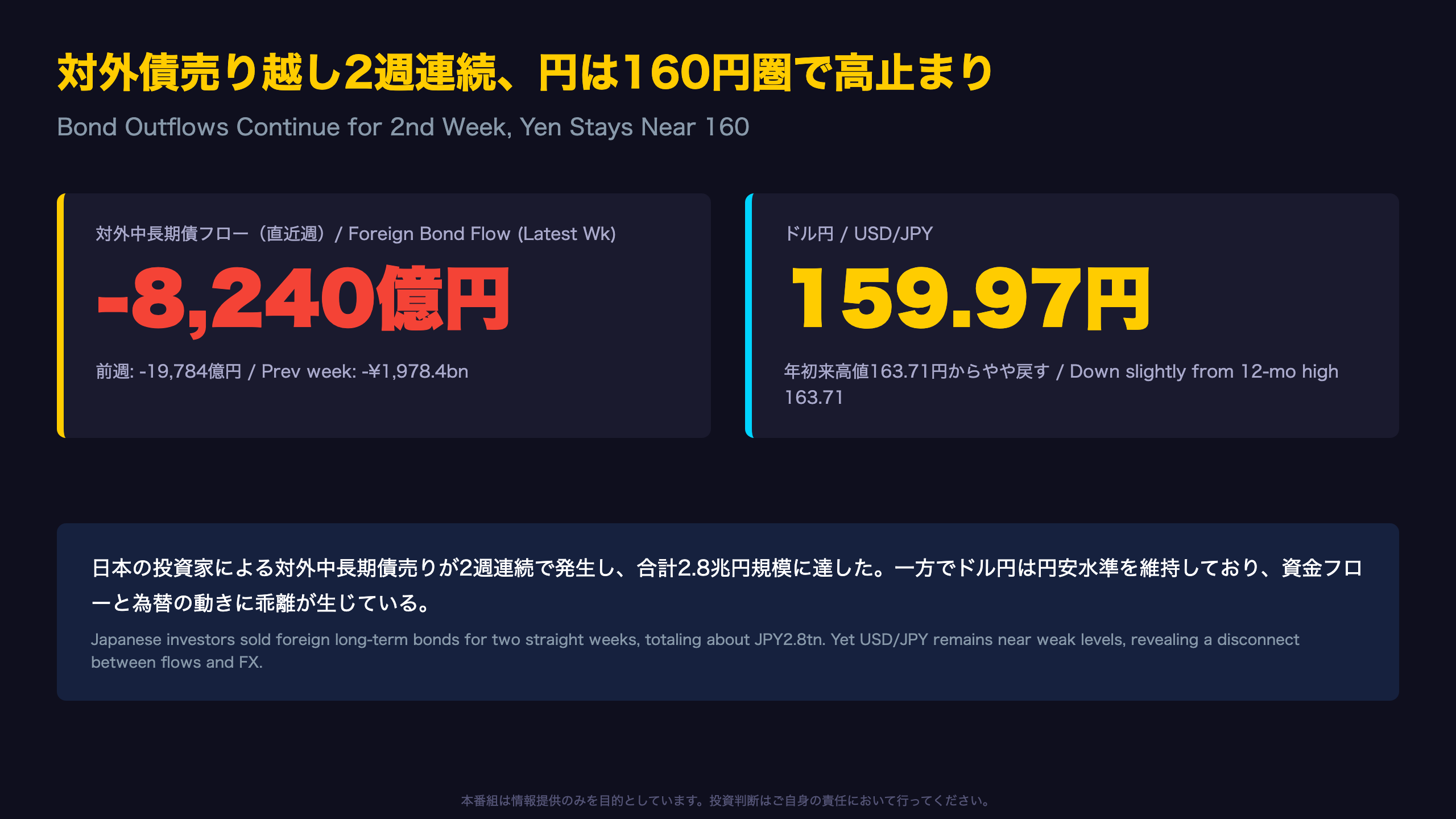
💴 Japanese investors sold foreign long-term bonds for a 2nd straight week: -¥824.0bn latest, -¥1,978.4bn prior week.
📉 But the 4-week net is nearly flat — suggesting a ‘round trip’ rather than a new trend.
💹 Meanwhile USD/JPY sits at 159.97, still near 12-month highs.
⚠️ We break down the disconnect between portfolio flows and FX with balanced, data-driven analysis.
対外債売り越し2週連続、円は160円圏で高止まり
Context: Japan’s Weekly Portfolio Flow Data
Japan’s Ministry of Finance (MOF) publishes a weekly report tracking net purchases and sales of foreign and domestic securities by Japanese residents and non-resident investors. Unlike the US TIC data (monthly, with a lag), this release is weekly and timelier, making it a closely watched proxy for portfolio-driven yen flows.
The latest release (Sep 3) covers the week of Aug 23-29. The standout figure: Japanese residents’ net sales of foreign long-term bonds reached -¥824.0bn (approx. -$5.2bn), following an even larger -¥1,978.4bn (approx. -$12.4bn) sell-off the prior week. This marks two consecutive weeks of unusually large repatriation flows out of foreign fixed income.
Meanwhile, foreign inflows into Japanese assets were muted: foreign investors bought a mere +¥35.8bn of Japanese equities last week, reversing a -¥764.1bn outflow the week before.
Market implication: Textbook portfolio-flow logic suggests large bond repatriation should support the yen. Yet USD/JPY held near 159.97, a level close to its 12-month peak weakness of 163.71. This divergence, explored further in later slides, suggests flow data alone is an incomplete lens for JPY direction.
規模で見る2週連続の対外債券売り
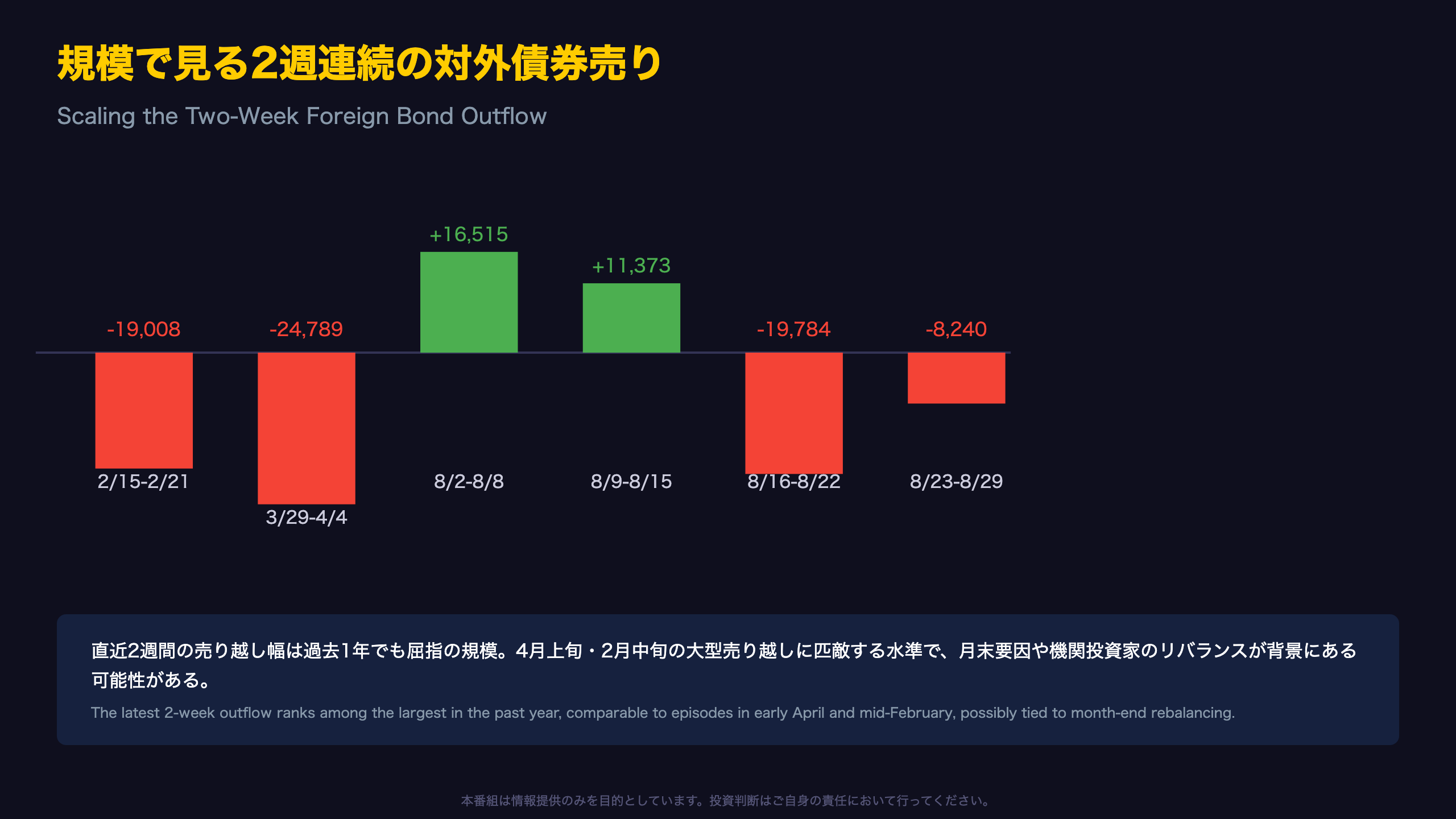
Scaling the Two-Week Bond Outflow
Weekly flow of Japanese residents’ net foreign long-term bond purchases (Res_BondL_JP):
| Week | Amount (JPY bn) |
|---|---|
| Aug 16-22 | -19,784 |
| Aug 23-29 | -8,240 |
Among the past 12 months of weekly prints, -¥1,978.4bn ranks among the largest. The single largest weekly outflow in the dataset was -¥2,478.9bn (week of Mar 29-Apr 4, 2026), followed by -¥1,900.8bn (week of Feb 15-21, 2026). This week’s figure is comparable in magnitude to those episodes, not simply noise.
For context, Japan’s MOF publishes this data weekly, unlike the monthly, lagged US TIC data, making it one of the timeliest gauges of Japanese institutional portfolio behavior globally.
Notably, these large outflows cluster around month-end (Aug 29), a period when institutional investors, such as life insurers and pension funds like GPIF, often rebalance hedge ratios or duration exposure. This timing makes it premature to label the move a structural capital flight from foreign bonds.
Meanwhile, foreign demand for JGBs (NonRes_BondL_Foreign) stayed positive in both weeks (+¥435.2bn, +¥509.1bn), suggesting inbound demand for Japanese bonds hasn’t deteriorated even as outbound flows swung sharply.
「往って来い」の資金移動 — 4週ネットはほぼゼロ
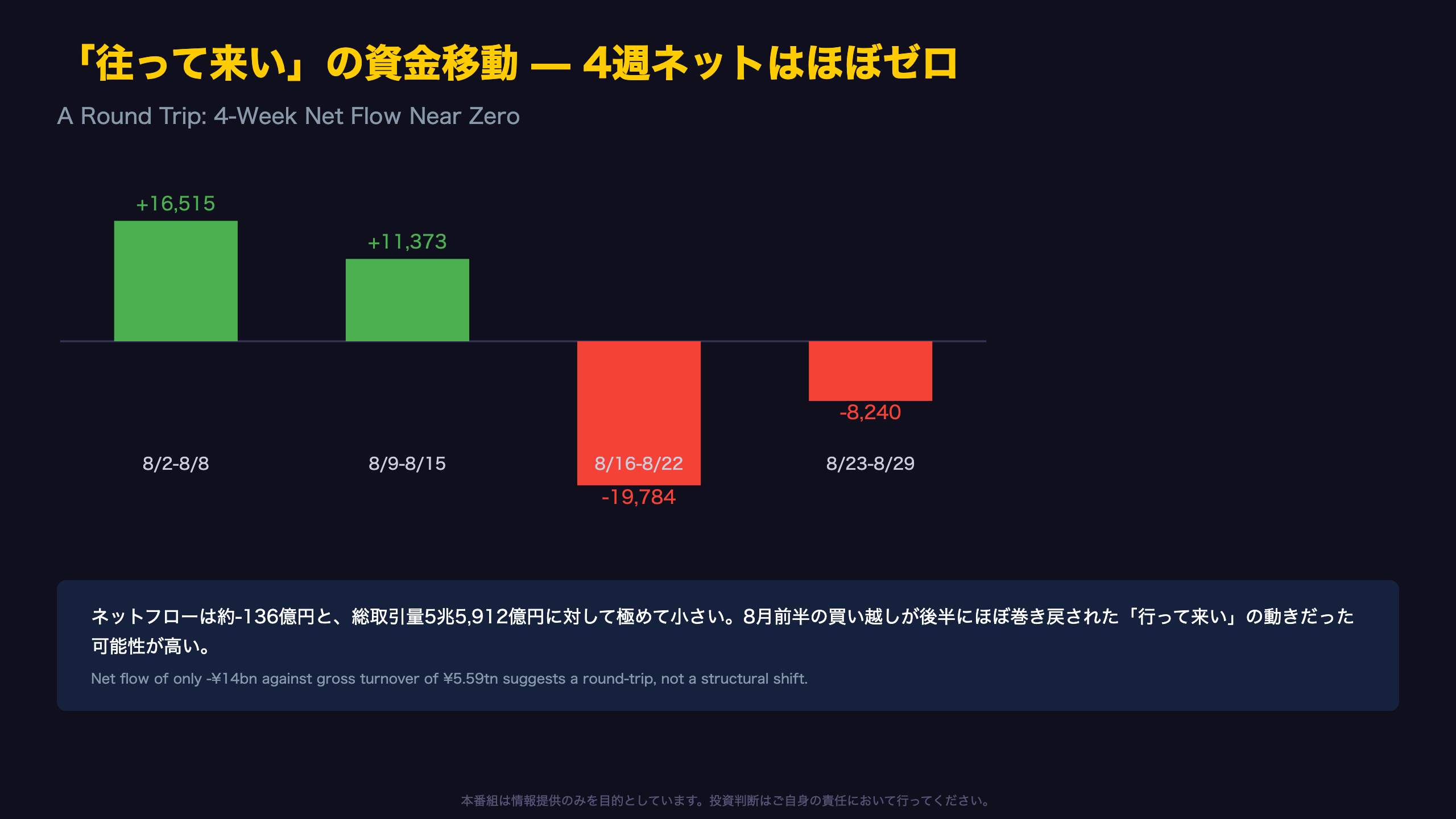
A Round Trip, Not a Retreat
Stacking the past four weeks of Res_BondL_JP flows:
| Week | Flow (JPY bn) |
|---|---|
| Aug 2-8 | +1,651.5 |
| Aug 9-15 | +1,137.3 |
| Aug 16-22 | -1,978.4 |
| Aug 23-29 | -824.0 |
The simple net over four weeks: approximately -¥13.6bn, essentially flat. Yet gross turnover (sum of absolute values) totals roughly ¥5.59tn (approx. $35bn). A huge volume of capital moved in both directions, but almost perfectly canceled out over the month.
This pattern is consistent with a ‘round-trip’ flow: positions built up in early August were largely unwound by month-end, rather than representing a fresh, structural pullback from foreign bonds. Japanese institutional investors, including life insurers and pension funds such as GPIF, often adjust hedge ratios or duration exposure around month-end, which could explain the whipsaw.
Bull case: if this is simple rebalancing noise, the yen-negative narrative around ‘capital returning home’ is overstated, and JPY weakness likely reflects other drivers such as rate differentials.
Bear case: if outflows persist into September, it could mark the start of a genuine shift in institutional appetite for foreign duration.
Only additional weekly prints will resolve which reading is correct, making this the key indicator to track over the next month.
海外勢は「様子見」、日本勢の対外株買いは継続
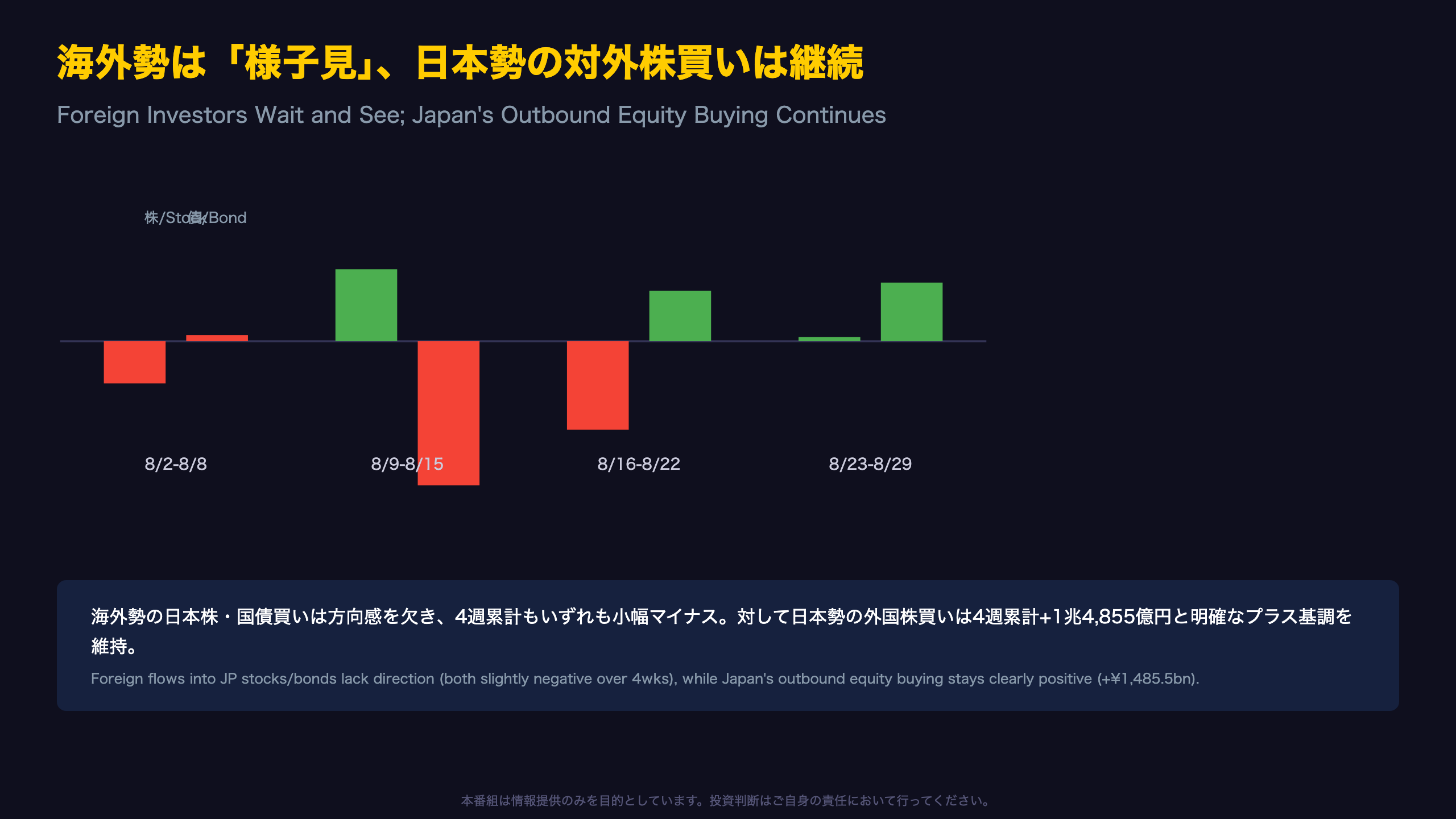
Foreign Investors Stay on the Sidelines
Foreign net purchases of Japanese equities (NonRes_Stock_Foreign) over the past four weeks:
- Aug 2-8: -¥368.4bn
- Aug 9-15: +¥622.4bn
- Aug 16-22: -¥764.1bn
- Aug 23-29: +¥35.8bn
Net over the month: -¥474.3bn. The alternating sign pattern, with no consecutive weeks in the same direction, suggests foreign investors lack conviction either way on Japanese equities right now. A similar picture holds for foreign JGB purchases (NonRes_BondL_Foreign): -¥56.6bn, -¥1,249.9bn, +¥435.2bn, +¥509.1bn, netting to -¥362.2bn over the month.
By contrast, Japanese residents’ foreign equity purchases (Res_Stock_JP) totaled +¥1,485.5bn over the same four weeks (+¥927.4bn, +¥1,391.3bn, -¥869.0bn, +¥35.8bn), a much clearer, sustained pattern of net buying. This is arguably the strongest signal in this week’s data: Japan’s outbound equity diversification trend, tied to NISA-driven retail flows and institutional asset allocation shifts, continues uninterrupted even as bond flows whipsaw.
International comparison: unlike periods of strong foreign conviction toward Japanese equities, the current choppy pattern signals a wait-and-see stance, possibly tied to uncertainty over the BOJ policy path or global risk sentiment.
為替への含意 — 資金フローと円相場の乖離
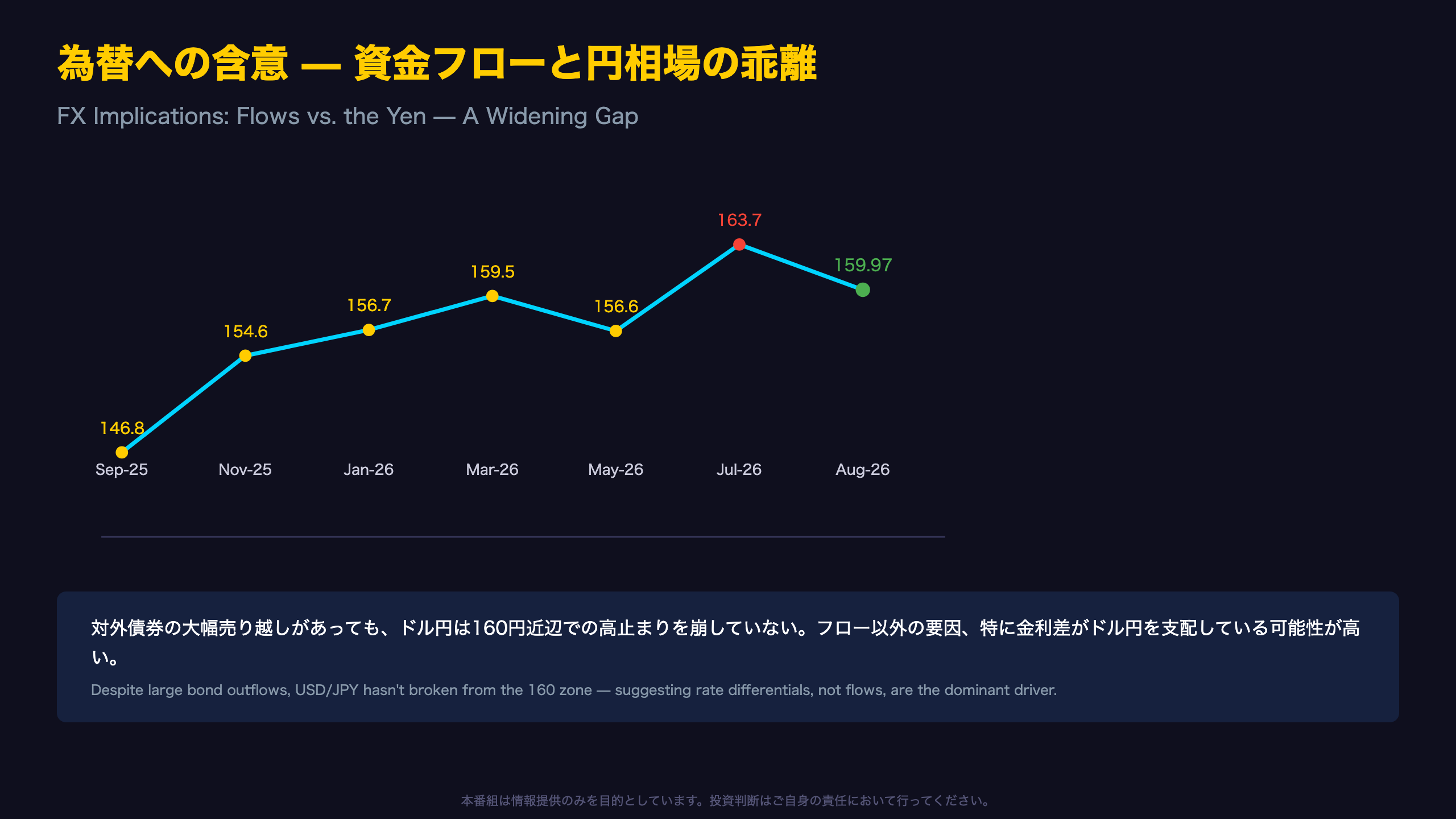
The Flow-FX Disconnect
Over the past 12 months, USD/JPY rose from around 146 (Sep 2025) to a peak of 163.71 (week of Jul 19-25, 2026). The latest print (Aug 23-29) sits at 159.97, modestly off the July peak but still deep in historically weak territory.
Textbook portfolio-flow logic holds that Japanese residents repatriating capital from foreign bonds, and foreign investors buying JGBs, should both be yen-supportive. Yet despite roughly ¥2.8tn (approx. $17.5bn) of combined foreign-bond selling by Japanese investors over the past two weeks, USD/JPY has not meaningfully pulled back from the 160 threshold.
Market implication: this divergence suggests weekly portfolio flow data alone is an incomplete guide to near-term JPY direction. Interest rate differentials between the Fed and BOJ, risk sentiment, and real-money trade-related dollar demand likely dominate. This mirrors a broader debate among FX strategists: unlike the monthly US TIC data, Japan’s weekly MOF flow data is timelier but also noisier, and a single week’s repatriation flow rarely moves USD/JPY on its own.
For readers benchmarking against other G10 currencies, this decoupling of portfolio flows from spot FX is not unique to Japan; similar gaps appear elsewhere around shifting rate-differential expectations. The next MOF release, expected around Sep 10, will show whether bond repatriation continues, a key input for gauging whether 160 acts as a near-term ceiling.
総括:強さと弱さの併存
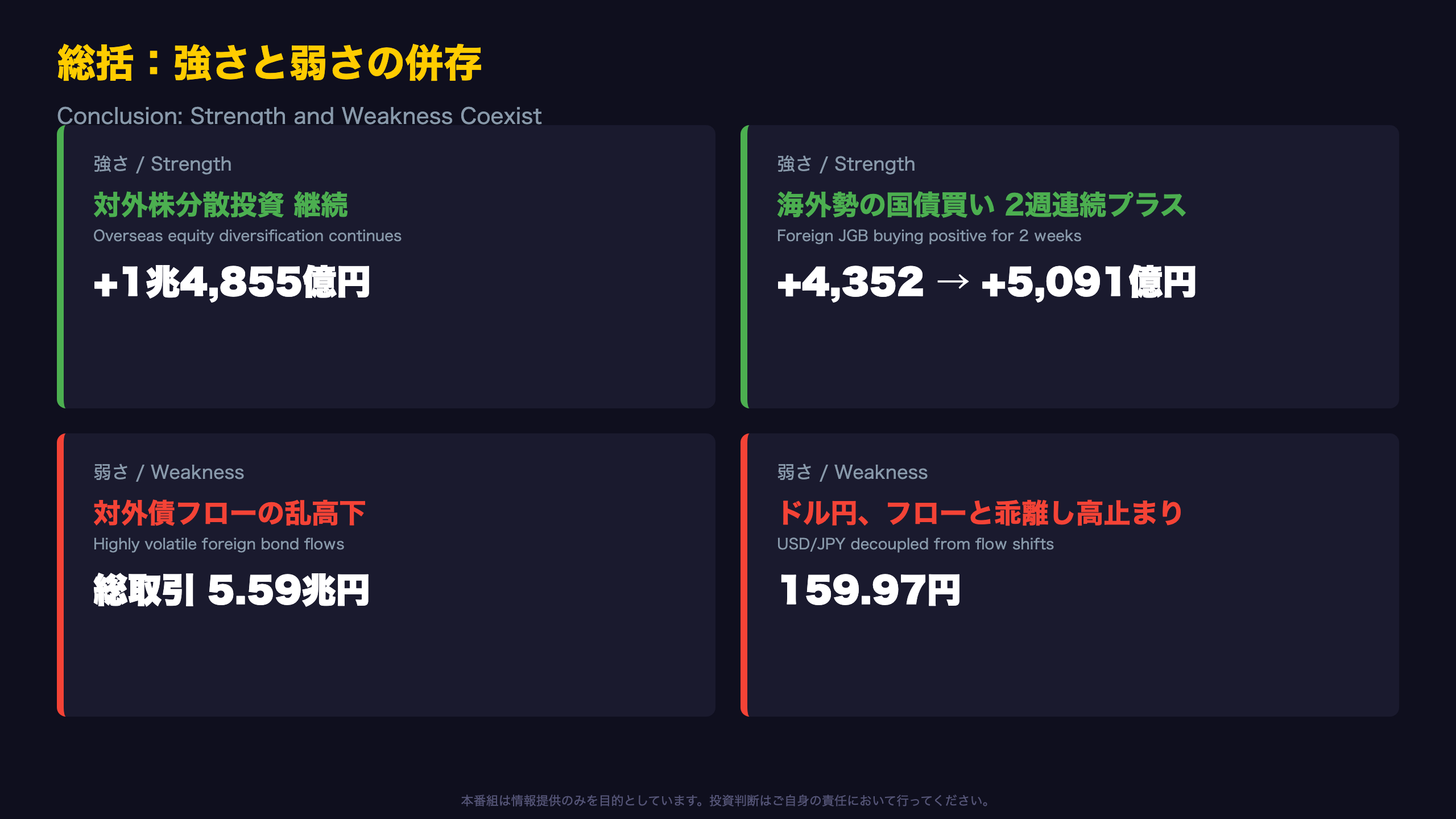
Conclusion: Strength and Weakness Coexist
This week’s release resists a simple narrative of either accelerating yen weakness or capital flight. Both resilience and fragility are visible in the data.
Signs of strength
– Japanese residents’ foreign equity buying totaled +¥1,485.5bn over the trailing four weeks, showing the overseas diversification trend remains intact.
– Foreign demand for JGBs turned positive for two straight weeks (+¥435.2bn, +¥509.1bn), indicating inbound bond demand hasn’t broken down.
Signs of caution
– Weekly swings in foreign-bond flows are extremely volatile, making the underlying direction hard to read with confidence.
– Foreign equity buying of Japanese stocks is net negative over four weeks (-¥474.3bn), albeit modestly.
– USD/JPY remains pinned near 159.97, decoupled from the flow-based case for yen strength.
Scenarios to watch: if foreign-bond outflows persist into September, it would support a genuine capital-repatriation narrative. If flows swing back to net buying, it would confirm late-August selling was simply a reversal of early-August purchases. Either way, whether USD/JPY breaks above 160 or retreats toward the mid-150s will be the key cross-check against the flow data.
The next MOF release is expected around September 10, covering Aug 30-Sep 5. Watch the sign of Res_BondL_JP and whether USD/JPY holds the 160 line.
Disclaimer: This article is for informational purposes only. All investment decisions are made solely at your own risk.