📺 Watch the Full Video Analysis
This article was automatically generated by the NFC Market Live AI analysis system. (Updated: 2026-09-03 05:37 JST)
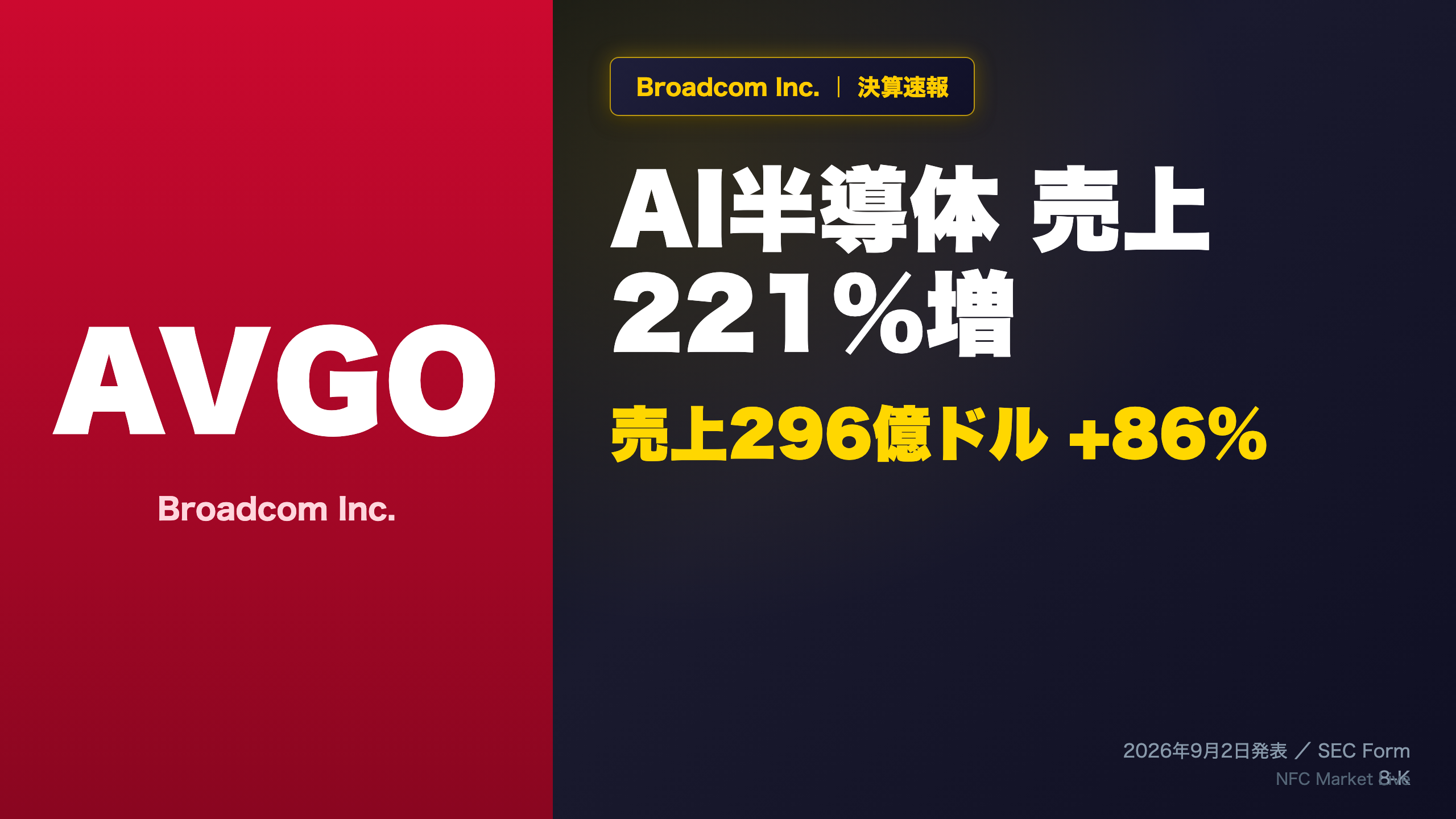
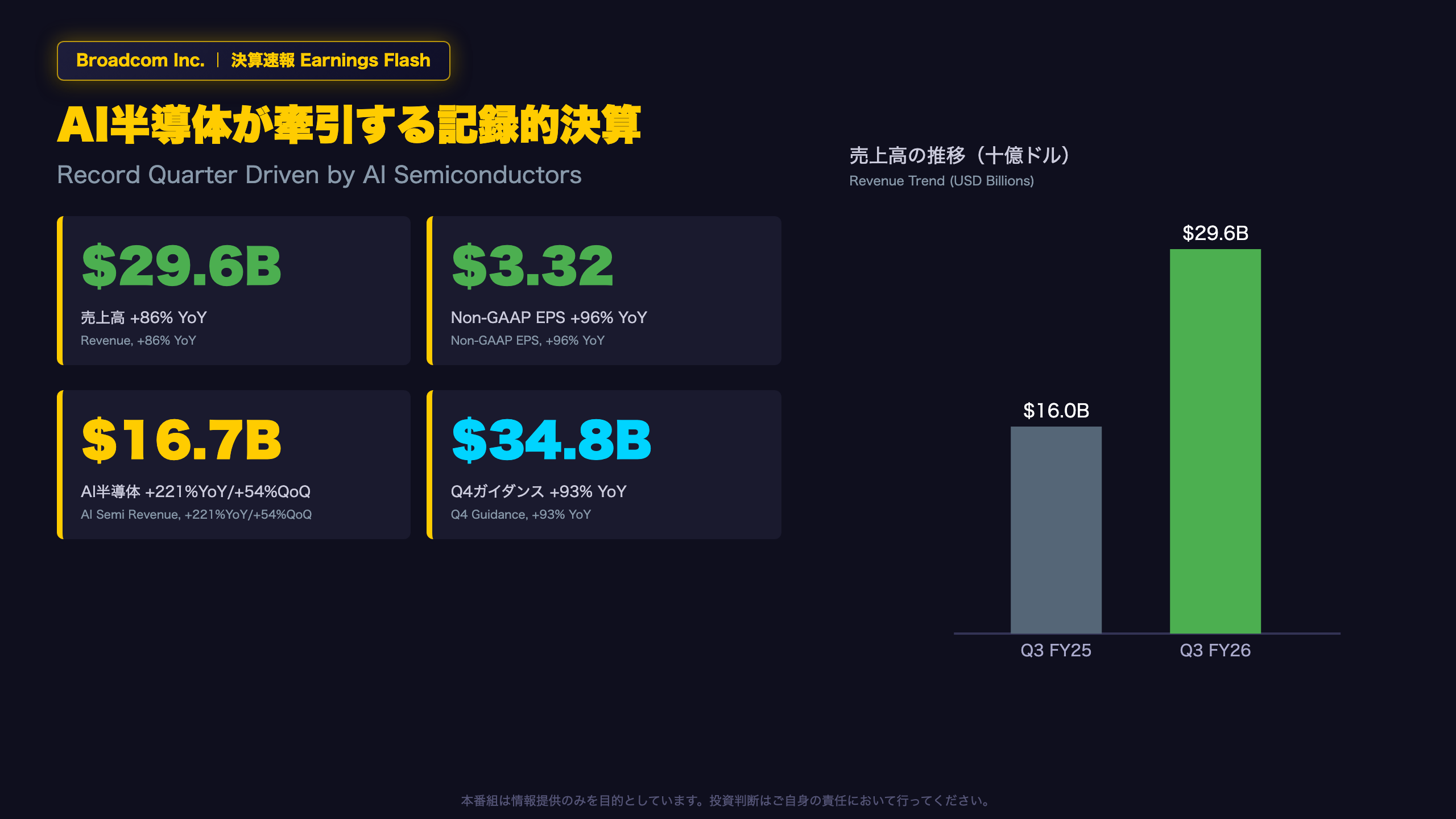
📊 Broadcom (AVGO) reported fiscal Q3 2026 results: revenue of $29.6B (+86% YoY) and non-GAAP EPS of $3.32 (+96% YoY) — both record highs.
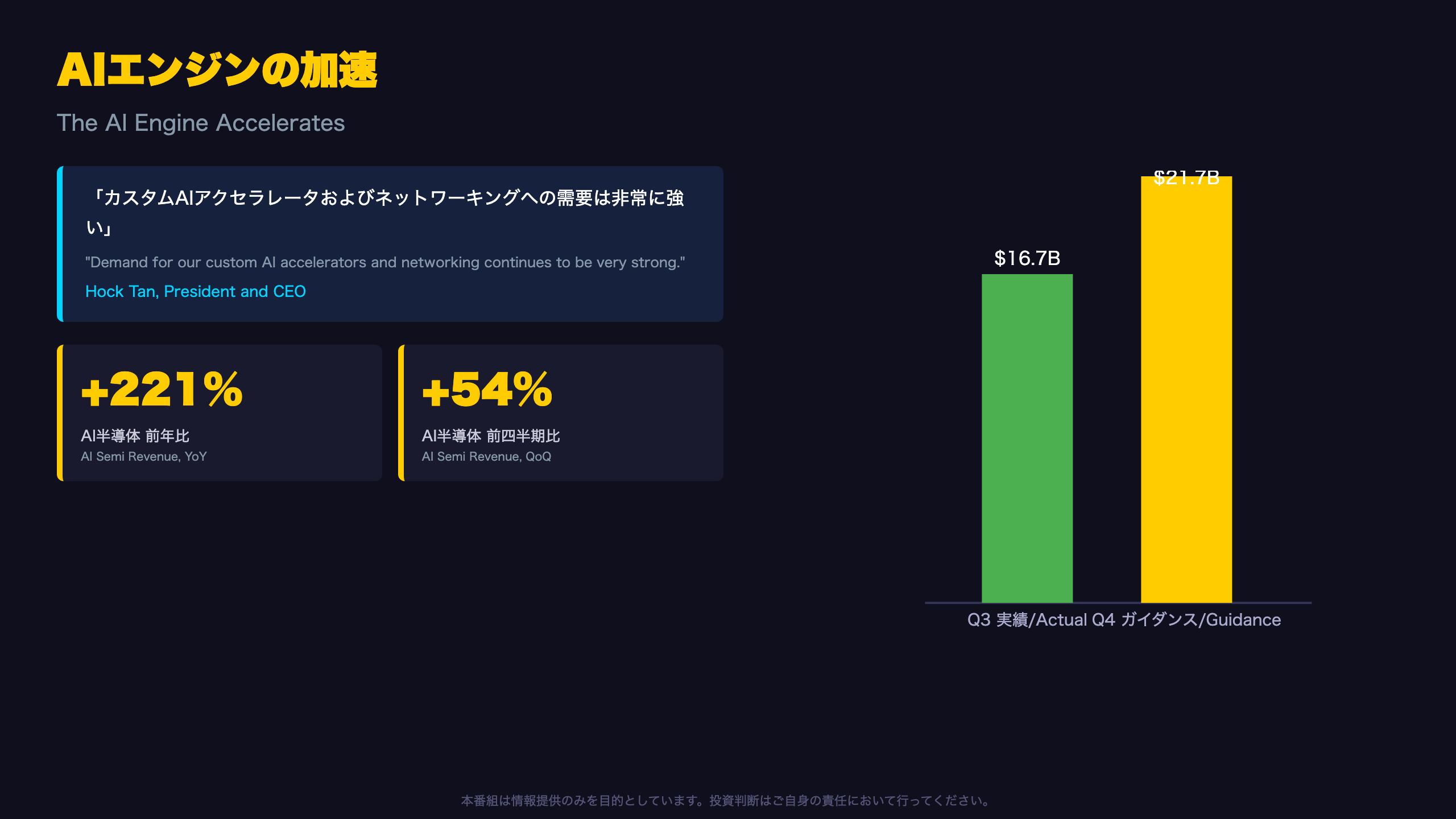
🚀 The engine: AI semiconductor revenue hit $16.7B, up 221% YoY and 54% QoQ.
⚠️ But infrastructure software grew just 29%, revealing rising concentration risk on a single AI-driven segment.
💡 Q4 guidance calls for $34.8B in revenue (+93% YoY). Whether AI demand sustains this pace is the next key question.
AI牽引の記録的決算 | Record Results Driven by AI
Context: What This 8-K Filing Represents
This report is Broadcom’s (NASDAQ: AVGO) Form 8-K Exhibit 99.1, the official U.S. earnings press release filed with the SEC for fiscal Q3 2026 (quarter ended August 2, 2026). Unlike a Japanese kessan tanshin, U.S. earnings releases typically pair GAAP results with company-defined non-GAAP metrics and detailed reconciliation tables.
The Headline Numbers in Global Context
Revenue of $29.6 billion, up 86% year-over-year, is a growth rate rarely seen among large-cap technology companies of Broadcom’s size. For comparison, major hyperscalers typically report cloud segment growth in the 20-30% range; Broadcom’s AI semiconductor segment grew 221% — a magnitude closer to early-stage growth companies than a mature, ~$190 billion-asset conglomerate.
Market Implications
Non-GAAP diluted EPS of $3.32 (up 96% YoY) will likely be measured against Wall Street consensus once published; this release itself discloses no consensus figure. Broadcom’s guidance of $34.8 billion in Q4 revenue (+93% YoY) reinforces the broader narrative of AI capital expenditure supporting U.S. tech equity valuations.
An Independent Read
Broadcom’s quarterly revenue was just $4.1 billion in early fiscal 2017. The current AI-driven inflection represents one of the steepest revenue acceleration curves in the company’s history as a semiconductor and infrastructure software supplier.
AIエンジンの加速 | The AI Engine Accelerates
Understanding “Custom AI Accelerators”
Broadcom’s AI semiconductor business primarily consists of custom ASICs designed for hyperscale cloud customers — distinct from Nvidia’s merchant GPU model. This is a crucial distinction for international investors: Broadcom co-designs silicon with a small number of large cloud providers rather than selling off-the-shelf chips broadly.
Sequential Acceleration
AI semiconductor revenue grew 54% sequentially to $16.7 billion in Q3 FY26. Management guided Q4 AI semiconductor revenue to $21.7 billion, implying the year-over-year growth rate itself accelerates from 221% to 236%.
CEO Hock Tan stated: “Demand for our custom AI accelerators and networking continues to be very strong.”
Market Implications
This acceleration reinforces the broader U.S. AI capex supercycle narrative already priced into names like Nvidia, AMD, and hyperscalers’ own capital expenditure guidance. For AVGO equity investors, the key risk is customer concentration — the filing does not disclose customer-level revenue breakdowns, a common limitation across the semiconductor sector’s ASIC suppliers.
A Note of Caution
Growth rates near 200%+ are mathematically difficult to sustain as the revenue base expands. Whether Q4’s guided $21.7 billion figure is achieved will be an important signal for whether AI infrastructure spending is broadening or concentrating among fewer hyperscale customers.
セグメント格差の拡大 | Diverging Segment Growth
Two Business Lines, Diverging Trajectories
Broadcom reports results across two segments: Semiconductor Solutions (custom AI ASICs, networking chips, broadband/wireless) and Infrastructure Software (anchored by VMware, acquired in 2023).
The Numbers
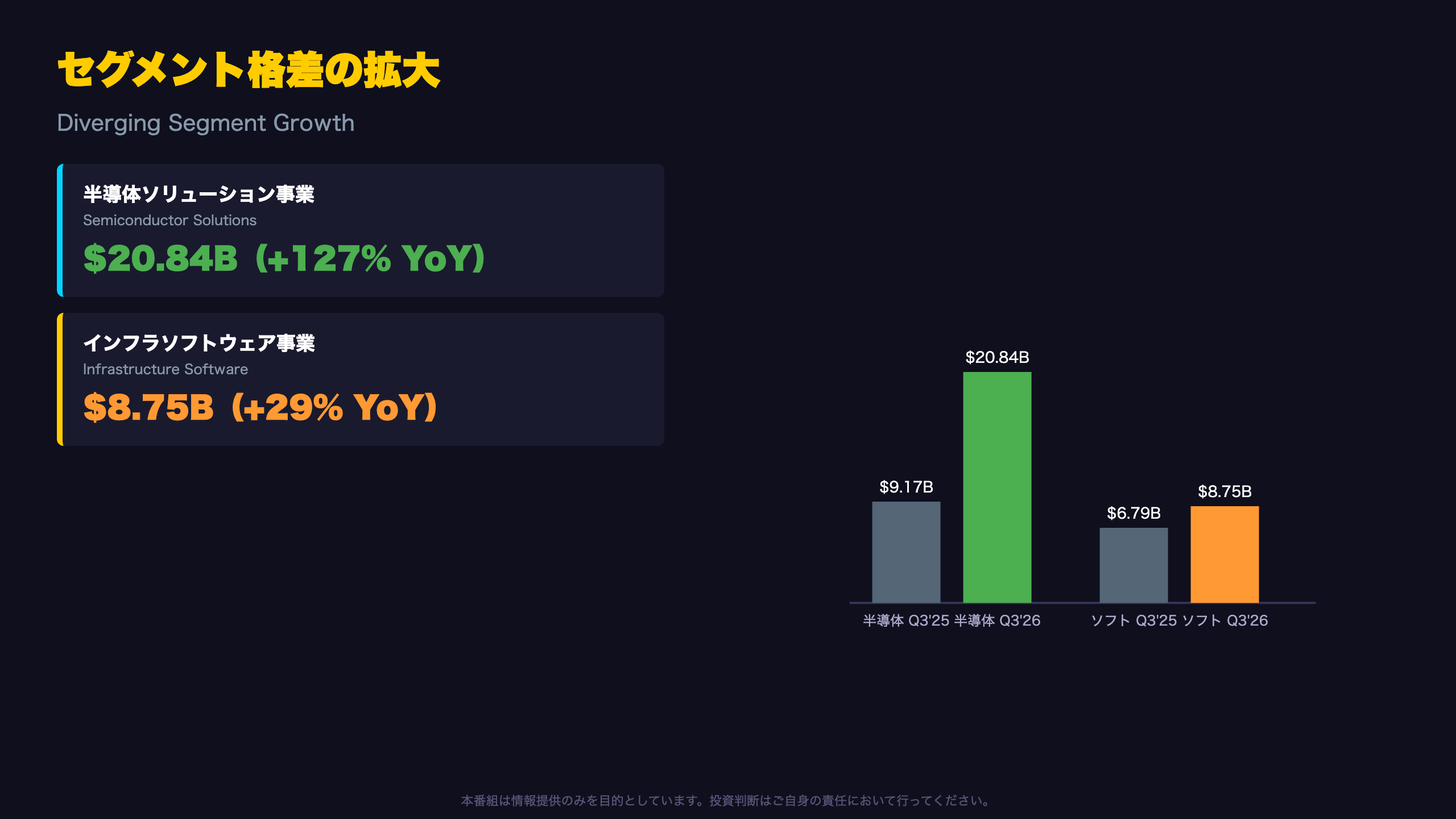
- Semiconductor Solutions: $20.839B in Q3 FY26 vs $9.166B in Q3 FY25 (+127% YoY), now 70% of total revenue (up from 57%)
- Infrastructure Software: $8.752B vs $6.786B (+29% YoY), now 30% of total revenue (down from 43%)
For context, U.S. enterprise software peers typically grow in the single-to-low-double digits, so 29% growth for the software segment is actually solid on a standalone basis — it simply looks modest next to AI-fueled semiconductor growth.
Two Readings
Bullish read: The semiconductor segment’s rising share reflects Broadcom’s successful positioning as a key AI infrastructure supplier, directly benefiting from hyperscaler capex growth.
Cautious read: A software segment growing at roughly a third of the company average suggests VMware integration synergies may be maturing, making consolidated growth an increasingly concentrated bet on a more cyclical semiconductor market.
This mix-shift is a critical variable for any relative valuation exercise comparing Broadcom to semiconductor-pure-play or software-focused peers.
GAAPとNon-GAAPの乖離、そして強固なキャッシュフロー | The GAAP-Non-GAAP Gap and Robust Cash Flow
Why GAAP and Non-GAAP Diverge So Much
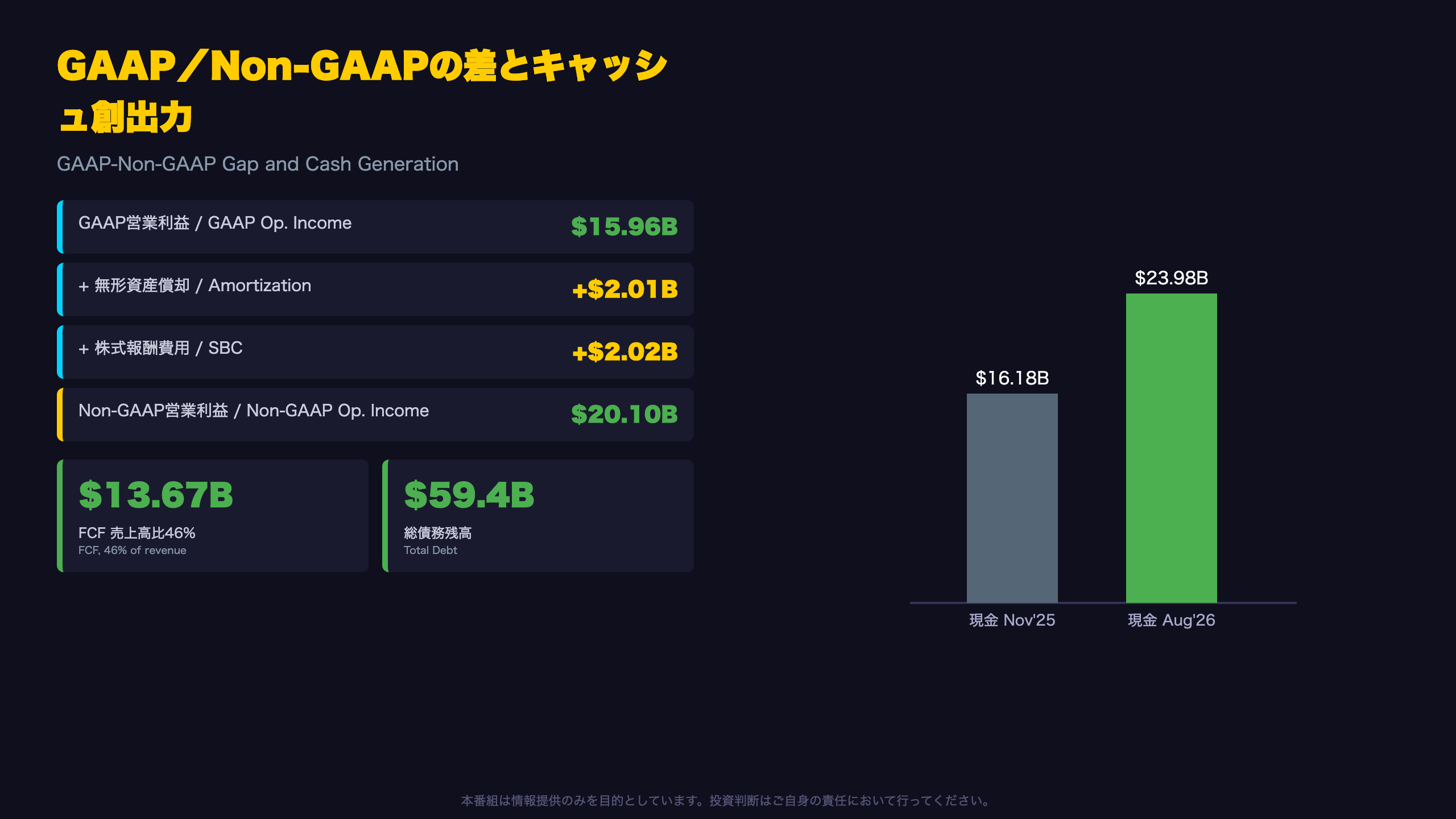
For investors unfamiliar with U.S. tech-sector reporting conventions, the gap between GAAP operating income ($15.955B) and non-GAAP operating income ($20.095B) — a $4.14B difference — mainly reflects two items: amortization of acquisition-related intangibles ($2.006B, largely a legacy of the 2023 VMware acquisition and earlier deals) and stock-based compensation ($2.019B). Unlike many Japanese companies, U.S. tech firms routinely exclude SBC from non-GAAP metrics, even though it represents real economic dilution — a point international investors should weigh when comparing AVGO’s non-GAAP EPS to peers with different SBC policies.
Cash Generation Is the Real Story
Operating cash flow of $14.197B (+98% YoY) and free cash flow of $13.665B (46% of revenue) reflect Broadcom’s asset-light model — capital expenditures were just $532 million, a fraction of what a capital-intensive chipmaker like TSMC would spend. This FCF margin ranks among the highest in large-cap technology.
Balance Sheet: Deleveraging in Progress
Total debt (short + long-term) stands at approximately $59.4 billion, down from $65.1 billion in November 2025, following $5.6 billion in debt repayments this quarter alone. Cash and equivalents grew to $23.975 billion.
Balanced View
Robust free cash flow supports both continued deleveraging and Broadcom’s $0.65/share quarterly dividend ($3.1 billion total). However, goodwill of $97.8 billion against total assets of $188.1 billion is a reminder that a meaningful share of the balance sheet reflects acquisition accounting rather than tangible operating assets.
第4四半期ガイダンスの読み方 | Reading the Q4 Guidance
Decoding the Fiscal Q4 Guidance
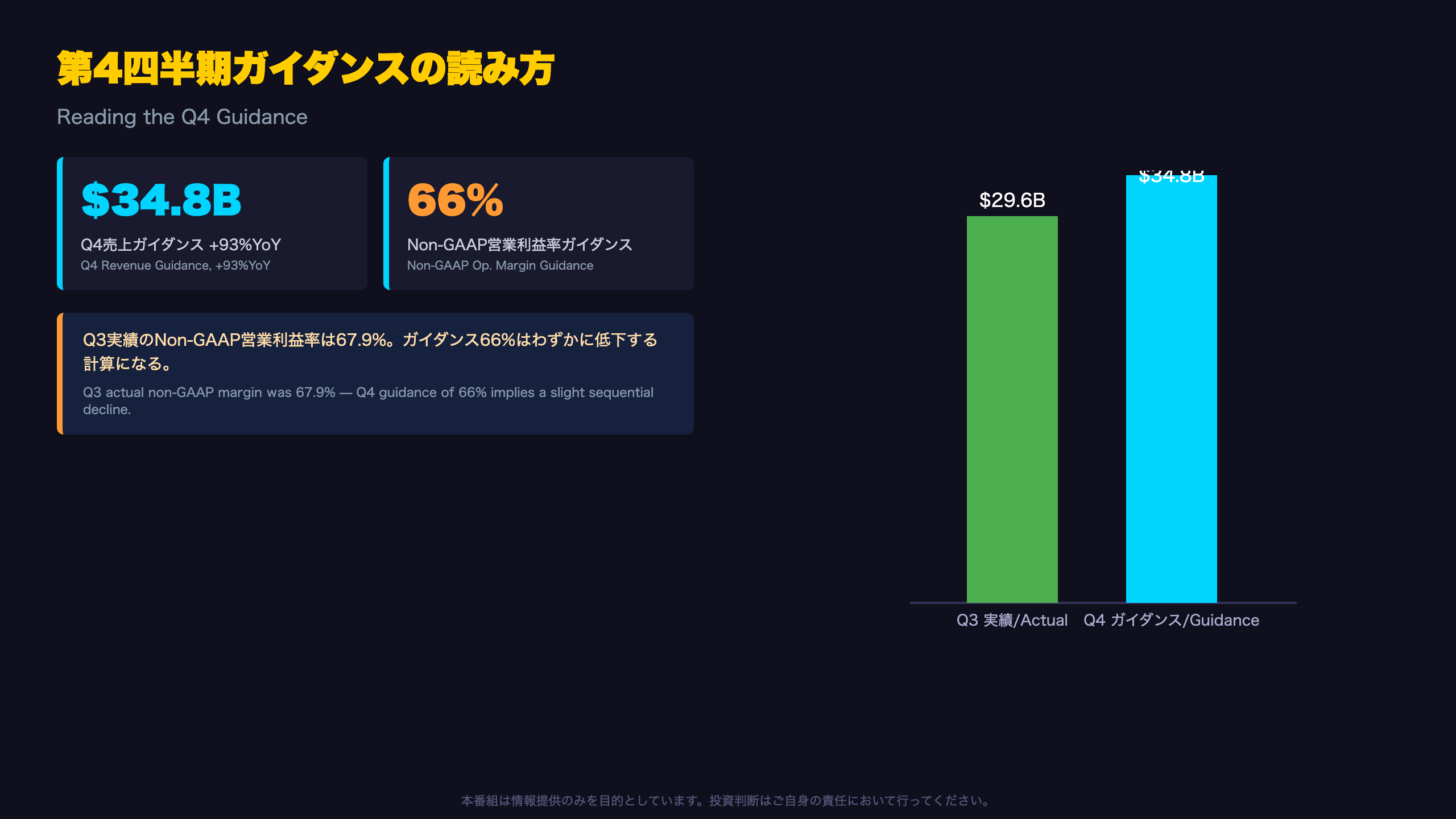
Broadcom’s fiscal Q4 revenue guidance of approximately $34.8 billion implies 17.6% sequential growth on top of Q3’s $29.591 billion, and 93% year-over-year growth — an acceleration from Q3’s already-elevated 86% pace. Among large-cap semiconductor names, sustained sequential growth above 15% for multiple consecutive quarters is historically rare outside major product-cycle inflections.
Margin Guidance: A Subtle Signal
CFO Amie Thuener guided non-GAAP operating margin to 66% of revenue, describing it as “flat from a year ago.” This represents a slight sequential step-down from Q3’s actual 67.9% margin — a nuance easy to miss amid headline growth figures. The filing does not explicitly state the cause, though mix shift toward AI ramp costs is one plausible factor.
AI Semiconductor Guidance
Q4 AI semiconductor revenue is guided to $21.7 billion (+236% YoY), roughly 62% of total guided revenue, up from 56% in Q3 — continuing the AI-driven concentration trend discussed earlier in this analysis.
Company’s Own Risk Disclosure
Broadcom’s press release states guidance “is only an estimate” and that “actual results will vary from the guidance and the variations may be material” — standard but important language for anyone modeling forward estimates off this data.
Looking Ahead
Broadcom’s fiscal Q4 2026 ends November 1, 2026. The key variable to watch is whether actual AI semiconductor revenue reaches the guided $21.7 billion, and whether operating margin holds at 66% amid continued AI infrastructure ramp costs.
Disclaimer: This article is for informational purposes only. All investment decisions are made solely at your own risk.