📺 Watch the Full Video Analysis
This article was automatically generated by the NFC Market Live AI analysis system. (Updated: 2026-10-22 17:29 JST)
📄 Primary Source
Statistics Norway
https://www.ssb.no/en/arbeid-og-lonn/sysselsetting/statistikk/arbeidskraftundersokelsen
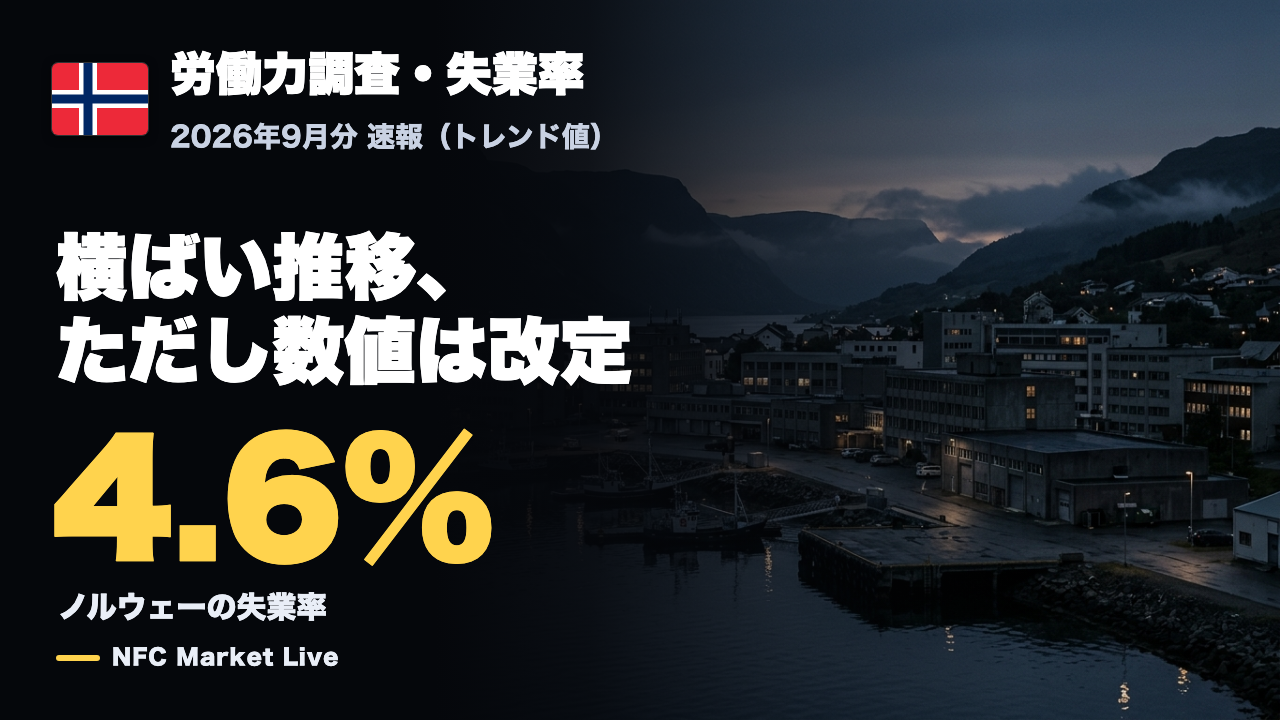
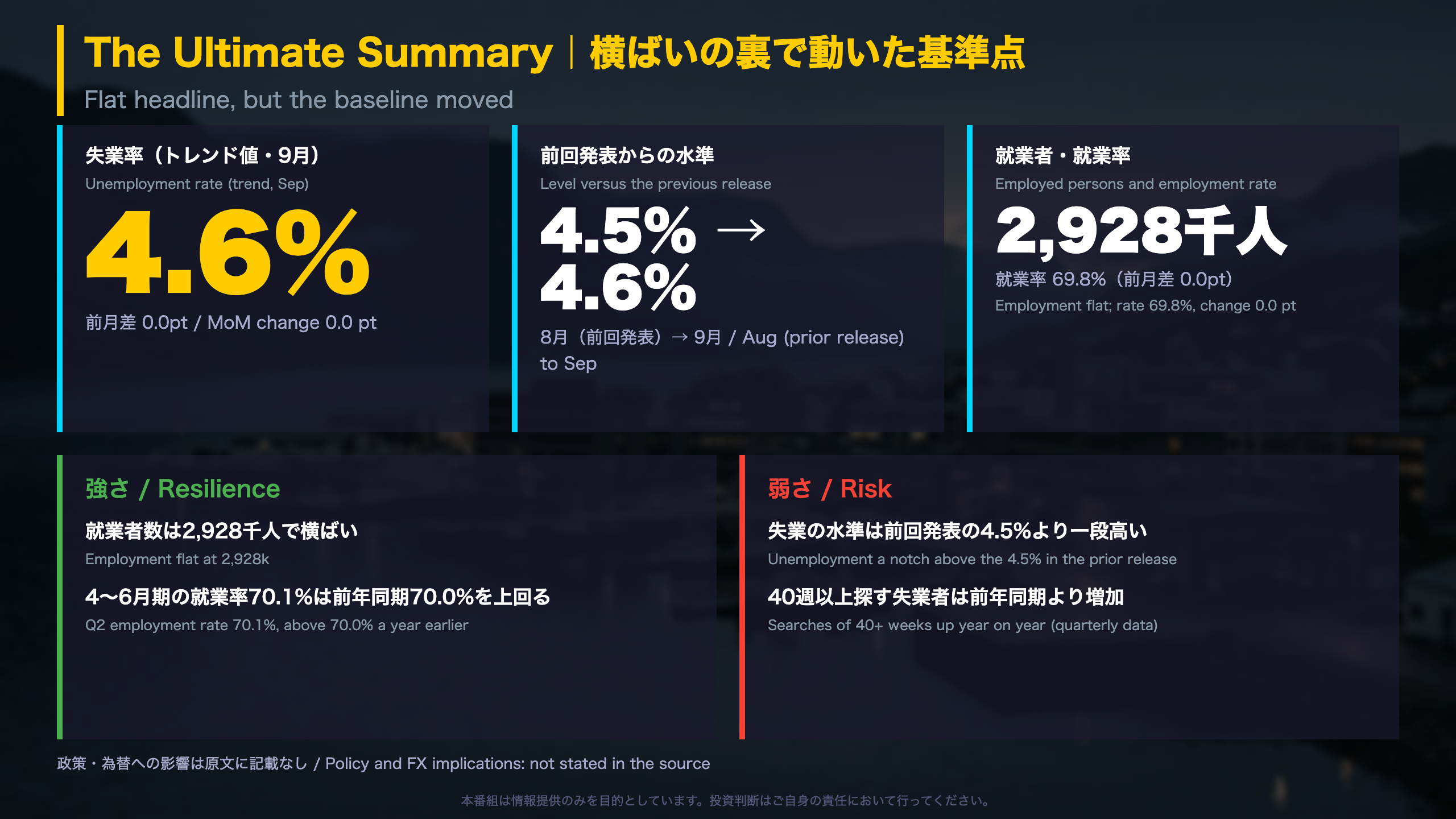
📊 Statistics Norway’s Labour Force Survey (September, trend): unemployment rate 4.6%, 141,000 unemployed. The monthly change is 0.0 pt, but the level sits a notch above the 4.5% shown for August in the previous release.
💡 Back-solving the published monthly change suggests August was revised up by roughly 4,000 people. Employment is flat at 2,928,000 and the employment rate is 69.8%.
⚠️ In the quarterly detail, people searching for 40+ weeks rose to 25,000 from 21,000 a year earlier, while the Q2 employment rate of 70.1% beat the year-earlier 70.0%.
📈 A balanced read of strengths and risks using only the release data. Next update: 5 November 2026.
The Ultimate Summary|横ばいの裏で動いた基準点
Norway’s September Labour Force Survey: Unpacking a Flat Headline
Who publishes it? Statistics Norway (SSB) runs the monthly Labour Force Survey (LFS), an interview-based survey using ILO/EU definitions. That makes the unemployment rate broadly comparable with the US household-survey rate or Eurostat’s series. It is not the same as the number registered with the Norwegian welfare agency (Nav).
Key numbers (trend, ages 15-74)
| Metric | Sep 2026 | Change | Previous release (Aug) |
|---|---|---|---|
| Unemployed | 141,000 | +1,000 | 136,000 |
| Unemployment rate | 4.6% | 0.0 pt | 4.5% |
| Employed | 2,928,000 | +1,000 | 2,928,000 |
| Employment rate | 69.8% | 0.0 pt | 69.9% |
Context
- Annual average unemployment was 4.0% in 2024 and 4.5% in 2025, so 4.6% sits slightly above last year’s average.
- Unadjusted quarterly rates were 4.8% in both Q1 and Q2 2026.
Reading the revision
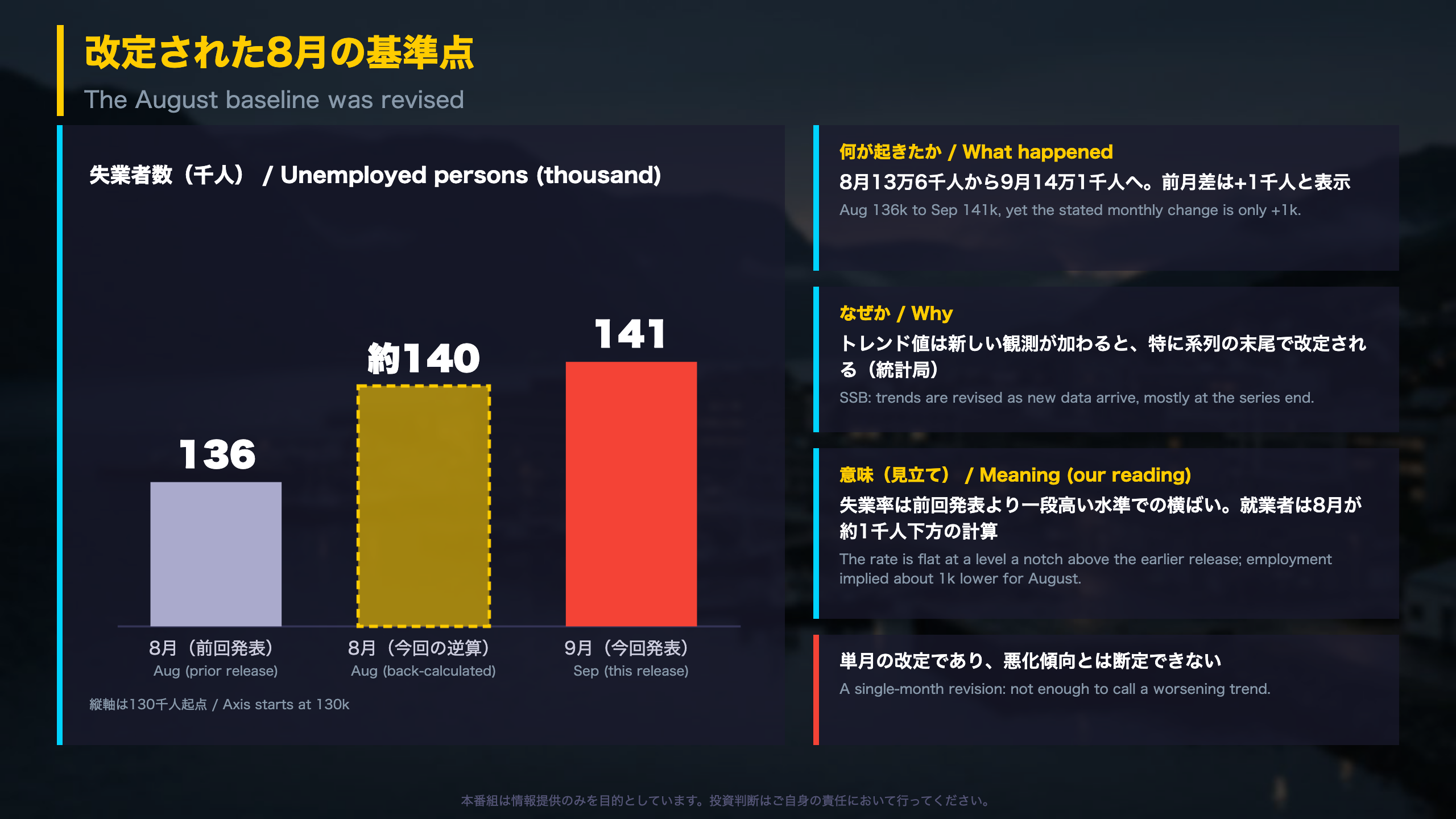
The zero change hides a shift in the starting point. Back-solving the published monthly changes suggests August was revised up by roughly 4,000 unemployed. SSB itself notes that trend figures are revised most at the end of the series.
Policy and market angle
The release contains no guidance on Norges Bank, the krone or bond yields, and we do not infer any. It is one input for a central bank that also tracks inflation and wages.
What next
The next update is 5 November 2026. The first test is how much the September trend figure is revised.
改定された8月の基準点
Why ‘Flat’ Can Still Mean ‘A Notch Higher’: Trend Revisions in Norway’s LFS
The arithmetic
In the 23 September release, August trend unemployment was 136,000 (4.5%). In the 22 October release, September is 141,000 with a stated monthly change of just +1,000. Since 141,000 minus 1,000 is 140,000, August was most likely revised up by around 4,000. Employment shows a small mirror image: August was 2,928,000, while September is 2,928,000 with +1,000, implying a downward revision of about 1,000. These are back-calculations affected by rounding, not published revisions.
Why SSB trends get revised
SSB’s trend is a smoothed series built with Henderson moving averages and asymmetric filters at the end. Its methodology notes say the trend can be slightly revised when new observations arrive, especially at the end of the series, and that first-month-of-quarter figures are re-estimated with late interviews and updated register data. SSB also advises users to rely on trends or three-month averages rather than the volatile monthly seasonally adjusted figures.
Two readings
- Noise view: sampling error plus end-point filtering can produce this gap, and SSB warns that confidence intervals for changes can be large.
- Level-shift view: against a 2025 average of 4.5%, a drift to 4.6% is plausible.
A single month cannot settle it.
Comparison and caveat
Like most statistical agencies, SSB revises recent data as more responses and register information arrive. The LFS is a sample survey, so small moves of 0.1 pt are within normal noise. This is why we describe the revision as a possibility, not a fact.
Watch
5 November 2026: does 4.6% hold, or does it move to 4.5% or 4.7%?
失業の中身:底堅い就業と長期化
Inside Norway’s Unemployment: Duration, Age and Gender
Duration of job search (April-June, thousands)
| Duration | Q2 2025 | Q2 2026 |
|---|---|---|
| 1-4 weeks | 46 | 40 |
| 5-13 weeks | 30 | 32 |
| 14-26 weeks | 23 | 22 |
| 27-39 weeks | 6 | 7 |
| 40-52 weeks | 10 | 14 |
| 53+ weeks | 11 | 11 |
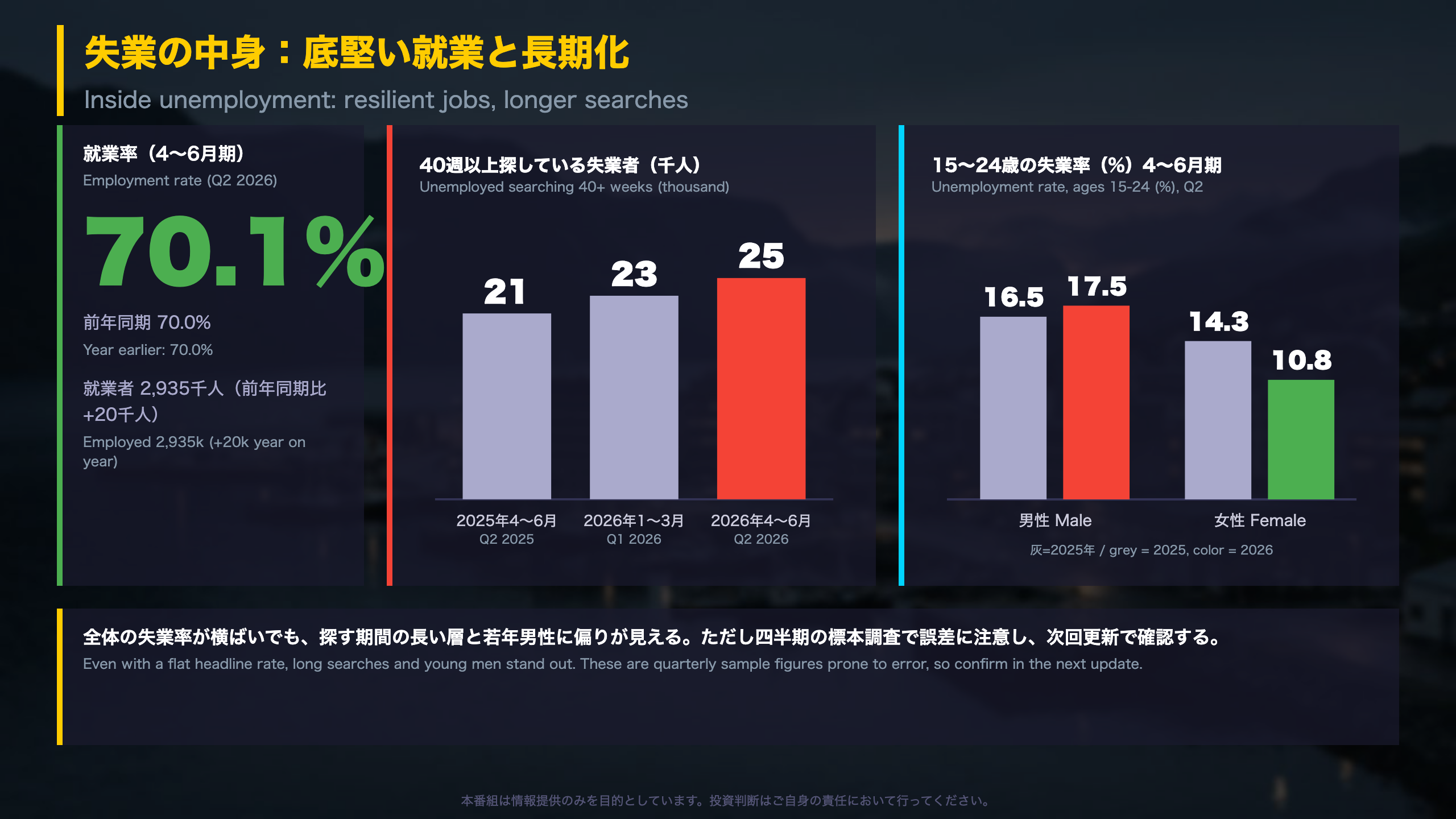
Short searches (1-4 weeks) fell, while the 40+ week group rose from 21,000 to 25,000, or from roughly 14% to 17% of all unemployed. The table’s categories are rounded, so the sum is approximate.
Unemployment rate by age (Q2, unadjusted)
- Ages 15-24: 15.4% to 14.3% (lower)
- Ages 25-54: 3.2% to 3.5% (slightly higher)
- Ages 55-74: 2.8% to 2.0% (lower)
Young men rose from 16.5% to 17.5%, while young women fell from 14.3% to 10.8%.
Two ways to read it
- Constructive: the employment rate of 70.1% beat 70.0% a year earlier, employed persons rose by about 20,000, and very short searches declined.
- Cautious: more people are stuck in long searches, and the prime-age (25-54) rate edged up, even though the headline is flat.
Why not over-read it
SSB warns that confidence intervals for changes can be so large that one cannot say for certain a change has occurred. Quarterly breakdowns by age and sex rest on small cells, so they are signals to verify, not conclusions.
International context
The LFS follows ILO/EU definitions, so the age and duration cuts are comparable with other European surveys and the US household survey. No policy implication is stated in the release.
質疑で深める:何が確認できるか
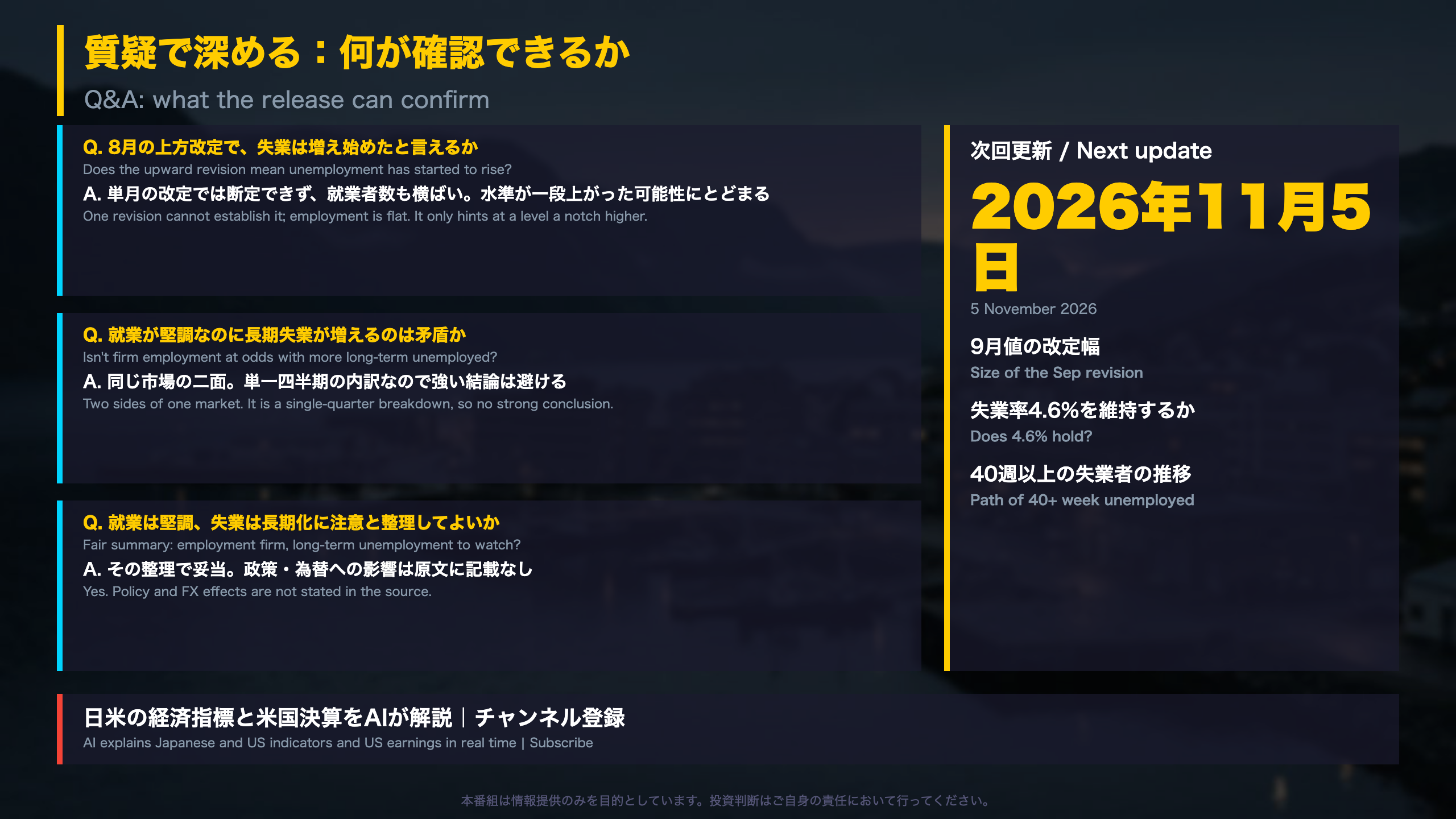
Q&A Backgrounder: What the Release Can and Cannot Tell Us
What the data confirm
- September unemployment rate: 4.6%, monthly change 0.0 pt.
- Employed persons: 2,928,000, monthly change +1,000.
- August’s baseline appears to have moved up from the previously published value (back-solved).
What the data do not confirm
- Any effect on policy rates, the krone or bond yields: nothing is stated in the source, and we draw no inference. Norges Bank, Norway’s central bank, looks at labour data alongside other indicators; this release alone gives no basis for a rate view.
- Whether the rise in long-term unemployment is temporary or persistent: only one quarter of data is available.
Competing interpretations
Optimists point to the stable employment rate and the fall in very short searches (1-4 weeks) as evidence of a balanced market. Cautious readers point to the rise in 40+ week unemployment and the uptick in the 25-54 rate (3.2% to 3.5%) as signs of growing friction beneath a solid surface. The two views are compatible: they describe two sides of the same labour market.
LFS versus registered unemployment
SSB states that LFS unemployment differs from the number registered at the employment offices (Nav). The LFS is an interview survey using ILO/EU definitions, similar in spirit to the US household survey, so it captures people actively seeking and available for work regardless of registration.
What to watch next
- Release date: 5 November 2026
- Focus: the size of the September revision, whether 4.6% holds, and the path of 40+ week unemployment.
Disclaimer: This article is for informational purposes only. All investment decisions are made solely at your own risk.