📺 Watch the Full Video Analysis
This article was automatically generated by the NFC Market Live AI analysis system. (Updated: 2026-10-22 17:29 JST)
📄 Primary Source
NFC Market Live
https://www.snb.ch/public/asset/en/www-snb-ch/publications/communication/summaries/zus_20261022/publications0_en/zus_20261022.en.pdf
📊 A deep dive into the SNB’s summary of discussion for its September meeting, published Oct 22. The policy rate was held at 0%.
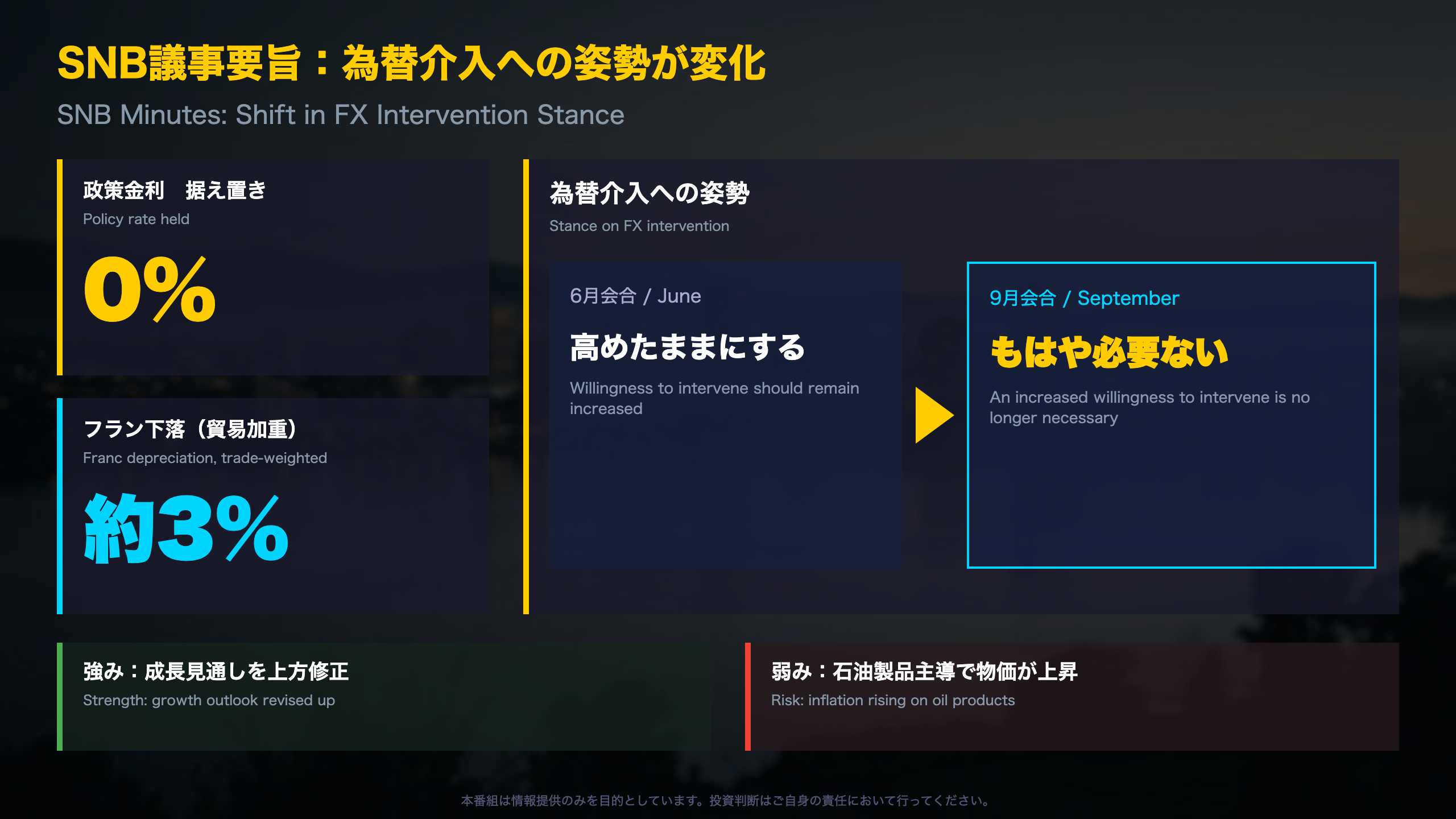
💡 The biggest change: language on FX intervention. In June the board kept its heightened willingness to intervene; now it says that is no longer necessary. The franc fell about 3% and monetary conditions eased.
📈 August inflation was 0.8%, core 0.6%. The 2026 GDP forecast was raised to 1.5-2.0%.
⚠️ Still, oil-driven inflation and Middle East uncertainty remain; the longer oil stays high, the greater the second-round risk.
🔎 Both strengths and risks are covered.
サマリー:介入姿勢の変化と強弱混在
What this document is
The SNB’s ‘Summary of discussion’ is published about four weeks after each quarterly assessment. It records what the Governing Board and its alternate members debated before the decision, and it is the Swiss counterpart to the minutes or summaries issued by other central banks. The September 22-23 decision was taken by Chairman Martin Schlegel, Vice Chairman Antoine Martin and Member Petra Tschudin. The text gives no vote breakdown, so no hawk/dove split can be measured from it.
What changed versus June
- Policy rate: unchanged at 0%.
- FX stance: in June the board said its willingness to intervene should remain increased; now it says that is ‘no longer necessary in the current environment’. The SNB remains willing to be active in the foreign exchange market ‘as necessary’.
- Inflation: 0.8% in August versus 0.6% in May, driven by oil products; trimmed-mean core (TM15) 0.6%.
- Growth: the 2026 GDP forecast moved from around 1% to 1.5-2.0%; 2027 stays around 1.5%.
Context for non-Swiss readers
Swiss inflation is far below the levels seen in the euro area or the US in recent years, and the policy rate is at 0%. The document notes that key rates were raised in both the euro area and the US over the period, which widened interest rate gaps with Switzerland. The franc is also a currency where exchange-rate moves feed directly into monetary conditions, which is why the SNB discusses FX alongside rates.
Balanced reading
Strengths: broad-based business turnover, upgraded growth, inflation within the price-stability range across the forecast horizon. Risks: oil-driven prices, a somewhat elevated unemployment rate, and high uncertainty tied to the Middle East. The date of the next assessment is not given in the text.
注目点1:フラン下落と金融環境の緩和
The franc story in the minutes
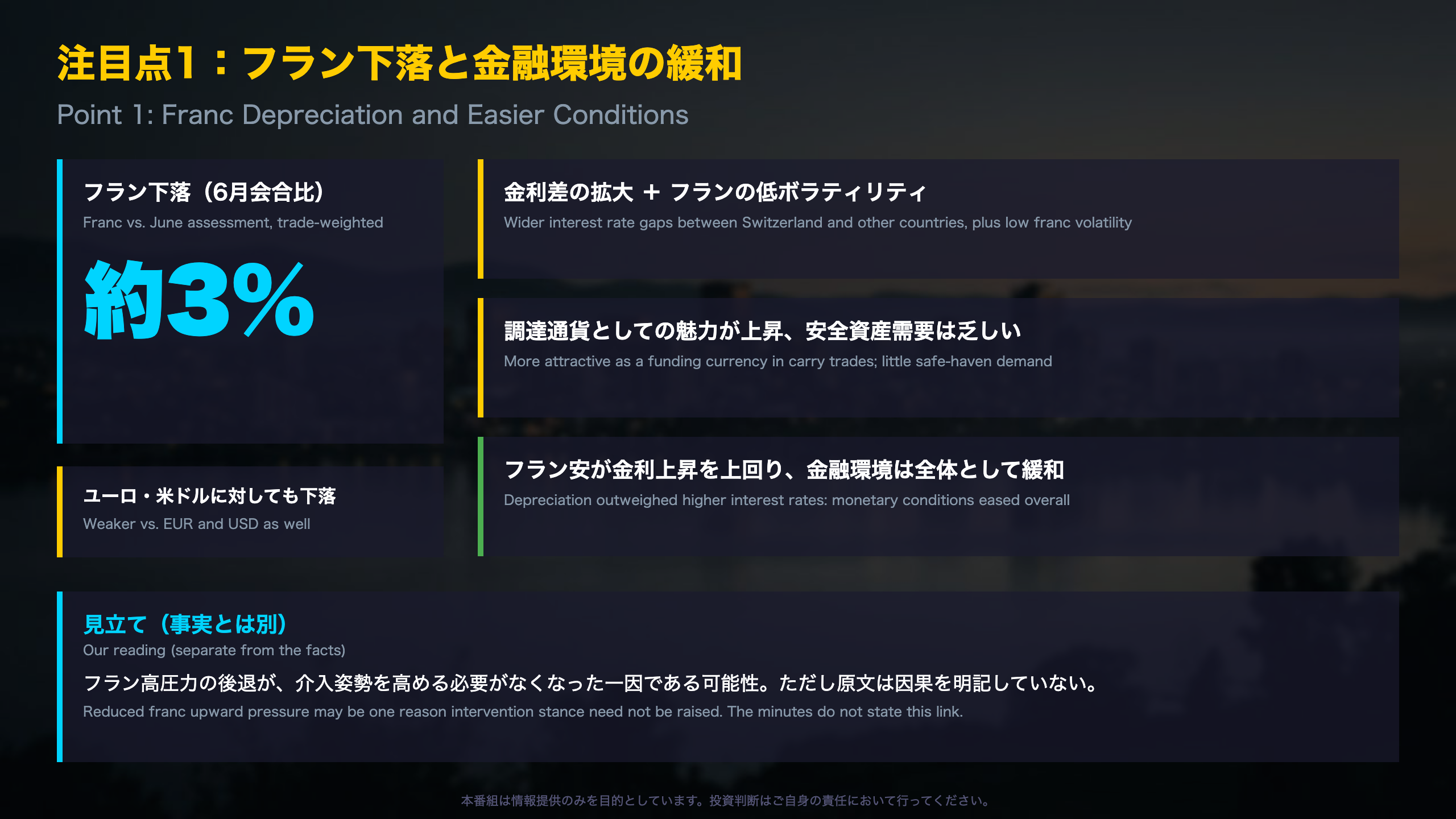
The minutes record a roughly 3% decline in the franc on a trade-weighted basis since the June assessment, with weakness against both the euro and the US dollar. The board links this to wider interest rate differentials between Switzerland and other countries, which together with low franc volatility made the franc attractive as a funding currency in carry trades (borrow in a low-yielding currency, invest elsewhere). Safe-haven demand for the franc was described as limited.
Why it matters for Swiss policy
Switzerland is a small open economy, so the exchange rate is a core part of monetary conditions, as important as the policy rate. The board concluded that the franc’s depreciation outweighed the modest rise in interest rates, so conditions eased overall. It also noted well-anchored inflation expectations and that excess liquidity is consistent with medium-term price stability.
Comparison with other central banks
The Fed and the ECB are usually described in terms of rate paths. The SNB, with its rate at 0%, relies on a second tool: foreign exchange market activity. That is why a change in intervention wording is read closely. The text itself says the SNB ‘is also willing to be active in the foreign exchange market as necessary to ensure appropriate monetary conditions’.
What to watch
The minutes do not explicitly connect the weaker franc to the change in intervention language, so that link is an interpretation. Watch whether the wording is repeated in the next summary and whether interest rate differentials stay wide. Exchange rate developments remain listed among the risks to the growth and inflation outlook.
注目点2:物価は小幅上昇、広がりは限定的
Inside the inflation numbers
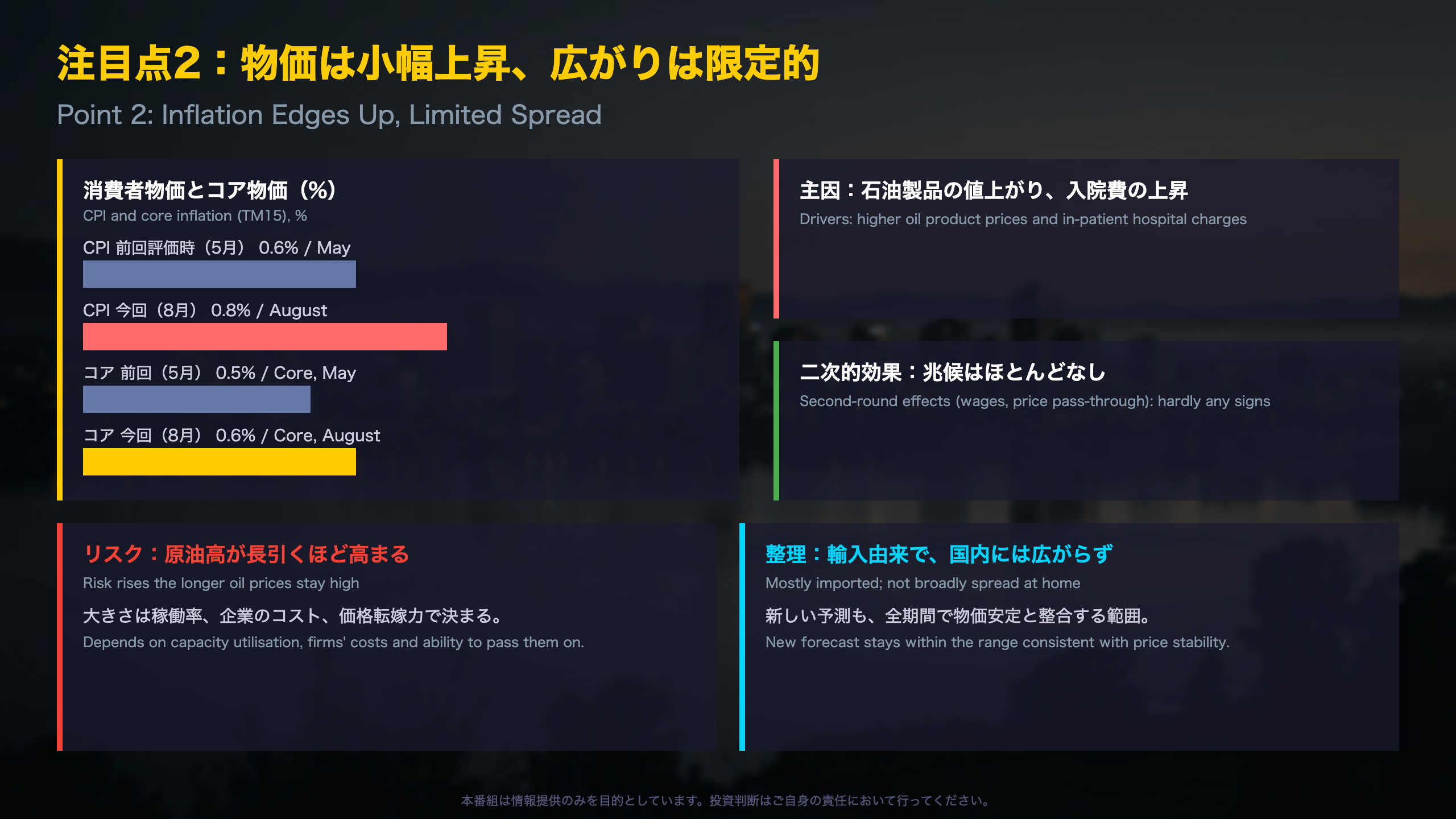
Swiss CPI inflation reached 0.8% in August, up from 0.6% in May, which was the figure cited at the June assessment. The SNB’s preferred underlying gauge, the trimmed mean (TM15), edged up from 0.5% to 0.6%. The minutes note that, since the start of the year, price developments for goods and services have been roughly in line with the long-term average, and that August also reflected higher in-patient hospital charges.
Why oil products rose faster than crude
Capacity constraints at crude oil refineries pushed the prices of petrol, diesel and heating oil up by more than crude itself. The delegates who talk to companies say how fast filling stations pass this through depends on their purchasing policies and local competition.
Company survey signals
- Short-term inflation expectations somewhat lower; medium-term unchanged
- Wage increases expected to be moderate again next year
- Purchase prices rising for oil-based products, and for software and cloud fees
- Longer delivery times, but no coronavirus-style supply chain disruptions
International comparison
Swiss inflation is much lower than in many large economies, where the minutes say inflation is above central bank targets mostly because of energy. The SNB frames Swiss inflation as imported, which is why second-round effects, meaning wage and price spirals, are the key thing it monitors.
Balanced view
Calm: core inflation is up only slightly, labour markets operate at normal capacity, and the forecast stays within the price-stability range. Caution: the minutes say the longer oil prices stay high, the greater the second-round risk. The next data points are further CPI and core readings.
質疑で深める:介入姿勢・物価・成長
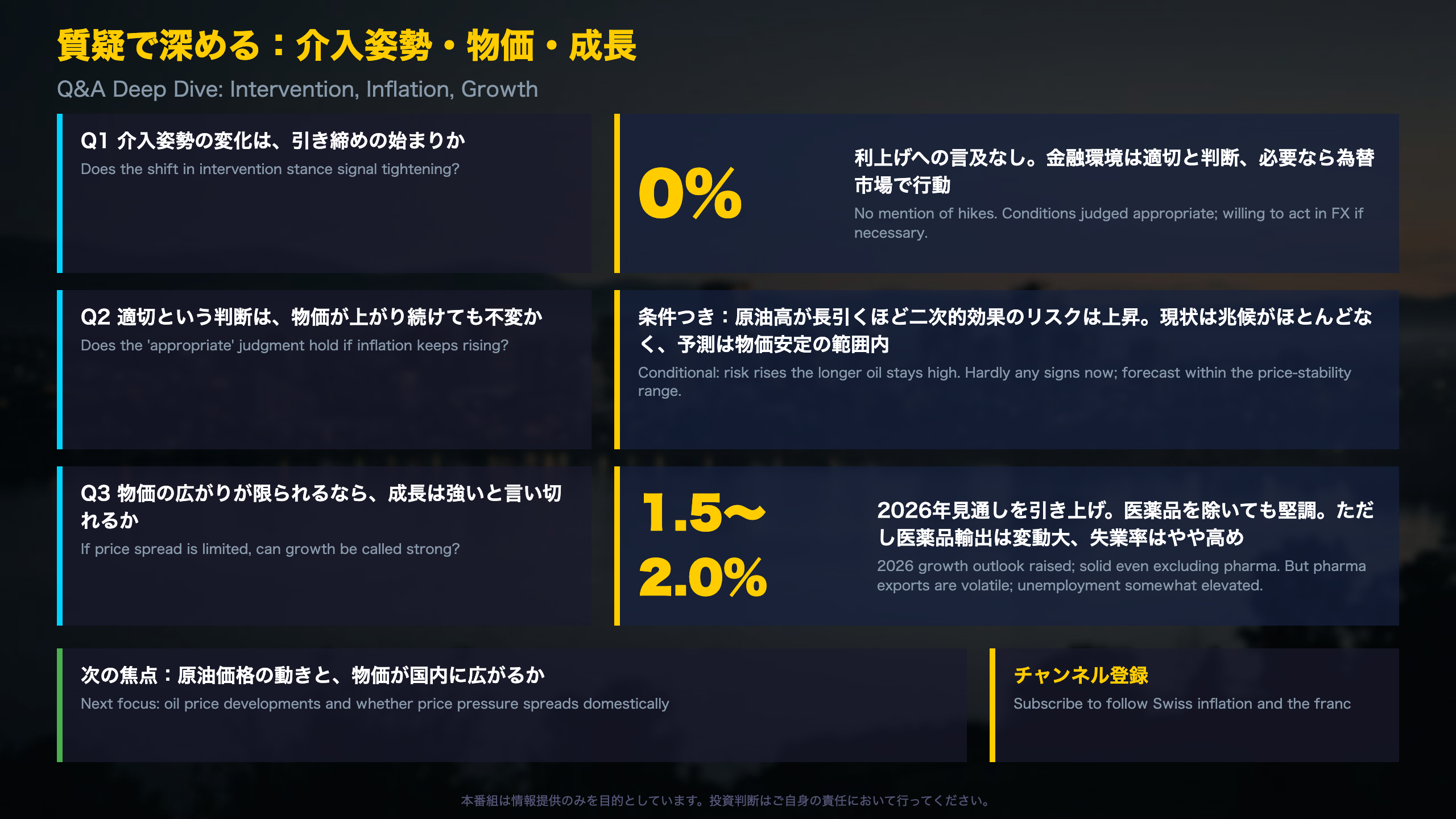
Growth and the labour market
Second-quarter GDP growth was exceptionally strong because of the chemicals and pharmaceuticals industry, which is notoriously volatile in Swiss data. The minutes stress that even without this one-off effect growth was solid and broad-based. Company talks by the SNB’s regional delegates show broad-based third-quarter turnover, including in manufacturing, though parts of watchmaking and some automotive suppliers lacked momentum. Capacity utilisation in manufacturing improved but stayed below average.
AI and jobs
The board discussed whether AI could raise structural unemployment and weigh on consumption. It called it ‘too early’ to say. Unemployment in services, including IT and finance, is somewhat higher than the economic situation would suggest, and the cause is unclear. Unemployment rose slightly in Q2 while employment also increased, so both must be read together.
Global backdrop
The minutes report stronger-than-expected global growth in Q2 and note that key rates were raised in the euro area and the US. Inflation abroad is described as above central bank targets, notably because of energy. The biggest global risks cited: the Middle East, trade tensions, high technology stock valuations and fiscal policy.
Balanced read-across
Strengths: upgraded 2026 growth to 1.5-2.0%, 2027 steady at around 1.5%, hiring plans among surveyed firms. Risks: volatile pharmaceutical exports, somewhat elevated unemployment, and a risk of second-round effects if oil stays high. The minutes give no date for the next assessment.
Disclaimer: This article is for informational purposes only. All investment decisions are made solely at your own risk.