📺 Watch the Full Video Analysis
This article was automatically generated by the NFC Market Live AI analysis system. (Updated: 2026-11-06 04:17 JST)
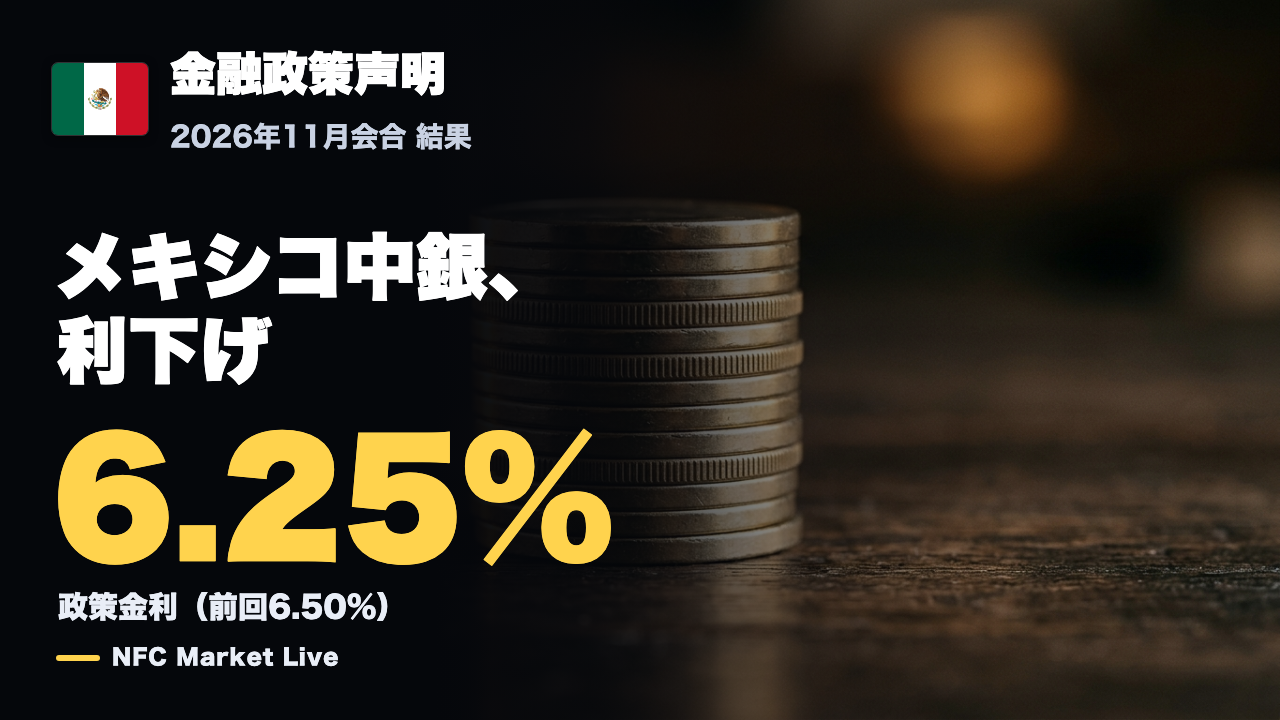
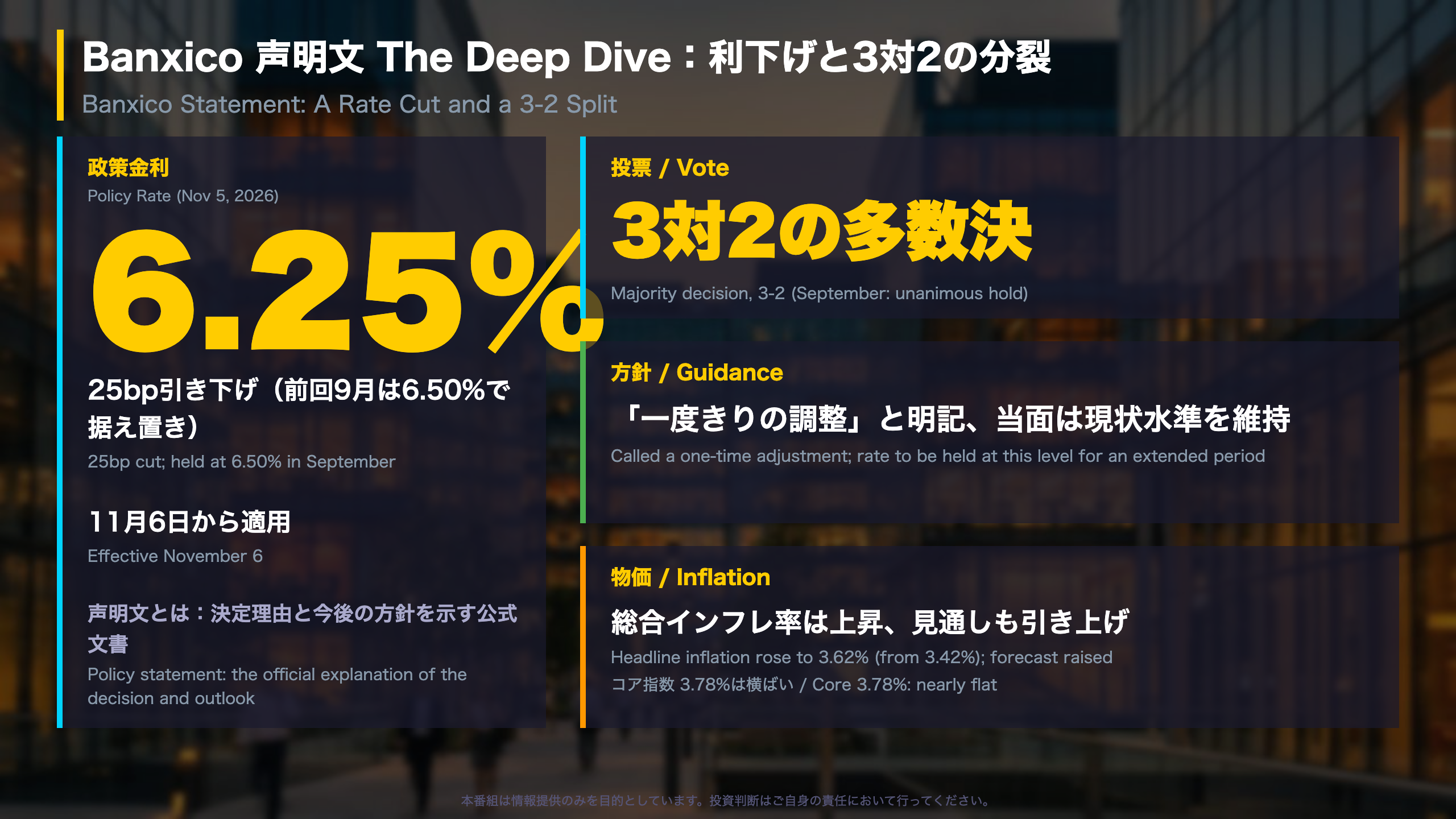
📊 Banxico cut its policy rate by 25bp to 6.25% on Nov 5. The decision was a 3-2 majority vote, after a unanimous hold in September.
📝 The statement calls the move ‘a one-time adjustment’ and says the rate will be held at the attained level for an extended period.
📈 Headline inflation rose to 3.62% while core was nearly flat at 3.78%. The Q4 2026 headline forecast was raised from 3.5% to 3.7%.
💡 Growth kept expanding and no demand-side pressures were perceived, yet risks to inflation remain tilted to the upside. We compare the wording with September’s statement.
The Ultimate Summary:利下げと3対2の分裂
Banxico’s November statement at a glance
Banco de México (Banxico) is Mexico’s central bank. On November 5 its five-member Governing Board lowered the overnight interbank target rate by 25 basis points to 6.25%, effective November 6. At the September 24 meeting it had held at 6.50% unanimously.
What changed versus September
- Vote: unanimous hold in September; 3-2 majority for the cut now.
- Growth wording: September said the economy had moderated its rate of expansion in Q3; November says it continued expanding.
- Inflation: headline rose from 3.42% to 3.62% (first half of September to first half of October) on non-core prices; core eased marginally from 3.79% to 3.78%.
- Global backdrop: the Fed held in October after raising 25bp in September, and long-dated US yields reached levels unseen in several decades.
Why it matters internationally
Banxico’s real policy rate is high relative to many peers, and unlike the Fed or ECB it frames each decision around the peso’s pass-through to prices and domestic slack. Compare this with the Bank of Japan, which watches wages and services prices: Banxico’s statement is built around core inflation, non-core energy and agricultural prices, and the exchange rate.
Independent read
The board cut but labelled it a one-time adjustment and signaled a long hold. A cut paired with a hawkish-sounding guidance and two dissents is best read as cautious easing, not the start of a clearly defined cycle. The statement gives no date for the next meeting and no market expectations; this analysis relies only on the released text.
The Red-line Analysis①:投票の分裂と方針文言

Vote split and forward guidance: a closer look
How the Governing Board voted
Banxico’s board has five members. In September all five voted to hold at 6.50%. On November 5 three (Victoria Rodriguez, Gabriel Cuadra, Omar Mejia) voted for a 25bp cut, while Galia Borja and Jonathan Heath voted to hold. The statement does not explain the dissenters’ reasoning.
Wording changes that matter
- New: the cut is described as a one-time adjustment, and the board says holding the rate at the attained level for an extended period will support convergence of inflation to target.
- Dropped: September’s line that policy would not have to react mechanically to anticipated Fed adjustments, along with the reference to differences between the Mexican and US economic cycles.
- Rationale: November adds that, under prevailing slack, exchange-rate pass-through to consumer prices would be limited.
International comparison
Central banks often pair a cut with guidance to anchor expectations. The Fed’s dot plot and the BOJ’s outlook report give numerical paths; Banxico gives none and instead signals a long pause in words. For global investors, the practical signal lies in the combination of a small cut, explicit pause language and a divided vote.
Two readings
- Cautious easing: small step, long hold, two dissents, upward-biased inflation risks.
- Policy pivot: the first cut after a hold is itself a regime change.
Neither is stated by the board; both are interpretations. The date of the next meeting is not in this document.
The Red-line Analysis②:物価と景気の評価
Inflation, growth and the forecast table
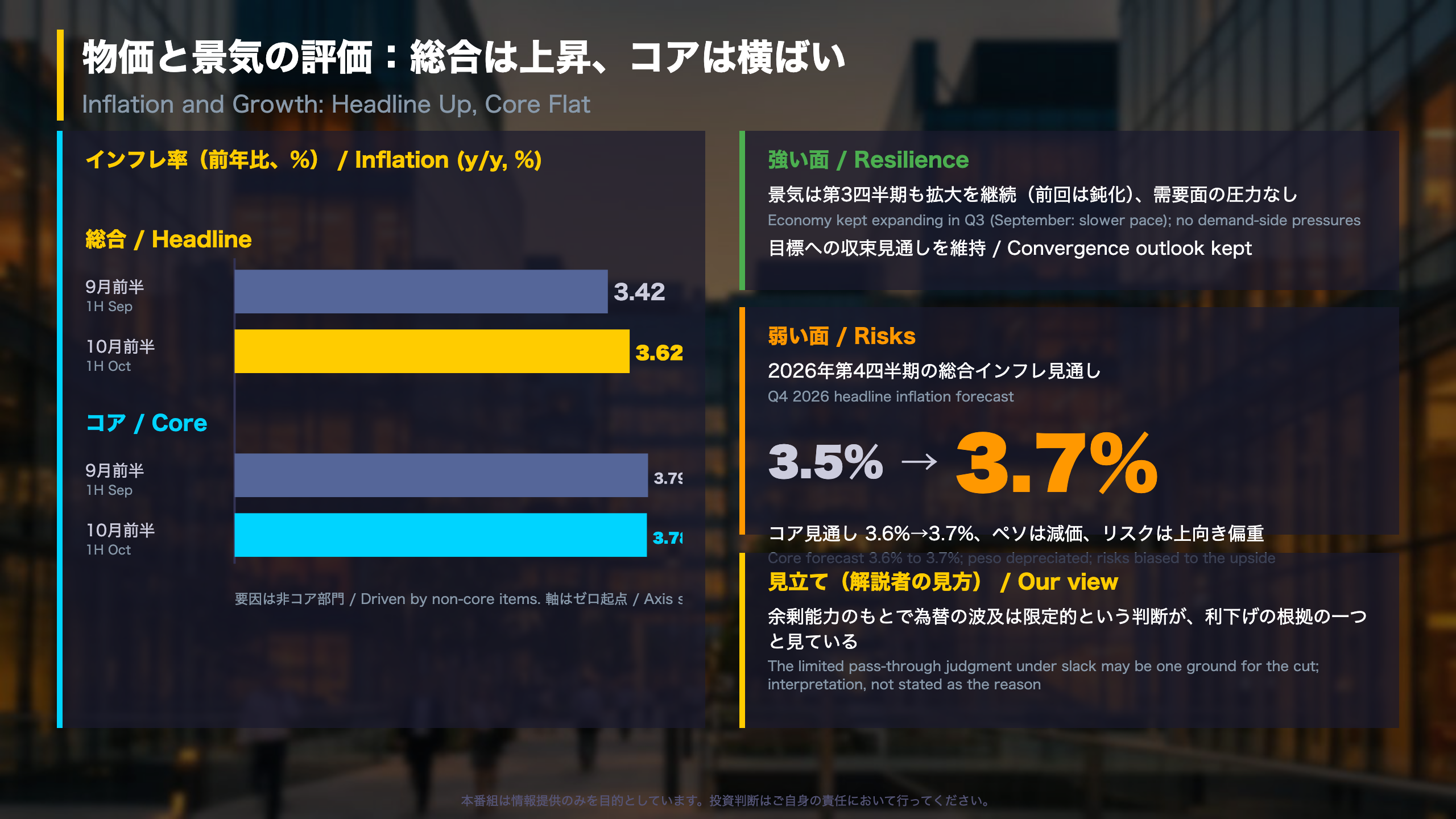
Inflation path (annual %, half-month readings)
| Period | Headline | Core |
|---|---|---|
| 1H July | 3.10 | 3.95 |
| 1H Sept | 3.42 | 3.79 |
| 1H Oct | 3.62 | 3.78 |
Headline inflation has risen for two straight meetings on non-core prices (a basket that includes more volatile items). Core inflation has drifted lower, but the latest move was only 0.01 point.
Forecast revisions (quarterly average, y/y)
- Q4 2026 headline: 3.5% to 3.7%; core: 3.6% to 3.7%.
- Q4 2027: both still 3.0%, so the convergence-to-target timing is unchanged.
- Seasonally adjusted annualized q/q: Q4 2026 headline 4.0% to 4.4%, core 3.2% to 3.4%.
Risk list
A greater depreciation of the peso now appears among upside risks, and the downside item on currency strength was softened from appreciation ‘since last year’ to ‘episodes’ of appreciation. The overall balance remains biased to the upside.
Comparison and context
Unlike the US CPI, which the Fed tracks through PCE and core services, Mexico’s statement separates core from non-core (agricultural and energy-type) prices, so a headline rise driven by non-core items is read differently from a core-led rise. Growth is described positively: the economy kept expanding, with no demand-side pressures.
Reading both sides
Resilience: expansion, contained core, working monetary restriction. Risk: higher headline, upgraded forecast, weaker peso. The next data points are the half-monthly CPI releases.
質疑で深める:為替・長期維持・次の注目点
Q&A follow-up: inputs and fault lines in the guidance
What the board says it will weigh
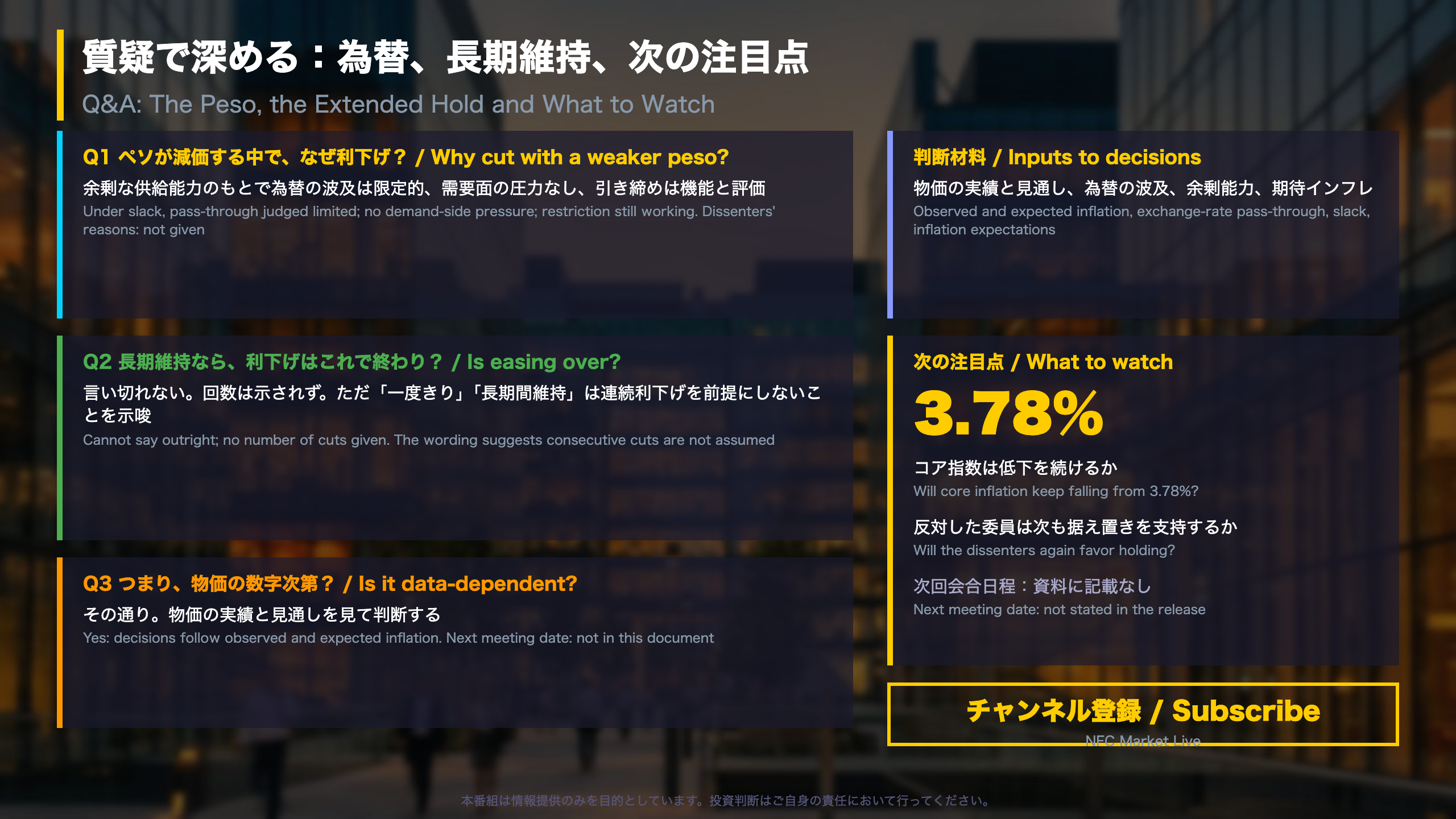
Future decisions will consider observed and expected inflation, exchange-rate pass-through to consumer prices, slack conditions and inflation expectations (end-2026 headline expectations fell, while longer-term ones stayed stable above target).
Two ways to read ‘extended period’
- Cautious reading: pairing ‘one-time adjustment’ with ‘extended period’ is consistent with not assuming consecutive cuts.
- Less hawkish reading: the statement gives no number of cuts and no end-point, so decisions can still shift with the data.
Neither is spelled out in the text; both are interpretations.
External context for non-specialists
US Treasury yields fell for most maturities, yet long-term yields reached levels not seen in decades. In Mexico, government yields fell at medium and long maturities and rose at short ones, and the peso depreciated while the US dollar traded in a narrow range. This is a different backdrop from Japan, where the BOJ focuses on wage-price dynamics; Banxico’s framework weighs the peso and domestic slack heavily.
Market-relevant checkpoints (facts only)
- The forecast table shows headline and core converging to 3.0% in Q4 2027.
- Watch half-monthly core CPI versus 3.78%.
- Watch whether Borja and Heath dissent again and whether the ‘one-time’ and ‘extended period’ language is retained.
The statement provides no numerical thresholds, and the date of the next meeting is not in this document.
Disclaimer: This article is for informational purposes only. All investment decisions are made solely at your own risk.