📺 Watch the Full Video Analysis
This article was automatically generated by the NFC Market Live AI analysis system. (Updated: 2026-10-07 08:43 JST)
📄 Primary Source
厚生労働省
https://www.mhlw.go.jp/toukei/itiran/roudou/monthly/r08/2608p/dl/pdf2608p.pdf
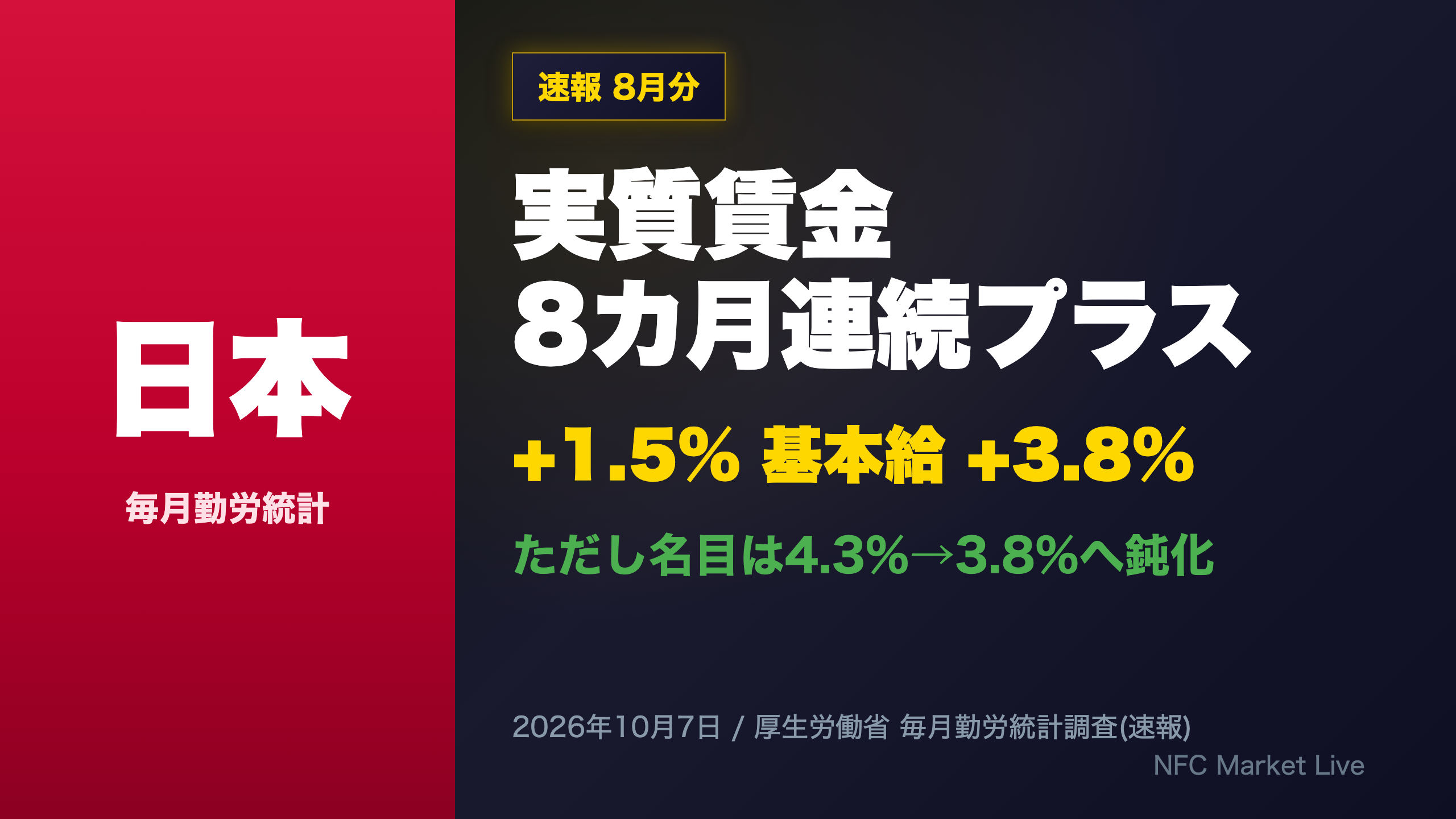
📊 Japan’s Monthly Labour Survey for August 2026 (flash).
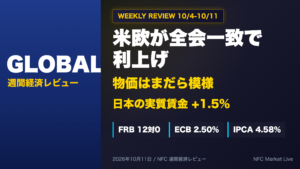
📈 Real wages rose 1.5% YoY, the eighth straight monthly gain since January 2026. Scheduled (base) pay grew a solid 3.8%.
⚠️ But special payments were flat (0.0%), and total cash earnings slowed from 4.3% in July (revised) to 3.8%. Like-for-like (common-establishment) base pay was only 3.1%, and the July flash was revised down.
💡 The wage-price loop continues, yet revisions and composition effects call for caution. Next: August final data on Oct 23, September flash on Nov 6.
今回の最重要ポイント
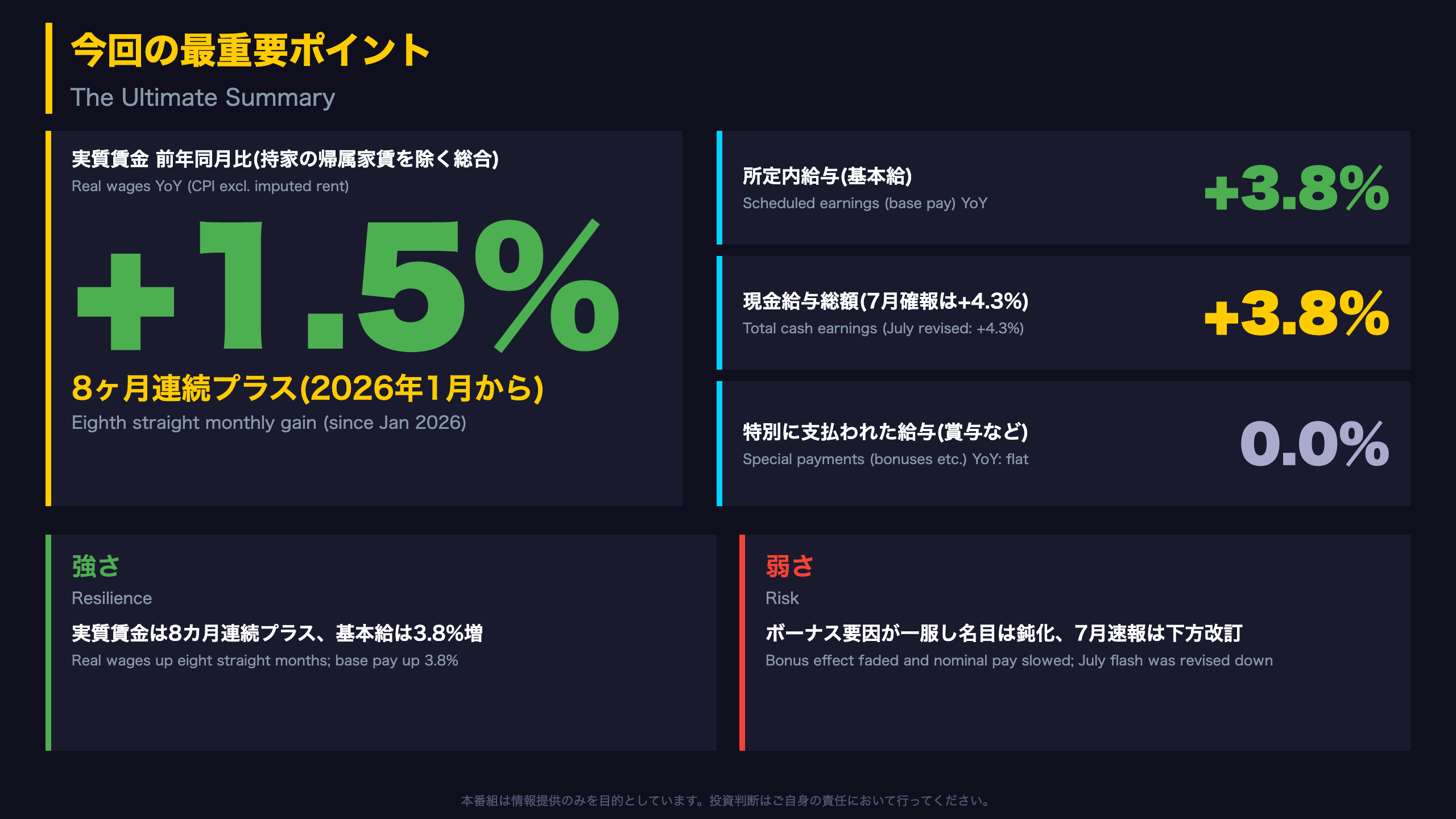
How to read the August wage data
The Monthly Labour Survey (Maikin Tokei), published by Japan’s Ministry of Health, Labour and Welfare (MHLW), is the country’s primary monthly gauge of wages, covering establishments with five or more employees. It is the Japanese counterpart to the US BLS Average Hourly Earnings data, and the Bank of Japan (BOJ) watches it closely when judging whether a virtuous wage-price cycle is taking hold.
What looks strong
- Real wages +1.5% YoY, the eighth straight positive month since January 2026, using CPI excluding imputed rent.
- Regular (non-bonus) pay +3.9%, the highest of any month in 2026.
- Regular employment +0.8%, so the labour base is intact.
What looks softer
- Total cash earnings slowed to 3.8% from a revised 4.3% in July, as bonuses were flat.
- The July flash was revised down: nominal pay from 4.7% to 4.3%, real wages from 2.4% to 2.0%.
- On a seasonally adjusted basis, total cash earnings fell 0.7% month on month.
Base effects
August 2025 was weak (nominal +1.3%, real -1.7%), so a low comparison base may be flattering the current year-on-year reading. This is an interpretation based on a single month.
Market angle
For FX and rate traders, the data neither clearly accelerates nor derails the BOJ’s normalization debate: solid base pay supports it, while revisions and like-for-like softness argue for patience. Treat it as one input, not a verdict.
実質賃金 8ヶ月連続プラスの推移
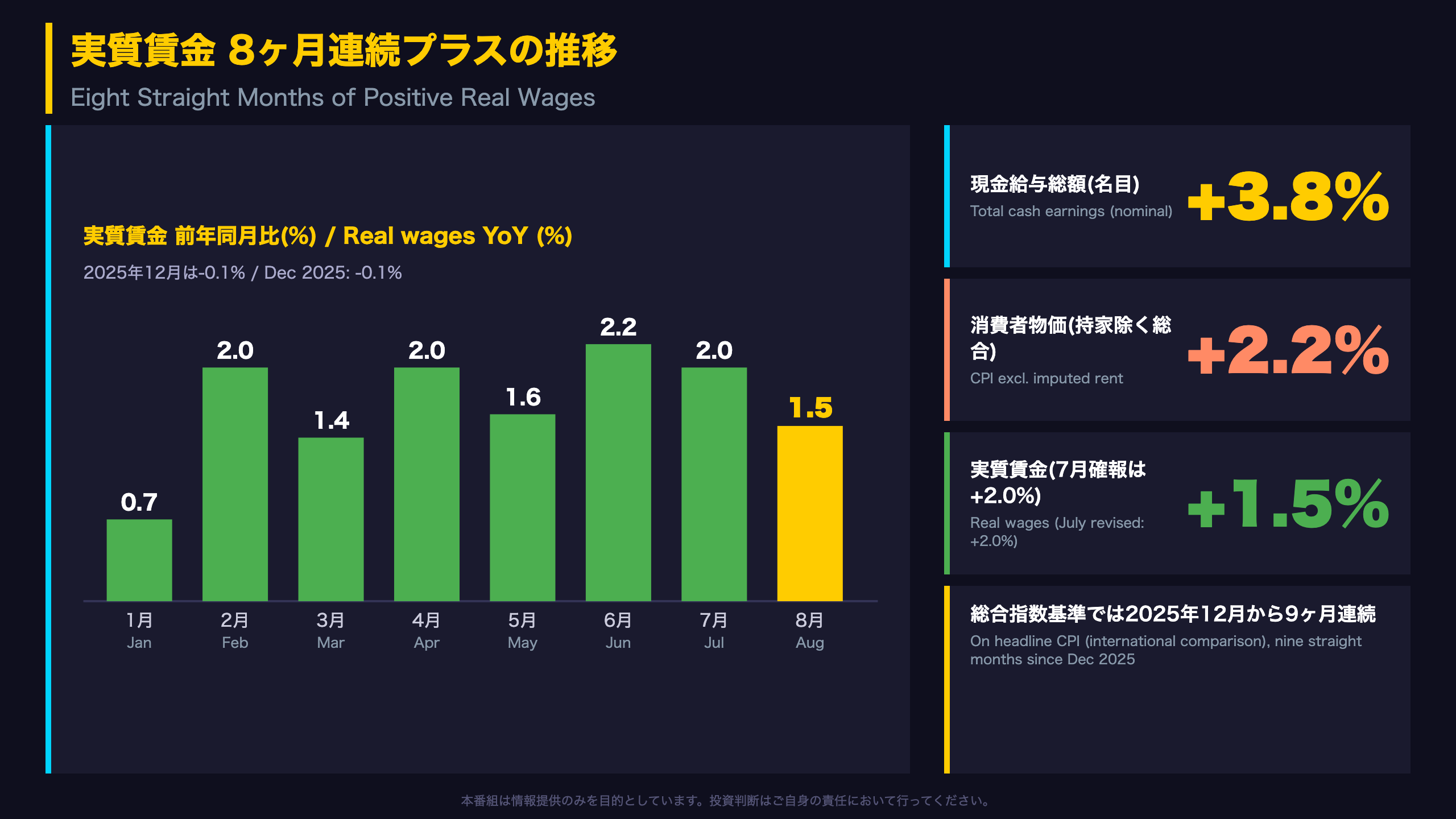
Real wages: from a four-year slump to eight months of gains
Japan’s “real wage” in the MHLW survey is nominal cash earnings deflated by CPI. The ministry’s preferred measure excludes imputed rent, since it reflects goods and services actually transacted; a second version uses headline CPI to allow international comparison.
Context
On the preferred basis, annual real wages fell in each of the last four years: -1.0% (2022), -2.5% (2023), -0.3% (2024) and -1.3% (2025). That makes the 2026 turn to positive territory notable, and the Bank of Japan has stressed wage-price dynamics in its normalization debate.
Monthly path
- Real wages: 0.7%, 2.0%, 1.4%, 2.0%, 1.6%, 2.2%, 2.0%, 1.5% (January to August)
- Underlying CPI (ex imputed rent): 1.7%, 1.4%, 1.6%, 1.5%, 1.7%, 1.9%, 2.2%, 2.2%
Inflation has risen from 1.4% in February to 2.2% in July and August. Nominal wages have also grown, but the real cushion has narrowed from the February and June peaks.
International comparison
On headline CPI, Japan’s real wages rose 1.9% in August. US real average hourly earnings fell 0.3% and weekly earnings rose 0.3% (both per MHLW’s compilation of BLS data). Unlike the US, where real wages have recently hovered near zero, Japan is in a catch-up phase after years of declines.
Threshold to watch
With CPI near 2.2%, nominal pay growth below that level would push real wages negative again.
名目賃金の中身:基本給・残業代・ボーナス
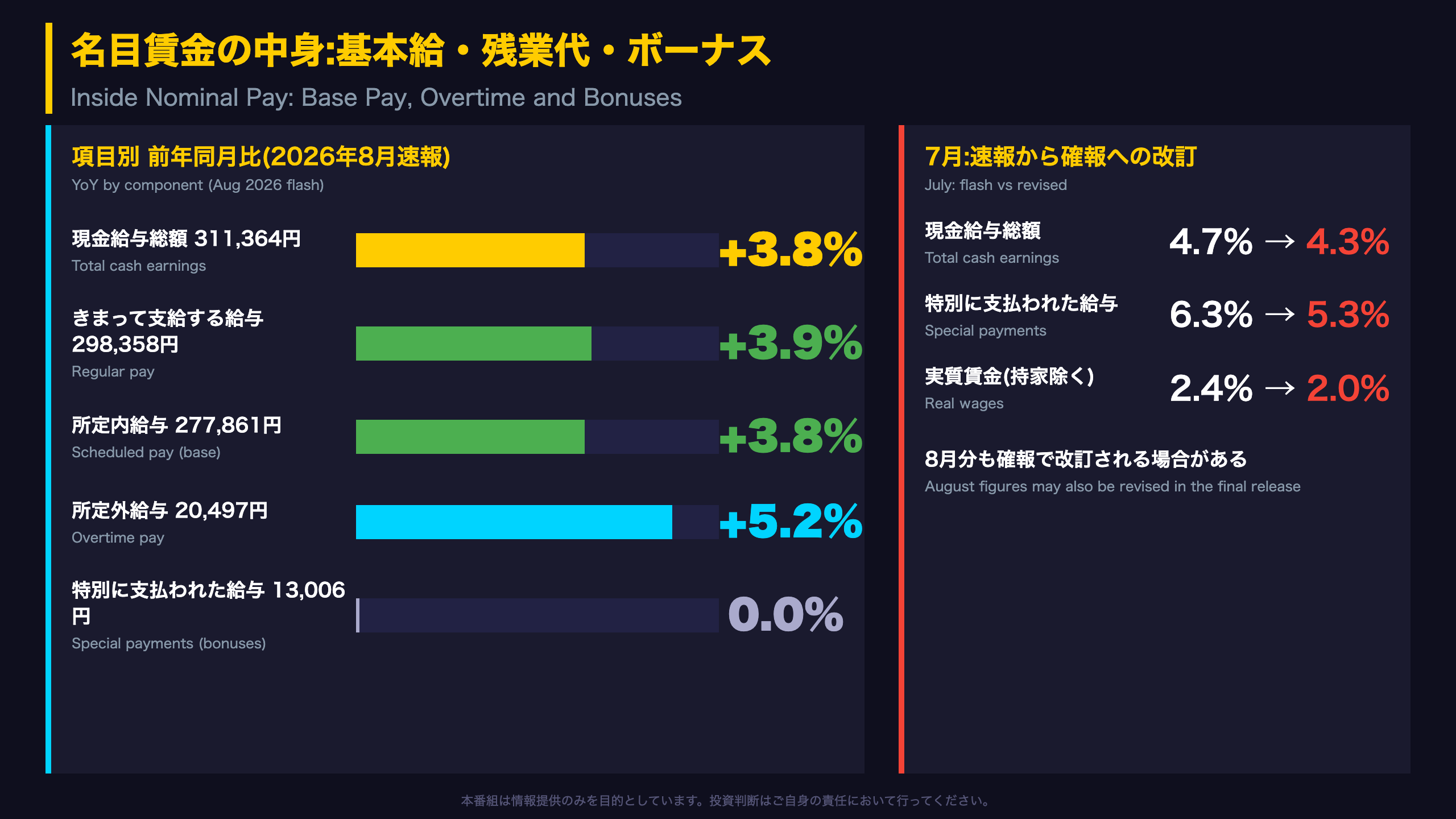
Anatomy of Japan’s nominal wage growth
The MHLW’s headline “total cash earnings” combines three pieces: scheduled pay (base salary and allowances fixed by contract), non-scheduled pay (overtime, holiday and late-night work) and special payments (bonuses, year-end allowances and one-off items).
August vs July (YoY)
- Total cash earnings: 3.8% (July revised 4.3%)
- Regular pay: 3.9% (3.8%)
- Scheduled pay: 3.8% (3.8%)
- Overtime pay: 5.2% (4.5%)
- Special payments: 0.0% (5.3%)
Why the headline cooled
Scheduled pay is about 89% of total cash earnings in August, overtime about 7%, and special payments about 4%. August is a low-bonus month, so the 311,364 yen total is dominated by base pay. July’s headline was boosted by summer bonuses (134,819 yen in the flash), and the flat August bonus reading explains much of the deceleration. The July flash was revised down, with bonus growth cut from 6.3% to 5.3%.
Base effects
In August 2025, special payments fell 7.8% and overtime pay rose just 0.4%. A flat reading now, after a weak base, does not indicate bonuses are surging.
Why it matters for the BOJ
Base pay (scheduled earnings) is the cleanest read on the results of the annual spring wage talks (shunto). Its 3.8% pace, unchanged from July, is stable. That is a firm backdrop for the central bank’s wage-price assessment, even if the headline number is noisier.
Comparison
US Average Hourly Earnings rarely carry a bonus swing of this size, so Japan’s monthly headline is structurally more volatile.
基本給の伸びと共通事業所の差
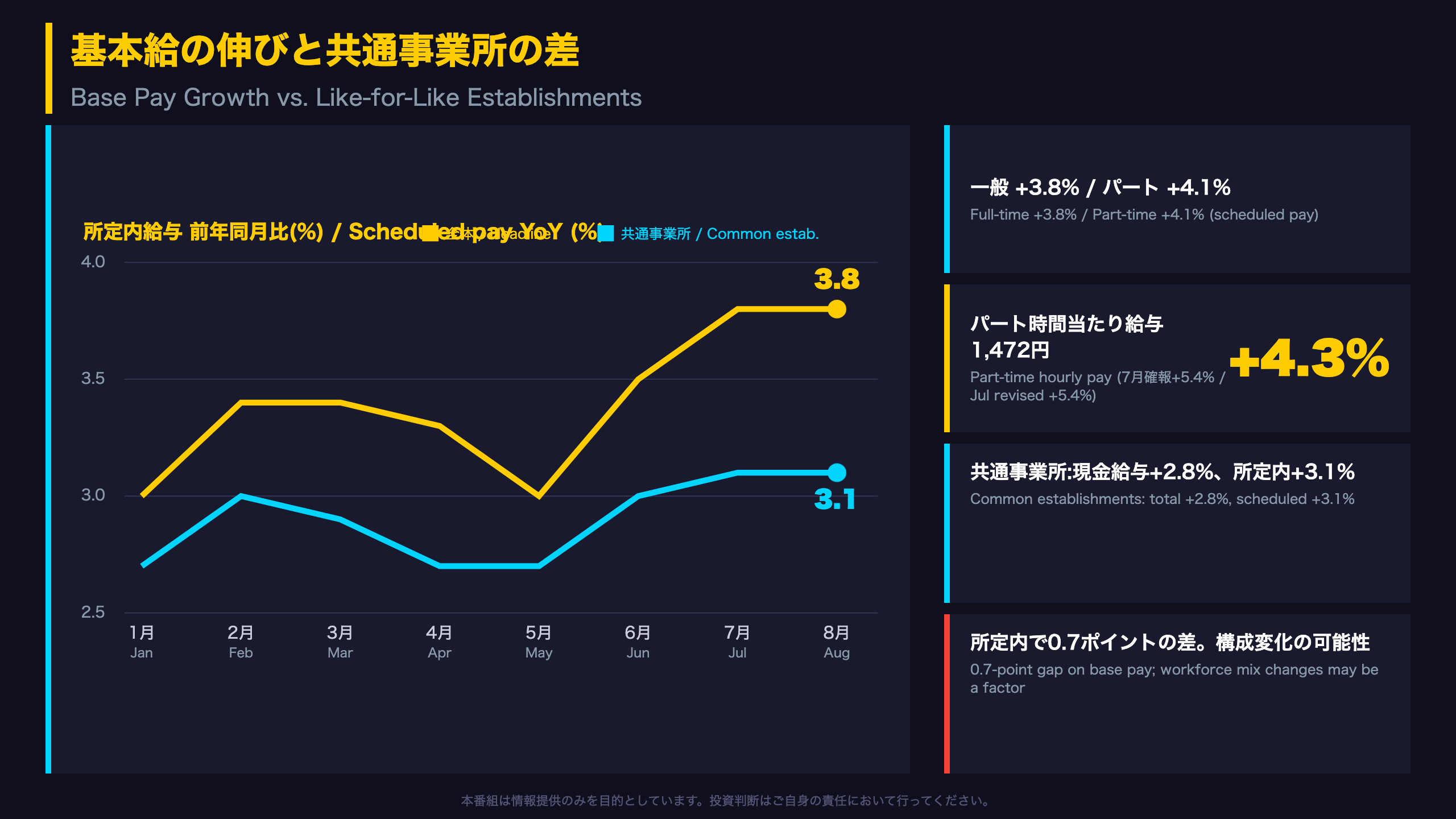
Headline wages vs. like-for-like pay
Japan’s MHLW publishes a common-establishment series as a reference. It restricts the sample to establishments surveyed in both the current month and a year earlier, and holds employee counts constant. It therefore strips out shifts in who is employed and measures pure pay changes at the same workplaces, similar in spirit to how analysts look at ‘same-store’ sales.
August comparison
- Total cash earnings: headline 3.8% vs. common-establishment 2.8%
- Scheduled pay: 3.8% vs. 3.1%
- Full-time scheduled pay: 3.8% vs. 2.8%
- Part-time scheduled pay: 4.1% vs. 4.9%
The full-time gap is a full percentage point, whereas part-timers show the opposite sign. The headline can therefore blur composition effects, such as changes in worker mix and sample turnover.
Two readings
- Cautious: same-workplace raises are closer to 3%, and some of the headline strength may be compositional.
- Constructive: even like-for-like base pay is above 3% and unchanged from July at 3.1%, which is still a high figure by the standards of Japan’s last three decades.
Data-quality notes
The sample is smaller in this series, and the ministry flags a January 2026 sample rotation that produced a -0.5% break in total cash earnings for establishments with 30+ employees. Part-time hourly pay rose 4.3% to 1,472 yen, slower than July’s revised 5.4%.
Why investors care
The BOJ looks for broad, durable base-pay growth, not noise from composition. The like-for-like series is closer to that concept, so the gap is worth watching in coming releases.
産業別のばらつきと労働需給
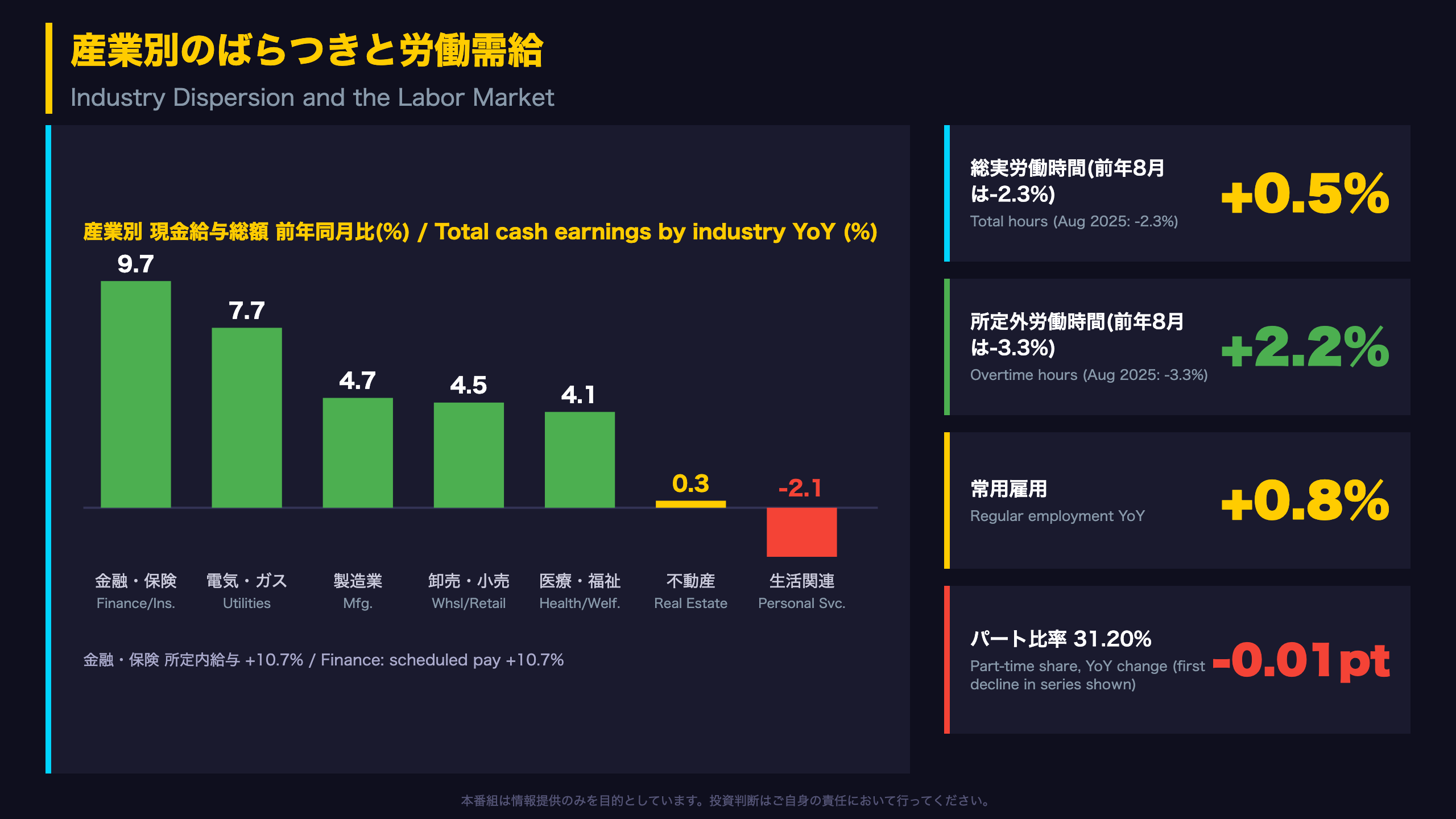
Beyond the average: sectors and the labor market
Who is driving wage growth
Dispersion by industry is wide. Finance and insurance is the standout: scheduled pay up 10.7% and regular pay up 10.5%, implying large base-pay revisions. Utilities (+7.7% total cash earnings) and manufacturing (+4.7%) are also strong. At the other end, personal services fell 2.1% and real estate gained only 0.3%, mostly because special payments dropped 24.2% while scheduled pay still grew 1.6%. Transport shows a similar story: regular pay +3.5% but a 27.6% fall in special payments dragged the total to +2.2%.
Labour market gauges
Total workers reached 52.2 million (+0.8%). The accession rate was 1.52% and the separation rate 1.65%, both little changed from a year earlier (-0.01 and -0.03 points). Regular employment growth has slowed from 1.3% in August 2025 to 0.8%, consistent with a tight labor market where firms struggle to expand headcount.
Hours worked
Overtime hours were up 2.2%, but August 2025 was weak (-3.3%), so part of the gain is a rebound. A single month is not a demand signal.
Part-time share
The part-time ratio was 31.20%, down 0.01 points YoY, the first negative reading since at least August 2024 in the series shown. It may hint that the long drift toward part-time work has paused, although the magnitude is within noise.
Why it matters
Broad-based increases across industries matter to the BOJ more than a few outliers. The data show strength in finance, utilities and manufacturing but weakness in some consumer-facing services, so the breadth is mixed.
国際比較・月次の下振れ・次回予定
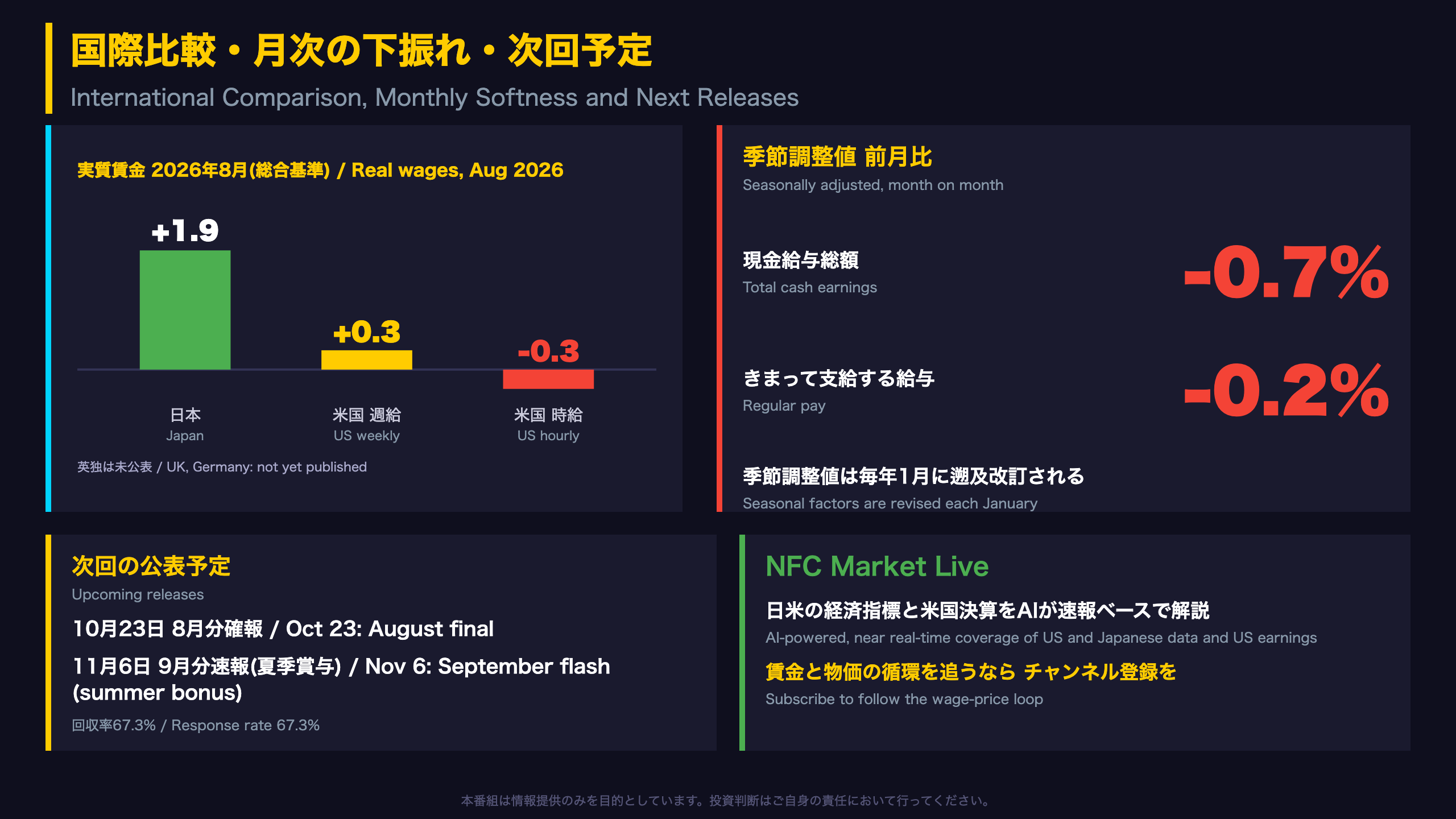
International context, seasonal adjustment and what’s next
How Japan compares
Using headline CPI (the international-comparison basis), Japanese real wages rose 1.9% in August. US real average hourly earnings fell 0.3% and weekly earnings rose 0.3% (BLS data compiled by MHLW). In July, Japan was at 2.1%, versus 0.6% in the UK and 1.6% in Germany; August figures for the UK and Germany were not yet available. Caveat: countries use different price indices and seasonal treatment, so comparisons are indicative only.
Month-on-month softness
Seasonally adjusted total cash earnings slid to 106.8 from 107.6, a 0.7% monthly decline, and regular pay fell 0.2%. Strong year-on-year prints can coexist with a flatter month-on-month path; since the seasonal factors are re-estimated every January, treat the monthly numbers as provisional.
Sample and revisions
22,241 of 33,045 sampled establishments responded (67.3%), slightly below July’s 68.6%. As the ministry notes, flash figures can be revised, and the July flash was.
Calendar
- Oct 23: August final
- Nov 6: September flash (flagged for summer bonuses)
- Nov 25: September final
Market framing
Rate markets will likely care more about the durability of base pay than the volatile headline. With CPI near 2.2%, nominal growth below that level would return real wages to negative territory. This is an arithmetic threshold, not a forecast.
Disclaimer: This article is for informational purposes only. All investment decisions are made solely at your own risk.