📺 Watch the Full Video Analysis
This article was automatically generated by the NFC Market Live AI analysis system. (Updated: 2026-09-17 02:39 JST)
📄 Primary Source
Bank of Canada
https://www.bankofcanada.ca/2026/09/summary-of-governing-council-deliberations-fixed-announcement-date-of-september-2-2026/
Deep dive into the Bank of Canada’s latest Governing Council deliberations 📊
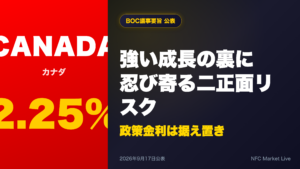
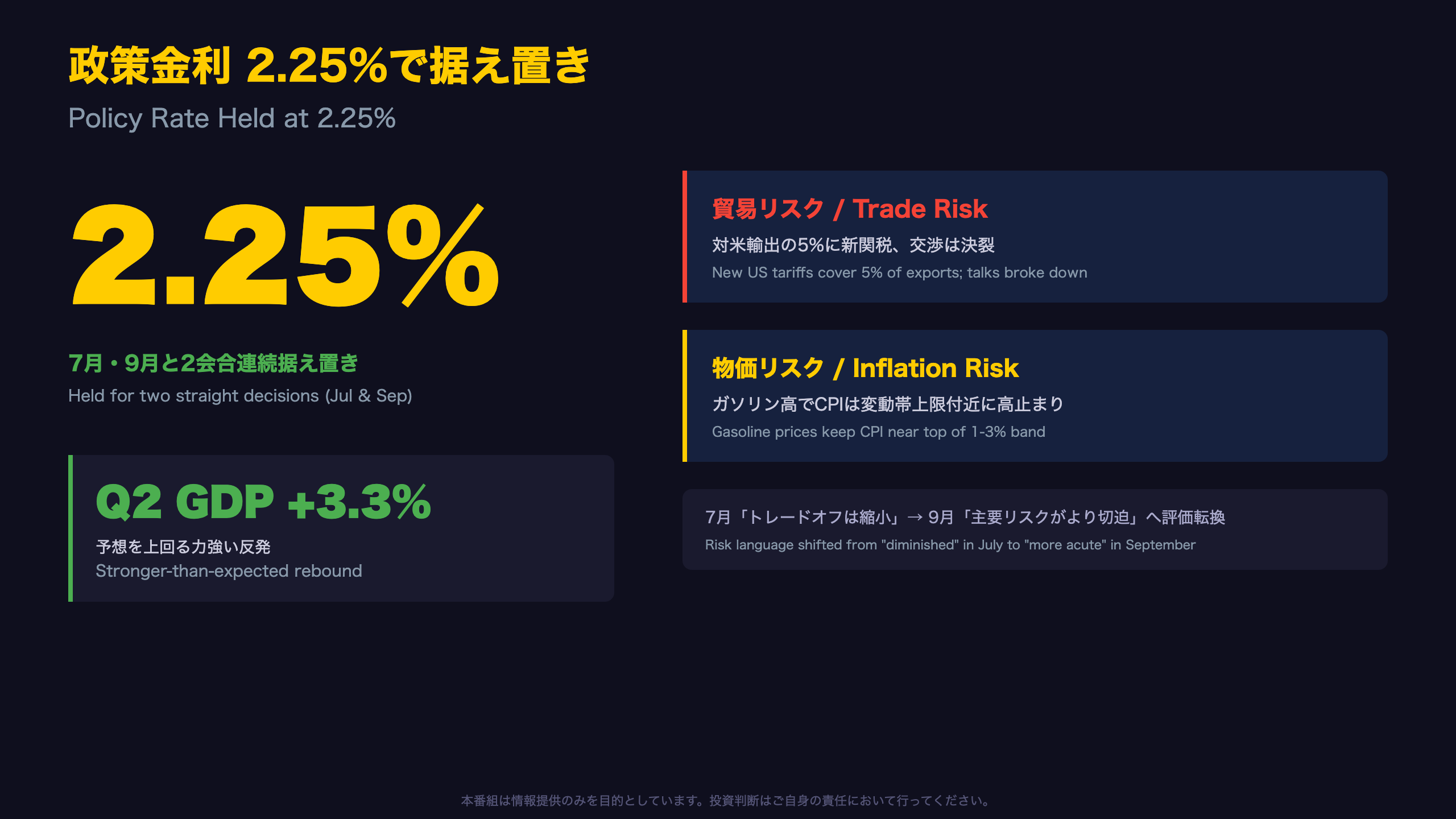
The BOC held its policy rate at 2.25% for a second straight decision. Q2 GDP surged 3.3%, beating expectations, with the recovery broadening into consumption, exports and housing 💡. But new US tariffs now cover ~5% of Canadian exports after talks collapsed ⚠️, and persistent gasoline-price strength has kept CPI pinned near the top of the 1-3% target band.
July’s optimistic tone — “the trade-off had diminished” — reversed sharply in September to “risks had become more acute” 📉. We break down the two-sided risk structure behind the hold, using only primary-source language from the minutes.
We also flag the two key data points that will decide the BOC’s next move.
政策金利 2.25%で据え置き 強まる二正面のリスク
A Shift in Tone, Not in Rate
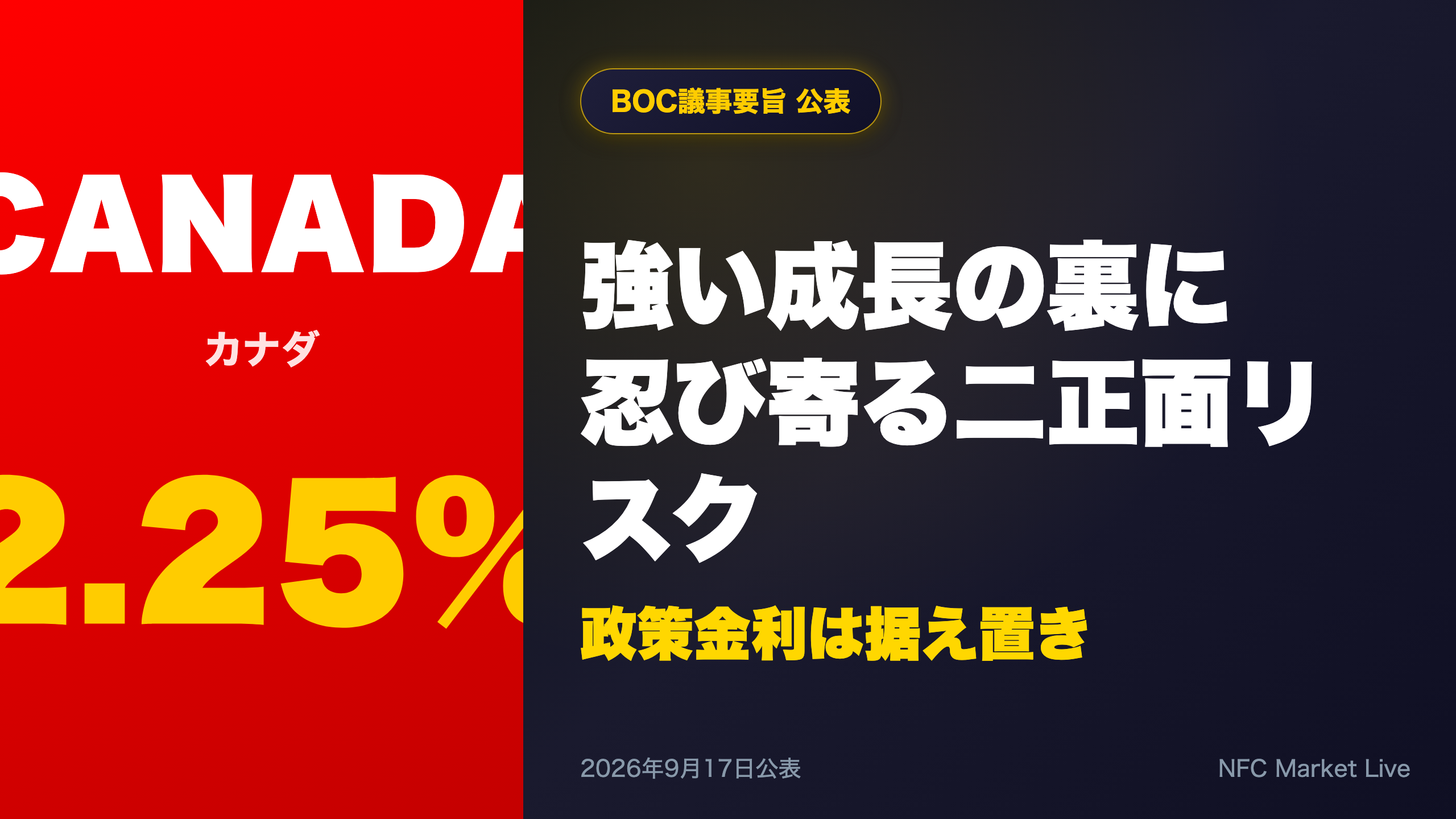
The Bank of Canada (BOC) held its policy rate unchanged at 2.25% for a second consecutive fixed announcement date, following the same decision on July 15. On the surface, nothing changed. But the underlying risk assessment shifted markedly.
In July, Governing Council noted that “growth was resuming and inflation was easing… the trade-off facing monetary policy had diminished.” By September, that language had reversed: “the main risks had become more acute.”
Two fronts of risk
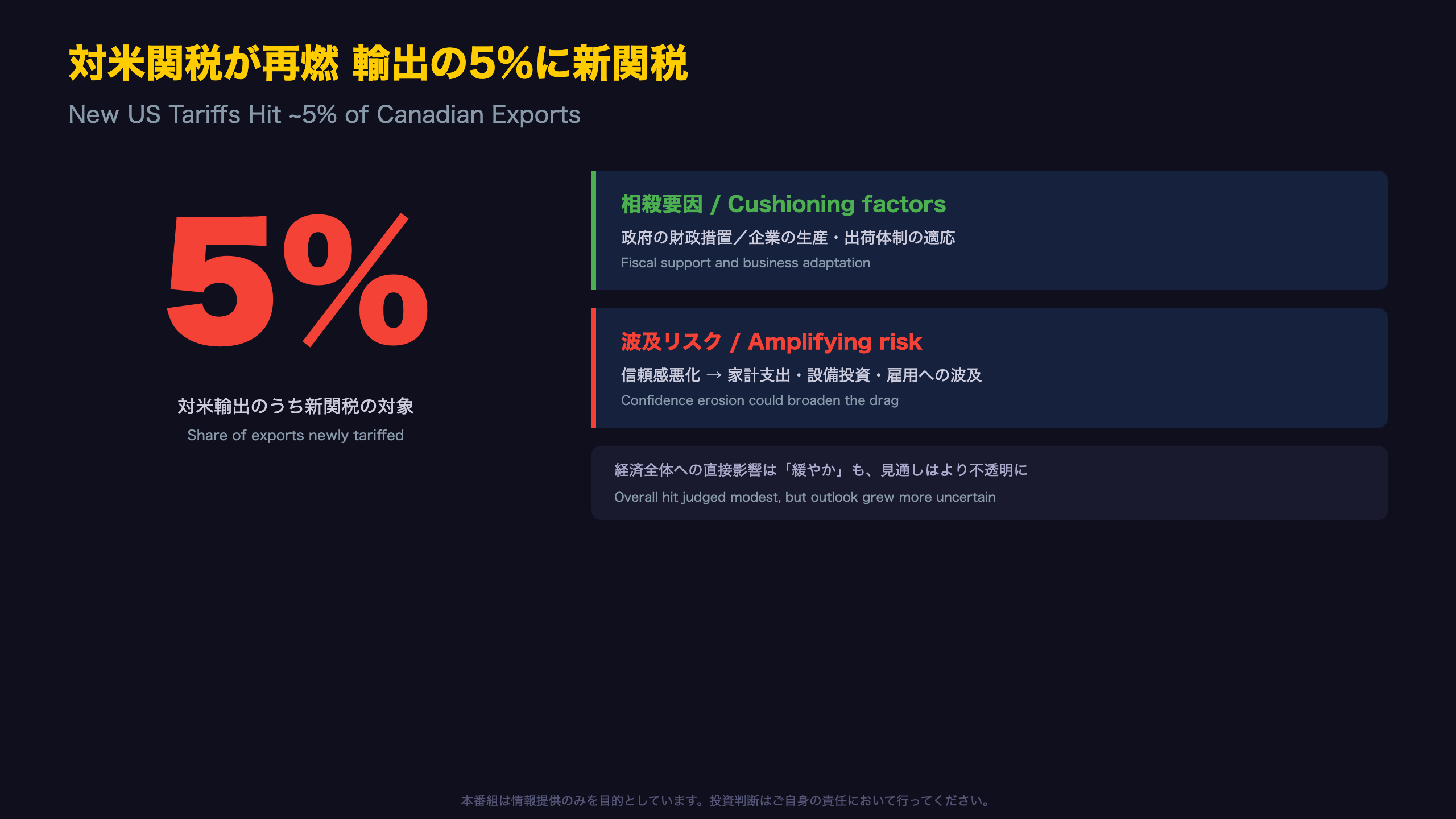
- Trade: New US tariffs now cover roughly 5% of Canadian goods exports after negotiations broke down
- Inflation: Persistently high gasoline prices have kept headline CPI near the top of the Bank’s 1%-3% control range
“If higher energy prices did spill over into other components of the CPI…it could require a monetary policy response.”
For readers unfamiliar with the BOC: Canada’s inflation-control framework targets 2% within a 1%-3% band, distinct from the Federal Reserve’s single-point target — meaning the BOC has slightly more built-in tolerance for headline noise from energy prices before acting. Core inflation near 2% suggests officials still have room to wait. No date for the next fixed announcement was disclosed in these minutes; watch whether tariff impacts and gasoline pass-through both materialize before assuming any near-term policy shift.
GDP 3.3%成長 消費・輸出・住宅に広がる回復
Broadening Beyond a One-Quarter Bounce
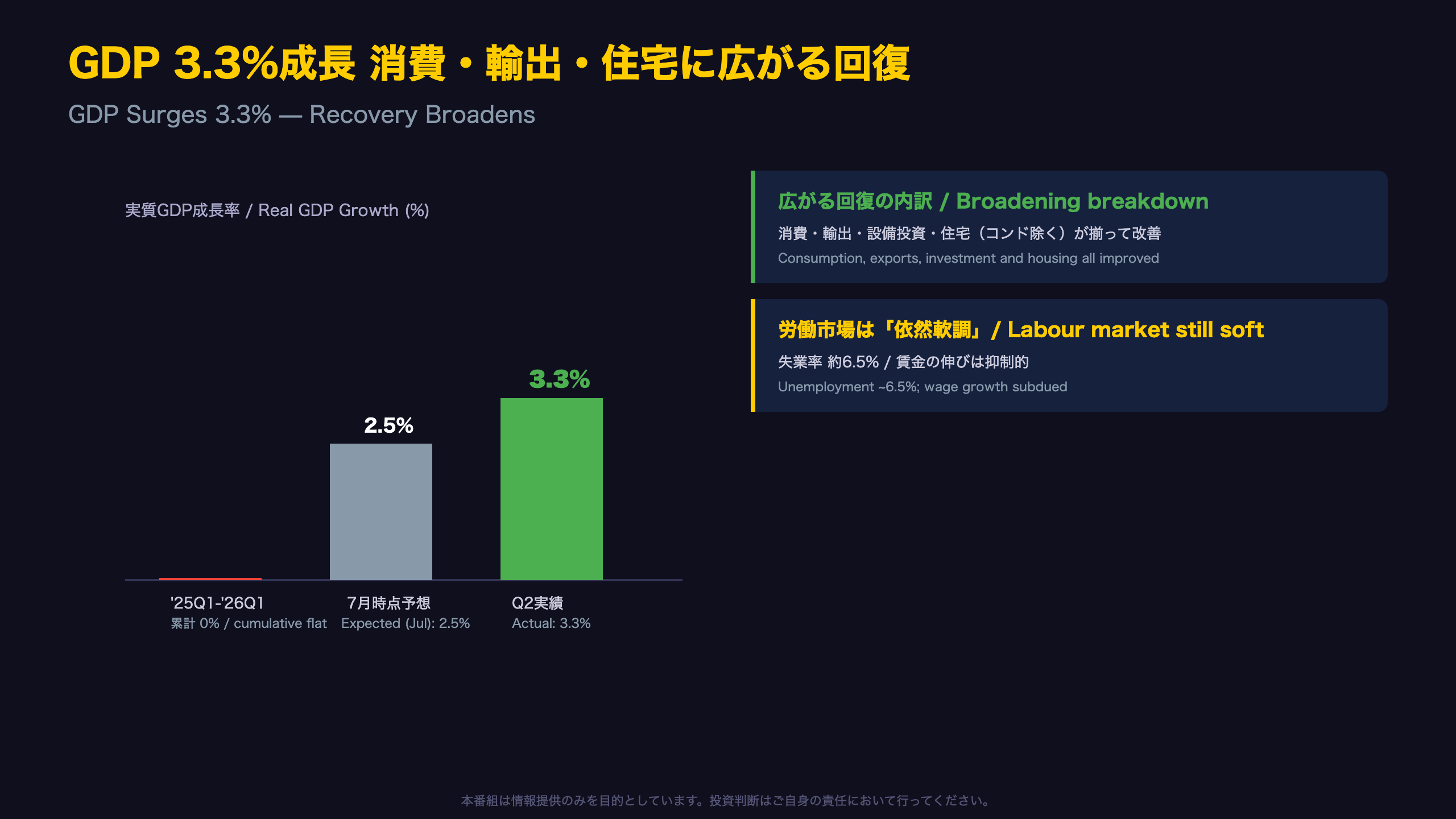
Canada’s real GDP grew 3.3% in Q2 2026, beating the roughly 2.5% pace policymakers had penciled in back in July. Crucially, the minutes note growth was broadening “even after accounting for certain temporary factors that magnified the rebound” — a meaningful qualifier for anyone worried this is a one-off statistical bounce.
What broadened
- Consumer spending: strong
- Exports & business investment: both picked up
- Housing: rebounded, though Toronto/Vancouver condo markets stayed soft
For context, this rebound follows an extended stagnation: the July minutes noted GDP “had not grown between the first quarter of 2025 and the first quarter of 2026” — over a full year of flat output. Seen against that backdrop, a 3.3% quarter is a meaningful inflection point, not just noise.
Yet the labour market tells a different story. Unemployment held near 6.5% and wage growth stayed subdued, prompting Governing Council to reiterate the labour market “remained soft.” This divergence — strong output alongside a soft labour market — echoes a pattern seen in the US, where AI-driven investment boosts headline growth even as underlying household stress (rising card delinquencies) simmers. For BOC watchers, the key question is whether Q2’s strength is durable or partly borrowed demand ahead of tariff escalation.
対米関税が再燃 輸出の5%に新たな関税
A Small Number With Outsized Political Weight
The new round of US tariffs covers roughly 5% of Canada’s goods exports to the United States — a relatively narrow slice of overall trade. Yet Governing Council was careful to distinguish between the aggregate economic impact (“likely modest”) and the concentrated impact on directly affected industries and workers, which it called significant.
The offsetting forces
- Cushioning: government fiscal measures, and businesses adapting production, shipping and customs arrangements
- Amplifying risk: eroding consumer and business confidence, which could spill into broader spending, investment and hiring cuts
This marks a notable tone shift from July, when the Business Outlook Survey showed “fewer US customers… holding back orders due to trade uncertainty” and businesses adapting successfully. By September, renewed tariff threats and the breakdown of trade talks reversed some of that optimism.
For international readers: this dynamic parallels how markets price in indirect “confidence-channel” tariff effects — similar to how US-China trade tensions in past cycles hit business capex intentions well before customs data showed direct trade-volume declines. Governing Council explicitly flagged a “diversity of views” among members on how much slack remains in the economy, underscoring that the committee itself is not unified on how large this indirect drag could become — a key swing factor for the BOC’s next move.
CPI上昇率は約3% 変動帯の上限に張り付く
The Bank’s “Look-Through” Strategy Faces a Time Limit
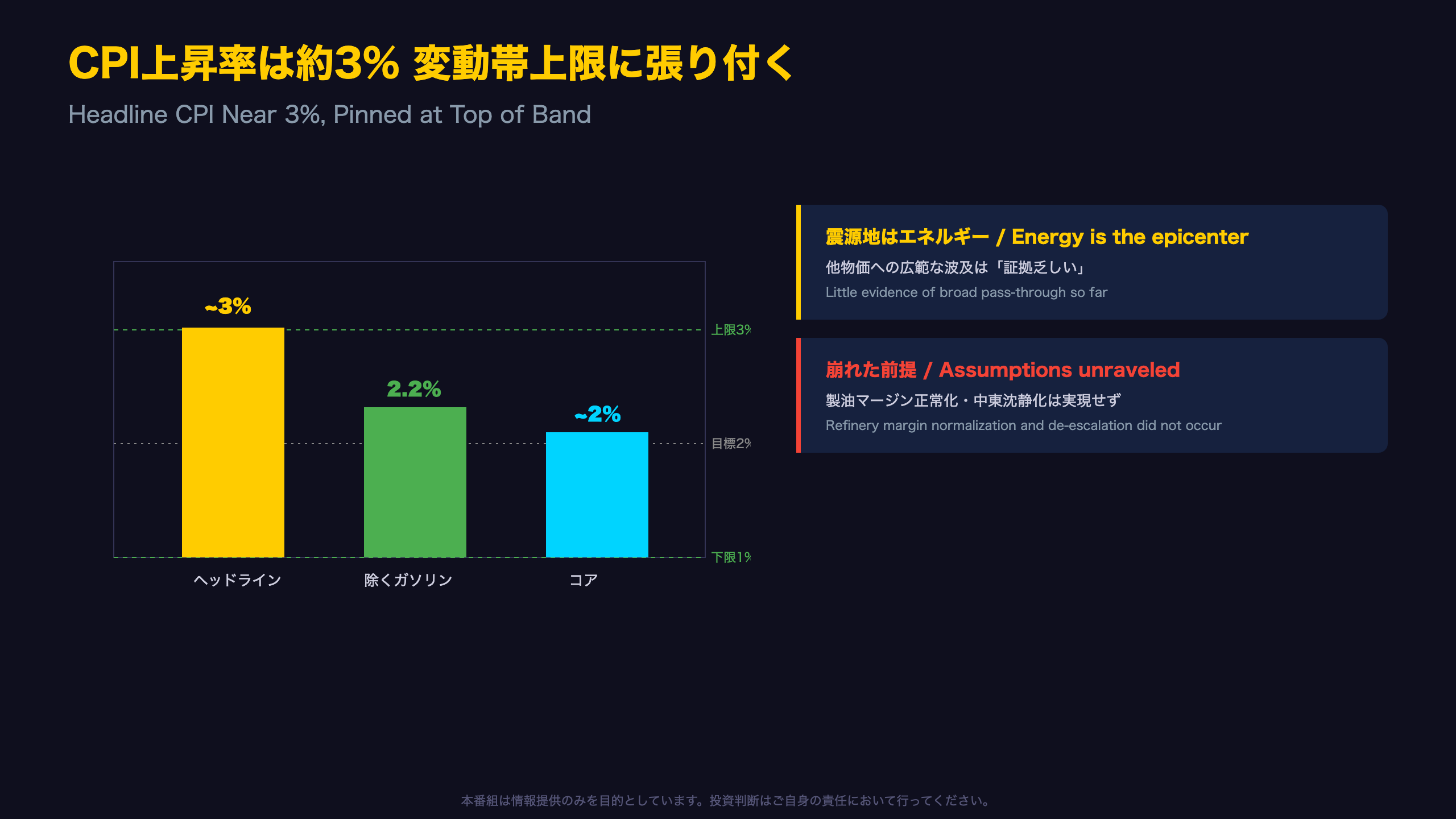
Headline CPI has been pinned near the top of the BOC’s 1%-3% inflation-control range since April, running around 3% for several consecutive months. That’s notably different from the Federal Reserve’s single 2% point target — Canada’s band-based framework gives the BOC explicit room to tolerate temporary overshoots without an automatic policy reaction, provided the source is judged transitory.
The inflation breakdown
- Headline CPI: ~3% (near top of range)
- CPI excluding gasoline: 2.2%
- Core measures: ~2%
This breakdown matters: it shows the overshoot remains narrowly concentrated in energy, not broad-based. Governing Council explicitly stated there is “little evidence that higher gasoline prices were passing through broadly to the prices of other goods and services” — the justification for continuing to “look through” the direct energy effect rather than tightening pre-emptively.
However, the assumptions underpinning July’s more optimistic inflation path — normalizing refinery margins and easing Middle East tensions — have not materialized. Refinery margins remain elevated due to damage to both Middle Eastern and Russian capacity, and the conflict shows “no signs of resolution.” This is why risk language shifted toward “increased” upside inflation risk, even as core inflation stays anchored near 2%. Canada’s retaliatory tariffs — concentrated in intermediate inputs like steel with domestic substitutes — are expected to have only a muted, gradual inflation impact, reinforcing that the primary inflation risk remains geopolitical and energy-driven, not trade-policy-driven.
据え置きの裏側 高まる二方向のリスクと次の分岐点
From “Diminishing Trade-offs” to “More Acute Risks”
Comparing the July and September minutes reveals a genuine shift in the BOC’s risk framework, even though the policy rate itself didn’t move.
July: “growth was resuming and inflation was easing… the trade-off facing monetary policy had diminished.”
September: “the main risks had become more acute.”
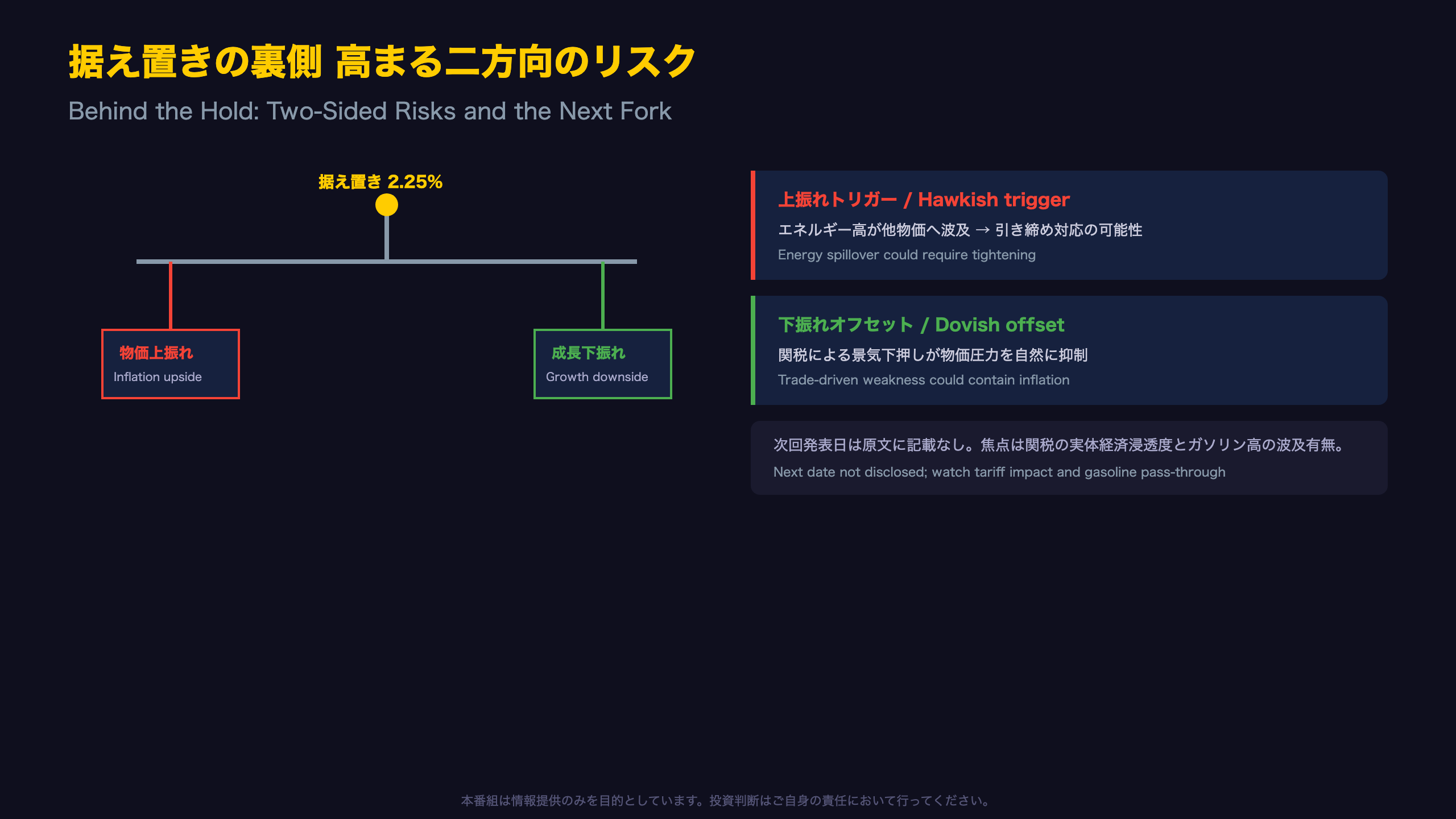
This isn’t just rhetorical drift — September’s minutes lay out an explicitly asymmetric policy trigger structure that international investors should note:
The asymmetric trigger
- Upside (hawkish) trigger: If elevated energy prices spill over into other CPI components, “it could require a monetary policy response to prevent broad-based inflation from setting in”
- Downside (dovish) offset: Weaker growth from the trade conflict could itself “keep inflationary pressures contained”
These two forces are in direct tension, and Governing Council itself acknowledged a “diversity of views” among members on how much economic slack currently exists. In practice, the September hold at 2.25% is less a settled pause than a genuine fork in the road.
For market participants, this asymmetry matters for positioning: the Canadian dollar and Government of Canada bond yields may now react more sharply and unevenly to incoming CPI prints and trade headlines than under a simple “steady as she goes” reaction function. Compared with the Fed’s current tightening bias amid above-target US inflation, the BOC is explicitly weighing a genuine supply-shock trade-off between growth and price stability. No date for the next fixed announcement was disclosed; the two variables to watch are the real-economy depth of new US tariffs and whether gasoline-driven inflation broadens into core goods and services.
Disclaimer: This article is for informational purposes only. All investment decisions are made solely at your own risk.