📺 Watch the Full Video Analysis
This article was automatically generated by the NFC Market Live AI analysis system. (Updated: 2026-10-20 00:46 JST)
📊 A walkthrough of the Bank of Canada’s Q3 2026 Business Outlook Survey, released October 19.
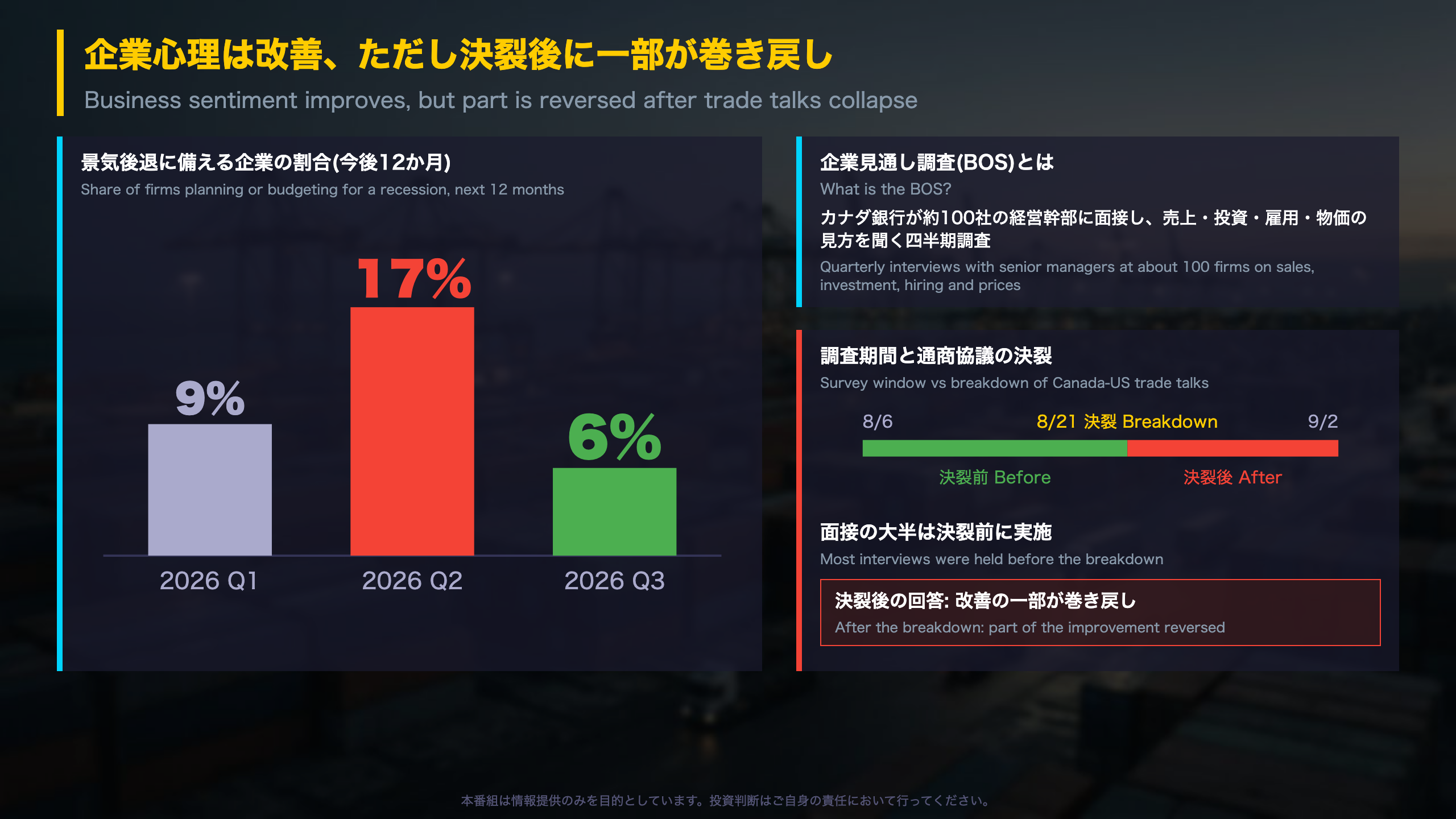
📉 Firms budgeting for a recession fell from 17% to 6%, the lowest since the question began in 2023, and sales outlooks sit above their historical average.
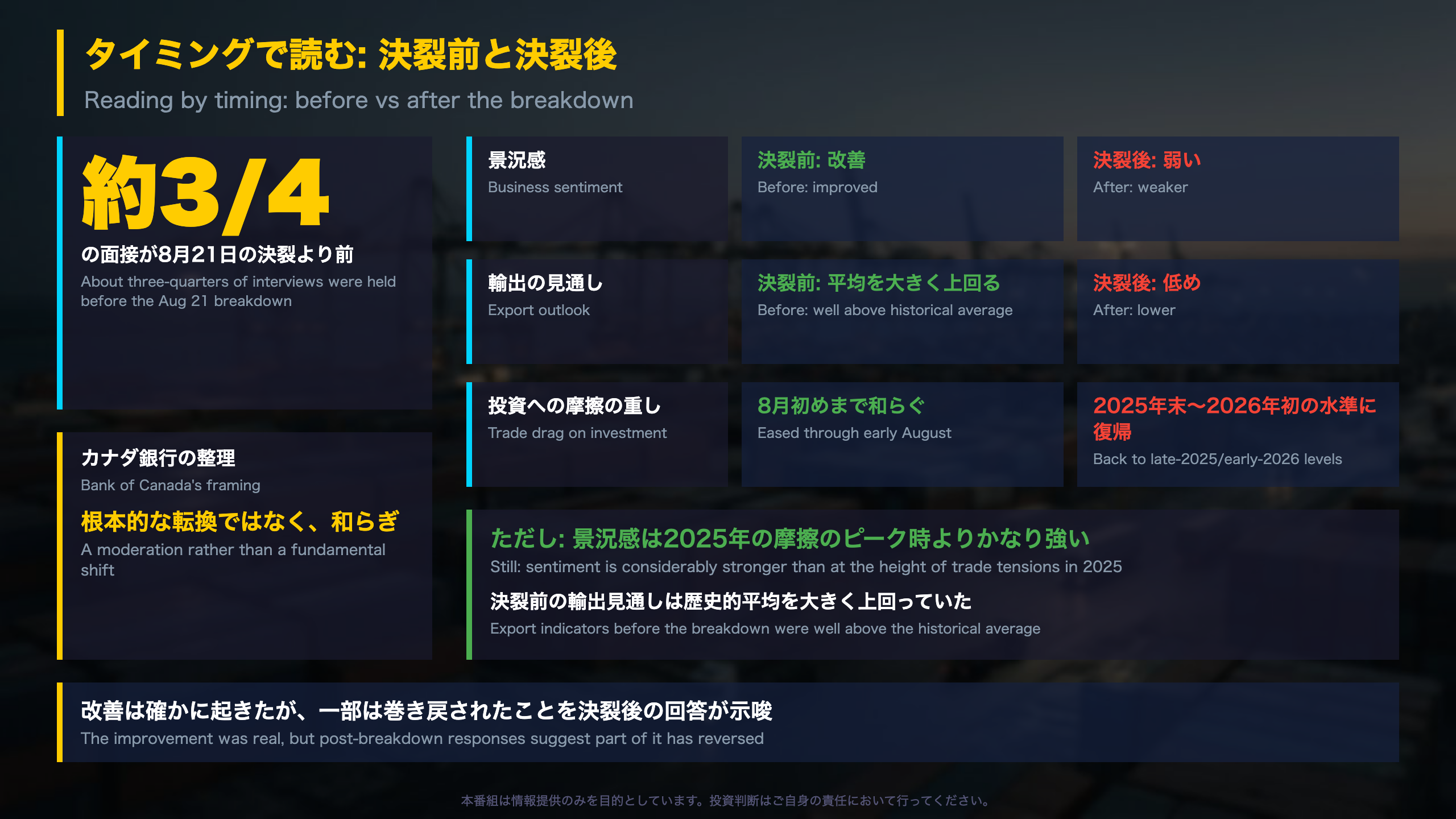
⚠️ But most interviews predate the August 21 collapse in Canada-US trade talks. Firms surveyed afterward reported weaker sentiment and export expectations, and one-year inflation expectations rose again in September.
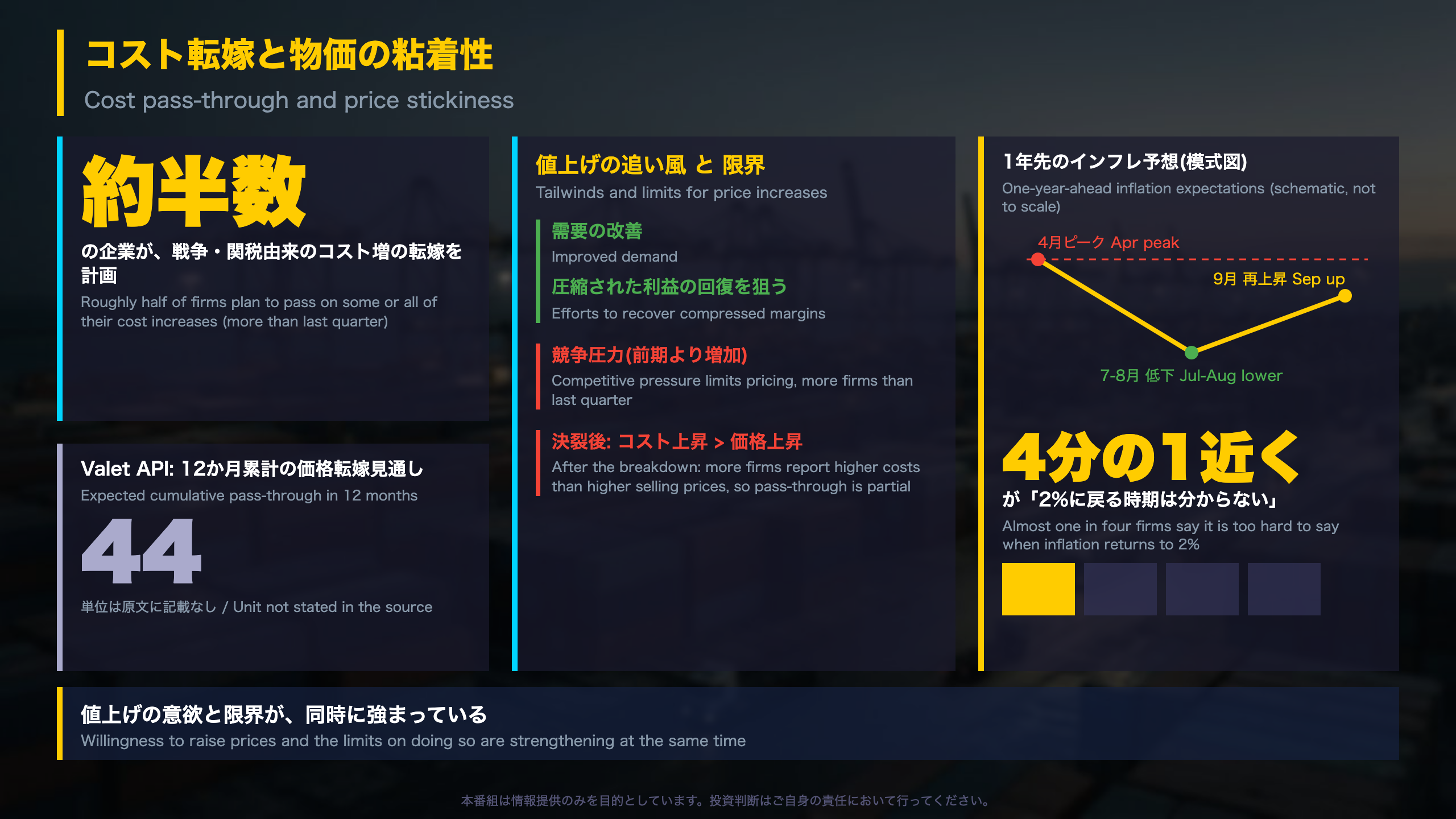
💡 Roughly half of firms plan to pass on costs, yet more cite competitive limits, and hiring intentions stay soft.
We weigh both the strengths and the risks, and flag what to watch next.
サマリー: 企業心理は改善、ただし決裂後に一部巻き戻し
What the Business Outlook Survey is
The Bank of Canada’s Business Outlook Survey (BOS) is a quarterly set of interviews with senior managers at about 100 firms, chosen to mirror the composition of Canada’s business-sector GDP. It is the closest Canadian analogue to the Fed’s Beige Book or regional Fed surveys, but it is interview-based and reports balances of opinion rather than a single diffusion index. The Q3 2026 round ran from August 6 to September 2 and is supplemented by the monthly Business Leaders’ Pulse (700-1,000 online respondents).
The numbers that matter
- Firms budgeting for a recession: 9% (Q1), 17% (Q2), 6% (Q3), the lowest since the question started in 2023.
- Sales outlooks: above their historical average.
- Investment intentions: eased slightly but robust. Hiring intentions: soft and below average, a contrast with Q1, when nearly half of firms planned to add staff.
How to read it
The constructive reading is that the drag from the Middle East war and from trade tensions eased. The cautious reading is that roughly three-quarters of interviews predate the August 21 collapse in Canada-US talks, so the headline may flatter current conditions. This note summarizes the data and is not a forecast of policy or of the Canadian dollar.
深掘り1: 回答の時期で読む(決裂前と決裂後)
Before vs. after the breakdown
Canada-US trade talks collapsed on August 21, and the Bank of Canada compared responses collected before and after. Firms interviewed afterward reported weaker sentiment and lower export expectations. The drag from trade tensions on investment plans, which had been easing through early August, is back to late-2025/early-2026 levels. Importantly, the Bank says sentiment remains well above the height of the 2025 tariff conflict, describing the shift as “a moderation rather than a fundamental shift.”
How firms are adapting (Box 2)
- Efficiency: switching suppliers, more spending on automation and AI.
- New markets: some aluminum firms entering Europe; some steel firms leaning on federal procurement and defence.
- Capacity cuts: investment shifted abroad (steel, autos), plus wait-and-see behaviour.
Context for non-Canadian readers
CUSMA is the Canada-US-Mexico trade agreement, known in the US as USMCA. In the Q1 round, most Canadian exporters said their goods were CUSMA-compliant and tariff-exempt, and the first joint review was scheduled to begin on July 1, 2026. Compared with US regional Fed surveys, the BOS is smaller and interview-based, so late-quarter swings can matter more.
Caveat
Post-breakdown responses are a minority subsample, so treat the reversal as directional rather than precisely measured. This is a data summary, not a forecast.
深掘り2: コスト転嫁と物価の粘着性
Pricing: the details behind the headline
Wages
Wage growth expectations have been roughly unchanged since mid-2024 and sit near the survey’s historical average. In Q1 firms expected wages to rise about 3.5%, slower than over the prior year; this quarter slightly more firms expect a pace similar to last year’s. Cost-of-living adjustments remain the main driver, but one-tenth of firms now cite recruiting and retention, a bigger share than in recent quarters.
Costs, selling prices and inflation expectations
- Expected growth in non-labour input costs and selling prices moderated but stays elevated, tied to fuel prices (Middle East war) and tariffs.
- One-year-ahead inflation expectations stayed below the April peak in July and August, then rose again in September. Two-year expectations remain elevated versus Q2; five-year expectations are roughly unchanged.
- Almost one in four firms said it is too hard to say when inflation returns to 2%.
Why it matters for comparison
The BOS is a firm-side survey, closer in spirit to the New York Fed’s business surveys than to household inflation expectations. In Q1, expectations beyond one year were steady at 2.5-3%, so the current drift higher in near-term readings is notable, though the Bank stresses levels are below the early-2025 trade-conflict peak.
What to watch
The Valet API series on expected cumulative 12-month pass-through reads 44 (unit not stated in the source). Watch whether the share of firms unable to say when inflation returns to 2% keeps rising. This is a data summary, not a forecast.
質疑で深める: 改善は本物か、採用と賃金は
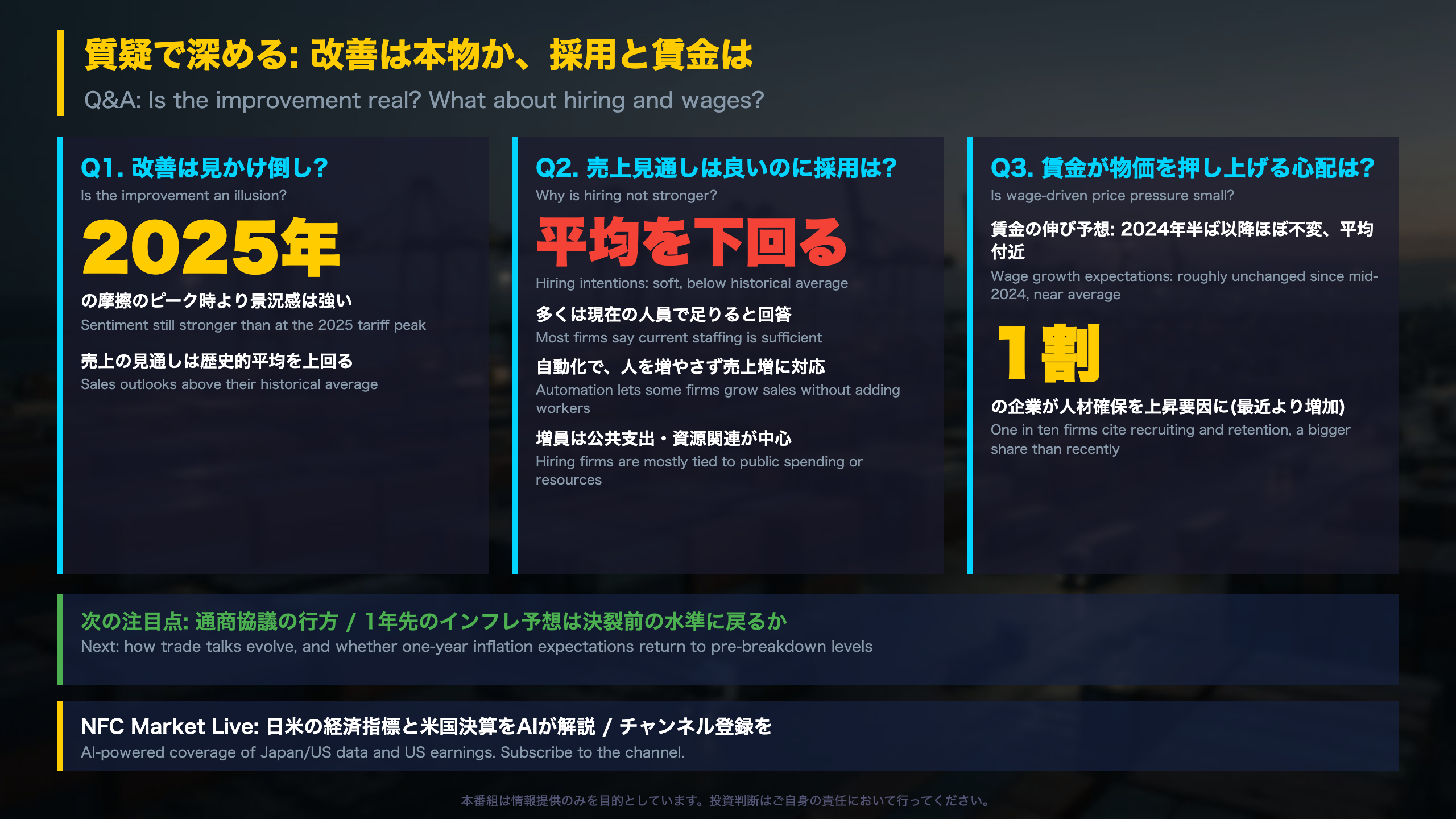
Demand, capacity and labour: what sits under the headline
What supports sales
- Consumer discretionary firms: better outlooks on budget-friendly offerings and stronger tourism.
- Housing-related firms: still weak, but the Bank describes demand as stabilizing after a softening, not recovering.
- Public spending on infrastructure and defence continues to underpin outlooks.
- Exporters: solid US demand, including AI-related infrastructure investment, plus high oil prices.
Capacity and labour
The share of firms that would struggle to meet an unexpected jump in demand rose to its historical average, but the rise came from firms expecting some difficulty, not significant difficulty. Labour shortages remain below historical levels and are concentrated in skilled trades and specialized technical roles; a few firms cite immigration-policy changes.
Q1 vs Q3
| Item | Q1 2026 | Q3 2026 |
|---|---|---|
| Investment intentions | Well above average | Eased slightly, robust |
| Hiring intentions | Near average | Below average |
| Recession budgeting | 9% | 6% |
International angle
Soft hiring alongside solid sales outlooks echoes the ‘low-hire’ pattern often discussed in US data, with automation cited as one reason. For readers tracking Canada-US links, the BOS shows exporters benefiting from US AI-related capex even as tariffs weigh on others. This is a data summary, not a forecast.
Disclaimer: This article is for informational purposes only. All investment decisions are made solely at your own risk.