This article was automatically generated by the NFC Market Live AI analysis system. (Updated: 2026-11-20 01:06 JST)
📄 Primary Source
Banco de México
https://www.banxico.org.mx/publicaciones-y-prensa/minutas-de-las-decisiones-de-politica-monetaria/{FF5D1AD4-3138-F1D7-ACE6-2D54E7072094}.pdf
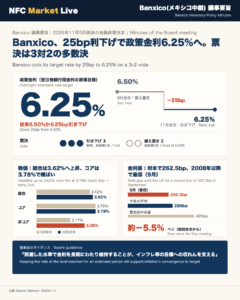
Banxico’s minutes for the monetary policy decision announced on November 5, 2026 (Minute No. 128), published November 20, were released with a split vote.
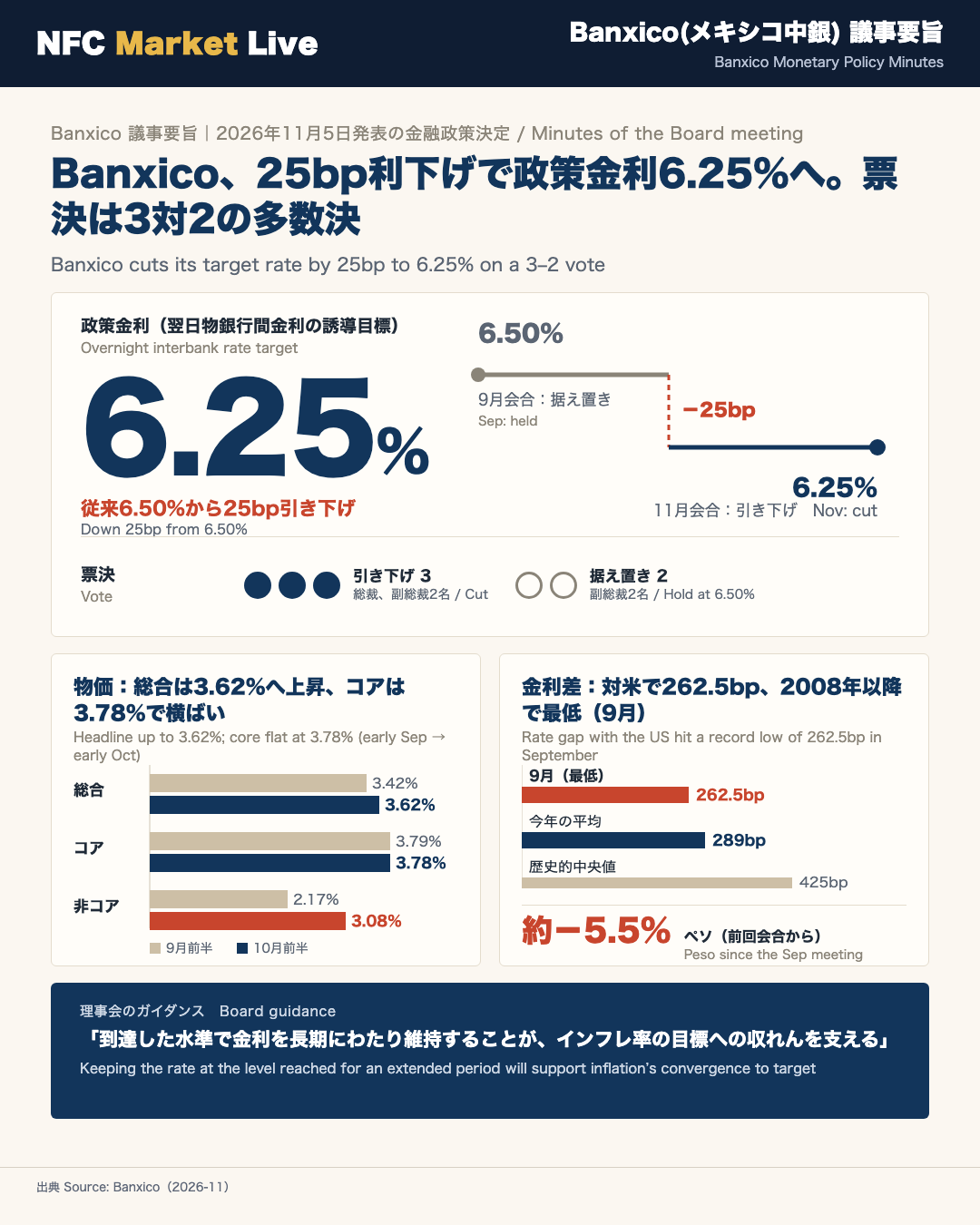
Key conclusion: the Board cut the overnight interbank rate by 25 basis points to 6.25% by majority, three votes to two. In September it had held at 6.50% unanimously.
Board reasoning: disinflation has continued, pass-through from the weaker peso is expected to be limited given economic slack, there are no demand-side price pressures, and the earlier monetary restriction is still at work. Supporters described the move as a one-off fine adjustment, not the start of a sequence of cuts.
Dissent: Galia Borja Gómez and Jonathan Heath Constable favored holding. Borja warned that a narrower rate gap could raise volatility in local markets; Heath argued the real ex-ante rate should move away from, not toward, neutral.
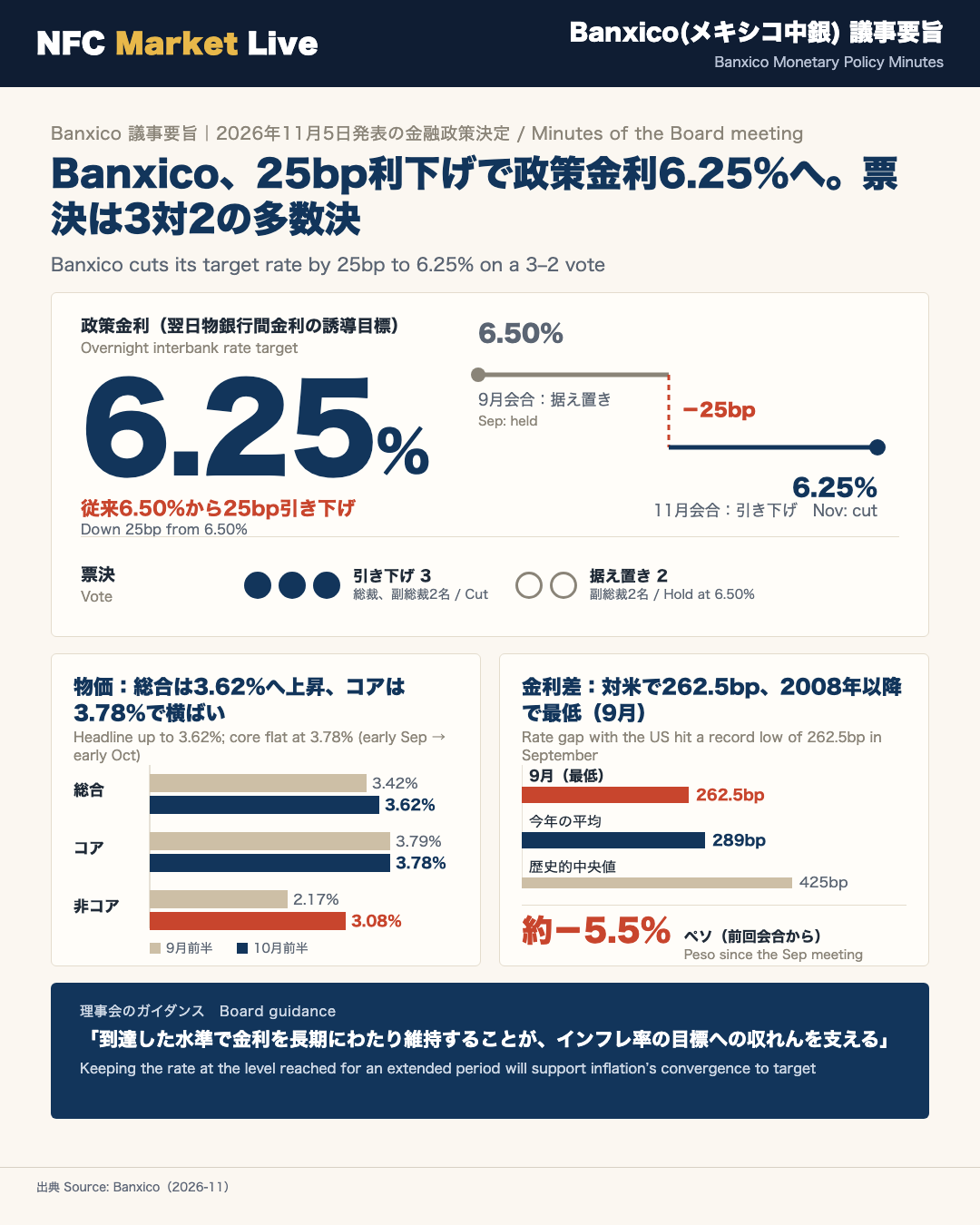
Key figures: headline inflation rose from 3.42% in the first half of September to 3.62% in the first half of October; core eased from 3.79% to 3.78%; non-core rose from 2.17% to 3.08%. Q3 GDP flash was +0.9% q/q (Q2: 1.4%). The peso depreciated 5.58% between decisions.
Guidance: holding the rate for a prolonged period at the level reached will support convergence to the target. The balance of risks for inflation remains tilted to the upside.
決定の骨子:3対2で25bp利下げ、6.25%へ
What happened
Banxico’s Board cut the overnight interbank rate by 25 basis points to 6.25% at its November 5, 2026 decision, down from 6.50%. The minutes, published on November 20 (Minute No. 128), show a 3-2 majority vote. Governor Victoria Rodríguez Ceja and Deputy Governors José Gabriel Cuadra García and Omar Mejía Castelazo voted for the cut; Galia Borja Gómez and Jonathan Heath Constable voted to hold at 6.50%.
Context for non-Mexican readers
Banxico (Banco de México) is Mexico’s central bank. Its five-member Board of Governors sets the target for the overnight interbank rate. Publishing the minutes about two weeks after the decision is standard practice; they summarize the discussion anonymously (‘one member’, ‘some’, ‘most’), while the votes and dissenting opinions are named. In September the Board held unanimously, so the November split is notable on its own.
The Board’s stated reasoning
The decision text cites continued disinflation, limited pass-through from the weaker peso given economic slack, no demand-side price pressure, and a degree of monetary restriction that is still operating. It also states that holding the rate for a prolonged period at the new level will support convergence of inflation to the target.
Comparison
Unlike the Federal Reserve, which held at 3.75-4.00% in October with two votes for a hike (as recounted in the minutes), Banxico moved in the opposite direction. Members on both sides stressed that Banxico should calibrate policy to Mexican conditions rather than react mechanically to the Fed.
Takeaway
The cut was framed by supporters as a fine adjustment, not the start of an easing sequence. The two dissents, covered separately, centered on risks to the peso and inflation expectations.
引き下げを支持した側の論理
The case for cutting
Members who supported the cut built their argument on several pillars described in the minutes.
- Inflation within the band: headline inflation has stayed inside the variability interval around the 3% target. The recent uptick is attributed to relative-price adjustments and base effects in the non-core component.
- Peso move: one member noted the peso fell about 5.5% between meetings, a move ‘not comparable with other stress episodes,’ leaving the exchange rate below its 2025 average. Evidence cited for Mexico points to exchange-rate pass-through near zero in the short run and limited in the long run, practically zero under economic slack.
- Lagged restriction: monetary policy operates with lags of four to six quarters, so the existing stance should keep supporting price stability.
- Relative stance: the volatility-adjusted rate differential versus the US is among the highest in emerging markets.
A one-off adjustment
Another supporter framed the move as a ‘fine adjustment’ that rules out the start of a sequence of cuts, followed by a prolonged pause. The argument: holding at 6.50% would imply a degree of restriction greater than required. The peso’s recent depreciation was not, by itself, considered a reason to keep tighter policy.
Why it matters
This mirrors the September minutes, where some members said the Board could evaluate a one-off cut at coming meetings. For English-speaking readers, note that Banxico’s ‘slack’ argument is central: with the output gap negative, officials argue demand is not feeding price increases. The dissenters challenged exactly that assumption, as the next section shows.
据え置きを主張した2人の反対論
Two named dissents
Galia Borja Gómez
Borja argued that an active ‘decoupling’ from a broad set of economies loosens Mexico’s relative monetary stance and could raise volatility in domestic financial markets. She noted the peso could be used more as a hedge for other assets, citing 2015, when rate differentials against many economies were very narrow. She favored a risk-management approach, noting the balance of risks remains tilted to the upside and that the stance has been in neutral territory for a year.
Jonathan Heath Constable
Heath argued a further cut not only weakens the stance but produces results opposite to its goals. In his view, lower growth expectations, currency overvaluation and the unusually low non-core inflation that had supported disinflation have ‘completely reversed.’ The ex-ante real rate should move away from, not toward, the neutral zone. He added that compressing the gap to the fed funds rate beyond historic lows is inconsistent with higher external rates and volatile depreciation, and warned that unwinding carry trades could steepen the yield curve.
Numbers behind the hawkish view
The eight-quarter average ex-ante real rate was cited at 3.96% in the discussion, near the upper bound of the neutral range. The September minutes cited 4.13% for the same statistic, so the cushion has narrowed.
Different readings
Another member who opted to hold said the debate should be about pausing or hiking, not cutting. The split shows that both camps assessed the same slack and pass-through evidence but weighted exchange-rate and expectations risks differently.
物価認識:総合は上昇、コアは緩やかな低下
Headline vs. core
Between the first half of September and the first half of October, headline inflation rose from 3.42% to 3.62%, while core was nearly flat at 3.78% (from 3.79%). Non-core accelerated from 2.17% to 3.08%. Fruits and vegetables climbed from 7.91% to 11.05%, partly on unfavorable base effects. Airfares rose 24.62% year over year (from 9.87%), mainly on jet fuel prices.
What members emphasized
- Headline inflation has stayed inside the variability interval (3% target, plus or minus 1 point) for 17 months since January 2025, though above the point target. It peaked at 4.59% in March.
- The 10% trimmed mean was 3.37%, suggesting a few components lifted the headline.
- Core has fallen from 4.52% in January, but only by about 17 basis points cumulatively since the second half of July. One member said progress in the second half of the year is slower than in the first.
- Services inflation (4.26%) is sticky. A member estimated that about 40% of the services basket has rigid pricing and responds with a lag to slack.
Expectations
The year-end 2026 core expectation fell 17 bp to 3.82%, and the 12-month headline expectation fell 23 bp to 3.92%. Several members noted longer-term expectations remain closer to 4% than to the 3% target.
For comparison
U.S. CPI was 3.7% in September per the annex, so Mexico’s headline is lower, but Banxico’s own forecast sees convergence to 3% only in Q4 2027. The question for the Board is whether sticky services and volatile non-core readings justify caution.
景気認識:予想を上回る成長と、なお残る余剰
Growth beat expectations
The flash estimate showed Q3 GDP up 0.9% quarter on quarter (seasonally adjusted), higher than anticipated but slower than the 1.4% pace in Q2. After a 0.34% contraction in Q1, this is two consecutive quarters of expansion. Growth forecasts for 2026 were revised up; one member said several brokerages moved their estimates to around 2%.
Where growth came from
- Industry and services led. Construction stayed strong, and manufacturing recovered, led by computer and electronics equipment, petroleum derivatives and transport equipment. One member noted about one-third of manufacturing sectors showed contraction or stagnation year on year.
- Exports posted 14 consecutive months of double-digit growth, described as the economy’s main engine, tied to U.S. technology and AI-related investment. Members cautioned the effect is concentrated in a few product lines.
- Fixed investment is up 6.8% since Q4 2025, though main components remain below end-2023 levels.
- Private consumption weakened in July, staying near Q4 2025 levels.
Slack persists
Most members expect slack through the forecast horizon despite the upward revisions. Average growth was close to 2% in 2000-2019, while 2024-2026 is estimated to be lower. The labor force participation rate is down almost 2 points versus 2023, which is why unemployment stays low.
Balance
The resilience in exports, investment and construction is real, but narrow. Consumption and parts of the labor market remain soft, and members still see risks to growth tilted to the downside, notably trade uncertainty.
為替・金利差・米連銀をめぐる議論
The peso
The peso depreciated 5.58% between the September and November decisions, trading between 17.49 and 18.93 per dollar. The annex cites greater risk aversion, a jump in volatility and a narrower rate gap versus the U.S., which reduced the appeal of carry trades. All members acknowledged the depreciation; most stressed it was orderly and that the peso remains stronger than at end-2024 and its 2025 average. One member called it a correction of prior overvaluation, while another noted a decline in long peso positions and a search for hedges.
The rate gap and the Fed
- The gap versus the U.S. policy rate hit 262.5 bp in September, the lowest since Banxico adopted the policy rate as its instrument in 2008; it has averaged 289 bp this year. One member said current conditions would be more consistent with 425 bp, the historical median.
- The Fed held at 3.75-4.00% in October, with two votes to raise by 25 bp; a member expects a hike in December. Between meetings, eight central banks, including Canada, Australia and Norway, raised rates.
‘Not mechanical’
Members on both sides said Banxico’s decisions need not react mechanically to the Fed, but that Fed actions matter to the extent they affect Mexico’s inflation outlook. One member recalled the post-pandemic cycle: Banxico began hiking in June 2021, the Fed in March 2022, with 725 bp versus 525 bp cumulatively; in 2025, Banxico began easing about six months before the Fed, cutting 300 bp versus 75 bp.
Contrast
The doves point to a high volatility-adjusted differential and low pass-through; the hawks stress a thin cushion. Both readings rely on the same data.
先行き:長期据え置きのガイダンスと、見るべきリスク
The Board’s guidance
The decision text says that holding the rate for a prolonged period at the level reached will support convergence of inflation to the target and is appropriate for confronting external macroeconomic challenges. Future decisions will weigh observed and expected inflation and its determinants, including exchange-rate pass-through, slack and inflation expectations. The Bank reaffirmed its commitment to its priority mandate of low and stable inflation.
Banxico’s inflation outlook
- The forecast still has headline inflation converging to the 3% target in Q4 2027.
- The Q4 2026 headline forecast was revised up because non-core inflation came in above expectations; members expect that effect to fade.
- Core should decline more clearly in early 2027 as base effects from special taxes (IEPS) on food items fade. One estimate puts that base effect at roughly 100 bp on food goods inflation until early 2027.
Risks cited
| Upside | Downside |
|---|---|
| Core persistence | Weaker activity in Mexico and/or U.S. |
| Further peso depreciation | Smaller pass-through of cost increases |
| Trade policy, geopolitics (Middle East conflict now in its eighth month) | Lingering disinflationary effects of past peso strength |
| Weather (Super El Nino), cost pressures |
Most members said the balance of risks remains tilted to the upside. One member noted that faster reversal of energy prices or progress toward a lasting peace deal could have favorable effects on domestic prices.
What to watch
The minutes point to the pace of core and services disinflation, the peso and its pass-through, inflation expectations (long-term closer to 4% than 3%), and the Fed’s path. No next meeting or release date is given in this document.
Disclaimer: This article is for informational purposes only. All investment decisions are made solely at your own risk.