This article was automatically generated by the NFC Market Live AI analysis system. (Updated: 2026-11-19 04:17 JST)
📄 Primary Source
Federal Reserve
https://www.federalreserve.gov/monetarypolicy/fomcminutes20261028.htm
📊 The Fed released minutes of its Oct 27-28 FOMC meeting (Nov 19).
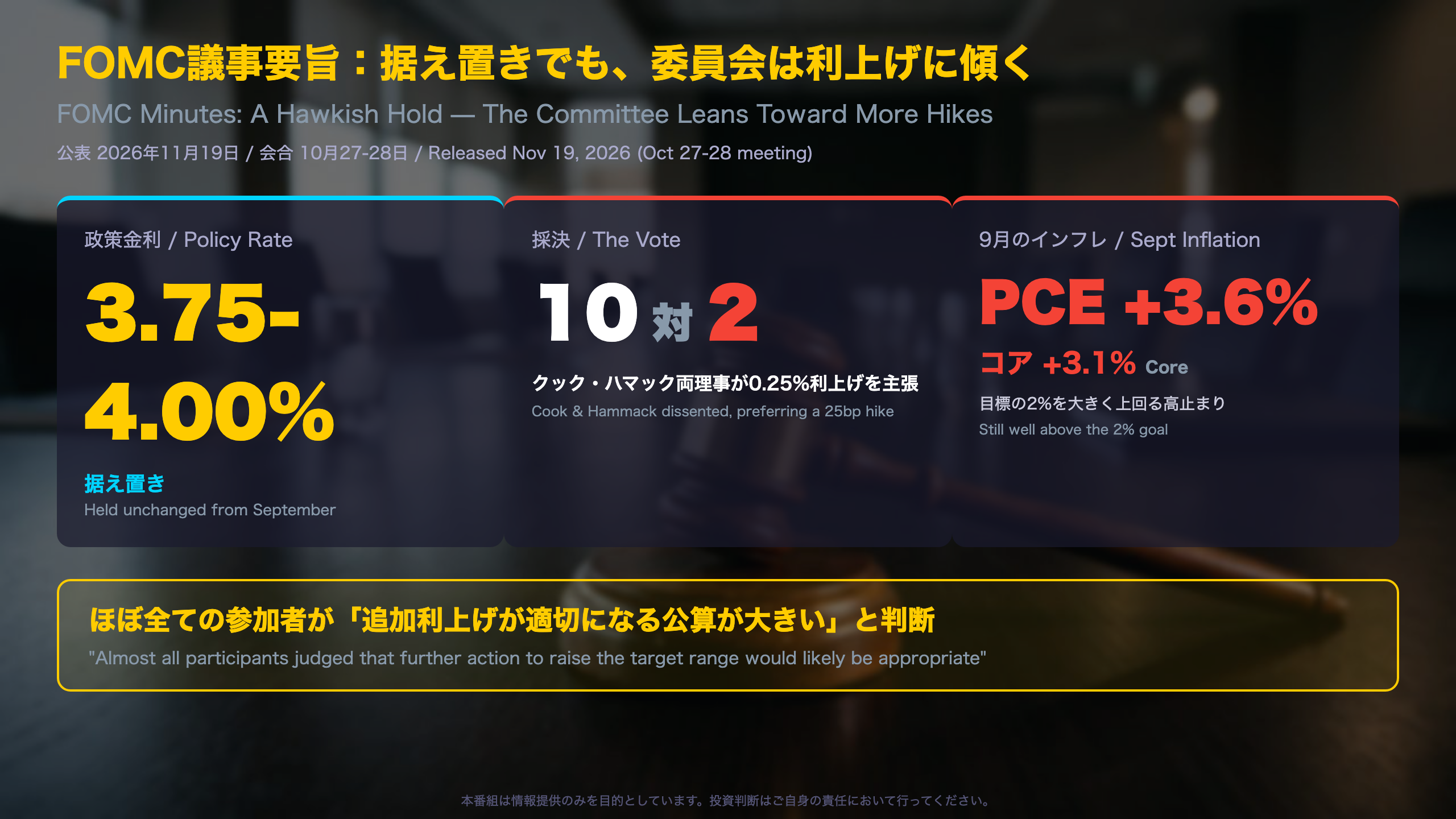
Rates were held at 3.75-4.00%, but the vote split 10-2 — Governors Cook and Hammack dissented in favor of a 25bp hike.
📈 Almost all participants judged further rate increases would likely be appropriate, framing the hold as a pause to gather information, not an end to tightening.
⚠️ Yet nearly all also flagged the risk of disappointing AI investment returns and rapid growth of opaque AI-related debt.
💡 The minutes record tighter financial conditions since September and dollar strength on widening rate differentials. Next meeting: Dec 8-9.
The Ultimate Summary — 据え置きでも、委員会は利上げに傾く
A Hold That Broke the Unanimity
The minutes of the October 27-28 FOMC meeting, released November 19, revealed a 10-2 vote to keep the federal funds rate at 3.75-4.00%. Just one meeting earlier, the Committee had hiked 25bp by a unanimous 12-0 vote. The dissenters — Governors Lisa Cook and Beth Hammack — wanted another quarter-point hike, meaning the dissent was in the hawkish direction.
Why FOMC minutes matter
Minutes are released three weeks after each meeting and reveal the distribution of views behind the headline decision — something the post-meeting statement cannot convey. Under Chair Kevin Warsh, the statement again closed with the unusually forceful pledge that the Committee \”will deliver price stability.\”
Key context for global investors
- Staff projected inflation returning to about 2% in 2028, but flagged the possibility that longer-run inflation expectations \”could have become unanchored\” after five years of above-target inflation as a salient risk
- The Desk survey median expected one more hike in December and another in March 2027, followed by a cut in early 2028; the longer-run fed funds estimate rose to about 3.4%
- Several foreign central banks — including the Bank of Japan and the Reserve Bank of Australia — raised rates during the intermeeting period, underscoring a global tightening backdrop
The headline says \”hold,\” but the vote split, the statement language, and the staff’s upside inflation risk assessment all point the same way: this was a hawkish pause.
据え置きの内実 — 割れた委員会
Mapping the Committee by Its Own Language
FOMC minutes encode the breadth of opinion through standardized phrasing. Here is the October distribution:
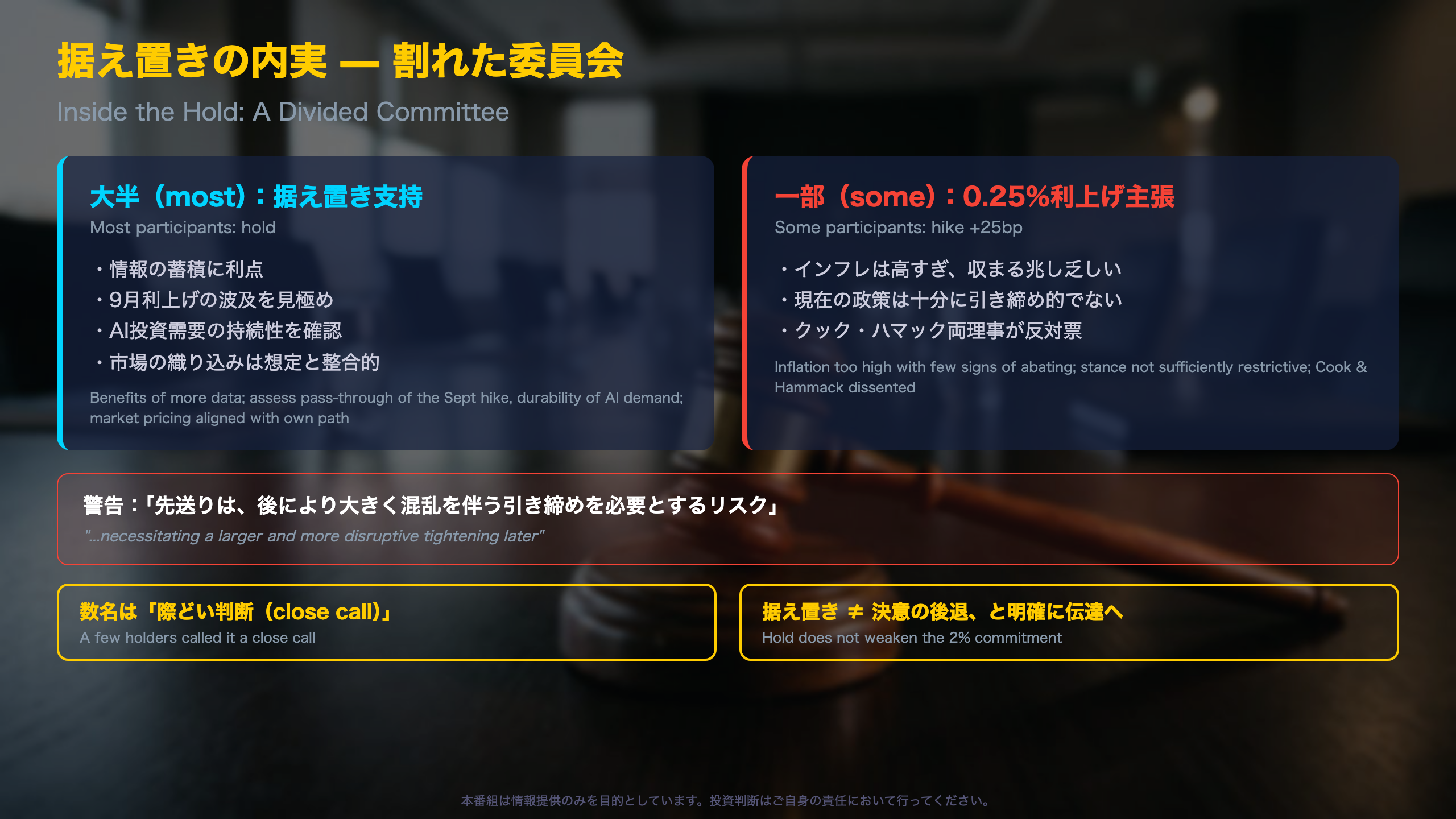
- Most participants: supported holding rates
- Many: saw benefits in accumulating information — on the durability of AI investment demand, the transmission of September’s hike, financing conditions, and geopolitics
- Some: favored a 25bp hike now, judging the stance \”not sufficiently restrictive\” with inflation showing \”few signs of abating\”
- A few: backed the hold but called it a \”close call\”
- A couple: said a move of more than 25bp could warrant consideration in December if inflation data disappoint
The hawks’ warning
The sharpest language in the minutes: further delay \”risked allowing high inflation to become entrenched or necessitating a larger and more disruptive tightening later.\” Some hawks indicated they could have accepted a hold only if markets clearly understood further tightening was likely — a conditional truce, not a change of view.
Communication as policy
Many participants stressed the importance of conveying that the hold \”did not reflect a weakening of the Committee’s commitment\” to 2% inflation. Several added that policy should be judged by the overall rate path rather than individual meetings. For investors accustomed to reading Fed pauses as pivots, the minutes push back explicitly on that interpretation.
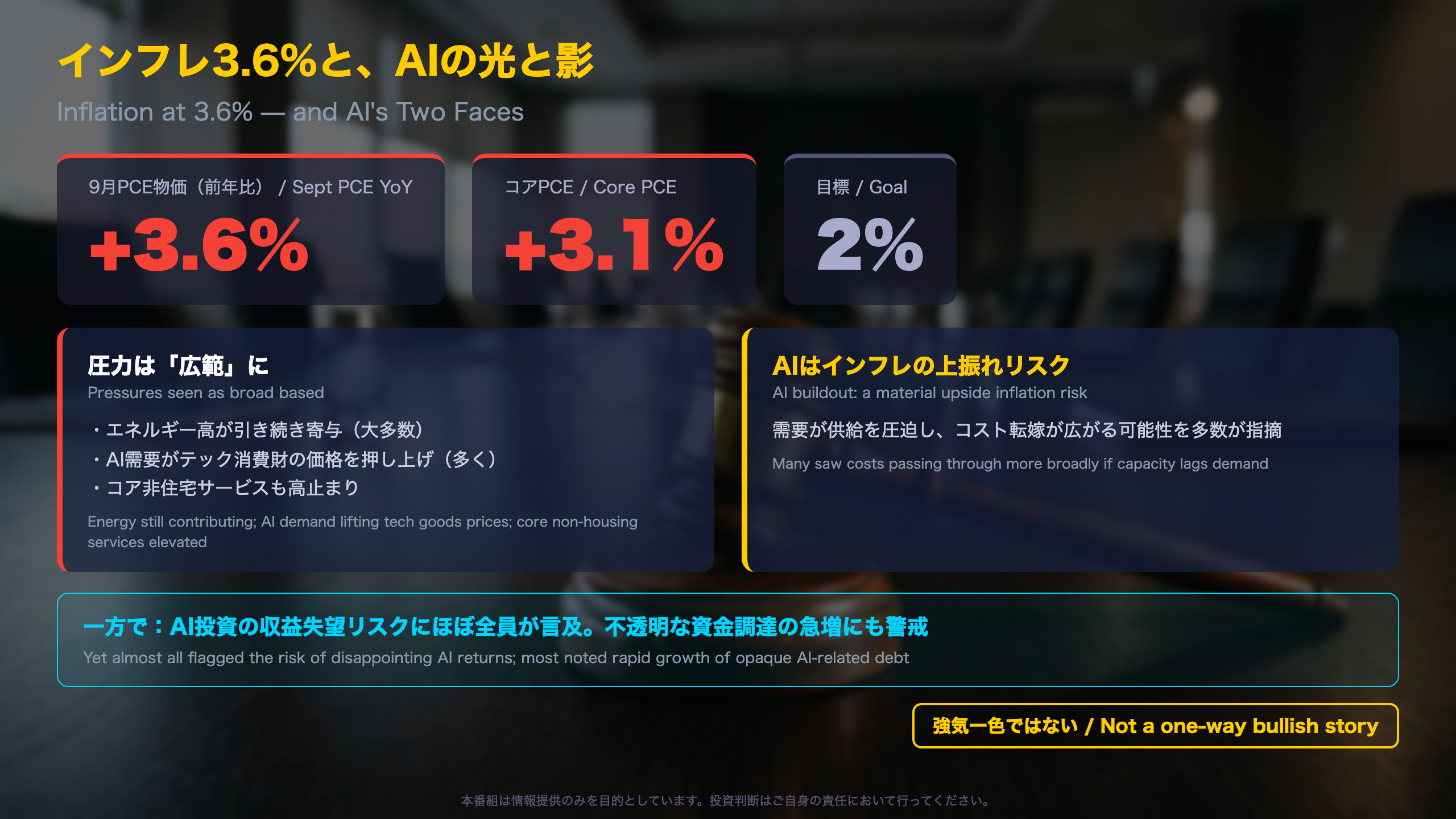
インフレ3.6%と、AIの光と影
Inflation: Lower Numbers, Harsher Verdict
Staff estimated September PCE inflation at 3.6% year over year, boosted by a rapid rise in consumer energy prices, with core PCE at 3.1%. While the headline figures edged down from the prior minutes, the Committee’s qualitative assessment hardened: most participants described inflation pressures as broad based, and several judged that price pressures were \”increasingly extending beyond industries directly affected by data center construction.\”
Expectations: anchored, with caveats
Medium- and longer-term inflation expectations were seen as consistent with the 2% objective, but a few participants flagged rising short-term expectations. A technical wrinkle worth noting for markets: with an unusual discrepancy between CPI and PCE inflation rates, participants cautioned that market-based expectation measures — priced off CPI-linked securities — \”might be difficult to interpret.\”
The financial stability session: AI’s debt plumbing
Unusually, these minutes open with a dedicated financial stability discussion. Staff highlighted hedge fund leverage and elevated valuations as the most salient vulnerabilities, and flagged off-balance-sheet leasing commitments and circular financing arrangements among AI firms as potential loss amplifiers if AI returns disappoint. Almost all participants commented on that disappointment scenario; a few warned that AI exposures were concentrating among a small number of firms, and several worried supervisors’ data may not capture banks’ indirect exposure through nonbanks. For equity investors heavily weighted toward AI infrastructure names, this is the Fed explicitly mapping the downside.
質疑:強い主語の意味と、投資家への含意
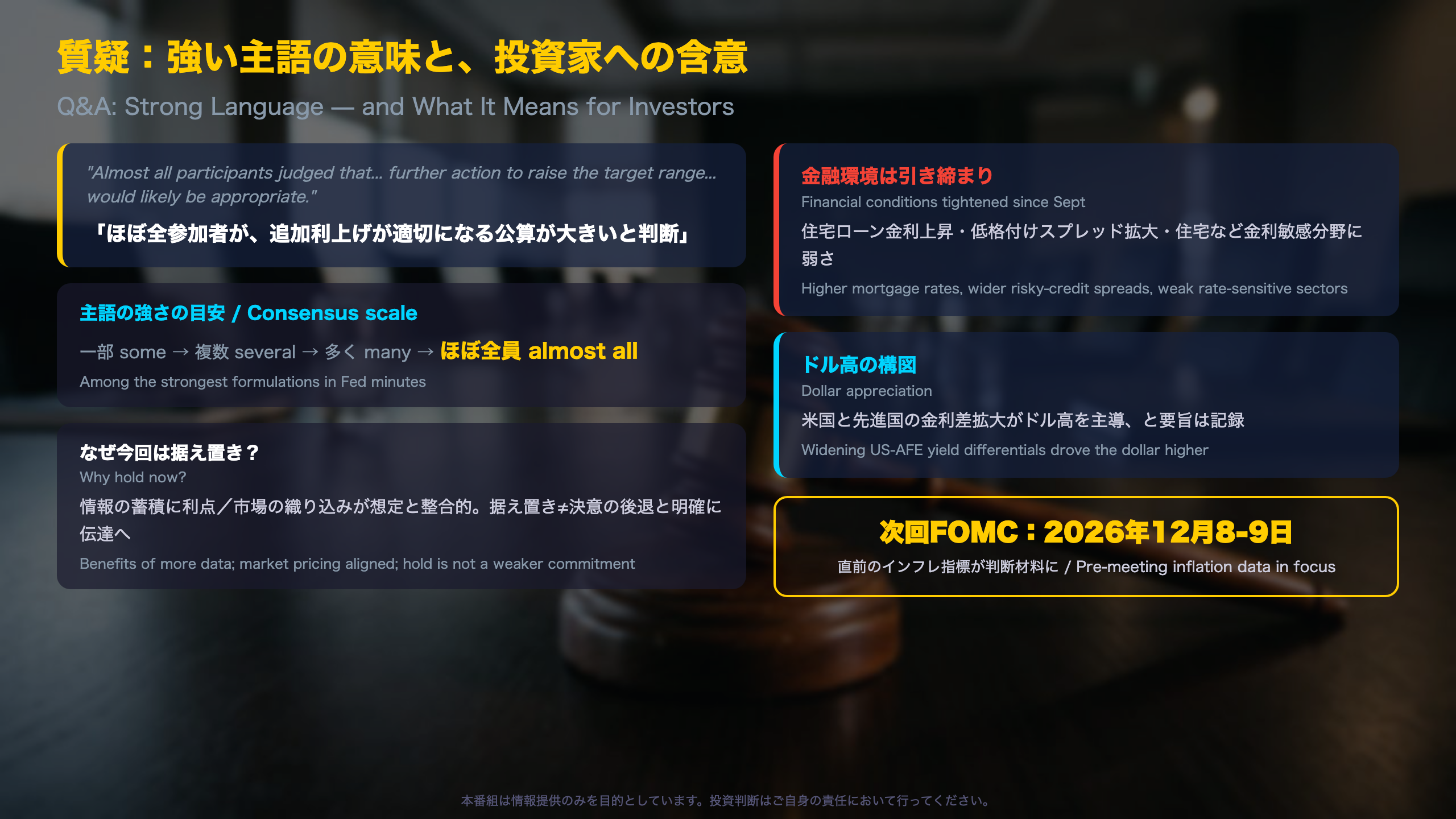
Three Facts for Global Portfolios
1. Financial conditions have already tightened
A majority of participants noted tightening since September. The minutes document: higher mortgage rates; notably wider spreads on speculative-grade bonds — especially high-yield debt financing data center construction; bank equities that \”fell sharply\” on loan growth and CRE concerns; and softness in housing, CRE, and small business borrowing. In effect, markets are doing part of the Fed’s work.
2. The dollar mechanics
While the U.S. policy path was little changed over the period, implied paths in other advanced economies shifted down — their economies look less resilient and more energy-sensitive. The resulting widening of U.S.-AFE rate differentials drove dollar appreciation. A French fiscal scare that pushed the Franco-German 10-year spread to euro-crisis-era highs added safe-haven demand for Treasuries. For yen-based investors, the differential channel remains the dominant dollar-yen driver described in the minutes.
3. What’s priced, per the minutes
Futures assigned high odds to a 25bp hike by year-end and two more by summer 2027. The Desk survey median saw one hike in December, another in March 2027, and a cut in early 2028, with the longer-run fed funds estimate rising to about 3.4% on higher real-rate estimates.
Next up: December 8-9
A couple of participants said a move larger than 25bp could warrant consideration if inflation data disappoint, and a few noted the next inflation release was \”likely to be unfavorable.\” The pre-meeting inflation prints are the key watchpoint. We report what the minutes show — a committee leaning toward tightening — without forecasting the December decision itself.
Disclaimer: This article is for informational purposes only. All investment decisions are made solely at your own risk.