This article was automatically generated by the NFC Market Live AI analysis system. (Updated: 2026-11-19 06:53 JST)
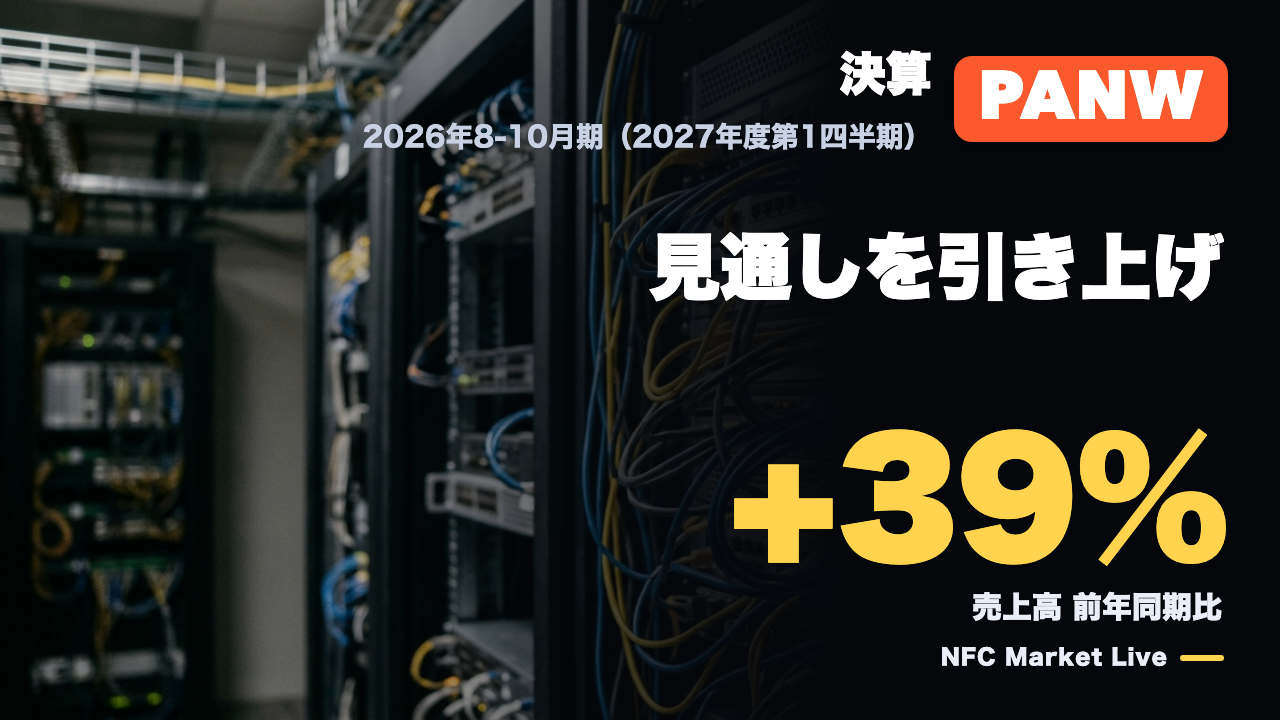
📊 Palo Alto Networks (PANW) reported fiscal Q1 2027 results: revenue rose 39% year over year to $3.445B and Next-Generation Security ARR grew 66% to $9.73B.
📉 GAAP operating income fell to $96M from $309M, while non-GAAP operating income rose to $1.059B.
💡 GAAP net income includes a $457M tax benefit, so the picture changes with the accounting lens. The company said it is materially raising its full-year guidance and announced an all-stock $4.5B deal to acquire Applied Compute.
⚠️ Next to watch: whether Q2 NGS ARR reaches the guided $10.20-10.22B range.
決算サマリー:売上39%増、GAAP営業利益は減少
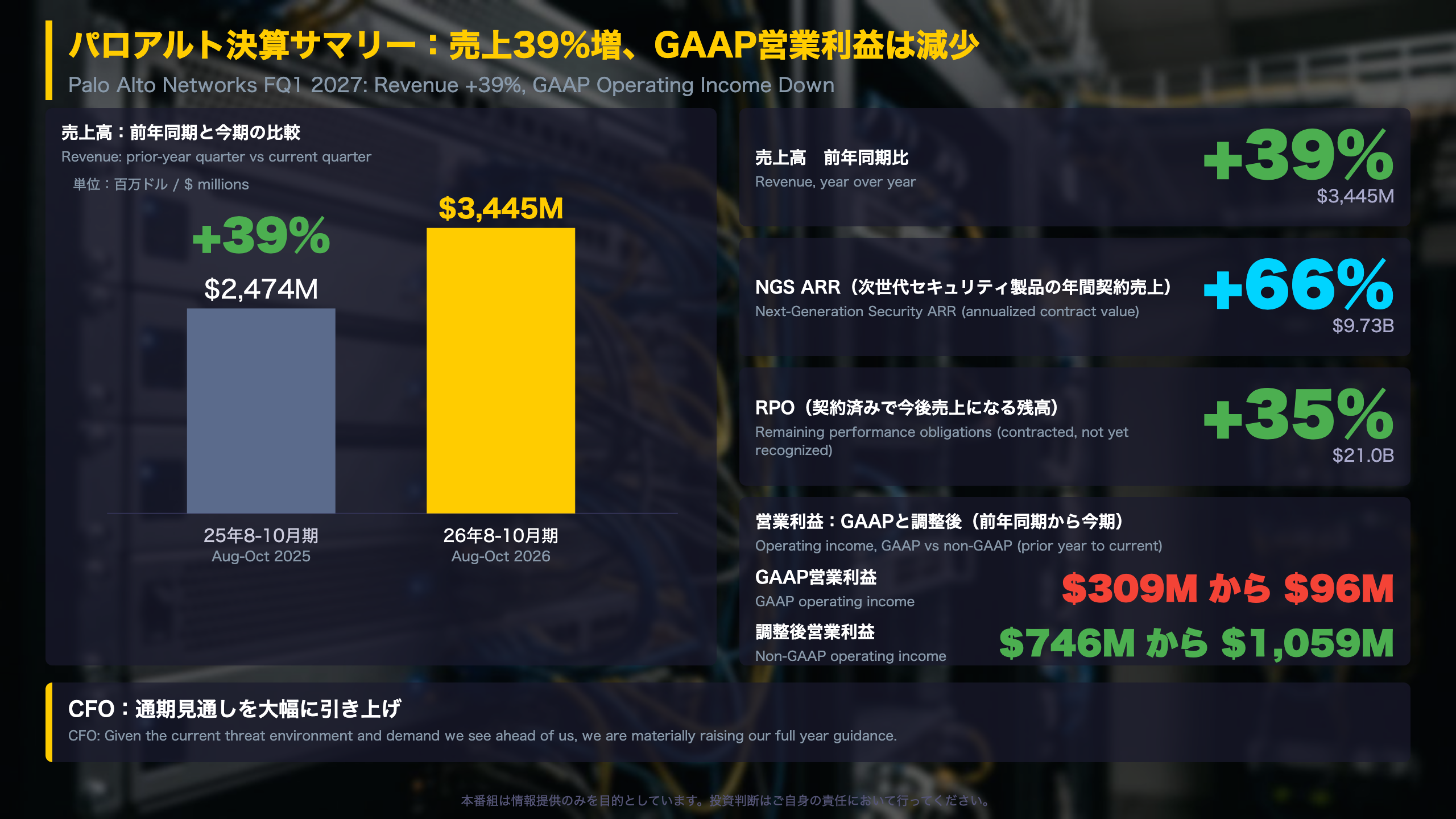
Q1 FY2027 at a glance: strong top line, thinner GAAP profit
Palo Alto Networks (PANW) filed this earnings release with the SEC as an 8-K exhibit on November 18, 2026, covering the fiscal quarter ended October 31, 2026. Its fiscal year ends in July, so this is the first quarter of FY2027.
Key figures (in millions of dollars, current vs. year-ago): product revenue 595 vs. 434; subscription and support 2,850 vs. 2,040; gross profit 2,342 vs. 1,836; total operating expenses 2,246 vs. 1,527.
What the numbers imply (our calculations from the release):
– Gross profit divided by revenue is roughly 68.0% versus 74.2% a year earlier. Product cost of revenue rose from 89 to 206.
– Operating expenses grew about 47%, faster than the 39% revenue growth.
– Non-GAAP operating income still rose from 746 to 1,059.
Why GAAP and non-GAAP diverge: GAAP includes stock-based compensation and amortization of acquired intangibles; non-GAAP strips them out. Many software peers present similar non-GAAP measures, though definitions differ, so direct comparisons need care.
Two readings: the constructive view is that growth is running at a high level and the CFO called it a very strong start in a seasonally slower quarter. The cautious view is that acquisition-related costs and stock compensation are weighing on reported profit.
What to monitor next: the Q2 guidance of $3.530-3.550B in revenue and $1.01-1.03 in non-GAAP EPS. The next earnings date is not stated in the release.
深掘り1:成長の勢い(NGS ARRとRPO)
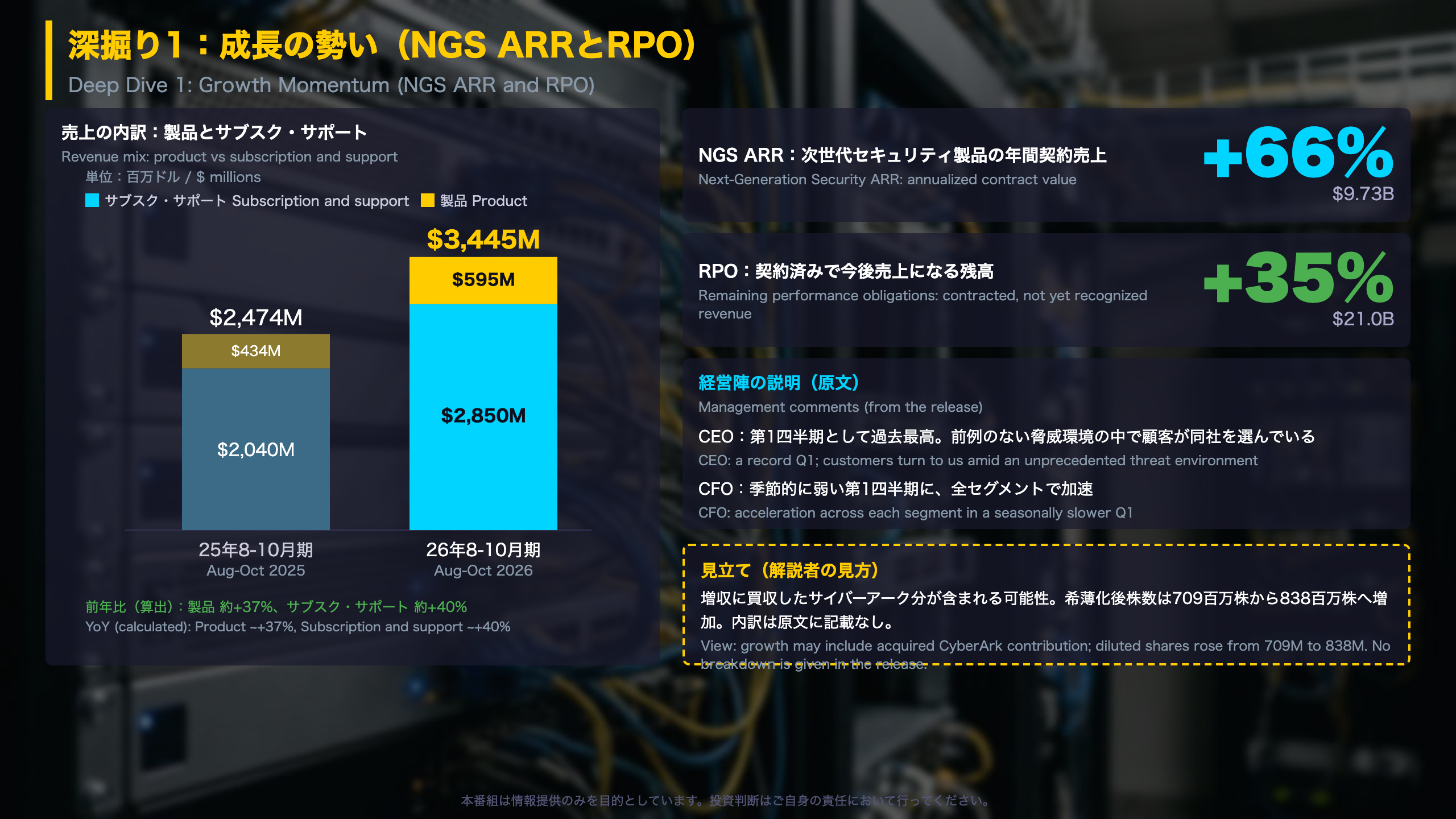
Decomposing the growth: ARR, RPO and revenue mix
What is NGS ARR? The release defines Next-Generation Security ARR as the annualized allocated revenue of all active contracts at period end, excluding hardware and legacy attached subscriptions and services. It is an operating metric, not a GAAP or non-GAAP accounting figure, so it is not comparable with GAAP revenue. Investors in US software often track ARR-type metrics; definitions vary by company.
Revenue mix (millions of dollars): product 595 vs. 434 (about +37%, our calculation); subscription and support 2,850 vs. 2,040 (about +40%). Subscription and support makes up roughly 83% of revenue.
RPO rose 35% to $21.0B. Deferred revenue on the balance sheet is $7.73B current and $6.859B long-term.
Guidance context: Q2 NGS ARR is guided to $10.20-10.22B, or +61% year over year, versus +66% in Q1, so the company itself signals a modest deceleration in growth rate.
Two readings:
– Constructive: the CFO described “acceleration across each of our segments” in a seasonally slower quarter.
– Cautious: basic weighted shares rose from 679M to 819M. The release does not explain this, but acquisition-related issuance is one possibility, and it means the organic share of growth cannot be isolated from the release.
Watch next: the earnings-call breakdown of organic versus acquired contribution, and whether Q2 NGS ARR lands in the guided range.
深掘り2:利益の読み方(GAAPと調整後)
Reading the bridge from GAAP to non-GAAP
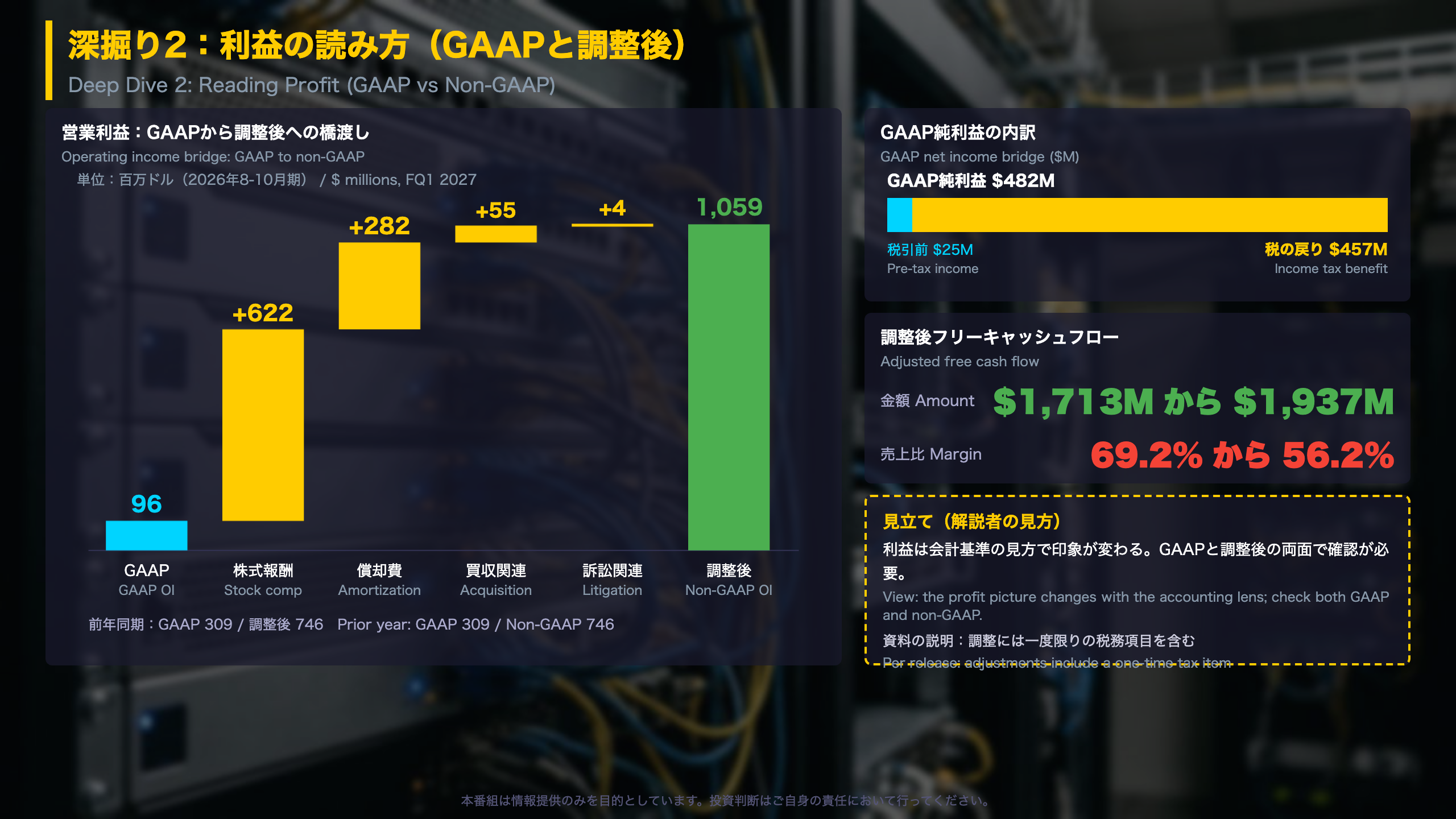
Operating income reconciliation (millions of dollars, current vs. year-ago): GAAP operating income 96 vs. 309; stock-based compensation-related charges 622 vs. 387; acquisition-related costs 55 vs. 5; amortization of acquired intangibles 282 vs. 39; litigation-related 4 vs. 6; non-GAAP operating income 1,059 vs. 746.
Amortization rose roughly sevenfold, a direct reflection of the CyberArk acquisition referenced in the release’s footnotes.
Net income: pre-tax income was only $25M, but an income tax benefit of $457M lifted GAAP net income to $482M. The release states the non-GAAP tax adjustment “included a one-time tax adjustment relating to a change in our tax position on a historical transaction during the transition period of the Tax Cuts and Jobs Act.” Non-GAAP net income rose about 33% to $881M, but non-GAAP EPS rose only about 13% to $1.05 because diluted shares increased about 18% (our calculations).
Cash flow: operating cash flow was $1.929B (vs. $1.771B); adjusted free cash flow $1.937B (vs. $1.713B). As a share of revenue, adjusted FCF margin fell from 69.2% to 56.2%. Adjusted FCF adds back $95M of acquisition-related payments.
International context: unlike many US peers that report only one non-GAAP profit measure, PANW also adjusts for the fair value of convertible notes and capped calls.
Balance: the constructive view is rising absolute cash generation; the cautious view is that operating expenses (about +47%) outgrew revenue (+39%), thinning GAAP profitability. Convertible notes of $1.93B moved to current liabilities.
質疑:通期見通しと次の注目点
Guidance and the Applied Compute deal
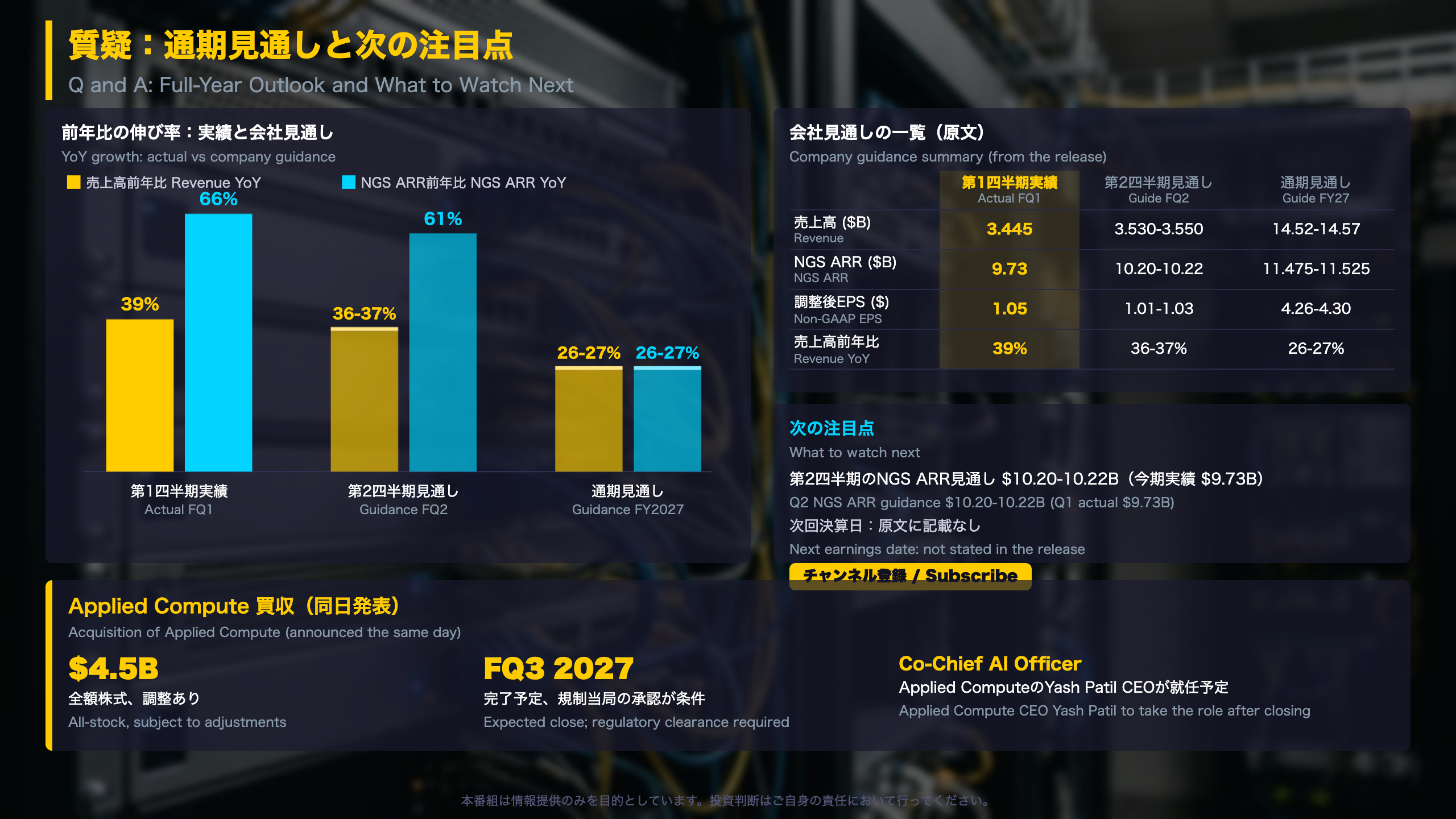
Guidance in brief (company figures): Q2 revenue $3.530-3.550B (+36-37% YoY), NGS ARR $10.20-10.22B (+61%), non-GAAP EPS $1.01-1.03. Full year revenue $14.52-14.57B (+26-27%), NGS ARR $11.475-11.525B (+26-27%), non-GAAP operating margin 29.5%, non-GAAP EPS $4.26-4.30, adjusted FCF margin 38.0%.
For context, Q1 non-GAAP operating margin works out to roughly 30.7% (1,059 divided by 3,445, our calculation), so the full-year 29.5% target sits slightly below it.
How much was the raise? The CFO said the company is “materially raising our full year guidance,” but the release does not state the prior figures, so the size of the raise cannot be verified from this document alone. We deliberately avoid comparing with sell-side consensus, which is not part of the source.
Applied Compute: an all-stock deal valued at $4.5B, subject to adjustments and regulatory clearance, expected to close in fiscal Q3 2027. Applied Compute is a platform for post-training and inference of open-weight AI models; its co-founder and CEO Yash Patil is slated to become Co-Chief AI Officer. CEO Nikesh Arora said every enterprise will run a mix of open and closed models and each needs securing. The release does not say whether the deal is in the guidance.
Fiscal calendar note for non-Japanese readers: PANW’s fiscal year ends July 31, so Q2 FY2027 covers November 2026 to January 2027.
Two readings: constructive, the raised outlook signals confidence in demand; cautious, full-year growth is lower than Q1 and the deal carries closing and integration risk, which the company itself lists among risk factors.
Watch next: the earnings-call detail on the deal and the raise, and whether Q2 NGS ARR reaches the guided range. The next earnings date is not stated.
Disclaimer: This article is for informational purposes only. All investment decisions are made solely at your own risk.