This article was automatically generated by the NFC Market Live AI analysis system. (Updated: 2026-11-19 22:20 JST)
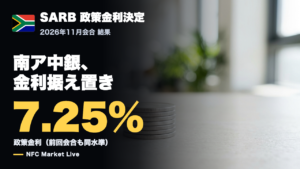
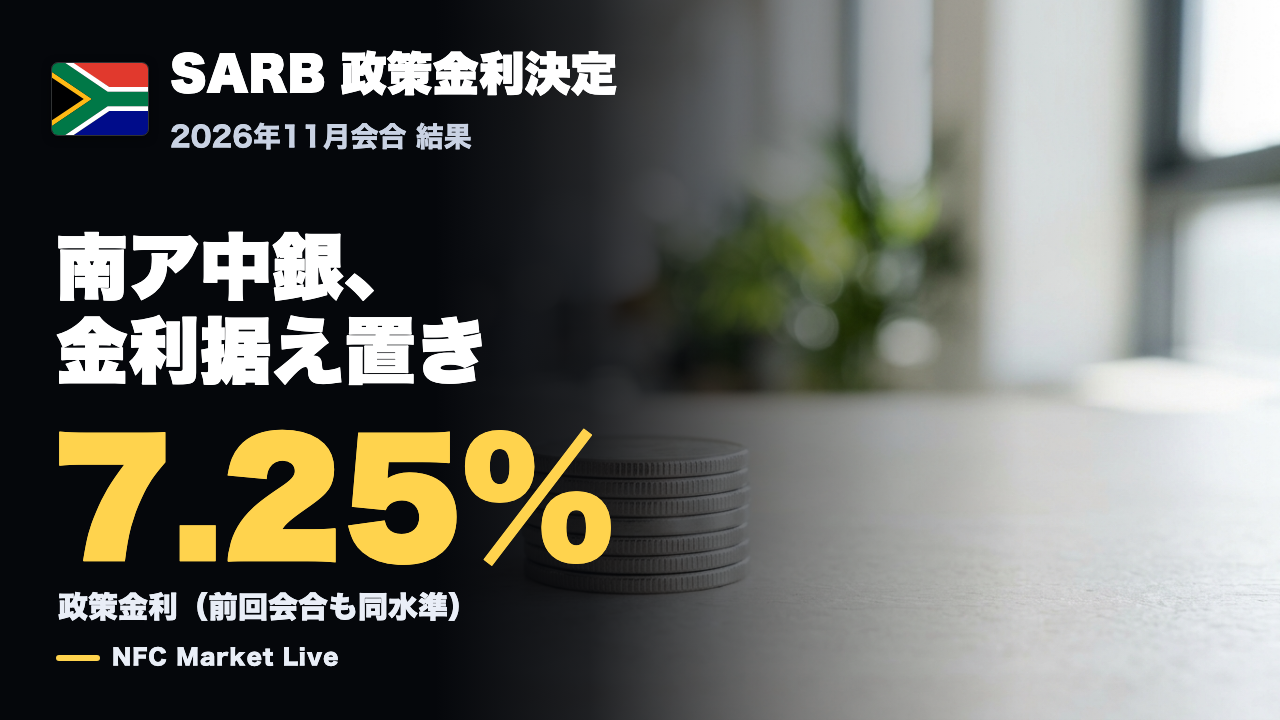
📊 The South African Reserve Bank’s MPC held its policy rate at 7.25%, with a 4-3 vote (four to hold, three for a 25 bp hike). September’s hike was unanimous.
📈 CPI is 5.2% (prev. 4.4%), driven mainly by fuel inflation of around 40%, while food and goods inflation stay unusually subdued.
💡 A gradual recovery appears under way, but fixed investment is only about 13% of output.
⚠️ The MPC ‘will not hesitate to raise rates if needed’. Next: CPI on Dec 15, MPC statement on Jan 28.
SARB 11月MPC:据え置き、投票は4対3に分裂
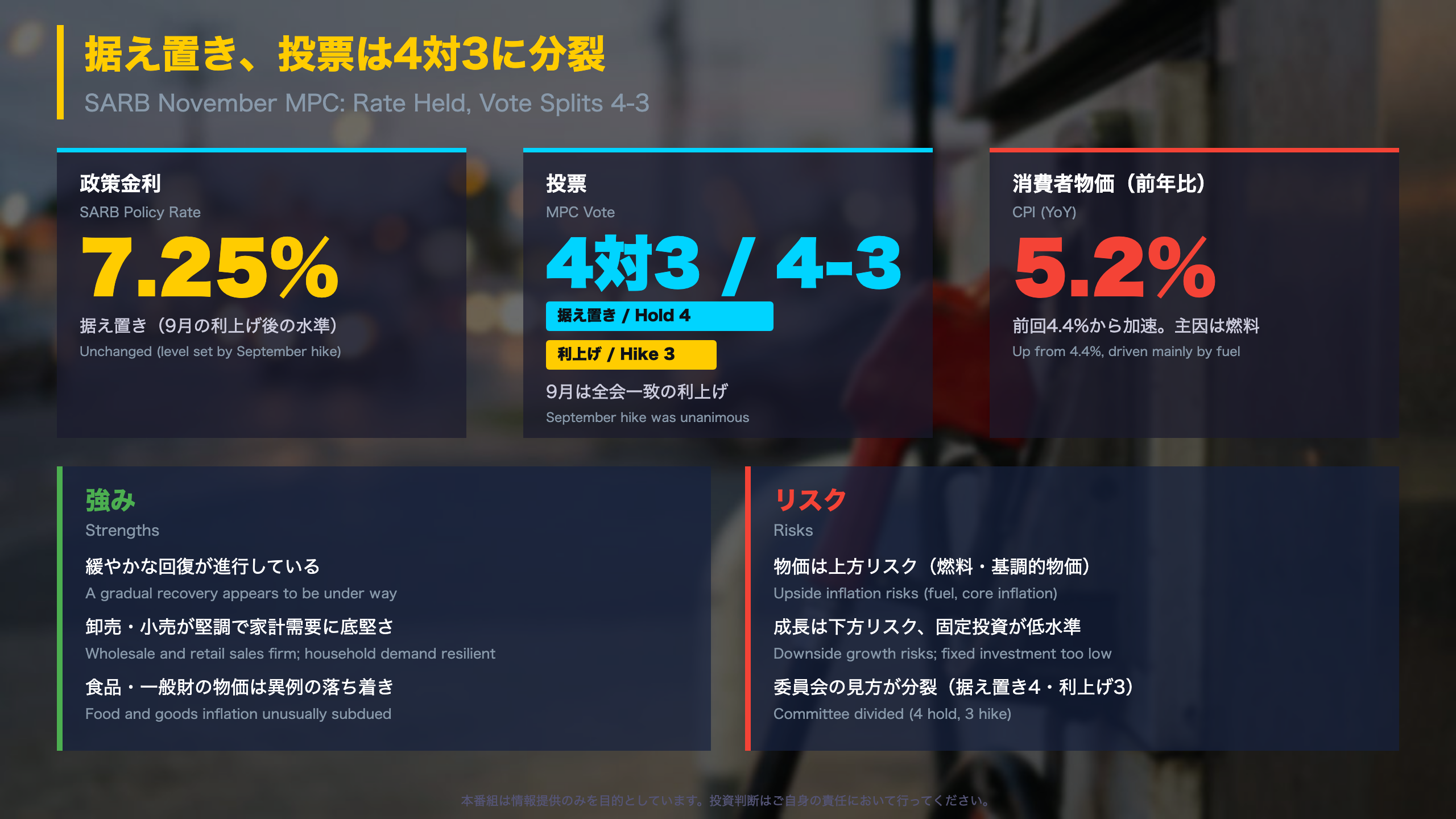
SARB Pauses at 7.25% — With a Divided Committee
Who decides. The Monetary Policy Committee (MPC) of the South African Reserve Bank (SARB) targets 3% inflation with a ±1 point tolerance band. In September it hiked 25 bp to 7.25% unanimously. In November it held, but the vote was 4–3, with three members favoring another 25 bp hike.
September vs. November
| Item | Sept | Nov |
|---|---|---|
| Policy rate | 7.25% (after hike) | 7.25% (held) |
| Vote | Unanimous | 4–3 |
| CPI | 4.4% | 5.2% |
| Growth risk | Downside | Downside |
| Inflation risk | Upside | Upside |
The balance-of-risks language did not change. What changed is the decision and how divided the room was.
International context
The statement says major central banks keep a tightening bias, citing the Bank of England’s recent hike, its first since 2023. Against that backdrop, SARB’s move is a hold at a ‘moderately restrictive’ level, not a pivot to easing.
Two readings
- Constructive: a gradual recovery appears under way, and food and goods inflation are unusually subdued.
- Cautious: headline inflation is above 5%, and the statement still sees upside inflation risks.
What to watch
South African CPI on 15 December and the next MPC statement on 28 January.
決定の中身:4対3の僅差と文言の変化
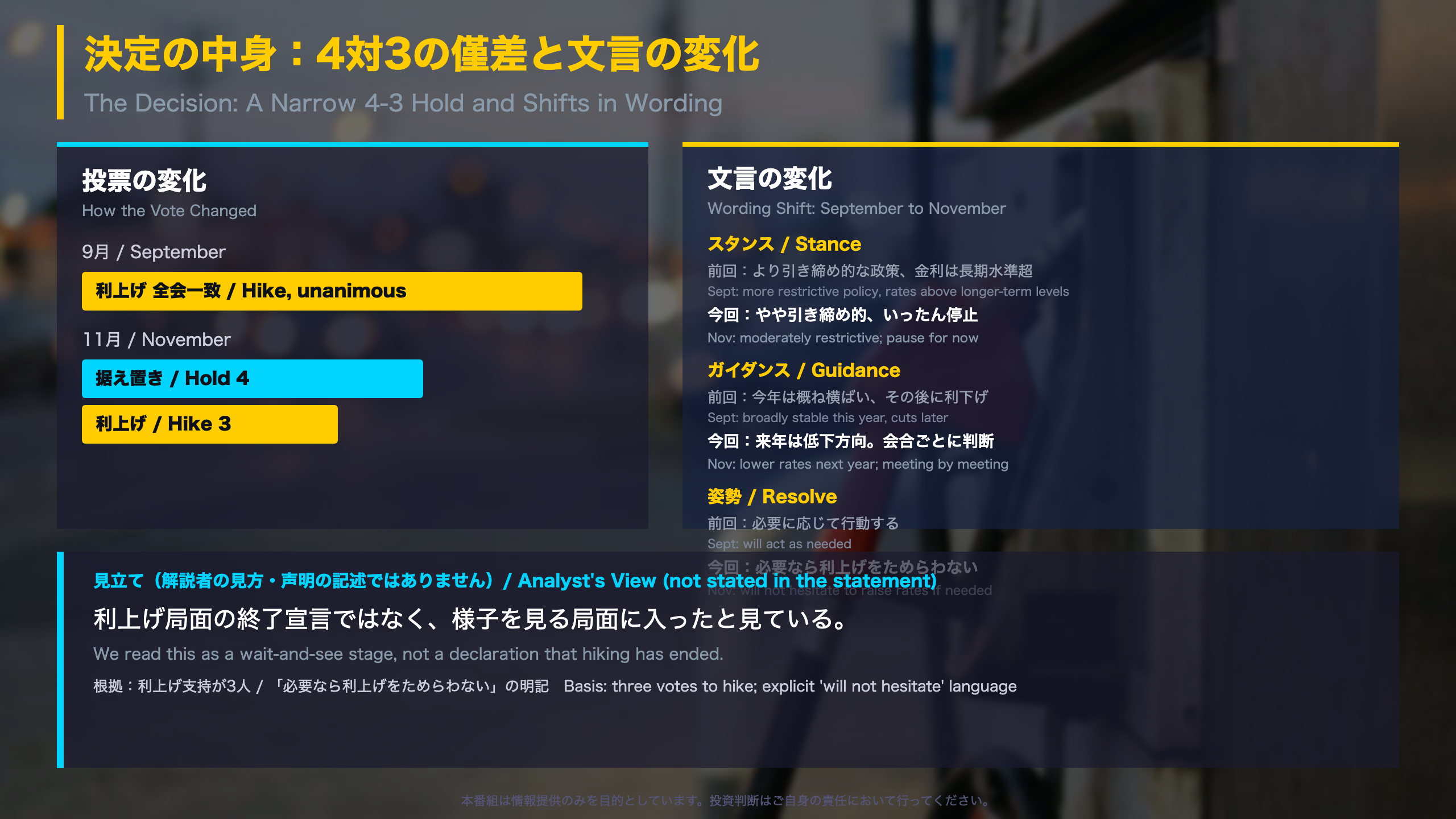
Reading the Redline: How the Language Shifted
Central bank statements are read for what changed. Comparing September with November:
| Topic | September | November |
|---|---|---|
| Decision | 25 bp hike, unanimous | Hold, 4–3 |
| Stance | ‘more restrictive monetary policy, with rates above longer-term levels’ | ‘moderately restrictive’; ‘pause for now’ |
| QPM path | Broadly stable rest of 2026, cuts later | Lower rates next year |
| Resolve | ‘We will act as needed’ | ‘will not hesitate to raise rates if needed’ |
| Process | Meeting-by-meeting | Meeting-by-meeting |
‘After two policy adjustments this year, and with a moderately restrictive policy stance, we decided to pause for now.’
Scenario analysis swapped
September tested higher global rates (about one hike above baseline) and higher expectations and wages (one to two hikes above). November tested an energy shock (about two hikes) and a fiscal/bond-yield shock (at least two hikes). Every scenario points toward tighter policy.
How to read it
The QPM is the SARB’s Quarterly Projection Model, a forecasting tool; the statement calls its rate path a ‘broad policy guide’, not a commitment. A dovish reader stresses the softer stance wording and the four votes to hold. A hawkish reader stresses the three votes to hike and the explicit ‘will not hesitate’ line. Neither reading is contradicted by the text.
Watch
Whether the 4–3 split narrows or widens on 28 January.
物価と成長:強弱が混在
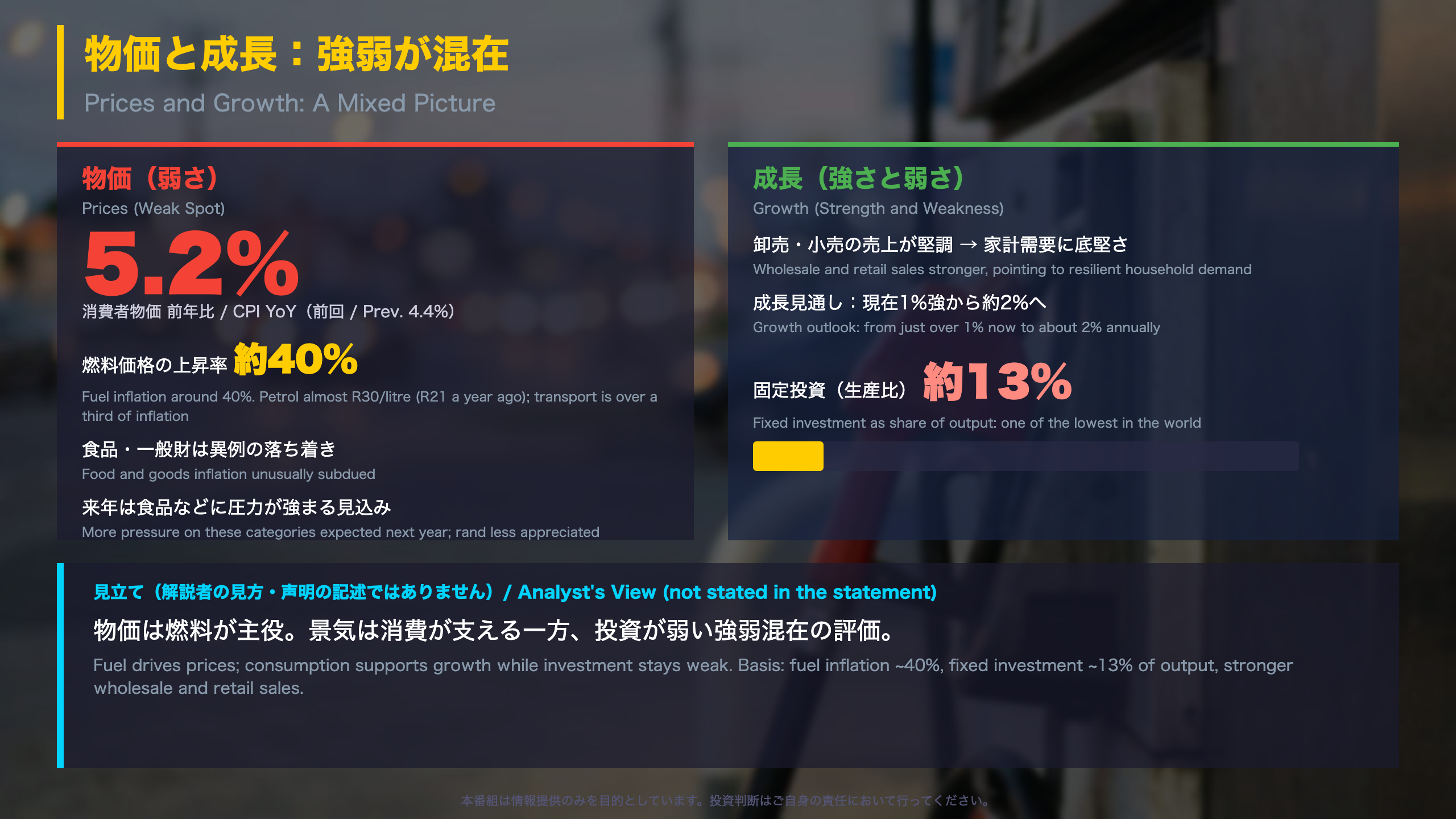
Inside the Numbers: Fuel Shock, Calm Food Prices, Weak Investment
Fuel is the story. Fuel inflation is around 40%. Petrol is almost R30 a litre versus R21 a year ago, and over a third of all inflation comes from transport. In September the statement cited an average fuel under-recovery of R2.83 per litre.
| Component | September | November |
|---|---|---|
| Food | Lowest since 2010 | Bottoming out from current lows |
| Rand | ‘notably resilient’ | ‘less appreciated’, affecting import prices |
| Services | Elevated | Rising since about the middle of last year; forecast expects a turn |
Growth
Statistics South Africa (Stats SA), the national statistics agency, revised historical data. The statement says this shifted the level of output more than growth rates. Q2 still contracted, but a gradual recovery appears under way. Wholesale and retail sales are stronger, yet fixed investment is about 13% of output, ‘one of the lowest rates in the world’.
Four overlapping inflation risks
- Global rates resetting higher, with currencies weakening against a stronger dollar
- Geopolitical exposure of fuel prices
- El Niño: water restrictions in the Western Cape; dry conditions early next year could hurt harvests
- An upward trend in core inflation
Independent note
In September the statement said the committee looks through the initial effects of price shocks while ensuring they do not entrench higher inflation. The 5.2% figure is a single monthly print, so the 15 December release will show whether pressure is spreading beyond fuel.
質疑で深める:心配されたリスクと次の焦点
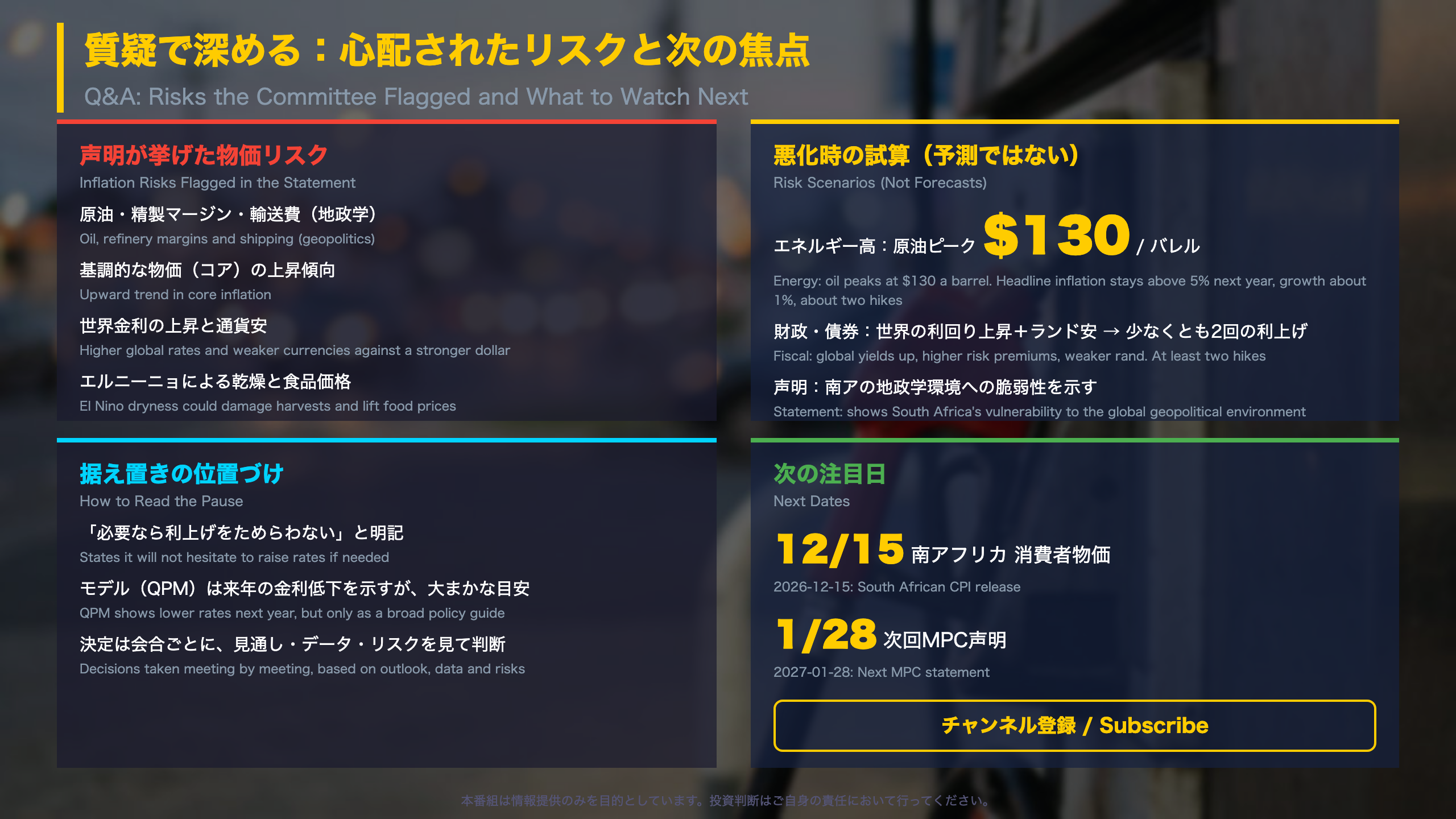
Stress Tests: What the Scenarios Say
The MPC uses scenarios to probe risks around its baseline forecast.
| Energy shock | Fiscal / bond-yield shock | |
|---|---|---|
| Assumption | Oil peaks at $130 a barrel, refinery margins elevated | Global bond yields rise; higher risk premiums for countries like South Africa; weaker rand |
| Inflation | Headline stays above 5% next year | Higher |
| Growth | About 1% | Lower |
| Policy rate | About two hikes higher | At least two hikes |
‘This scenario shows South Africa’s vulnerability to the global geopolitical environment.’
The baseline Quarterly Projection Model (QPM) still shows lower rates next year, and the statement calls its path a broad guide.
Closing assessment
The MPC calls 2026 ‘a challenging year’: inflation far above early-year expectations, weaker growth and rising unemployment, traced mainly to negative supply shocks from geopolitical conflicts. It also sees ‘clear potential’ for higher growth given lower inflation, an improving fiscal position and structural reforms.
Why it matters outside South Africa
For global readers, the statement is a case study in a small open economy facing an imported energy shock and rising global yields, where the rand and risk premiums transmit global conditions into domestic prices. Our reading is limited to what the document says.
Calendar
15 Dec 2026 (CPI). MPC statements: 28 Jan, 18 Mar, 27 May, 22 Jul, 29 Sep, 25 Nov 2027.
Disclaimer: This article is for informational purposes only. All investment decisions are made solely at your own risk.