📺 Watch the Full Video Analysis
This article was automatically generated by the NFC Market Live AI analysis system. (Updated: 2026-11-17 09:47 JST)
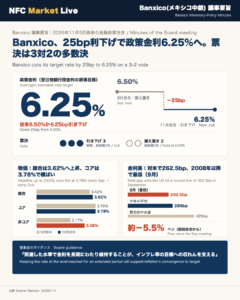
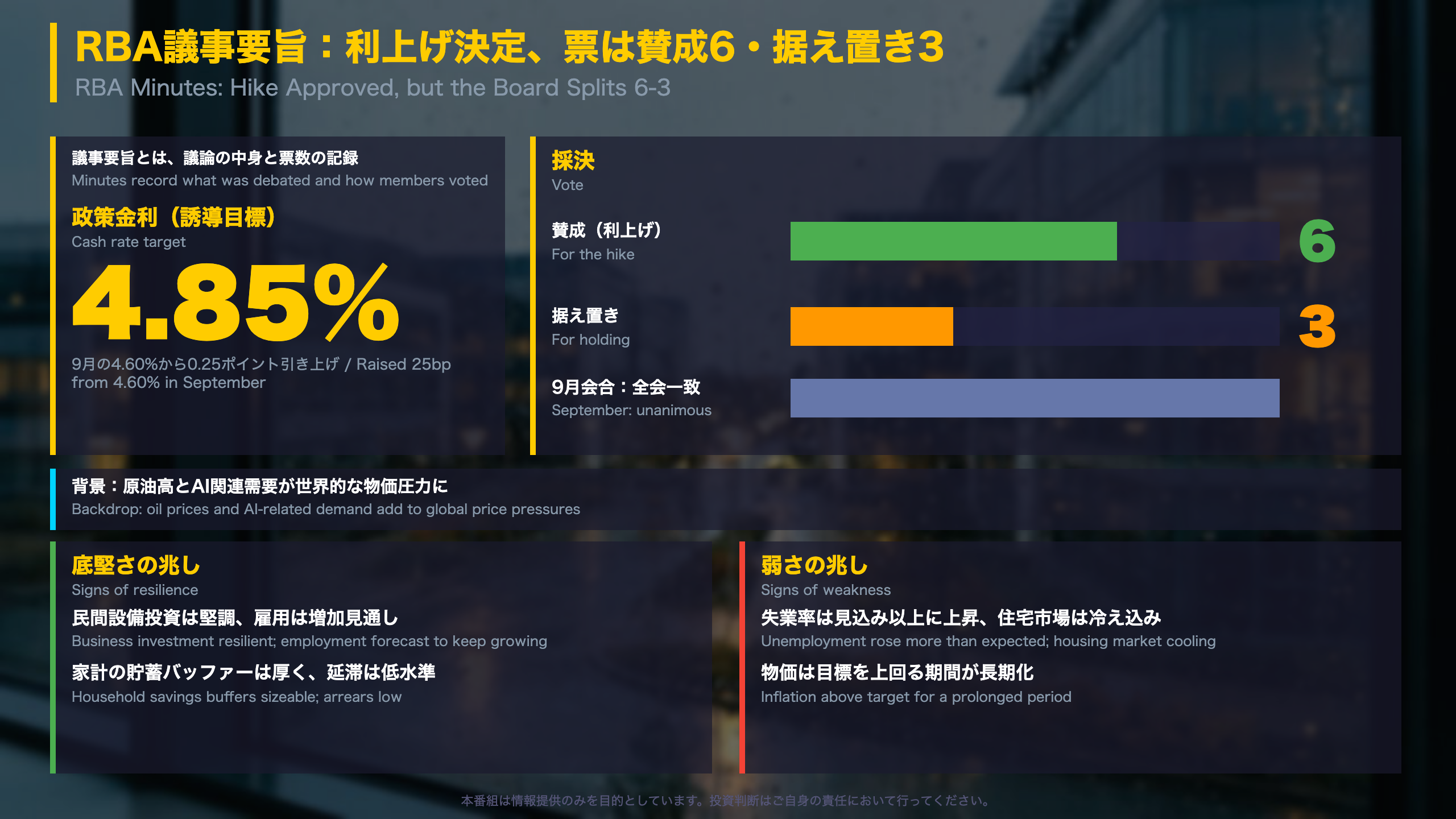
📊 The RBA published minutes of its Nov 2-3 Monetary Policy Board meeting on Nov 17. The cash rate target was raised to 4.85%, but the vote split six to three, a break from September’s unanimous decision.
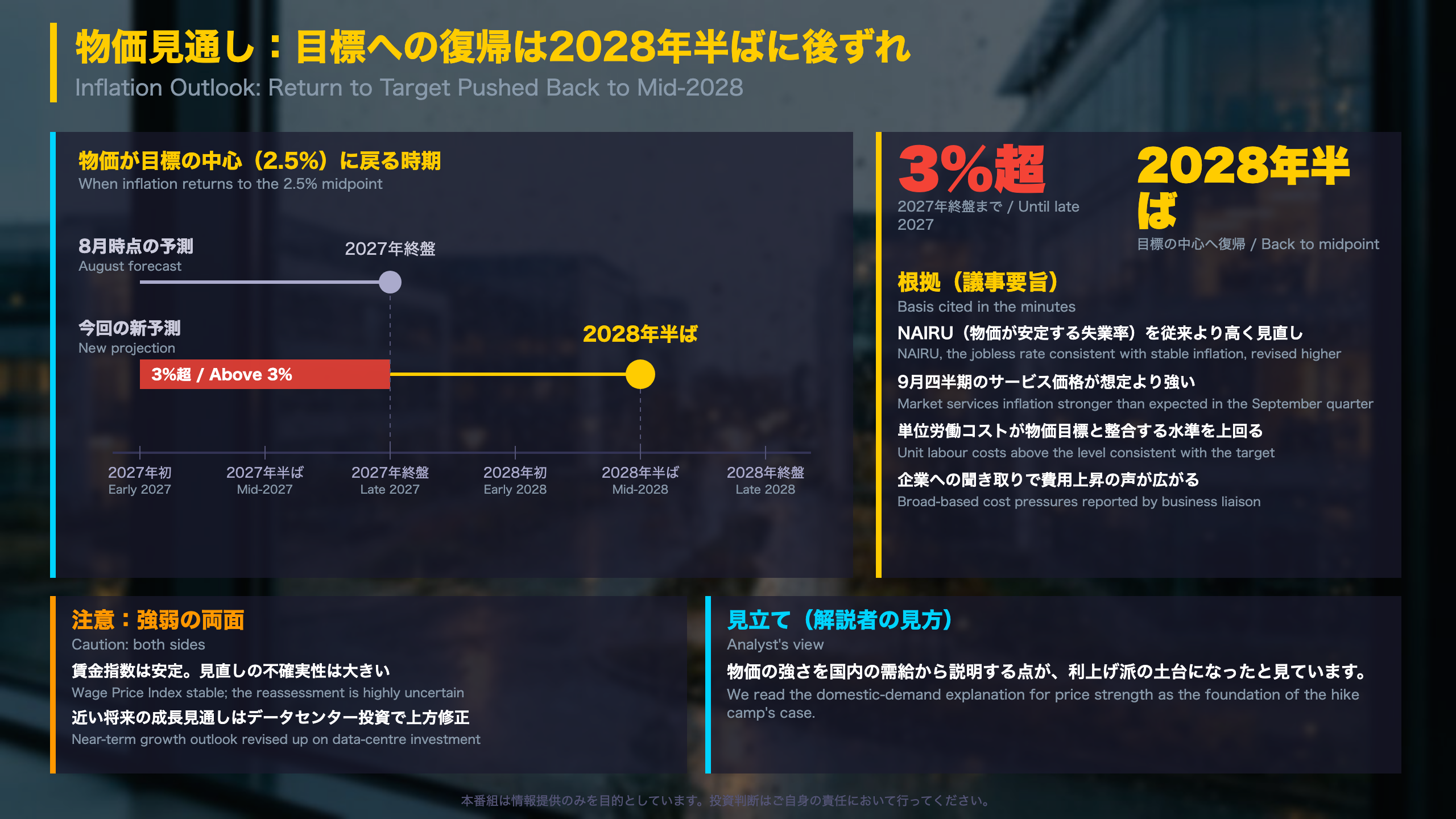
📈 Staff now see inflation returning to the 2.5% midpoint only in mid-2028, citing tighter domestic capacity (a higher NAIRU estimate).
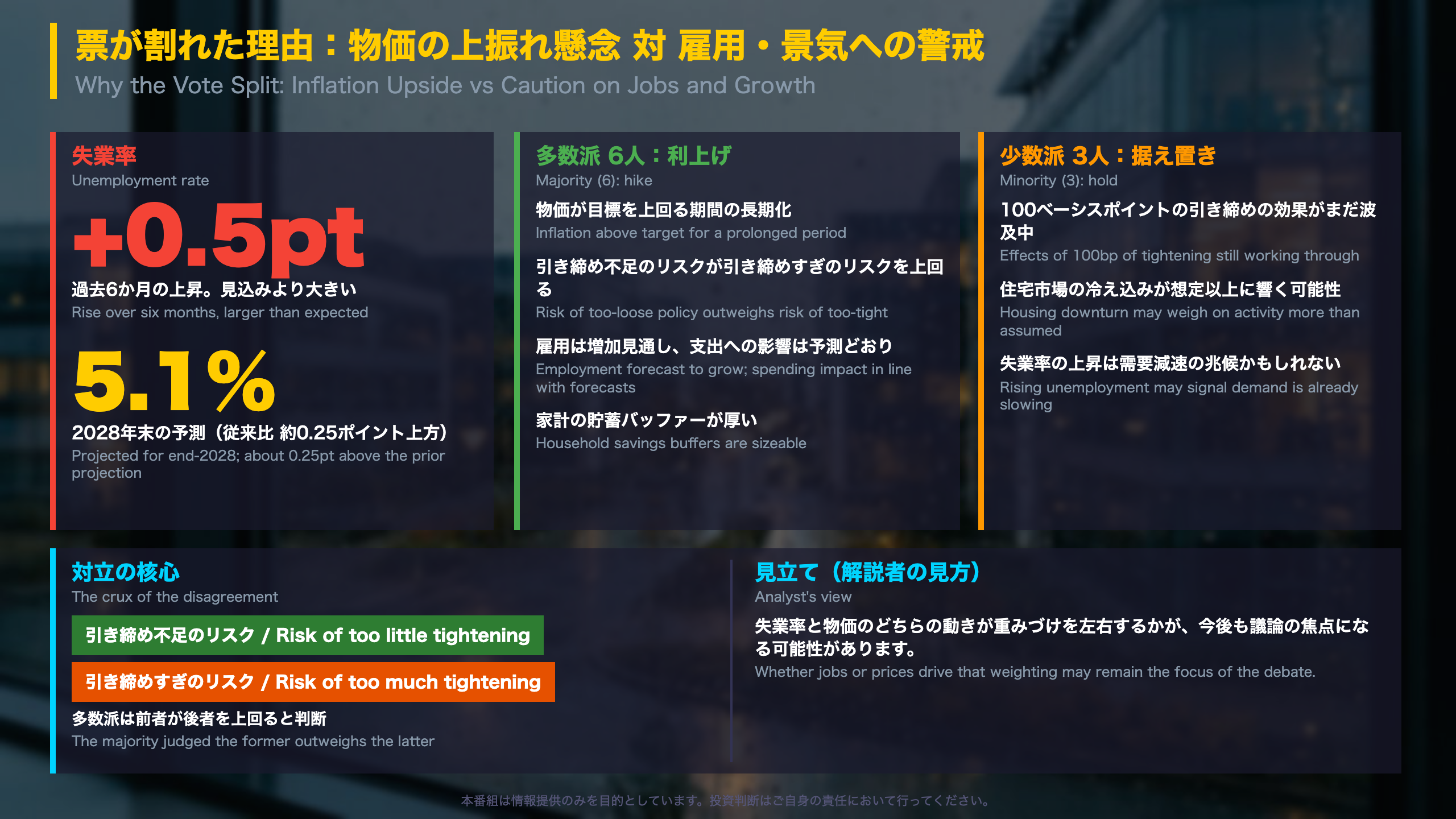
📉 Unemployment rose 0.5pt in six months; the minority wanted time to judge earlier hikes and flagged the housing downturn.
💡 The split hinged on which risk matters more: tightening too little or too much. Next to watch: October headline inflation.
サマリー:利上げは決定、票は6対3に割れた
RBA Minutes: A Hike Without Consensus
What are these minutes?
The Reserve Bank of Australia (RBA) publishes minutes of its Monetary Policy Board roughly two weeks after each meeting. The decision and statement come on the day, while the minutes add the arguments and the vote count. This time the board raised the cash rate target to 4.85%, with six votes in favour and three to hold, a break from September’s unanimous decision.
Key facts
- Cash rate: 4.35% before September, 4.60% after September, 4.85% now.
- Staff now see inflation returning to the 2.5% midpoint only in mid-2028, versus around late 2027 in the August forecasts.
- The minutes state that overnight indexed swap pricing implied an 85% probability of a hike at this meeting.
International context
The minutes note that policy-rate expectations across advanced economies had eased somewhat since the previous meeting, partly on a reassessment of the future profitability of some AI-related sectors, while market pricing still implied a few more hikes at many central banks over the year ahead. Unlike the Fed, whose minutes arrive about three weeks after a meeting, the RBA’s come about two weeks after.
What to watch
The board says it will stay attentive to the data and continue to do what it considers necessary to bring inflation sustainably back to target. Next checkpoints are October’s headline inflation figure and the Statement on Monetary Policy. The next meeting date is not given in the source.
深掘り1:物価見通しの上方修正
Inside the Inflation Revision
The numbers
| Item | Detail |
|---|---|
| Headline and underlying inflation | Above 3% until late 2027 |
| Return to 2.5% midpoint | Mid-2028 (later than August) |
| Oil and refined product prices | Up 20-25% since August |
| Pass-through assumption | About two-thirds of conflict-related extra costs |
Why it matters
NAIRU, the non-accelerating inflation rate of unemployment, is the jobless rate consistent with stable inflation. It cannot be observed directly, so a higher estimate implies the labour market was tighter than previously thought. The minutes list persistently higher-than-expected inflation, strong labour and non-labour input costs, labour competition in some states and industries, and above-average capacity utilisation as the basis.
The counter-evidence
‘growth in the Wage Price Index (WPI) had remained broadly stable and in line with forecasts to date’
Weak productivity may reconcile stable wages with a higher NAIRU, because unit labour costs remain above the level consistent with the target. The oil path also assumes a retracement of roughly US$30 per barrel over two years, which the minutes say requires some resolution of the conflict.
Near-term flag
Headline inflation in October is expected to be significantly higher than in September as subsidies households received a year earlier drop out of the annual calculation. The staff still judge the risks to the inflation forecast to be skewed to the upside.
深掘り2:票が割れた理由
Anatomy of a 6-3 Vote
Backdrop
- Unemployment rose 0.5 percentage point in six months, more than expected; staff now project 5.1% by end-2028, about 0.25 point above the prior projection.
- GDP growth was revised up near term on data-centre investment but lowered from mid-2027 given the higher cash rate path and a weaker housing market.
- Staff expect aggregate demand and potential supply to return to balance around mid-2027.
Majority case (six members)
‘the risks of unintentionally leaving monetary policy insufficiently restrictive … currently to outweigh the probability associated with unintentionally setting monetary policy too tight’
They cited inflation above target for a long time, likely higher near-term headline inflation, forecast employment growth, and spending that has so far tracked staff forecasts.
Minority case (three members)
They wanted more time to see the effect of the 100 basis points of tightening delivered this year, weighted downside growth risks more, and feared the economy ‘might be near the point of entering a materially sharper downturn’. Supporting points in the minutes: monthly market-services inflation slowed through the September quarter (not seasonally adjusted, so possibly a seasonal pattern), wage growth has been stable, and evidence for higher inflation expectations ‘rested on information that was either new or imprecise’.
Takeaway
A split after a unanimous September decision signals genuine disagreement over how to weigh risks. Both camps rest on evidence in the minutes, so a single month of data is unlikely to settle the question.
質疑で深める:中立金利・引き締めの度合い・家計
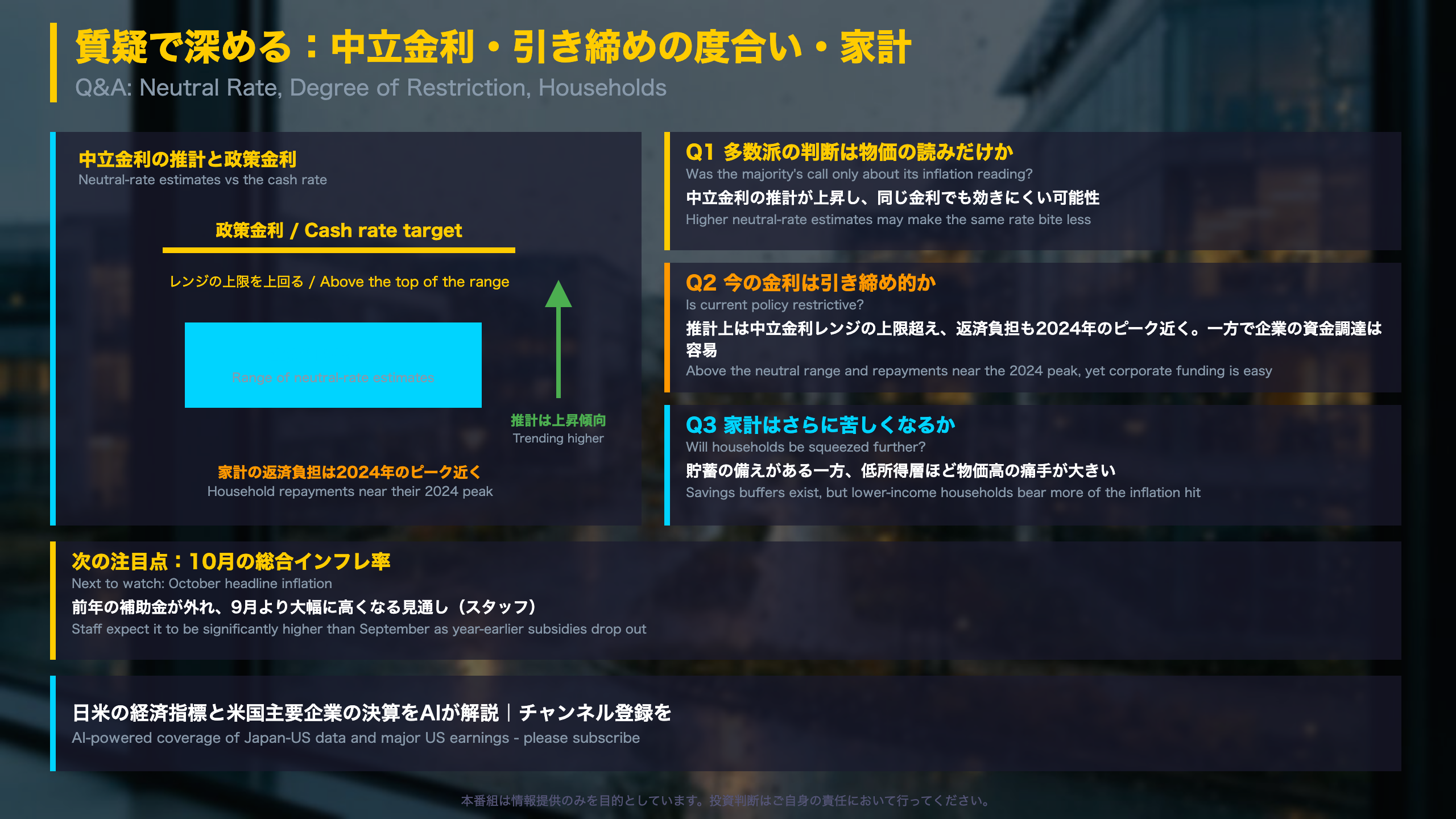
Q&A Extras: Mixed Financial Conditions
Reading the neutral rate
The neutral rate is the policy rate that neither stimulates nor restrains the economy. The minutes say estimates have trended higher, partly reflecting lower global saving as fiscal deficits stay large and higher global investment, especially related to AI. Yet the cash rate and its market-implied path remain above the top of the range of central estimates, and the minutes warn that such estimates ‘do not provide a direct guide for monetary policy’.
Sub-indicators
- The Australian dollar is around 5% higher since the start of the year and consistent with estimates of its longer-run equilibrium.
- Scheduled household loan payments are around their 2024 peak as a share of disposable income, but with offset-account balances the household credit-to-income ratio is well below its post-GFC average.
- Data centre developers raised debt equal to at least one-fifth of this year’s increase in business debt; some Australian operators saw equity prices fall and credit spreads widen.
- Funding conditions tightened for private credit lenders, which could reduce credit availability for residential property developers.
Different readings
Restrictive: housing weakness and a cash rate above neutral estimates. Not restrictive enough: easy corporate funding and rising neutral-rate estimates.
Next
Watch October headline inflation and the Statement on Monetary Policy. The next meeting date is not provided in the source.
Disclaimer: This article is for informational purposes only. All investment decisions are made solely at your own risk.