This article was automatically generated by the NFC Market Live AI analysis system. (Updated: 2026-11-05 22:50 JST)
📄 Primary Source
NFC Market Live
https://www.youtube.com/watch?v=zr01m7XZaqQ
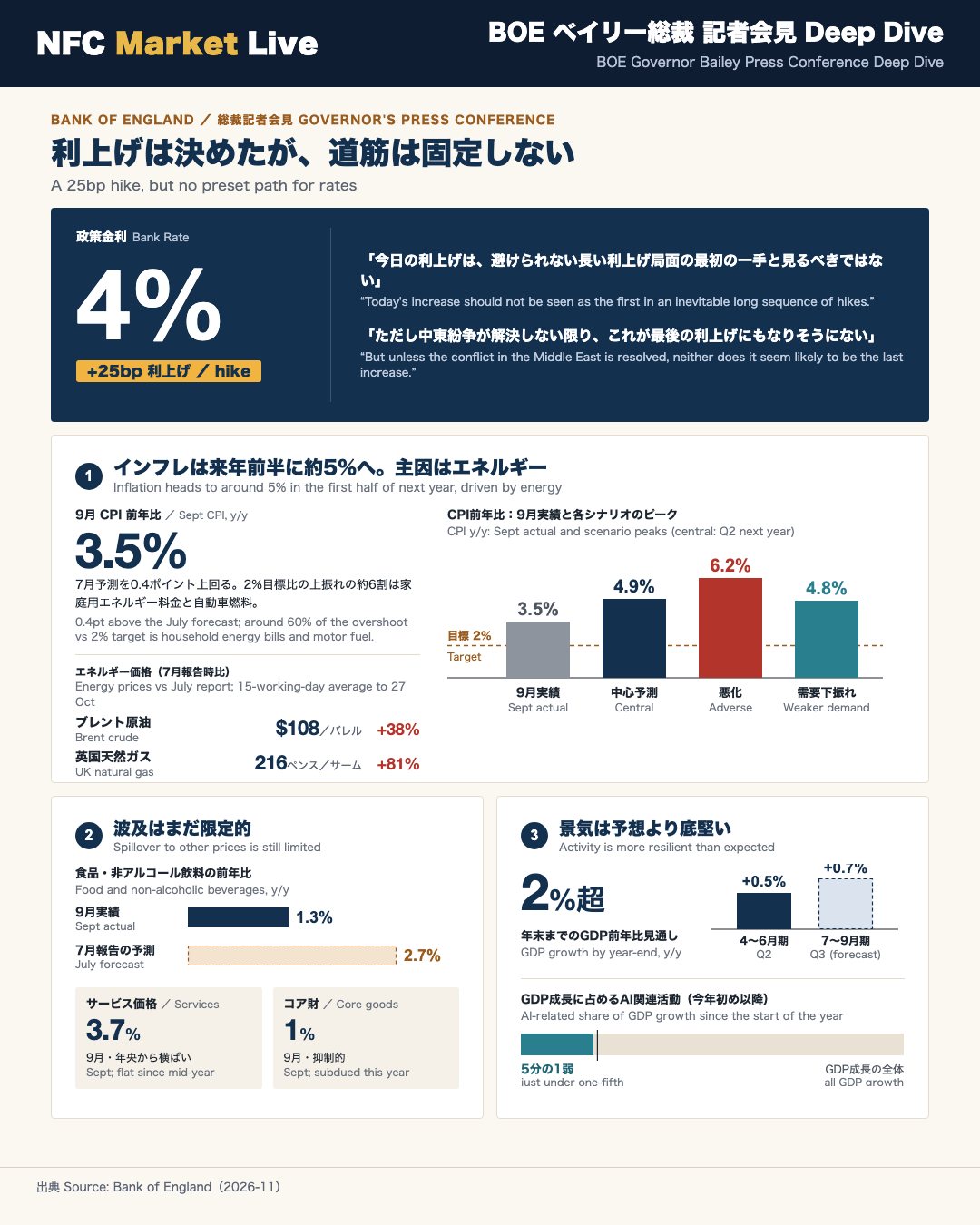
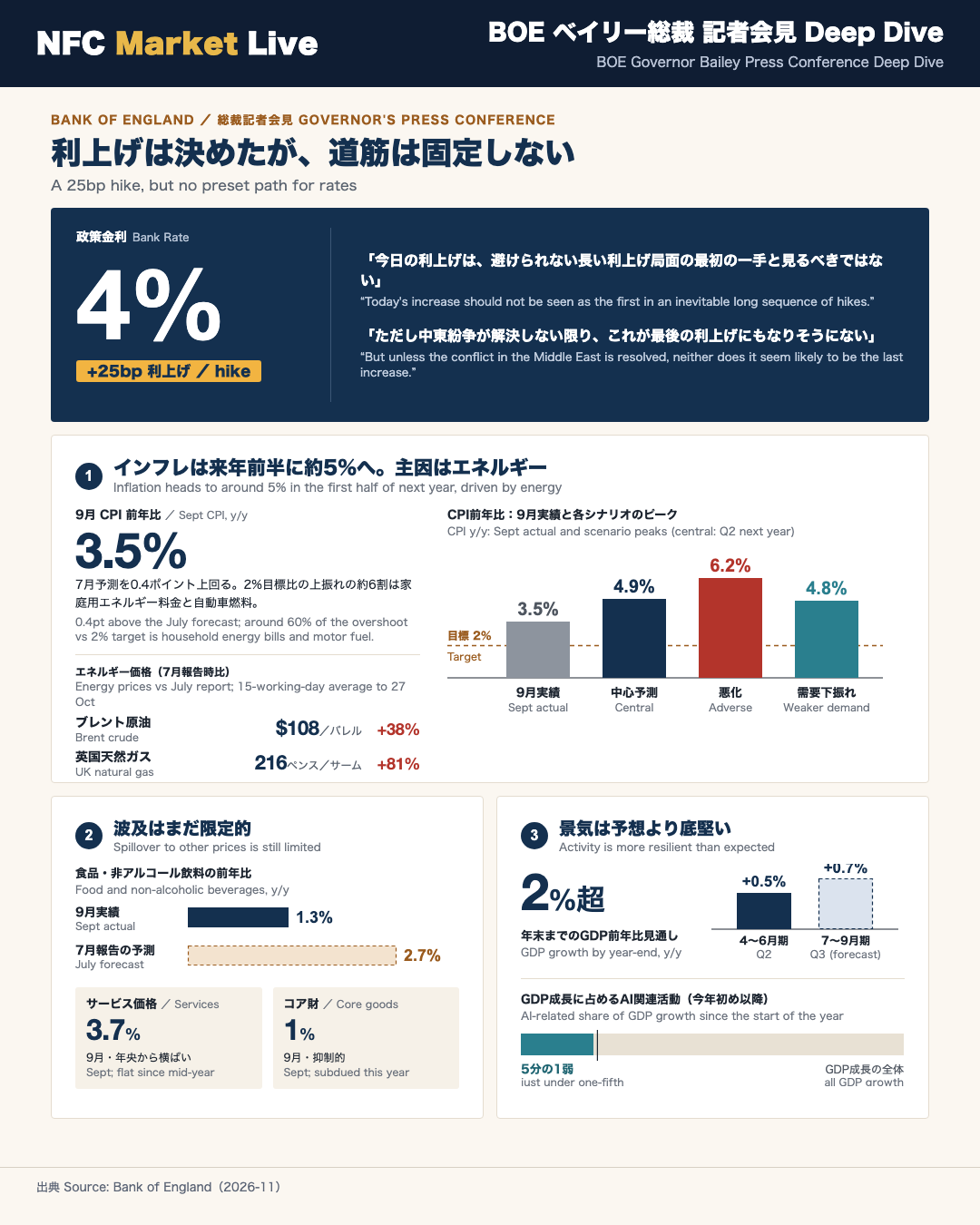
The Bank of England raised Bank Rate by 25 basis points to 4%. Governor Andrew Bailey said higher energy prices linked to the Middle East conflict have pushed inflation up in every G7 economy, and that inflationary pressure keeps building in the pipeline the longer the conflict goes unresolved.
Key figures from the press conference:
– September CPI inflation was 3.5%, 0.4 percentage points above the July forecast. It is expected to reach around 5% in the first half of next year, with the central projection peaking at 4.9% in Q2.
– The Ofgem price cap was £1,723 in Q4 and is expected to rise to around £2,150 in Q1 next year.
– Food inflation was 1.3% in September (July forecast: 2.7%), services inflation 3.7%, core goods 1%.
– GDP grew 0.5% in Q2, with 0.7% expected in Q3. Annual growth is expected to exceed 2% by year-end.
Bailey said today’s increase should not be seen as the first in an inevitable long sequence of hikes, but that it does not seem likely to be the last unless the conflict is resolved. He stressed that policy is not on a preset path. Peak inflation in the three scenarios is 4.9% (central), 6.2% (adverse) and 4.8% (weaker demand). The next meeting is in December.
総括:25bp利上げで4%、「最後とも限らないが、長い連続利上げでもない」
Bottom line: a hike, but no preset path
The Bank of England raised Bank Rate by 25 basis points to 4%. Governor Andrew Bailey opened by saying that energy prices lifted by the Middle East conflict have pushed inflation up in every G7 economy since February, the UK included. The longer the conflict goes unresolved, he said, the more inflationary pressure builds in the pipeline, and the MPC needed to act to limit its impact.
The key lines
‘Today’s increase should not be seen as the first in an inevitable long sequence of hikes.’
‘But unless the conflict in the Middle East is resolved, neither does it seem likely to be the last increase.’
This two-sided message is the heart of the press conference: the hike is justified by pressure already in the pipeline, yet a sustained tightening cycle is explicitly not pre-committed.
Resilience versus risk
- Resilience: annual GDP growth is expected to exceed 2% by the end of the year, the labour-market softening appears to be stabilising, and indirect effects on food and goods prices have so far been limited.
- Risk: CPI inflation was 3.5% in September, expected to reach around 5% in H1 next year; services inflation is stuck at 3.7%; lower-paid households and job seekers bear the brunt.
Context for non-UK readers
The Monetary Policy Committee (MPC) is the BOE’s nine-member rate-setting body, with a 2% CPI target. Unlike the Fed’s dot plot, the BOE does not publish a rate path, so the Governor’s wording (‘not on a preset path’) is the main forward guidance. Policy is judged meeting by meeting, with the December meeting next.
Tone assessment
Cautious and data-dependent rather than aggressively hawkish. Bailey acknowledged that a further 25bp would be well supported if there is no resolution of the conflict, but refused to commit to timing or to the ‘two and done’ label put to him by a journalist.
Note: the opening of the transcript contains speech-recognition errors; the reference to a war in its ‘ninth month’ is read as the Middle East conflict from context.
インフレ見通し:エネルギー価格が主役、来年前半は5%前後へ
What is driving inflation
UK CPI inflation rose to 3.5% in September, 0.4 percentage points above the July Monetary Policy Report forecast. Bailey said household energy bills and motor fuel together account for around 60% of the overshoot.
Energy prices (15-working-day average to 27 October)
- Brent crude: $108 per barrel, 38% higher than at the time of the July report
- UK natural gas: 216 pence per therm, 81% higher
- Refined products versus the start of the conflict: petrol +59%, diesel +105%, jet fuel +118%
The Ofgem price cap
Ofgem is the UK energy regulator; it sets a quarterly cap on what suppliers can charge households, based on wholesale prices observed over a preceding window. The cap rose to £1,723 in Q4 and is expected to reach around £2,150 in Q1 next year. Bailey said that, other things unchanged, inflation is expected to rise to around 5% by the middle of next year.
Why this matters for the BOE
Bailey was explicit: ‘Monetary policy cannot influence global energy prices.’ The MPC is instead watching whether higher energy costs pass through to domestic price- and wage-setting. This is a key difference from a demand-driven inflation episode, where rate policy acts directly on the source.
International comparison
Bailey noted that inflation has risen in every G7 economy since February. Deputy Governor Clare noted that euro-area inflation data released the previous day looked similar, as Europe is also an energy importer. The UK’s services-heavy economy transmits the shock differently from goods-heavy economies.
Analyst view
The hike decision rests less on the energy shock itself than on the risk of second-round effects. The Q1 price cap observation window was already more than three-quarters complete, so much of the household bill increase is effectively locked in regardless of recent oil moves.
波及の現状:食品は予想を下回り、サービス価格は粘着的
Direct versus indirect energy effects
Bailey’s Chart 3 showed that the inflation overshoot is almost entirely explained by direct energy effects. Indirect effects on other goods and services were actually negative relative to July expectations.
Why pass-through has been slow (per the Governor)
- Some firms hold fixed-price energy contracts or hedges and will not face higher costs until renewal.
- The BOE’s Agents (its regional business intelligence network) and survey data suggest some firms are absorbing costs in margins or cutting other costs.
Both are temporary, Bailey said, so some costs are likely to be passed through gradually.
Food inflation undershoots
Food and non-alcoholic beverage inflation was 1.3% in September versus the 2.7% forecast in July, helped by easing domestic cost pressures and some agricultural commodity prices. The BOE expects it to rise to around 3% by Q1 next year.
The domestic backdrop
- Services inflation: 3.7% in September, flat since mid-year. Bailey said this is not itself evidence of second-round effects, but may indicate a slowing of domestic disinflation.
- Core goods inflation: 1%, subdued, but expected to rise somewhat, partly on import price pressure from demand for AI-related products.
- Wages: private-sector regular pay growth was 3% in August; broader indicators suggest around 4%. Underlying wage growth is judged slightly above a target-consistent rate.
Tone
Bailey called the stability of firms’ forward-looking wage expectations ‘an encouraging sign’, but added immediately that ‘it remains early days’. The Agents’ Pay Survey in coming months is the next evidence point.
Why it matters internationally
‘Second-round effects’ means energy costs feeding into wages and broader prices, the scenario central banks fear most from a supply shock. The BOE’s tentative reading is that the shock is still concentrated in energy.
Analyst view
Limited pass-through so far may help explain why the BOE moved by only 25bp and stressed optionality. This is an interpretation, not a reason stated by the Governor.
景気の底堅さ:GDP見通し上方、AI関連投資が一部をけん引
Activity more resilient than expected
Bailey said both global and domestic activity have held up better than expected in the face of the shocks. Annual GDP growth is expected to exceed 2% by the end of the year.
Key figures
- GDP grew 0.5% in Q2, with 0.7% expected in Q3.
- Business investment grew 1.8% in Q2, which Bailey described as ‘not expected’ given higher energy prices and tighter financial conditions.
- Strength was concentrated in business-to-business services.
The AI contribution
BOE staff built an ‘AI activity proxy’ combining computer programming and consulting, information services and application software output. It suggests just under a fifth of GDP growth since the start of the year is accounted for by AI-related activity. Agents’ intelligence indicates the strength is not broad-based.
Q&A colour
Bailey said it was unsurprising that AI shows up first in business services and in investment, consistent with the early ‘capital deepening’ phase of general-purpose technology cycles, which he hopes will lead to broader productivity growth. Clare added that consumer-facing sectors report weak pricing power and an inability to pass on costs, so dispersion across sectors is large.
Labour market and households
- Several indicators point to spare capacity, which should weigh against wage pressure next year.
- Bailey cited tentative evidence that labour-market softening has stabilised, but noted hardship for the lower paid and job seekers; consumer confidence has recently weakened.
- A reporter cited real post-tax labour income of -0.1% this year and -0.6% next year. Clare said it falls by about half a percentage point next year, mainly due to inflation, and noted next year’s GDP forecast is a slightly higher 1.3%: ‘it’s inflation doing the damage.’
Context
The UK economy is more services-based than goods-based, and a net energy importer. The ‘resilient GDP, squeezed households’ split matters because the BOE must judge whether firms can keep absorbing costs.
Analyst view
The picture is balanced: business investment is a genuine strength, but it is narrow, and the Governor himself framed persistence as the key judgement.
3つのシナリオ:中心4.9%、悪化6.2%、需要下振れ4.8%
Three projections behind the decision
Besides the central projection, the MPC published an adverse inflation scenario and a weaker demand scenario, all conditioned on the market interest-rate curve (average of the 15 working days to 27 October).
Scenario comparison
| Central | Adverse inflation | Weaker demand | |
|---|---|---|---|
| Energy | In line with futures curves | Oil ~1/3 higher, gas ~2/3 higher on average | In line with futures curves |
| Domestic demand | Resilient | – | Households cannot smooth the real-income shock; more spare capacity |
| Peak CPI | 4.9% in Q2 next year | 6.2% | 4.8% |
| Later path | Back to 2% in Q3 2028, slightly below target by the end of the forecast | Above 2% throughout | Below target during 2028, 1.2% in 2029 |
Central projection details
- Oil peaks at $116 per barrel in Q4 this year, falling to $74 by Q4 2029.
- Gas peaks at 215 pence per therm in Q4, falling to 83 pence by Q4 2029.
- Bailey said this implies some form of resolution to the conflict.
- Second-round effects emerge more materially from 2028, adding about 0.5 percentage points on average to CPI in the second half of the forecast period.
Adverse and weaker-demand scenarios
In the adverse case, persistently high energy prices lift long-term inflation expectations, producing substantially stronger second-round effects. In the weaker-demand case, firms’ pricing power and workers’ bargaining power weaken, second-round effects do not materialise, and inflation falls below target.
Governor’s reading
‘This is a risk rather than a commitment to further tightening.’
The longer the conflict persists, the more likely persistent inflation takes hold and the higher rates may need to be, but Bailey stressed the outlook is highly uncertain.
Context
The BOE uses scenarios rather than a rate path to communicate uncertainty. Note the contrast with the Fed’s projections: the BOE publishes inflation paths conditioned on the market curve, not a committee view of future rates.
Analyst view
The 4.8% to 6.2% spread in peak inflation shows that the key variables are second-round effects and demand strength after the peak, which is why pay and pricing behaviour are the data to watch.
直近48時間の急変動と、追加利上げの条件・市場カーブ
The last 48 hours
Bailey said wholesale Brent crude and UK gas prices had fallen around 15% since the start of the week, to about $95 per barrel and 218 pence per therm on the morning of the press conference.
Would the decision have differed?
BBC’s Faisal Islam asked whether the hike would have happened at today’s oil price. Bailey: ‘I would be pretty confident… that had we known what was going to happen in the last 48 hours, the decision would still be the same,’ citing inflationary pressure already in the pipeline.
- The Q1 Ofgem price cap observation window had less than a fortnight to run and was more than three-quarters complete.
- If good news on the conflict continues, inflation would ‘peak somewhat below 5%’.
- The BOE forecast did not have oil at $95 until May 2027.
- Gas at 218p is still around the Q4 peak in the central projection (215p).
Conditions for a further hike
Asked by the FT’s Sam Fleming whether peace progress would remove the need for a second hike, Bailey replied ‘I didn’t say that.’ Absent resolution, he said, the case for a further 25bp, with no commitment on timing, would be ‘quite strong.’ He also characterised the recent good news as resting on anticipation or ‘vibes’ after the US midterms rather than real progress (the attribution in the transcript is slightly ambiguous but reads as Bailey’s remark).
The market curve
Bailey said the high end of the market curve largely reflects risk premia rather than expected rates. A colleague added that the Market Participants Survey median expects Bank Rate at 4.25%, while the curve peaked at 4.75% as the press conference began. Views differ within the committee on how much of the gap is risk premium.
What he declined to say
Bailey declined to sign up to Bloomberg’s ‘two and done’ label, saying the central scenario should be read as a risk judgement.
What to watch
The next MPC meeting is in December; the full survey was due the day after the press conference. For non-UK readers, the MaPS is the BOE’s regular survey of market participants’ policy-rate and inflation expectations.
Analyst view
Bailey’s answers separate day-to-day price swings from the pipeline pressure already locked in, which is the logic he used to defend the decision.
Q&A深掘り:信認、家計、他機関との違い、答えなかった点
Where the questions clustered
1. Credibility (several reporters)
Reporters from Reuters and another outlet noted that the central projection has inflation returning to target only in Q3 2028, after a long period above it, and asked about credibility. Bailey pointed to an era of very large supply shocks and said: ‘this is when we need the inflation targeting framework more than ever.’ He added that an inflation-targeting regime cannot promise inflation at target every month. Clare recalled that the BOE raised rates to 5.25% after Russia’s invasion of Ukraine and had begun cutting at the start of this year.
2. ‘Too late?’ (AFP)
Bailey answered ‘no’, citing the very rapid recent rise in energy prices and tightening that has already occurred. He said the UK’s two-year mortgage rate has risen the most in the G7, with the possible exception of Japan, after market-priced rate cuts for this year came off the table in March.
3. Households (Channel 4, PA)
Bailey said the MPC is very conscious of the burden on low earners and the unemployed, but could give no assurances about where rates will go. Targeted support is a matter for the government.
4. Why BOE differs from the OBR
The OBR (the UK fiscal watchdog) expects inflation to peak around 3.75%. Bailey cited different timing of the forecasts and a heterogeneous business picture. Clare said food-sector firms report weak pricing power; the BOE’s central case includes some pass-through, while the two alternative scenarios capture the opposite outcomes.
5. Answered versus avoided
- Answered clearly: the decision would have stood even after the 48-hour price drop; not too late; public-sector pay is not seen as a particular risk (Clare); the FPC is reviewing the loan-to-income mortgage rule regularly.
- Declined or deflected: the ‘two and done’ label; whether firms should pay one-off cost-of-living payments (‘we’re not delivering orders’); a direct plea to President Trump (he endorsed the Prime Minister’s statement instead); a view on Brexit itself (he said only that trade and openness are sources of growth).
Analyst view
Bailey consistently drew institutional boundaries on fiscal, housing and political questions, which reads as a deliberate emphasis on the BOE’s independence.
Disclaimer: This article is for informational purposes only. All investment decisions are made solely at your own risk.