This article was automatically generated by the NFC Market Live AI analysis system. (Updated: 2026-11-05 21:06 JST)
📄 Primary Source
Bank of England
https://www.bankofengland.co.uk/monetary-policy-summary-and-minutes/2026/november-2026
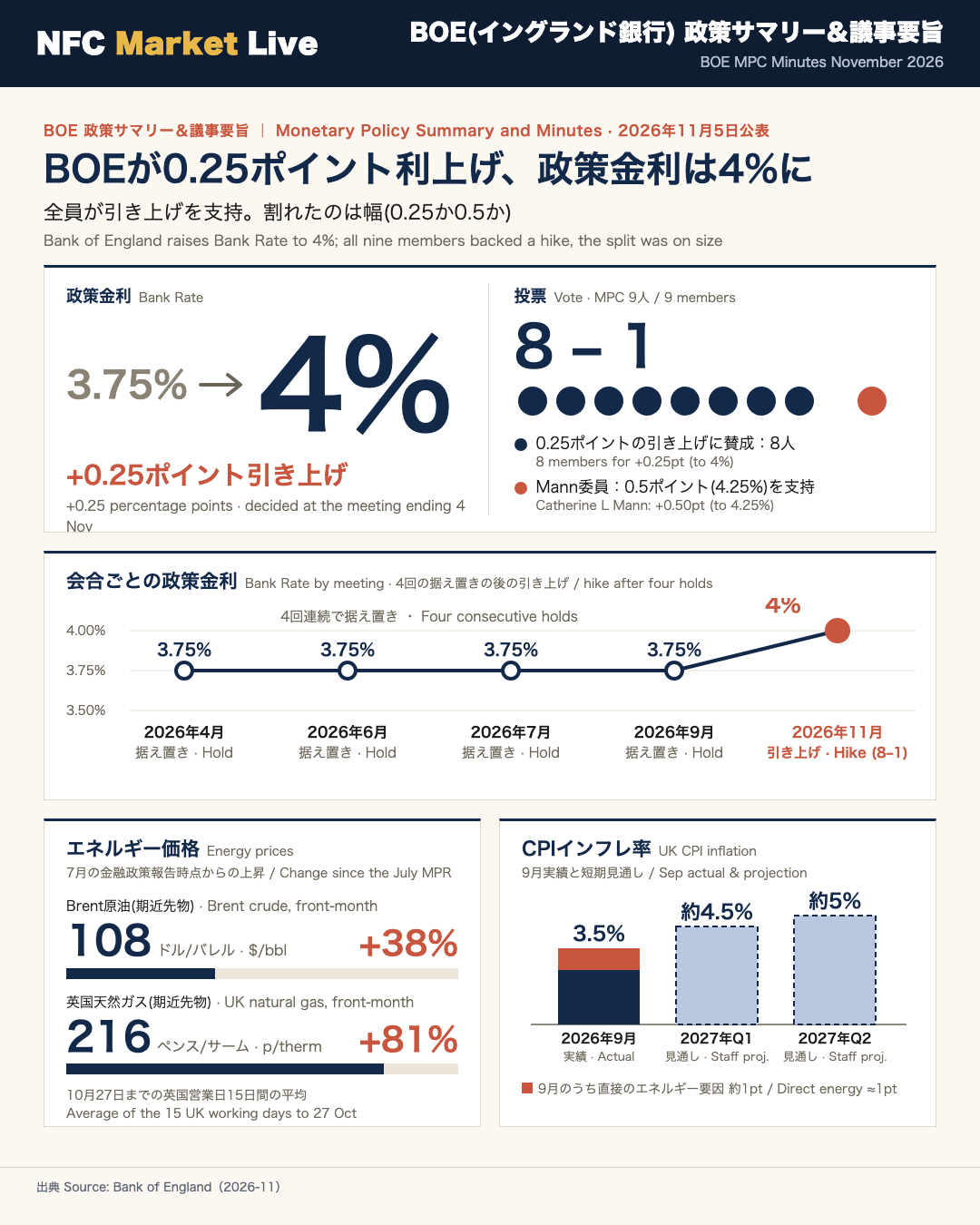
The Bank of England’s Monetary Policy Committee raised Bank Rate by 0.25 percentage points, from 3.75% to 4%, on 5 November 2026. The vote was 8–1: Catherine Mann preferred a 0.5-point rise to 4.25%. Rates had been held at 3.75% at the April, June, July and September meetings.
The Committee said the conflict in the Middle East is now in its ninth month and global energy prices have kept rising from an already elevated level. UK CPI inflation rose to 3.5% in September, with direct energy effects contributing around 1 percentage point. CPI is expected to rise to around 5% by the middle of next year before falling back. Front-month Brent averaged $108 per barrel and UK gas 216 pence per therm, 38% and 81% above the July Report.
The MPC noted limited evidence so far of knock-on effects on other prices and wages, while activity data have generally been stronger than expected. It stressed that policy is not on a pre-set path and that it will keep monitoring pay, pricing behaviour and slack to return CPI inflation to the 2% target in the medium term.
The minutes show a range of views on what comes next: Alan Taylor described the move as a one-for-now insurance hike, while Huw Pill said a single 25-basis-point hike is unlikely to be sufficient.
決定の概要と投票内訳:8対1で0.25%利上げ
What the Bank of England decided
The Monetary Policy Committee (MPC) is the nine-member body at the Bank of England (BOE) that sets Bank Rate, the UK’s main policy interest rate. At its meeting ending on 4 November 2026, it voted 8–1 to raise Bank Rate by 0.25 percentage points, from 3.75% to 4%. Catherine L Mann was the lone dissenter, and she voted for a larger 0.5-point rise, to 4.25%.
Context: the end of a hold
Bank Rate had been held at 3.75% at the April, June, July and September meetings, so this is the first change in the period covered by the minutes. Note the shape of the vote: nobody argued for keeping rates unchanged. The disagreement was about size, not direction. That is unusual compared with the common pattern of split votes between hold and hike.
The stated rationale
The summary says that ‘the degree of inflationary pressure in the pipeline is now sufficient to warrant an increase in Bank Rate.’ Two factors are cited:
- Energy: the conflict in the Middle East is in its ninth month and global energy prices have kept rising from an already elevated level.
- Activity: data in recent months have generally been stronger than expected.
At the same time, the Committee acknowledges ‘limited evidence of knock-on effects on other prices and wages.’ This reads as a decision driven by rising risk rather than by second-round effects already visible in the data.
Why it matters for reading UK policy
The BOE targets CPI inflation of 2%, and the Committee says it will adjust Bank Rate as necessary to return inflation to that target in the medium term. It explicitly states that policy ‘is not on a pre-set path.’ The stock of UK government bonds held for monetary policy purposes was £362 billion on 4 November.
エネルギー価格とインフレ見通し:直接効果は明確、波及は限定的
Energy: the central uncertainty
The minutes identify the impact of protracted overseas conflicts on global energy prices as the main source of uncertainty for UK inflation. Over the 15 UK working days ending 27 October, front-month Brent crude futures averaged $108 per barrel and UK front-month natural gas 216 pence per therm. These were 38% and 81% higher than at the time of the July Monetary Policy Report (the BOE’s quarterly forecast publication), and 5% and 27% above the 2026 Q4 assumptions in that report’s adverse scenario. A drawdown in energy supply buffers during 2026 could amplify price pressures.
Inflation path
- September CPI: 3.5%, with direct energy effects contributing around 1 percentage point, mostly fuels.
- Bank staff’s near-term projection: around 4½% in 2027 Q1 (about 1¼ points above the July Report) and around 5% in 2027 Q2.
- Inflation is then projected to fall as energy base effects fade and restrictive policy bears down on prices.
- The 28 October Budget measures are expected to lower CPI by ¼ point by 2027 Q2.
Two-sided risks
Upside: continued periodic conflict, wider regional escalation or further damage to refining capacity could keep prices above what futures curves embed.
Downside: a credible, sustained de-escalation could push prices lower. Food inflation has stayed lower than expected, and many firms are absorbing costs through hedging, fixed-price contracts and thinner margins. The Committee judged these buffers to be mostly temporary, but also noted that if firms’ resilience fails, weaker demand could limit their pricing power instead.
Comparison point for readers
Unlike the US Federal Reserve, which often looks through supply-driven energy moves, the MPC here frames its task as ensuring the economic adjustment to the shock happens in a way that meets the 2% target sustainably, while guarding against second-round effects.
国内景気・スラック・基調インフレ:強さの持続性をめぐる見方
Activity has been resilient
The minutes say there has been further evidence of resilient activity despite higher energy prices. Momentum came from the effect of global growth on UK exports and some positive impact from artificial intelligence deployment, which is expected to affect both demand and supply and remains highly uncertain. Consumer demand has held up so far, although the latest consumer confidence reading suggests this may not last. On balance, members judged that GDP growth was likely to fall back somewhat in coming quarters.
Slack and underlying inflation
- Stronger growth has coincided with signs that the margin of slack (spare capacity in the economy) is stabilising, though members still differ on how wide it is.
- Many measures of underlying inflation are no longer falling and are somewhat above rates consistent with the 2% target in the medium term.
The Committee split in interpretation. For some members, this was a signal that policy had not been as restrictive as previously judged. For others, it was premature to draw much signal from a few months of data, given short-term volatility, uncertainty about technological change, and the difficulty of separating underlying inflation from the energy shock.
Financial conditions
Benchmark two-year mortgage rates have risen by nearly 50 basis points since early September. In the BOE’s Market Participants Survey, the median expected Bank Rate path rose to 4% in November and 4.25% in February, but stayed below the UK short-term interest rate curve. Lending growth to businesses has remained strong, while new mortgage approvals for households have been falling. Most members judged policy to be still restrictive, noting the judgement depends on the measure used.
Why it matters
The mix of firmer activity and sticky underlying inflation supports the case for tightening, while falling mortgage approvals and the cautious consumer confidence reading are the main signs of strain on the demand side.
委員別の論拠:利上げ幅と先行き姿勢のグラデーション
Everyone voted to hike; the tone on what follows differs
The minutes publish each member’s rationale individually. All nine supported a hike, but they differ on whether this is a one-off or the first of several steps.
| Member | Vote | Key forward-looking remark |
|---|---|---|
| Bailey (Governor) | +25bp | Can see the argument for a further rise absent news that softens inflation risks; thereafter more conditional |
| Breeden | +25bp | Current restrictiveness judged sufficient to balance risks, including weaker demand |
| Dhingra | +25bp | Additional insurance; holding rates high for long needs evidence of pricing power and purchasing power recovering |
| Greene | +25bp | Additional hikes likely to be required |
| Lombardelli | +25bp | Likely a case for a further increase in the near term absent weaker inflation evidence |
| Pill | +25bp | A single 25bp hike is unlikely to be sufficient |
| Ramsden | +25bp | Necessary for appropriate restrictiveness; notes adjustment could come via job losses or business failures |
| Taylor | +25bp | ‘One-for-now’ insurance hike, not the start of a cycle; next move could be up, down or sideways |
| Mann | +50bp | A larger hike is ‘good policy’ for risk management and credibility |
The two ends of the spectrum
More hawkish: Greene points to underlying wage growth stuck around 3.5%, above target-consistent levels, and upside surprises in GDP and credit. Mann cites projected CPI of 4.9% by mid-2027 and an inflation risk premium in the yield curve, reflecting five years of above-target inflation averaging 4.7%.
More cautious: Taylor warns of curve dislocation and unwarranted tightening in financial conditions and stresses that policy is not on a pre-set path. Dhingra highlights the drag on real disposable incomes from energy prices and mortgage rates.
Takeaway
An 8–1 headline understates the range of views on the path ahead. For readers used to Fed dot-plot style guidance, the BOE instead publishes individual rationales, which is where the conditional signals sit.
シナリオと先行き:政策は「事前に決まった道筋にない」
Three pictures of the economy
The November Monetary Policy Report set out a central projection and two scenarios. According to the minutes, each would require a different policy response:
- Central projection: assumes larger second-round effects on wage and price-setting than in the July Report, owing to higher energy prices.
- Adverse scenario: persistently higher energy prices plus an additional mechanism for larger second-round effects.
- Weaker demand scenario: recent domestic resilience falters and widening spare capacity limits second-round effects.
What the Committee says it will watch
The summary states that monetary policy ‘is not on a pre-set path’ and that the MPC will assess evidence at each meeting, in particular how likely high energy prices are to feed through to other prices and the economy, by monitoring underlying pay, pricing behaviour and slack. The minutes add that the availability of evidence on second-round effects will increase over time.
Survey-based expectations of wages and prices (the DMP survey and the BOE Agents’ intelligence) have moved little since September. But households’ and firms’ attentiveness to headline inflation is high, and wage settlements could come in above current expectations if headline inflation in the new year surprises to the upside. Taylor says the 2027 pay round is key and that ‘telling data will arrive soon.’
Balancing the arguments
Supporting further tightening: the upgraded near-term inflation path, underlying inflation measures that have stopped falling, and stronger-than-expected activity.
Counselling caution: limited evidence of second-round effects, activity expected to fall back, financial conditions that have already tightened materially, and the possibility that a sustained de-escalation lowers energy prices.
For context
The BOE publishes its minutes alongside the decision, unlike some central banks that publish them weeks later. This is why individual views are visible on the same day as the rate move.
Disclaimer: This article is for informational purposes only. All investment decisions are made solely at your own risk.