📺 Watch the Full Video Analysis
This article was automatically generated by the NFC Market Live AI analysis system. (Updated: 2026-10-29 04:19 JST)
📄 Primary Source
NFC Market Live
https://www.youtube.com/watch?v=L2yK5eSv1ZE
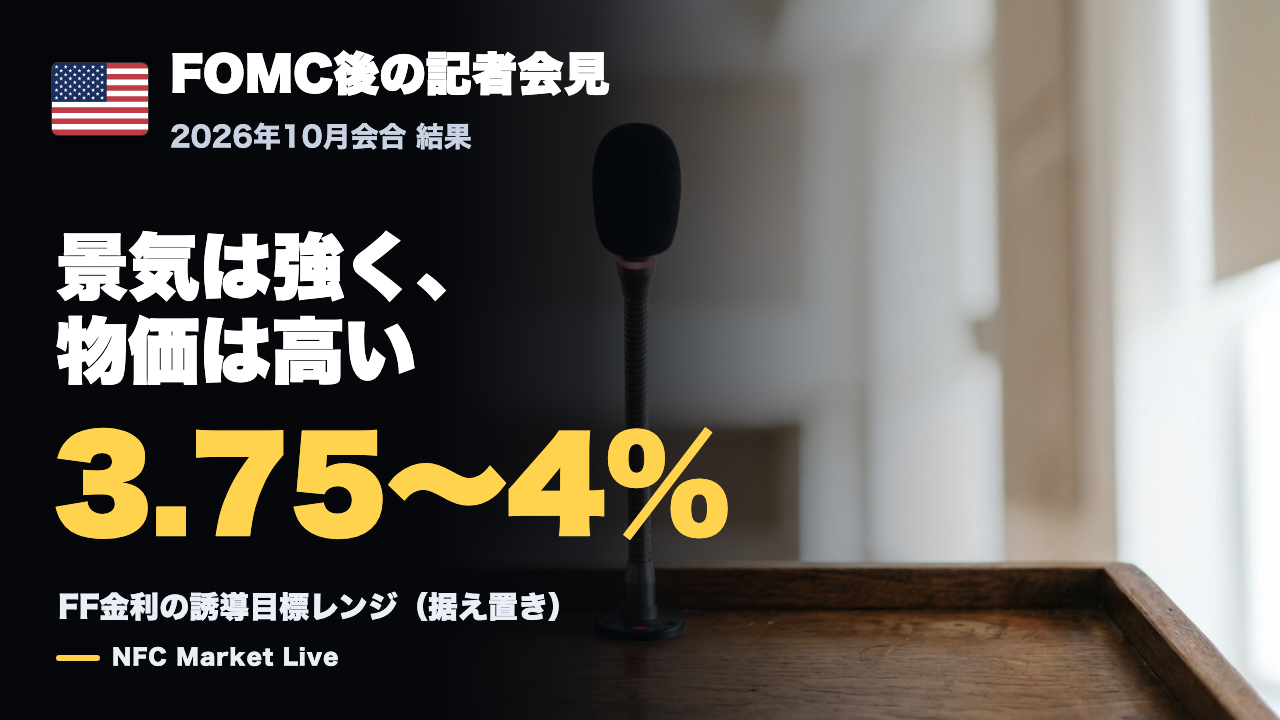
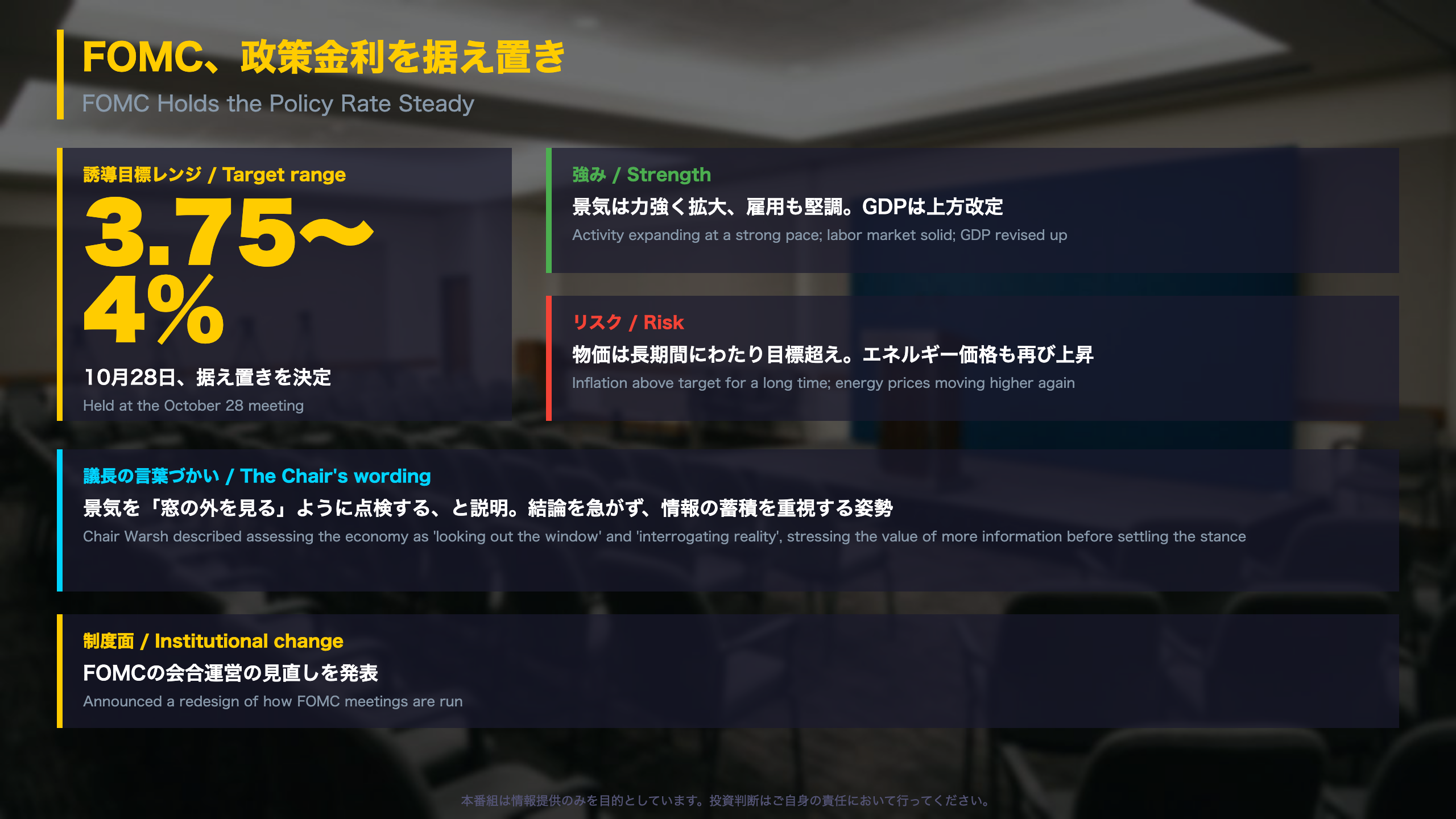
📊 At its October 28 meeting the FOMC held the federal funds target range at 3.75%-4%.
Chair Warsh credited strong growth and a solid labor market, but stressed that inflation has stayed above the 2% goal for a long time.
💡 Key takeaways: no forward guidance outside a crisis, ‘no soft inflation target’, and a view that interest rates do bite on the AI investment boom.
⚠️ He declined to prejudge the December decision, saying more information is coming.
📅 Next: the December FOMC meeting (about six weeks away) and the Productivity and Jobs Task Force hearing on November 16.
FOMC、政策金利を据え置き
Reading the Q&A: where attention clustered
The FOMC (Federal Open Market Committee) is the Fed’s rate-setting body. On October 28 it held the federal funds target range at 3.75% to 4%. Unlike the Bank of Japan, which publishes a quarterly Outlook Report, the Fed’s main tone-setting event on decision day is the Chair’s press conference, so wording matters as much as numbers.
Where questions concentrated
- Why not hike today? The New York Times and Bloomberg pressed this from different angles.
- AI and interest rates: the Financial Times, Wall Street Journal and Reuters asked how the AI capex boom affects demand and inflation.
- December: the Associated Press asked whether support for another hike this year remained.
Clear versus evasive
| Clear | Evasive |
|---|---|
| Politics played no role; no soft inflation target; productivity is rising | Comment on the President’s remarks; the December decision; balance-sheet conclusions |
‘I’m not going to be responding to quotes from public officials.’
Our read
The Chair spent as much time on how the Fed decides as on what it decided, describing the exercise as ‘interrogating reality’. One reading is caution; another is that he is prioritizing process and institutional design. The transcript alone cannot settle which.
What to watch
The next meeting is about six weeks away. Between now and then, price data (including energy) and whether capital spending keeps broadening are the checkpoints named in the Chair’s remarks. This article makes no market forecast.
景気は強い、物価はまだ高い
What the Chair called the ‘new monetary medicine’
In the Q&A, Chair Warsh described what he has put in place in roughly five months as a ‘new monetary medicine’: doubling down on the 2% inflation target, taking responsibility rather than blaming others, and laying out the Fed’s framework and transmission mechanisms (first presented at the Jackson Hole symposium, the Fed’s annual economic gathering). He added that in September the Committee ‘removed a dose of accommodation’.
Sub-indicators he cited
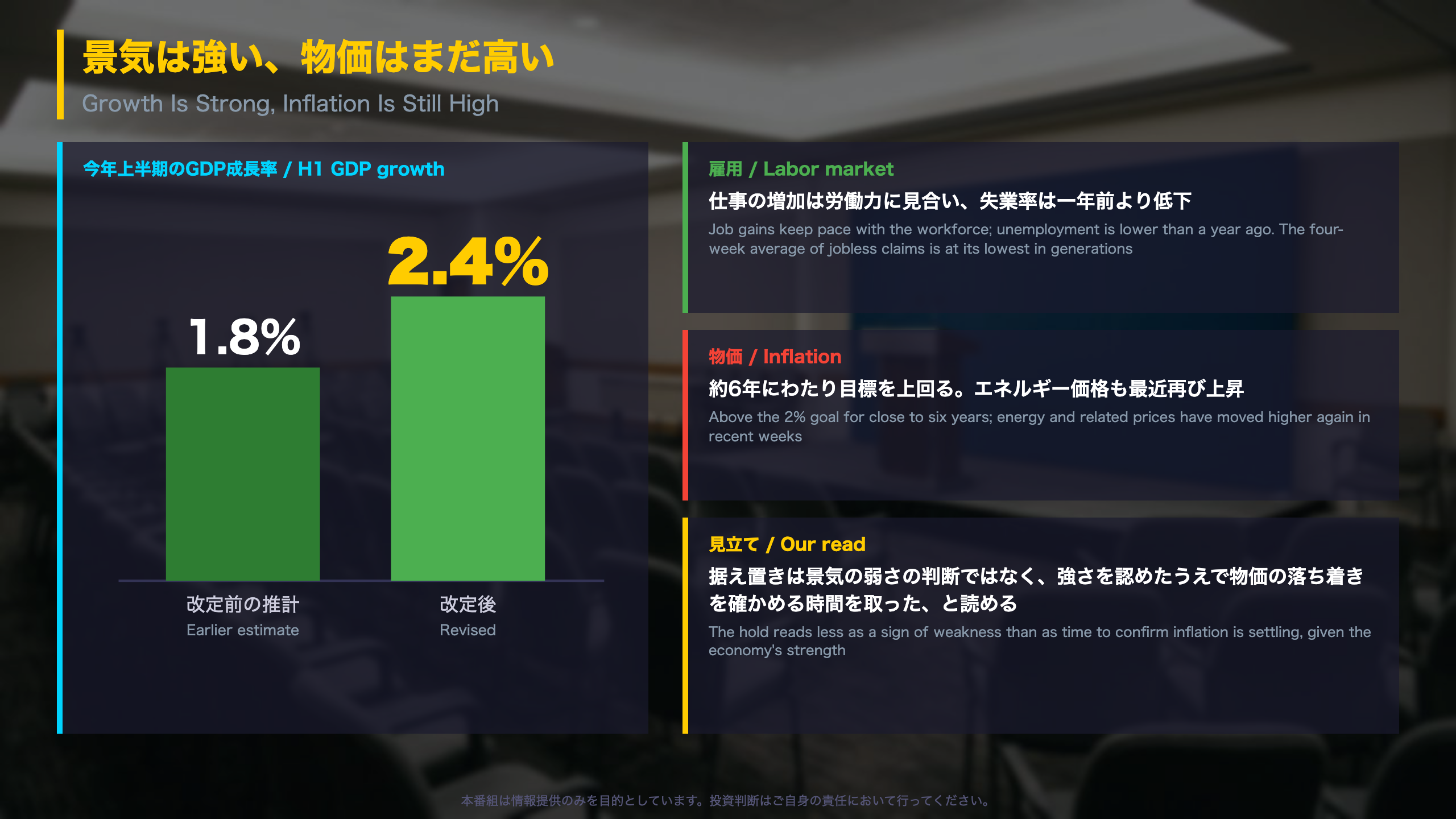
- The four-week average of unemployment insurance claims is at its lowest level ‘in generations’.
- Payroll growth is ‘noticeably above’ last year’s pace.
- Financial and credit conditions tightened for some businesses and households, but he would not call them tight.
Two ways to read it
‘Real activity is clearly pointing in the right direction. That’s good news. But inflation is too high.’
The constructive reading: broadening capital spending and better productivity leave room for growth and price stability to coexist. The cautious reading: inflation has stayed above target for close to six years and energy prices are rising again. For readers used to Japan’s CPI, note that the Fed targets 2% on the PCE price index, a broader consumption measure that typically runs differently from CPI.
What to watch
Before the December meeting, the checkpoints are energy-related price data and whether the investment strength keeps broadening. This article offers no market forecast.
AI投資に金利は効くのか
Do rates bite on the AI boom? The Chair says yes
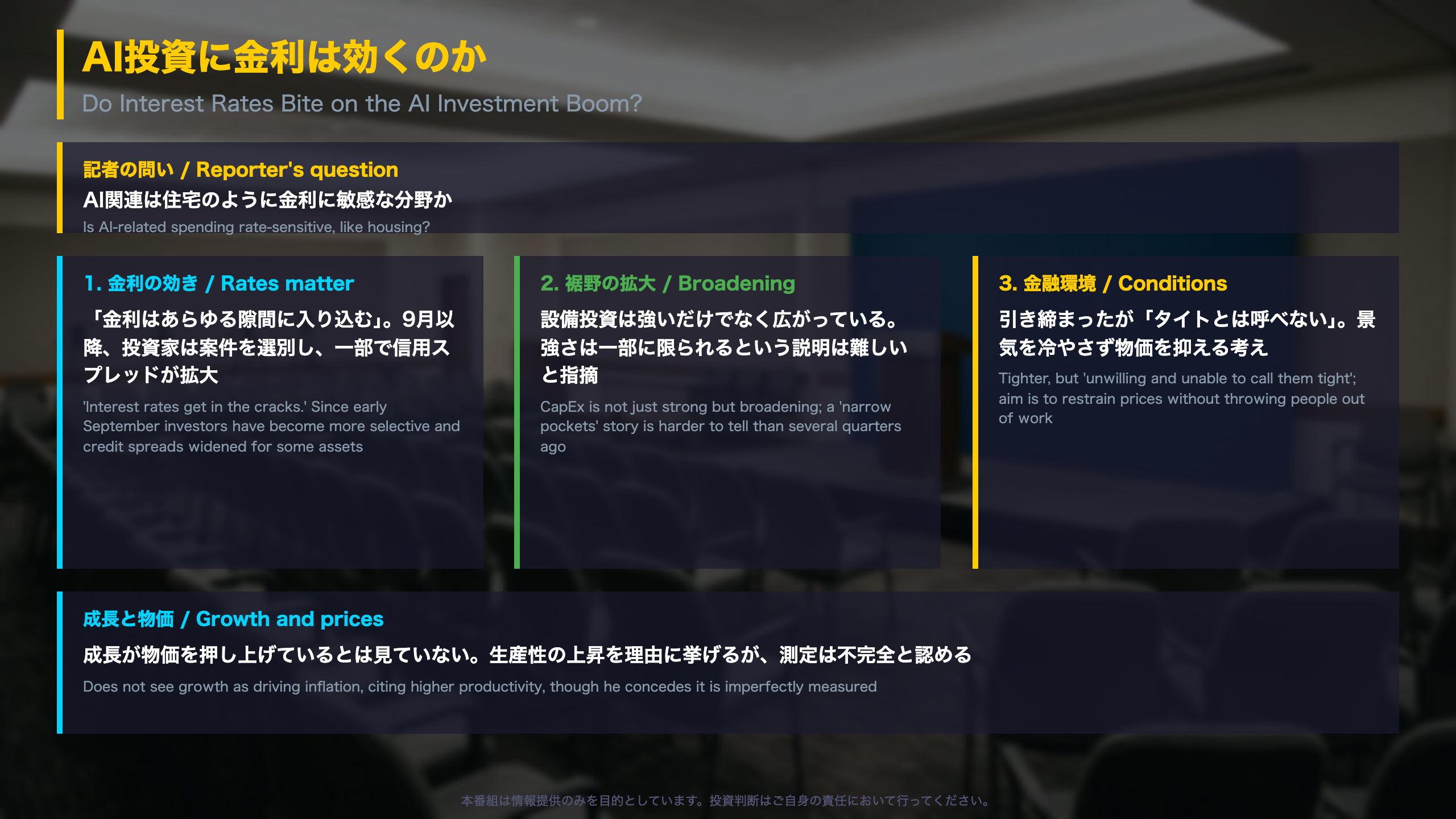
A Financial Times reporter asked whether the AI investment surge, which is adding to both growth and inflation, is less rate-sensitive than housing. The Chair said he had been skeptical of the narrative that rate rises would have no effect on AI.
Key points
- ‘Interest rates get in the cracks.’ Since early September, market participants have discriminated between kinds of investment, and credit spreads widened for certain assets; for others, conditions tightened only slightly.
- Answering the Wall Street Journal, he said the market effects of the September step were consistent with his expectations.
- Capital spending is ‘not just robust, not just strong, but broadening’.
Oil and rates
Asked by Fox Business about oil and inflation, he declined to speculate but noted that oil prices and market interest rates had moved together this year until recently, when rates ‘rolled over to the downside’ even as crack spreads (the gap between crude and refined-product prices) stayed elevated.
The Asia link
For non-US readers: he said much of the feedstock for the technology surge comes from Japan and Korea, with some from Singapore, so he watches those economies for signs of what is shipping to the US.
A different reading
Several colleagues reportedly see AI investment adding a demand component to inflation. The Chair did not see growth as the cause of inflation, citing a multi-year rise in productivity, but conceded that aggregate demand and productivity are imperfectly measured. This article makes no market forecast.
質疑で深める:据え置きの理由と先行き
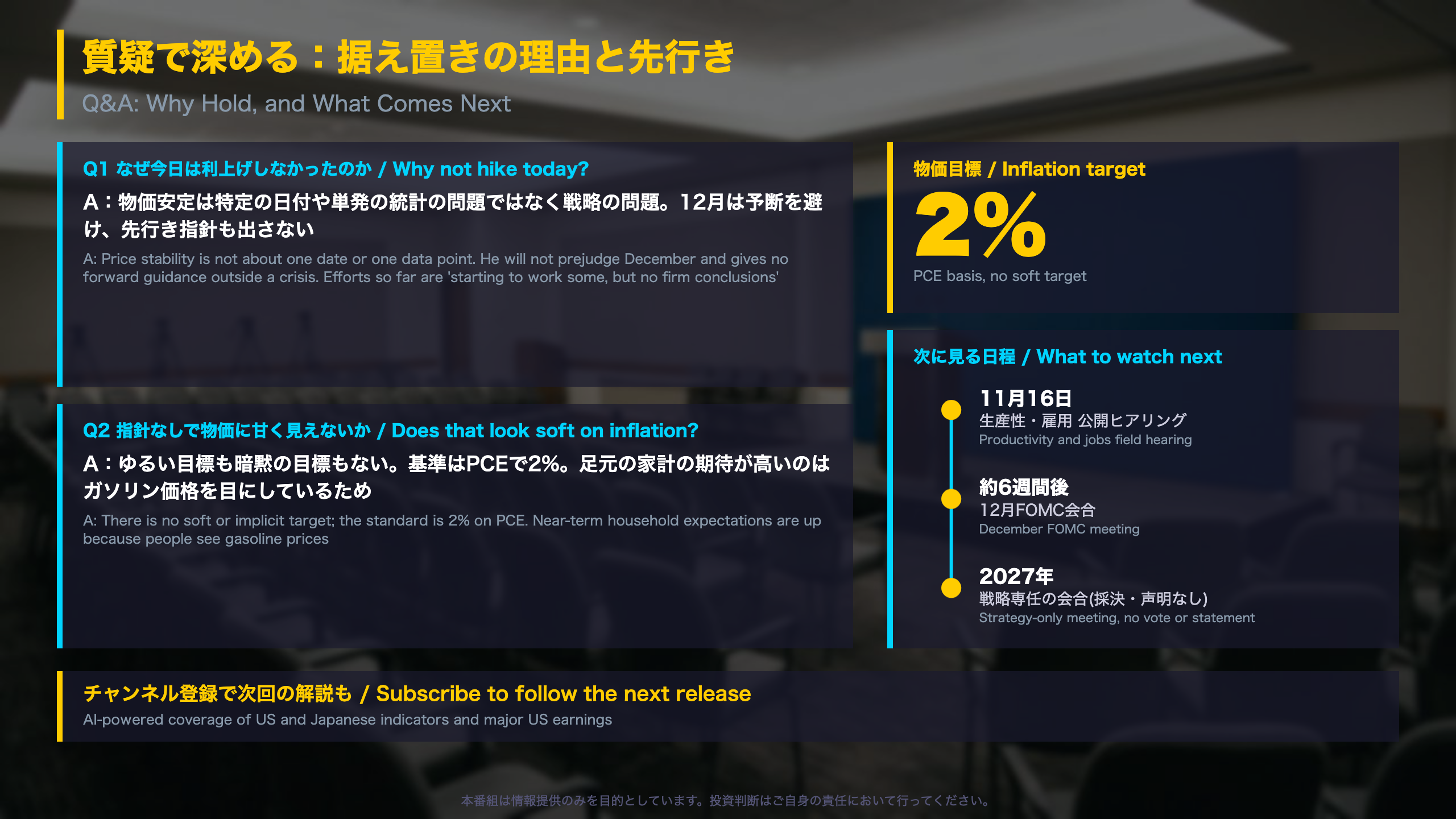
Forward guidance and the new meeting format
Why no forward guidance?
Asked by the Associated Press whether support for another hike this year remained, the Chair said:
‘I don’t believe in forward guidance absent exigent circumstances, absent a crisis.’
He acknowledged it was helpful in the 2008 financial crisis, but not ‘in normal, ordinary times, especially times where the underlying real economy is this strong’. He also said he does not submit a ‘dot’ in the Summary of Economic Projections, the quarterly chart in which each member marks a rate path. Other members may discuss their views once the pre-meeting blackout period ends.
Meeting schedule
- From next fall, eight meetings per year.
- In 2027, one meeting will be strategy-only, with no vote on the funds rate and no policy statement.
- Later he referred to two strategy meetings in 2028; the target mix is two strategy meetings and six policy meetings. Details are still to come.
Task forces
Five task forces have a year-end deadline. The Productivity and Jobs Task Force holds a public field hearing on November 16. The balance-sheet group’s recommendations should reach the FOMC around early in the first quarter, and he called them unlikely to affect this policy stance.
Two readings
Supporters may see flexibility; skeptics may see less visibility between meetings. The Bank of Japan, by contrast, publishes an Outlook Report each quarter. Asked whether the Fed would be involved in the White House proceedings on Governor Cook, he replied ‘Not to my knowledge.’
Next: the December meeting, about six weeks away. This article makes no market forecast.
Disclaimer: This article is for informational purposes only. All investment decisions are made solely at your own risk.