📺 Watch the Full Video Analysis
This article was automatically generated by the NFC Market Live AI analysis system. (Updated: 2026-09-28 09:00 JST)
The Bank of Japan released minutes from its July 30-31, 2026 Monetary Policy Meeting.
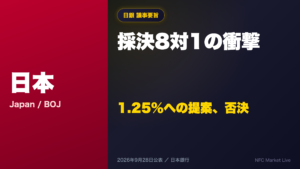
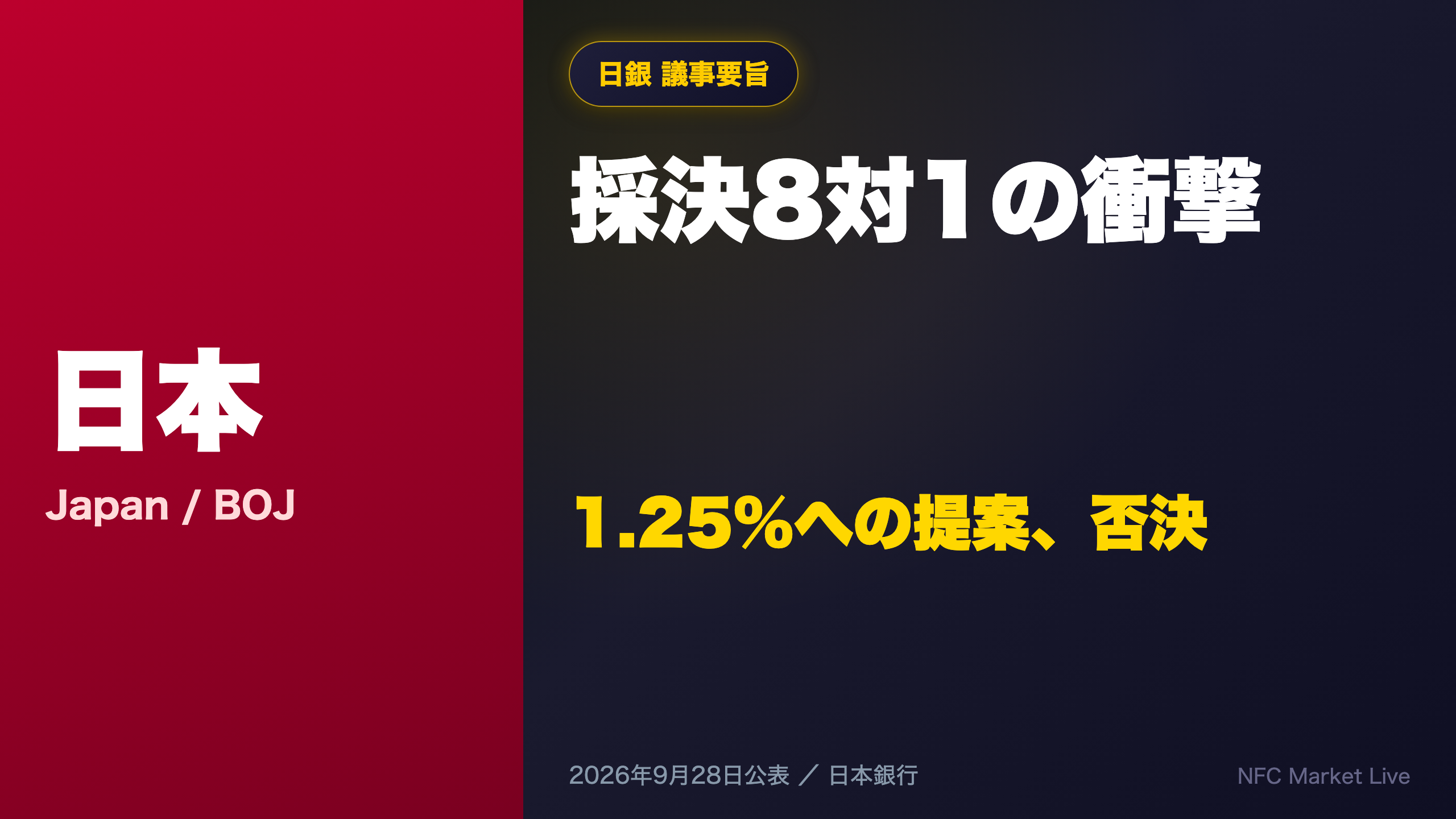
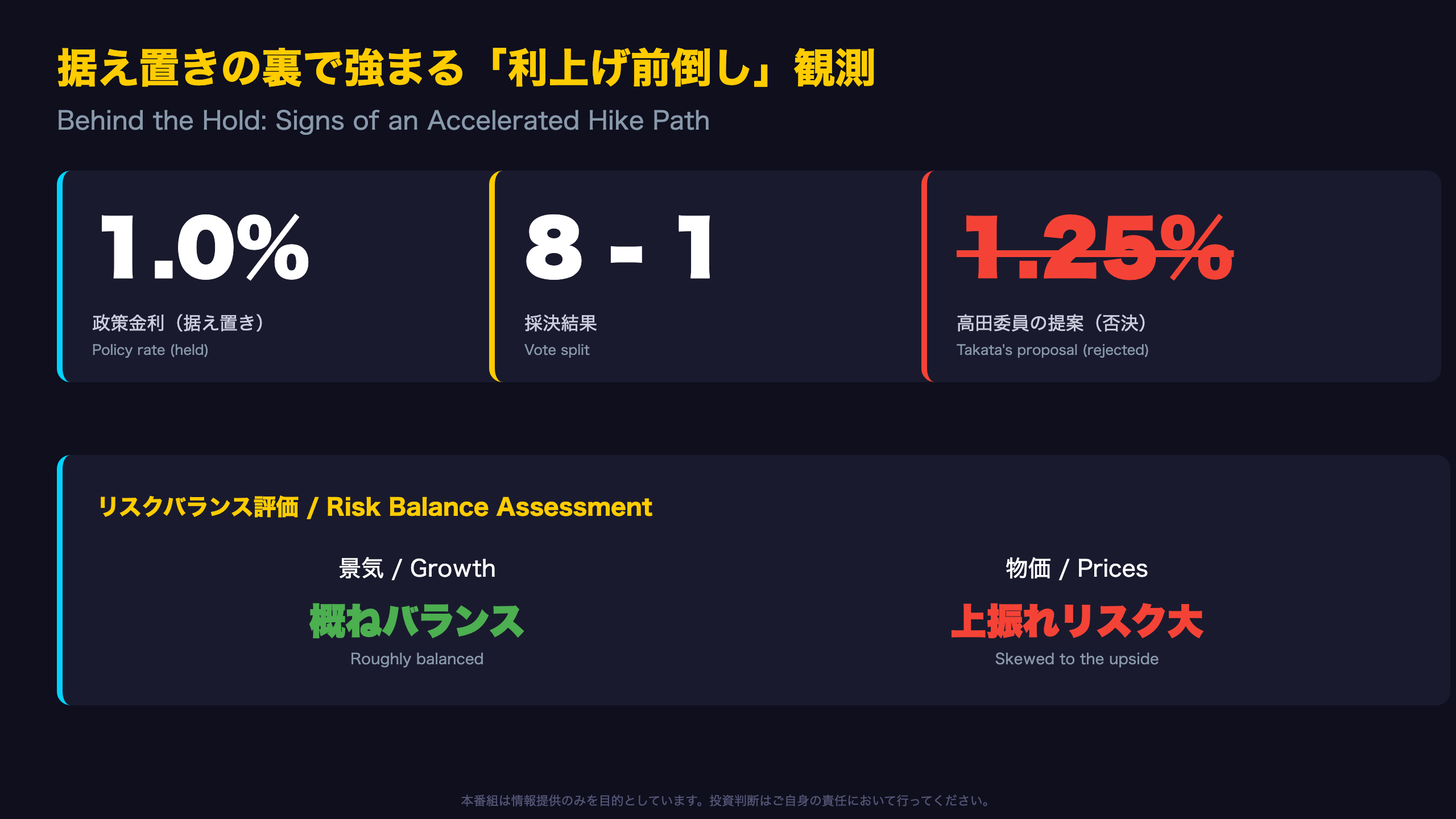
📊 Policy rate held at 1.0%, but the vote split 8-1. Board member Takata proposed an immediate hike to 1.25%.
⚠️ Inflation risk balance skewed to the upside; domestic corporate goods prices are up over 7% YoY as pass-through spreads to consumers.
💡 The BOJ’s policy objective is quietly shifting from ‘achieving 2%’ to ‘preventing an overshoot.’
A deep dive into what this means for JGB yields and the yen.
据え置きの裏で強まる「利上げ前倒し」観測 / Behind the Hold: An Accelerated Hike Path
What the Vote Split Really Signals
The headline “8-1” vote masks a more nuanced story for global rates investors. Board member Takata did not simply vote against holding rates—he tabled a formal counter-proposal specifying an explicit target of 1.25%, a full 25 basis points above the current 1.0% guidance rate.
For context, the Bank of Japan (BOJ) is Japan’s central bank, and its Policy Board operates similarly to the FOMC, with dissents occasionally submitted as formal alternative rate proposals rather than simple “no” votes. Historically, BOJ dissents have centered on the direction of policy. Takata’s move to specify a precise numerical target marks an escalation from directional disagreement to a dispute over pace—arguably a more market-moving signal.
Takata’s rationale, quoted directly: “a new phase has begun requiring agile responses to the risk of price overshoots driven by overseas demand shocks, as well as shifts in the global monetary environment.”
This contrasts with the majority view, which stressed a need to “carefully monitor the economy, prices, and financial conditions, including the effects of the policy change” from June’s hike. One member noted rate hikes typically take “one to one-and-a-half years” to filter through to inflation and the real economy.
Market implication: A specific numerical counter-proposal, even if voted down, tends to shift market pricing of the terminal rate path forward. Watch JGB futures and JPY rate swaps for repricing after this release.
二人のタカ派、異なる論理 / Two Hawks, Two Different Rationales
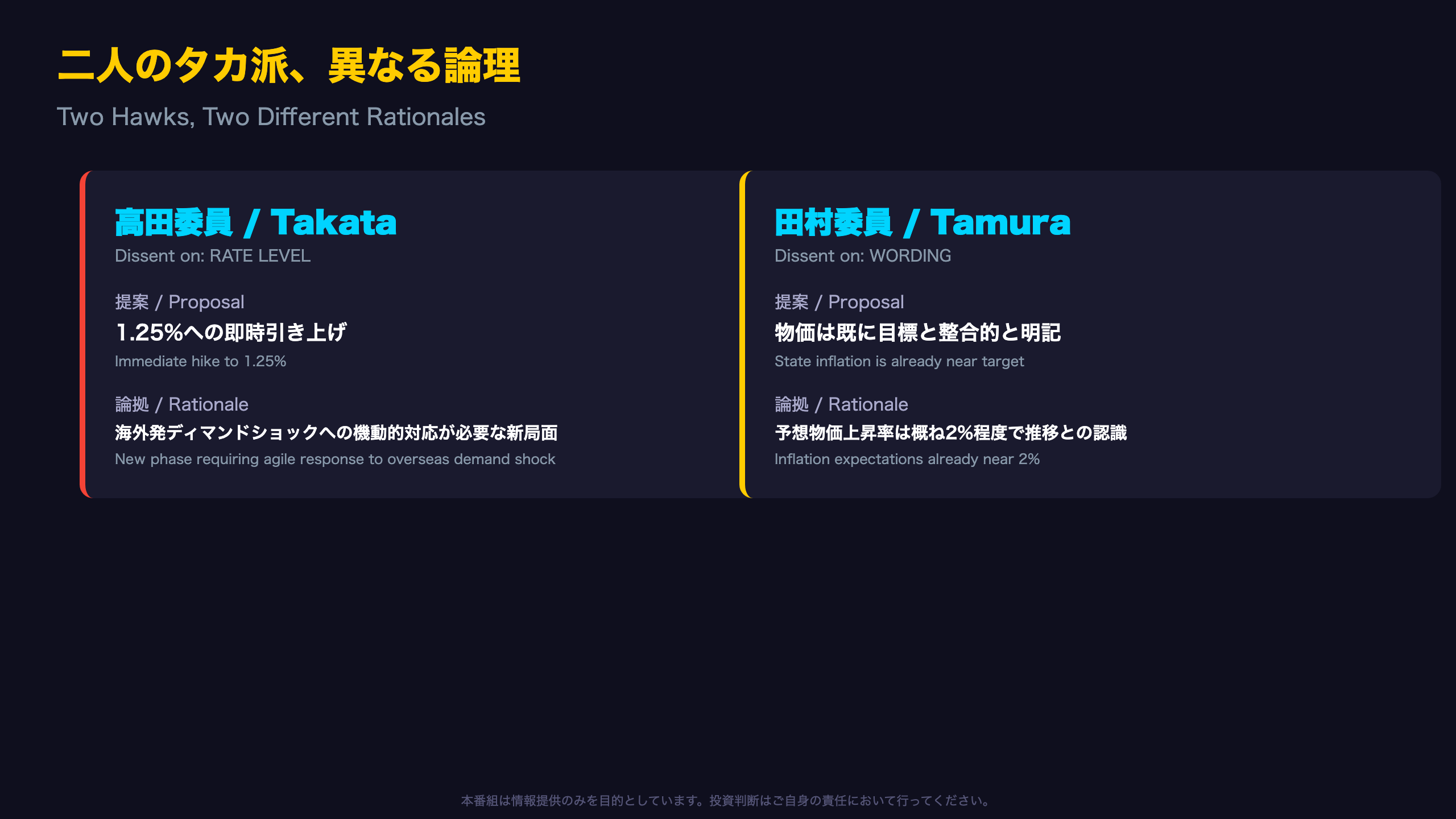
Not All Hawks Fly the Same Path
Markets tend to lump Takata and Tamura together as the BOJ’s resident hawks, but a close reading of this meeting’s dissents reveals two distinct lines of argument.
Takata’s dissent is about the rate level itself. He proposed an immediate hike to 1.25%, citing the need for “agile responses to price overshoot risks stemming from overseas demand shocks and shifts in the global monetary environment.” This is a direct challenge to the pace of normalization.
Tamura’s dissent, by contrast, concerned the wording of the Outlook Report, not the rate decision itself. He sought language stating inflation is “expected to move at a level broadly consistent with the price stability target,” and that medium-term inflation expectations are “expected to be at around 2%.” This is an argument over how confidently the board should characterize the current inflation assessment—not a call for immediate action.
Why this matters: The bar for building a majority behind Tamura’s framing is arguably lower than building one behind Takata’s explicit rate hike. If Tamura-style language gains traction in future minutes, it could be an earlier “tell” that the board is quietly upgrading confidence in sustained 2% inflation—similar to how Fed watchers parse subtle FOMC statement changes as leading indicators before policy shifts.
「2%達成」から「上振れ回避」へ / From Achieving 2% to Preventing Overshoot
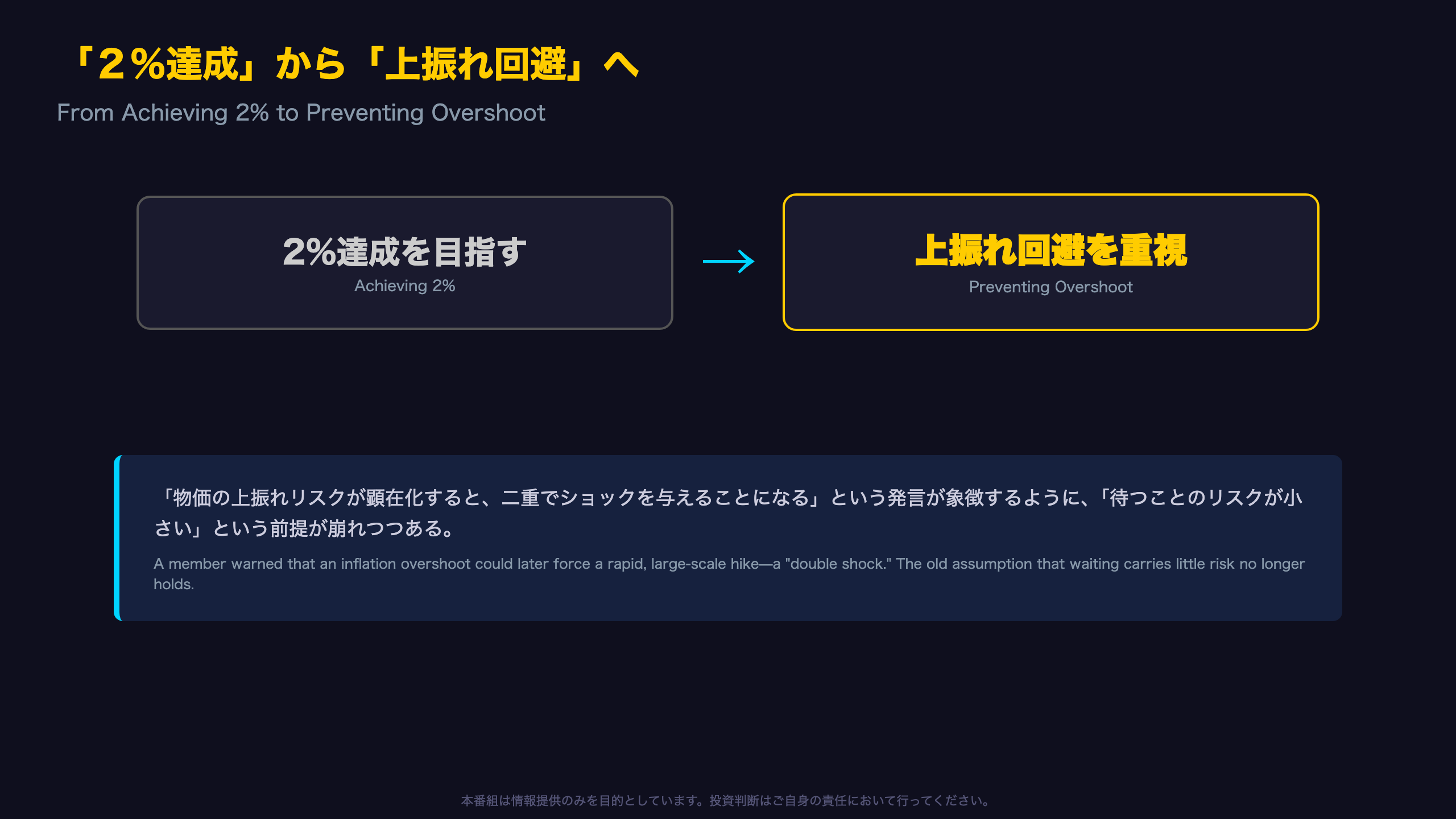
Where the Forward Guidance Seed Is Hiding
The most consequential—if quietly stated—shift in this minutes release is a change in the BOJ’s underlying objective function. Since exiting deflation, the Bank’s goal has been to “raise” underlying inflation to 2%. This time, “many members” acknowledged the goal is shifting toward “anchoring” inflation at 2% and, increasingly, toward “preventing overshoot” beyond that level.
This is not merely semantic. When a central bank’s objective shifts from achieving a target to defending it, the calculus around policy speed typically changes: in an achieving phase, the cost of waiting is low; in a defending phase, the risk of waiting rises.
One member’s comment captures this vividly: “if the risk of an inflation overshoot materializes, it would deal a major blow to Japan’s economy and public livelihoods, and could ultimately force a rapid, large-scale rate hike later—delivering a double shock.”
Global context: This echoes debates central banks have had post-pandemic, most notably the Fed’s “behind the curve” self-criticism in 2021-22. The BOJ appears to be trying to avoid repeating that mistake.
That said, this is not yet full consensus—qualifiers like “many members” and “the majority” still leave room for a cautious minority favoring a wait-and-see approach given the 1-to-1.5-year policy lag. This tension will likely determine the actual pace of the next hikes.
強い実体経済と、上振れる物価リスクの綱引き / Resilient Growth Meets Upside Inflation Risk
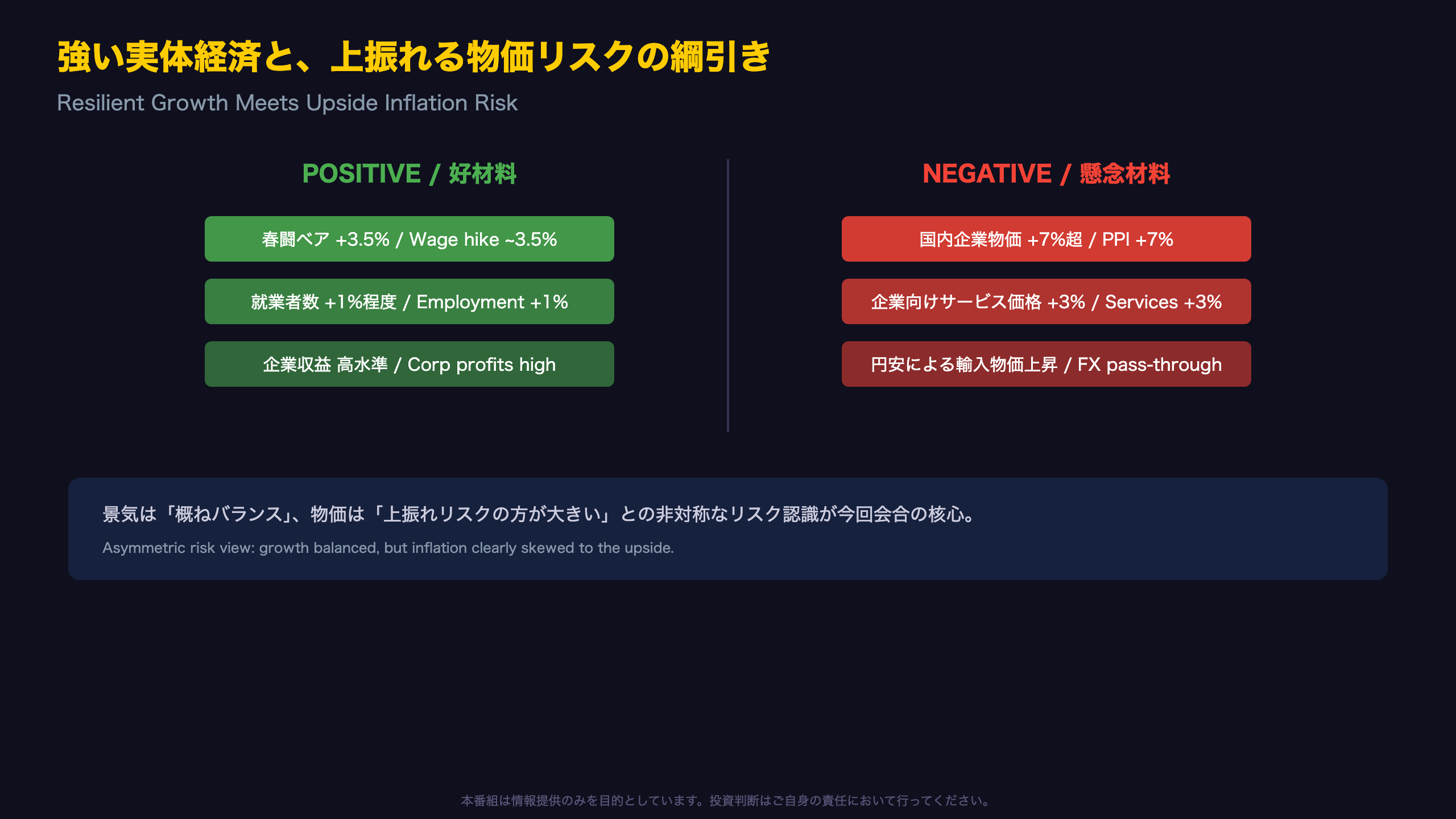
Reading Both the Strength and the Fragility
This meeting’s minutes offer ample evidence of Japan’s underlying resilience. Year-on-year growth in employed persons has expanded to around 1%, labor markets remain tight, bank lending continues to grow in the “low 6%” range, and corporate cash flow is assessed as “favorable.”
At the same time, price-side risks deserve equal attention. Domestic corporate goods prices (a proxy similar to the U.S. Producer Price Index) are already rising above 7% year-on-year, and the board noted “cost pass-through is progressing from midstream to downstream.” Yen depreciation compounds this by pushing up import prices, with the minutes noting exchange rate moves are “increasingly affecting prices” compared to the past—a structural change echoing debates at the Fed and ECB about post-pandemic inflation persistence.
One member cautioned that pass-through estimates must account for structural shifts in corporate wage- and price-setting behavior since the pandemic, implying models anchored to pre-2020 relationships may understate current inflation risk.
“Oil price gains are likely to spread to a wide range of consumer-level goods going forward” (multiple members)
Bottom line: This is not a simple bull or bear story. The board’s asymmetric assessment—growth “balanced,” prices “skewed higher”—is the real signal for JPY import costs and JGB breakevens.
緩和的な金融環境とJGB市場への含意 / Still-Accommodative Conditions and JGB Implications
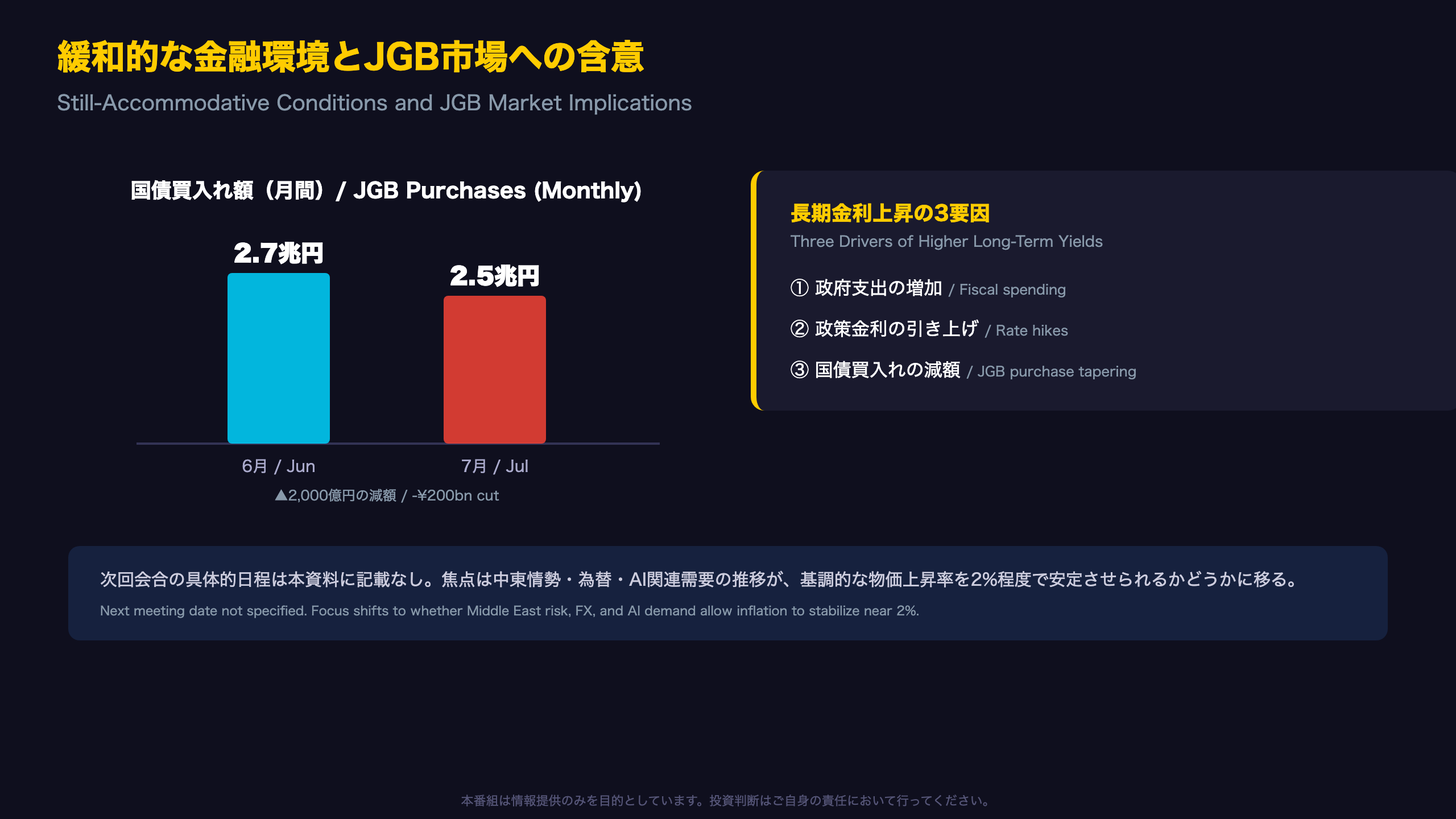
The Tug-of-War Between QT and Long-Term Yields
One easily overlooked detail is the continued tapering of JGB purchases: monthly purchases fell from ¥2.7 trillion in June to ¥2.5 trillion in July, a ¥200 billion cut. This represents ongoing quantitative tightening running parallel to the rate-hike cycle, meaning long-term yields face upward pressure from two independent channels—policy rate hikes and balance-sheet reduction.
Indeed, the minutes note 10-year JGB yields rose during the meeting period due to “uncertainty over the Middle East situation and speculation about future fiscal and monetary policy.” Encouragingly, JGB market liquidity indicators are described as showing “improvement on the whole,” suggesting market functioning continues to normalize even as yield levels rise—a nuance distinct from stress-driven yield spikes.
“If the policy rate is raised at an appropriate pace, long-term rates should also form in a stable manner consistent with that path” (multiple members)
The flip side: if markets conclude the BOJ’s pace is inadequate, term premiums could rise sharply as inflation and future rapid-hike risks get priced in—a dynamic familiar to Fed and Gilt market watchers alike.
What to watch next: The exact date of the next Monetary Policy Meeting is not disclosed in this document. Going forward, key swing factors include the trajectory of Middle East tensions, the pace of yen depreciation, and evidence on whether AI capex is translating into durable profitability.
Disclaimer: This article is for informational purposes only. All investment decisions are made solely at your own risk.