📺 Watch the Full Video Analysis
This article was automatically generated by the NFC Market Live AI analysis system. (Updated: 2026-09-28 20:43 JST)
📄 Primary Source
Banco Central do Brasil
https://www.bcb.gov.br/content/focus/focusmarketreadout/R20260925.pdf
📊 A deep dive into Brazil’s latest Focus Market Readout from the central bank (BCB).
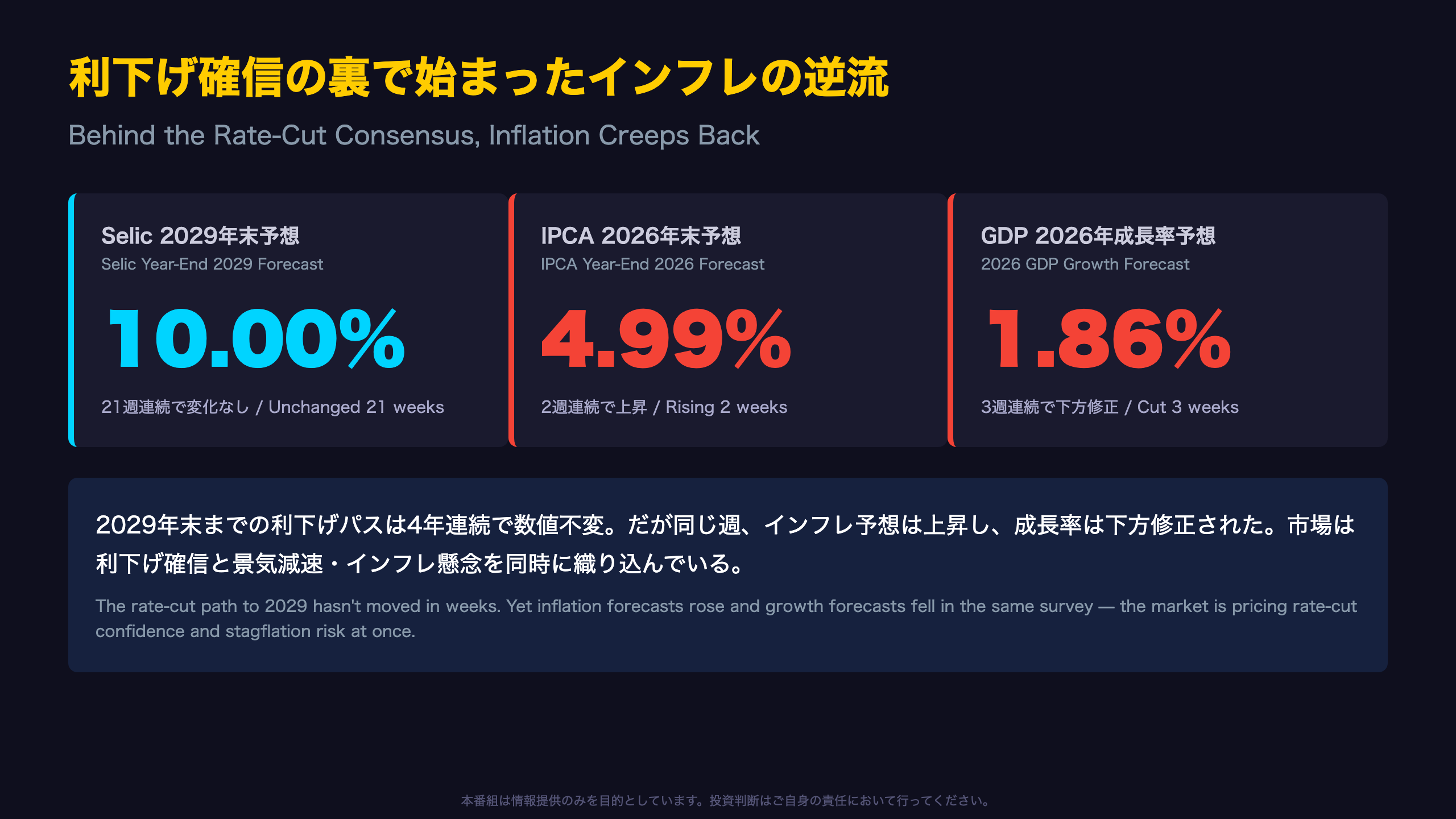
The Selic rate-cut path to 2029 remains unchanged for a fourth straight year, with over 130 forecasters in tight agreement.
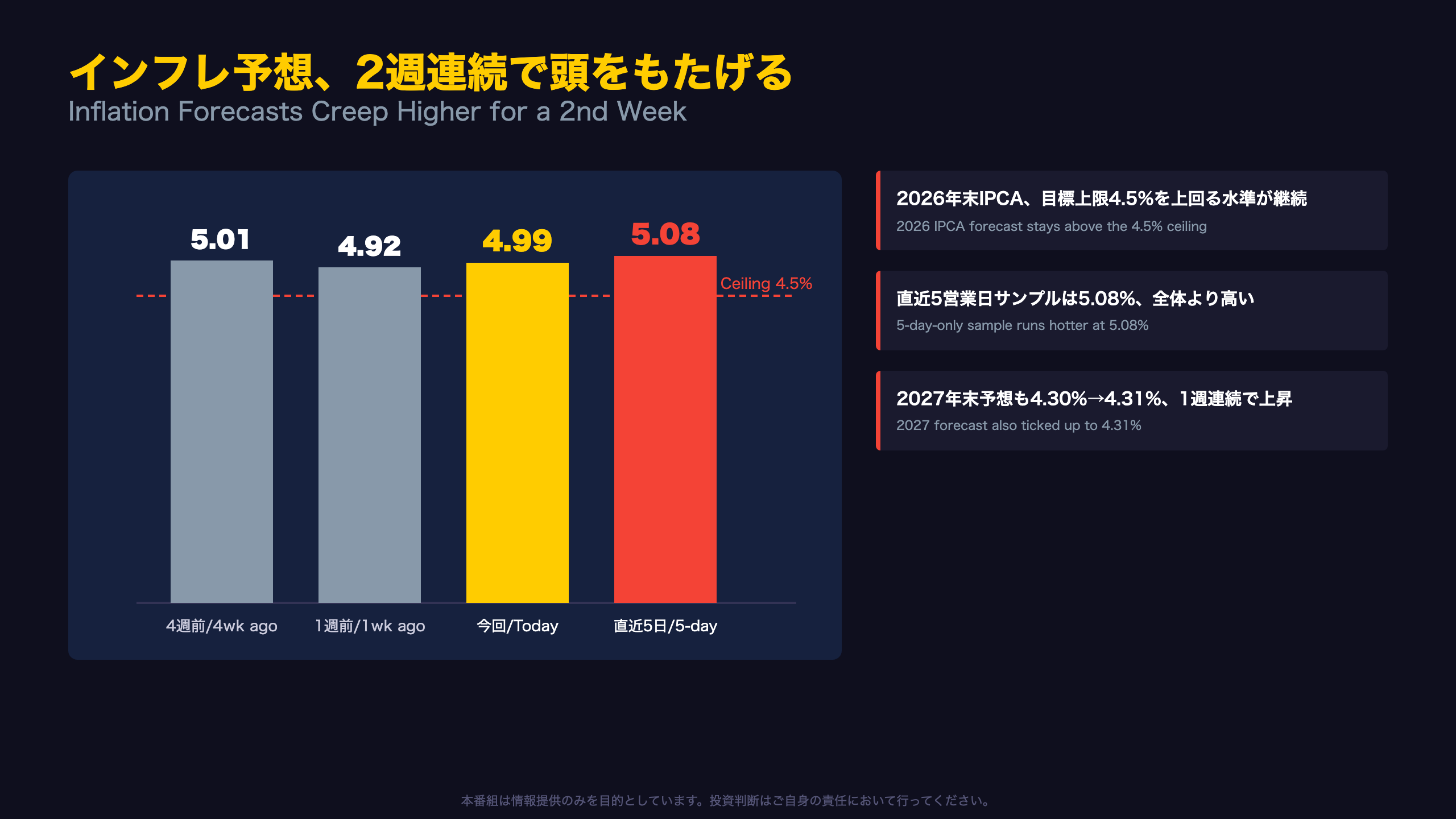
📈 Yet 2026 inflation forecasts rose for a second straight week to 4.99%, above the BCB’s 4.5% tolerance ceiling.
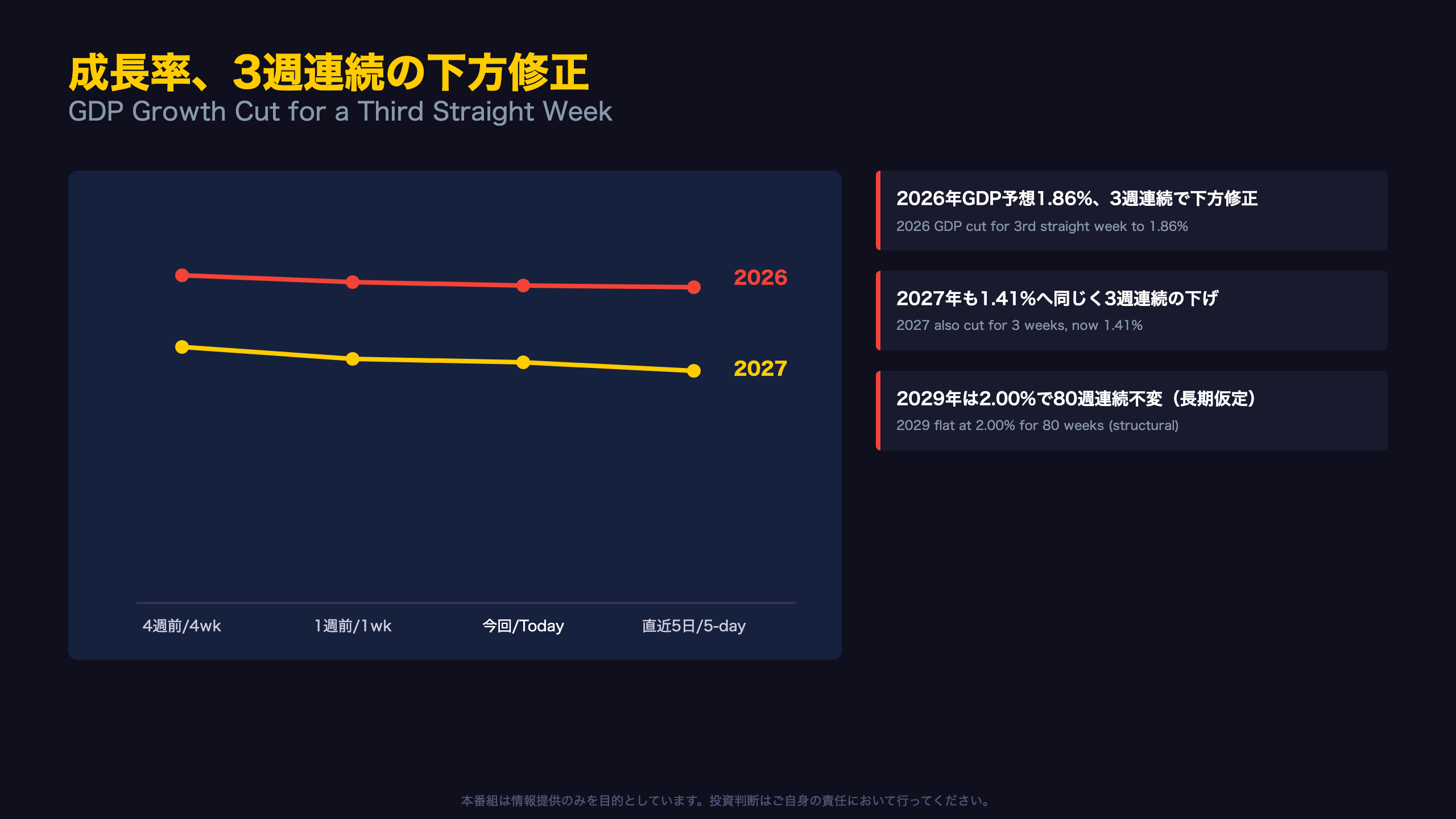
📉 GDP growth forecasts for both 2026 and 2027 were cut for a third consecutive week.
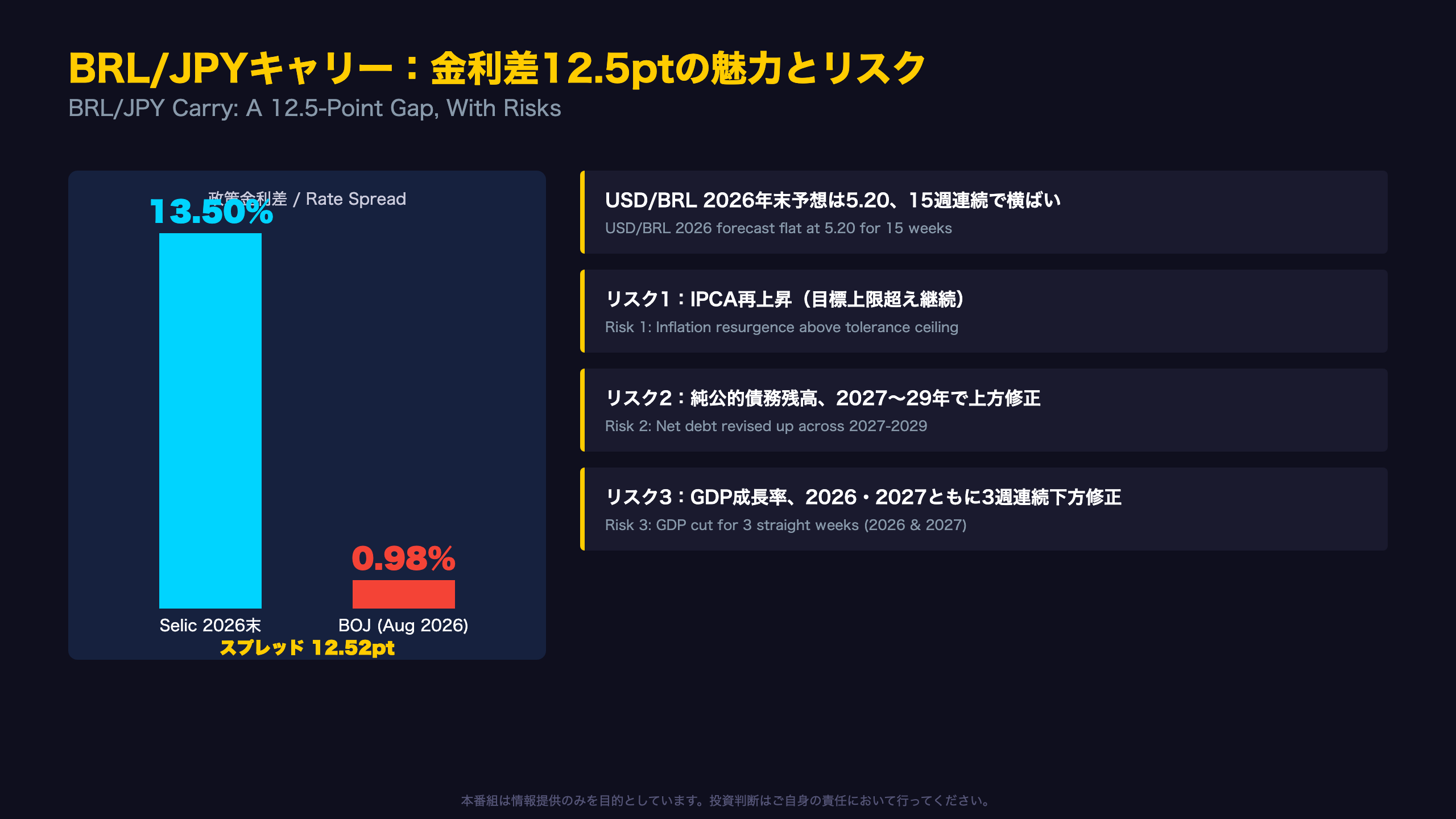
💡 The Selic-BOJ rate spread stands at 12.52 points — key for BRL/JPY carry trades.
⚠️ Fiscal metrics also show early signs of strain.
利下げ確信の裏で始まったインフレの逆流
What Is the Focus Market Readout?
Published every Monday by the Banco Central do Brasil (BCB), the Focus Market Readout aggregates weekly median forecasts from over 130 market participants — banks, asset managers, and consultancies. Unlike a typical private-sector poll, this survey is a formal input into the BCB’s own COPOM (Monetary Policy Committee) rate-setting deliberations, functioning somewhat like the Fed’s Survey of Professional Forecasters, but updated weekly rather than quarterly.
A Rate Path Frozen in Place
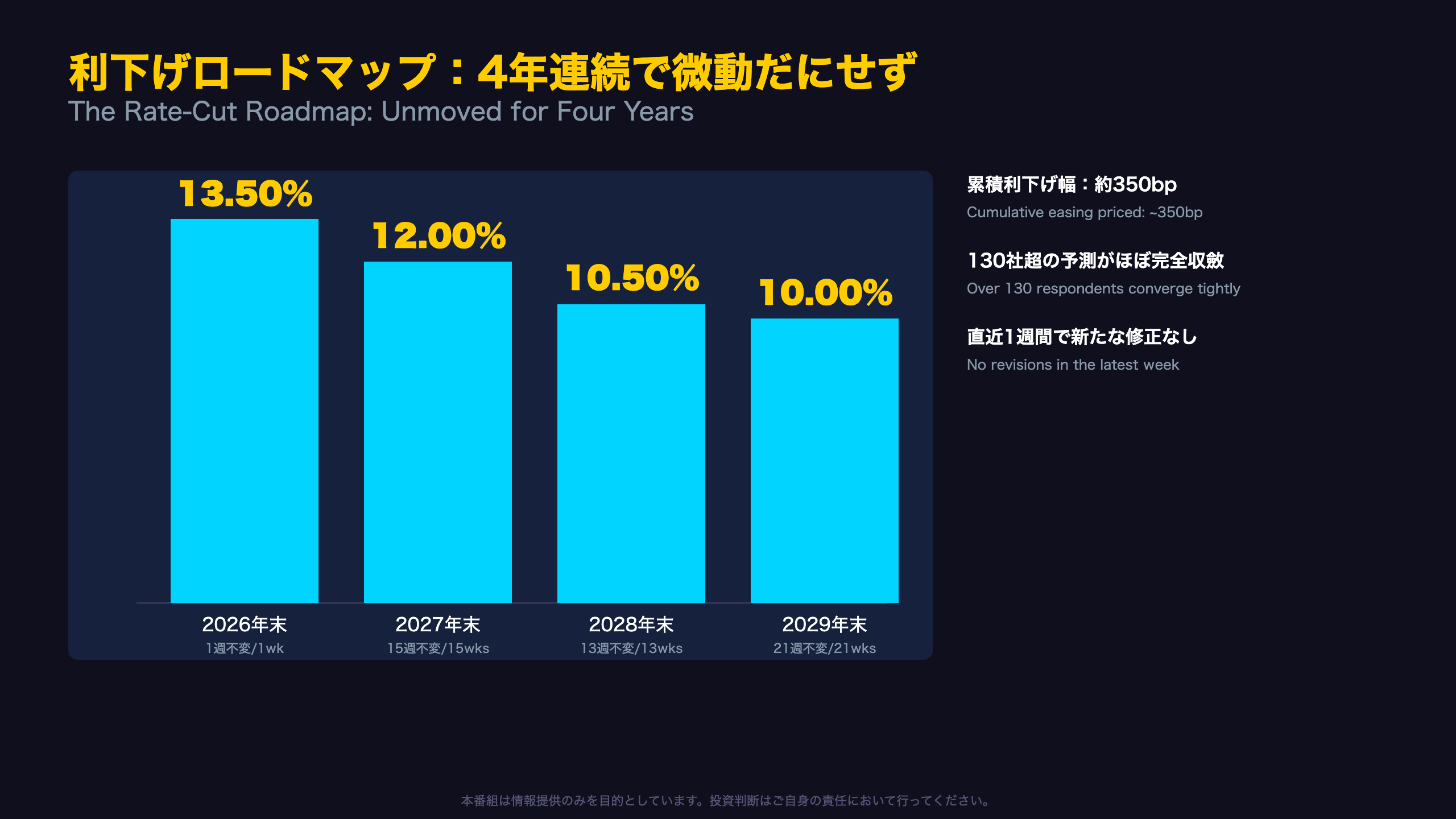
The year-end Selic forecasts for 2026 (13.50%), 2027 (12.00%), 2028 (10.50%), and 2029 (10.00%) have been unchanged for 1, 15, 13, and 21 consecutive weeks respectively. This is a far longer stretch of forecast stability than typically seen in Fed funds futures pricing during a cutting cycle, reflecting Brazil’s comparatively well-anchored — if still elevated — real rate framework.
Inflation’s Quiet Divergence
While the 30-day median IPCA forecast for 2026 sits at 4.99%, the subset of respondents polled only in the last 5 business days puts it higher, at 5.08% — above the BCB’s upper tolerance band of 4.5% (target midpoint: 3.0%). This is not yet a trend reversal, but it is a data point worth monitoring for anyone holding BRL-denominated assets.
Market Implications
For dollar- or yen-based investors, the takeaway is nuanced: the wide Selic-BOJ rate spread remains a powerful carry trade attraction, but the inflation uptick is a reminder that Brazil’s real rate cushion, while large, is not immune to shocks.
利下げロードマップ:4年連続で微動だにせず
Why “No Change” Is Itself the Story
The key to reading the Focus Report isn’t the headline number — it’s the parenthetical figure in the trend column showing how many consecutive weeks a forecast has held. Right now, the 2027 year-end Selic forecast has sat at 12.00% for 15 straight weeks, and the 2029 forecast at 10.00% for 21 weeks — nearly half a year of near-total convergence among 130-plus respondents.
Tracing the Adjustment That Already Happened
Comparing to the prior week’s report (Sep 18), the 2026 year-end Selic forecast moved from 13.75% to 13.50% one week earlier; this week it simply held at that new level. In other words, the actual repricing occurred a week ago, and the latest data reflects a full “digestion” phase rather than fresh news.
A 350bp Easing Curve Over Four Years
From 13.50% at end-2026 to 10.00% at end-2029, the market is pricing roughly 350 basis points of cumulative easing. The most likely trigger for a break in this path would be if the recent two-week uptick in inflation expectations solidifies into a genuine trend.
This stability doesn’t mean complacency, though. Even the freshest 5-business-day sample shows no change to the Selic forecast (13.50% for 2026), meaning the recent inflation jitters have not yet fed through to rate-path expectations — a distinction worth watching closely in the coming weeks.
インフレ予想、2週連続で頭をもたげる
Measuring the Distance to Target
The BCB’s inflation targeting framework sets a 3.0% midpoint with a tolerance band of 1.5% to 4.5% — similar in structure to the Fed’s 2% target, but with a much wider tolerance band reflecting Brazil’s higher inflation volatility. This week’s 2026 year-end IPCA forecast of 4.99% sits 0.49 points above the 4.5% ceiling, meaning a formal target miss is effectively the baseline expectation.
A “V-Shaped” Move Over Four Weeks
The past four weeks trace a V-shape: 5.01% (4 weeks ago) to 4.92% (1 week ago) to 4.99% (today). Calling this a fresh uptrend would be premature — it’s arguably just a recovery to the level seen a month ago. That said, the 5-business-day-only sample runs hotter still, at 5.08%, a signal that shouldn’t be dismissed.
Monthly Data Hints at Near-Term Pressure
Monthly IPCA data for September 2026 rose from 0.52% to 0.56% over two weeks, with the freshest 5-day sample jumping to 0.68% — a reminder that near-term price momentum, not just annual targets, deserves attention.
Two Readings, Both Valid
Bulls can point to the 2027 year-end forecast, nearly flat at 4.31%, as evidence the medium-term disinflation story remains intact. Bears would note that if the hotter 5-day sample persists for several more weeks, it could eventually force the BCB to reconsider its pace of cuts — a key risk for BRL asset holders to track.
成長率、3週連続の下方修正
A Two-Tier Structure: Live Forecasts vs. Structural Assumptions
When reading Focus Report growth data, it’s important to distinguish between the “live” forecasts for 2026-2027 and the effectively fixed long-run assumption for 2029. The 2029 GDP forecast of 2.00% has not moved in 80 consecutive weeks — over a year and a half — suggesting respondents treat it more as a convenient long-run equilibrium growth assumption than a genuinely re-evaluated number, similar to how U.S. forecasters treat “potential GDP growth” in long-range Fed projections.
The Freshest Sample Runs Even Weaker
Against the 30-day medians, the 5-business-day-only sample shows 1.85% for 2026 (versus 1.86%) and 1.36% for 2027 (versus 1.41% — a 5bp gap). Unlike the inflation data, where the freshest respondents ran hotter, here the newest respondents are more pessimistic on growth — a divergence worth flagging for anyone tracking Brazil’s macro momentum.
2028 Turns a Corner
The 2028 forecast, previously stable, was revised down for the first time this week (1.87% to 1.83%), hinting that growth concerns may be spreading beyond the immediate 2026-2027 horizon.
Caution is warranted: three weeks of downward revisions is a short sample and shouldn’t be read as confirmation of a structural slowdown. Cross-checking against fiscal and trade data (see the next section) is essential before drawing firmer conclusions.
財政収支の分岐:改善するプライマリー、悪化するネット
The Primary-Nominal Twist
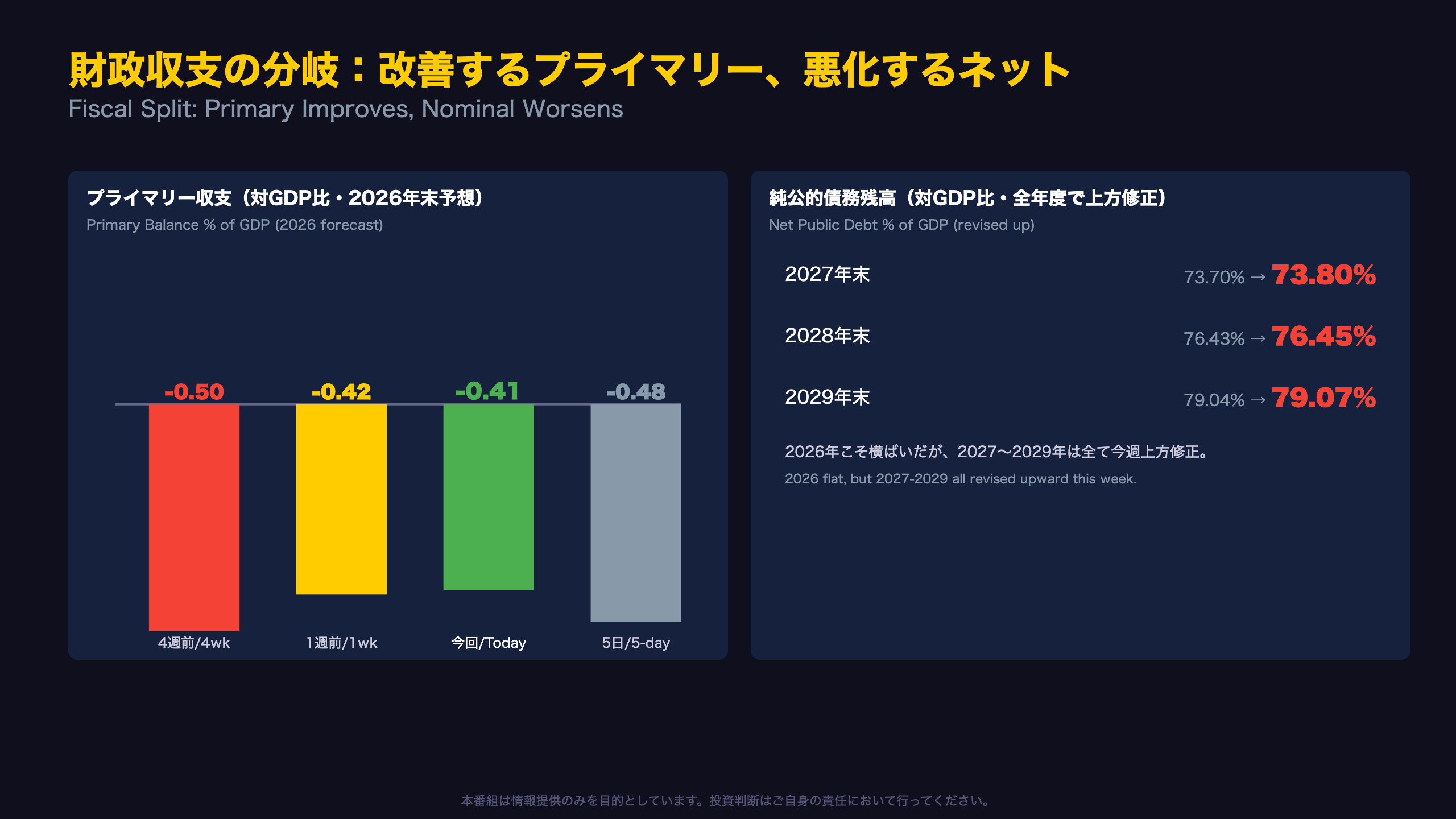
An improving primary balance alongside a worsening nominal balance is a structural hallmark of Brazilian fiscal dynamics. Even as the government makes progress on spending and revenue measures, elevated Selic rates keep debt-servicing costs weighing heavily on the nominal balance — a dynamic distinct from, say, the U.S. federal budget, where interest costs are a smaller share of the overall deficit picture.
Debt Forecasts Revised Up Across the Board
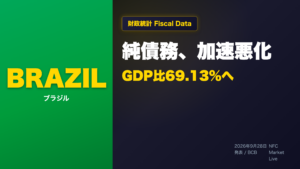
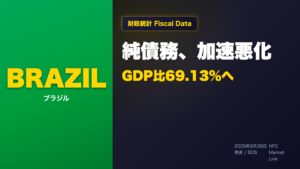
What stands out this week is that net public debt-to-GDP forecasts for 2027, 2028, and 2029 were all revised upward simultaneously (by roughly 0.01 to 0.10 points each). While individually small, the fact that all three outer years moved in the same direction in the same week suggests a modest but broad-based increase in market wariness about Brazil’s medium-term fiscal trajectory.
Two Readings
Bulls would note the 2026 primary balance has improved for three straight weeks — genuine, if gradual, fiscal discipline. Bears would counter that the nominal balance still sits at a deep -8.90% of GDP, and high policy rates continue to erode the benefit of that primary improvement.
Linking to FX and Inflation
Fiscal deterioration concerns typically transmit through a weaker BRL, higher inflation expectations, and a slower pace of rate cuts. No such FX move is visible yet in this week’s data, but continued fiscal slippage combined with the inflation uptick already discussed could eventually force a broader scenario reassessment.
BRL/JPYキャリー:金利差12.5ポイントの魅力とリスク
The Arithmetic of the Carry Trade
The BRL/JPY carry trade logic is straightforward: borrow in low-yielding yen, hold BRL-denominated assets earning the Selic rate, and pocket the spread. Using this week’s Focus survey data, the year-end 2026 Selic forecast of 13.50% versus Japan’s policy rate of 0.98% (August 2026, FRED series IRSTCI01JPM156N) produces a spread of 12.52 percentage points — among the widest available in liquid EM/DM currency pairs, comparable to historically attractive setups like AUD/JPY in the early 2000s or MXN/JPY today.
Reading the Calm in USD/BRL
The USD/BRL forecast for year-end 2026 has sat at 5.20 for 15 consecutive weeks, and the 2028 forecast has held at 5.30 for 10 weeks. This kind of prolonged stability is unusual for an EM currency and could reflect either genuine macro anchoring or simply a lack of fresh catalysts. Either way, low near-term forecast volatility tends to support carry trade positioning, since realized FX volatility is the single biggest risk to unwinding a high-carry position.
Three Risks for Japanese Retail Investors
For Japanese investors considering Brazilian government bonds or BRL-denominated assets, three risk vectors from this week’s data stand out:
- Inflation resurgence: 2026 IPCA forecasts rose for a second straight week, sitting above the BCB’s upper tolerance band.
- Fiscal deterioration: Net public debt-to-GDP forecasts were revised up across 2027-2029 simultaneously.
- Growth slowdown: GDP forecasts were cut for a third consecutive week across both 2026 and 2027.
None of these individually signals a scenario change, but together they represent the classic ingredients of an EM risk-off episode: slowing growth, sticky inflation, and rising debt concerns. Investors accustomed to G7 carry trades should note that Brazil’s macro volatility profile is structurally higher, even when FX forecasts look calm.
What to Watch Next
The next Focus Market Readout is expected around October 2, 2026. Key watch points: whether IPCA forecasts extend their rise to a third consecutive week, and whether GDP downgrades extend to a fourth.
Disclaimer: This article is for informational purposes only. All investment decisions are made solely at your own risk.