📺 Watch the Full Video Analysis
This article was automatically generated by the NFC Market Live AI analysis system. (Updated: 2026-09-28 09:11 JST)
📊 A deep dive into the Central Bank of Brazil’s (BCB) latest fiscal statistics.
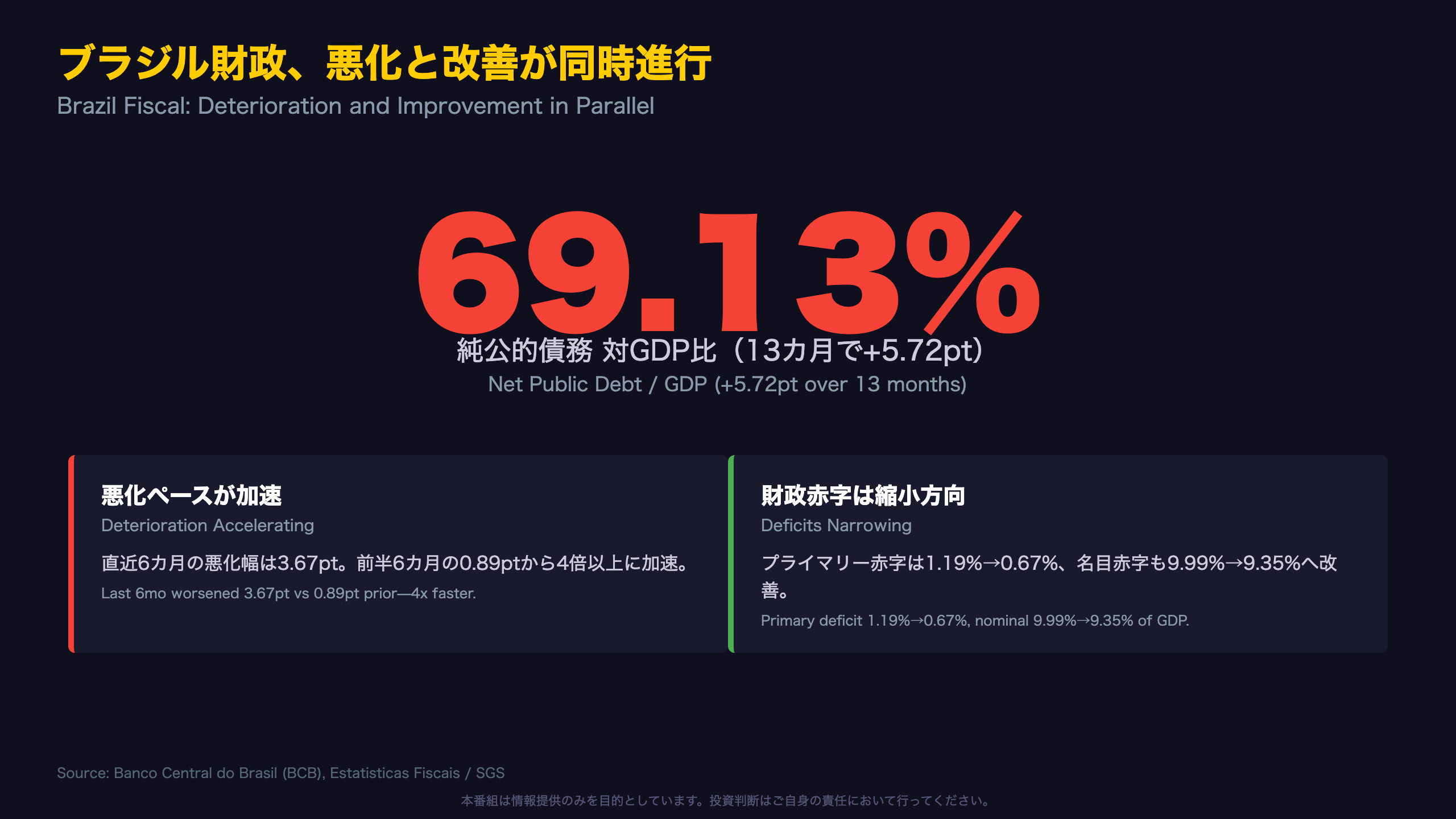
Net public debt hit 69.13% of GDP, up 5.72 points in 13 months—with the pace of deterioration accelerating 4x in the last 6 months.
📉 Meanwhile, the primary deficit narrowed from 1.19% to 0.67% of GDP, and the nominal deficit from 9.99% to 9.35%.
⚠️ Yet the nominal deficit remains stuck near 9-10% of GDP, reflecting the heavy cost of high Selic interest rates.
💡 We examine whether Brazil faces a debt ‘snowball’ effect even as deficits narrow.
ブラジル財政、悪化と改善が同時進行
Two Contradictory Signals in Brazil’s Fiscal Data
According to fiscal statistics released by Banco Central do Brasil (BCB) on September 28, 2026, net public debt (DLSP) reached 69.13% of GDP—up 5.72 points from 63.41% in July 2025, over 13 months.
For context: what is BCB’s SGS system?
The BCB’s Sistema Gerenciador de Séries Temporais (SGS) is Brazil’s equivalent of the US FRED database—a public API providing monthly time series on debt, fiscal balances, and monetary indicators. Unlike the US Treasury’s monthly statements, Brazil’s fiscal series break down net debt (adjusted for FX reserves and central bank assets) separately from gross debt.
A two-speed deterioration
The pace of deterioration has clearly changed gears. From July 2025 to January 2026, net debt rose just 0.89 points over six months. But from February to July 2026, it jumped 3.67 points—more than 4x faster.
The other side of the story
Meanwhile, the primary deficit (12-month cumulative, % of GDP) actually narrowed from 1.19% in June 2026 to 0.67% in July. The nominal deficit also improved slightly, from 9.99% to 9.35%.
Bear case: Accelerating debt deterioration raises questions about the effectiveness of fiscal consolidation efforts, especially relevant for holders of Brazilian sovereign bonds (NTN-B) and BRL positions.
Bull case: If deficit narrowing continues, the debt ratio’s upward trajectory could eventually slow with a lag.
The next SGS data release is expected around late October, covering August figures.
純債務・粗債務 加速する悪化トレンド
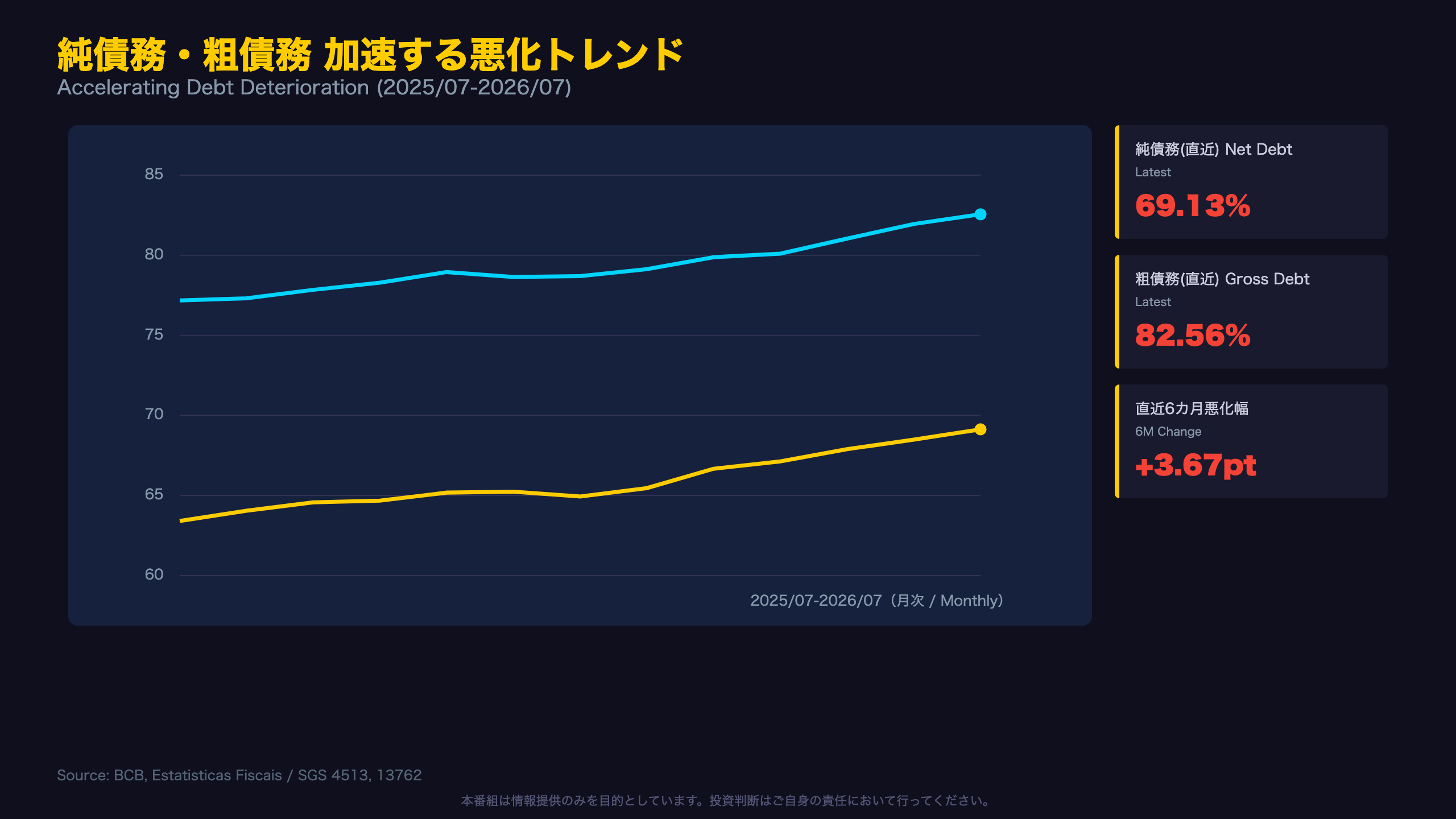
Inside Brazil’s Accelerating Debt Trajectory
Looking at the monthly progression of net public debt (DLSP), the deterioration is not linear but appears to have shifted gears. Through late 2025, the rise was gradual (roughly +0.15pt/month), but March 2026 saw a sharp one-month jump of +1.21 points, followed by a steady 0.4-0.7pt monthly climb since.
For international readers: what is DLSP?
DLSP (Dívida Líquida do Setor Público) is Brazil’s net public sector debt—broadly comparable to the US federal debt held by the public, but netted against the central bank’s FX reserves and government financial assets. It differs from “gross debt” (Dívida Bruta), which is closer to the headline figure used in most international debt/GDP comparisons (e.g., IMF data).
The pace of expansion in reais
In absolute terms, net debt grew from R$7.85 trillion in July 2025 to R$9.17 trillion in July 2026—an increase of R$1.31 trillion, roughly comparable in scale to Argentina’s entire annual GDP.
Market implications
For holders of Brazilian sovereign debt (NTN-B, Global Bonds) or BRL-denominated assets, an accelerating debt/GDP trajectory historically correlates with wider risk premiums and elevated long-term real interest rates, though causality runs both ways given Brazil’s already-high Selic rate environment.
The gap between gross (82.56%) and net (69.13%) debt—about 13.4 points, reflecting FX reserves—has stayed roughly stable, suggesting reserves have not been drawn down to offset the debt build-up.
高金利のコスト:名目赤字はGDP比9%台高止まり
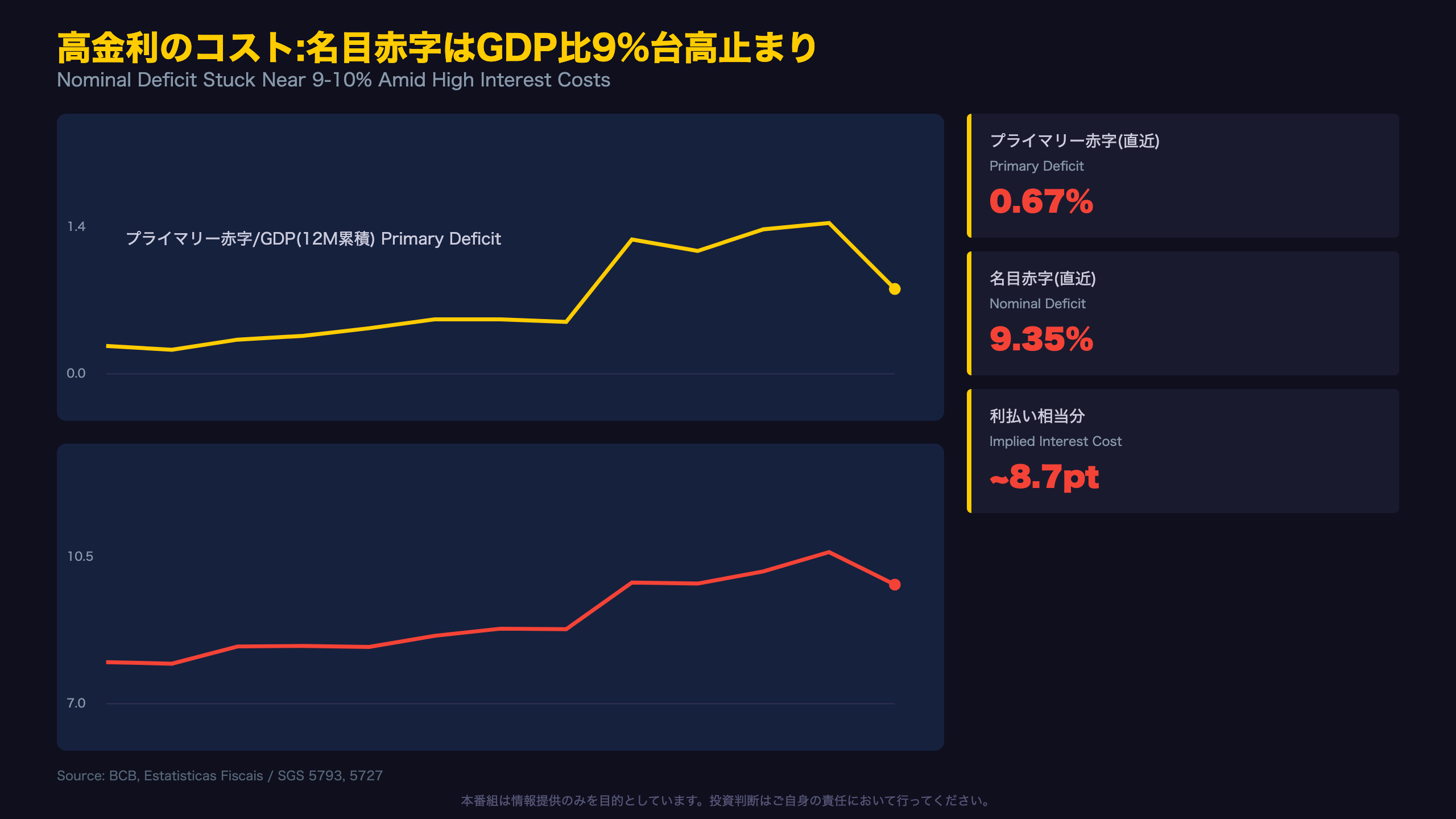
Primary vs. Nominal: What Brazil’s Twin Deficits Reveal
In BCB’s fiscal data convention, a positive value represents a deficit (financing need). Reading the data this way, the primary deficit (12-month cumulative, % of GDP) widened steadily from 0.22% in July 2025 to a peak of 1.19% in June 2026, before narrowing to 0.67% in July.
Sizing up the interest burden
The gap between the nominal and primary deficit is effectively the interest bill on Brazil’s debt stock.
| Period | Primary Deficit | Nominal Deficit | Interest Cost (implied) |
|---|---|---|---|
| Jul 2025 | 0.22% | 7.82% | 7.60pt |
| Jun 2026 | 1.19% | 9.99% | 8.80pt |
| Jul 2026 | 0.67% | 9.35% | 8.68pt |
International comparison
An implied interest cost of 8.6-8.8% of GDP is exceptionally high by global standards. For comparison, US federal net interest payments run around 3% of GDP even amid recent rate hikes—less than half Brazil’s burden. This gap largely reflects Brazil’s persistently elevated Selic policy rate, historically among the highest real rates in major emerging markets.
Bull vs. bear read
Bull case: The primary deficit’s narrowing in July could signal early traction from fiscal discipline efforts under Brazil’s fiscal framework.
Bear case: As long as the nominal deficit sits near 9-10% of GDP, debt is likely to keep growing faster than nominal GDP, absent a meaningful drop in Selic.
The trajectory of Selic rates remains the single biggest swing factor for this interest burden going forward.
7月の改善シグナル、単月変動の危うさ
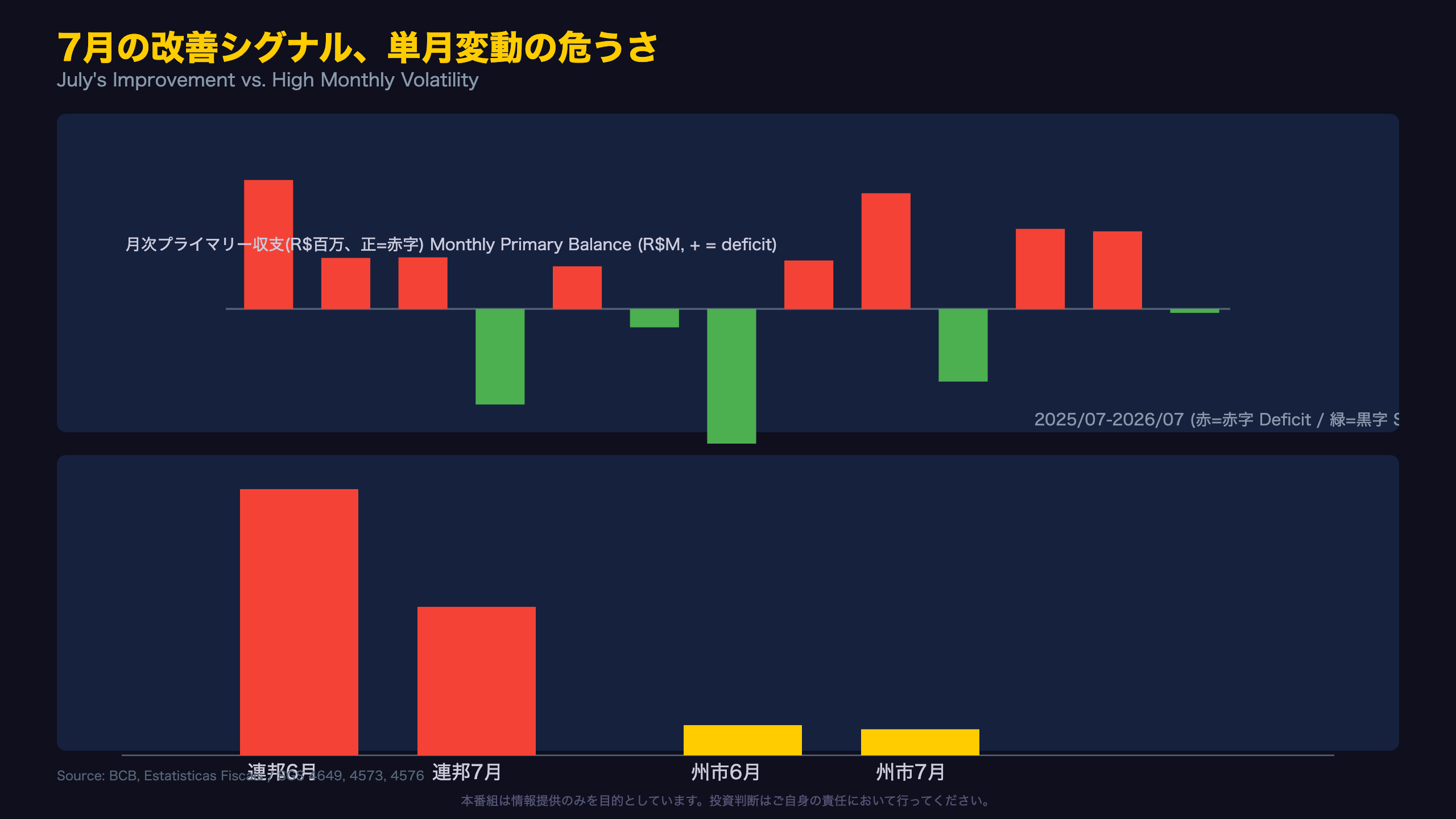
Monthly Volatility and the Federal-vs-Local Breakdown
Lining up Brazil’s monthly primary balance figures (R$ million, positive = deficit) reveals just how seasonal and volatile this data can be.
| Month | Primary Balance (R$M) |
|---|---|
| Jan 2026 | -103,689 (surplus) |
| Mar 2026 | +80,676 (deficit) |
| Jun 2026 | +55,313 (deficit) |
| Jul 2026 | -1,361 (small surplus) |
January’s large surplus likely reflects Brazil’s income tax (IRPF) collection cycle—a seasonal pattern common in many countries’ fiscal calendars, similar to the US Treasury’s April tax-season surplus effect. Given this seasonality, treating July’s small surplus as a genuine “trend reversal” would be statistically premature.
Federal government vs. subnational governments
July’s improvement came almost entirely from the federal government plus central bank segment, whose deficit shrank from R$147.7 billion in June to R$81.8 billion. State and municipal finances, by contrast, stayed essentially flat (R$16.2 billion to R$14.0 billion deficit)—suggesting Brazil’s often-volatile subnational finances were not the driver this time.
What to watch next
The next SGS data update (August figures, expected around late October) will be key. Because August and September carry less seasonal distortion than January, sustained improvement in those months would carry more weight as evidence of a genuine fiscal turn—relevant for anyone tracking Brazil’s risk premium on sovereign bonds or the BRL.
債務スノーボール:赤字縮小でも比率悪化が続く矛盾
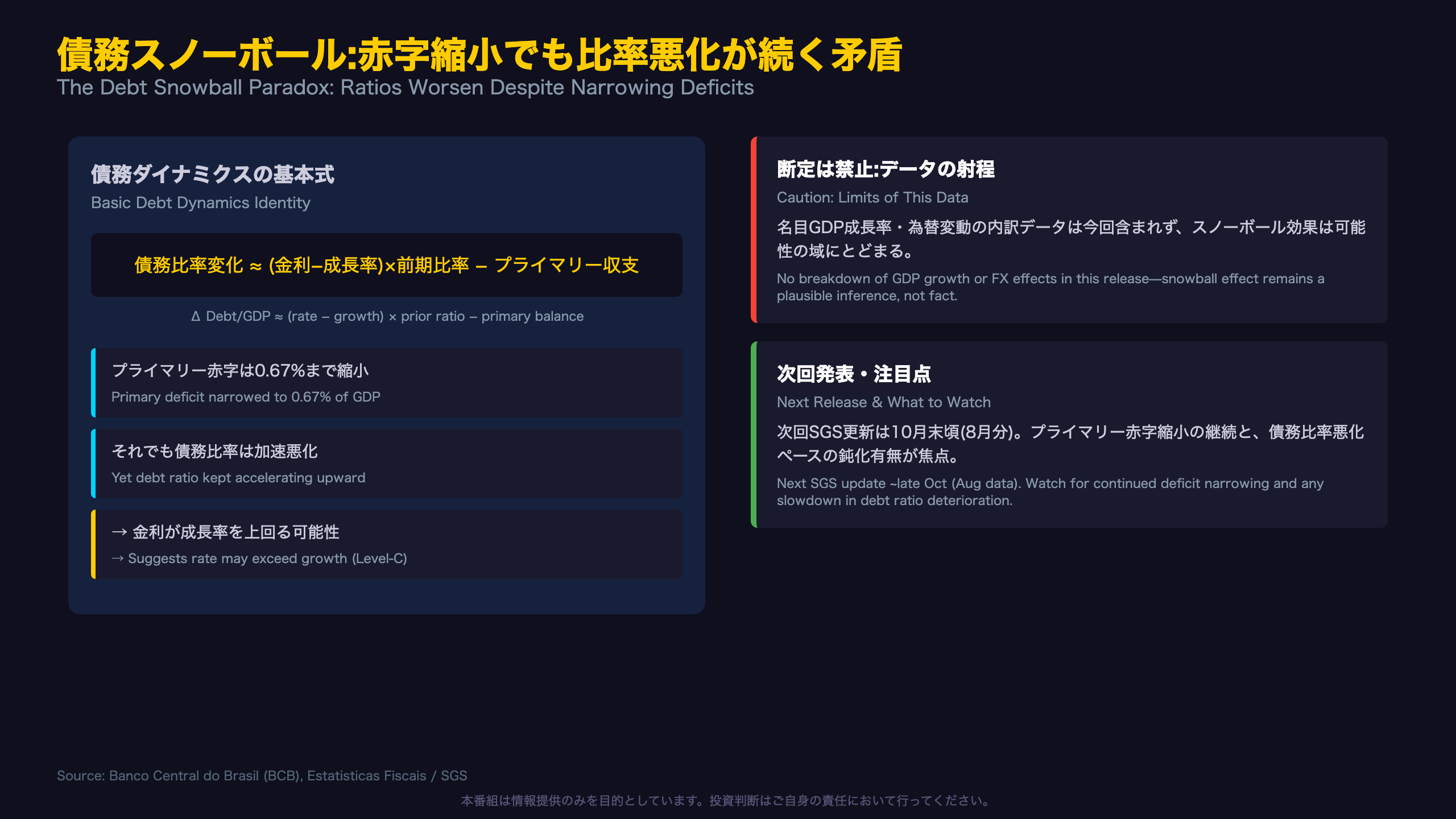
The Debt Snowball Puzzle: Why Ratios Worsen Even as Deficits Narrow
The most striking structural feature in this month’s data is that fiscal deficits (a flow measure) are narrowing while debt ratios (a stock measure) keep deteriorating—and at an accelerating pace.
The accounting behind debt dynamics
Simplifying the standard debt dynamics identity used by economists (including at the IMF and BIS):
Change in debt/GDP ≈ (nominal interest rate − nominal GDP growth) × prior debt ratio − primary balance (surplus reduces the ratio) + FX/inflation valuation effects
The fact that the primary deficit has narrowed to just 0.67% of GDP while the debt ratio keeps climbing suggests the “interest rate minus growth” term in this equation remains substantially positive. In plain terms: Brazil’s elevated Selic rate may be outpacing nominal GDP growth (real growth plus inflation), causing the debt stock to compound on its own—a classic “debt snowball.”
Why this is Level-C, not Level-A, analysis
Today’s dataset does not include nominal GDP growth figures, FX rate movements, or inflation-accounting adjustments needed to decompose this identity precisely. So while a debt snowball effect appears plausible given the data pattern, it cannot be confirmed as fact from this release alone—this is an inference, not a stated conclusion in the source data.
Market context for international investors
For context, debt-snowball dynamics historically preceded credit rating pressure in several emerging markets (e.g., South Africa, Argentina in past cycles). Brazil’s investment-grade-adjacent rating makes this trajectory worth monitoring, though Brazil’s deep domestic capital market and primarily local-currency debt profile differ meaningfully from historical EM debt crisis cases.
What comes next
The next SGS release (August data, expected late October) will be telling on two fronts: whether July’s primary deficit narrowing persists, and whether the debt ratio’s monthly climb (recently over +0.6pt) shows any signs of deceleration.
Disclaimer: This article is for informational purposes only. All investment decisions are made solely at your own risk.