📺 Watch the Full Video Analysis
This article was automatically generated by the NFC Market Live AI analysis system. (Updated: 2026-09-11 11:55 JST)
📄 Primary Source
財務省
https://www.mof.go.jp/pri/reference/bos/results/siryou202602.pdf
Deep dive into Japan’s Ministry of Finance Corporate Business Sentiment Survey (BSI), Q3 FY2026 📊
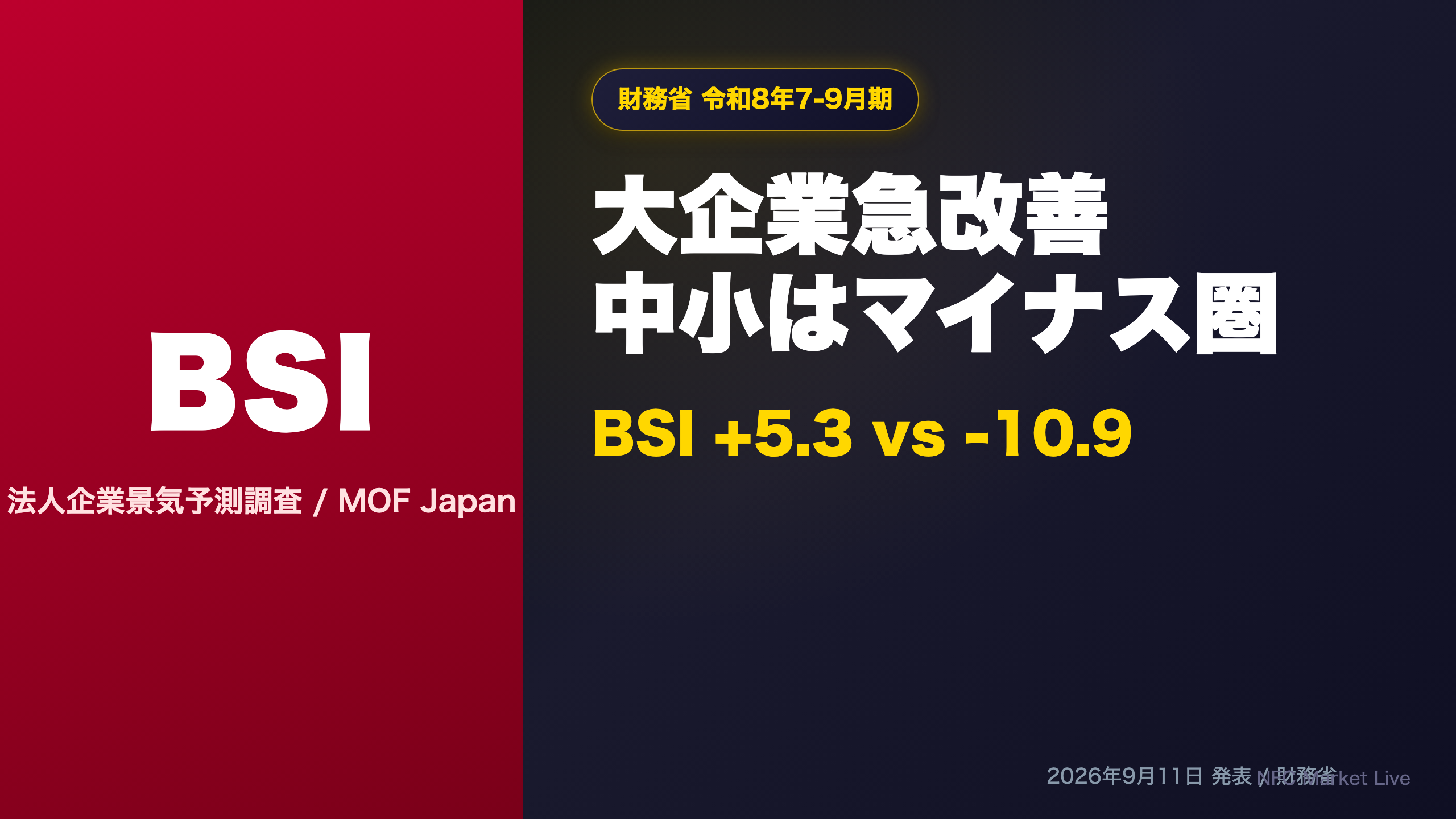
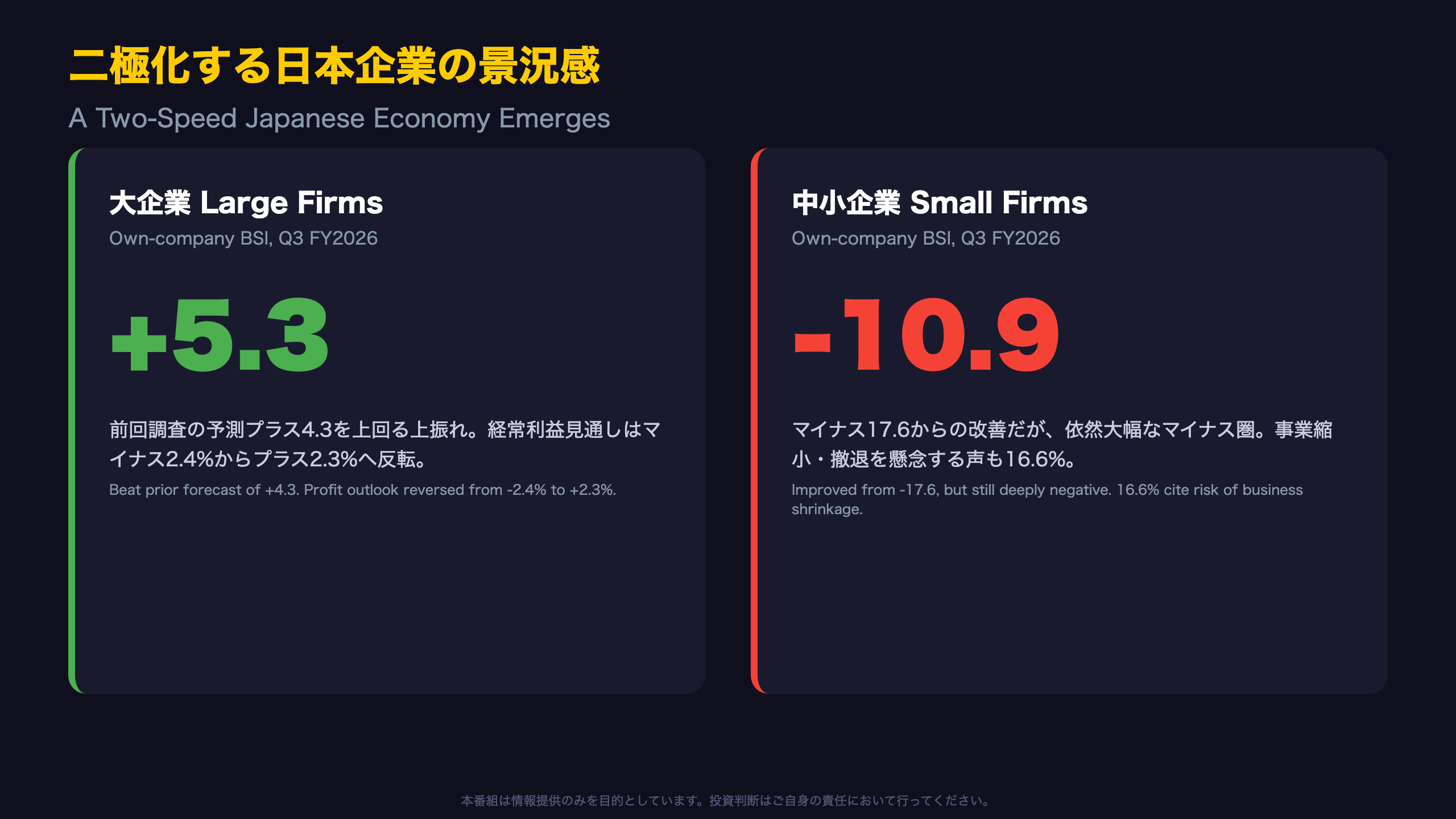
Large-company sentiment BSI jumped from -0.5 to +5.3, beating the prior forecast of +4.3. Ordinary profit outlook swung from -2.4% to +2.3% YoY — a dramatic reversal 📈
But small businesses remain deeply negative at -10.9, with 16.6% citing risk of business shrinkage or exit due to labor shortages, versus just 4.7% for large firms ⚠️
We break down the two-speed Japanese economy hidden inside this data, and what it means for BOJ policy. Next survey due in December.
二極化する日本企業の景況感
About the Survey
Japan’s Ministry of Finance (MOF) conducts the Corporate Business Sentiment Survey (BSI) quarterly, tracking business conditions, capex, and employment judgments across roughly 15,000 firms. Alongside the Bank of Japan’s Tankan survey, it is one of the most closely watched leading indicators of Japanese corporate health. This edition covers Q3 FY2026 (July-September), released September 11, 2026.
Behind the Headline Numbers
The large-firm sentiment BSI rose from -0.5 in Q2 to +5.3 in Q3, a 5.8-point swing that beat the prior survey’s own forecast of +4.3 — a genuine upside surprise. Even more striking, the FY2026 ordinary profit outlook for all firm sizes reversed direction entirely, from a forecast decline of -2.4% to a projected gain of +2.3% year-on-year.
The Gap Investors Should Watch
However, this improvement is far from uniform. Small business sentiment only moved from -17.6 to -10.9, remaining firmly in negative territory. For context, US equivalents like the NFIB Small Business Optimism Index tend to move in narrower ranges; Japan’s BSI methodology (measuring net “improved minus worsened” respondents) can produce much larger swings.
Market Implications
For yen and JGB traders, the large-firm strength is a data point supporting the BOJ’s normalization narrative, while SME weakness is a counterargument for gradualism. The next survey is due around December 2026.
規模別BSIの推移:広がる格差
SME Sentiment in Historical Context
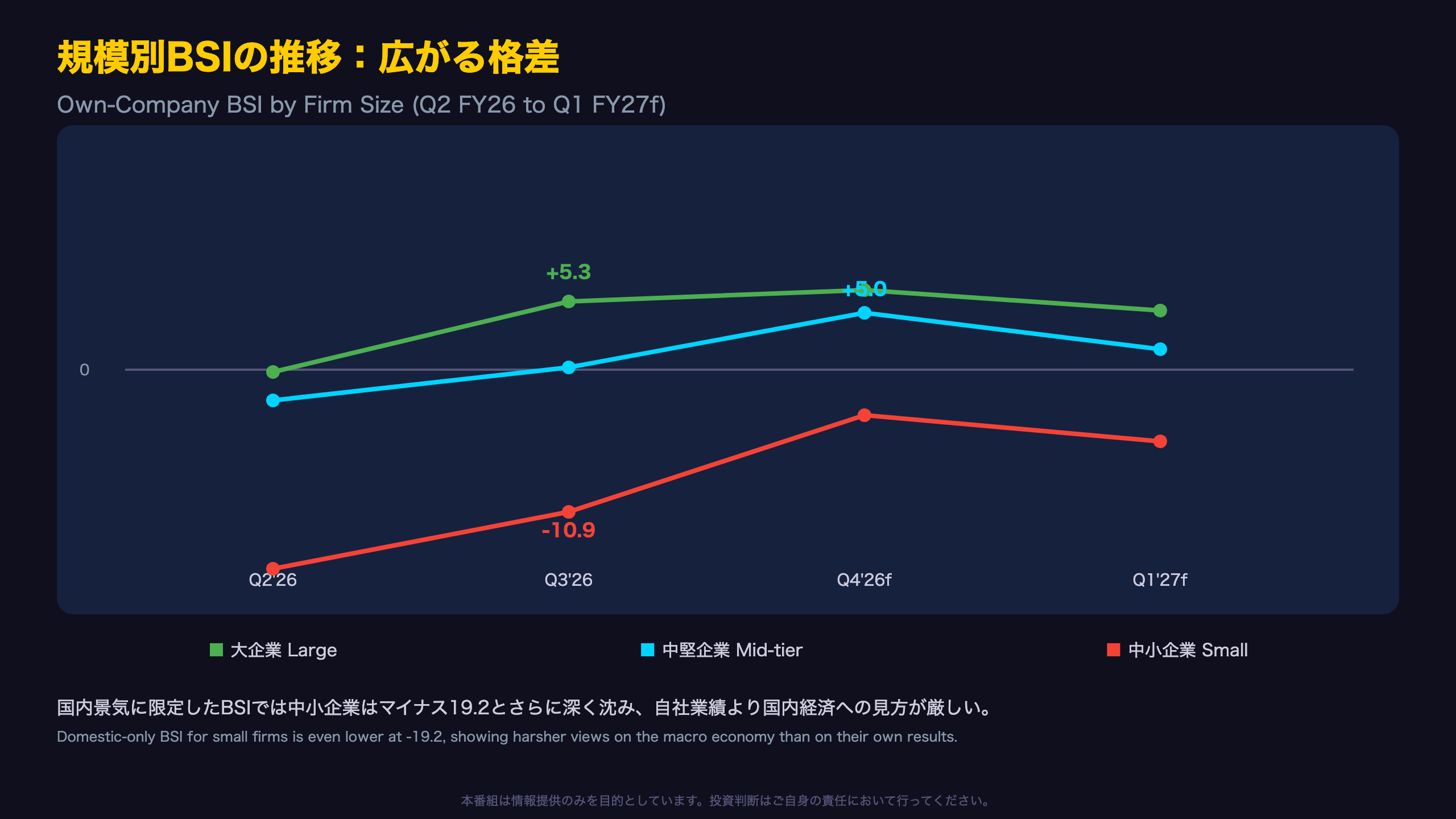
At -10.9, small-firm sentiment is far from crisis territory. The historical time series shows SME BSI collapsing to -72.4 in Q1 2009 (post-Lehman) and -61.1 in Q2 2020 (COVID). Today’s reading, while still negative, sits well above those troughs — but the gap versus large firms (+5.3) is what makes this quarter’s release notable, not the absolute SME level itself.
Own-Company vs. Domestic Economy Views
A subtle but important nuance: small firms rate their own company’s BSI at -10.9, but rate the broader domestic economy (国内の景況判断) even lower, at -19.2 — an 8.3-point gap. Large firms show only a 2.4-point gap (+5.3 vs +2.9). This suggests smaller firms are notably more skeptical about Japan’s macro backdrop than about their own individual performance, a psychological or structural pattern worth monitoring.
Forward Path
Looking ahead, large firms are forecast to hold near +6.0 and +4.6 over the next two quarters, while small firms are projected at -2.8 then -6.4 — implying the improvement trend may partially reverse. This is a key data point for anyone modeling Japan’s SME credit risk or regional bank asset quality.
決算計画の急改善と隠れたねじれ
Beyond Sentiment: The Hard Numbers
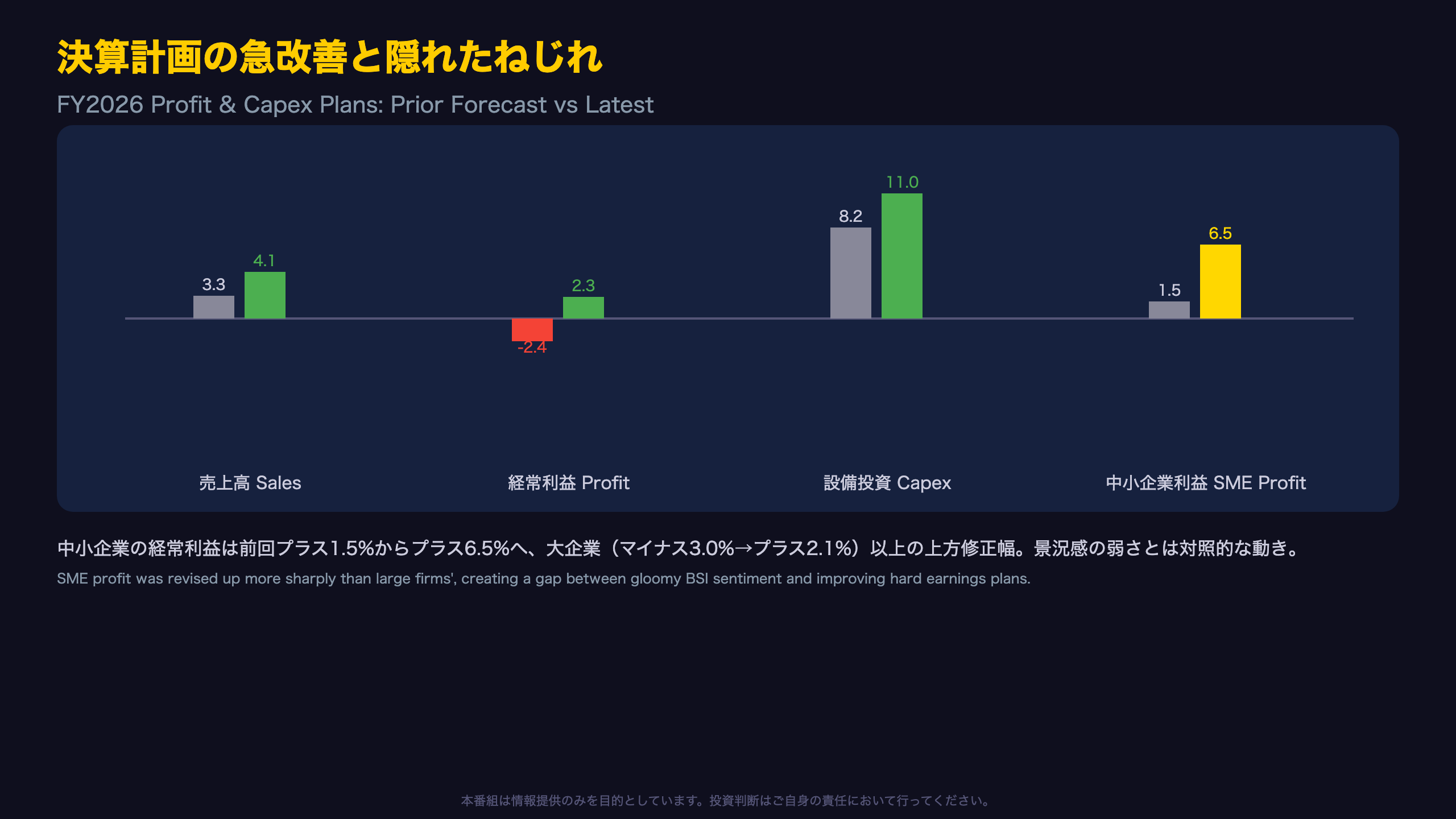
The survey’s quantitative section (計数編) reports actual planned yen amounts, distinct from the qualitative BSI diffusion index. For FY2026, all-size ordinary profit is now projected at ¥110.7 trillion, up 2.3% year-on-year — a full reversal from the prior survey’s forecast of -2.4%. Manufacturing alone swung from -4.7% to +5.8%, one of the largest directional reversals in the dataset.
The Hidden SME Strength
Here’s the twist most headlines will miss: small-firm profit growth was revised up to +6.5% (from +1.5%), outpacing large firms’ +2.1% (from -3.0%). This creates a genuine disconnect — SME sentiment (BSI) remains negative, but SME hard profit plans are improving faster than large companies’. For investors modeling regional bank exposure or SME credit risk, this divergence between soft sentiment and hard numbers is a signal worth tracking closely.
Capex Still Lagging for SMEs
Capital expenditure (including software, excluding land) is now projected at +11.0% for all firms (up from +8.2%), but small firms remain in contraction at -2.4% (albeit improved from -9.2%). This is calculated from a consistent panel of companies that responded in both FY2025 and FY2026 surveys, per the source methodology notes.
What’s Next
The December survey will show whether this profit-plan strength eventually filters through into improved SME sentiment readings.
人手不足という共通課題、二極化する対応力
A Structural, Not Cyclical, Problem
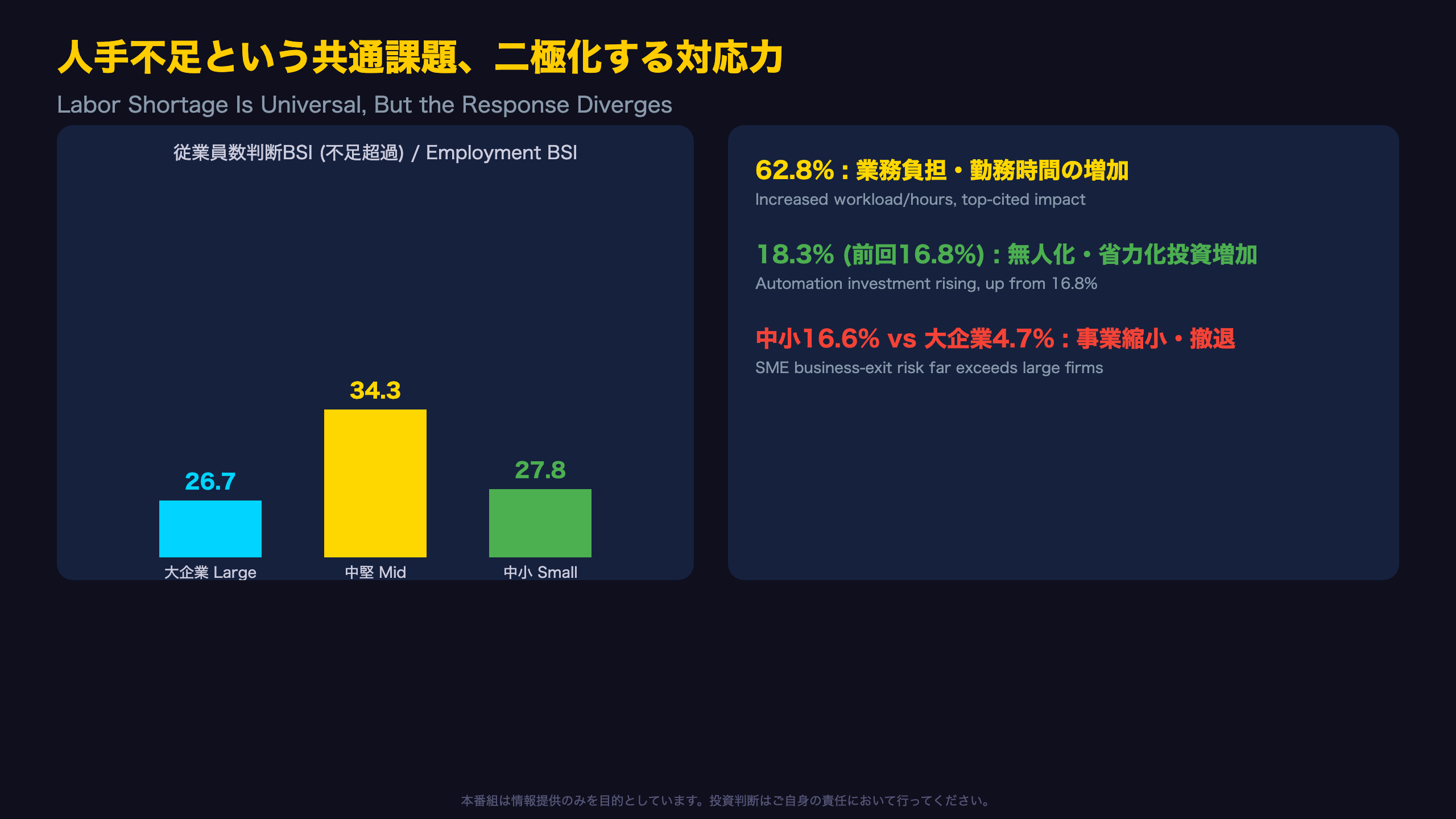
The employment BSI (net “shortage minus surplus”) sits at +26.7 for large firms, +34.3 for mid-tier, and +27.8 for small firms in Q3 FY2026 — all firmly in shortage territory. Cross-referencing the historical time series (Reference Table 4), this reading has stayed persistently positive for roughly a decade, confirming Japan’s labor crunch is structural rather than a temporary cyclical blip — a key distinction versus, say, the post-pandemic US labor market normalization.
Diverging Responses by Size
Asked how labor shortages affect management, 18.3% of all firms (up from 16.8%) now cite rising automation/labor-saving investment — evidence companies are responding productively. But the ability to make that choice varies sharply by size: only 4.7% of large firms and 7.7% of mid-tier firms cite risk of business contraction or exit, versus 16.6% of small firms.
Cross-Checking with Capex Data
This pattern lines up with capex breakdown data: production/sales machinery equipment was the top-ranked capex priority for large manufacturers (66.6% cited it as their #1 investment target), consistent with automation-driven investment.
Why This Matters for Policy and Credit Markets
For BOJ watchers, rising automation capex driven by labor scarcity supports the case that wage-cost pressures remain embedded in the corporate sector — a hawkish-leaning data point. For credit analysts and regional bank investors, the 16.6% SME exit-risk figure is a tangible early-warning indicator worth tracking each quarter.
業種の振れ幅とコスト圧力、そして日銀への含意
Sector-Level Volatility
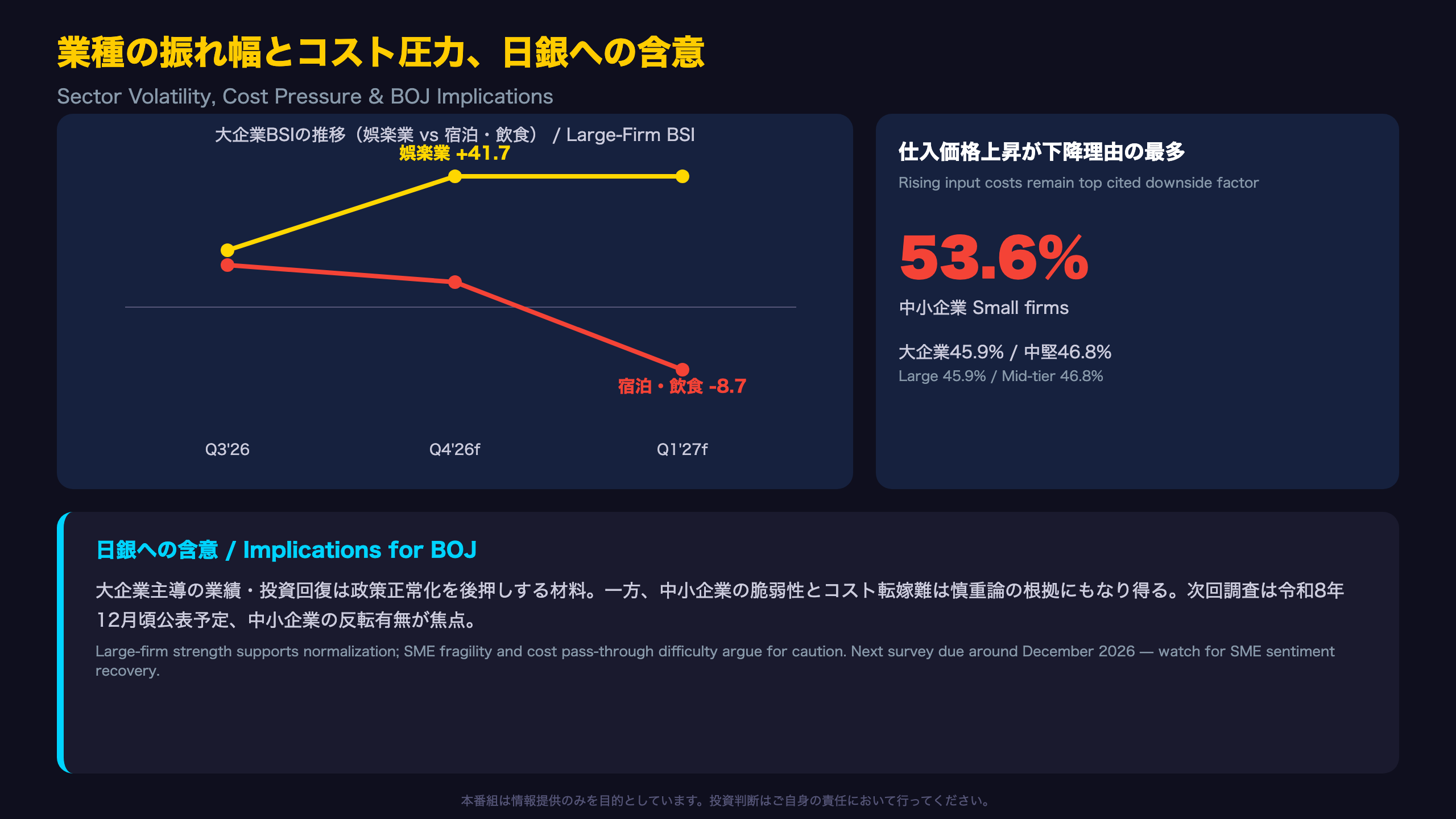
Breaking down the industry data (Table 1-2), large-firm entertainment/leisure BSI jumped from +25.0 in Q3 to a forecast +41.7 in Q4, holding at +41.7 into Q1 2027 — an unusually strong and persistent reading. In sharp contrast, accommodation and food services swing from +17.0 in Q3 to +10.6 in Q4, then a forecast -8.7 in Q1 2027 — a dramatic reversal that may reflect inbound tourism or seasonal factors, though a single sector/single quarter data point cannot support a definitive causal claim.
SME Sector Weakness Persists
Among small firms, retail BSI sits at -21.8 (improved from -31.9 previously) and wholesale at -16.3 (from -17.2). Both show improving trends but remain in clearly negative territory — a reminder that SME retail and distribution channels are still under real pressure.
The Common Thread: Input Costs
Across the “reasons for downward judgment” data (Table 1-3), rising input/purchase prices (仕入価格) remain the single largest cited factor for pessimism: 53.6% for small firms, 45.9% for large firms, 46.8% for mid-tier. This cost-push dynamic has persisted across survey waves, suggesting pass-through difficulties remain a live issue for Japanese corporates of all sizes — relevant context for anyone tracking Japan’s CPI and wage-price spiral debate versus the Fed’s more services-driven inflation dynamics.
What This Means for BOJ Watchers
Large-firm profit and capex strength is a data point supporting the BOJ’s policy normalization case. SME fragility and persistent cost pass-through difficulty argue for a gradual approach. The next survey release is expected around December 2026, with SME sentiment recovery and input cost trends the key variables to watch.
Disclaimer: This article is for informational purposes only. All investment decisions are made solely at your own risk.