📺 Watch the Full Video Analysis
This article was automatically generated by the NFC Market Live AI analysis system. (Updated: 2026-09-02 11:24 JST)
📊 The Reserve Bank of New Zealand (RBNZ) hiked its Official Cash Rate by 25bp to 2.75%, the second consecutive increase.
📈 The key surprise: actual June-quarter inflation hit 4.1%, overshooting RBNZ’s own July forecast of 3.9%.
⚠️ Inside the committee, the number of members flagging upside inflation risk grew from 2 to 4 — including Chair Anna Breman.
💡 Meanwhile exports remain strong while Auckland and Wellington face job insecurity and weak consumption — a widening K-shaped recovery.
Next watch point: whether Q3 GDP confirms the expected broadening recovery.
タカ派ハイク、しかしインフレは想定超え
New Zealand’s Central Bank Hikes Again — But Inflation Beat Its Own Forecast
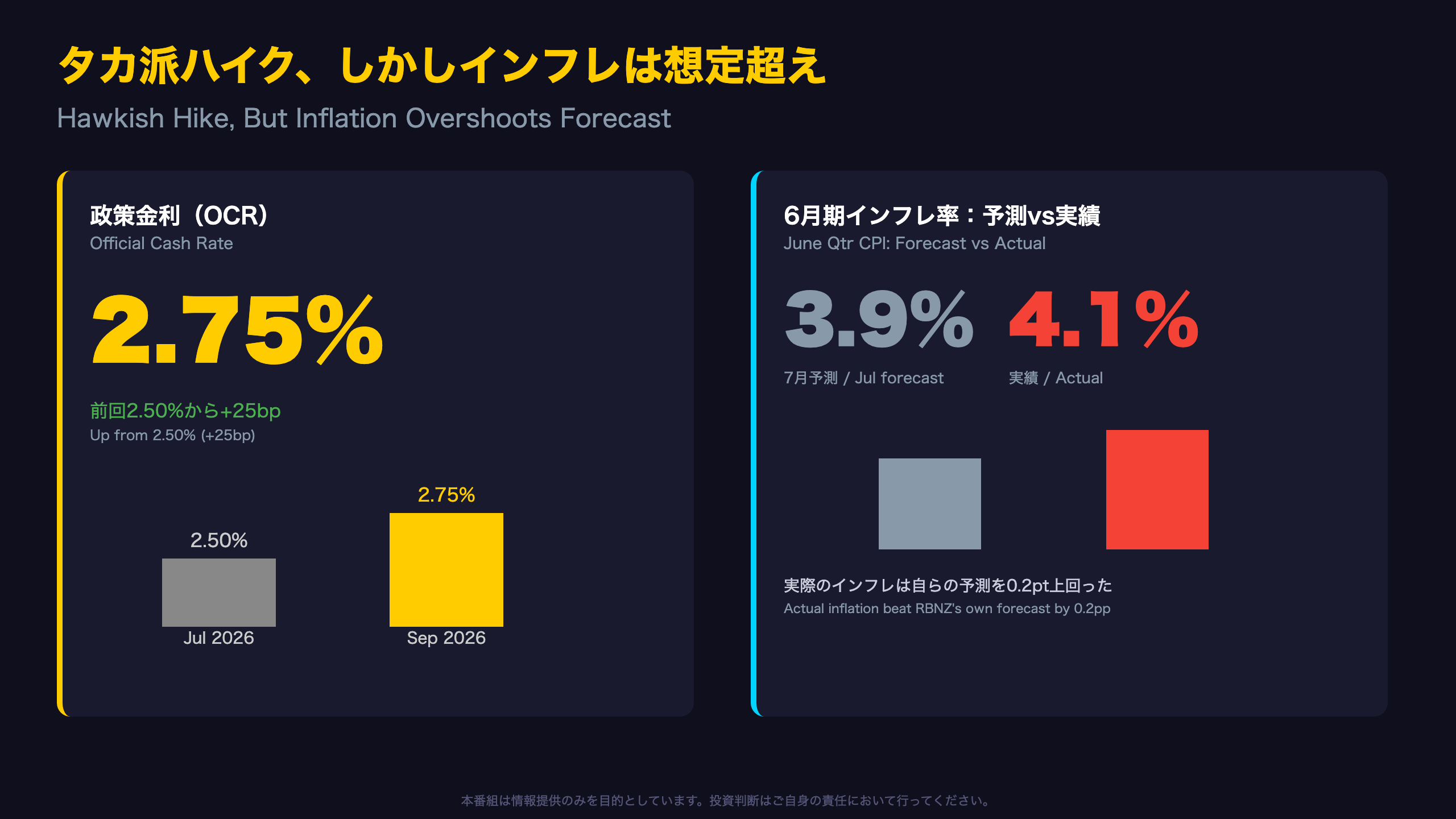
The Reserve Bank of New Zealand (RBNZ) — New Zealand’s equivalent of the US Federal Reserve — raised its Official Cash Rate (OCR, the RBNZ’s benchmark policy rate) by 25 basis points to 2.75% on September 2, 2026. This marks the second consecutive hike, continuing a tightening cycle that began in the second half of 2025.
The more striking detail: actual June-quarter inflation came in at 4.1%, overshooting the RBNZ’s own July forecast of a 3.9% peak. The statement attributes this to “higher fuel prices arising from the conflict in the Middle East.” For US-based readers, this is roughly comparable to a central bank’s own inflation projection missing within just two months — a meaningful credibility test for the forecasting process itself.
Importantly, core CPI excluding fuel came in at 2.9%, still inside the RBNZ’s 1-3% target band, offering a more benign read than the headline suggests. The RBNZ maintains that “core inflation, expected wage growth, and inflation expectations remain consistent with inflation returning to target.”
For currency markets, an inflation overshoot alongside continued hikes is typically NZD-supportive, though New Zealand’s small, export-heavy economy remains highly sensitive to global commodity swings. The next data point to watch is Q3 GDP.
文言の逆転:「緩和」から「引き締まった」へ
From ‘Eased’ to ‘Tightened’: A Two-Month Reversal in Language
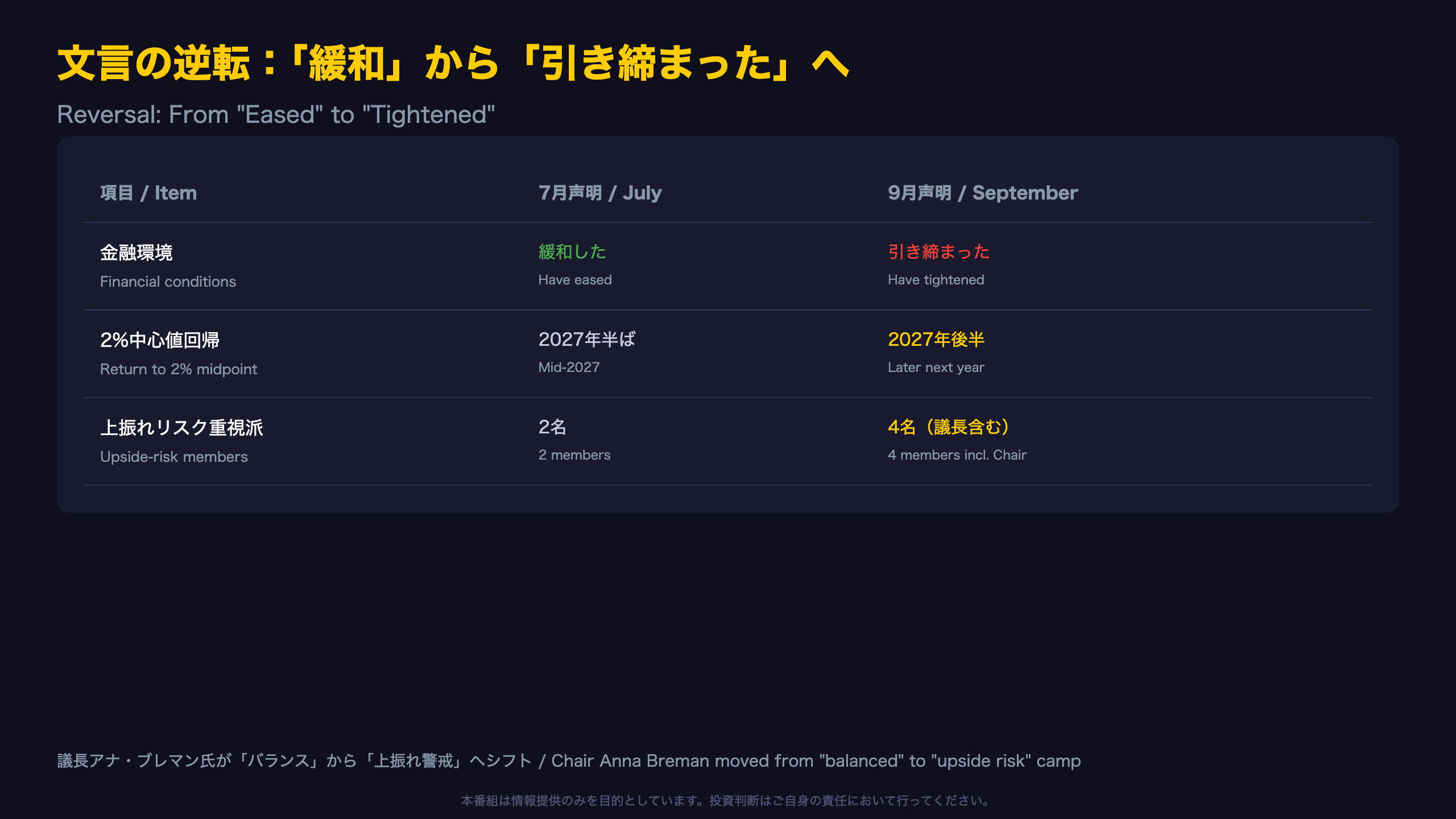
The most striking textual shift concerns financial conditions. July read “domestic financial conditions have eased”; September flips this entirely: “Domestic financial conditions have tightened in recent months.”
This stems from rising wholesale interest rates feeding through into higher mortgage and business lending rates. Notably, the Committee flagged that pass-through to term deposit rates has lagged, noting “a greater pass through to deposit rates would be more consistent with the desired stance and transmission of monetary policy” — an admission that policy transmission isn’t fully working as intended, echoing deposit-beta debates seen during Fed hiking cycles.
Equally important is a subtle delay in the inflation timeline. July stated the midpoint return would occur by “mid-2027.” September separates this into two steps: the 1-3% band by mid-2027, with the 2% midpoint reached only “later next year” — effectively pushing out full normalization.
The Committee’s internal risk balance also shifted hawkish: in July, only two members (Prasanna Gai, Hayley Gourley) saw upside inflation risks; by September that group expanded to four, now including Chair Anna Breman. Only Paul Conway and Carl Hansen remain in the ‘balanced risk’ camp.
広がる二極化:輸出は堅調、内需は不調
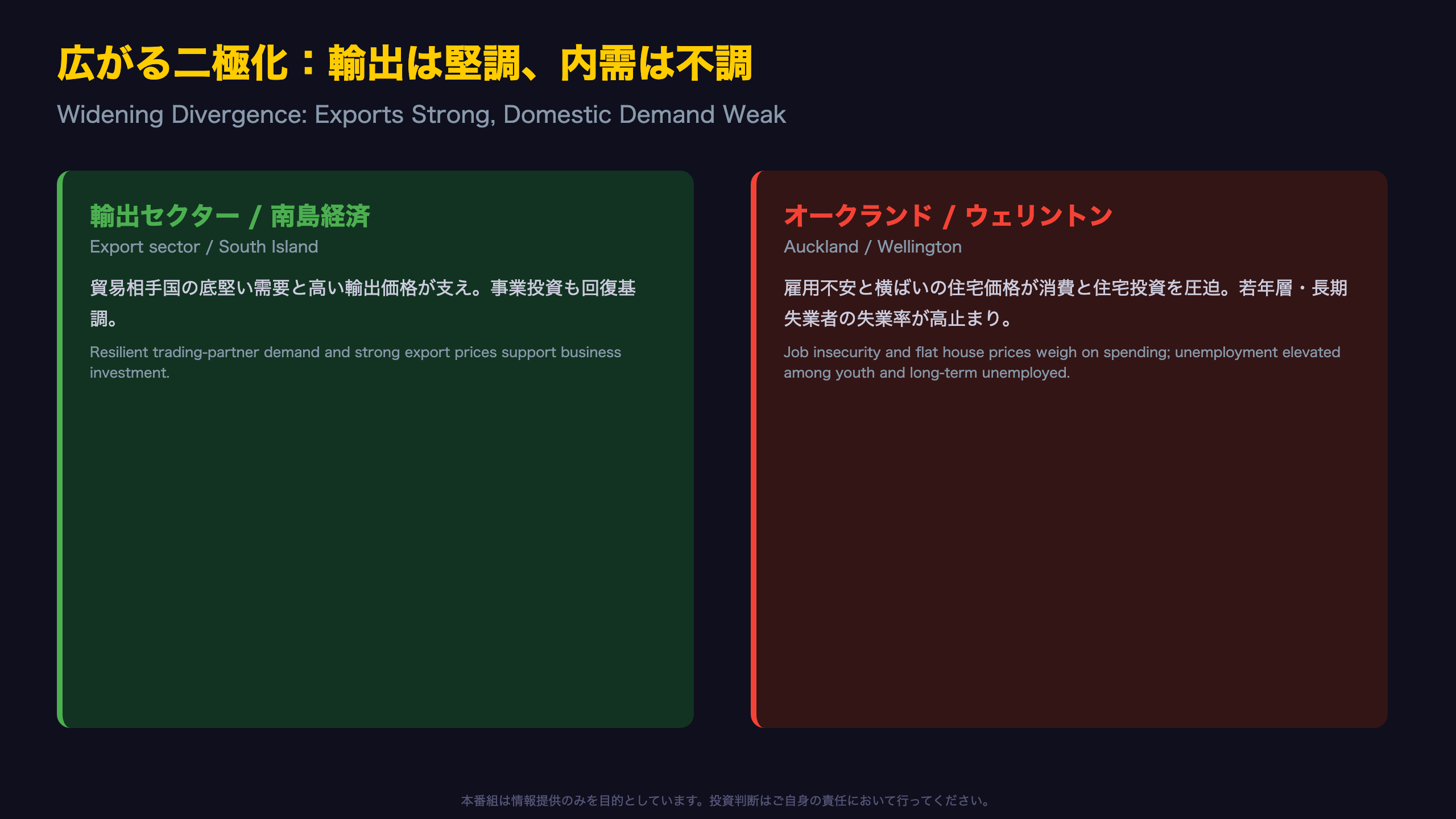
Strong Exports, Weak Domestic Demand: A Widening K-Shaped Recovery
September’s meeting record paints a sharper picture of economic divergence than July’s. Export-exposed sectors and regions — particularly the South Island and parts of the North Island — are benefiting from resilient trading-partner demand and elevated export prices, feeding through into stronger business investment.
By contrast, Auckland and Wellington — New Zealand’s two largest urban centers — face elevated unemployment, with the Committee specifically noting the impact falls hardest on “youth and the long-term unemployed.” The statement acknowledges that “employment growth has not been sufficient to fully absorb new entrants into the labour market.”
Household behavior reflects this unevenness: job insecurity and falling real house prices are driving “precautionary behaviour,” pushing household savings rates higher while consumption growth stays weak. Strong growth in dwelling consents has “not yet translated into residential construction nationwide” — a supply-pipeline disconnect worth watching for construction-linked equities.
This divergence explains why the RBNZ continues to see “spare capacity” in the labor market even as headline inflation runs hot — a nuance that matters for how aggressively the bank tightens further.
利上げサイクルの行方
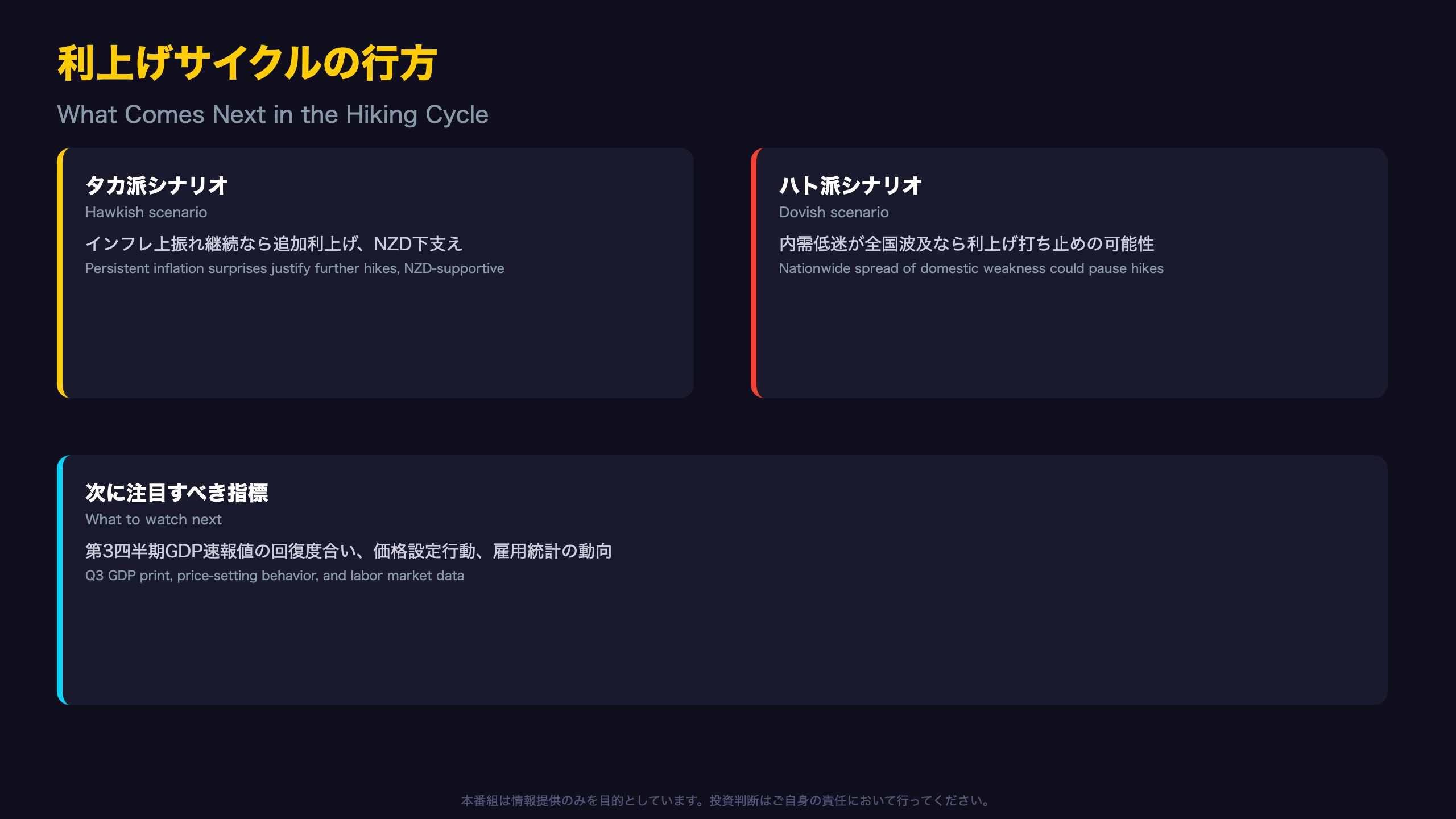
What Comes Next in RBNZ’s Tightening Cycle
With this 25bp move, the RBNZ has delivered two consecutive hikes. The statement notes that “conditional on the central economic outlook, members judged that the OCR may need to increase further” — leaving the door open for additional tightening, echoing a Fed-style “higher for longer” signal.
However, the RBNZ explicitly cautions that “the future OCR path is not pre-determined,” preserving full data-dependency rather than committing to a fixed trajectory.
Both bullish and bearish readings are plausible. In the hawkish scenario, persistent inflation surprises justify further hikes, providing ongoing NZD support. In the dovish scenario, weakness in Auckland and Wellington spreads nationally, and the Committee — which unanimously agreed “downside risks to activity were significant” — pauses tightening sooner than markets expect.
No specific date for the next Monetary Policy Review is given in this statement. The next key data points to watch are the Q3 GDP print, alongside employment and price-setting behavior data.
Disclaimer: This article is for informational purposes only. All investment decisions are made solely at your own risk.