📺 Watch the Full Video Analysis
This article was automatically generated by the NFC Market Live AI analysis system. (Updated: 2026-07-24 01:55 JST)
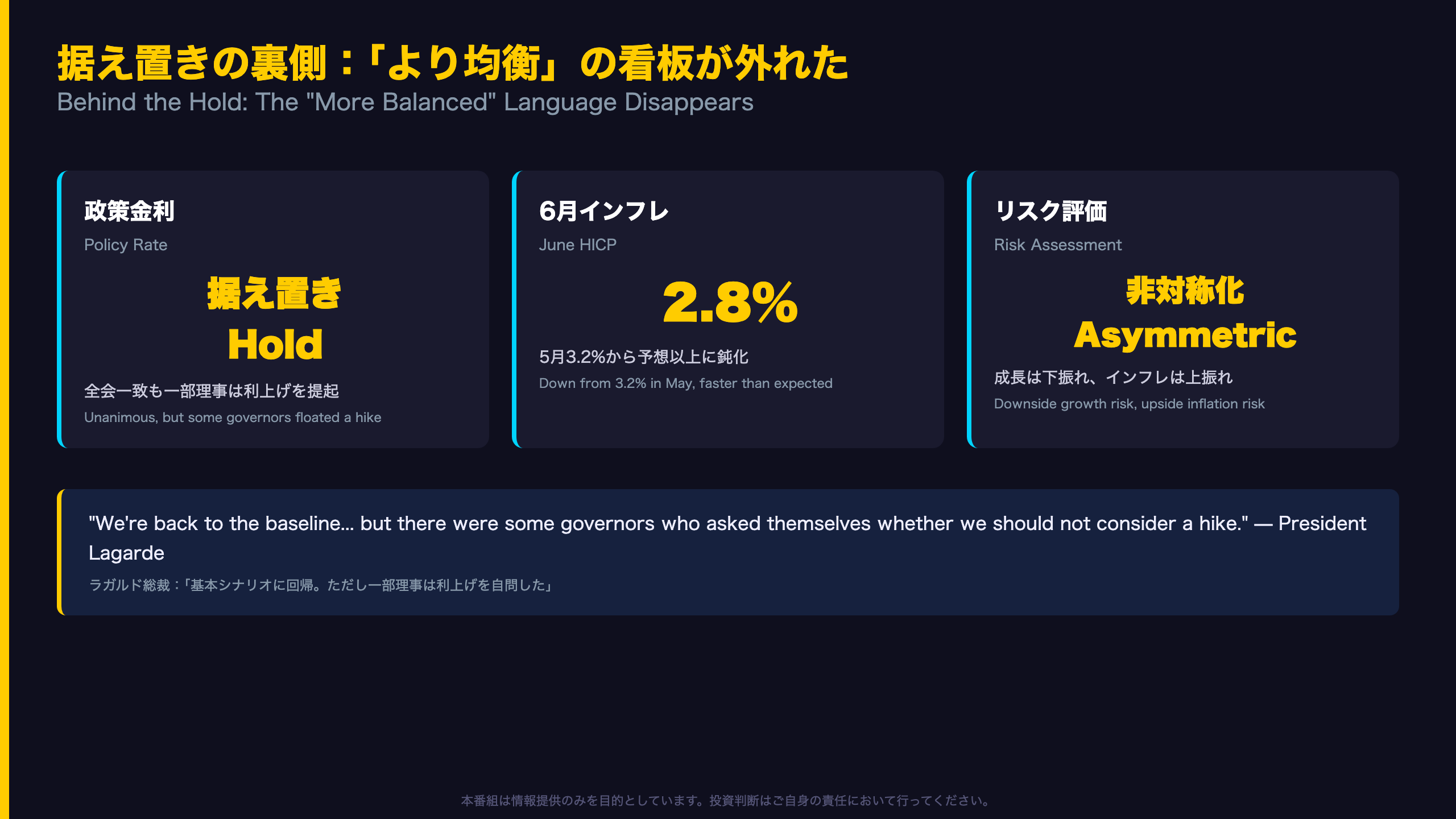
The ECB unanimously held rates steady — but President Lagarde revealed some Governing Council members actually pushed for a hike. 📊
June inflation eased to 2.8% from 3.2%, faster than expected, while the statement quietly dropped ‘more balanced’ risk language in favor of an asymmetric outlook. ⚠️
We break down the Red Sea tensions, the Middle East energy shock, and the data roadmap to September’s ‘live’ meeting. 🎙️📉
据え置きの裏側:「より均衡」の看板が外れた
Behind the Unanimous Vote: A Hawkish Undercurrent
What didn’t make it into the ECB’s official press release is arguably the most newsworthy part of this event. When asked directly whether today’s decision was unanimous, President Lagarde offered a nuanced answer:
“Yes, it was a unanimous decision. But I’m going to qualify that because there were some governors who asked themselves whether we should not consider a hike.”
For readers unfamiliar with ECB structure: the “Governing Council” comprises the six-member Executive Board plus the governors of all 20 euro-area national central banks (e.g., Bundesbank, Banque de France). A “unanimous” hold decision doesn’t preclude internal debate — Lagarde’s admission is a meaningfully hawkish data point that a simple reading of the statement would miss.
The “Back to Baseline” Framing
Lagarde repeatedly used the phrase “we’re back to the baseline” — referencing the ECB’s June (Sintra) staff projections. Since June, the Council navigated a whipsaw: a US-Iran Memorandum of Understanding briefly cooled tensions and crude prices, only for the ceasefire to collapse and tensions to reignite, including a Houthi threat reported the very morning of this press conference.
The Roadmap to September
Lagarde detailed the data pipeline before the next meeting (September 10, Berlin): two inflation prints, Q2 GDP, two consumer expectations surveys, one compensation-per-employee reading, and two PMI releases. Her phrase “the burden of proof is on data” suggests September is a genuine “live” meeting.
「全会一致」の内実:利上げ論を巡る攻防

A Unanimous Vote With Visible Cracks
On the surface, a “hold” decision suggests a quiet meeting. But the real story emerged in the Q&A. When Reuters’ Francesco Canepa asked directly whether the decision was unanimous or whether a hike was discussed, Lagarde responded:
“Yes, it was a unanimous decision. But I’m going to qualify that because there were some governors who asked themselves whether we should not consider a hike.”
Handelsblatt’s Stefan Reccius pressed further, asking whether there had been a push for “front-loading” — a back-to-back rate hike. Lagarde corrected the word choice (“push is the wrong word”) but did not deny that the underlying debate existed among Council members representing the 20 national central banks.
“The Burden of Proof Is on Data”
Asked what threshold would trigger a September hike, Lagarde offered a characteristically terse answer: “the burden of proof is on data.” This signals that the sheer volume of incoming data will mechanically determine the September outcome, consistent with the ECB’s stated “meeting-by-meeting” approach rather than a pre-committed path.
インフレは予想以上に鈍化、しかしショックは道半ば
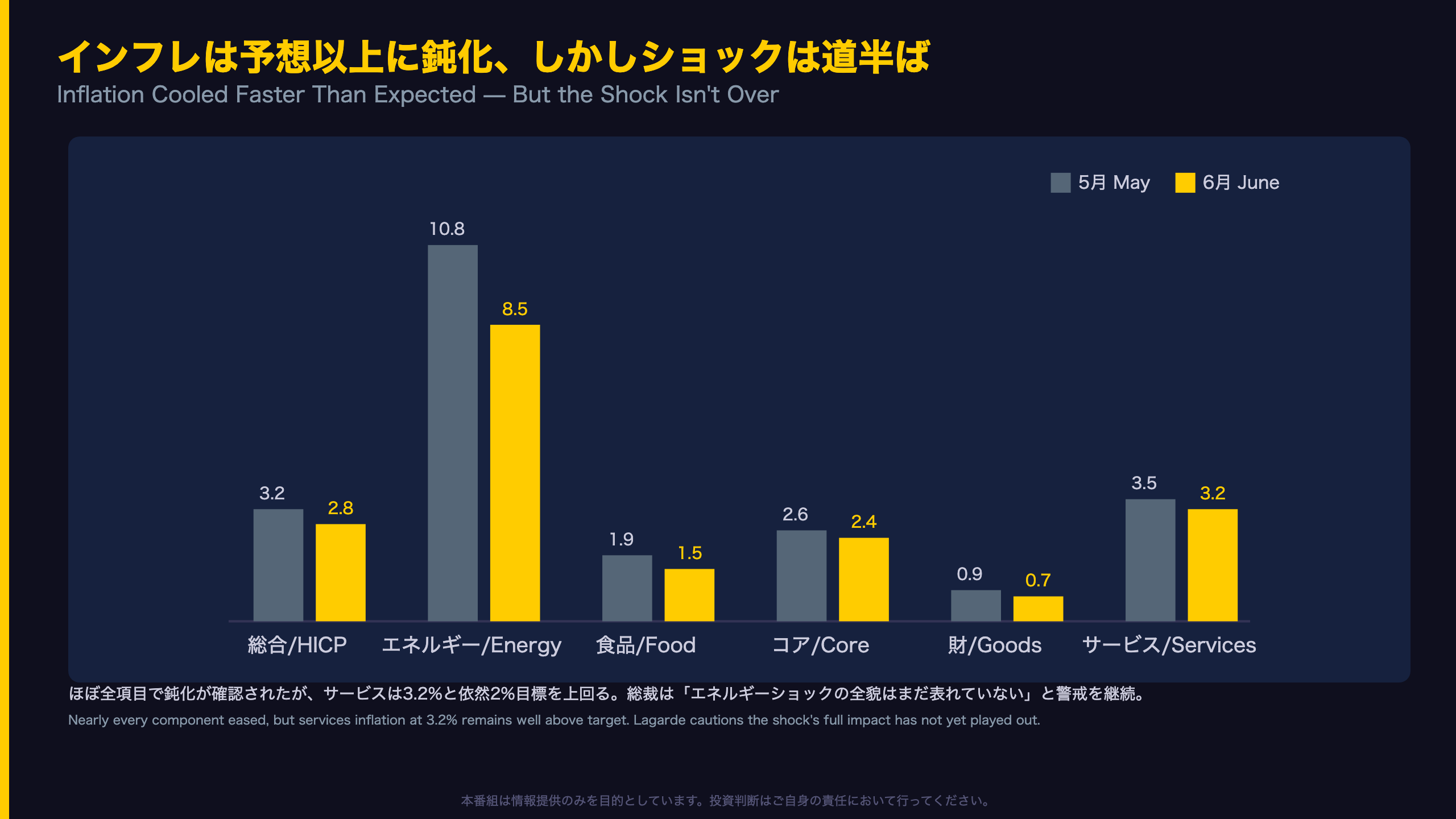
The Full Inflation Breakdown
The June inflation slowdown was broad-based, not confined to a single component:
| Component | May | June |
|---|---|---|
| Headline HICP | 3.2% | 2.8% |
| Energy | 10.8% | 8.5% |
| Food | 1.9% | 1.5% |
| Core (ex-energy, food) | 2.6% | 2.4% |
| Goods | 0.9% | 0.7% |
| Services | 3.5% | 3.2% |
Services inflation, at 3.2%, remains well above the ECB’s 2% target — a persistent feature of euro-area inflation dynamics comparable to the stickiness seen in US services inflation post-pandemic. Lagarde noted the ECB’s wage tracker and surveys continue to indicate moderate wage growth, with rising labor productivity helping contain unit labor cost growth. Compensation per employee (CPE), a key wage metric, fell to 3.5% from 3.8%.
However, Lagarde cautioned that the rise in energy prices since the conflict began is likely to keep inflation well above target into the first half of 2027 — meaning this June improvement should not be read as the start of a smooth disinflation glidepath. Longer-term inflation expectations remain anchored near 2%, which the ECB views as the critical stabilizer for its medium-term mandate.
「より均衡」の消失:非対称化するリスク認識
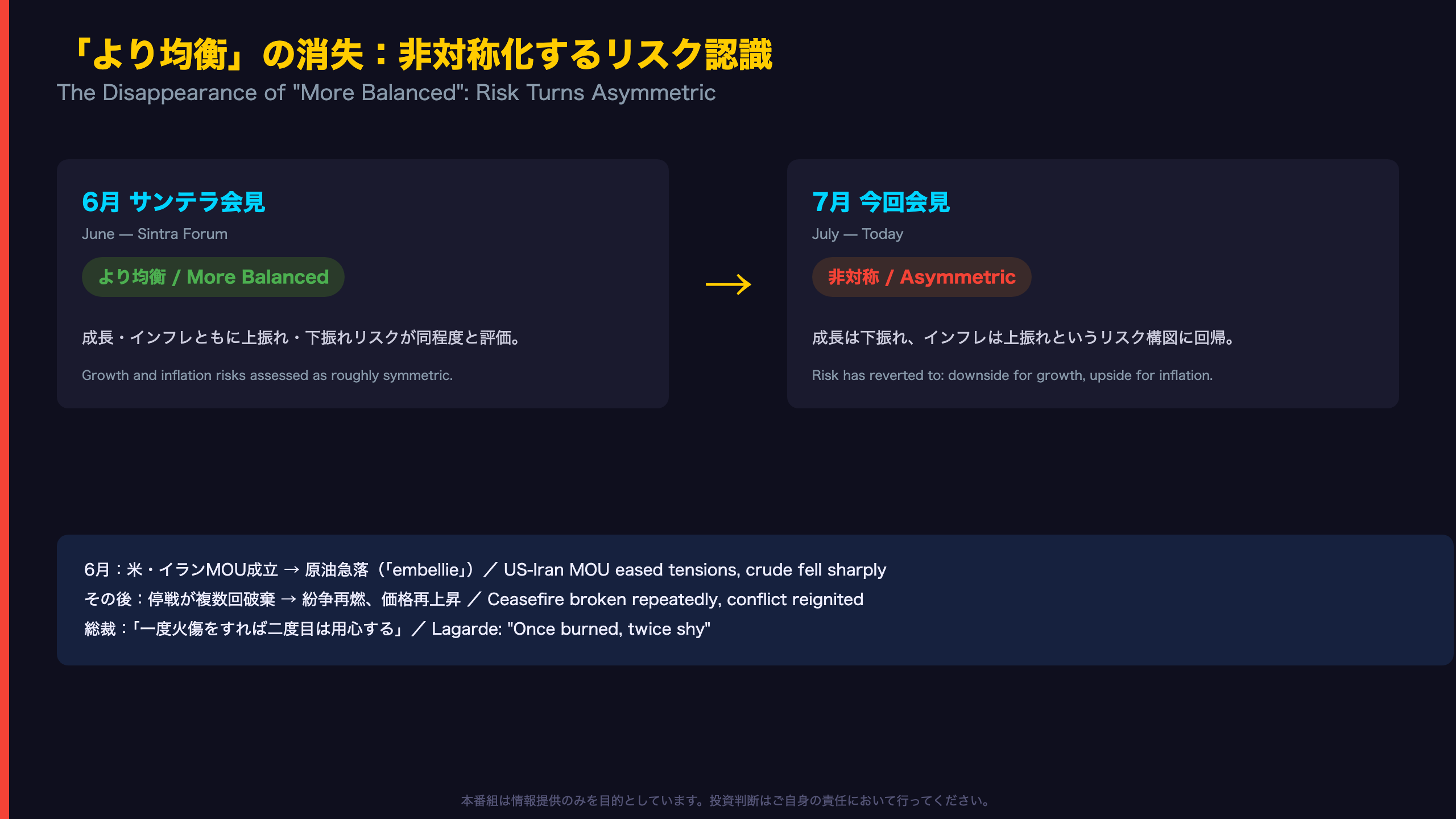
Why a Single Phrase Matters
In central bank communication, risk-assessment language functions as a precise signal that markets parse closely. At the June Sintra Forum, Lagarde had described both growth and inflation risks as “more balanced” — central-bank shorthand for a neutral assessment where upside and downside risks are roughly equally likely.
This time, that phrase disappeared, and Lagarde confirmed in the Q&A this was a deliberate edit: “that segment, more balanced, has been removed.” She described the intervening period using the term “embellie” (a brief improvement), acknowledging it was short-lived before the conflict flared up again.
What This Means for the Path Ahead
For readers benchmarking this against the Fed’s risk-balance language in FOMC statements, a shift from “balanced” to “asymmetric” risk typically precedes greater willingness to act if data confirms the skew. Here, growth risks are skewed downside while inflation risks are skewed upside — a genuinely hawkish tilt in risk framing, even though the policy rate itself was left unchanged. Lagarde’s own assessment that a “mild scenario” (swift resolution of the conflict) “looks quite unlikely” as of today reinforces that the baseline has shifted toward the less benign outcome, raising the stakes for September’s data-dependent decision.
金融環境はわずかにタイト化、銀行融資は明暗分かれる
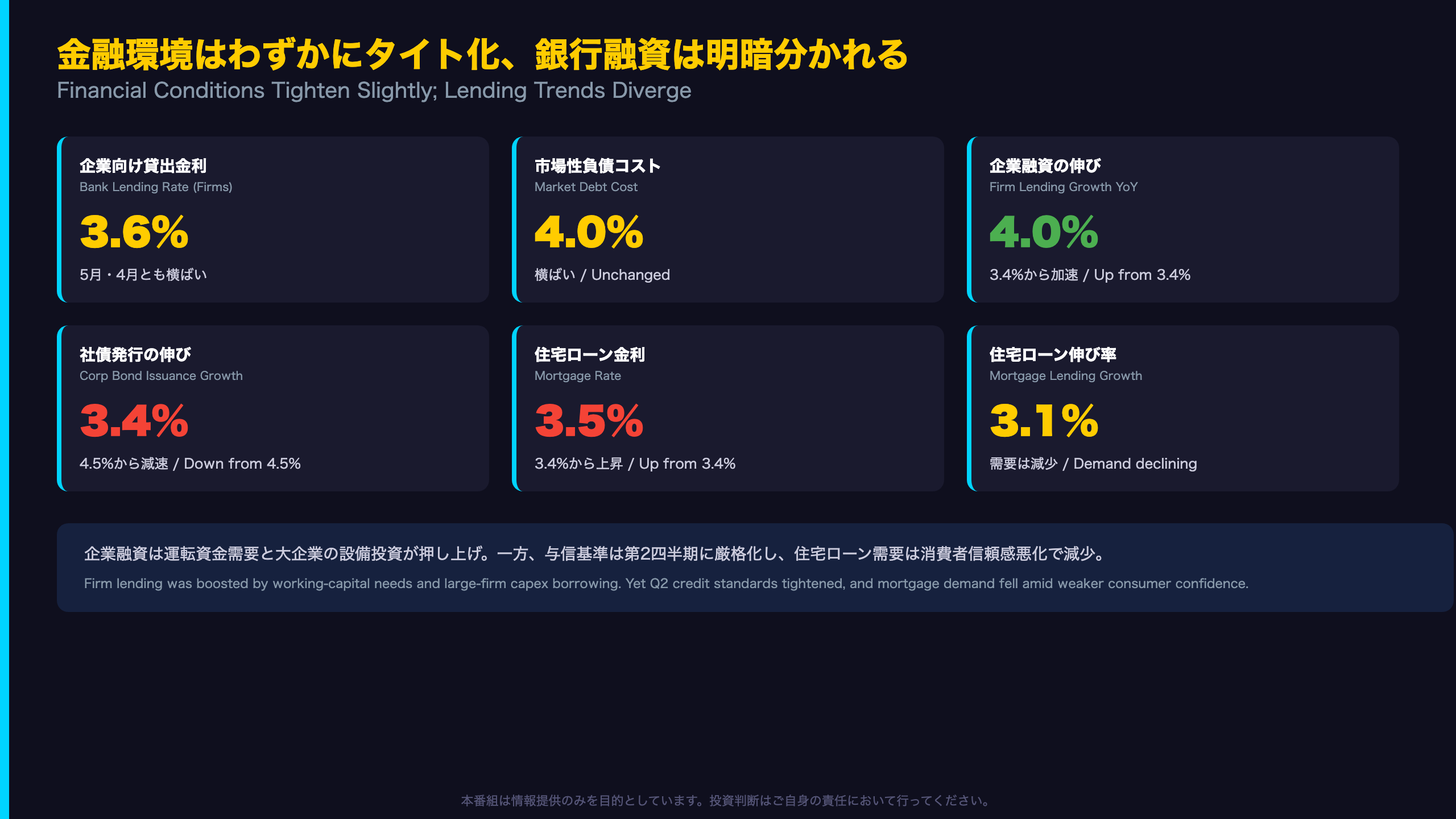
What the Bank Lending Data Really Shows
The lending figures Lagarde cited reveal more nuance than the headline suggests. Corporate lending growth accelerating from 3.4% to 4% sounds unambiguously positive, but Lagarde specified this was driven by both “higher working capital needs” — a defensive move tied to supply-chain risk hedging — and “borrowing for fixed investment by large firms,” a genuinely forward-looking signal. Distinguishing between these two drivers matters for assessing underlying corporate confidence.
Meanwhile, corporate bond issuance growth slowed from 4.5% to 3.4%. With market-based debt costs holding at an elevated 4%, this may reflect a partial substitution toward bank credit, though the transcript doesn’t offer enough detail to confirm this as more than a plausible contributing factor.
Housing: A Clearer Slowdown Story
The mortgage market shows a more unambiguous deceleration. Mortgage rates ticked up to 3.5% from 3.4%, while demand fell on “deteriorating consumer confidence and higher interest rates.” Lagarde’s characterization that banks “became more concerned about the economic risks faced by their customers and less willing to take on risks themselves” — combined with Q2 credit-standard tightening — points to a household borrowing environment that is cooling more clearly than the mixed picture on the corporate side.
会見で初めて語られたこと:続投表明と紅海の緊張
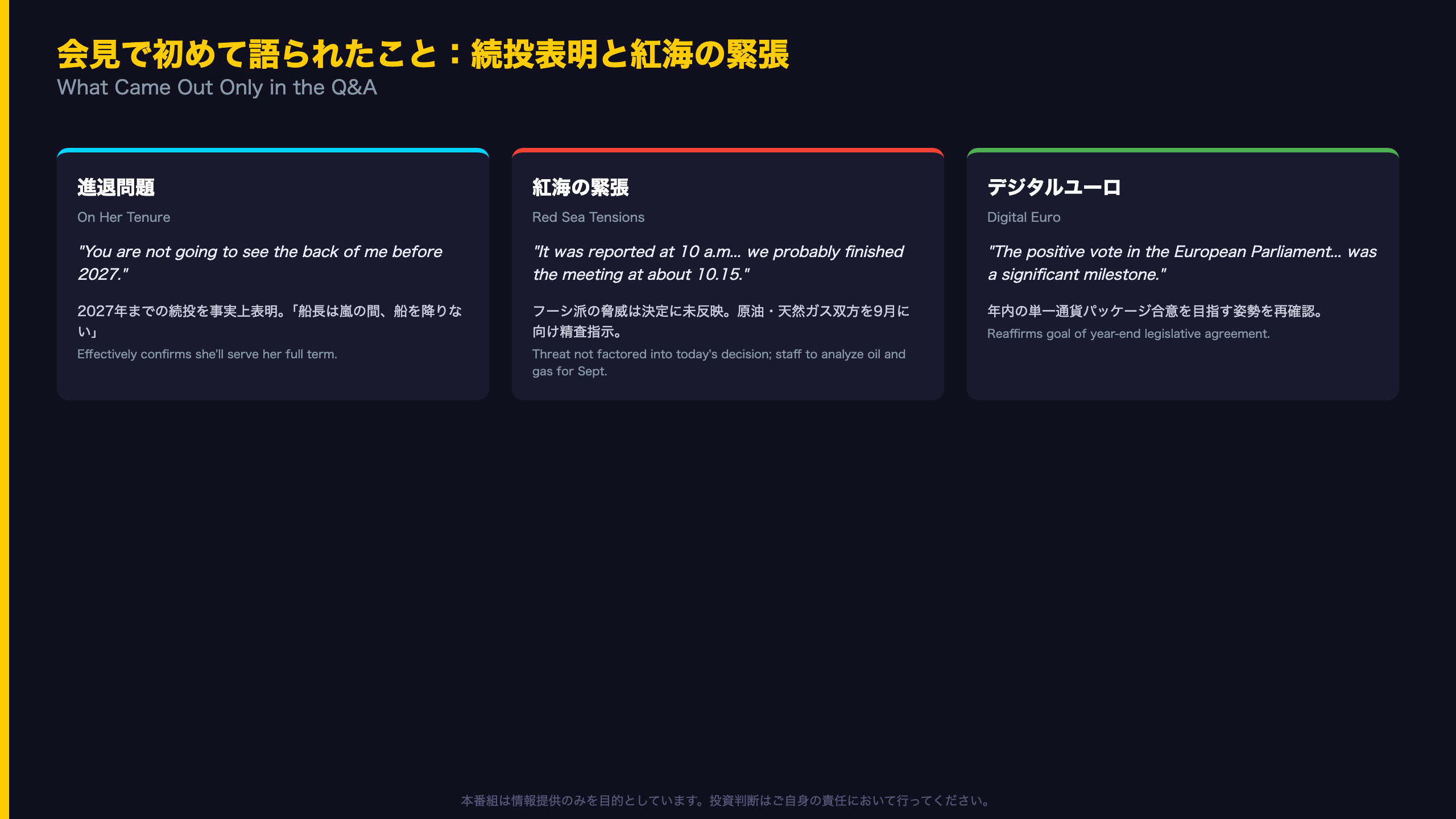
Three Off-Script Moments the Press Release Won’t Show You
1. A Direct Answer on Her Tenure
Amid persistent media speculation about an early departure, Lagarde chose unusually direct language this time:
“You are not going to see the back of me before 2027… When there are clouds on the horizon, the captain stays on the ship.”
This nautical metaphor — which she noted she has used before — was redeployed here as a de facto commitment to serve out her term.
2. The Red Sea Timing Detail
Asked whether the Council discussed Red Sea tensions, Lagarde revealed a Houthi threat against Saudi-linked vessels was “reported at 10 a.m.” that morning, while the meeting had likely concluded around 10:15 — meaning this incident wasn’t factored into today’s decision. She noted the ECB monitors not just crude prices but the “crack spread” (the price differential between crude and refined products). Crucially, she confirmed staff have been instructed to conduct deep sensitivity analysis on both oil and natural gas prices — flagging gas inventories at “rather low levels” as a fresh vulnerability ahead of September.
3. Digital Euro Progress
On the digital euro, Lagarde called this month’s European Parliament vote “a significant milestone,” welcoming the shared goal among Parliament, the EU Council, and the Commission to reach agreement on the single currency package by year-end.
市場への含意:9月はライブミーティングに
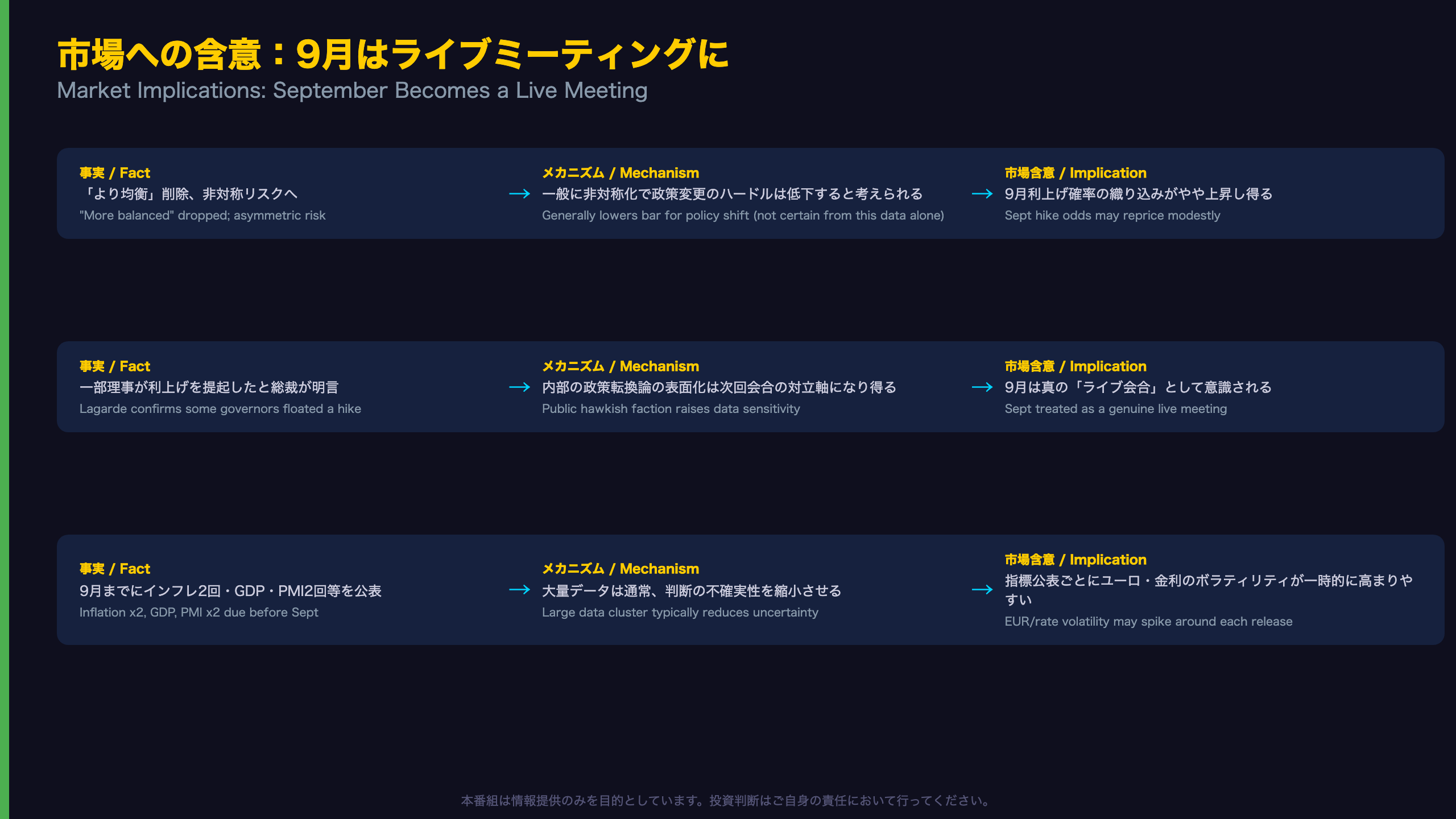
Reading the Market Implications Through the Evidence Chain
[Fact] Lagarde removed the “more balanced” risk-language, signaling an asymmetric risk configuration: downside growth risk, upside inflation risk.
[Mechanism] Generally, when a central bank shifts its risk assessment toward asymmetry, the bar for a subsequent policy shift is thought to lower, though this cannot be confirmed as certain from this single data point.
[Market implication] Euro rate markets may see a modest repricing of September hike probability, though this transcript alone cannot quantify the magnitude of that shift.
[Fact] Lagarde confirmed “some governors” raised the prospect of a hike during deliberations.
[Mechanism] The public disclosure of an internal hawkish faction typically raises market sensitivity to subsequent data surprises, since it signals the Council’s threshold for a policy shift may be lower than previously assumed.
[Market implication] September is likely to be treated by markets as a genuine “live meeting,” amplifying reaction to each incoming inflation and PMI print between now and then.
[Fact] Before the September 10 meeting, the ECB will receive two inflation readings, Q2 GDP, two consumer expectations surveys, one compensation-per-employee figure, and two PMI releases.
[Mechanism] A large data cluster ahead of a policy decision generally reduces uncertainty about the eventual outcome by the time of the meeting itself.
[Market implication] Paradoxically, in the interim, EUR volatility and euro-area rate volatility may see intermittent spikes around each individual data release, as markets attempt to front-run the Council’s eventual read.
Disclaimer: This article is for informational purposes only. All investment decisions are made solely at your own risk.