📺 Watch the Full Video Analysis
This article was automatically generated by the NFC Market Live AI analysis system. (Updated: 2026-10-08 07:45 JST)
📄 Primary Source
Federal Reserve
https://www.federalreserve.gov/monetarypolicy/fomcminutes20260916.htm
📊 Deep dive into the FOMC minutes (Sept 15-16 meeting, released Oct 8, 2026).
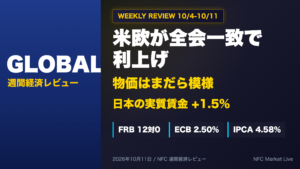
🔺 The Fed raised rates 25bp to 3.75-4.00% — by a unanimous 12-0 vote, a stunning shift from July’s 9-3 hold.
📈 Unemployment fell to 4.1%, AI investment keeps surprising to the upside, and labor market risks are now judged broadly balanced.
⚠️ Meanwhile headline PCE sits at an estimated 3.8%, and staff pushed the return to 2% inflation back to 2029. Most participants see another hike by year-end.
💱 The minutes explicitly cite the joint US-Japan yen intervention; with the ECB also hiking, the dollar fell despite Fed tightening.
Next meeting: October 27-28. We track the Warsh Fed’s hiking cycle.
The Ultimate Summary — 全会一致の利上げ再開
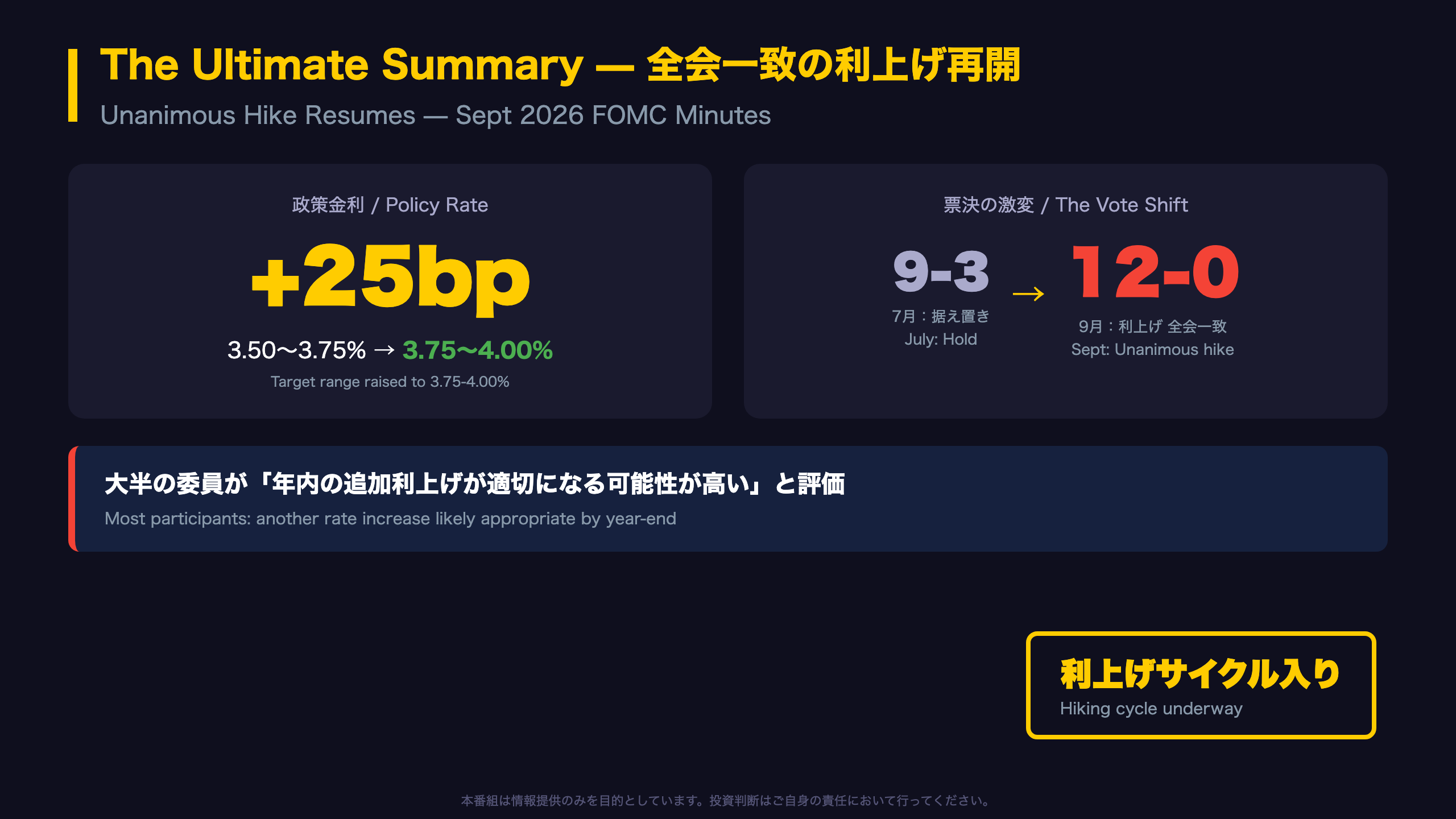
From 9-3 Hold to 12-0 Hike in a Single Meeting
For readers unfamiliar with the mechanics: FOMC minutes are released three weeks after each meeting and reveal the internal debate behind the policy statement. The September 2026 minutes document one of the fastest consensus shifts in modern Fed history. In July, the Committee held rates at 3.50-3.75% by a 9-3 vote, with Hammack, Kashkari, and Logan dissenting in favor of a hike. Eight weeks later, all twelve voters — including Jerome Powell, now serving as a Board member under Chairman Kevin Warsh, and Christopher Waller — backed a 25bp increase to 3.75-4.00%.
Why This Matters Globally
The Fed is now moving in the opposite direction of its 2024-25 easing phase, and it is not alone: the minutes note the ECB also raised rates citing inflation pressure from the Middle East conflict. This synchronized tightening among developed-market central banks is reshaping rate differentials — one reason the dollar fell over the intermeeting period despite hawkish Fed expectations.
The Forward Path
The minutes state that \”most participants assessed that another increase in the target range would likely be appropriate by year end,\” while stressing data dependence. Several participants viewed the current stance as \”not restrictive or only mildly restrictive\” — a phrase that leaves room for more than one additional move. For US equity and bond investors, the October 27-28 meeting is now the key event: back-to-back hikes would confirm that the Warsh Fed treats 4%+ policy rates as the new operating zone, not a ceiling.
ウォーシュ体制の変質 — 9対3から12対0へ
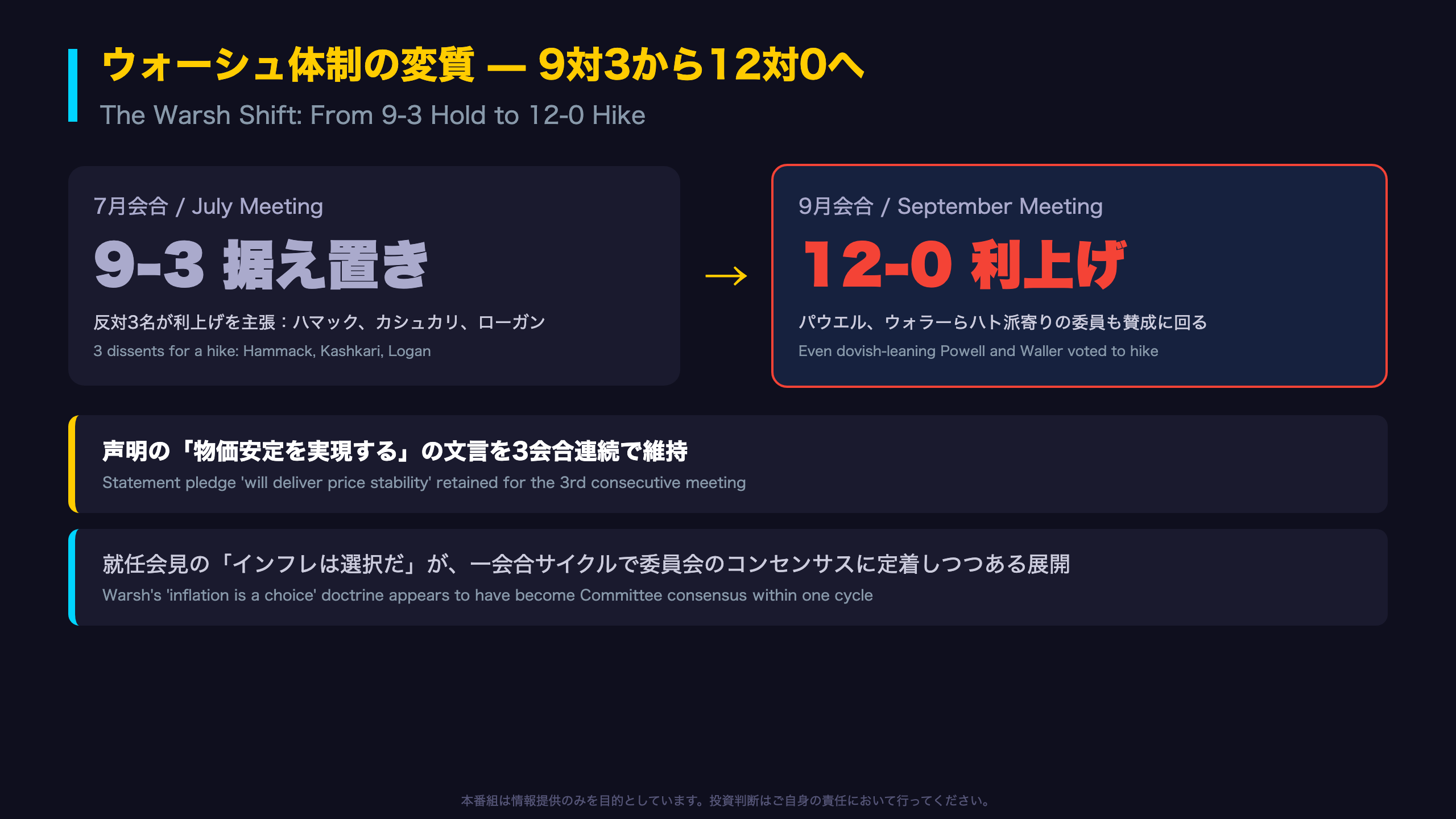
Understanding the Warsh Transition
For international readers: Kevin Warsh, a former Fed governor known for hawkish views, became Fed Chairman in 2026, with Jerome Powell remaining on the Board as a governor. At his first press conference in June 2026, Warsh declared \”inflation is a choice\” and announced five task forces to review Fed operations. These September minutes are the clearest evidence yet of how that philosophy is reshaping the institution.
A Consensus Built on Data, Not Pressure
The minutes show the unanimity was not imposed — it was earned by the data. Three developments flipped the July holdouts: estimated headline PCE re-accelerated to 3.8% in August; almost all participants judged labor-market risks had shifted from skewed-to-the-downside to \”broadly balanced\”; and many participants observed financial conditions remained supportive of growth, with equities up substantially and credit spreads narrow. When the employment side of the dual mandate stops flashing warnings, the inflation side dominates — a classic Fed reaction function, executed unusually fast.
Balance Sheet Signals
A few participants urged strengthening tools for Treasury market dysfunction \”while limiting the Federal Reserve’s footprint in the Treasury market.\” That phrasing echoes Warsh’s long-standing preference for a smaller Fed balance sheet. Separately, the Desk paused reserve management purchases during the period, judging reserves still ample. Investors should watch for the balance-sheet task force findings, flagged in July as input for future meetings — a potential second channel of tightening beyond the policy rate.
インフレの膠着 — 2%回帰は2029年へ
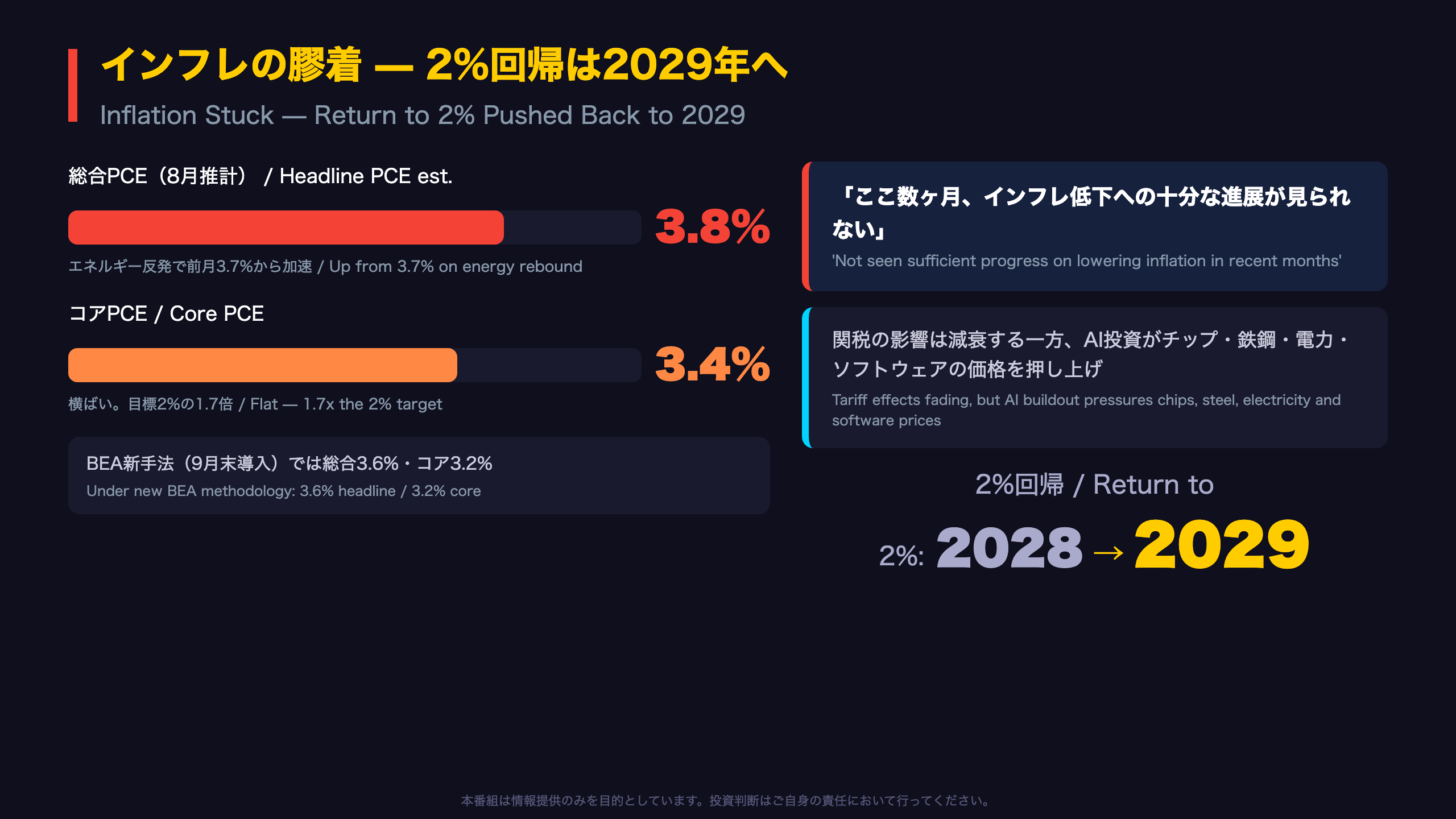
Why 3.4% Core Inflation Triggered a Hike
Context for global readers: the Fed targets 2% inflation on the PCE price index, a broader measure than CPI that typically runs a few tenths lower. Core PCE at an estimated 3.4% means inflation has been running at 1.7 times target — and the minutes say it has \”moved sideways in recent months\” per various modeling approaches of underlying inflation.
The AI Inflation Channel
The most distinctive feature of this cycle is the AI buildout as an inflation driver. The minutes cite surging AI-related investments as contributing to price pressures, with earlier minutes detailing large price increases in chips and steel for data centers, plus pressure on smartphones, computer equipment, software, and electricity. Some participants warned AI could cause \”aggregate demand to outpace aggregate supply over the medium term.\” The disinflationary productivity payoff from AI is acknowledged but seen as uncertain in timing — hence the Fed is tightening against the demand effects now.
Comparing Time Horizons
The staff’s 2% target date has slipped repeatedly: the July forecast said 2028; September now says 2029. That is more than three additional years of above-target inflation from today. Several participants noted that successive supply shocks have repeatedly delayed the return to 2% — the institutional memory driving the risk-management case for hikes. A mitigating note: longer-term inflation expectations, both market- and survey-based, remain anchored at levels consistent with 2%, which is why the Committee can tighten gradually rather than aggressively. Watch the next PCE releases under the BEA’s new methodology, which mechanically shaves roughly 0.2 points off measured inflation.
利上げを可能にした経済の強さ — 雇用リスク「均衡」へ
The Dual Mandate Rebalanced
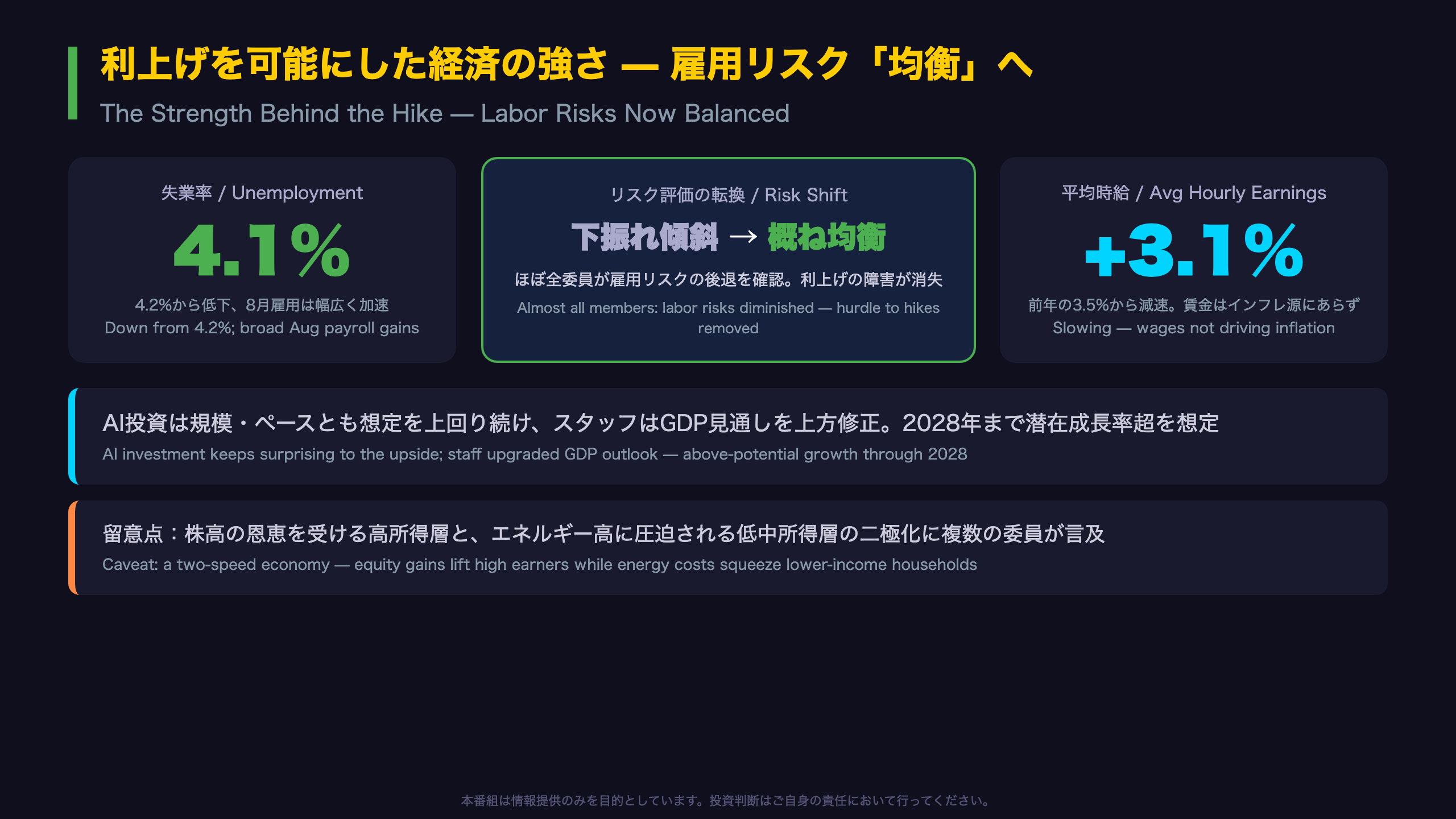
The Federal Reserve operates under a dual mandate — price stability and maximum employment — which forces a constant trade-off. These minutes capture the moment that trade-off dissolved: almost all participants judged that risks to the labor market \”had diminished and were now broadly balanced,\” while inflation risks remained tilted to the upside. When one side of the mandate stops signaling danger, policy follows the other side. That is the mechanical explanation for the unanimous hike.
A Goldilocks Labor Market — for Hawks
The data mix is unusual: unemployment fell to 4.1%, August payrolls accelerated broadly, and labor force participation rebounded — yet wage growth cooled, with average hourly earnings at 3.1% year-over-year versus 3.5% a year earlier, and the Employment Cost Index at 3.3%. Falling unemployment with decelerating wages means the Fed can tighten without fear of either breaking the job market or chasing a wage-price spiral. Some participants explicitly said the labor market \”was not currently a source of inflationary pressures.\”
The AI Economy’s Two Faces
AI investment keeps surprising to the upside in scale and pace, and staff now project GDP growth above potential through 2028 with unemployment below its longer-run rate through 2029. But participants flagged a two-speed economy: equity gains support high-income consumption while energy costs squeeze lower-income households, and the farm sector is strained by drought and diesel costs. For investors, this validates the resilient-consumer thesis at the index level while warning of stress in down-market retail and agricultural credit. Low hiring and firing rates also mean any future labor deterioration could be slow to show up in headline data.
日本人投資家へのインプリケーション — 円買い介入と次の一手
The Official Record of Joint FX Intervention
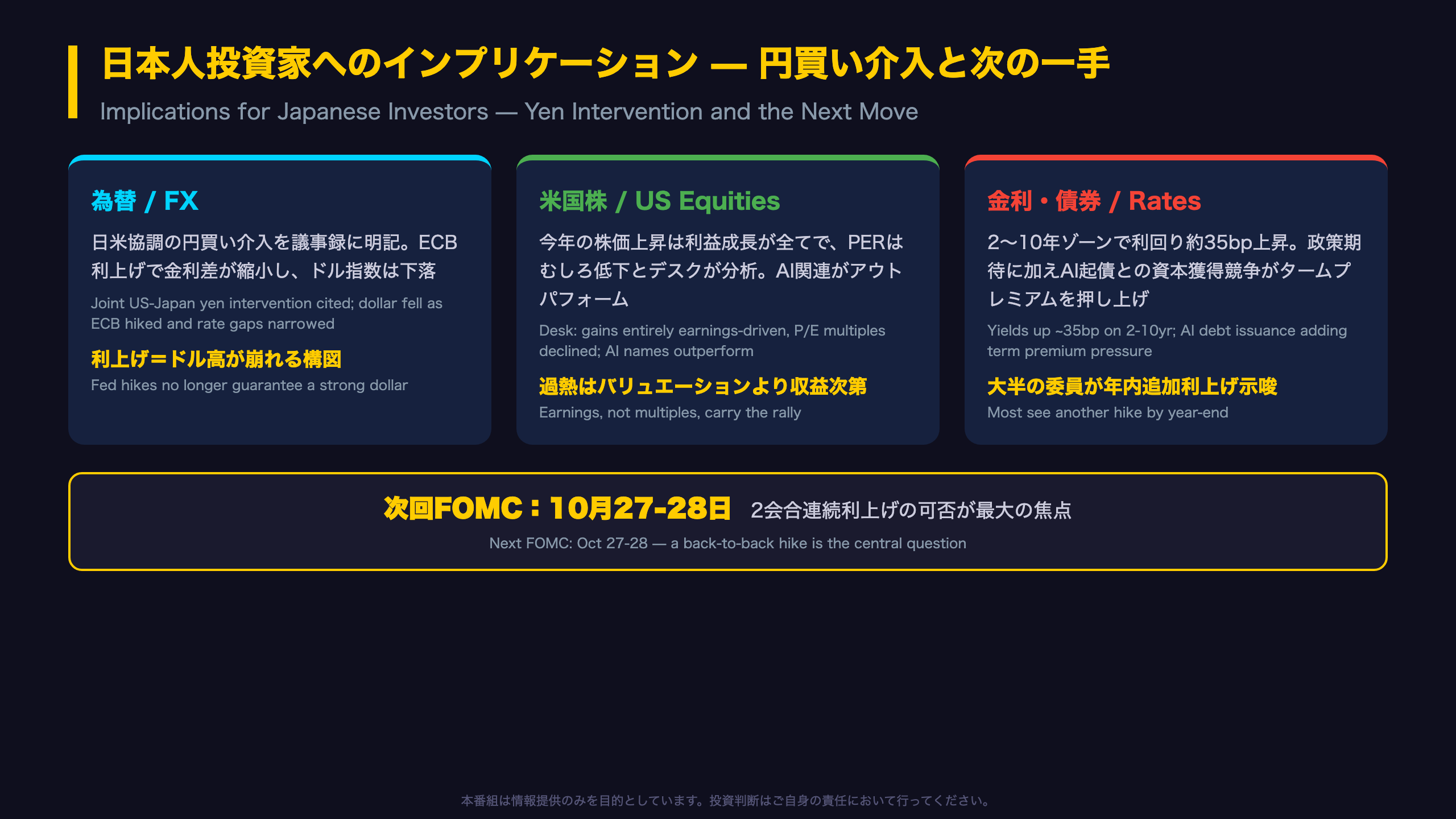
For global macro watchers, the most striking passage in these minutes is operational: \”The joint US-Japan intervention to support the yen in late July also directly contributed to dollar depreciation, given the yen’s considerable weight in currency indexes.\” The New York Fed’s Desk executed the intervention purely as fiscal agent for the US Treasury, with the Fed’s own SOMA portfolio uninvolved — a careful delineation of Treasury-led FX policy from Fed independence. Coordinated G7 intervention of this kind is rare; the last comparable yen-supporting joint action dates back decades.
Asset Class Readout
- FX: The dollar fell over the period despite rising US rate expectations, as the ECB hiked and foreign short rates rose faster than US rates. The old reflex of Fed-hike-equals-strong-dollar is breaking down in a synchronized global tightening.
- Equities: The Desk noted this year’s equity gains were entirely earnings-driven, with P/E multiples declining — a healthier rally structure than multiple expansion. But recall the staff’s July financial stability assessment flagged equity premiums near dot-com-era levels, and hyperscaler debt spreads remain wide on heavy AI-related issuance.
- Rates: Treasury yields rose about 35bp across the 2-10 year curve, driven by policy expectations plus term premium pressure from Treasury buyback uncertainty and competition for capital from private AI-infrastructure debt issuance.
What to Watch
Next FOMC: October 27-28. With most participants signaling another hike by year-end and the BEA’s new inflation methodology debuting in late September data, the October meeting will test whether the Warsh Fed delivers consecutive hikes.
Disclaimer: This article is for informational purposes only. All investment decisions are made solely at your own risk.