
📺 Watch the Full Video Analysis
This article was automatically generated by the NFC Market Live AI analysis system. (Updated: 2026-10-20 15:16 JST)
📄 Primary Source
Office for National Statistics
https://www.ons.gov.uk/employmentandlabourmarket/peopleinwork/employmentandemployeetypes/bulletins/uklabourmarket/latest
📊 A walk-through of the UK labour market overview published by the ONS on October 20.
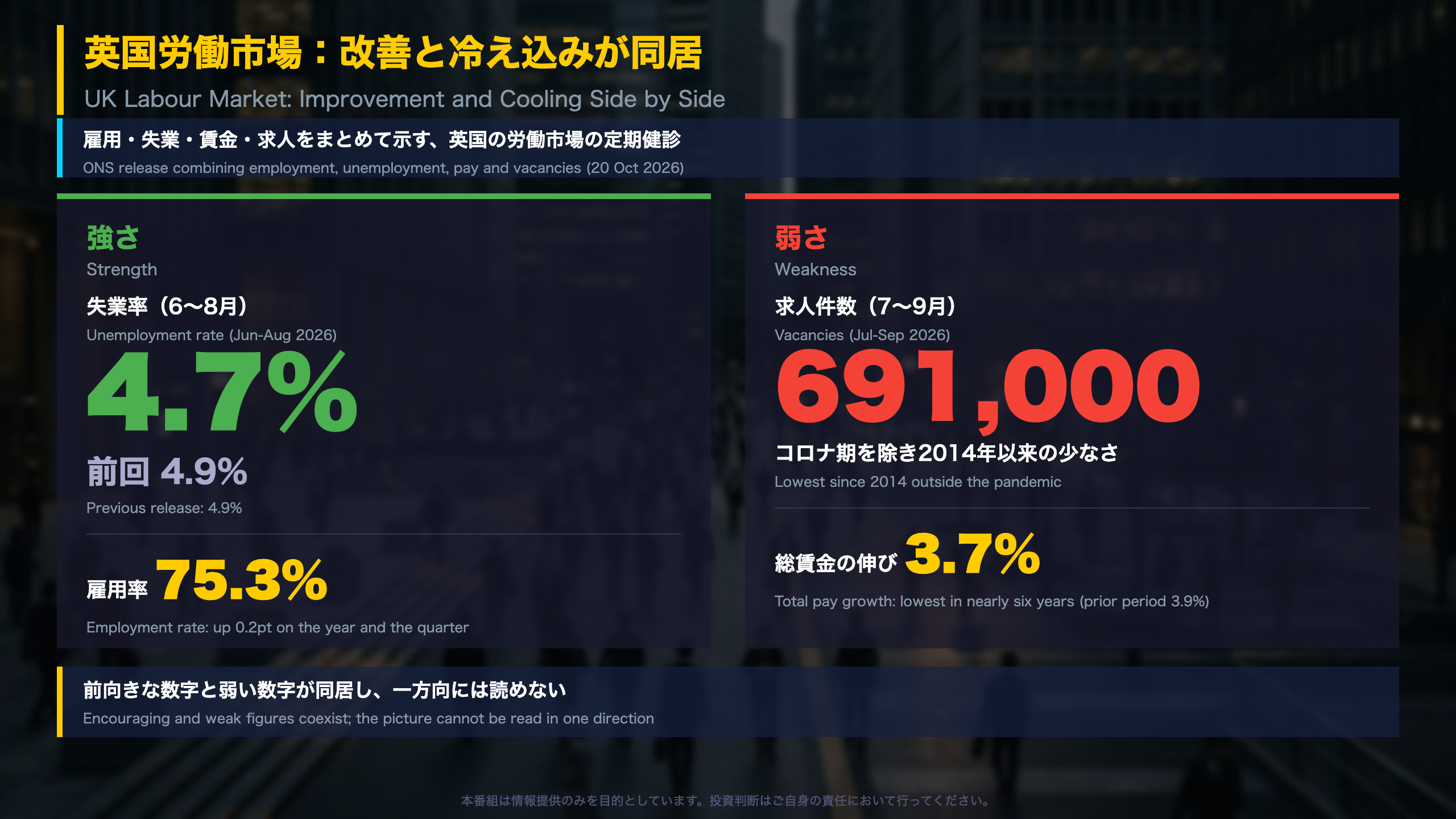
📉 Unemployment for June to August fell to 4.7% from 4.9% in the previous release, and the employment rate rose to 75.3%.
⚠️ Vacancies of 691,000 are the lowest since 2014 outside the pandemic, and total pay growth of 3.7% is the weakest in nearly six years.
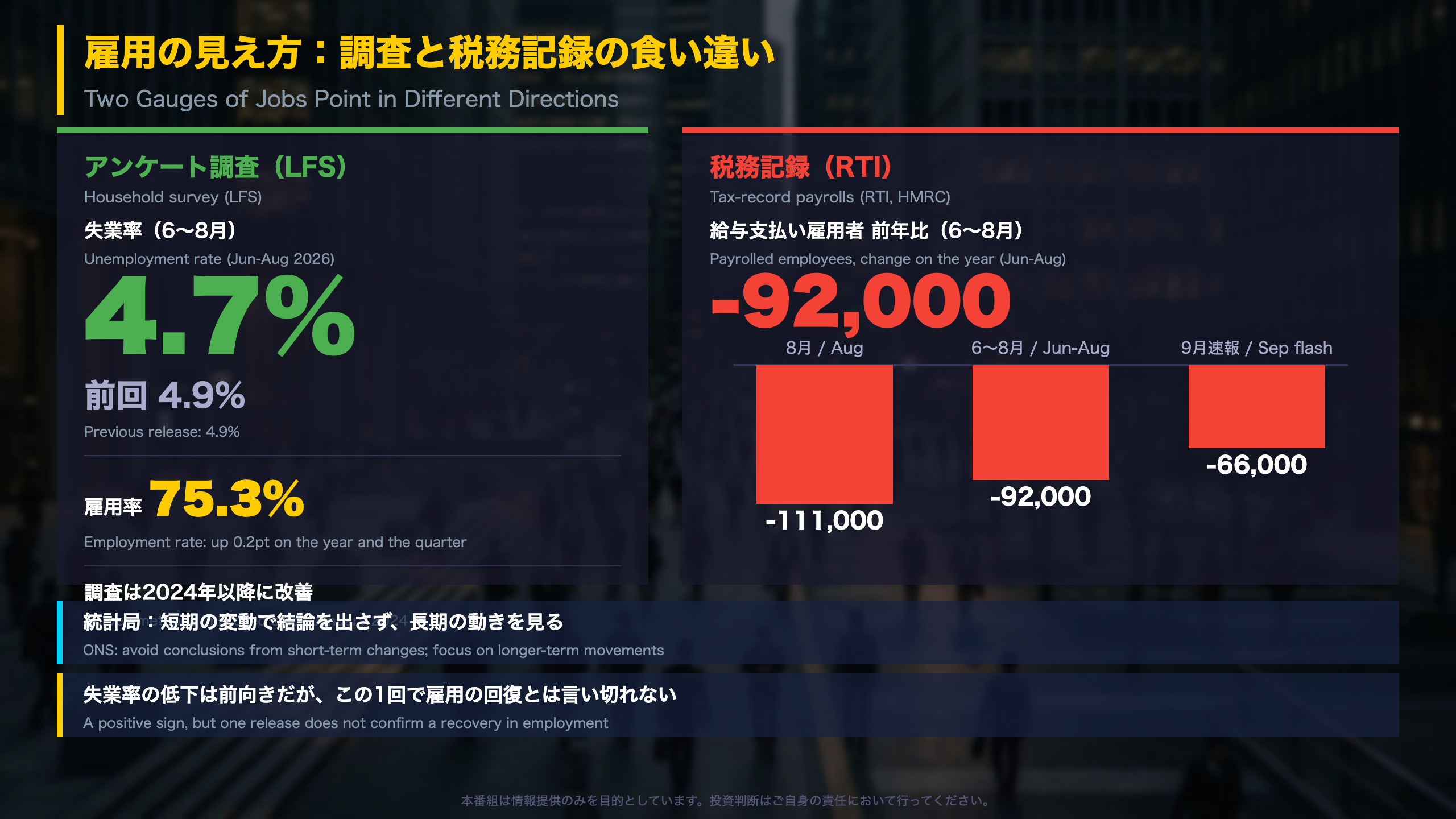
💡 Payrolled employees are still down on the year, so the survey and tax-record gauges disagree.
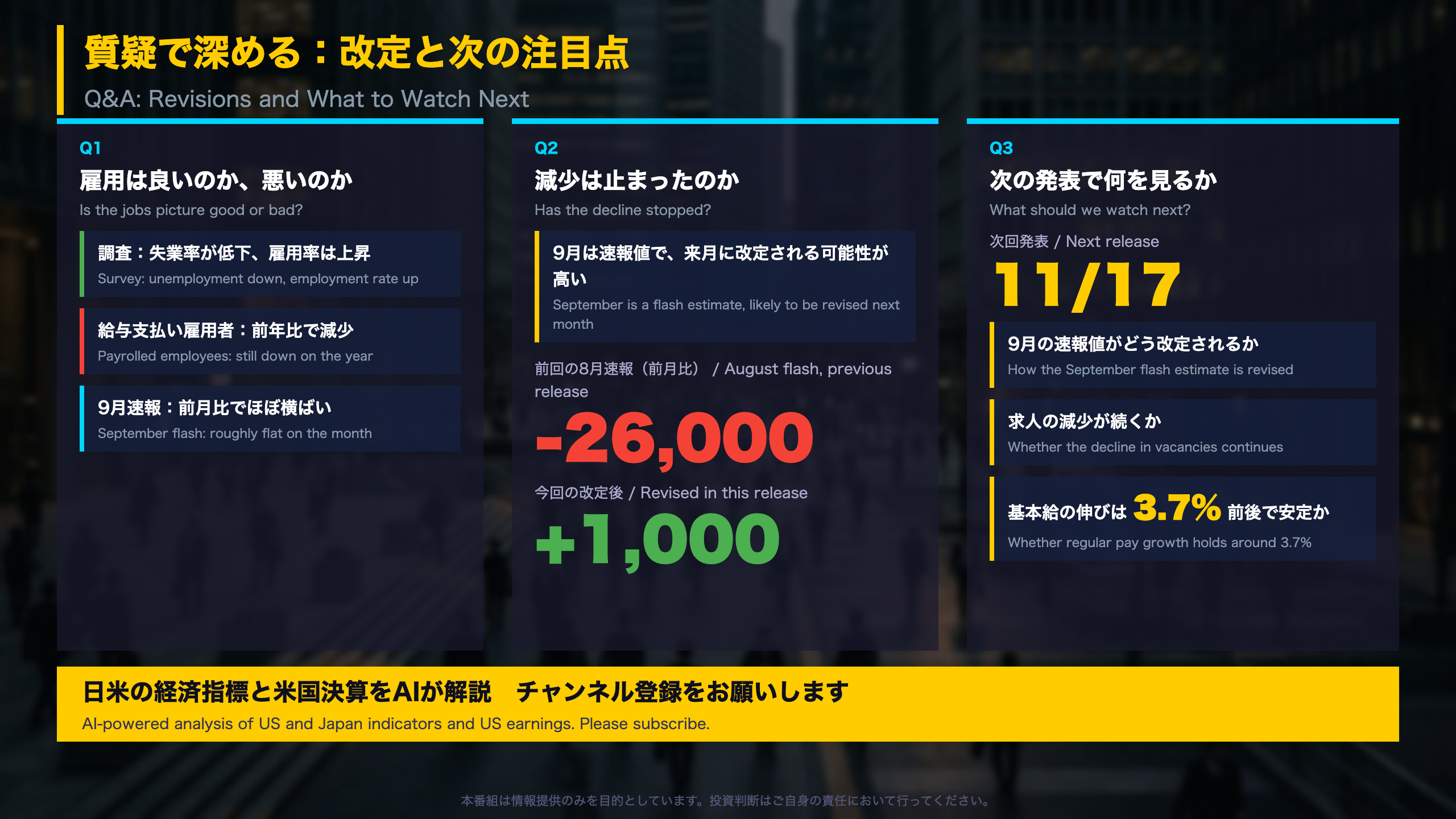
📅 Next release: November 17. Watch the September payroll revision, vacancies and regular pay growth.
The Ultimate Summary|英国労働市場の強さと弱さ
What the ONS release is
The Office for National Statistics (ONS) is the UK’s national statistics agency. Its monthly Labour market overview combines the Labour Force Survey (LFS, a household survey), HMRC tax-based payroll data (PAYE Real Time Information, or RTI), the Claimant Count and the Vacancy Survey. It is the UK counterpart of the US jobs report, with a key difference: the main unemployment measure is survey-based, while payroll data come from tax records rather than an employer survey.
Headline moves
- Unemployment: 4.7% (previous release: 4.9%)
- Employment rate: 75.3% (75.1%)
- Vacancies: 691,000, the lowest since 2014 outside the pandemic
- Total pay growth: 3.7% (3.9%), the lowest in nearly six years
Why it matters
The ONS itself describes the labour market as “broadly flat in 2026”. Wage growth, vacancies and labour-market slack are core inputs for central banks, including the Bank of England, which received the previous month’s data in advance for its policy meeting. Unlike the US, where the payroll survey dominates the debate, UK readers must weigh a survey measure that is still being improved against tax records showing falling payrolls.
Next release: 17 November 2026.
雇用の見え方:調査と税務記録の食い違い
Two gauges, two signals
The LFS shows unemployment at 4.7% and employment at 75.3%. HMRC’s RTI payroll count, built from administrative tax records covering the whole population, shows payrolled employees down 92,000 on the year for June to August and down 37,000 on the quarter. The September flash estimate is 30.3 million, down 66,000 on the year and up 13,000 on the month.
The revision lesson
In the previous release, the August flash estimate was a monthly fall of 26,000. It has now been revised to a rise of 1,000. Flash payroll data are routinely revised, so single-month readings carry uncertainty.
Survey quality
- The LFS sample rose from 80,078 to 81,193 individuals between January-March and April-June 2026.
- A telephone-collection resourcing issue in May 2026 had a minimal effect on headline rates but a small, noticeable effect on average hours.
- The ONS cautions: “Caution should be taken when drawing conclusions from short-term changes.”
Balanced read
Optimists point to the lower unemployment rate and higher employment rate. Cautious readers point to the year-on-year fall in payrolls. For US readers, this resembles the household-versus-establishment survey gap in the US jobs report, though the UK gap is partly tied to the redesign of the survey and the move to the Transformed LFS.
求人の減少と賃金の安定
Demand for labour: vacancies
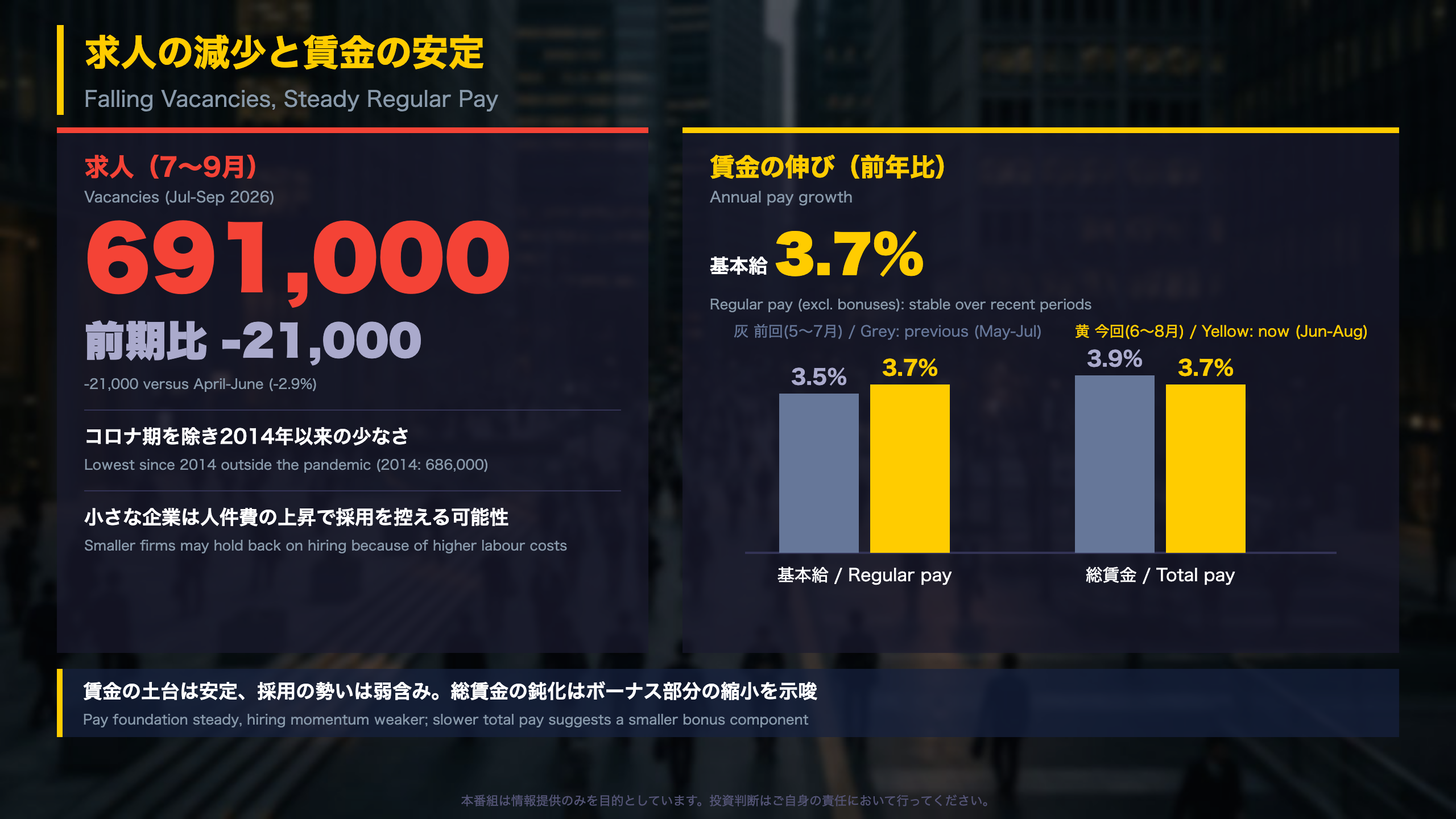
The ONS Vacancy Survey estimates 691,000 vacancies for July to September 2026, down 21,000 (2.9%) on April to June and 37,000 (5.1%) on the year. Outside the pandemic, the last time the count was this low was July to September 2014 (686,000). The ONS says feedback continues to suggest smaller firms may not be recruiting because of higher labour costs.
Pay growth
| Measure (June-Aug, y/y) | Rate |
|---|---|
| Regular pay | 3.7% |
| Total pay (incl. bonuses) | 3.7% (prior 3.9%) |
| Public sector regular pay | 6.3% |
| Private sector regular pay | 3.0% |
| Real regular pay (CPIH) | 0.6% |
Total pay growth is the lowest since August to October 2020 (2.8%), the ONS notes. Regular pay has been stable across six consecutive three-month periods after a year of slowing.
Balanced read
Positives: stable regular pay and positive real pay growth. Negatives: vacancies at multi-year lows and a smaller bonus contribution. Public sector pay is distorted by the timing of pay awards, so the private-sector rate is the cleaner guide.
Comparison note: UK Average Weekly Earnings come from a monthly business survey and cover Great Britain, so they are not a like-for-like match with US payroll-based wage data.
質疑で深める:改定と次の注目点
What to watch before the next release
The next Labour market overview is due on 17 November 2026. Four items stand out:
- September payroll revision – the flash estimate (30.3 million, +13,000 on the month) can be revised when more data arrive.
- Vacancies – the rolling three-month count moves to August-October next time; the question is whether the 691,000 level stabilises.
- Regular pay growth – currently 3.7%, stable across six periods.
- Claimant Count – up to 1.701 million in September from 1.692 million in August; the ONS notes recent revisions have tended to be downward.
Institutional context
- The ONS is moving toward the Transformed Labour Force Survey (TLFS), an online-first replacement for the LFS, and says it will not seek reaccreditation for the current LFS outputs.
- A consultation on release times for market-sensitive statistics closes on 30 October 2026.
Balanced view
Supportive readings: falling unemployment and inactivity. Cautious readings: falling vacancies and payrolls. Revisions can move both, so this release is best treated as one data point, not a trend.
Disclaimer: This article is for informational purposes only. All investment decisions are made solely at your own risk.