📺 Watch the Full Video Analysis
This article was automatically generated by the NFC Market Live AI analysis system. (Updated: 2026-07-30 22:12 JST)
📄 Primary Source
NFC Market Live
https://www.youtube.com/watch?v=G5m9FOeBD1Q
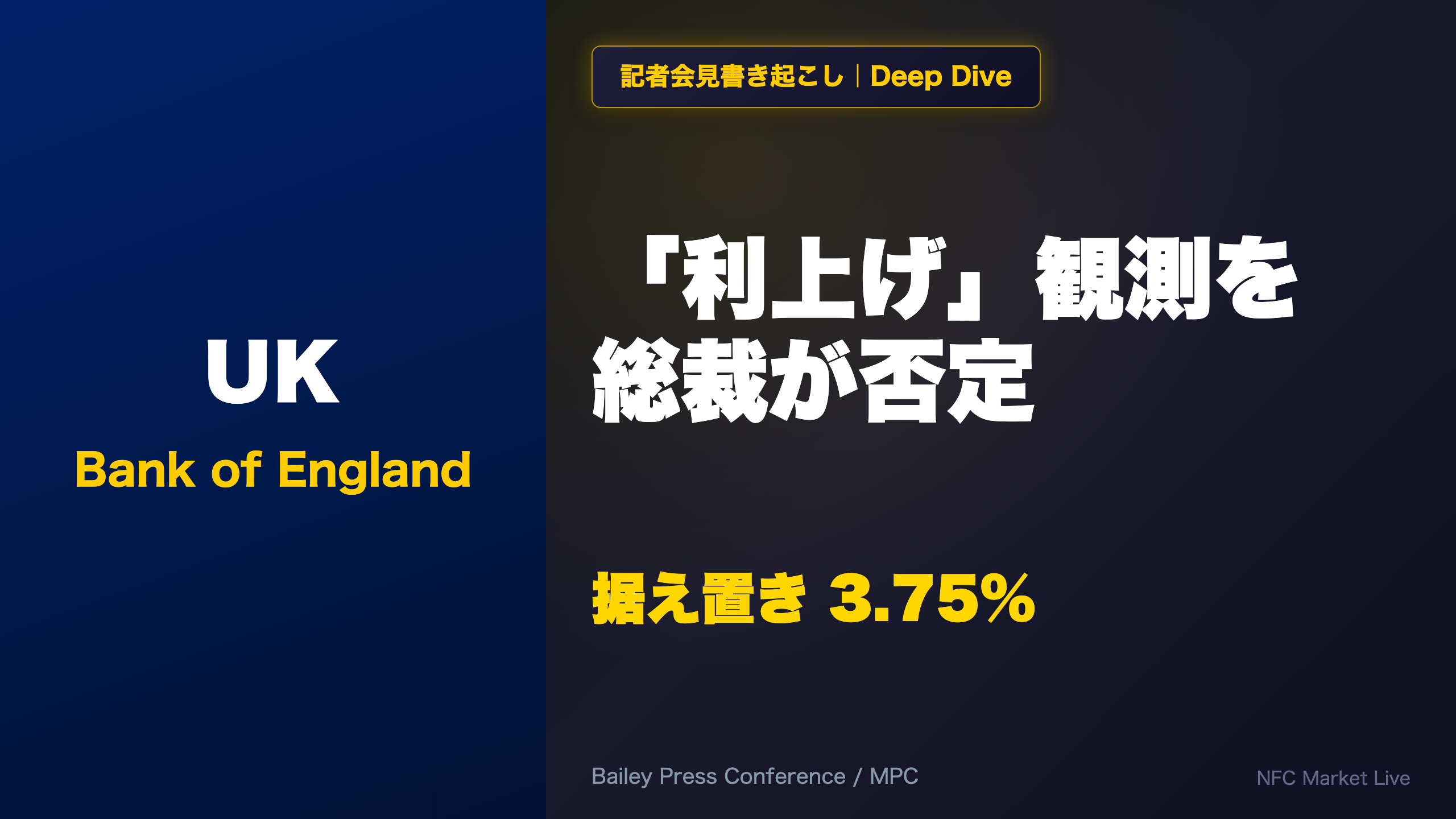
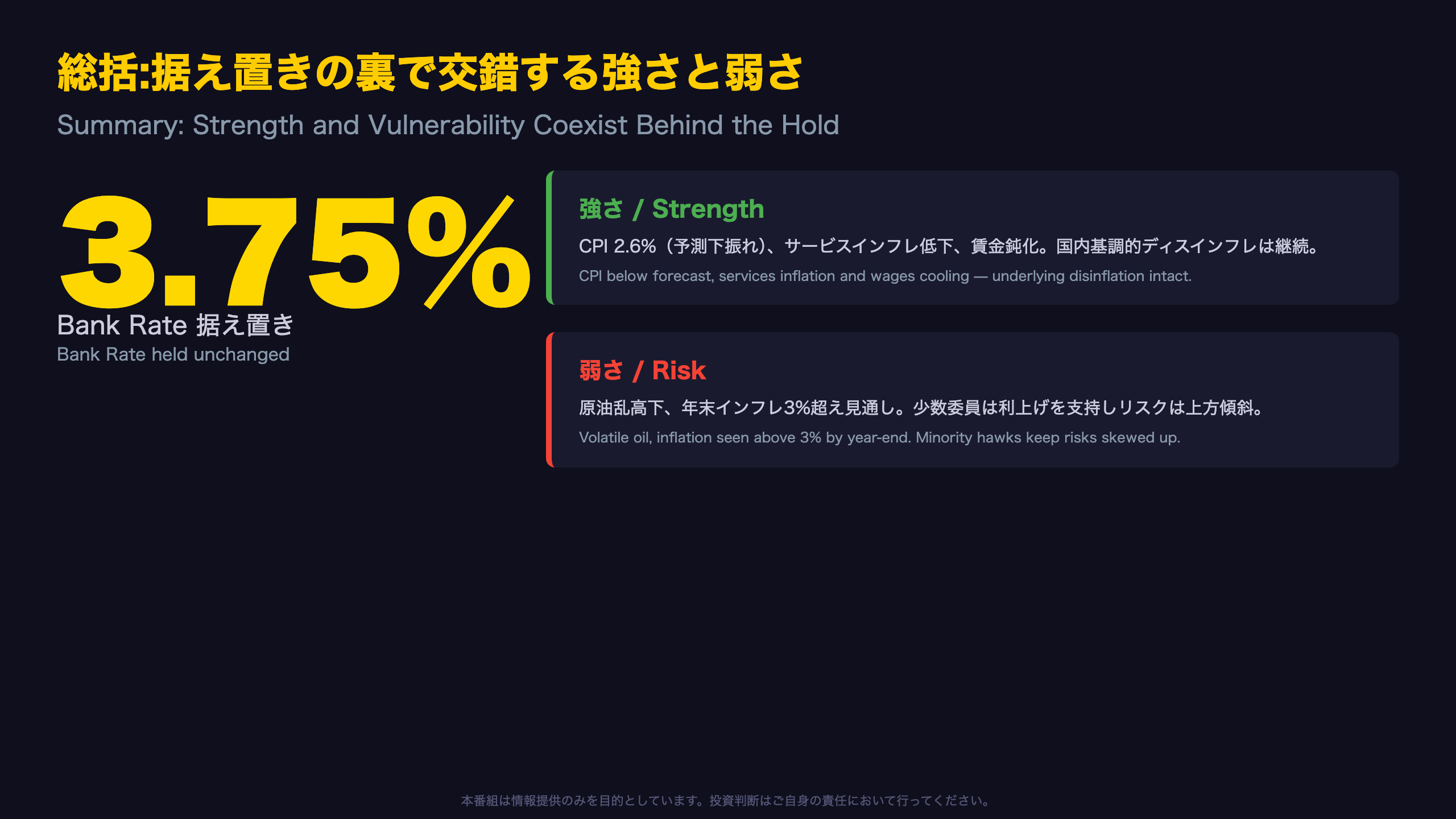
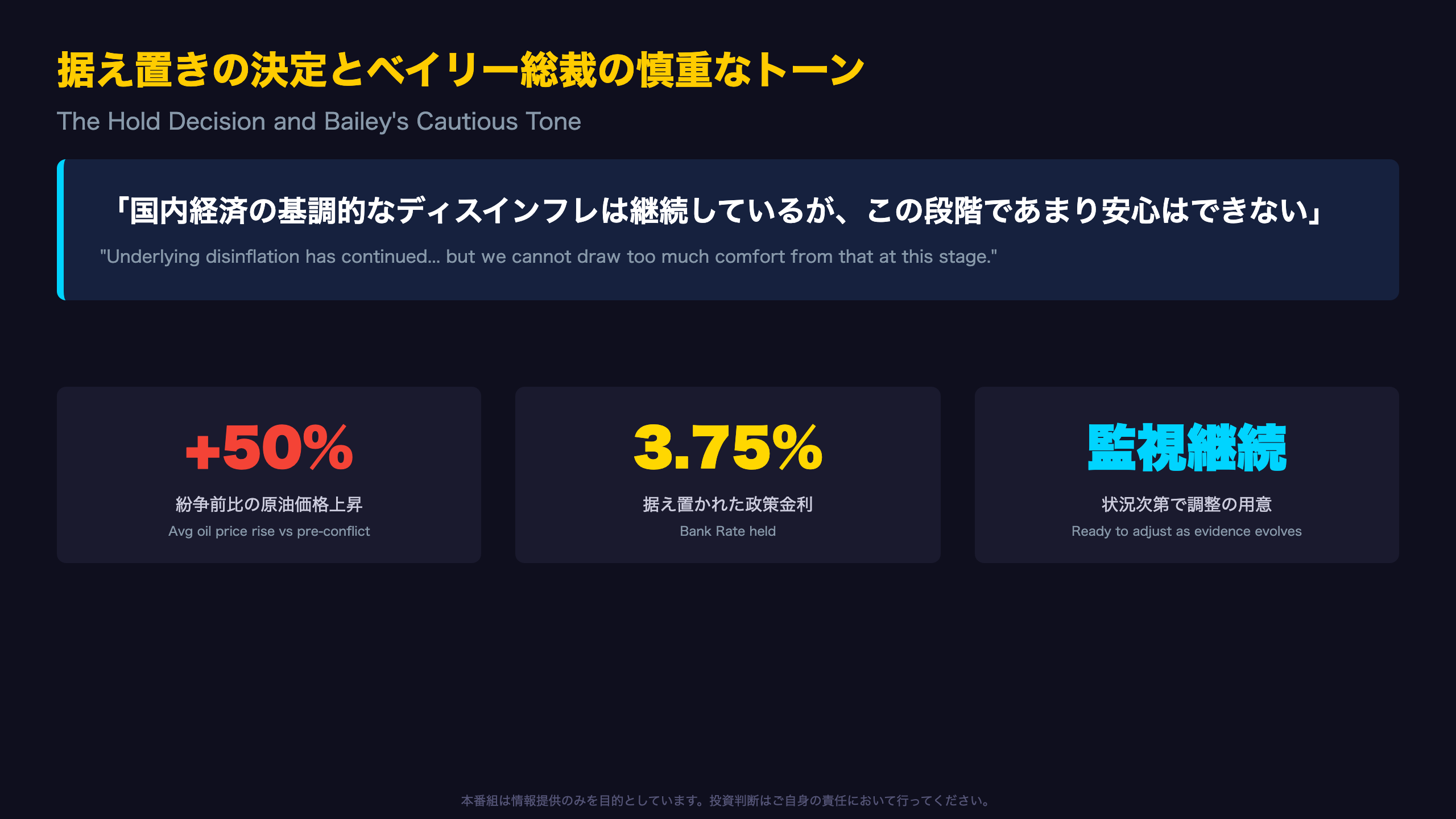
The Bank of England held Bank Rate at 3.75%. Governor Andrew Bailey acknowledged Middle East-driven energy price spikes could push inflation above 3% by year-end, but stressed limited evidence of second-round effects and continuing underlying disinflation.
📊 June CPI at 2.6%, below the April forecast
📉 Services inflation eased from 4.5% to 3.6%
⚠️ A minority of MPC members voted for a hike; risks remain skewed upward
When asked if the BOE was “edging toward a hike,” Bailey firmly pushed back: “Please do not leave this room thinking that.”
💡 Deep dive covers the three scenarios, QT market impact, and the nuanced tone shifts across the Q&A.
総括:据え置きの裏で交錯する強さと弱さ
Why the Hold Wasn’t a Surprise
The decision to hold Bank Rate at 3.75% aligned closely with the BOE’s own Market Participants Survey, which Bailey cited as showing a median expectation for rates to stay unchanged this year before gradually declining. This wasn’t a market-moving surprise but a confirmation of pricing already embedded in gilts.
Context for International Readers
For readers unfamiliar with UK monetary policy communication: the Monetary Policy Report (MPR) is the BOE’s quarterly forecast document, roughly analogous to the Fed’s Summary of Economic Projections but paired with named scenario analysis. The Monetary Policy Committee (MPC) votes similarly to the FOMC, but individual member “paragraphs” — a relatively new transparency tool — are published alongside minutes, a practice not mirrored at the Fed.
Comparing Forecast Vintages
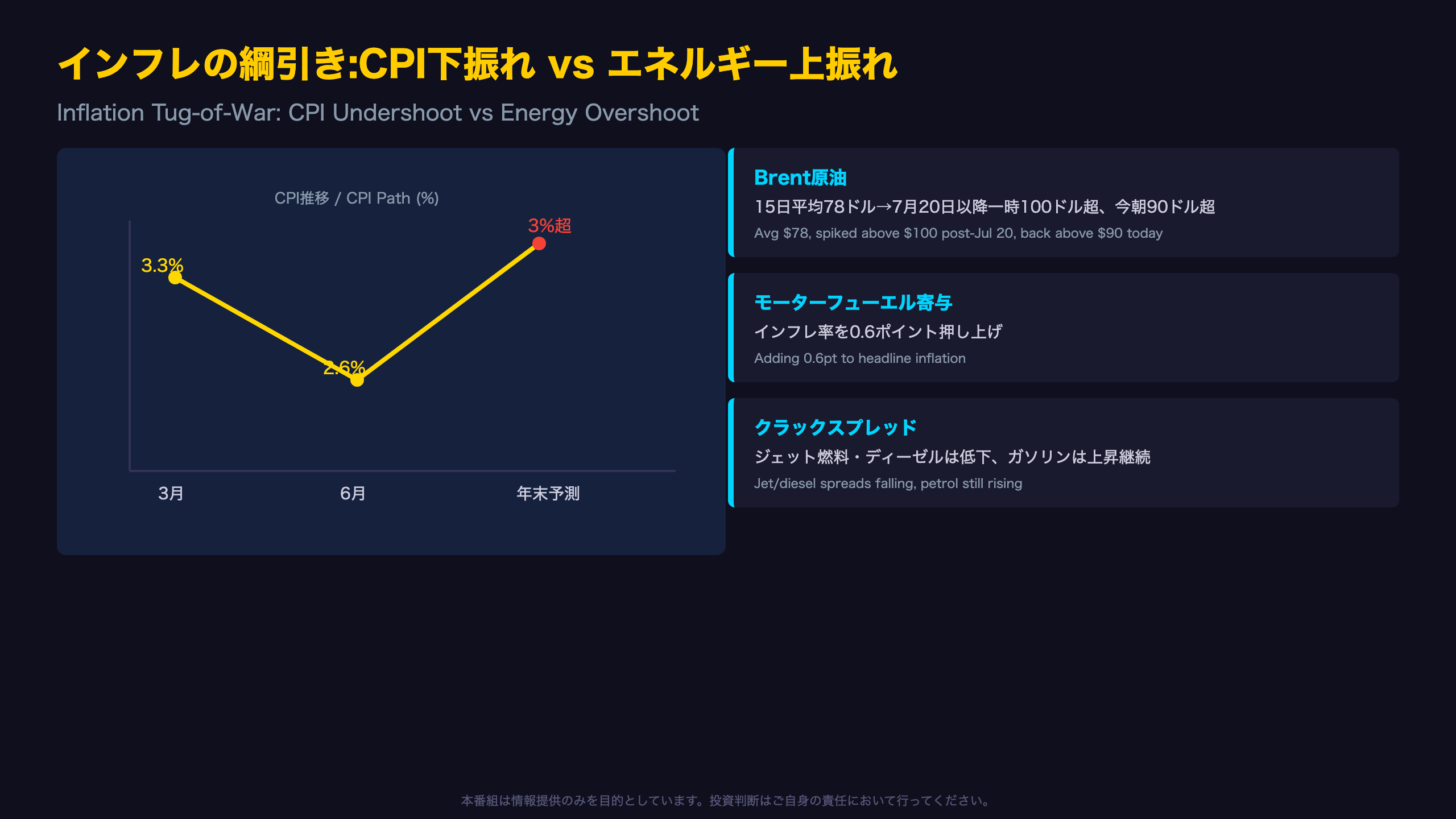
June CPI at 2.6% came in 0.4 percentage points below the April MPR forecast — a meaningful undershoot. Yet Brent crude, which averaged $78/barrel over the 15 working days to July 20 (down from $100 in April), spiked back above $100 in early August before retreating to $84 and then bouncing above $90 — extreme volatility that complicates any simple narrative.
“These are, of course, all significant moves,” Bailey noted regarding oil price swings.
Market Implications
For GBP and gilt traders, this setup suggests two-way risk: dovish on realized inflation data, hawkish on the energy-driven forecast path. The minority hawkish vote (unspecified in the transcript beyond “majority”) keeps a mild upside risk premium alive in short-sterling futures.
What’s Next
Watch the next MPR print and the September QT pace decision as the two nearest catalysts for repricing.
据え置きの決定とベイリー総裁の慎重なトーン
The 1844 Bank Charter Act — Why BOE’s Balance Sheet Is Unique
A striking technical point emerged late in the presser: the BOE’s balance sheet is legally split into an Issue Department and a Banking Department under the 1844 Bank Charter Act. Unlike the Fed or ECB, which run consolidated balance sheets and can use seigniorage income (roughly £4bn/year) as a buffer or book deferred negative assets against future income, the BOE cannot. This structural quirk is precisely why the BOE requires a government indemnity to cover potential QT losses — a detail with no direct US or Eurozone equivalent.
QT By the Numbers
- Peak balance sheet: £895bn (early 2022)
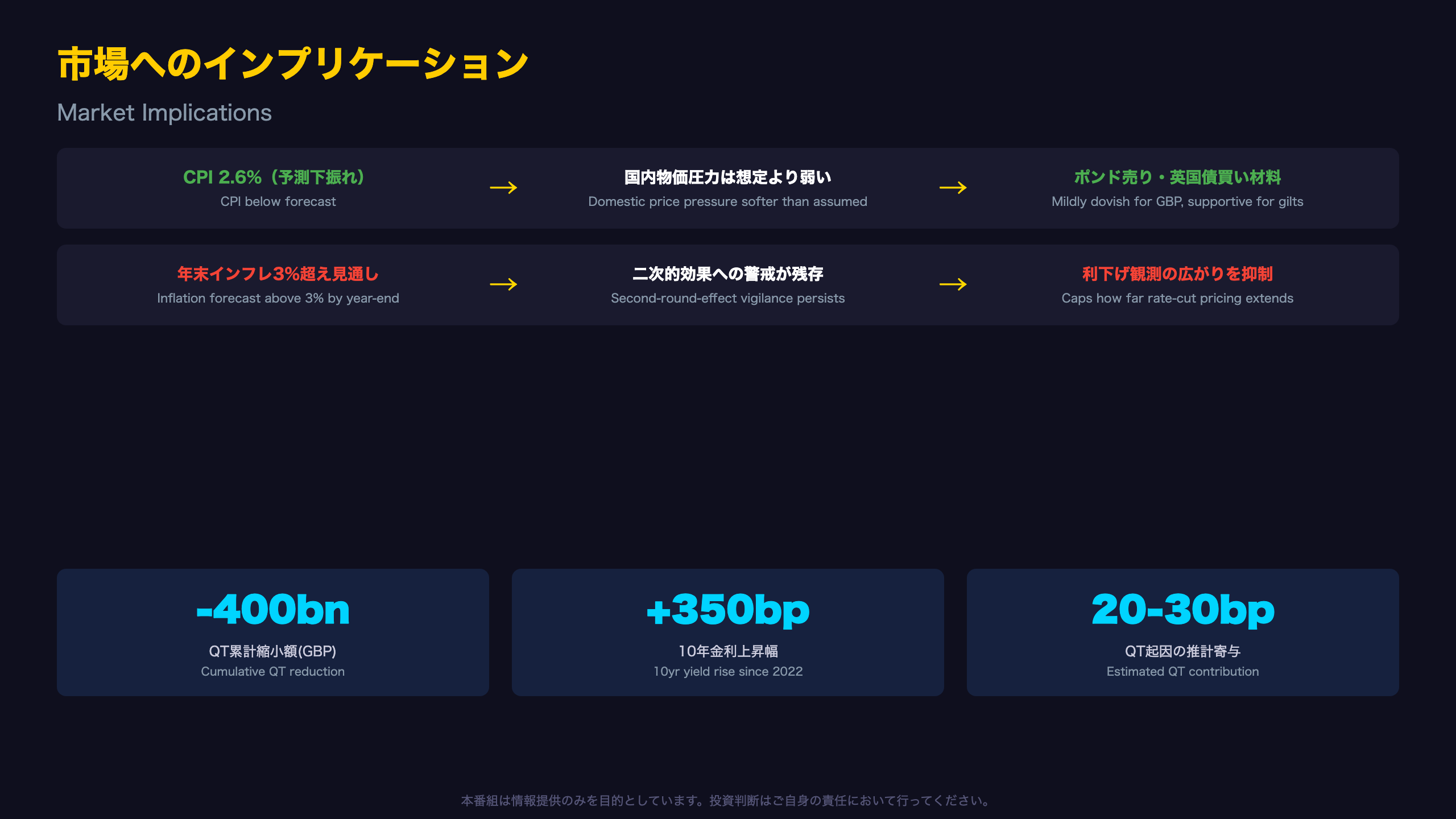
- Current balance: £491bn (a £400bn reduction)
- 10-year gilt yield rise over the period: ~350bps
- Term premium’s share: ~200bps
- Estimated QT contribution: 20-30bps (up from a prior 15-25bp estimate)
This means QT explains only roughly one-tenth to one-sixth of the total term premium move — a modest figure that supports Bailey’s repeated framing that Bank Rate remains the primary policy tool, with QT operating quietly in the background.
Market Read-Through
For gilt investors, this suggests QT pace changes are unlikely to be a major yield driver on their own. The next catalyst is the formal September QT decision, with the BOE’s own market survey suggesting most participants expect a slower pace ahead.
インフレの綱引き:下振れするCPIと上振れするエネルギー
Food Price Outlook: A Modest Upside Surprise, With Caveats
An angle not covered in the anchor script: food prices. Bailey said fresh intelligence suggests food inflation for the rest of the year “will be lower than we thought,” based on Bank agents and survey data — a genuinely encouraging data point.
But Several Upside Risks Remain
- Direct energy pass-through: Bailey noted “the size of the energy content in processed food costs is probably larger than many people would predict”
- A developing El Niño system in the Pacific off Latin America
- Supply chain disruption risk if the Middle East conflict re-escalates, including Panama Canal transit issues flagged in the Report’s Box E
Chief Economist Claire Lombardelli specifically flagged the interaction between El Niño and supply-chain stress as a compounding risk — part of why the Committee sees inflation risks skewed to the upside.
Crack Spread Detail
Jet fuel and diesel crack spreads have retreated from recent peaks, but petrol crack spreads continue rising — the most visible price at the pump, with outsized influence on household inflation psychology.
What to Watch
The September/October MPR should reveal whether El Niño progression and crack spread dynamics force a food inflation revision — a concrete threshold worth tracking for anyone modeling UK CPI.
3つのシナリオ:中央・穏健・悪化
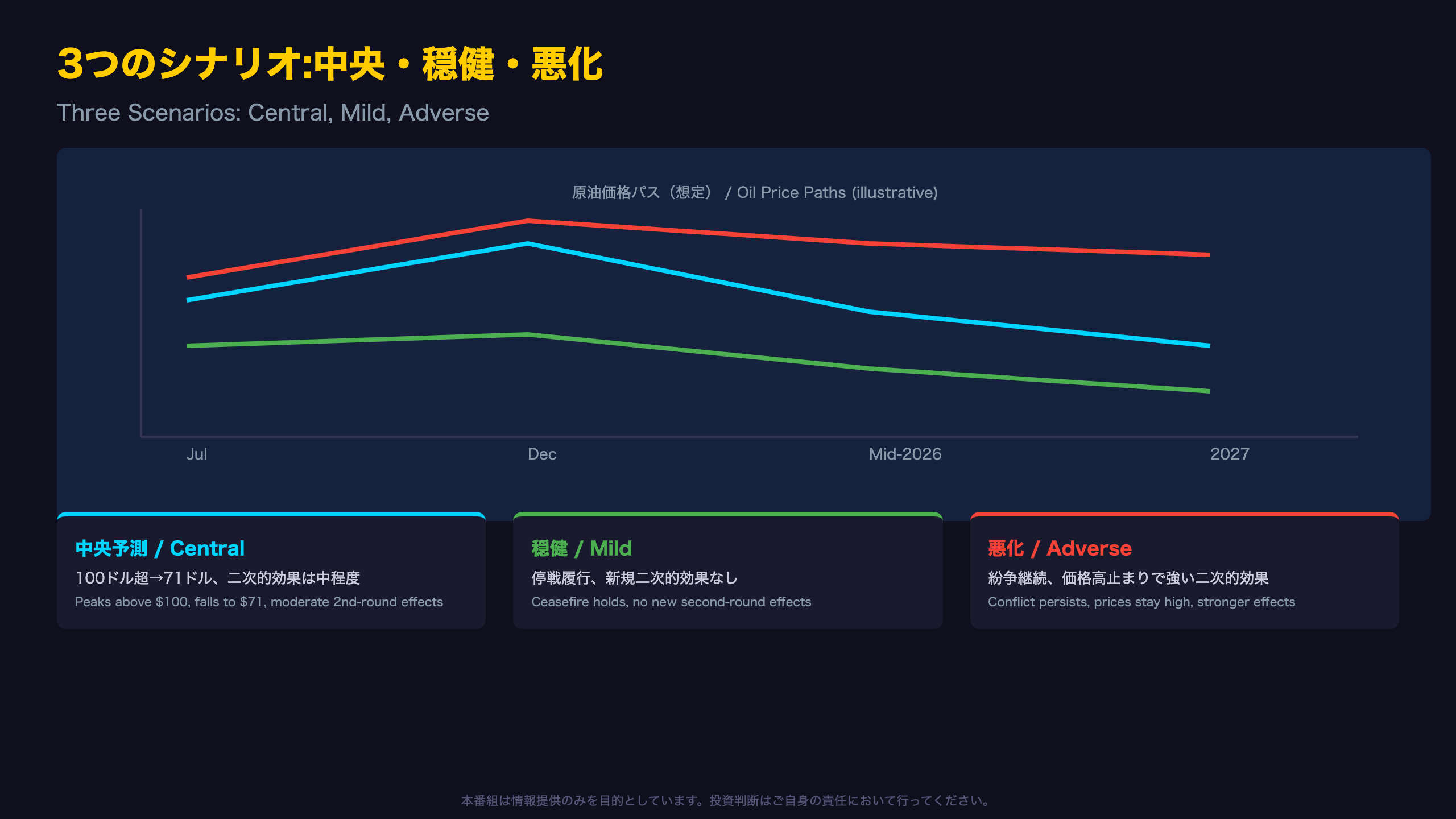
Scenario Analysis: A Post-Bernanke-Review Framework
A key structural point: the BOE’s use of a central projection plus two named scenarios (rather than a single fan chart) stems directly from a recent independent review of its forecasting process. This is a meaningfully different communication style from the Fed’s SEP dot plot, giving the MPC room to express structural uncertainty about supply shocks rather than forcing a single point forecast.
How the Scenarios Evolved Since April
Chief Economist Claire Lombardelli noted that in April “it was unclear how long this would go on for… there were worlds in which this could escalate through energy prices quite quickly but also end quite quickly.” Neither extreme materialized. The Committee has since learned the conflict “could go on for a lot longer” but also that the most extreme energy price spikes once considered plausible “haven’t come to pass and are unlikely to.”
The Adverse Scenario Is About Duration, Not Just Peak
Deputy Governor Dave Ramsden characterized the adverse scenario as reflecting the conflict’s “episodic nature” — a lower peak than April’s version, but more persistent. Bailey added a geopolitical nuance: sustained oil prices above $100 tend to generate “points of resistance,” implying a degree of self-correcting mechanism in extreme price spikes.
Reading the Scenarios Correctly
Bailey was explicit that these scenarios are “neither all-encompassing nor do they reflect the full distribution of risks.” For market participants, this means the scenarios should inform directional thinking about policy sensitivity — not be treated as precise probability-weighted forecasts for pricing derivatives.
二次的効果の証拠は乏しい:3つの観察
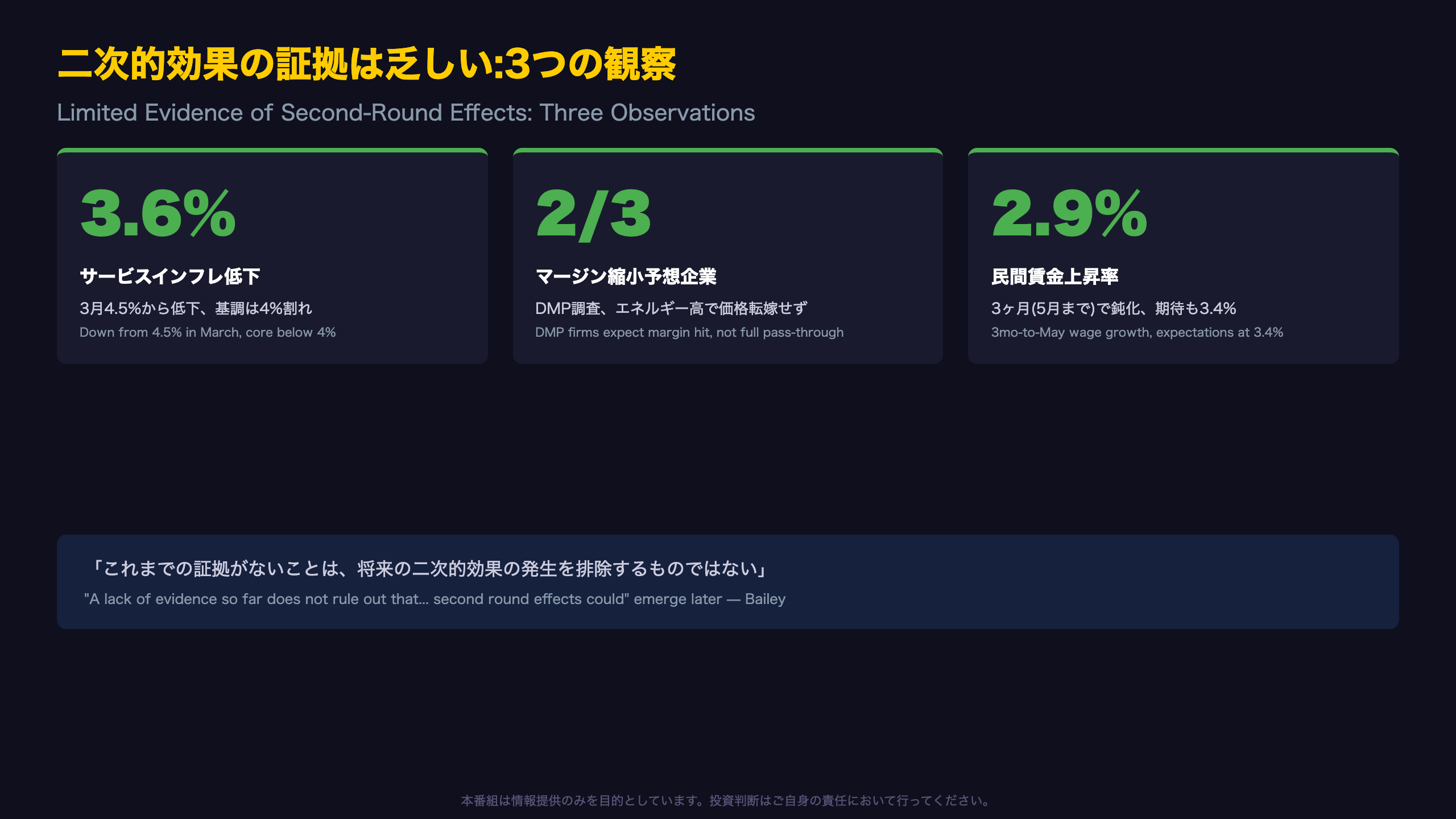
Behind the Numbers: The Decision Maker Panel (DMP)
The “two-thirds of firms expect margin compression” figure comes from the Bank’s Decision Maker Panel (DMP), a rolling survey of UK business executives that, together with the Bank’s regional Agents network, forms one of the BOE’s most important real-time data sources — something with no direct Fed equivalent (the closest US analogue is the regional Fed Beige Book, though DMP is quantitative survey data rather than qualitative anecdotes).
The Structural Lag in Wage Setting
Bailey flagged an important nuance: because firms typically set wage settlements by Q2 of the year, the true impact on wage growth “may only emerge well into next year.” This means the current benign wage data cannot be read as conclusive — it’s simply too early in the transmission chain to rule out delayed second-round effects.
Agent-Reported Wage Settlements
- 2026 average pay settlement (agent-reported): 3.5%
- 2025 average settlement: 4.0%
- Firms cite “looser labor market conditions” as the driver
A Novel Leading Indicator: Search Data
The transcript reveals the BOE now tracks internet search volume for inflation-related terms as a psychological proxy for inflation expectations. Searches spiked after the conflict began and, while down from peak, remain “well above historical norms” — suggesting household inflation psychology hasn’t fully normalized even as hard wage data looks benign.
Policy Read
Chief Economist Lombardelli emphasized that judging how these effects interact — not any single data point — will determine the Committee’s next move.
Q&Aハイライト:利上げ観測への明確な否定

Individual Member Paragraphs: A New Transparency Tool
In recent years, the BOE began publishing individual written paragraphs from each MPC member alongside the collective policy statement — a departure from the Fed, which does not attribute individual dissent rationale in comparable detail outside of dot-plot anonymity. Bailey described this as intended “to give people a sense of how the range of views is formed.”
The Hawkish Minority’s Logic: “Insurance” Tightening
Asked to characterize the dissenting view, Bailey referenced research suggesting that pre-emptively tightening against potential second-round effects could be less costly than correcting course later — a classic “insurance policy” argument in monetary theory. He was careful to note: “I don’t think the evidence points to stronger second-round effects, but I think they think there will be.”
Pushback on Transparency Itself
One reporter asked whether publishing multiple scenarios and individual paragraphs might actually increase uncertainty and risk fueling wage-price second-round effects among non-specialist audiences. Bailey rejected the premise that the BOE is “edging toward a hike” and reframed transparency’s purpose as conveying “meaningful messages,” distinguishing the collective policy statement (majority view) from individual paragraphs (range of views).
Studious Avoidance of Fiscal Commentary
Multiple reporters pressed Bailey on the new government’s fiscal policy and bank taxation plans. He consistently declined to comment, citing insufficient time since the change of government — a pattern reflecting the BOE’s careful guarding of its independence from fiscal politics.
市場へのインプリケーション
Reading the FX Implications
The transcript contains no direct FX commentary, but Bailey’s explanation of the rate curve’s shape is highly relevant for sterling traders. He explicitly stated that the curve’s upward slope “reflects risk premia rather than expectations” of future hikes.
“Market participants find it most likely that Bank Rate will remain at its current level throughout this year, while investors quite reasonably require a premium to compensate for the risk.”
What’s Actually Driving Gilt Volatility
Asked whether the Fed’s reduced forward guidance might spill over into gilt market volatility, Bailey was unambiguous: “By far… the biggest influence on volatility in gilt markets has been the fluctuating events in the Middle East.” This is a notable data point for global macro traders — UK rates volatility right now is a geopolitical risk proxy more than a pure monetary policy signal.
The UK’s Unique “Trade-off Language”
Referencing a recent speech in Iceland, Bailey explained that while the BOE lacks a Fed-style dual mandate, its remit contains “trade-off language” allowing some flexibility in how fast inflation returns to target, with growth and employment forming the second tier of a hierarchical mandate — structurally similar to the ECB’s hierarchy but distinct in implementation. This matters for international investors comparing central bank reaction functions across jurisdictions.
Chain of Reasoning (Evidence → Mechanism → Market Read)
[June CPI 2.6%, below forecast] → suggests underlying domestic price pressure is softer than assumed → modestly dovish for GBP, supportive for gilts at the margin. [Energy-driven inflation forecast above 3% by year-end] → keeps second-round-effect risk alive → limits how far rate-cut pricing can extend, capping gilt rally.
Next Catalysts
The September QT pace decision and the next MPR’s second-round-effect evidence are the two clearest near-term repricing triggers.
Disclaimer: This article is for informational purposes only. All investment decisions are made solely at your own risk.