This article was automatically generated by the NFC Market Live AI analysis system. (Updated: 2026-11-10 17:38 JST)
📄 Primary Source
Sveriges Riksbank
https://www.riksbank.se/en-gb/press-and-published/notices-and-press-releases/press-releases/2026/minutes-of-the-monetary-policy-meeting-on-3-november-2026/
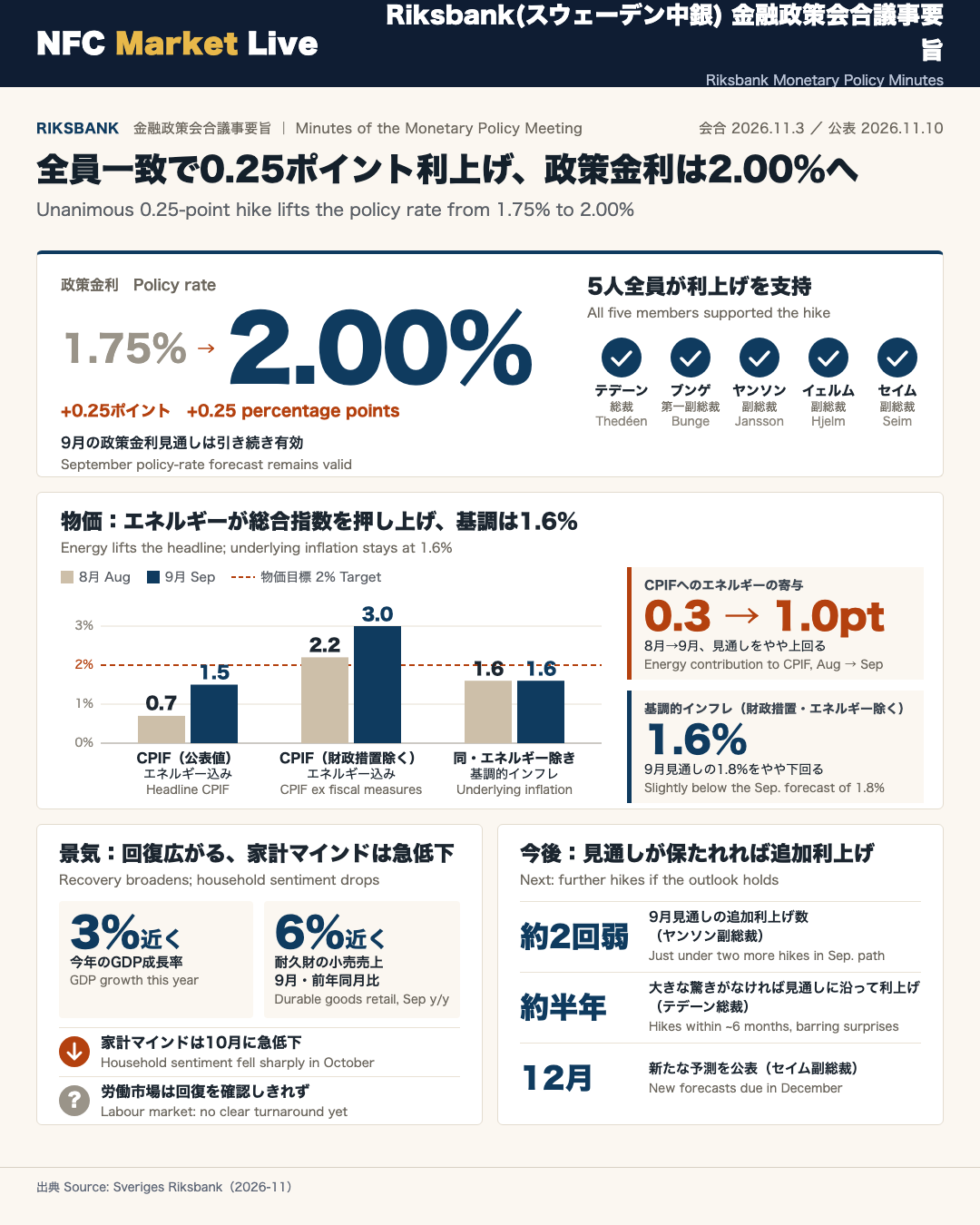
The Riksbank published the minutes of its 3 November 2026 monetary policy meeting on 10 November. The Executive Board raised the policy rate by 0.25 percentage points, from 1.75% to 2.00%, and the policy-rate forecast from the September Monetary Policy Report remains valid. All five members supported the proposal, and the minutes record that there was no ensuing discussion.
📊 Inflation: CPIF was 1.5% in September, up from 0.7% in August. Energy’s contribution rose from 0.3 to 1.0 percentage points, while CPIF excluding energy was unchanged at 0.5%. Excluding the direct effects of temporary fiscal measures, inflation was 3.0% including energy and 1.6% excluding energy.
📈 Activity: Governor Thedéen pointed to GDP growth of nearly 3% this year and rising employment and labour force participation. Household confidence fell sharply in October, and several members said they would watch consumption closely.
💡 Reasoning: Hjelm stressed larger and longer-lasting supply disruptions. Jansson said developments since September justified acting now. Seim argued that early action lowers the risk of more forceful tightening later.
⚠️ Ahead: Bunge stressed a gradual approach, evaluating each step. Thedéen expects hikes in line with the September forecast over roughly the next six months if there are no major surprises, but fewer if demand is weaker. Jansson did not rule out a December hike, and Seim said new forecasts will be published in December.
【サマリー】全員一致の0.25ポイント利上げ:全員が強調した「慎重な正常化」
A unanimous 25bp hike to 2.00%
The minutes of the Riksbank’s 3 November 2026 meeting, published on 10 November, show that the Executive Board raised the policy rate by 0.25 percentage points, from 1.75% to 2.00%, and that the policy-rate forecast from the September Monetary Policy Report remains valid. The Riksbank is Sweden’s central bank, and its five-member Executive Board sets policy. All five members backed the proposal, and the minutes state that there was ‘no ensuing discussion’.
How each member framed the decision
| Member | Core argument | Forward hint |
|---|---|---|
| Governor Thedéen | Stronger economy, higher inflation risks | Hikes in line with the September path over roughly six months, absent major surprises |
| First Deputy Governor Bunge | Economy nearing normal conditions | Gradual approach, evaluating each step |
| Deputy Governor Jansson | Developments since September tipped the balance to act now | A December hike not ruled out |
| Deputy Governor Hjelm | Supply disruptions larger and longer-lasting | A further increase ‘likely’ |
| Deputy Governor Seim | Underlying inflationary pressure above normal | New forecasts due in December |
What changed since September
In September, all five had supported holding the rate at 1.75%. Even then, Seim said she would advocate a first hike in November and Thedéen called a November hike reasonable. Jansson had justified waiting by pointing to moderate inflation at the outset; this time he said the changes since then were enough to convince him to act rather than wait. The policy rate had been unchanged since September 2025.
Strengths and caveats
- Resilience: Thedéen cited GDP growth of nearly 3% this year, and business sentiment remains strong.
- Caveats: Household confidence fell sharply in October, and Bunge called the labour market ‘a question mark’.
The common thread is tone: every member described the move as a normalisation of policy rather than a dramatic tightening.
物価認識:エネルギーが押し上げる総合指数と、1.6%にとどまる基調
September CPIF: energy lifts the headline
According to Deputy Governor Jansson, CPIF, the Riksbank’s target variable, rose to 1.5% in September from 0.7% in August. Energy’s contribution jumped from 0.3 to 1.0 percentage points, slightly above forecast. Excluding energy, CPIF was 0.5% in both months, a few tenths below the September forecast.
Stripping out temporary fiscal measures
| Measure | August | September |
|---|---|---|
| CPIF excl. direct effects of temporary fiscal measures, incl. energy | 2.2% | 3.0% |
| Same, excl. energy (underlying inflation) | 1.6% | 1.6% |
Governor Thedéen noted that underlying inflation of 1.6% was slightly below the 1.8% forecast in the September Monetary Policy Report, partly because travel prices rose less than expected. He said this hardly changes the assessment that the more fundamental driving forces point upward.
Where members focused
- Jansson: Inflation excluding energy staying below 2% is reassuring. Energy-inclusive three- and six-month rates exceed 4.5% annualised, but he cautioned that such high-frequency measures are volatile. Futures prices point to steep declines, yet have systematically underestimated energy prices this year.
- Hjelm: Import prices rose about 4.5% month-on-month in September and about 15% since the war began (versus about 40% in 2021-22). Input prices excluding energy in the domestic supply index are up about 10%. Yet underlying inflation in the US and euro area has barely moved, so indirect effects are limited so far.
- Bunge: Producer-price increases and elevated pricing plans are a concern; signs of changed pricing behaviour could call for swifter action.
- Thedéen: Firms may have adapted enough to avoid large price increases, in which case underlying inflation would rise less than expected.
Takeaway
The gap between the energy-driven headline and the 1.6% underlying rate shaped the debate, and members were careful not to over-read a single month.
景気認識:回復は広がる一方、家計マインドが急低下
A broadening recovery
Governor Thedéen said new information since September confirms a stronger Swedish economy and supports the forecast that GDP will grow by nearly 3% this year. The employment rate and labour force participation have kept rising, and youth unemployment fell in September. Durable goods sales in retail were almost 6% higher in September than a year earlier.
Jansson noted that preliminary statistics suggest solid growth in the third quarter, somewhat stronger than the September Monetary Policy Report anticipated. Business sentiment is stronger than normal in manufacturing and retail. Hjelm added that the outlook for the construction sector is improving.
Reading the sharp fall in household confidence
The National Institute of Economic Research’s Economic Tendency Survey showed household sentiment dropping sharply in October. Members offered different interpretations:
| Member | View |
|---|---|
| Jansson | Possibly the electricity price rise in September, expected high winter prices, or the protracted government formation; consumption has been strong despite weak sentiment |
| Hjelm | Household inflation expectations rose in the same survey, consistent with anticipated higher spending on fuel, electricity and mortgages; the risk is offset ‘with some margin’ by rising corporate optimism |
| Seim | Sampling may explain it, and one outcome should not drive conclusions; fiscal support to real incomes is being phased out |
| Bunge | Unclear whether it is a temporary dip; if household demand weakens, firms’ pricing power falls and the need for further tightening could decline |
The labour market remains the open question
Bunge called the labour market ‘a question mark’. Hjelm noted that services account for just over 50% of business-sector employment and that recruitment plans there are below normal. Yet order volumes are near normal and productivity appears temporarily high (‘negative labour hoarding’), which supports expectations of higher employment. If demand develops as expected without the spare capacity being used, he said, it would imply higher permanent productivity and a less expansionary policy rate than he currently assesses.
Summary
The picture has two sides: strength in business, production and exports, and softness in household sentiment and service-sector hiring. Members avoided over-interpreting single-month data.
なぜ「今」だったのか:利上げ論拠の整理(供給・需要・為替)
What accumulated since September
Jansson said that even in the September forecast there was a relatively high probability that a hike might be appropriate at this meeting, and that what has happened since was enough to convince him to act. Members stressed different arguments.
Hjelm: three reasons
- The policy rate is ‘mildly expansionary’ even apart from the extraordinary demand drivers, so normalisation is reasonable as the economy strengthens.
- The recovery has become clearer, with several indicators pointing to further strengthening.
- Most important for him: supply disruptions and the cost increases they entail have become larger and lasted longer than feared.
Hjelm said it is appropriate, within limits, to look through supply-driven inflation provided inflation expectations are anchored and wage formation and fiscal policy do not hinder policy. But when resource utilisation is above normal, price pass-through can increase non-linearly, so policy should keep utilisation in check with a margin of safety. In a ‘parallel universe’ without the supply disruptions, he said, the option value of waiting would have outweighed other factors.
Seim: the cost of inflation and acting early
She described underlying inflationary pressure as stronger than normal and pointed to rising prices of electronic products linked to AI development. She stressed that inflation erodes real incomes and purchasing power, and is regressive, hitting low-income households hardest. Acting early, she argued, reduces the risk of having to act more forcefully later.
Thedéen: support for the recovery is no longer needed
The cut from 2.25% to 1.75% just over a year ago was meant to support a tentative recovery. With the upturn now relatively strong and broad, he argued it is appropriate to move policy in a less expansionary direction.
The krona
Jansson noted the krona has strengthened by nearly 3% against the euro and about 1% against the US dollar since shortly after the September decision. But it remains significantly weaker since the war began on 28 February and will soon exert upward pressure on prices. Thedéen said the recent stabilisation dampens inflation risks somewhat.
Takeaway
All five framed the move as normalisation, but with different emphases: supply shocks (Hjelm), underlying prices (Seim), and the recovery itself (Thedéen, Bunge).
次の一手:委員間のニュアンスの差、シナリオ、12月に向けた確認点
The path ahead: common ground and nuances
Common ground: All five members see further hikes in line with the September forecast as likely or reasonable, conditional on the outlook for activity and inflation holding.
| Member | Key forward-looking remark |
|---|---|
| Jansson | What matters is the total of ‘just under two further increases’ envisaged in September, not exact timing; he does not think hiking now rules out a December hike; even if slightly faster, still a ‘relatively cautious normalisation’ |
| Hjelm | The extent is still to be seen, but a further increase is ‘likely’ |
| Seim | Gradual adjustment if conditions hold; new forecasts in December, with readiness to adjust |
| Bunge | Gradual approach evaluating each step; a different policy could result if the premises do not hold |
| Thedéen | Expects hikes in line with the September forecast over roughly the next six months, absent major surprises |
Scenario branches (Thedéen)
- Upside inflation: If supply-driven cost increases interact with strong domestic demand and spread across industries, the policy rate might need to rise ‘a few times more’.
- Weaker demand: If growth is weaker and underlying inflation rises more slowly, the rate would likely not need to rise as far as the latest forecast indicates.
He described the September policy-rate forecast as a weighting of such scenarios and cautioned against overstating its precision.
Risks members flagged
- Supply: Futures-implied energy price declines have repeatedly proved too optimistic this year (Thedéen, Jansson). Crude oil is up about 50% from just over USD 70 per barrel in late June/early July.
- Financial: Bunge highlighted debt-financed AI investment, higher rates and public-debt problems as a potential ‘bitter cocktail’, citing the IMF’s framing of a supply disruption from the war versus a demand disruption from the AI investment boom.
- Political: Seim noted that the US mid-term elections on the day of the meeting could affect the krona, activity and Swedish inflation.
What to watch next
Household confidence and consumption, labour-market improvement, producer prices and corporate pricing plans, the krona, and energy prices. Seim said new forecasts will be published in December.
Disclaimer: This article is for informational purposes only. All investment decisions are made solely at your own risk.