This article was automatically generated by the NFC Market Live AI analysis system. (Updated: 2026-11-05 18:04 JST)
📄 Primary Source
Norges Bank
https://www.norges-bank.no/en/topics/monetary-policy/Monetary-policy-meetings/2026/november-2026/
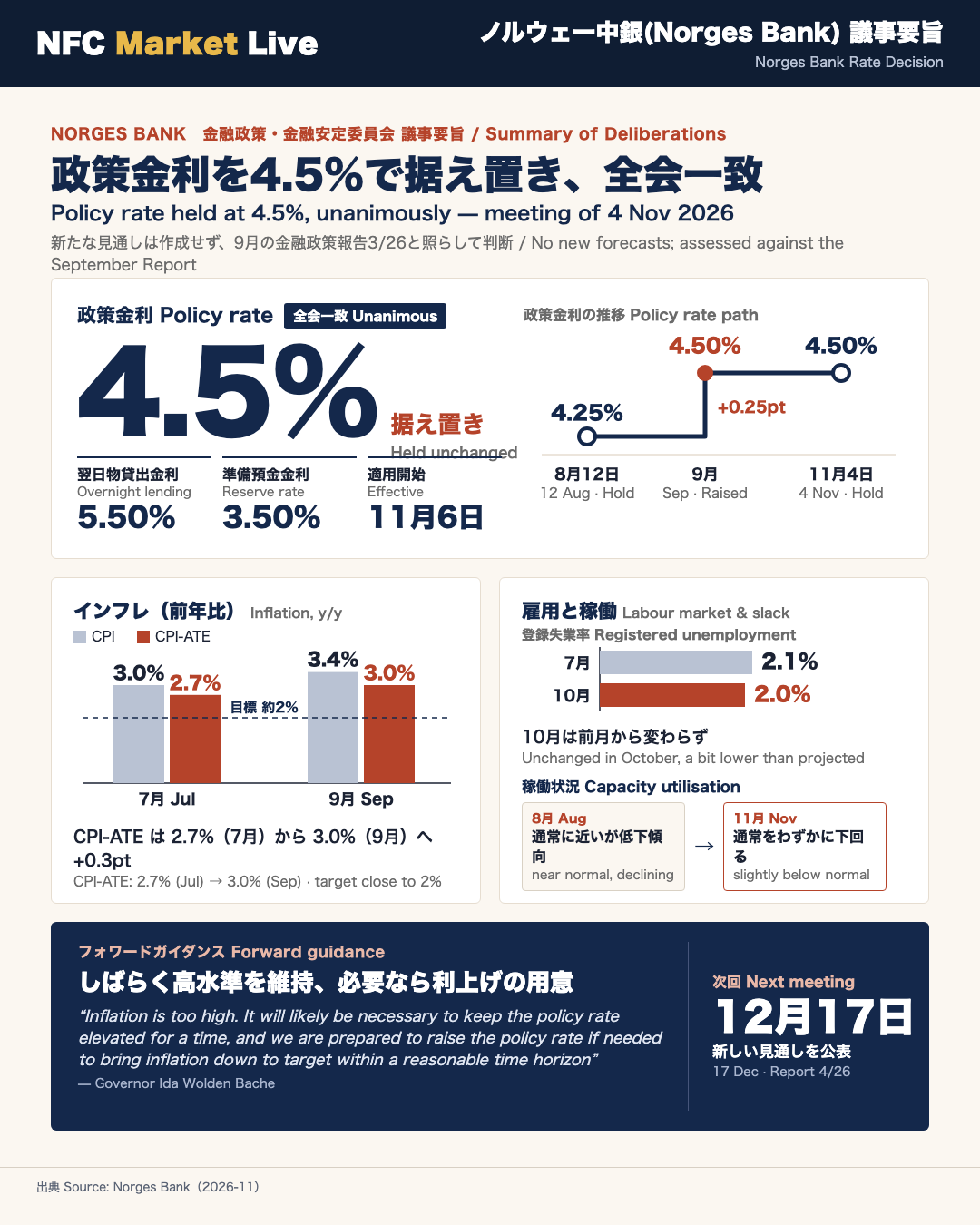
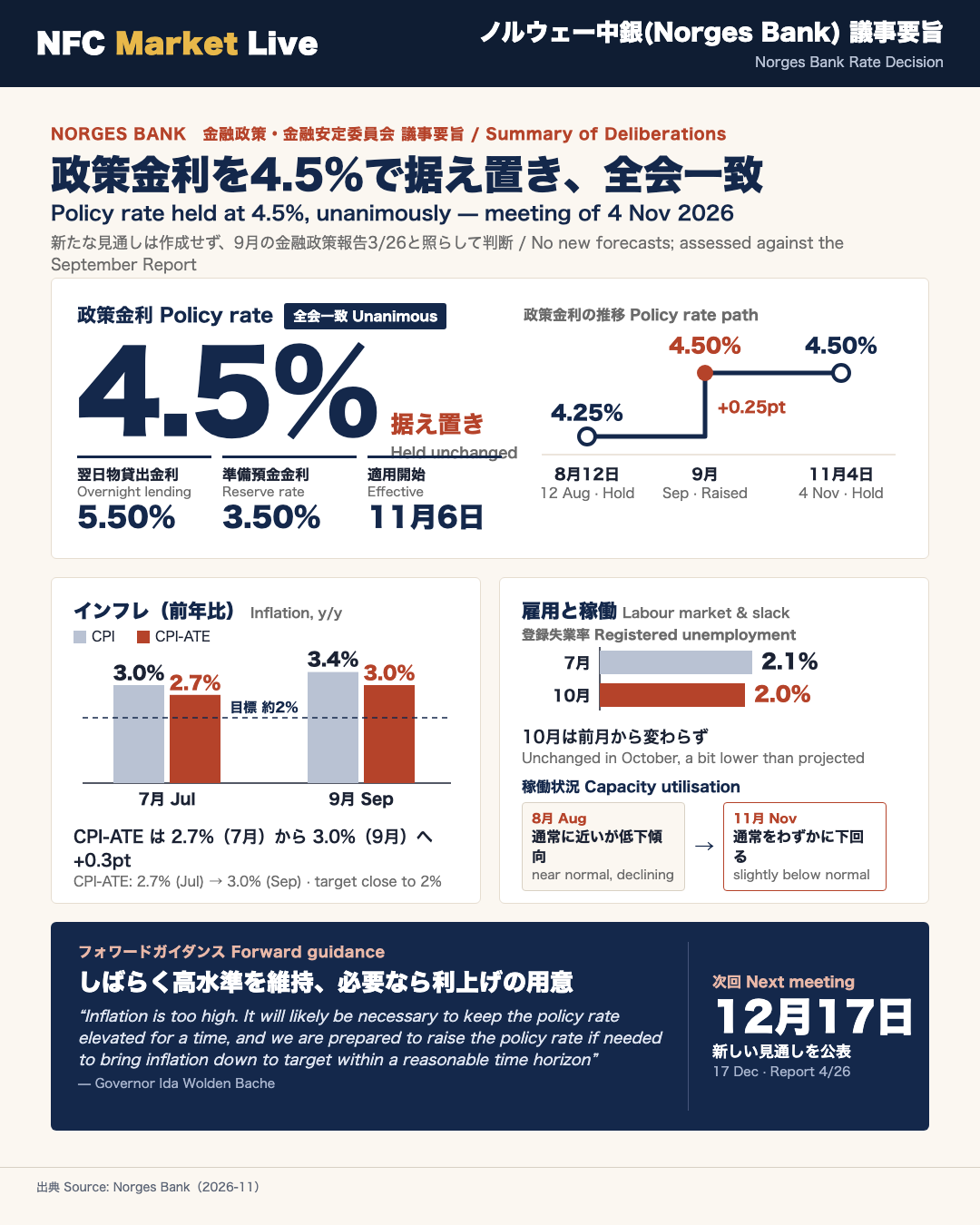
📊 Norges Bank’s Monetary Policy and Financial Stability Committee voted unanimously on 4 November to keep the policy rate at 4.5%. The overnight lending rate is 5.50% and the reserve rate 3.50%, effective 6 November. The rate was raised from 4.25% to 4.5% in September, and was held at 4.25% at the August meeting.
💡 In September, 12-month CPI inflation was 3.4% and CPI-ATE (adjusted for tax changes, excluding energy) was 3.0%. Inflation was broadly as projected, but domestically produced goods and services inflation was higher than the September Report assumed, while imported consumer goods inflation was lower. The krone has appreciated and is stronger than assumed. Registered unemployment was 2.0% in October, a bit lower than expected, and capacity utilisation appears slightly below a normal level.
⚠️ Governor Ida Wolden Bache said inflation is too high, that it will likely be necessary to keep the policy rate elevated for a time, and that the Committee is prepared to raise it if needed. Conflicts in the Middle East continue to create uncertainty about the inflation outlook.
📅 Next meeting: 17 December 2026, with new forecasts in Monetary Policy Report 4/26.
11月会合の結論:政策金利4.5%を全会一致で据え置き
The Decision: Rate Held at 4.5%, Unanimously
Norges Bank, Norway’s central bank, kept its policy rate at 4.5% on 4 November. The vote was unanimous. The overnight lending rate is 5.50% and the reserve rate 3.50%, both effective 6 November. No new forecasts were produced. The Committee judged incoming data against Monetary Policy Report 3/26, published on 24 September.
How the Path Evolved
| August meeting | November meeting | |
|---|---|---|
| Policy rate | 4.25%, unchanged | 4.5%, unchanged (raised in September) |
| Committee tone | Further hike may still become necessary | Rate likely to stay elevated for a time; prepared to raise if warranted |
| CPI-ATE y/y | 2.7% (July) | 3.0% (September) |
| Capacity utilisation | Close to normal, drifting down | Slightly below normal |
“The Committee is prepared to raise the policy rate if warranted by the inflation outlook.”
Institutional Context
Norges Bank’s Monetary Policy and Financial Stability Committee has five members. It targets inflation of close to 2% over time, similar to the Fed and the ECB. It also has a mandate to support high employment and economic stability. Its CPI-ATE measure strips out tax changes and energy products.
Two Ways to Read the Statement
- Hawkish-leaning: the hike option is explicitly stated, and inflation is described as markedly above target.
- Balanced: the Committee says it does not want to restrict the economy more than needed. The September projection had the rate near 4.5% for a period, then declining somewhat.
Market Pricing Mentioned in the Documents
The November summary says the market is pricing in a policy rate increase by the end of the first half of 2027. It also says Norwegian rate expectations have declined a little since September. This is market pricing, not Committee guidance.
What Comes Next
The next decision is on 17 December 2026, together with Monetary Policy Report 4/26 and new forecasts.
インフレ:見通しどおりの物価、エネルギーと為替の綱引き
Inflation Is Close to Plan, but the Mix Matters
In September, 12-month CPI inflation was 3.4% and CPI-ATE was 3.0%. Norges Bank describes this as broadly as projected. The composition, however, is mixed.
- Domestic goods and services: inflation stayed elevated and was higher than expected in the September Report.
- Imported consumer goods: inflation slowed and was lower than expected.
- Average of underlying indicators: unchanged from August to September, close to CPI-ATE.
Comparison With the August Meeting
In August, July CPI was 3.0% and CPI-ATE 2.7%. CPI-ATE was 0.6 percentage point below projection then, driven mainly by slower food and ICT price rises. By the November document, CPI-ATE had moved up to 3.0%.
Energy and the Krone
- Oil spot prices fell, but futures rose somewhat.
- Gas and electricity prices, spot and futures, moved up.
- Aluminium and various agricultural products fell.
- The krone has appreciated and is stronger than assumed.
“New information on the drivers of inflation pulls in different directions.”
Why This Matters Internationally
Norway is a major oil and gas exporter, yet the Committee treats energy mainly as an inflation input and a source of uncertainty linked to the Middle East. CPI-ATE is the Bank’s core-type measure. It excludes energy and tax changes, much like the “core” gauges followed by the Fed and ECB. A stronger krone lowers import prices, which is why the Committee links it to dampening inflation.
Balanced Reading
- Upside inflation risks: elevated domestic inflation, higher energy prices and rapid business cost increases.
- Downside inflation factors: slower imported inflation and the krone appreciation.
What to Watch
The SMART system, which combines forecasts from many models, shows near-term inflation forecasts close to the September Report. Domestic inflation, energy prices and the krone are the items to follow before 17 December.
雇用・景気・住宅:底堅い労働市場と低調な建設活動
A Resilient Labour Market, a Soft Construction Sector
In the November document, registered unemployment was 2.0% in October, unchanged and a bit lower than projected. Labour Force Survey (LFS) unemployment has changed little. Preliminary figures show the number of salaried employees rising slightly more than expected. Capacity utilisation is now judged to be slightly below a normal level, versus “close to normal and drifting down” in August.
Demand and Housing
- Household consumption is rising broadly as projected, based on card transactions and wholesale/retail sales.
- Seasonally adjusted house prices have risen as expected.
- New home sales and building permits remain very low.
- The Ministry of Finance estimates the 2027 budget proposal is roughly neutral for activity.
Supplementary Points From the August Documents
House prices fell 1.1% (seasonally adjusted) in July, and some members worried about low construction activity. Household credit growth was stable at about 4.7%. Banks were described as highly profitable and well above capital and liquidity requirements. The countercyclical capital buffer was kept at 2.5%. This buffer is an extra capital requirement for banks, set between 0% and 2.5% in normal times, designed to lessen the risk that banks amplify a downturn.
Global Backdrop
- Trading-partner growth in Q3 2026 was somewhat stronger than projected, and AI-related investment continues to lift US growth.
- Long-term yields have fallen somewhat since September in most countries, but have risen further in some European countries such as France.
- Leading equity indices declined slightly, led by technology stocks, and corporate credit spreads in the US and Europe widened.
- The krone has strengthened against many currencies.
Balanced Assessment
- Resilience: low unemployment, employment above expectations, consumption on track.
- Soft spots: capacity slightly below normal, depressed housing construction, and wider credit spreads abroad.
For English-speaking readers, the I-44 import-weighted krone index mentioned in the August summary is the Bank’s preferred gauge of the krone against Norway’s import partners.
フォワードガイダンスと今後の焦点:12月17日に新見通し
Forward Guidance in Three Parts
The November statement can be read as three layers:
- Diagnosis: inflation remains markedly above target, and rapid business cost increases will likely keep it elevated.
- Baseline: the current outlook implies the policy rate will likely need to stay elevated for a time.
- Conditional option: the Committee is prepared to raise the rate if warranted by the inflation outlook.
“The future path of the policy rate will depend on how the economy evolves.”
Change in Language Since August
In August the Committee noted that it had judged in June that a hike would likely be needed at an upcoming meeting. Inflation had been lower than projected, but it was too early to conclude the outlook had changed materially. By November, after the September hike to 4.5%, the message centres on keeping the rate elevated while retaining a hike option.
What the Committee Is Watching
- Domestically produced goods and services inflation, still above projection.
- Energy prices tied to Middle East conflicts: oil futures, gas and electricity are higher.
- The stronger krone, which in isolation dampens inflation.
- Employment and capacity utilisation: unemployment is low, while capacity is slightly below normal.
Two Perspectives
- Case for staying alert on hikes: inflation has been above target for years. The Committee warns that prolonged high inflation can make households and firms plan for persistent inflation, making it stickier.
- Case for avoiding over-tightening: the Committee says it does not want to restrict the economy more than needed. Capacity is slightly below normal and construction is very weak.
Market Pricing, as Reported in the Summary
The November summary says the market is pricing in a policy rate increase by the end of the first half of 2027. Norwegian rate expectations have fallen a little since September. Neither point is Committee guidance.
Next Event
The 17 December 2026 meeting will bring Monetary Policy Report 4/26 and a new forecast path. Until then, the data on domestic inflation, energy prices and the krone are the items most directly linked to the Committee’s stated conditions.
Disclaimer: This article is for informational purposes only. All investment decisions are made solely at your own risk.