📺 Watch the Full Video Analysis
This article was automatically generated by the NFC Market Live AI analysis system. (Updated: 2026-10-09 01:08 JST)
📄 Primary Source
Banco de México
https://www.banxico.org.mx/publicaciones-y-prensa/minutas-de-las-decisiones-de-politica-monetaria/{F63C3DE2-0AEC-9BAE-A86E-FC59895F9702}.pdf
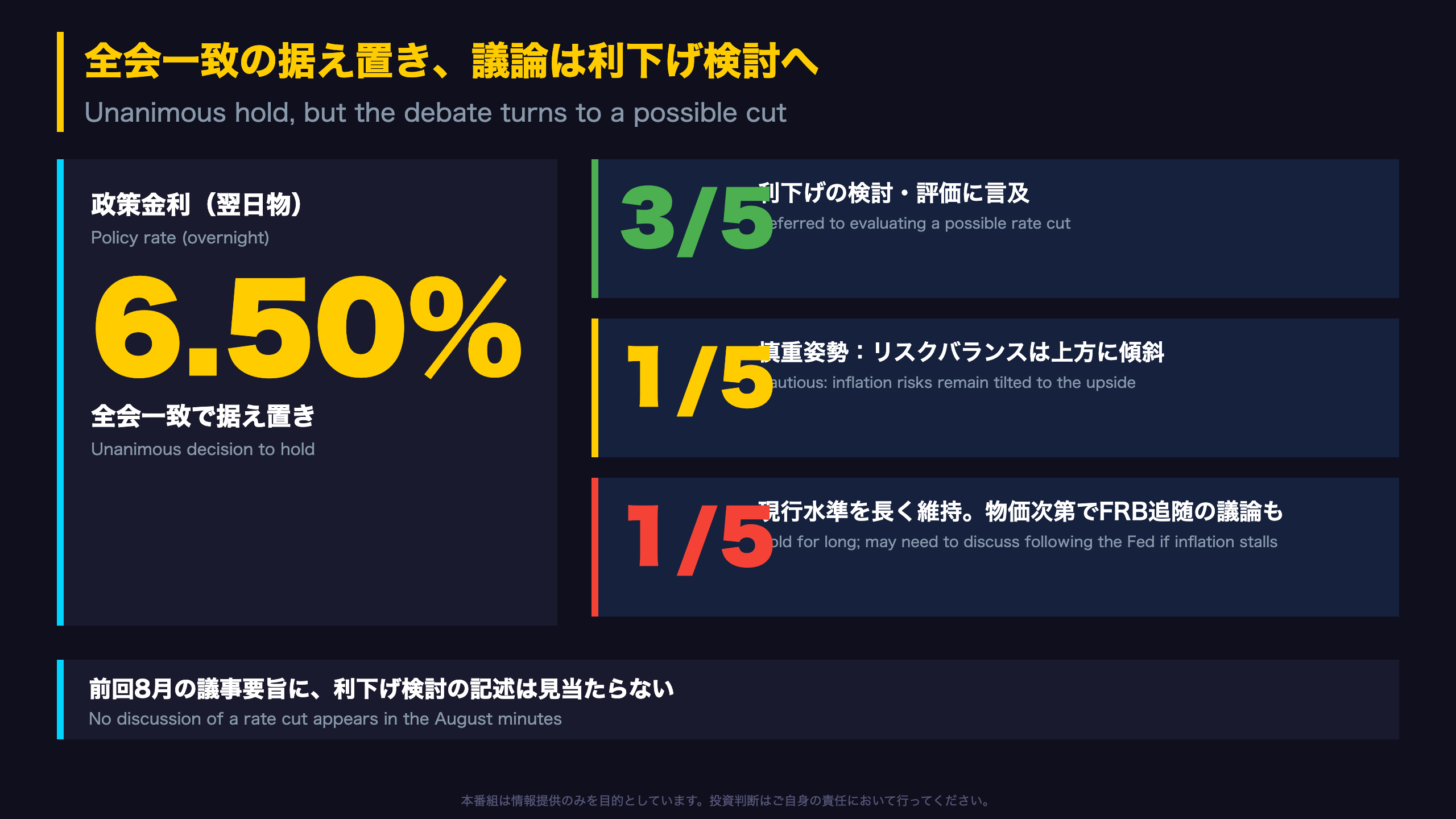
📊 Banxico held its overnight rate at 6.50% by unanimous vote.
💡 The minutes show three of five voting members referring to a possible rate cut. August’s line that keeping the rate at its current level is appropriate is gone, replaced by wording that Banxico need not react mechanically to Fed hikes.
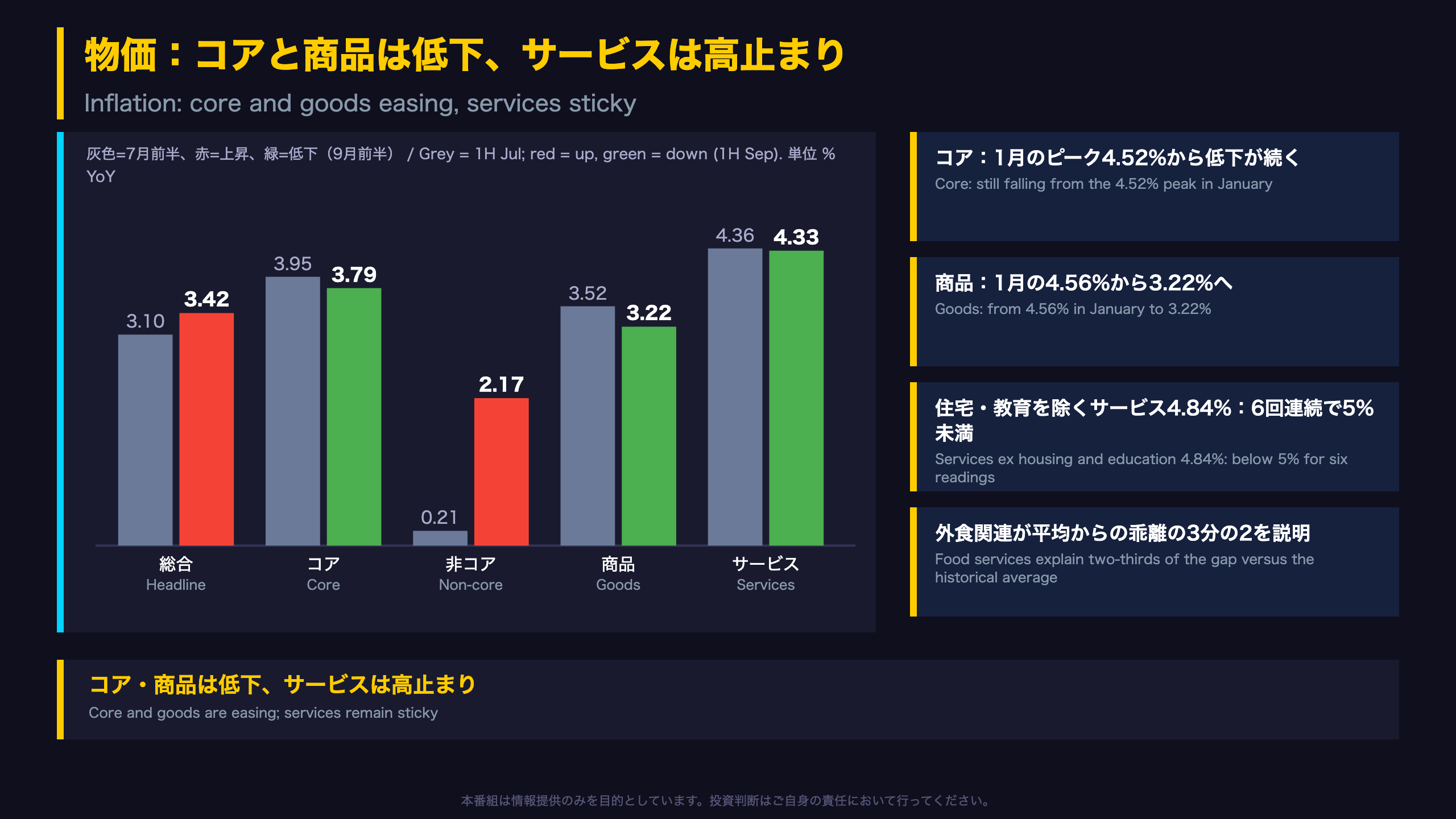
📉 Core inflation fell to 3.79% (January peak: 4.52%) and the 2026 growth forecast was raised to 1.5%.
⚠️ But services inflation is sticky at 4.33%, one member sees the real rate near the top of the neutral range, and the inflation risk balance still tilts upward.
We break down the balance of power on the board.
全会一致の据え置き、議論は利下げ検討へ
A hold with a shifting debate
What is Banxico? Banxico is Mexico’s central bank (Banco de Mexico). Its Board of Governors has five voting members. The inflation target is 3%, with a variability interval of one percentage point either side. The overnight interbank rate is the policy rate, currently 6.50%.
What changed since August
The August minutes centered on defending the hold and judging whether the neutral stance was sufficient. In September, three of the five voting members referred to evaluating a possible reduction. One described a fine-tuning cut as not an anticipated decision but a discussion that should be kept open, conditional on continued disinflation and orderly financial markets.
The hawkish counterweight
Another member argued the current stance should be held for a prolonged period. The average ex-ante real rate over the last eight quarters is 4.13%, near the top of the neutral range. If inflation does not converge to 3% convincingly, this member said, the board might need to discuss moving in step with the Fed.
International comparison
The Fed raised its target range by 25 bp to 3.75-4.00% in September, its first hike in more than three years, and the ECB (deposit rate 2.50%) and Bank of Japan (1.25%) also tightened. Mexico is therefore discussing a possible easing while major peers tighten, a divergence that one member explained by pointing to different cycle positions: the US output gap sits at the 82nd percentile of its history, Mexico’s at the 12th.
Market implications
The peso depreciated 1.86% between the two meetings (range 16.86-17.61 per dollar) and domestic yields rose, so the FX and rates backdrop is a stated constraint. Any move toward a cut would rest on orderly markets, which is a condition cited by the members themselves.
Independent view
The distribution of views matters more than the vote. A unanimous hold with three members opening the door to cuts and one flagging possible hikes signals a board whose range of options has widened in both directions. The next meeting date is not given in the source.
ガイダンスの文面が変わった
Reading the two statements side by side
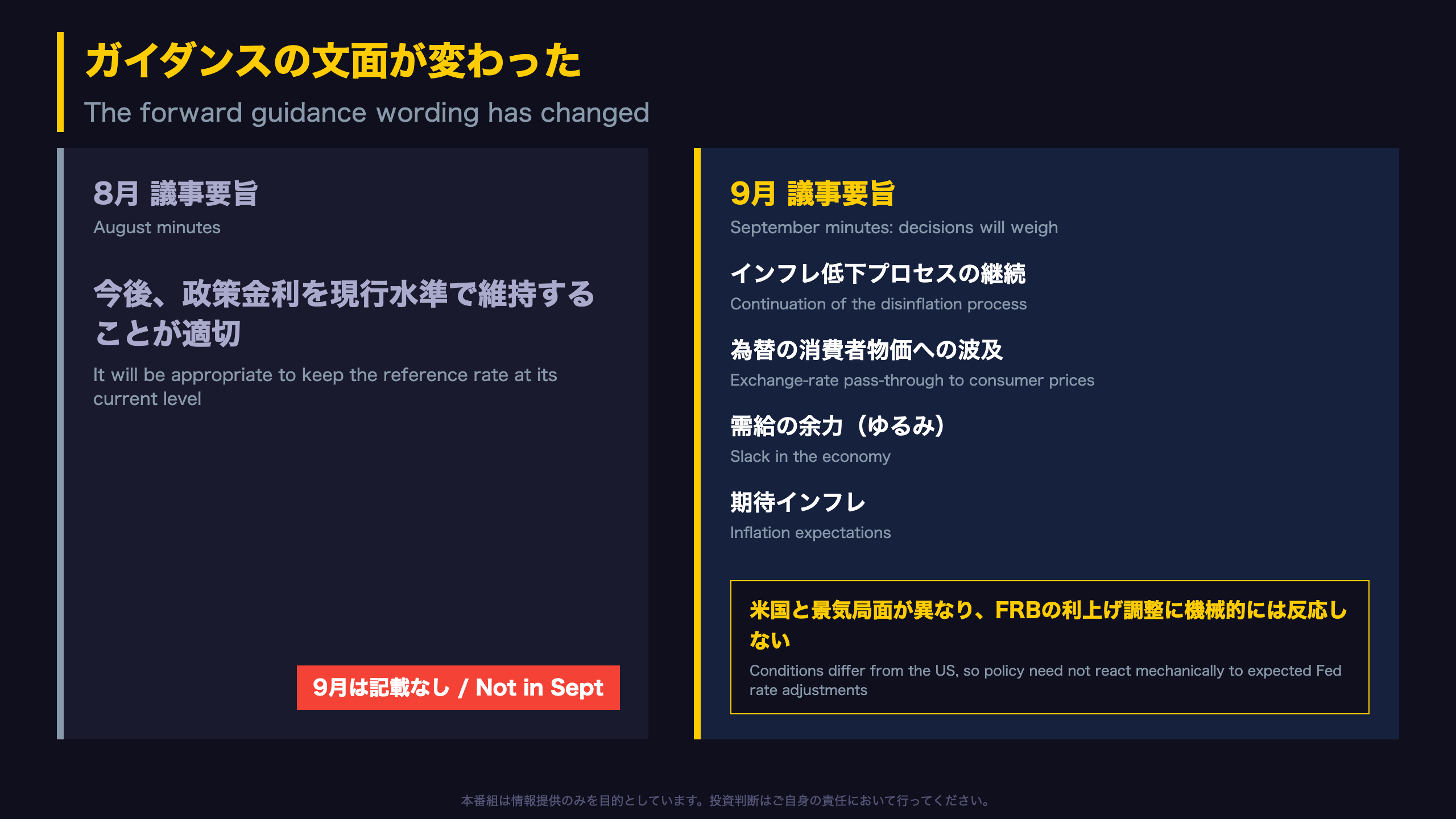
The forward guidance is the official signal Banxico sends about its next steps, and it is published with the decision. Comparing the August and September texts shows a change in tone.
- August: it would be appropriate to keep the reference rate at its current level, and the stance was judged adequate to meet external challenges.
- September: future decisions will consider the continuation of the disinflation process and the expected behavior of its determinants, namely exchange-rate pass-through to consumer prices, slack and inflation expectations. Because Mexican conditions differ from US conditions, policy need not react mechanically to the expected Fed adjustments.
What the members added
One member said decisions should be taken meeting by meeting, without committing to a predetermined path. Another said the two economies are in different cycle phases. The most hawkish member countered that if inflation does not approach 3% in a consolidated way, a discussion of following the Fed’s hiking cycle might become necessary.
International context
The Fed lifted its range by 25 bp to 3.75-4.00%, and the median FOMC projection implies another 25 bp this year, with eight of eighteen officials expecting a further increase in 2027. The ECB is data-dependent and meeting-by-meeting with a 2.50% deposit rate. Banxico is thus choosing explicit independence from the Fed’s path rather than a fixed guide.
Market implications
With the explicit hold commitment gone, domestic rate expectations may depend more on inflation data, the peso and Fed signals. The peso weakened 1.86% between meetings, so FX is a factor the board is openly monitoring.
Independent view
Two readings coexist: more flexibility toward easing, or a quiet insurance clause against Fed-driven pressure. The next meeting date is not stated in the source.
5人の力関係:ハト寄り3、中立1、タカ寄り1
Mapping the five voices
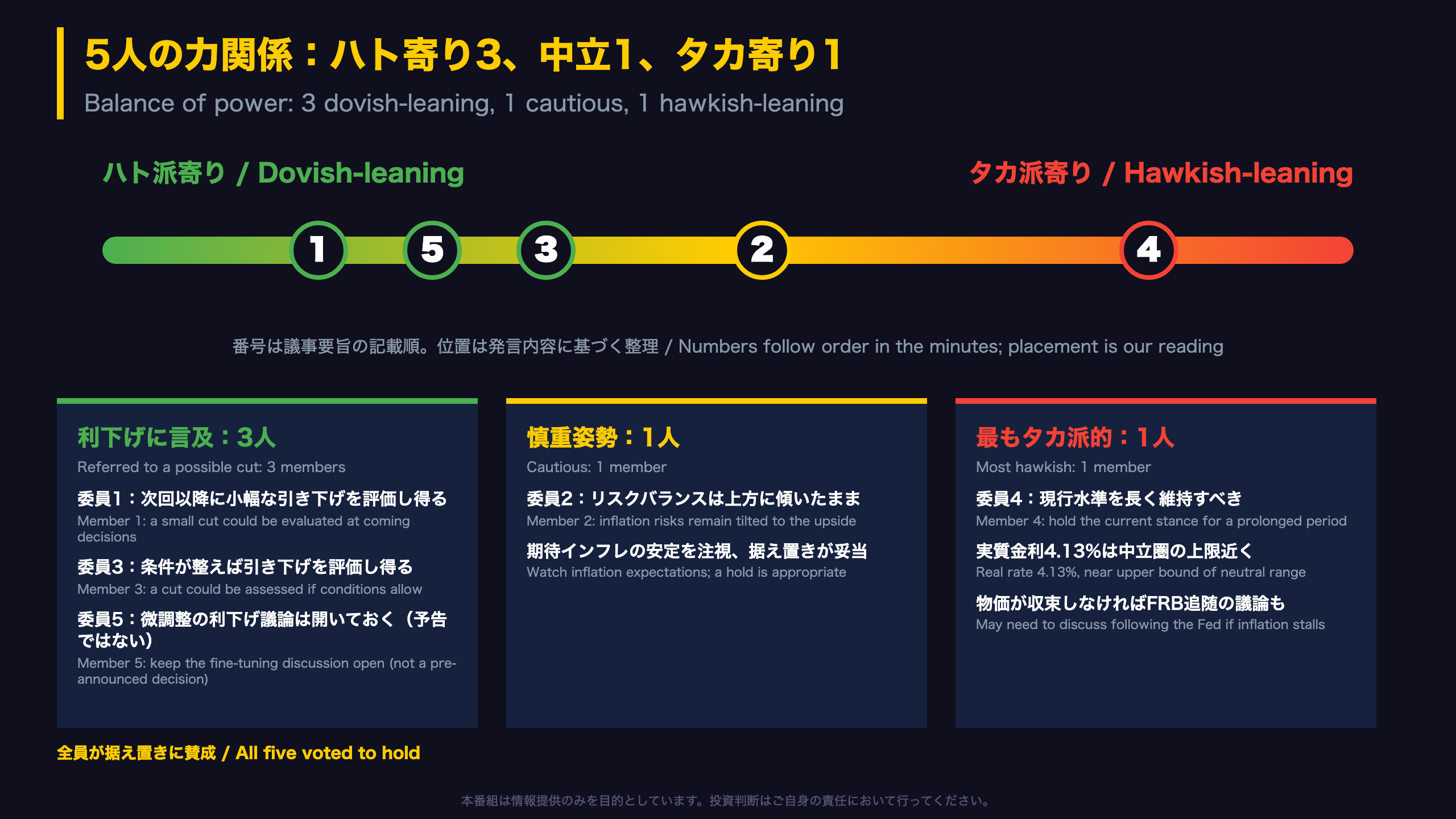
The minutes keep members anonymous, so the numbering below follows the order in which they appear, and the placement is our reading of their statements.
- Members 1, 3 and 5 (dovish-leaning): Member 1 said a small reduction could be evaluated at upcoming decisions. Member 3 said the board could assess a cut if conditions allow, and stressed meeting-by-meeting decisions. Member 5 said there are elements to discuss fine-tuning the rate downward, but not as an anticipated decision.
- Member 2 (cautious): inflation risks stay tilted upward because of geopolitics, trade policy and climate; expectations require close monitoring.
- Member 4 (hawkish-leaning): the stance should be held for a prolonged period.
The numbers behind the arguments
Member 4 noted the eight-quarter average ex-ante real rate is 4.13%, close to the upper bound of the neutral range, meaning the restrictive effect of prior tightening has been largely diluted. Member 5 pointed out that the US output gap is at the 82nd percentile of its history while Mexico’s is at the 12th, and that the volatility-adjusted rate differential is among the highest in emerging markets.
Why this matters internationally
The Fed, ECB and Bank of Japan have all raised rates recently, so a cut discussion in Mexico is a notable divergence. In Mexico’s own framework, the Board reacts to domestic inflation, not mechanically to the Fed, though the US cycle affects the peso and the economy through trade and financial links.
Independent view
A 3-1-1 split is not a vote count for a cut: all five voted to hold, and the dovish members attached explicit conditions. But an agenda that includes cuts and, at the other end, a possible Fed-following discussion shows a wider band of outcomes than in August.
物価:コアと商品は低下、サービスは高止まり
Inside the inflation numbers
Who publishes it? Mexico’s CPI is compiled by INEGI and released every fortnight. Banxico focuses on core inflation, which strips out volatile agricultural and energy prices, because it better reflects the trend.
Sub-index detail (first half of September)
- Food, beverages and tobacco goods: 4.59% (July: 4.85%)
- Non-food goods: 2.03% (July: 2.37%), below the 25th percentile of its history according to one member
- Housing services: 3.57%; education: 5.84%
- Government-authorized tariffs: 7.75%
Momentum beneath the annual rate
One member showed that the three-month average of annualized monthly core inflation was 3.16%, versus 4.65% in January-March. The share of core items with annualized monthly inflation of 3% or less rose from 39.1% in January to 47.1% in August. That momentum is more encouraging than the year-over-year readings.
Why services stay sticky
Members pointed to heterogeneity: about 20% of the services basket reprices only once or twice a year, and food services track input costs rather than demand. One member showed that, excluding food services and low-frequency repricers, the remaining items are inflating near 3%.
Fiscal effects
A counterfactual shared in the minutes suggests that without the early-2026 excise tax changes (IEPS), headline inflation would now be at the 3% target and core around its 3.65% historical average. The effect is a one-off price-level change that should fade early in 2027.
International comparison
US CPI was 3.4% in August and core CPI 2.4%, so Mexico’s core inflation (3.79%) is above the US level, while the Fed’s target is 2%.
Independent view
The encouraging trend is in goods and momentum; the open question is whether services can fall without a clear demand squeeze. The next meeting date is not given in the source.
景気の反発とFRBとの距離、次の焦点
Growth, the Fed gap and the conditions for easing
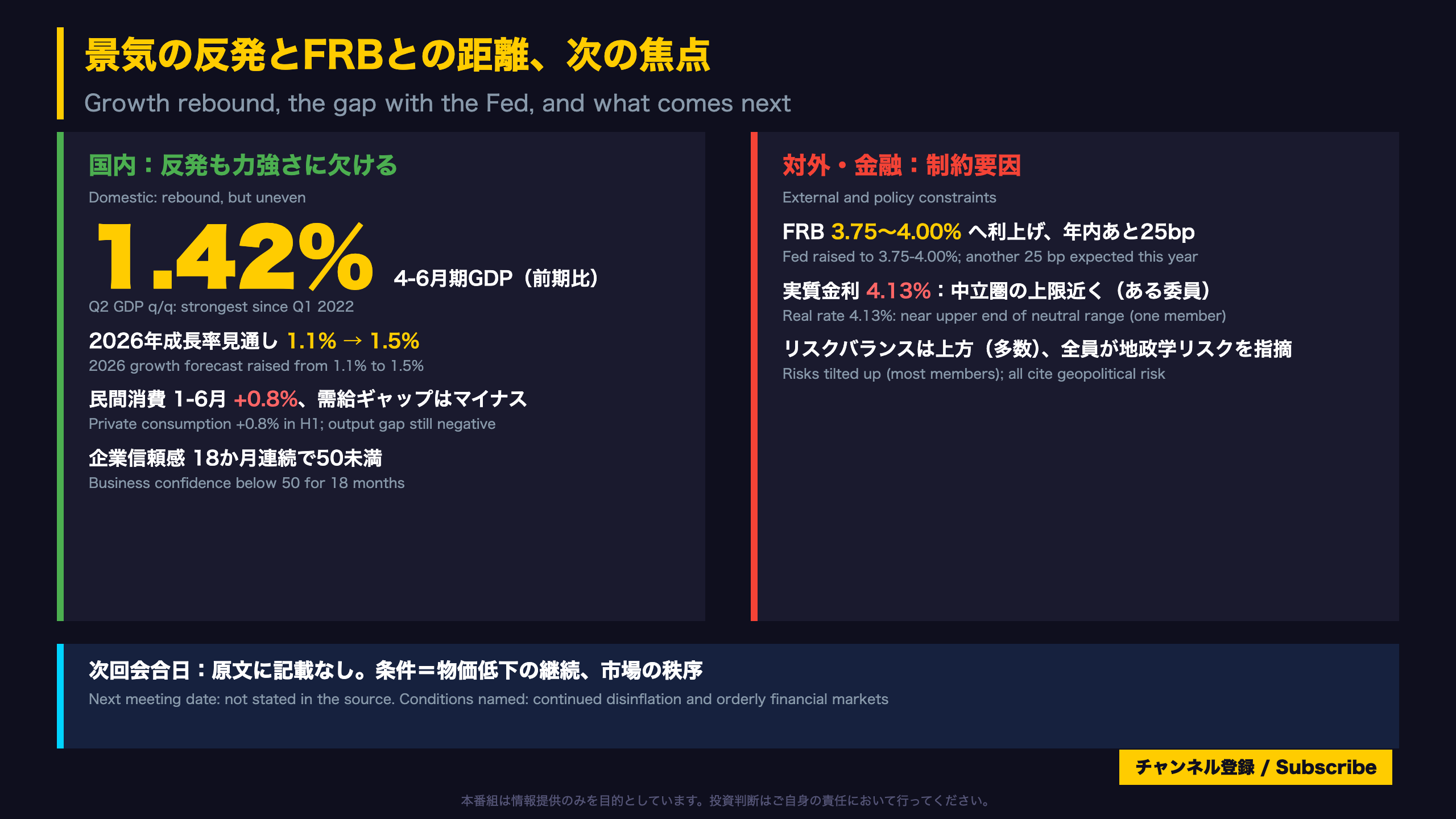
Growth: INEGI’s data show a 1.42% quarterly rebound in Q2 after a Q1 contraction, the strongest since Q1 2022. Banxico raised its 2026 growth forecast from 1.1% to 1.5%. But one member stressed that 2026 would still be the third consecutive year of growth below the 2000-2019 average of roughly 2%.
The weak spots
- Private consumption grew 0.8% in January-June, a slowdown. The purchasing power of remittances has fallen by more than 20% over 18 months.
- Fixed investment rose 5.5%, but business confidence has stayed below 50 for 18 months, and the recovery is led by public investment.
- Export growth of 11.8% is driven by non-auto manufacturing tied to AI-related hardware, with limited domestic value added.
External and policy backdrop
The Fed’s 25 bp hike to 3.75-4.00% was its first in more than three years; eight of eighteen FOMC members expect another hike in 2027. Brent has again exceeded 100 dollars per barrel. Banxico’s staff notes the peso depreciated 1.86% between meetings. One member noted that if Mexican inflation does not converge, following the Fed’s cycle could become a discussion item.
Risk balance
A majority judged inflation risks to be tilted to the upside, and every member highlighted geopolitical risks (energy, supply chains). A few also cited El Nino and the possible reversal of unusually low non-core inflation.
International comparison
The ECB and the Bank of Japan have also hiked, so Mexico’s dovish-leaning minority is out of step with peers, though its inflation is well below the rate-hike economies’ peaks.
Independent view
A cut discussion requires continued disinflation and orderly markets, both explicitly named in the minutes. The date of the next meeting is not stated in the source.
Disclaimer: This article is for informational purposes only. All investment decisions are made solely at your own risk.