This article was automatically generated by the NFC Market Live AI analysis system. (Updated: 2026-11-09 21:08 JST)
📄 Primary Source
NFC Market Live
https://www.inegi.org.mx/contenidos/saladeprensa/boletines/2026/inpc/inpc_2q2026_11.pdf
📊 Mexico’s October consumer prices (INPC): +3.75% year on year, +0.65% month on month.
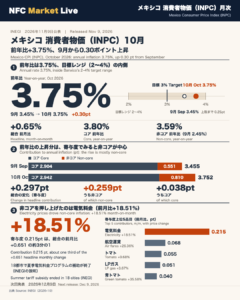
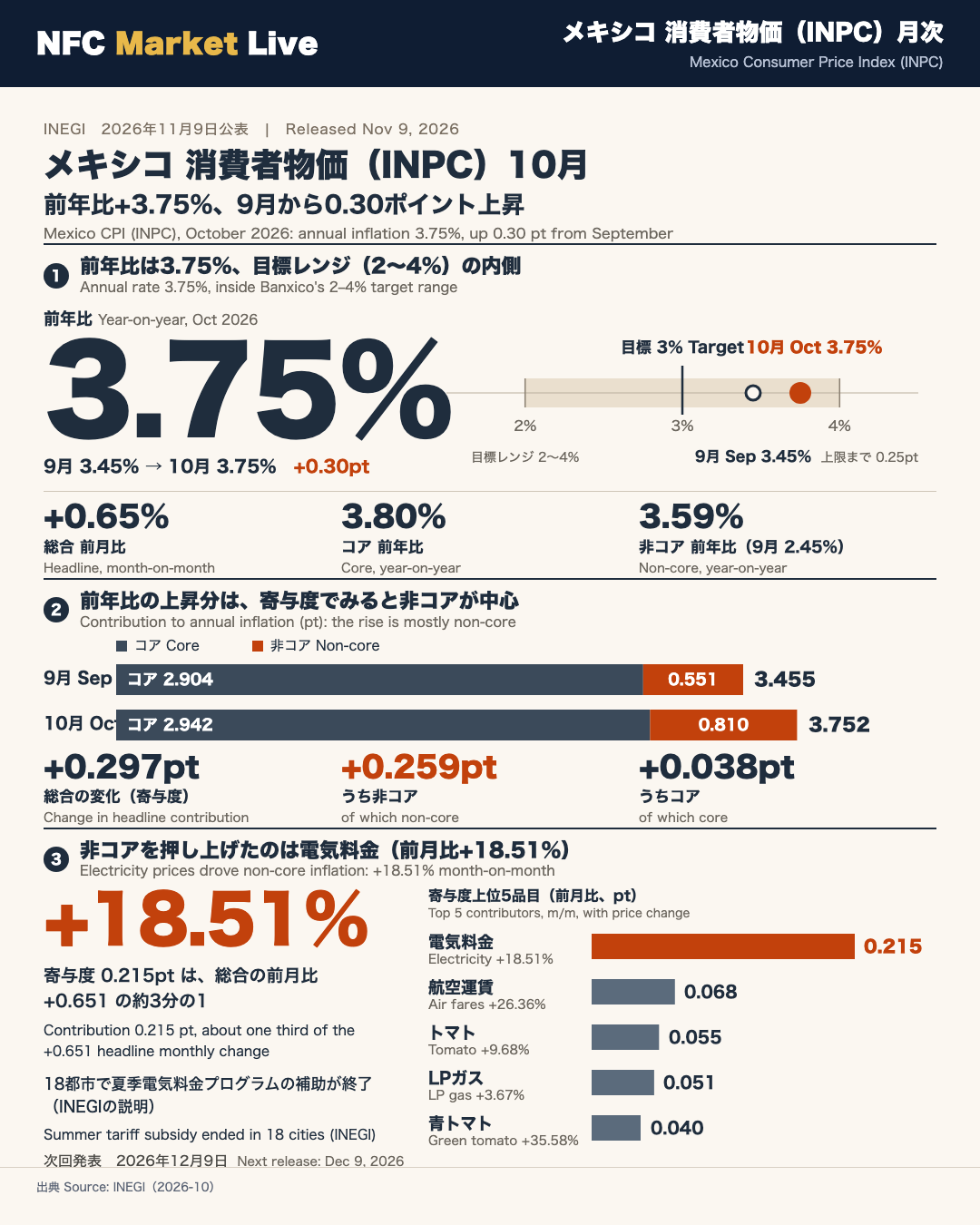
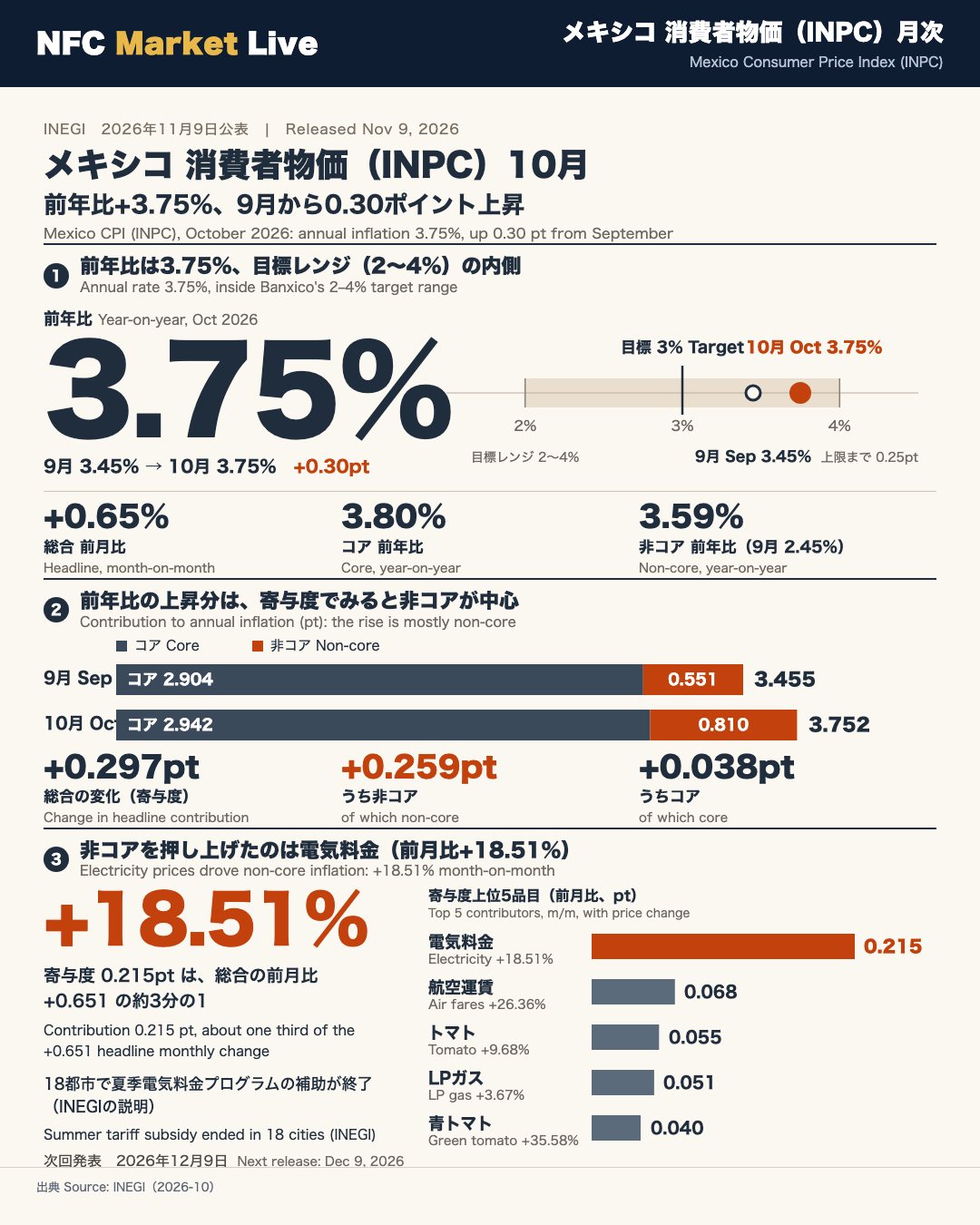
INEGI published the data on November 9. Headline annual inflation rose from 3.45% in September to 3.75%. The monthly gain of 0.65% was larger than the 0.36% recorded in October 2025. Banxico’s target is 3% with a tolerance of plus or minus 1 percentage point, and 3.75% sits inside that range.
🔎 Breakdown
• Core: +0.34% m/m, +3.80% y/y (September: +3.75%). Goods rose 0.22% and services 0.44% on the month.
• Non-core: +1.75% m/m, +3.59% y/y (September: +2.45%). Energy and government-authorized tariffs rose 2.13%, and fruit and vegetables 2.35%.
⚡ INEGI’s explanation
INEGI attributes the non-core rise mostly to the end of the summer electricity tariff subsidy programme in 18 cities covered by the index. Electricity prices rose 18.51% m/m, contributing 0.215 points. Air transport rose 26.36%. Falling items included paid internet, telephone and TV packages (-2.48%), potatoes and other tubers (-6.29%) and limes (-16.53%).
📅 The next monthly release is on December 9.
10月の消費者物価:前年比+3.75%、9月から0.30ポイント上昇
What was released
On November 9, 2026, INEGI (Mexico’s National Institute of Statistics and Geography) published the October consumer price index, the INPC. It measures the average price change of a household basket of about 123,000 specific items grouped into 292 generic products. It is Mexico’s counterpart to the US CPI, and INEGI publishes it both fortnightly and monthly. It is also the index to which the central bank’s (Banxico) inflation target applies: 3% year on year, with a tolerance of plus or minus 1 percentage point.
Headline figures (INEGI)
- Annual inflation: 3.75%, up from 3.45% in September (+0.30 pt, our calculation).
- Monthly change: +0.65%, versus +0.36% in October 2025 and +0.42% in September 2026.
- Core (excludes goods and services with high volatility or prices not driven by market conditions): +0.34% m/m, +3.80% y/y.
- Non-core: +1.75% m/m, +3.59% y/y.
Context from the release
The index stood at 147.026. In the two halves of October it was 146.739 and 147.313, a fortnightly rise of 0.39%, against 0.09% in September. In the ten-year October chart in the release, this month’s +0.65% is second only to the +0.84% of 2021 (our reading of the chart).
INEGI’s explanation
INEGI says the non-core increase reflects, to a greater extent, the end of the summer electricity tariff subsidy programme in 18 cities covered by the index.
Next release
The next monthly INPC publication is scheduled for December 9, 2026.
総合・コア・非コア:前年比の上昇は主に非コア
Annual inflation rose, and most of the rise came from non-core
Annual inflation moved from 3.45% in September to 3.75% in October (+0.30 pt). INEGI’s incidence table, which shows how many percentage points each component contributes to the annual rate, allows a split:
- Core contribution: 2.904 to 2.942 (+0.038)
- Non-core contribution: 0.551 to 0.810 (+0.259)
- Total: 3.455 to 3.752 (+0.297; differences are our calculation)
Position against the target
Banxico’s target is 3% plus or minus 1 pt, i.e. a 2% to 4% band, and it applies to headline INPC. At 3.75% the rate is inside the band, 0.75 pt above 3% and 0.25 pt below the 4% ceiling (our calculation).
Signs of moderation
- Core inflation of 3.80% is below the 4.28% a year earlier.
- Goods inflation is 3.25% against 4.12% a year ago.
- Non-food goods are at 2.15%, against 3.15% a year ago.
Points to watch
- Core rose 0.34% m/m, above September (0.20%) and October 2025 (0.29%).
- Services inflation is 4.32% y/y (September: 4.27%), above the headline rate. The ‘other services’ group, which includes eating out and mobile phone service, rose 0.69% m/m versus 0.56% a year earlier.
- Non-core annual inflation is 3.59%, against 1.18% a year earlier and 2.45% in September.
Our reading
In the release’s October chart, non-core monthly changes were similar in size in 2017 (+1.76%), 2020 (+1.77%) and 2021 (+1.87%), and much smaller in 2022 (+0.38%) and 2023 (+0.34%). A large October non-core move may therefore not be unusual. This is a single month, however, and the release does not say whether the electricity effect is temporary. The firmer core and services readings are the items to check in the next release.
非コアを動かした電気料金と品目別の動き
Electricity up 18.51% m/m
INEGI says the rise in the non-core index reflects, to a greater extent, the end of the summer-season electricity tariff programme (a subsidy) during October in 18 cities covered by the index, including Mérida, Monterrey, Torreón, Villahermosa, Cancún and Coatzacoalcos.
- Non-core: +1.75% m/m (September: +1.20%)
- Energy and government-authorized tariffs: +2.13% (September: +0.41%); energy +3.49%, tariffs -0.06%
- Fruit and vegetables: +2.35% (September: +4.40%)
Electricity contributed 0.215 points to the 0.651-point monthly headline gain, about one third (our calculation).
Largest movers (m/m, contribution in points)
Up: electricity +18.51% (0.215); air transport +26.36% (0.068); tomato (jitomate) +9.68% (0.055); LP gas +3.67% (0.051); tomatillo +35.58% (0.040).
Down: paid internet, telephone and TV packages -2.48% (-0.026); potatoes and other tubers -6.29% (-0.022); limes -16.53% (-0.019); oranges -8.90% (-0.012); automobiles -0.47% (-0.011).
Versus September
September’s top movers were vegetables, with tomato at +30.25% and onion at +23.00%. In October tomato rose a smaller 9.68%, and electricity became the biggest single contributor. Air transport went from +6.59% to +26.36%. Professional services swung from -16.44% to +9.88%. Telecom bundles fell in both months (-2.06%, then -2.48%).
Our reading
The electricity jump stems from a specific, dated event: the end of a seasonal tariff programme in 18 cities. The release does not indicate how prices will evolve from November.
地域別・消費目的別・最低消費バスケットの動き
Regions: all ten highest-reading cities are on the programme-end list
National monthly inflation was 0.65%. The states above the national average were Tabasco (+2.39%), Yucatán (+1.59%), Quintana Roo (+1.36%), Nuevo León (+1.25%) and Coahuila (+1.21%). Among cities, Villahermosa (+2.39%), Ciudad Acuña (+2.38%), Monclova (+1.89%), Mérida (+1.59%) and Cancún (+1.43%) led. At the low end were Ciudad Juárez (-0.12%), Matamoros (-0.06%) and Sinaloa state (+0.12%).
All ten cities in the top-ten city list also appear among the 18 cities where the summer electricity tariff programme ended. The regional table itself gives no reason, so this is an overlap noted from the release, not a stated cause.
By purpose of consumption (m/m, y/y)
- Housing, water, electricity, gas and other fuels: +1.49%, +3.60%
- Insurance and financial services: +1.18%, +7.55% (September y/y: 5.88%)
- Recreation, sport and culture: +1.15%, +3.20%
- Food and non-alcoholic beverages: +0.67%, +3.55% (September y/y: 2.55%); the second half of October was +1.10% on the first half
- Information and communication: -0.36%, -1.55%
- Restaurants and accommodation: +0.36%, +6.20%
Minimum consumption basket
The IPCCCM, a 170-item basket designed by CONEVAL (Mexico’s social policy evaluation council) and INEGI, rose 0.61% m/m and 3.59% y/y. September: +0.59% and +3.29%. October 2025: +0.32% and +3.61%.
Next release
The next monthly INPC is due on December 9, 2026. Items to track: non-core monthly changes, and core (3.80% y/y) and services (4.32% y/y) inflation.
Disclaimer: This article is for informational purposes only. All investment decisions are made solely at your own risk.