📺 Watch the Full Video Analysis
This article was automatically generated by the NFC Market Live AI analysis system. (Updated: 2026-08-28 03:49 JST)
📄 Primary Source
Banco de México
https://www.banxico.org.mx/publicaciones-y-prensa/informes-trimestrales/{1C6D1A06-5589-9F27-16E7-8B8303213E5C}.pdf
📊 Banco de México (Banxico) released its Q2 2026 quarterly report.
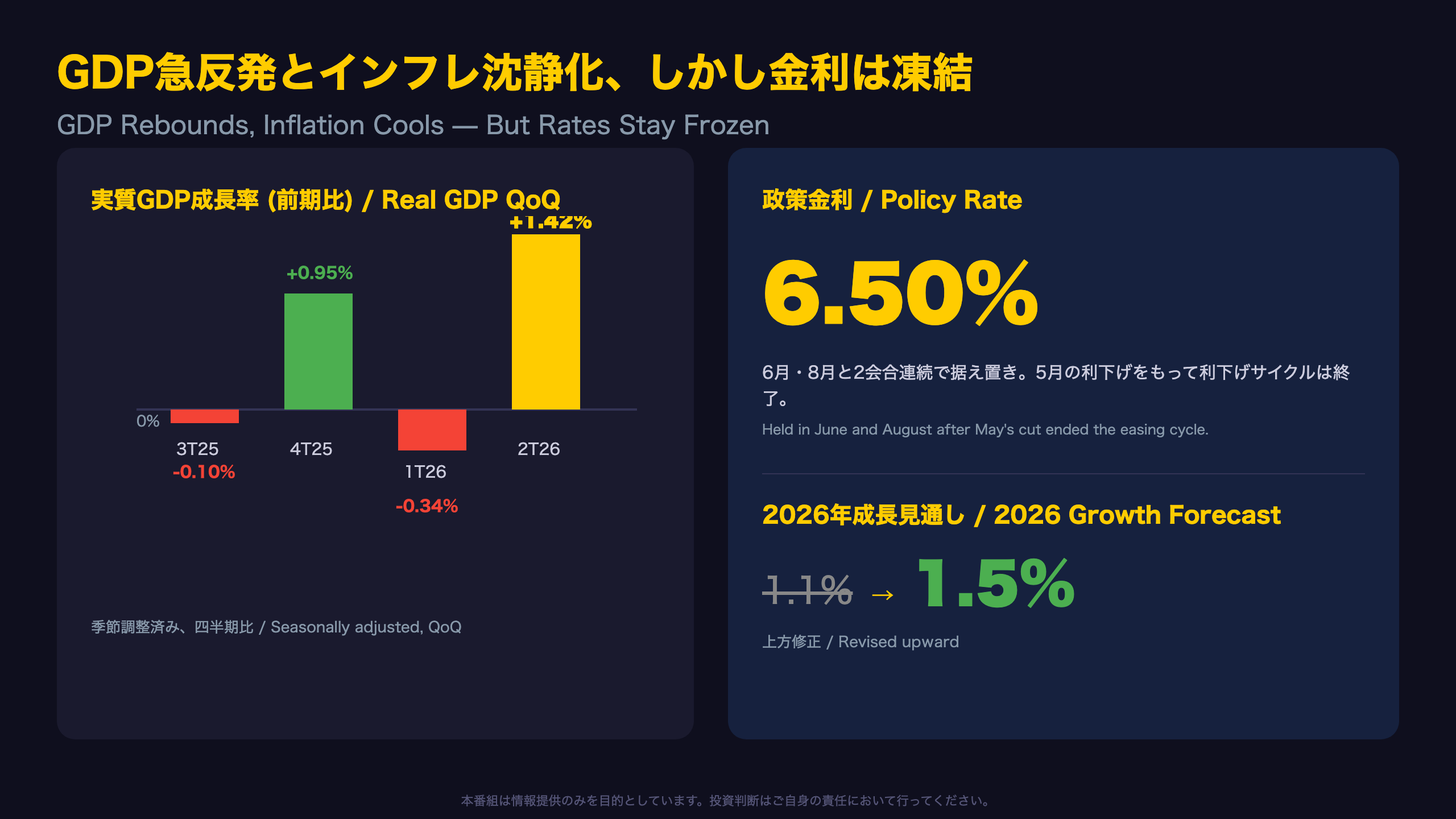
GDP rebounded +1.42% QoQ, and the 2026 growth forecast was raised from 1.1% to 1.5%.
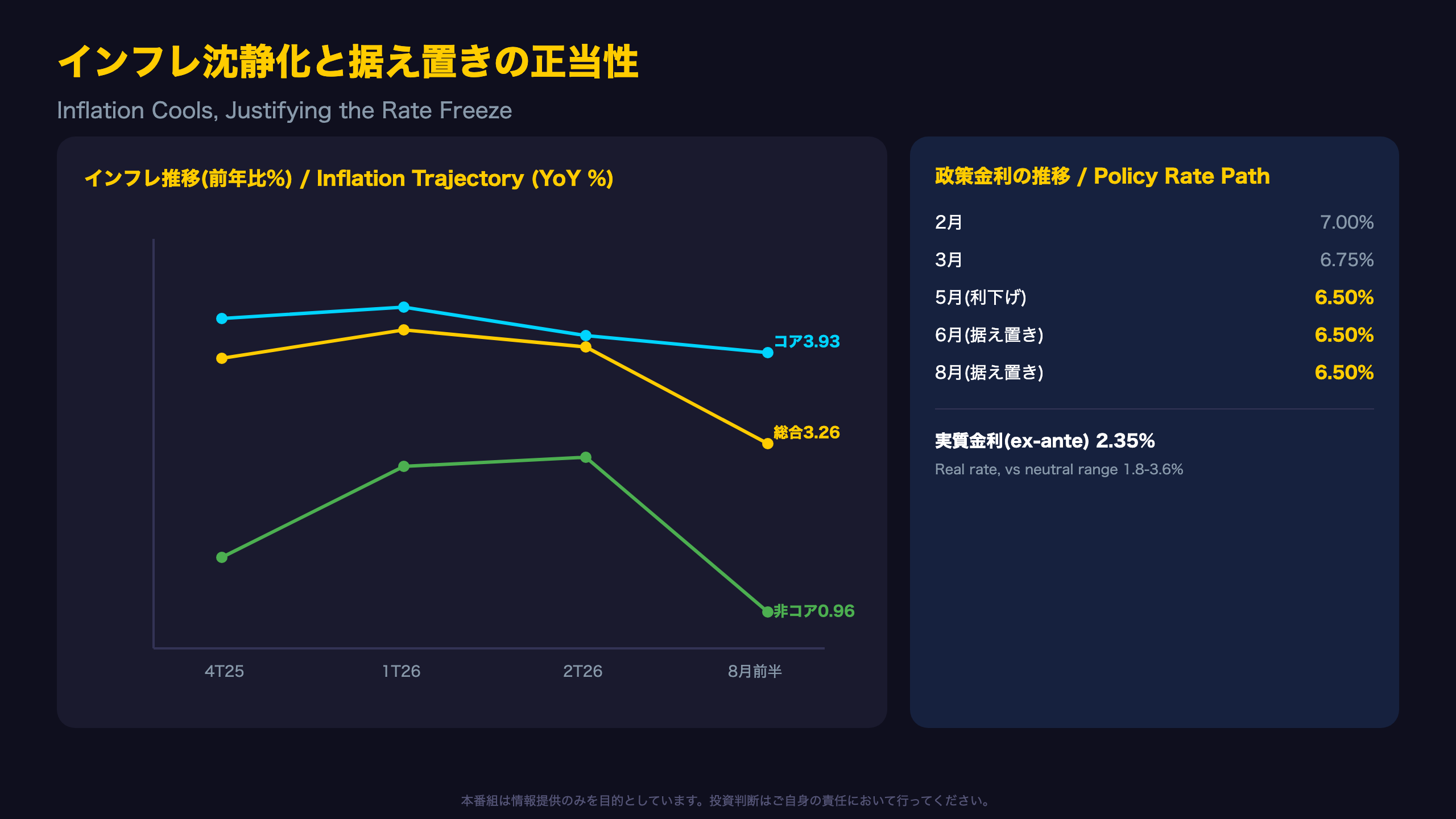
Inflation cooled to 3.92% (3.26% in early August), confirming the policy rate freeze at 6.50%.
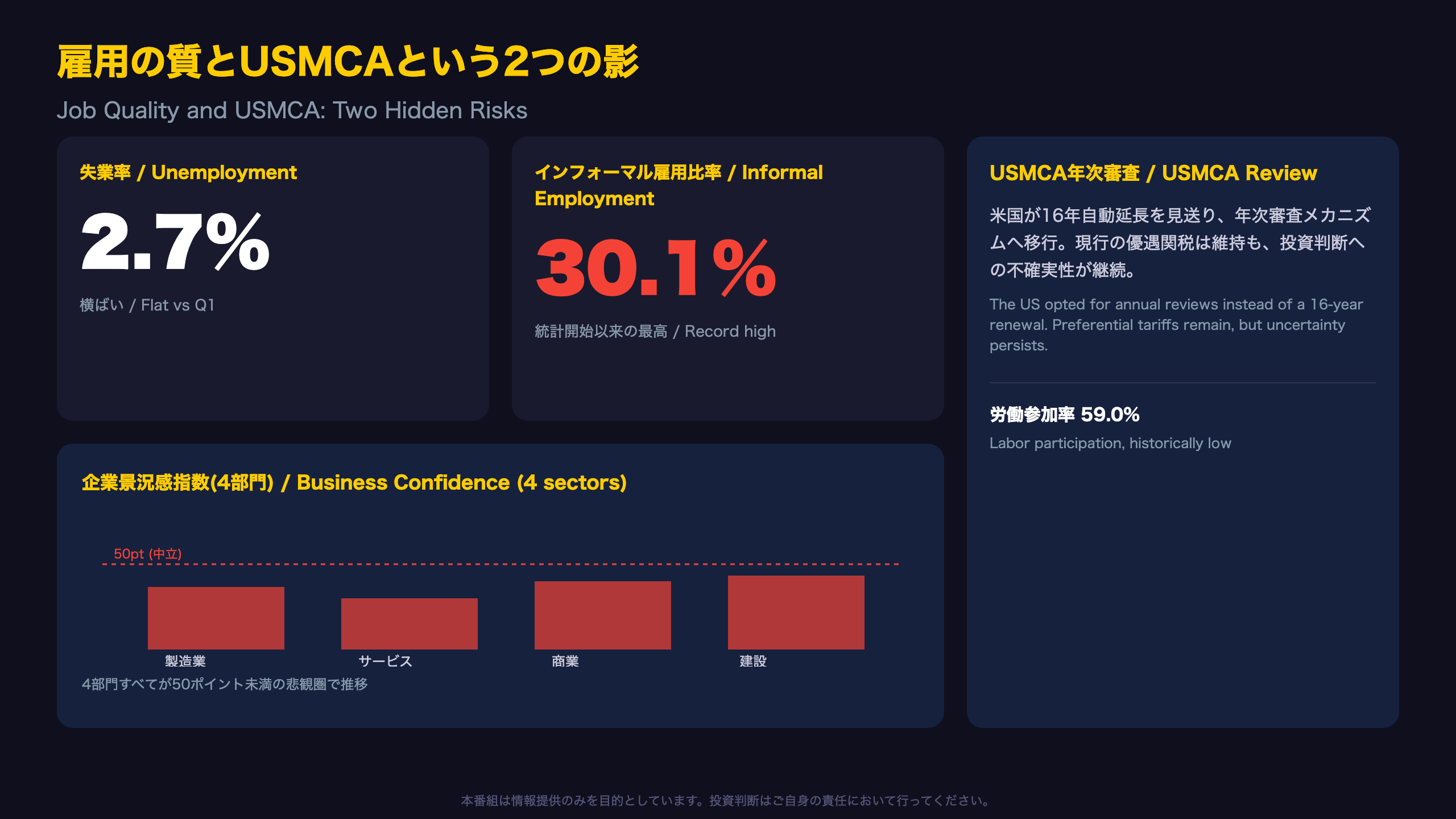
📉 Yet informal employment hit a record 30.1%, and business confidence stayed pessimistic across all four sectors.
💡 With USMCA review risk still looming, we break down the strength and hidden cracks in Mexico’s economy.
GDP急反発+1.42%、それでも金利は「凍結」継続
Why Mexico’s GDP Swings Matter More Than the Headline
Mexico’s GDP has whipsawed between contraction and expansion for a full year: -0.10% (Q3 2025), +0.95% (Q4 2025), -0.34% (Q1 2026, revised), and now +1.42% (Q2 2026).
This “sawtooth” pattern suggests an economy highly sensitive to single-quarter shocks rather than one on a smooth recovery path. Banxico itself cautioned in the report that “output gap conditions (holgura) persist,” reflecting prolonged underlying weakness — a notably measured tone despite the headline beat.
Context for international readers: Banxico (Banco de México) is Mexico’s central bank, operating under an inflation-targeting regime similar to the Federal Reserve’s dual mandate framework, but with a single priority mandate — price stability — enshrined in its constitution. Its quarterly report (Informe Trimestral) is the closest equivalent to the Fed’s Monetary Policy Report, combining GDP, inflation, and financial stability analysis.
Notably, Q1 2026 GDP was revised from an initially reported -0.62% to -0.34% — a meaningful statistical revision that partly explains why this quarter’s rebound looks so dramatic. For USD/MXN traders, the key threshold to watch is whether full-year 2026 growth approaches the upper end of Banxico’s 1.0%-2.0% forecast range, which would validate the current peso strength. The next quarterly report is due around November 2026.
GDP反発の内訳:全セクターがプラス転換
Inside the Rebound: A Tale of Two Auto Industries
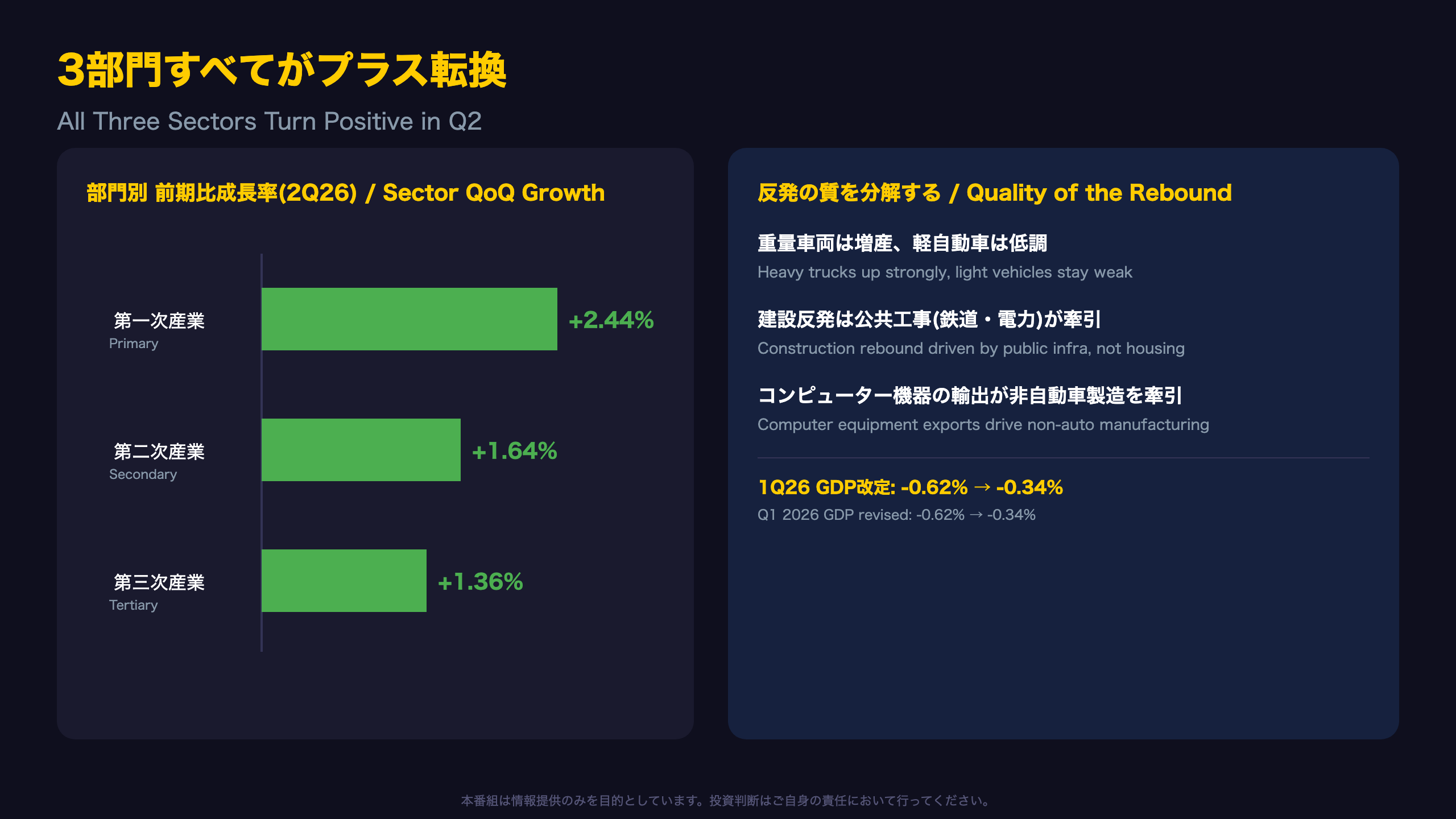
One underappreciated detail: Mexico’s manufacturing rebound is bifurcated. Heavy vehicle (truck) production surged significantly, while light vehicle production remained weak — a divergence that widened further in April. This split matters for investors tracking Mexico’s auto supply chain, since light vehicles are far more exposed to US retail demand while heavy trucks track industrial/commercial cycles.
For context: Mexico’s manufacturing sector accounts for roughly a third of GDP and is deeply integrated into North American supply chains under USMCA — the successor to NAFTA. Unlike a typical emerging-market industrial base, Mexico’s factories are largely tied to US demand cycles rather than domestic consumption, which explains why computer/electronics equipment exports (linked to the broader AI and data-center buildout in the US) have been a standout driver.
Construction’s rebound also deserves scrutiny: it was driven almost entirely by public infrastructure (railways, power grids) rather than private residential building, which stayed weak. This is a government-spending story, not a private housing recovery story — an important distinction for anyone modeling durable domestic demand.
On the encouraging side, wholesale trade grew strongly as manufacturing recovered, and 11 of 14 service subsectors posted gains — evidence the rebound had reasonably broad footing, even if its durability remains unproven.
インフレ沈静化と利下げサイクルの終焉
The Truncated Mean Reveals Genuine Disinflation
Beyond the headline number, Banxico’s “truncated mean” indicator — which strips out the top and bottom 10% of extreme price movements — tells an important story. As of early August, core truncated-mean inflation stood at 3.91%, nearly matching the unadjusted core rate of 3.93%. This convergence suggests the disinflation is broad-based rather than driven by a handful of volatile items — a meaningfully stronger signal than the headline number alone.
Context for international readers: This truncated-mean methodology is conceptually similar to the Cleveland Fed’s trimmed-mean CPI, used by the Fed to filter out noise from volatile categories like used cars or energy. Banxico’s version excludes 10% from each tail of the price-change distribution.
Within non-core inflation, livestock (pecuarios) prices fell 5.55% year-over-year in early August — a reversal of 2025’s supply shocks rather than a sign of structural deflation. Meanwhile, gasoline prices rebounded to +1.51% YoY as Middle East tensions kept energy markets volatile, partially offsetting the broader non-core decline.
For USD/MXN and Mexican bond investors, the key takeaway is that Banxico’s ex-ante real rate (2.35%) still sits above its estimated neutral midpoint (2.7% range 1.8%-3.6%) — meaning policy remains modestly restrictive even after the pause, leaving room for further easing later if energy risks don’t materialize.
隠れた弱さ:雇用の質とUSMCAの影
The Gender Gap: Half Explained by Access to Jobs, Not Pay
A special analysis box (Recuadro 2) in this report decomposes Mexico’s gender labor-income gap from 2005 to 2025. The finding is notable: roughly half of the gap level is explained by differences in employment access (the share of men versus women in paid work), while hours worked and hourly pay explain the rest.
Context for international readers: This kind of decomposition analysis is methodologically similar to the Oaxaca-Blinder decomposition commonly used by the US Bureau of Labor Statistics to study gender pay gaps — separating “who gets a job” effects from “how much they’re paid” effects.
Equally notable: 40% of the gap’s narrowing between 2005 and 2025 came specifically from improved employment access for women — meaning rising female labor force participation, not wage convergence, has been the primary driver of progress.
Separately, the report flags a structural quirk in Mexico’s labor data: digital platform workers (delivery drivers, ride-hailing) registered with IMSS (Mexico’s Social Security Institute) rose to 247,900 by July 2026, up from 206,521 in December 2025. These workers are classified as “urban temporary” positions rather than permanent formal jobs — a classification detail that likely contributes to the record 30.1% informal employment share, and one that international investors modeling Mexican consumer spending should watch closely as gig work expands.
対外部門は劇的改善、しかし信用力には逆風
Pension Funds Quietly Reshaping Mexico’s Capital Markets
A special analysis box (Recuadro 3) in this report highlights an underappreciated structural trend: Mexico’s mandatory pension funds (Afores) have become a major domestic financing source. Non-monetary domestic funding sources posted an annual flow equivalent to 3.8% of GDP in Q2 2026 — well above the 2010-2019 historical average of 2.0%.
Context for international readers: Afores are Mexico’s privatized, mandatory retirement savings accounts, roughly analogous to a combination of 401(k) plans and compulsory pension contributions found in countries like Australia or Chile. A 2020 pension reform mandates a gradual increase in employer contributions from 2023 through 2030, meaning this pool of capital is set to keep growing structurally — a rare visible, long-duration domestic bid for Mexican government bonds and equities.
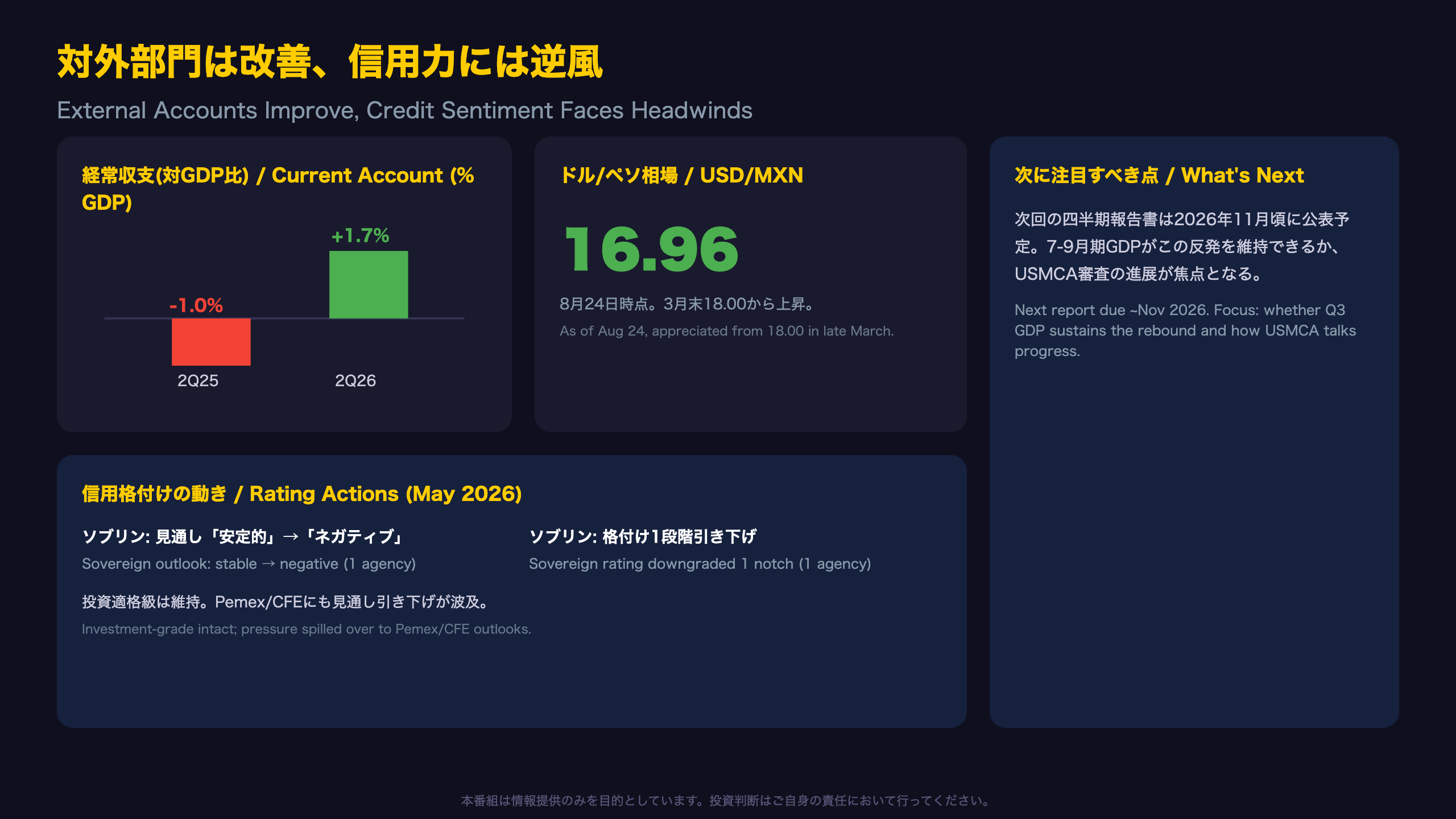
This matters directly for the current account and peso story: as Siefores (the investment arms managing Afore assets) absorb government bonds that non-resident investors sell, Mexico becomes less dependent on volatile foreign portfolio flows — a genuine structural buffer against emerging-market capital flight episodes.
On the credit side, caution is warranted: in May, rating agencies also cut the outlook for state oil company Pemex and state utility CFE to negative, showing sovereign rating pressure spilling over to state-owned enterprises. That said, Pemex’s 5-year CDS spread had fallen back to levels last seen in February 2020 by late May 2026 — suggesting markets aren’t pricing in acute distress despite the rating actions.
Disclaimer: This article is for informational purposes only. All investment decisions are made solely at your own risk.