📺 Watch the Full Video Analysis
This article was automatically generated by the NFC Market Live AI analysis system. (Updated: 2026-07-31 16:56 JST)
📄 Primary Source
NFC Market Live
https://www.youtube.com/watch?v=0OHN8Fa1sFo
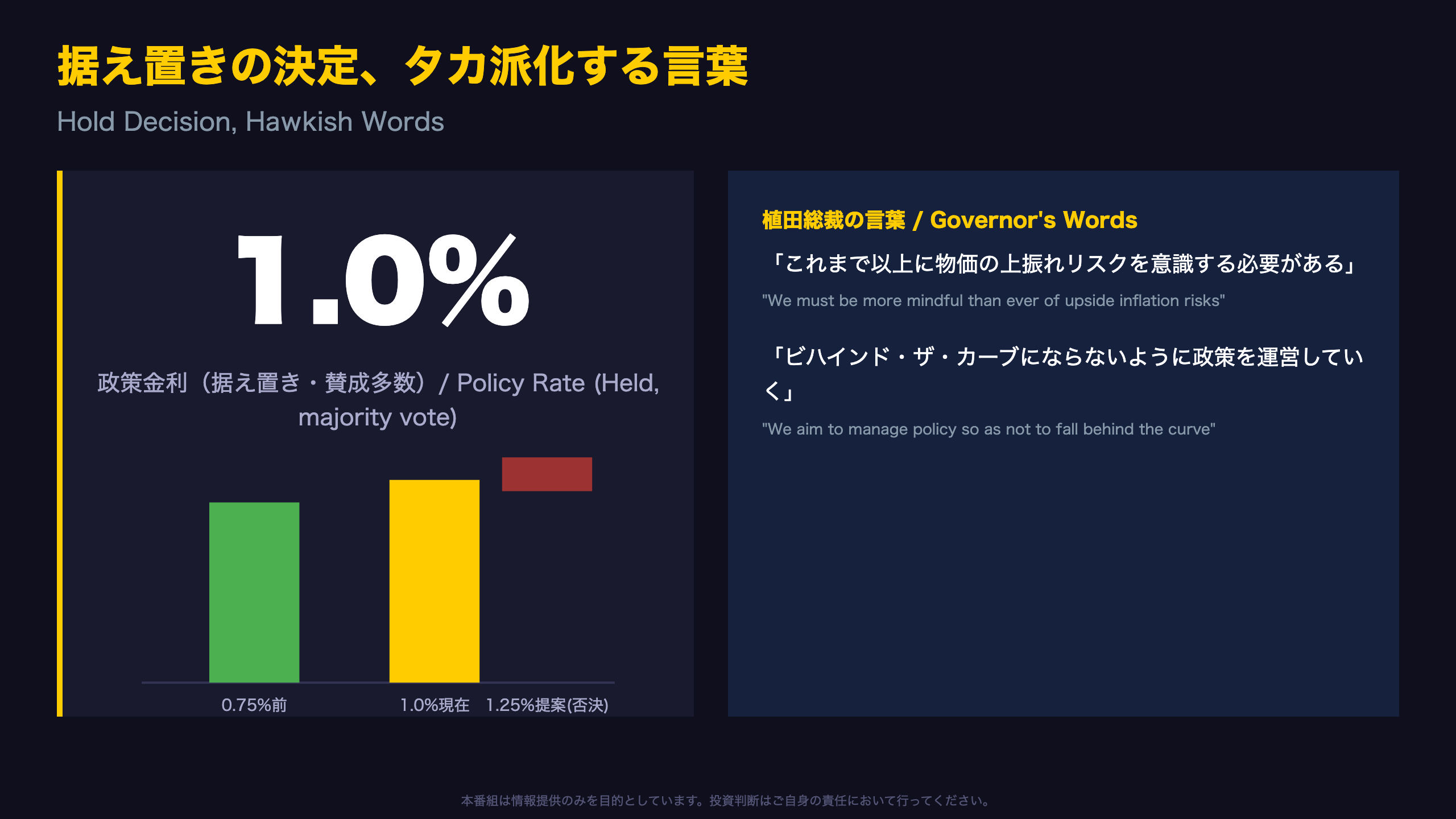
The Bank of Japan held its policy rate steady at around 1.0%, with Board Member Takata’s proposal to hike to 1.25% rejected by majority vote.
📊 Governor Ueda stated the BOJ needs to be “more mindful than ever” of upside inflation risks.
⚠️ He explicitly said the BOJ aims to avoid being “behind the curve.”
📈 The Outlook Report expanded risk factors from one (Middle East tensions) to three, adding AI-related demand and FX volatility.
💡 This deep dive decodes the gap between the hold decision and Ueda’s increasingly hawkish rhetoric.
This video is for informational purposes only.
総括:据え置きの決定、タカ派化する言葉
A Hold That Was Expected — But the Language Wasn’t
At its July 31 policy meeting, the Bank of Japan (BOJ) voted by majority to keep its policy rate at around 1.0%. The decision itself surprised no one. But a close reading of Governor Kazuo Ueda’s remarks reveals a notable shift in tone compared with prior press conferences.
The Two Phrases That Matter
Ueda stated: “Given that underlying inflation is approaching the 2% price stability target, we need to be more mindful than ever of upside risks to prices.” When a reporter raised concerns about the BOJ being “behind the curve” — a term used when a central bank reacts too slowly to inflation — Ueda responded directly: “Our approach is to manage policy so as not to fall behind the curve.”
“I believe underlying inflation is getting fairly close to 2%. The risk of it overshooting cannot be ignored — there is some degree of that risk,” Ueda said.
Why This Matters for International Investors
For readers unfamiliar with BOJ communication style: the bank rarely uses explicit hawkish phrases like “behind the curve” unprompted. Its use here, even in response to a direct question, signals the BOJ is actively managing market expectations about the pace of future hikes — a departure from its historically cautious, gradualist rhetoric.
This mirrors dynamics seen at the Fed and ECB, where forward guidance language often moves markets more than the rate decision itself. For USD/JPY and JGB traders, the linguistic shift may matter more than today’s unchanged rate.
決定の内幕:高田委員提案の否決が示すもの
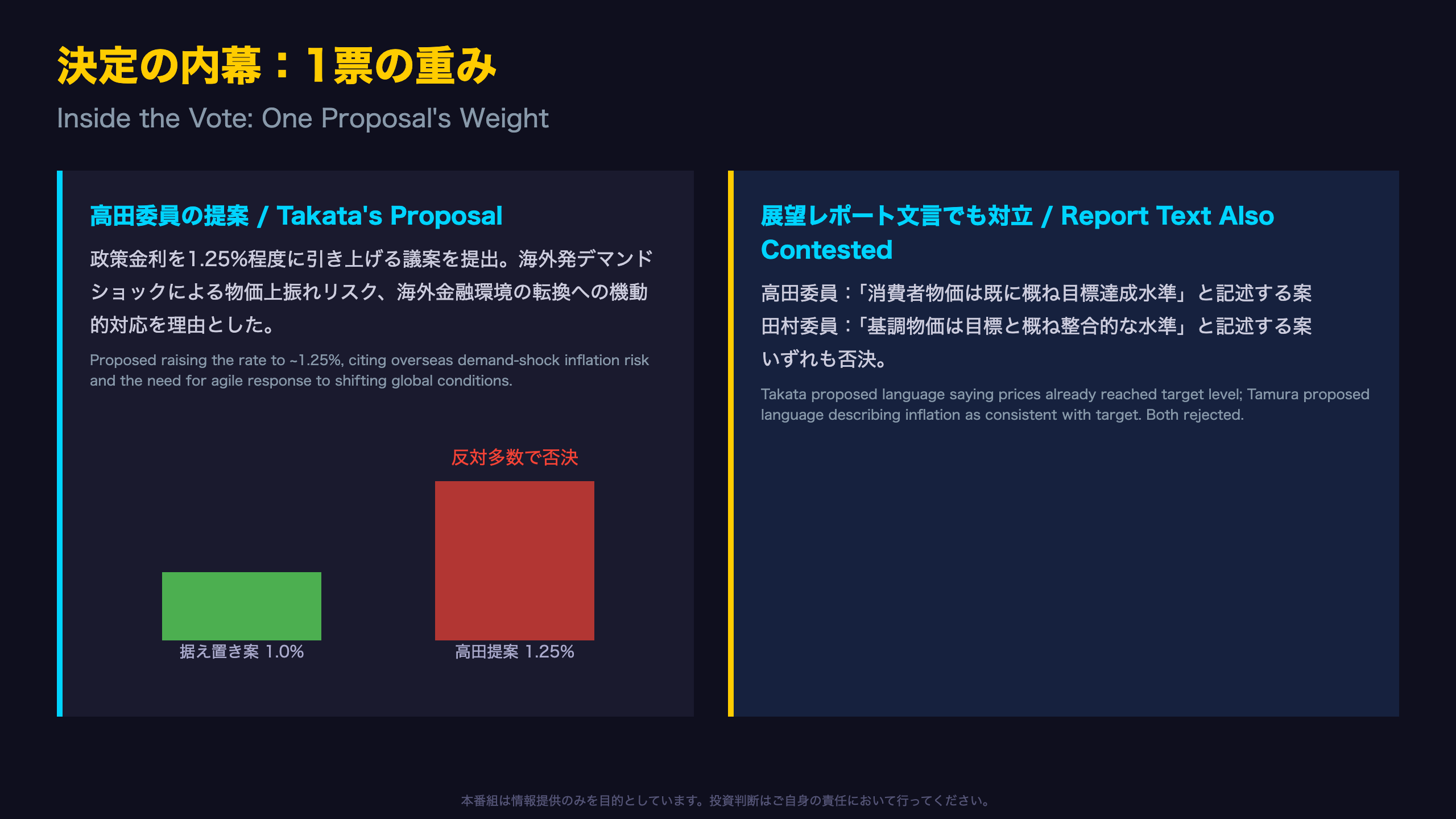
“Majority Vote,” Not Unanimous — Why That Matters
BOJ policy decisions are typically reported as a single institutional outcome, but this meeting’s hold decision came via majority vote, not unanimity — a distinction that carries real signal value for market watchers unfamiliar with the nuances of BOJ board dynamics.
Takata’s Specific Proposal
Board Member Takata proposed raising the policy rate to around 1.25%, citing “a new phase requiring agile responses to overseas demand-shock-driven upside price risks and shifts in global financial conditions.” This was not a vague dissent — it was a concrete, quarter-point hike proposal put to an actual vote.
Disagreement Extended to the Outlook Report Text
Notably, the friction wasn’t limited to the rate decision. Takata also proposed report language stating that “consumer prices have already reached a level broadly consistent with the price stability target,” while Board Member Tamura proposed language describing underlying inflation as “already broadly consistent with the target.” Both proposals were voted down.
This reveals that even the board’s shared narrative of the current situation is contested internally — a dynamic reminiscent of split votes at the Fed’s FOMC.
Forward Implications
A single rejected proposal doesn’t guarantee future rejections. If anything, repeated hawkish proposals from individual members are typically read by markets — much like Fed dot-plot dispersion — as an early signal that a policy shift may be approaching.
展望レポート:物価見通しとリスク要因3倍増
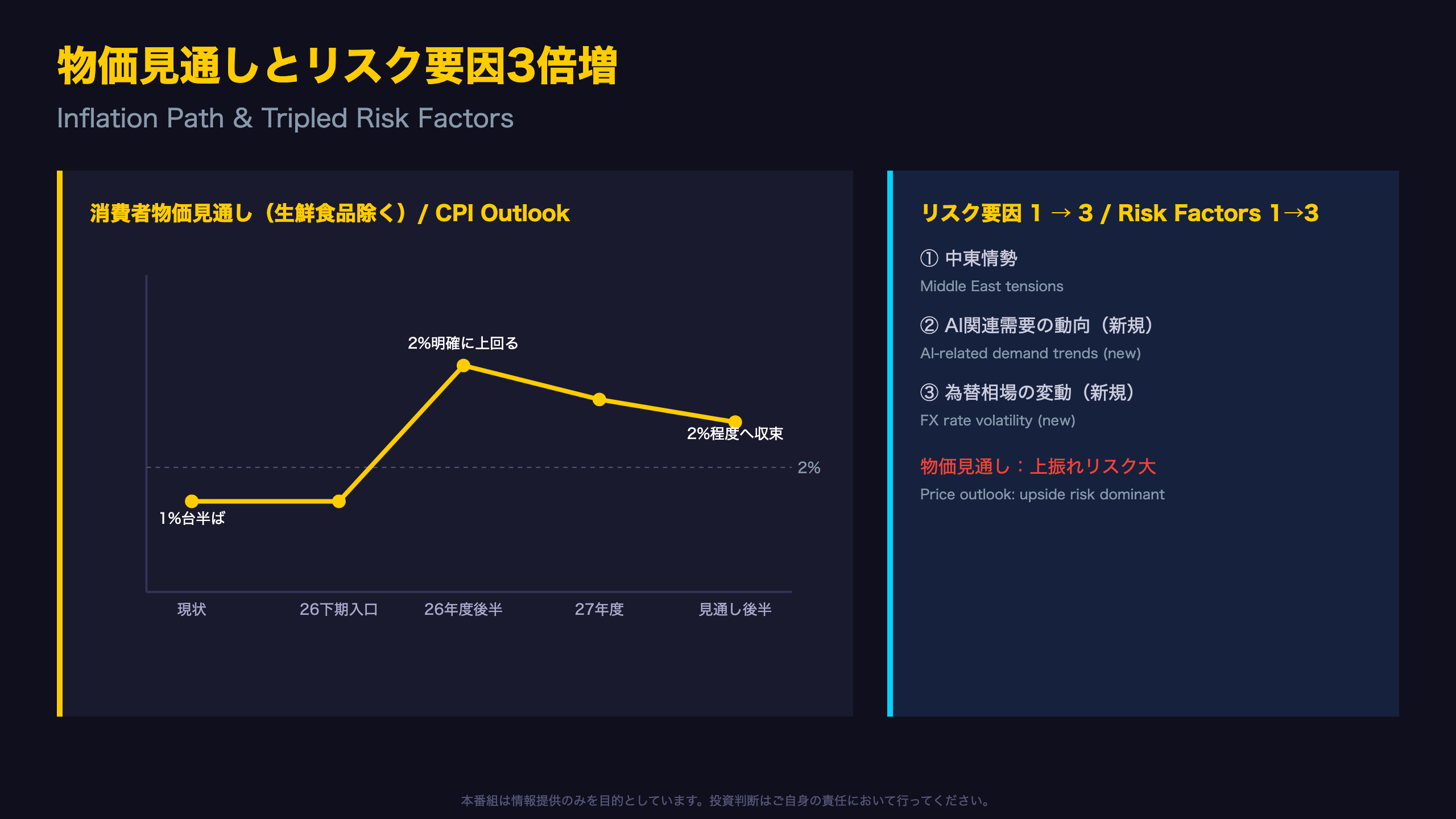
From “Mid-1%” to “Clearly Above 2%” — Mapping the Inflation Path
The BOJ’s Outlook Report doesn’t describe a simple straight-line rise in inflation. Instead it lays out a three-stage path: current levels (mid-1%) → clearly exceeding 2% from H2 FY2026 → converging back toward around 2% later in the projection horizon. This nuance matters for readers used to simpler Fed/ECB-style forward guidance.
What’s Driving the Upswing
According to Ueda’s remarks, the drivers are multi-layered:
- Past oil price increases continuing to push up energy and goods prices
- Rising semiconductor prices tied to surging global AI-related demand
- Recent yen depreciation feeding through to durable goods prices
Ueda specifically noted memory chip prices have “risen substantially” and called AI demand “one of the key upside factors to watch” — a genuinely new theme not present in prior Outlook Reports.
Why Tripling the Risk Factors Matters
Previously, the BOJ’s named risk factor was largely limited to Middle East tensions. This report explicitly adds AI-related demand trends and FX volatility. Ueda explained: “We specifically named the Middle East situation, AI-related trends, and FX movements — these are simply the three most important factors for now.”
Expanding the list of risk factors doesn’t automatically mean a rate hike is imminent — but for institutions used to Fed-style dot plots, this signals the BOJ’s reaction function has become explicitly more multi-dimensional and data-dependent.
An Asymmetric Risk Balance
Crucially, Ueda described the growth outlook as “broadly balanced” while stating price risks are “skewed to the upside” — an asymmetry between growth and inflation risk assessments that international investors should track closely.
Q&A深掘り①:「ビハインド・ザ・カーブ」を巡る攻防
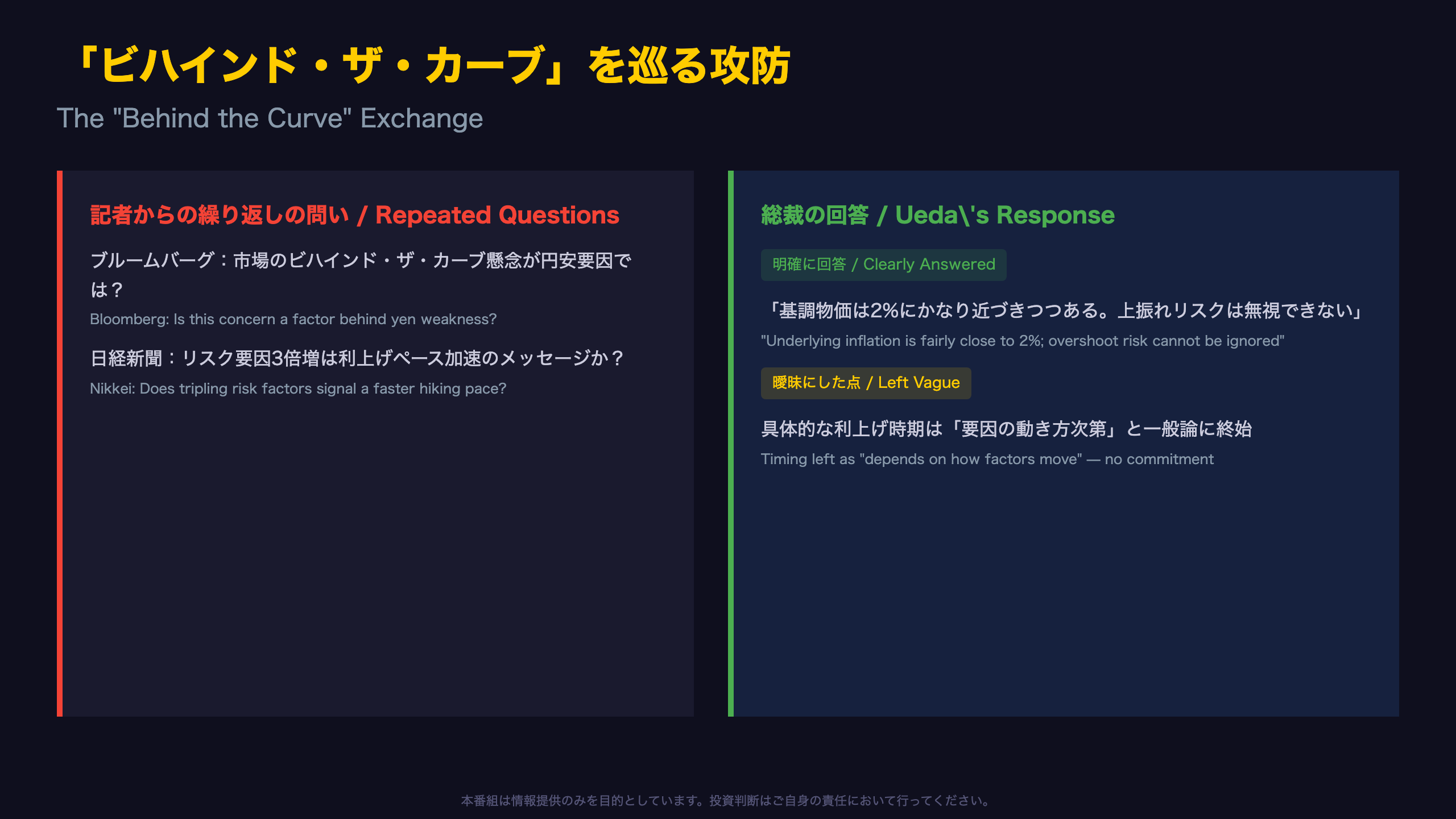
Multiple Reporters, One Theme — Where Market Attention Is Concentrated
The single most repeated theme at this press conference was the “behind the curve” concern. Bloomberg’s reporter raised it directly, TV Tokyo’s reporter framed it via a comparison with Western central banks, and Nikkei’s reporter asked point-blank whether expanding the risk factor list was itself “a message that the pace of hikes could accelerate.”
Ueda’s Consistent Response Pattern
Governor Ueda’s answer was consistent across questions:
“I believe underlying inflation is getting fairly close to 2%. The risk of it overshooting cannot be ignored — there is some degree of it. We intend to manage policy so that doesn’t happen… our approach is to avoid falling behind the curve.”
This qualifies as a clearly answered point — Ueda didn’t dismiss the concern; he validated the risk assessment and stated the BOJ’s counter-approach.
What Remained Vague
On specific timing, however, Ueda repeatedly deflected to generalities: “It depends on how these factors move.” Even when Nikkei’s reporter asked directly whether the risk-factor expansion signaled a faster hiking pace, Ueda gave essentially the same non-committal answer — a pattern familiar to Fed watchers parsing FOMC press conferences for hints without explicit forward commitments.
The FX Admission
Notably, Ueda himself acknowledged that FX pass-through to prices “appears to have become somewhat larger than before” — an admission made amid ongoing yen weakness that suggests currency movements may carry more weight in future policy decisions than in past cycles.
Q&A深掘り②:政府との距離感と骨太ショック
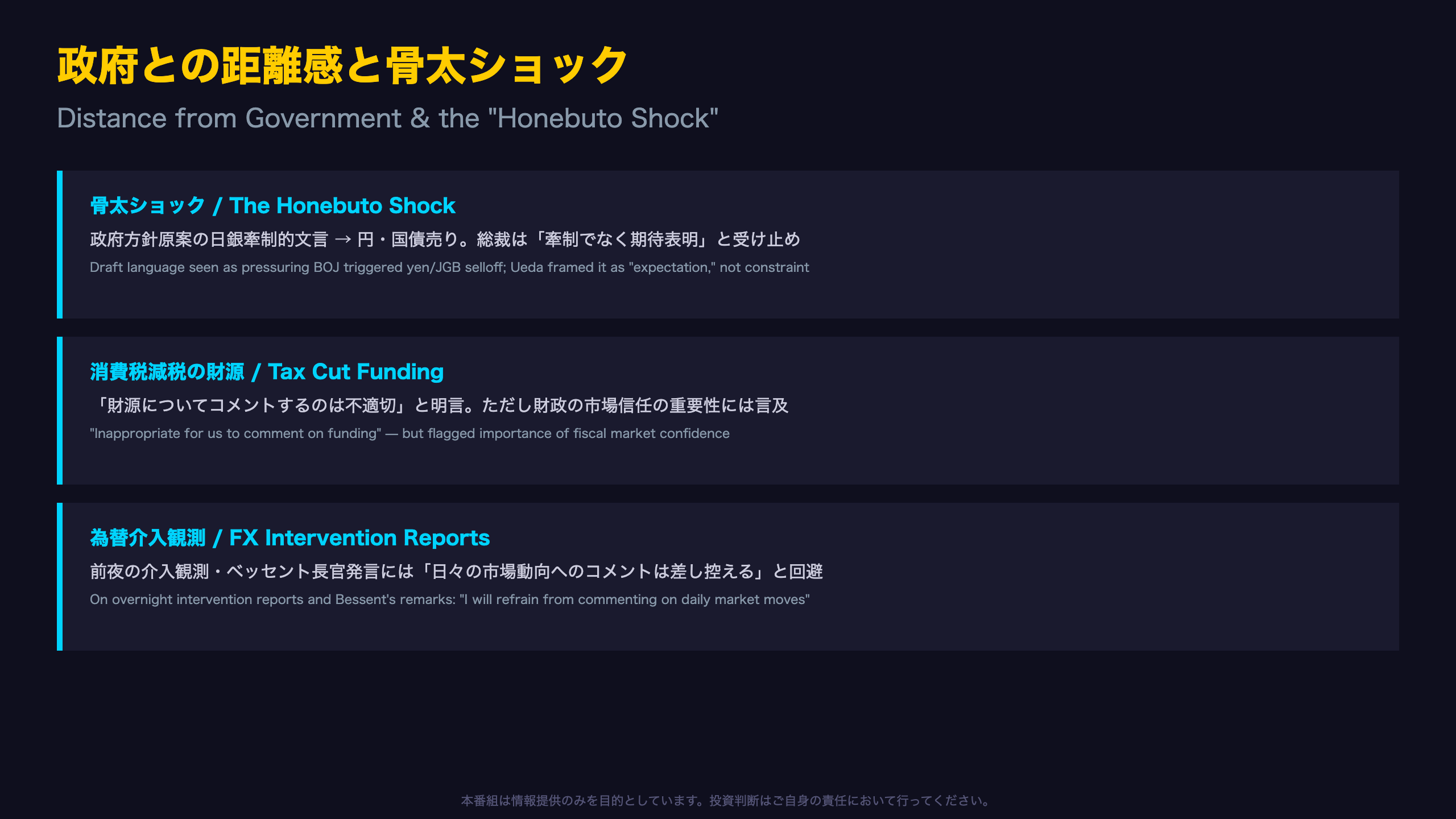
What Was the “Honebuto Shock”?
The lead reporter’s question referenced the so-called “Honebuto shock” — a market event in which a draft version of the government’s Honebuto (broad economic policy guidelines) reportedly contained language perceived as constraining the BOJ’s policy autonomy, triggering yen and JGB selloffs. This question went directly to the sensitive issue of central bank independence, a topic international readers will recognize as structurally similar to debates over Fed independence in the US.
How Ueda Framed the Government’s Language
Ueda characterized the Honebuto guidelines as “the government’s basic policy for economic and fiscal management aimed at realizing a strong economy through stronger domestic investment, alongside an expression of expectation for the BOJ’s monetary policy toward achieving price stability.” This diplomatic framing — recasting perceived pressure as “expectation” — is a classic technique central bankers use globally to preserve institutional independence without provoking open conflict with elected officials.
Silence on Tax Cut Funding
Asked about the government’s planned 1-point food consumption tax cut starting April 2027, Ueda drew a clear line: “It would be inappropriate for us to comment on funding sources.” However, he added that it is “important for the government to secure market confidence regarding medium-term fiscal consolidation” — a subtle nudge toward fiscal discipline without direct criticism, comparable to how Fed officials occasionally comment on US fiscal sustainability without endorsing specific policy.
No Comment on FX Intervention
On reports of overnight FX intervention and US Treasury Secretary Bessent’s comments that the yen is undervalued, Ueda maintained the standard central banker posture: “I will refrain from commenting specifically on daily market moves.”
Q&A深掘り③:AI・熊本地震・デフレ脱却論
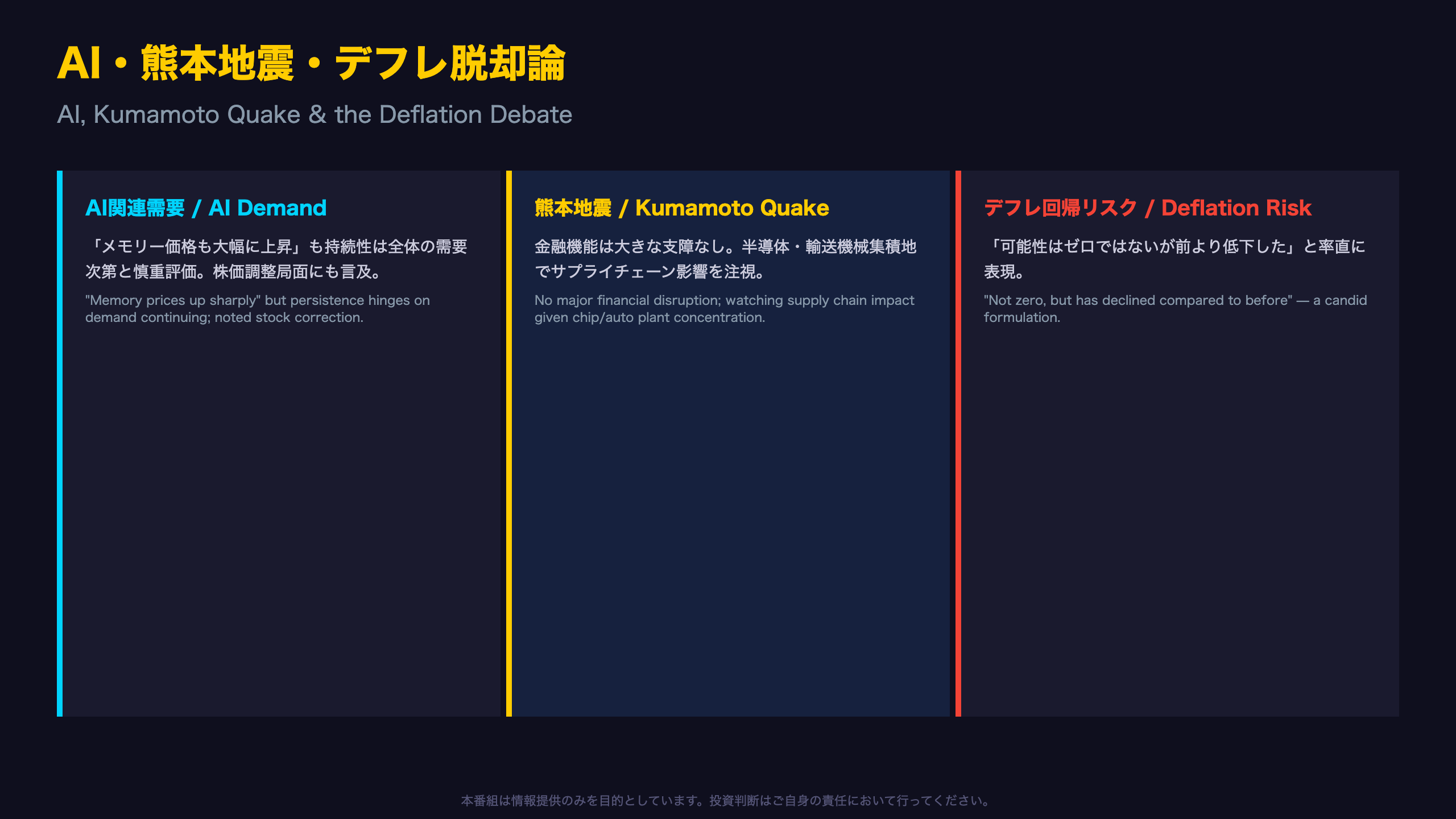
Ueda’s Guarded Take on AI Investment “Persistence”
Multiple reporters — including from Kyodo and Asahi — asked about AI’s impact on prices and monetary policy. Ueda acknowledged that “AI-related demand is very strong, and memory chip prices have risen substantially,” but consistently qualified this with a conditional caveat: persistence “depends on the overall strength of AI demand continuing.”
A Rare Reference to Stock Market Corrections
Notably, Ueda referenced a specific market event directly: “Looking at stock prices, for example, there has been a considerable correction phase this week.” It’s unusual for a central bank governor to reference a specific near-term market move directly — this suggests policymakers are increasingly attentive to AI-bubble-style concerns, echoing debates seen around US hyperscaler capex sustainability.
“I think people watching this are always keeping an eye on some probability that this very high growth in spending could stop,” Ueda said — a framing similar to how Fed officials discuss concentration risk in AI-driven capex cycles.
Kumamoto Earthquake: Learning from 2016
On the Kumamoto earthquake, Ueda drew on the region’s 2016 earthquake experience, noting it is “an area with a concentration of semiconductor and transport equipment factories,” meaning the overall economic impact will depend heavily on how critical any halted production is within broader supply chains. He downplayed financial-system disruption (“no major difficulties”) while flagging continued monitoring of damaged transport infrastructure.
The Deflation-Exit Debate
Asked by Mainichi Shimbun whether deflation-return risk remains, Ueda gave an unusually candid answer: “the possibility is not zero,” but “compared to before, that risk has declined to some degree.” Pressed further by Toyo Keizai on the government’s stricter definition of “deflation exit” (no prospect of returning to deflation), Ueda offered a probabilistic interpretation: the government likely judges deflation-exit based on the probability falling below some threshold, rather than reaching exactly zero — a nuance important for readers comparing this to the Fed’s own probabilistic risk-assessment language.
インプリケーション:市場が読むべきシグナル
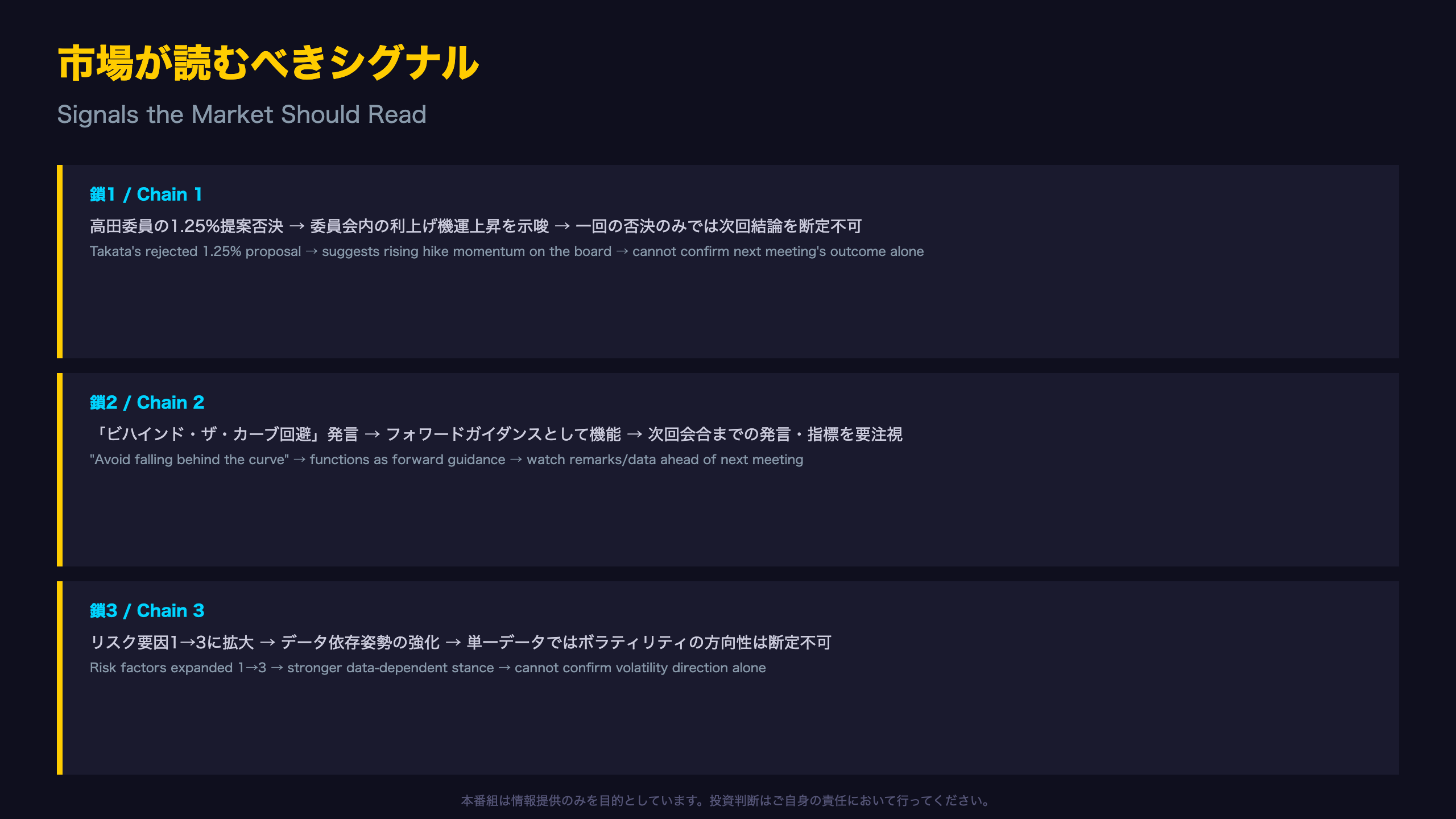
Reading the Market Implications Through the Chain of Evidence
Chain 1: The Dissenting Proposal and Board Dynamics
Fact: Board Member Takata proposed raising the policy rate to 1.25%, and it was rejected by majority vote.
Mechanism: A concrete proposal — not just a verbal dissent — suggests the debate over tightening has moved from theoretical discussion to formal voting behavior within the board.
Market implication: Generally, repeated individual hawkish proposals tend to strengthen market expectations for future hikes, but a single rejected proposal alone cannot confirm the outcome of the next meeting.
Chain 2: The “Behind the Curve” Pledge as Forward Guidance
Fact: Ueda explicitly stated the BOJ’s approach is “to avoid falling behind the curve.”
Mechanism: When a central bank governor uses this specific phrasing, it generally functions as forward guidance signaling openness to future tightening — a device familiar to Fed and BOE watchers.
Market implication: This data point alone cannot confirm the specific timing or magnitude of the next hike. Markets should watch subsequent remarks and data releases ahead of the next meeting (as early as September) for confirmation.
Chain 3: Risk Factor Expansion and a More Data-Dependent Stance
Fact: The Outlook Report expanded named risk factors from Middle East tensions alone to three factors, adding AI-related demand and FX volatility.
Mechanism: A broader list of monitored variables generally signals an intensified meeting-by-meeting, data-dependent reaction function.
Market implication: While a more multi-dimensional framework is generally thought to reduce policy predictability amid data volatility, this single report cannot determine the direction of that volatility on its own.
Bottom Line
Rather than taking comfort in today’s hold, investors should recognize that economic data, FX movements, and AI-related capex trends have all gained weight as variables the BOJ is now explicitly monitoring ahead of its next decision.
Disclaimer: This article is for informational purposes only. All investment decisions are made solely at your own risk.