📺 Watch the Full Video Analysis
This article was automatically generated by the NFC Market Live AI analysis system. (Updated: 2026-08-10 09:02 JST)
📄 Primary Source
日本銀行
https://www.boj.or.jp/mopo/mpmsche_minu/opinion_2026/opi260731.pdf
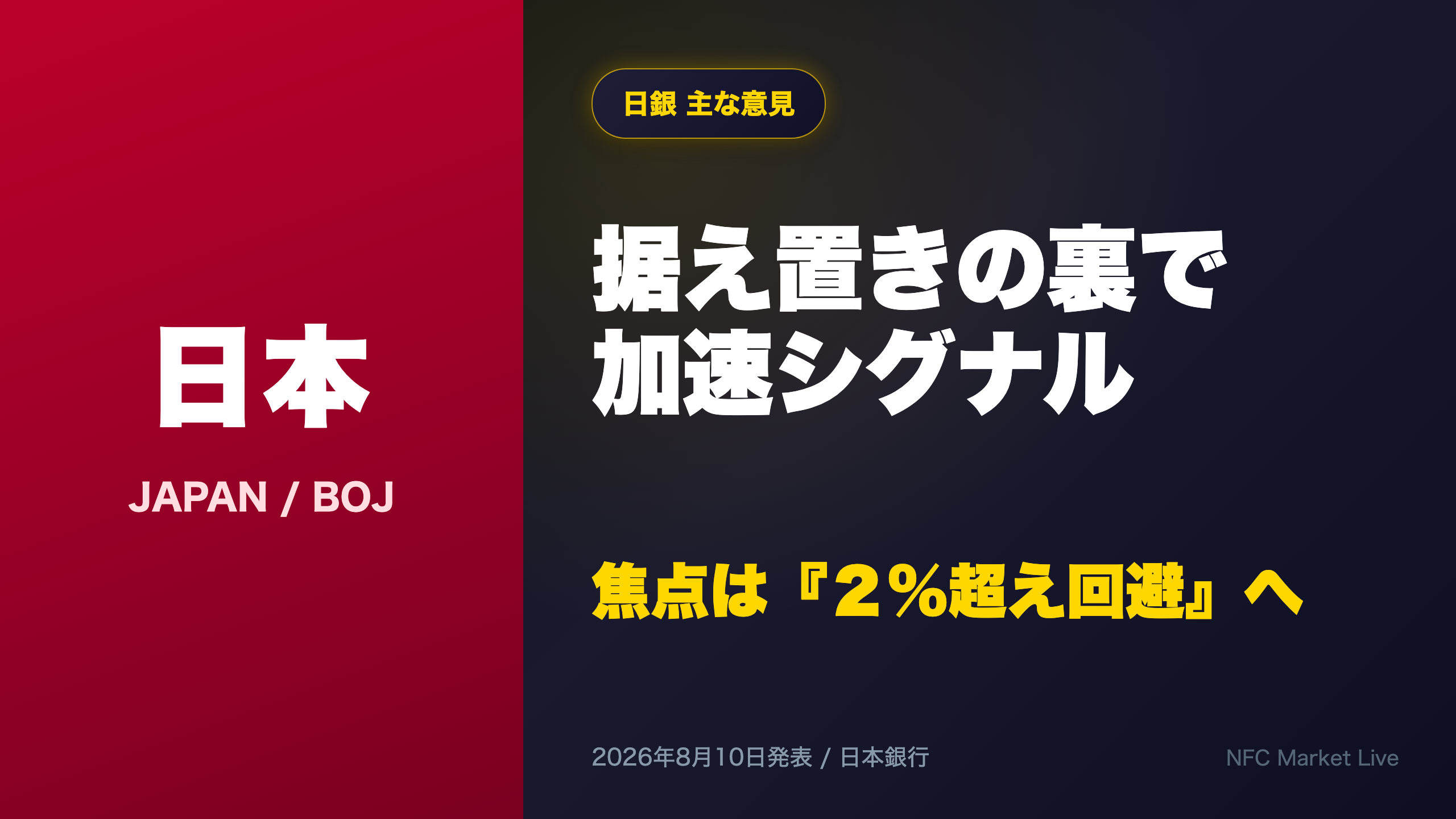
The Bank of Japan released its Summary of Opinions from the July 30-31, 2026 meeting on August 10. 📊
While one member argued for holding rates steady given transmission lags from June’s hike, several others said the pace of future hikes could accelerate faster than markets expect. ⚠️
The policy focus is shifting from reaching 2% inflation to preventing an overshoot. 💡
Broadening AI demand supports growth, but board members flagged correction risk in AI stocks. 📈📉
All eyes are on the next meeting.
据え置きの裏で強まる利上げ加速論
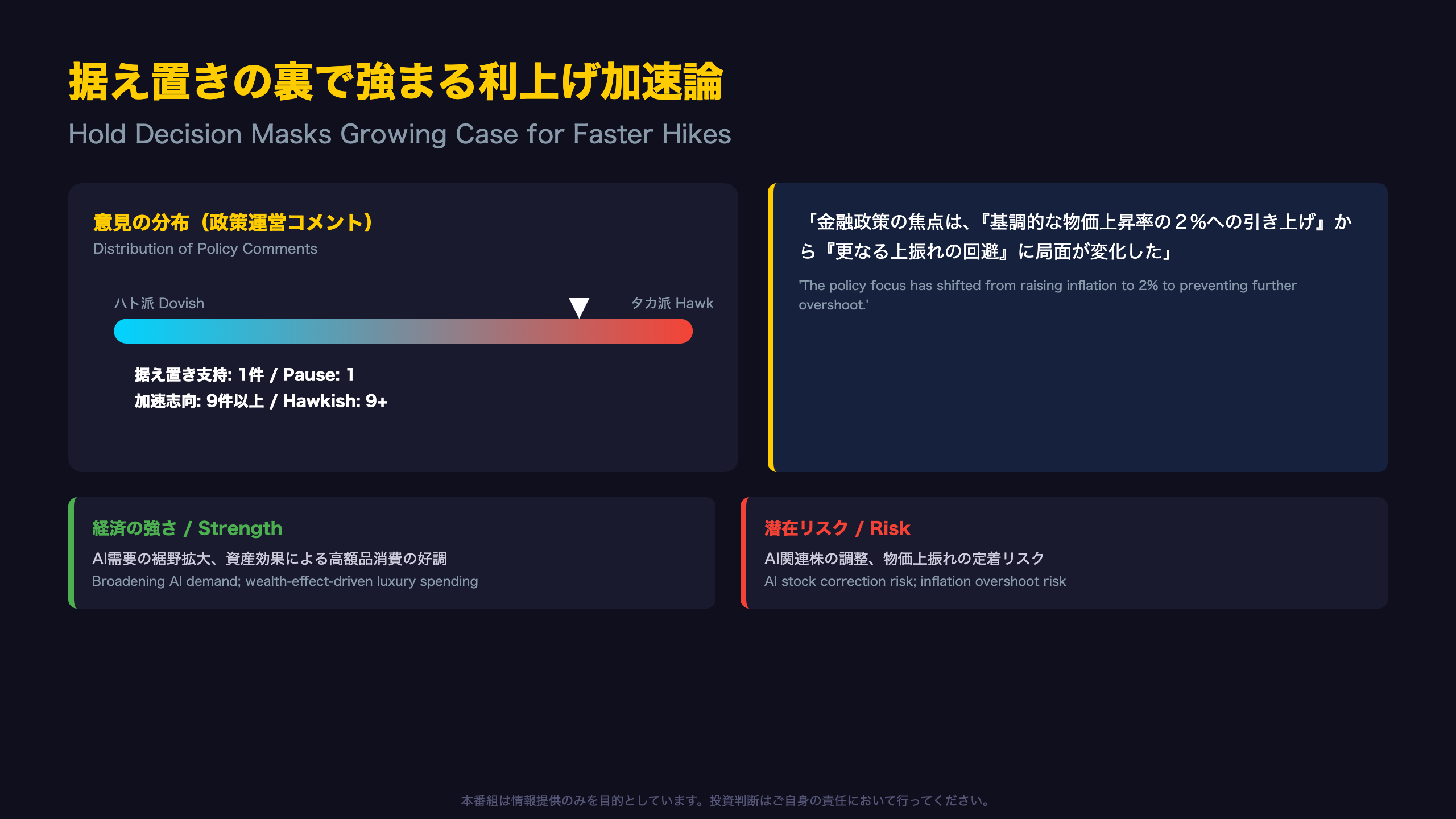
A Pause With a Hawkish Undertone
BOJ’s ‘Summary of Opinions’ differs structurally from the U.S. Fed’s FOMC minutes: it compiles anonymized, self-submitted summaries from each policy board member and government representatives, rather than a single narrative consensus record. This lets readers gauge the distribution of views rather than one institutional voice.
For the July 30-31, 2026 meeting, published August 10, only one member explicitly argued for holding rates steady, citing a ‘1 to 1.5 year lag’ before hike effects fully show up in inflation and the real economy. That single pause voice stands in stark contrast to at least nine other opinions pushing for continued or accelerated tightening.
One phrase stands out: the policy focus has ‘shifted from raising underlying inflation to 2% toward preventing it from overshooting.’ This is one of the few qualitative leading indicators available, since unlike the Fed’s dot plot, the BOJ offers no formal rate-path guidance.
Why this matters: a pivot toward ‘overshoot prevention’ language, combined with explicit mentions that hikes ‘could be faster than markets expect,’ suggests the reaction function may be tilting hawkish even though no rate change was likely enacted this particular month. Compare this to the BOJ’s April Outlook Report, which projected 2% achievement around H2 FY2026-FY2027 — that timeline is reaffirmed here, but the risk balance has clearly shifted upward.
AI需要の裾野拡大と株価波及リスク
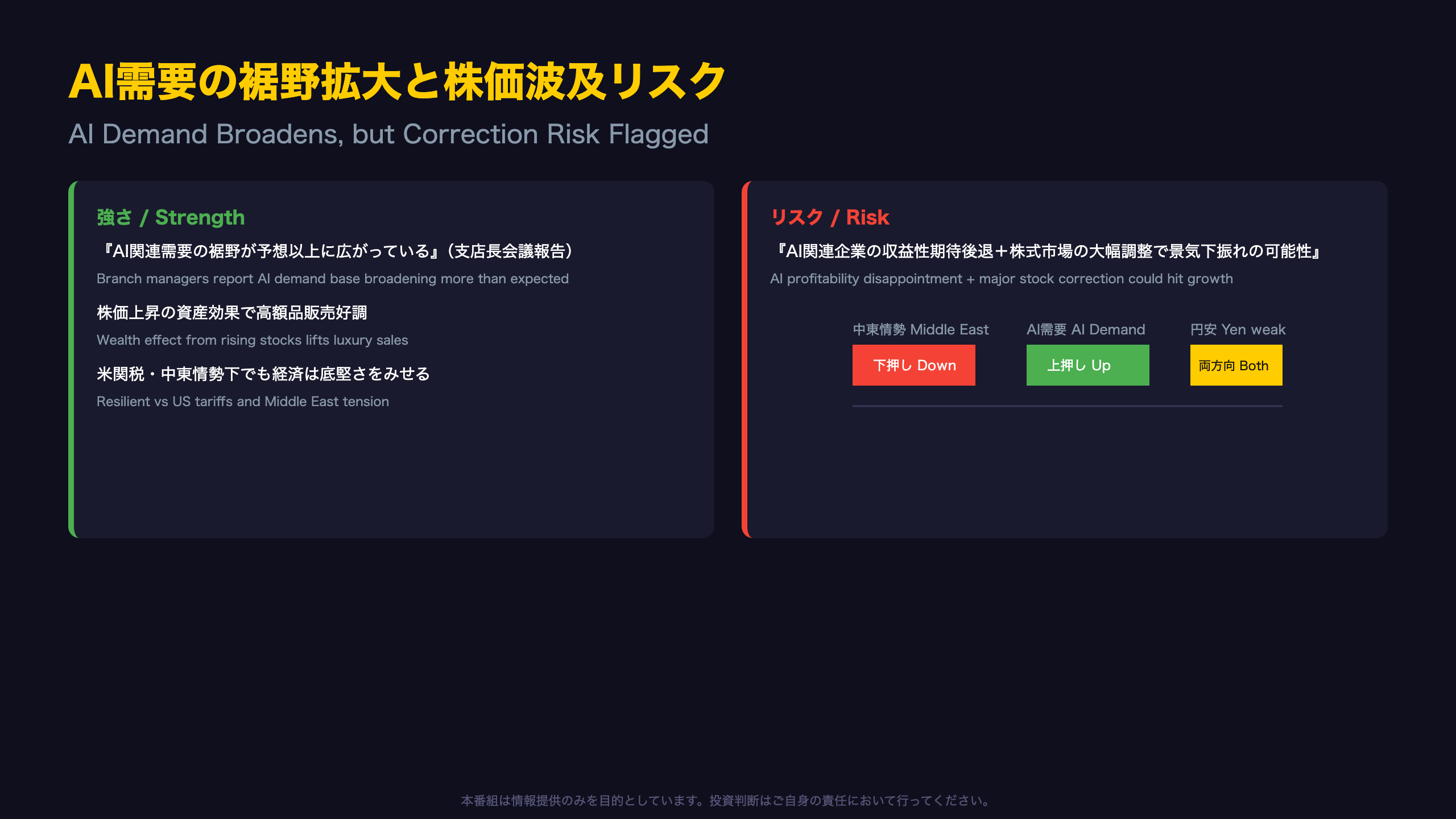
Resilience Powered by AI, With a Bubble Warning Attached
Among the Summary of Opinions from the July 30-31, 2026 meeting, the most notable economic theme is the broadening of AI-related demand. One member cited the BOJ’s regional branch managers’ meeting (支店長会議) — a quarterly internal survey where BOJ branch heads report grassroots economic conditions — noting the AI demand base is spreading wider than expected.
This pairs with a wealth-effect story: rising equity prices are reportedly boosting luxury goods sales, suggesting Japan’s asset markets are feeding directly into consumption strength.
A historical contrast worth noting: one member explicitly compared Japan’s past vulnerability to external shocks — where domestic demand fell sharply and price growth weakened — with the current resilience shown against both U.S. tariff policy and the Middle East situation. This framing suggests some policymakers view the current cycle as structurally different, though it remains one member’s characterization rather than a formal BOJ assessment.
The flip side: one member flagged that if expectations for AI companies’ future profitability recede and stocks undergo a major correction, the economy could weaken — a direct acknowledgment that BOJ officials watch equity valuations, not just consumer prices, as a risk channel. For international readers, this echoes debates in the U.S. around AI capex sustainability risk to growth.
Fiscal backdrop: the government’s ‘Honebuto policy 2026’ calls for ‘responsible proactive fiscal policy,’ which one member noted could lift domestic output, employment, real income, and inflation — an additional upside factor board members are tracking.
物価上振れリスクの高まり
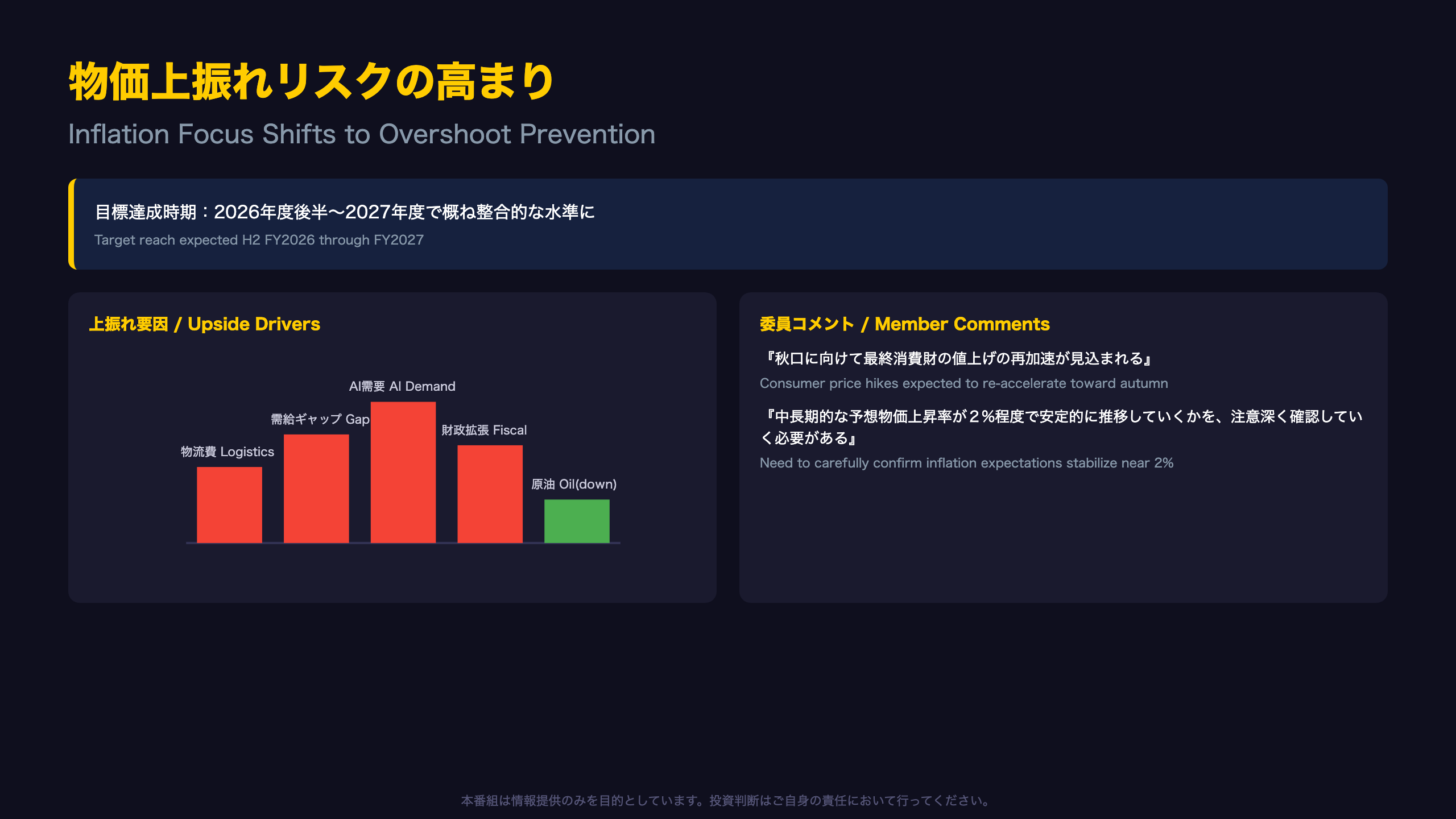
From ‘Reaching 2%’ to ‘Preventing Overshoot’
Japan’s inflation narrative took a subtle but important turn in this Summary of Opinions. Where the June minutes emphasized reaching the 2% target, the July minutes show members increasingly preoccupied with the risk of overshooting it.
One data point stands out: domestic logistics costs, packaging materials, and food tray prices are cited as drivers of an expected re-acceleration of final consumer goods price hikes toward autumn — a granular, cost-push narrative distinct from the demand-pull AI story discussed elsewhere.
Context for international readers: Japan’s CPI framework differs from the U.S. Fed’s PCE-based approach. The BOJ targets a broad ‘underlying inflation’ concept that strips out temporary factors like government subsidy effects — one member explicitly noted that government measures affect household perceptions of specific prices but must be excluded when assessing the underlying trend. This matters because headline CPI can look tame (still below 2% per the July minutes) while underlying pressures build.
Oil price nuance: oil and naphtha benchmarks have declined from their April peak as tankers cleared a Persian Gulf bottleneck, easing near-term pressure. But one member flagged this as potentially temporary, warning supply-demand balance could tighten again once transient factors fade — a single-data-point caveat rather than a firm forecast.
The bigger structural claim: one member linked Japan’s output gap — described as supply shortage, demand excess — with global AI demand and expansionary fiscal policy abroad, arguing these could compound to push inflation meaningfully higher, representing the more hawkish end of the board’s inflation debate.
据え置き派1、加速志向派多数
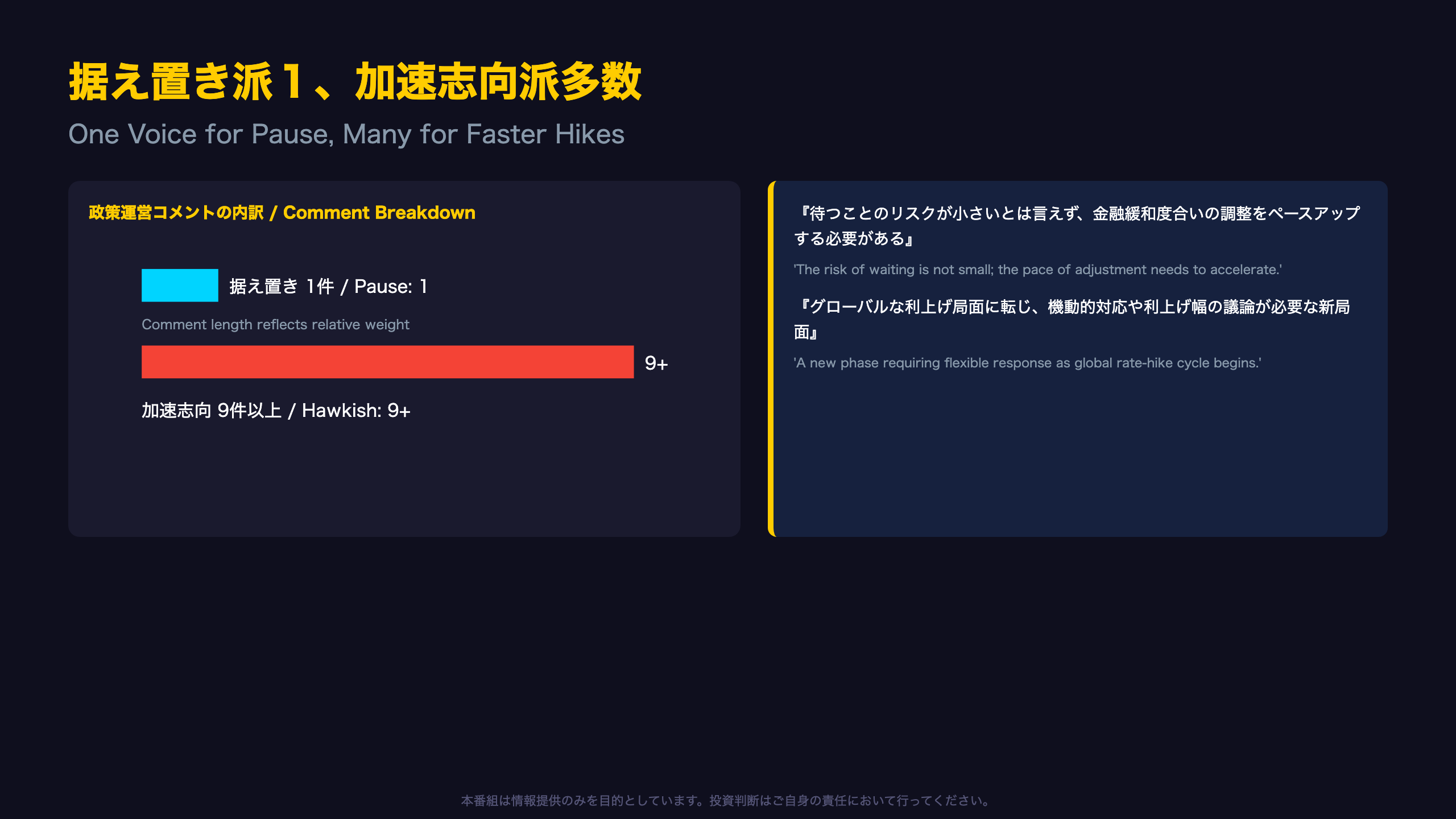
The Count Behind the Words
BOJ’s Summary of Opinions doesn’t publish a formal vote tally like FOMC minutes do — but counting distinct viewpoints offers a useful proxy for gauging committee sentiment.
In the July 30-31 minutes, only one comment explicitly argues for holding rates steady, grounded in a transmission-lag argument: rate hike effects take ‘1 to 1.5 years’ to fully materialize, so the board should carefully assess the impact of the previous hike before moving again.
Against that single pause voice, at least nine separate comments push toward continued or accelerated tightening — from generic ‘continue raising rates as appropriate’ language to sharper statements: ‘the pace of hikes could be faster than markets expect,’ and ‘the risk of waiting is not small, so the pace of adjustment needs to accelerate.’
A global backdrop shift: one member observed that since June 2026, the shift from last year’s global rate-cutting phase to a rate-hiking phase has created a ‘major regime change’ in Japan’s surrounding financial environment — a notable departure from Japan’s historical position as a policy outlier maintaining ultra-easy conditions while other G10 central banks hiked.
What’s conspicuously absent: June’s minutes extensively debated the BOJ’s JGB purchase tapering schedule, including a proposal to halt further reductions from next April. The July excerpt contains no such discussion in the monetary policy section — this doesn’t necessarily mean the topic wasn’t discussed, only that it’s not reflected in the provided opinions. Investors watching JGB market functioning should note this apparent pause in the taper debate without over-interpreting it.
政府「骨太方針2026」と市場の視線
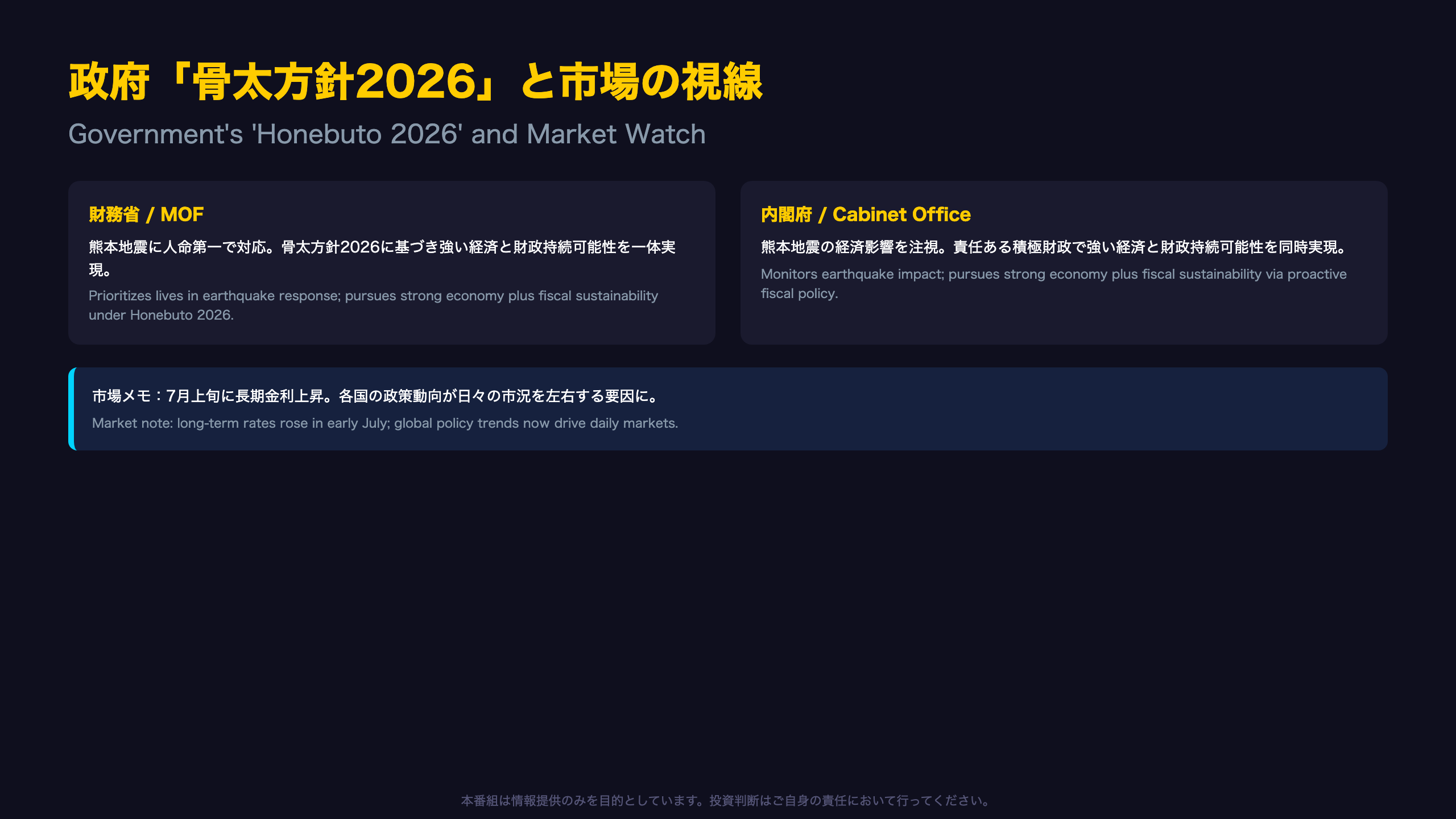
A New Variable: The Kumamoto Earthquake
Unlike the June minutes, the July Summary of Opinions includes references from both the Ministry of Finance (MOF) and the Cabinet Office to the Kumamoto earthquake, a natural disaster not mentioned in the prior meeting. MOF stated it would make an all-out effort prioritizing ‘human life first,’ while the Cabinet Office committed to monitor the impact on livelihoods and the economy. No quantitative economic impact assessment is provided in the source text.
Understanding Japan’s fiscal-monetary dialogue: at each BOJ policy meeting, MOF and Cabinet Office representatives attend as non-voting government observers and submit their own opinions — a structural feature distinct from the U.S. Fed, where Treasury does not have a standing seat at FOMC meetings. This gives international readers a rare direct window into how Japan’s fiscal authorities publicly frame expectations for BOJ policy.
‘Honebuto 2026’ (Basic Policy for Economic and Fiscal Management and Reform): Japan’s annual Cabinet-approved fiscal roadmap. The government describes its stance as ‘responsible proactive fiscal policy,’ paired with commitments to ‘fiscal sustainability,’ suggesting Tokyo aims to balance stimulus with credibility, likely mindful of JGB market sensitivity. One BOJ member explicitly linked this fiscal stance to inflation, saying it ‘is believed to raise domestic production, employment, real income, and the inflation rate’ — meaning fiscal expansion is read internally as an additional upside price risk.
Market color: the minutes note long-term interest rates rose in early July, and that policy trends among various countries are now a daily market-moving factor — a simple but telling sign that JGB yields are increasingly driven by global monetary policy synchronization rather than purely domestic factors.
市場へのインプリケーション
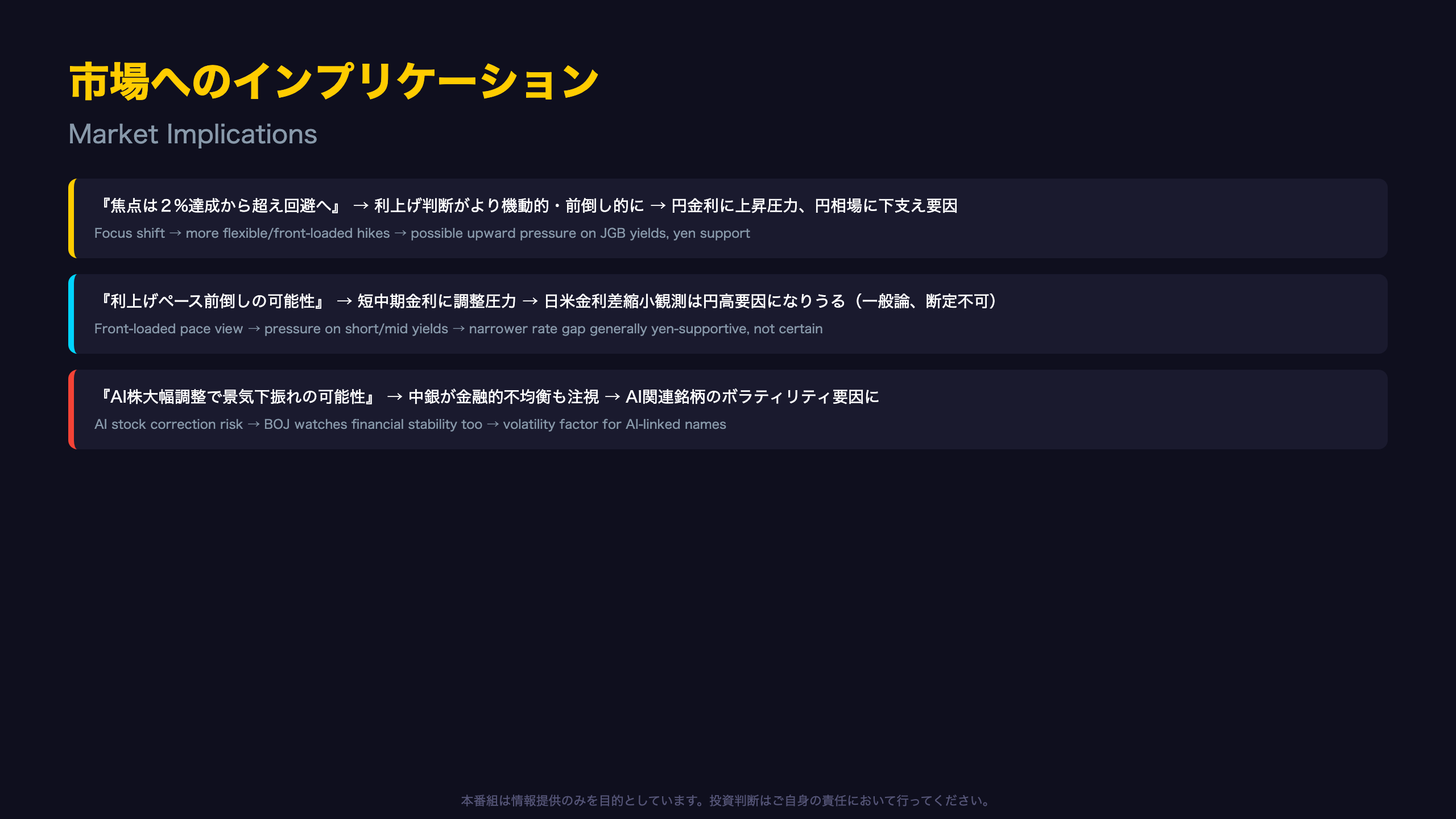
Reading Market Implications Through the Evidence Chain
(1) One member’s statement that the policy focus has ‘shifted…to preventing further overshoot’ [fact] → suggests the BOJ’s reaction function may lean toward more flexible, front-loaded rate decisions going forward [mechanism] → if this view gains traction, it could put upward pressure on Japanese yields and provide some support for the yen [market implication]. This remains a single meeting’s compiled opinions, not an official decision, so the actual outcome of the next meeting should be watched closely.
(2) Several members’ comments that ‘the pace of hikes could be faster than markets expect’ [fact] → if markets come to price in a more front-loaded hike path than currently assumed, short- and medium-term JGB yields could face stronger adjustment pressure [mechanism] → a narrowing US-Japan rate differential is generally thought to support yen appreciation, though this single data point cannot determine the direction or magnitude with certainty [market implication, appropriately hedged].
(3) One member’s warning that ‘a major AI stock correction could weaken the economy’ [fact] → the fact that the central bank itself is watching AI-related equity valuations shows the board weighs financial stability alongside price stability [mechanism] → in a period of continued capital inflows into AI-related names, this kind of risk commentary from a central bank could itself become a source of market volatility [market implication].
A balanced read: none of this constitutes a formal policy commitment. It reflects the range of views compiled from one meeting’s participants, and the real test will be whether the next meeting’s actual decision — and any accompanying rate action — validates the hawkish tilt seen here.
Disclaimer: This article is for informational purposes only. All investment decisions are made solely at your own risk.