📺 Watch the Full Video Analysis
This article was automatically generated by the NFC Market Live AI analysis system. (Updated: 2026-08-05 09:02 JST)
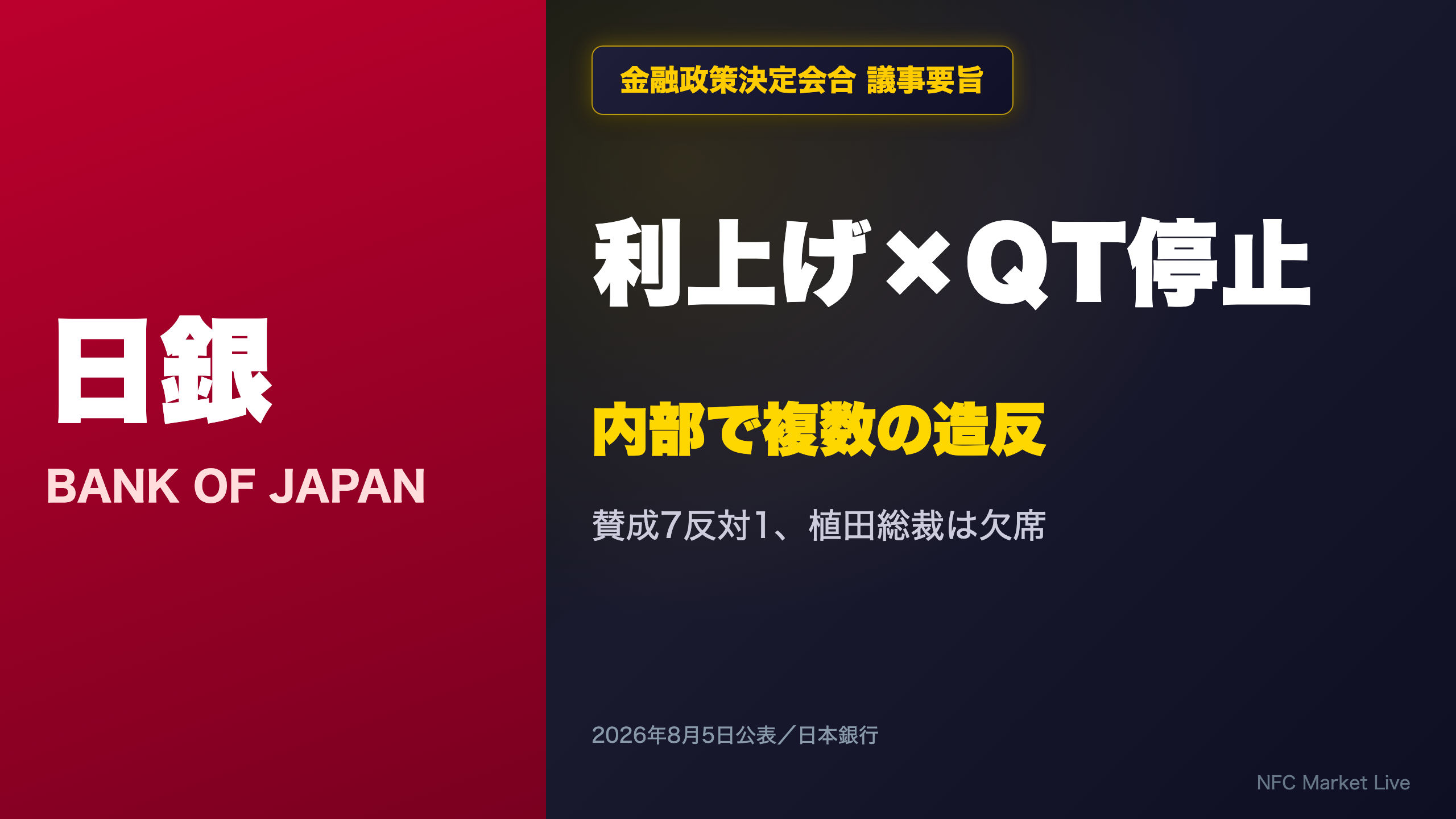
The Bank of Japan raised its policy rate 0.25pp to around 1.0% in a 7-1 vote at its June 2026 meeting. 📈
Simultaneously, the Board decided to halt JGB purchase tapering from April 2027, settling at a floor of ~¥2tn/month. ⚖️
Governor Ueda was absent, submitting written views, with Deputy Gov. Himino chairing instead. 🈳
Members split sharply on how to weigh Middle East risks — inflation upside vs. output/employment downside. 💬
Takata and Tamura dissented on the inflation wording; Tamura’s push to keep tapering was rejected 7-1. 📊
We break down what this hawkish-hike-meets-dovish-QT-halt combination means for JGB yields and the yen. 🔍
利上げ×QT停止 同時決定の内実
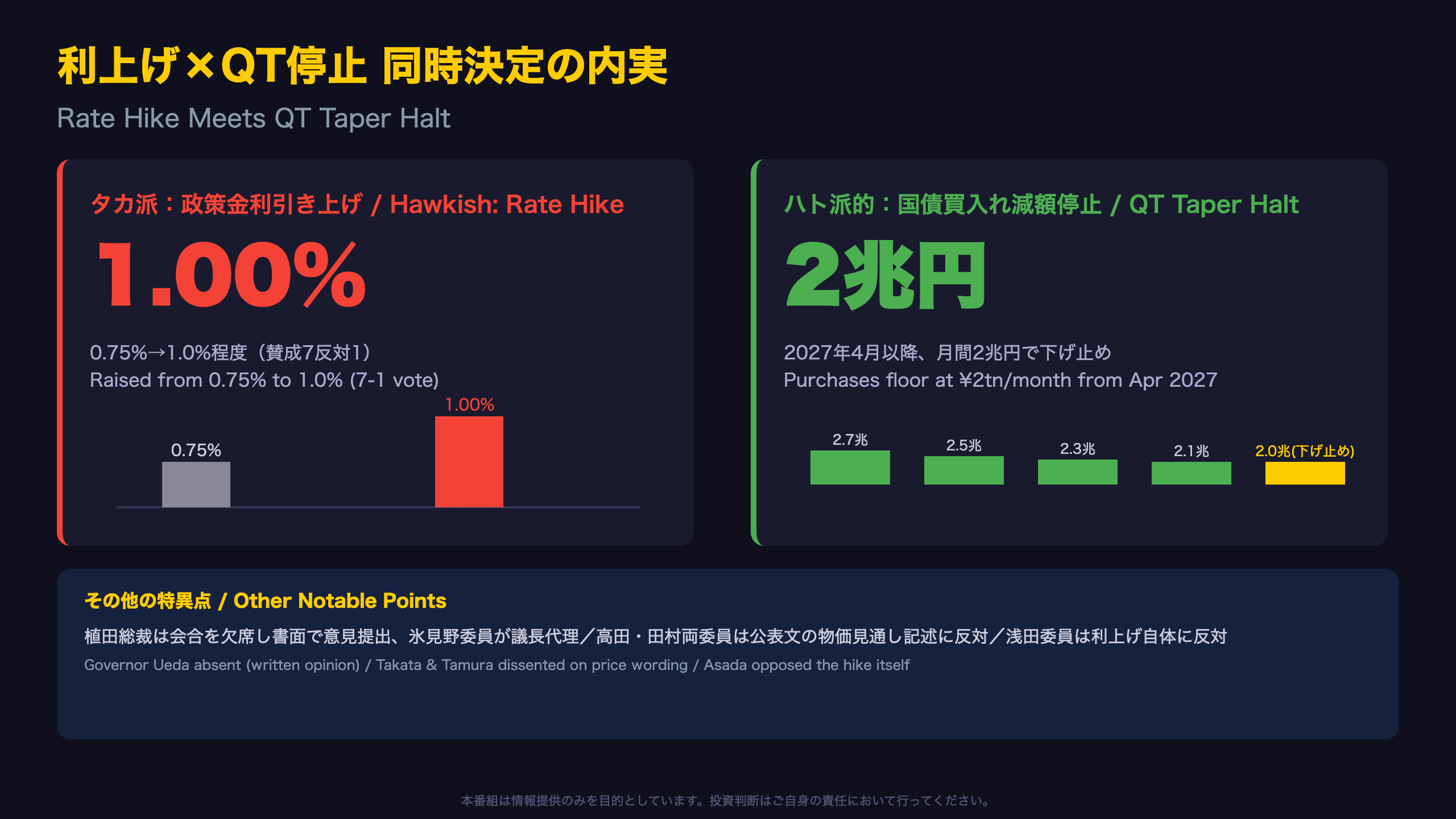
Rate Hike and QT Taper Halt Announced Together
At the June 15-16, 2026 Monetary Policy Meeting, the Bank of Japan (BOJ) delivered two major decisions simultaneously. The policy rate — guided via the uncollateralized overnight call rate — was raised from around 0.75% to around 1.0%, passing 7-1. At the same meeting, the Board decided to halt the tapering of long-term Japanese Government Bond (JGB) purchases starting April 2027, settling at a floor of roughly ¥2 trillion per month.
For readers unfamiliar with BOJ’s Monetary Policy Meeting (MPM) minutes: these documents are published with roughly a six-week lag and summarize the debate among the nine-member Policy Board, offering rare insight into internal dissent that headline rate announcements don’t reveal.
“Long-term interest rates should in principle be formed in financial markets, and the Bank’s JGB purchases should be conducted in a predictable manner while preserving flexibility to ensure JGB market stability,” the minutes state.
Notably, Governor Ueda was absent from the meeting — an unusual occurrence for a rate-setting decision — with Deputy Governor Himino chairing in his stead under Article 16(5) of the Bank of Japan Act. Ueda reportedly submitted written views, though their content isn’t disclosed.
Market angle: Compared to the Fed’s dot plot or ECB’s forward guidance, BOJ minutes emphasize consensus-building language (“most members,” “a few members”), making the magnitude of dissent — here, one dissenter on the hike and one on the JGB plan — a key signal for gauging the pace of future normalization.
同じ中東情勢、正反対の結論
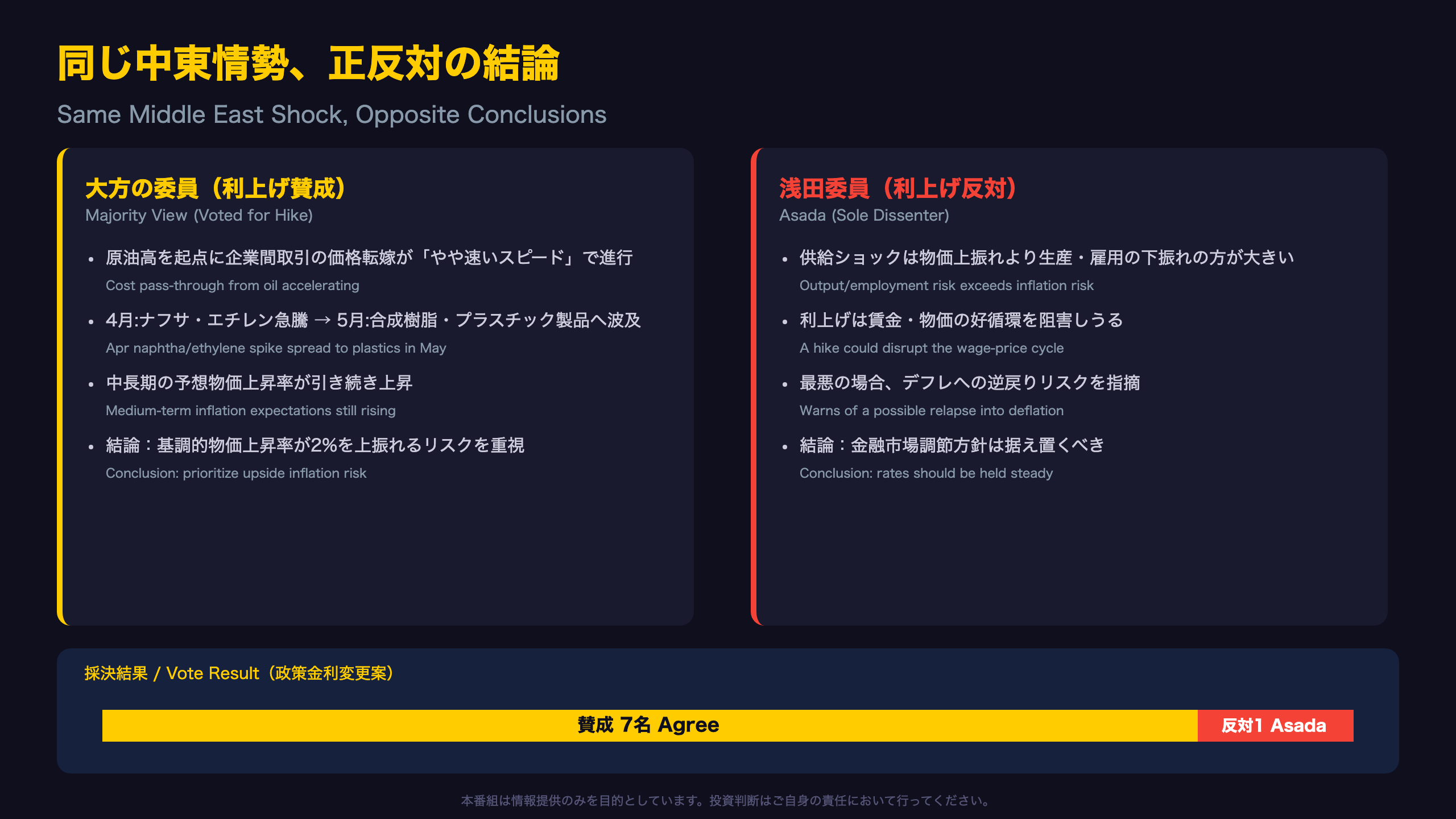
One Shock, Two Readings: The Middle East Dilemma
A striking feature of these minutes is how the same exogenous shock — the Middle East situation — led the majority of the Policy Board and dissenter Asada to opposite policy conclusions.
The majority focused on the speed of cost pass-through. According to the minutes, one member noted that “in April, prices of upstream basic chemicals such as naphtha and ethylene surged, and by May, price increases in midstream materials like synthetic resins and plastic products became conspicuous” — evidence that the lag between input cost increases and retail price changes has “shortened compared to past episodes.”
By contrast, Asada argued that “the downside risk to production and employment from the supply shock is larger than the upside risk to prices,” warning that a downturn in production and employment “could disrupt the virtuous cycle between wages and prices, and in the worst case, cause the Japanese economy — which appeared to have escaped deflation — to relapse into it.”
Context for international readers: Unlike the Fed’s FOMC, where dissents are named and explained in a standardized format, BOJ minutes attribute dissent narratively, often blending it into paragraph-form summaries. This makes it easy to overlook that Asada represents a genuinely dovish minority — a useful contrarian indicator when gauging whether BOJ tightening has further to run.
Importantly, even the majority acknowledged the shock’s dual nature: it exerts “downward pressure on the economy and upward pressure on prices.” The disagreement is about risk-weighting, not a factual dispute over what’s happening on the ground.
QT停止の舞台裏:田村委員の造反
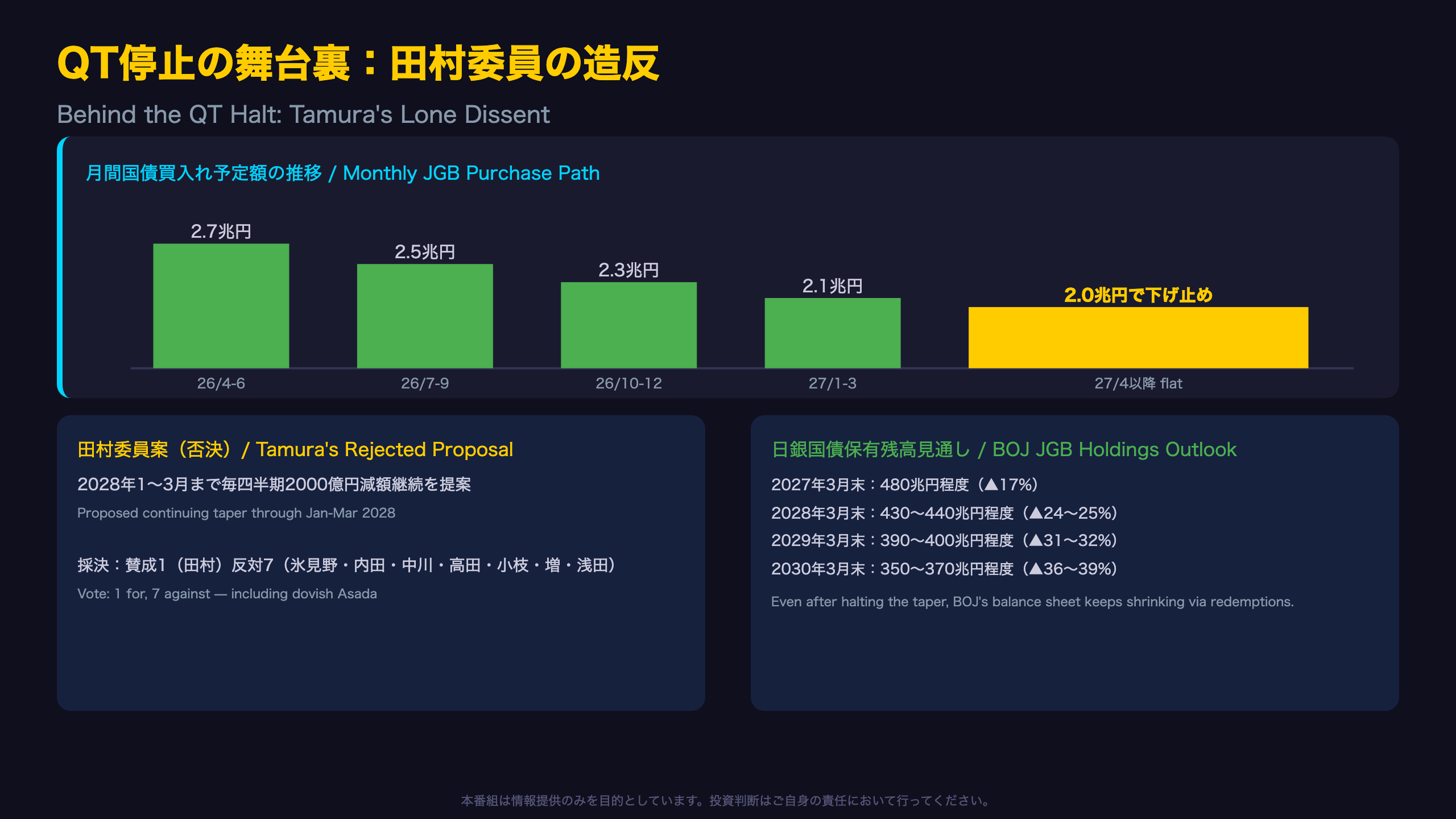
Why the BOJ Chose to Stop Tapering: A Market-Function Story
Under the new JGB purchase plan, the Bank will continue its existing taper of roughly ¥200bn per quarter through March 2027, but then halt further reductions from April 2027, settling at a floor of about ¥2 trillion per month.
The staff’s justification rested on market functioning data: the bond market survey’s functioning-conditions diffusion index has “improved to broadly the same level as the February 2025 survey — the peak before it deteriorated sharply following the U.S. tariff announcement” — and the yield-curve distortion in the 7-10 year zone, where BOJ holdings were once disproportionately concentrated, “has broadly been resolved.”
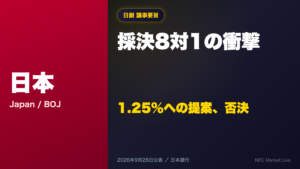
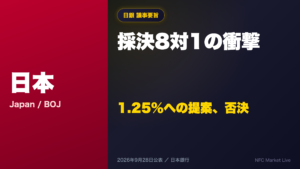
Board member Tamura dissented, arguing that “the formation of long-term rates should be left to the market and market participants,” and proposed continuing the ¥200bn/quarter taper through Q1 2028. That counter-proposal was rejected 7-1 (Tamura the sole supporter), while the chair’s original halt-in-2027 plan passed 7-1 (Tamura the sole dissenter).
A subtle but telling detail: Asada — the same member who voted against the rate hike as too hawkish — voted for halting the taper and against Tamura’s continued-reduction proposal. This consistency reveals Asada as the Board’s most consistently dovish voice, opposing tightening on both the rate-policy and balance-sheet fronts simultaneously.
For context: unlike the Fed’s balance-sheet runoff, which continues on autopilot, the BOJ pre-announced a purchase floor two years in advance — a distinctive form of forward guidance aimed at anchoring JGB market expectations.
Even with tapering halted, projected holdings still shrink via redemptions: from roughly ¥480tn (March 2027, -17% vs. June 2024) to ¥350-370tn (March 2030, -36 to -39%) — a point several members stressed should be communicated clearly to avoid the perception of fiscal accommodation.
物価はもう目標達成?割れる評価
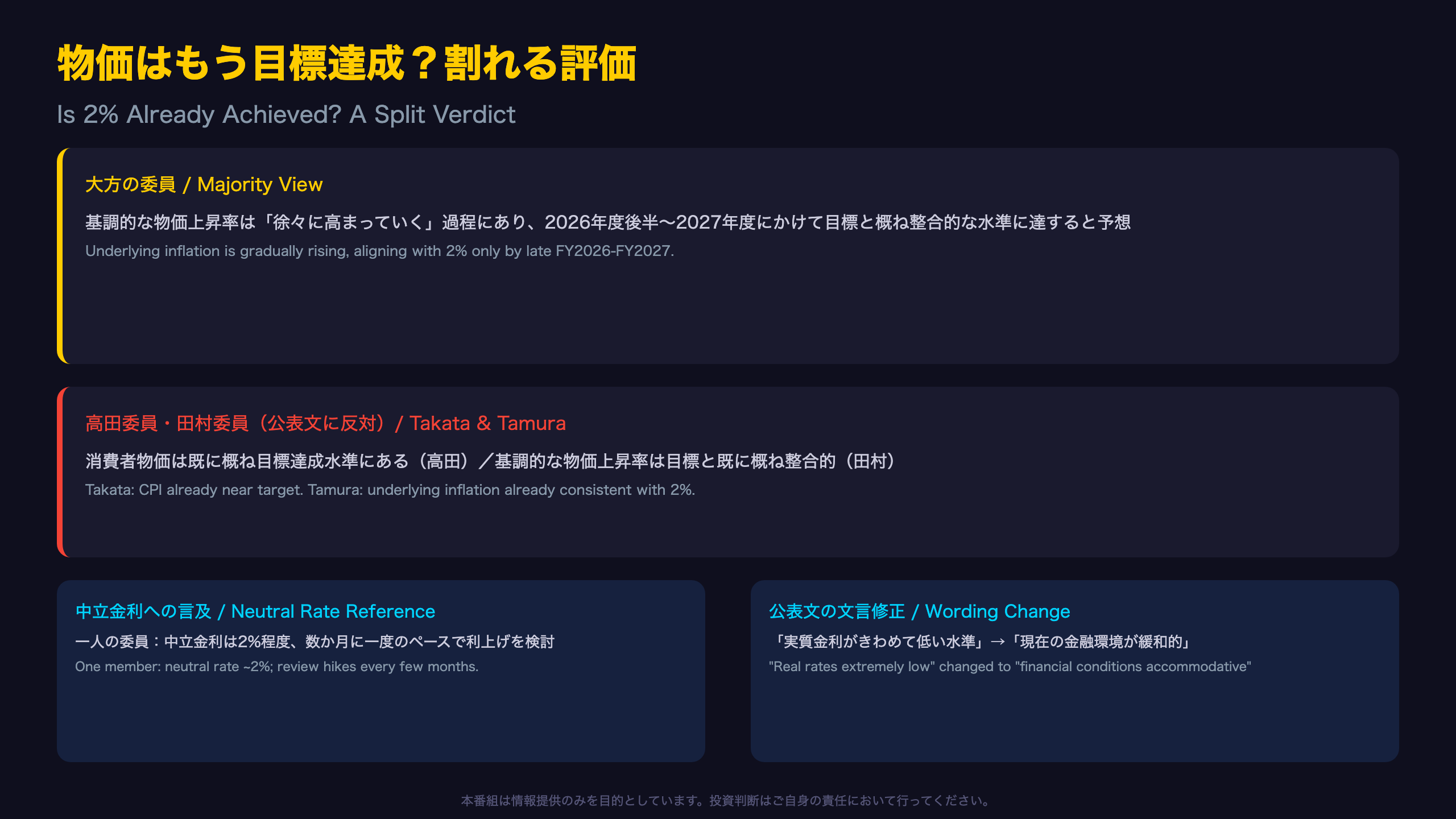
“Target Already Met” vs. “Still a Way to Go”: A Split on Inflation
The majority view holds that underlying (trend) CPI inflation is “gradually rising” and will only become “broadly consistent with the price stability target” from the second half of FY2026 through FY2027 — implying the 2% target hasn’t yet been durably achieved.
Board members Takata and Tamura disagree. Takata stated that “consumer prices, including the underlying rate, are already at a level broadly consistent with the price stability target,” while Tamura said “the underlying rate of CPI inflation is already at a level broadly consistent with the 2% target.” Both dissented from the wording of the official statement on these grounds (noted in a footnote to the published statement) — a rare, explicit paper trail of internal disagreement over the diagnosis of inflation, not just the policy response.
Why this matters internationally: The BOJ’s concept of “underlying (kicho-teki) inflation” — a trend measure stripped of temporary government subsidy effects and volatile items — has no perfect analogue in Fed or ECB communication, though it functions similarly to “supercore” or “trimmed-mean” gauges used by regional Fed banks. One member cautioned that the headline rate of around 1.5% (aided by government energy subsidies) “may mask the reality of nascent price pressure building beneath the surface.”
Separately, one member offered a rare numerical anchor for future policy: Japan’s neutral rate is around 2%, and the Board should “review the case for a hike every few months” as it approaches that level — one of the closest things to explicit forward guidance in the document.
Finally, the wording change from “real interest rates are at an extremely low level” to “financial conditions are accommodative” is a subtle but meaningful signal that the deepest phase of monetary easing may be receding, even as officials stress conditions remain supportive.
市場へのインプリケーション
Three Watchpoints Heading Into the Next Meeting
These minutes point to three coordinates markets should track ahead of the next Monetary Policy Meeting on July 30-31, 2026 — the same meeting at which this set of minutes was formally approved.
First, the pace of further hikes. The Board reaffirmed it will “continue to raise the policy rate and adjust the degree of monetary easing in response to economic, price, and financial developments.” Yet a footnote reveals Takata and Tamura dissented from the statement’s price-outlook wording, arguing the 2% target is already broadly met. Whether these two members push for a faster hike cadence — or continue dissenting on separate grounds — is the first thing to check in the next minutes.
Second, a structural shift in JGB supply-demand dynamics. Halting the taper at ¥2 trillion/month from April 2027 slows the pace of BOJ balance-sheet shrinkage, likely easing concerns about deteriorating supply-demand balance, particularly in super-long maturities. However, Tamura’s rejected push for a full “market-led” approach (continuing the taper through 2028) suggests this fault line could resurface.
Third, Asada’s consistently dovish voting pattern. In this meeting, Asada opposed the rate hike and opposed Tamura’s continued-taper proposal (effectively supporting the more accommodative halt). Whether this pattern persists will serve as a litmus test for how entrenched the dovish minority remains within the Board.
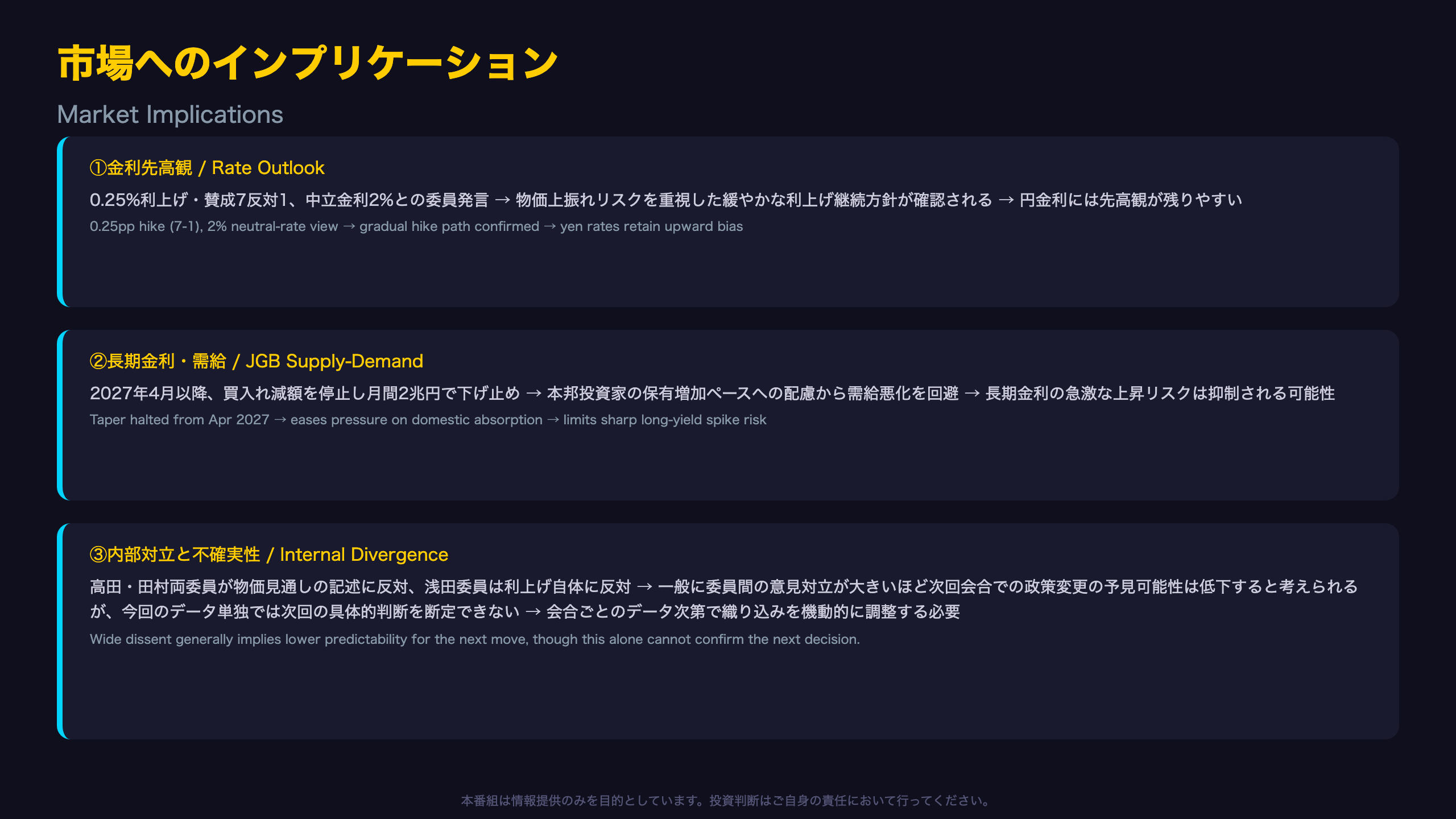
Market implications recap (chain of reasoning):
– Rate hike to 1.0% (7-1) + a member’s 2% neutral-rate reference → gradual tightening bias intact → yen rates likely retain a modest upward skew, though the next move’s timing cannot be inferred from this document alone.
– JGB taper halt from April 2027 → eases pressure on domestic absorption capacity → tempers, but does not eliminate, upside risk to super-long yields.
– Wide internal dissent (Takata, Tamura, Asada each on different grounds) → generally implies lower predictability of the exact sequencing of future decisions; this alone cannot confirm what the July 30-31 meeting will decide.
Disclaimer: This article is for informational purposes only. All investment decisions are made solely at your own risk.