📺 Watch the Full Video Analysis
This article was automatically generated by the NFC Market Live AI analysis system. (Updated: 2026-08-07 16:28 JST)
📄 Primary Source
総務省統計局
https://www.stat.go.jp/data/cpi/2025/pdf/def2025-2020.pdf
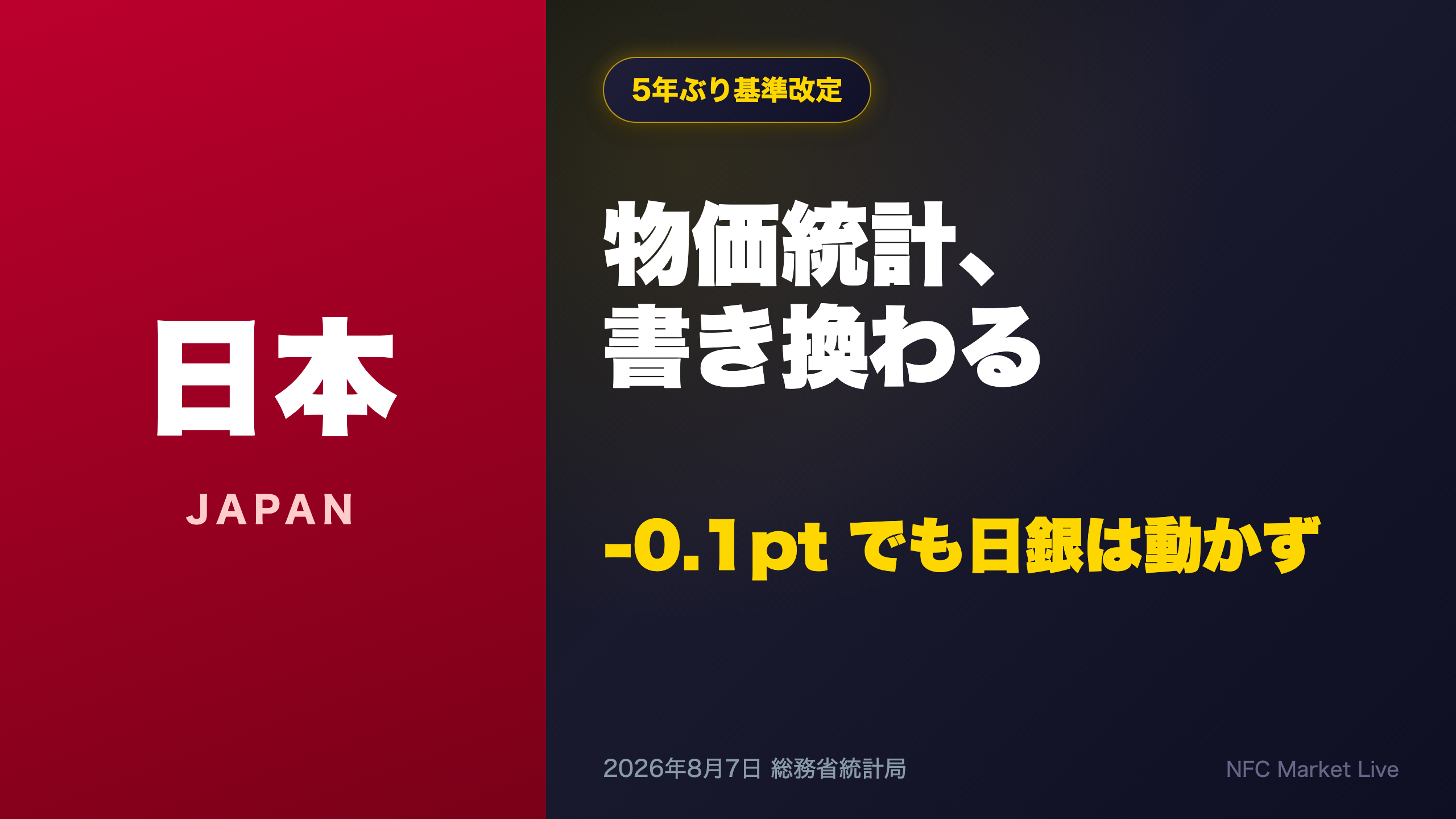
Japan’s headline CPI for June 2026 was revised from 1.7% YoY (2020 base) to 1.6% YoY (2025 base), according to the Statistics Bureau’s retroactive rebasing report.
📊 The headline shift is just -0.1pt, but the consumption basket was rebuilt dramatically: Food +128pts, Clothing -54pts, Transport & Communication -49pts.
💡 The contribution gap breaks down into a Weight Effect (+0.10pt), a Reset Effect (-0.15pt), and an Item Revision Effect (+0.02pt) — the Reset Effect dominates.
📉 Compared to past rebasings (2000: -0.4pt, 2005: -0.5pt, 2010: -0.6pt, 2015: -0.1pt, 2020: -0.7pt), this is among the smallest revisions in 25 years.
⚠️ Minimal impact on the BOJ’s 2% target assessment, but analysts must handle the old/new base splice carefully.
The Ultimate Summary:数値は動かず、構造は動いた
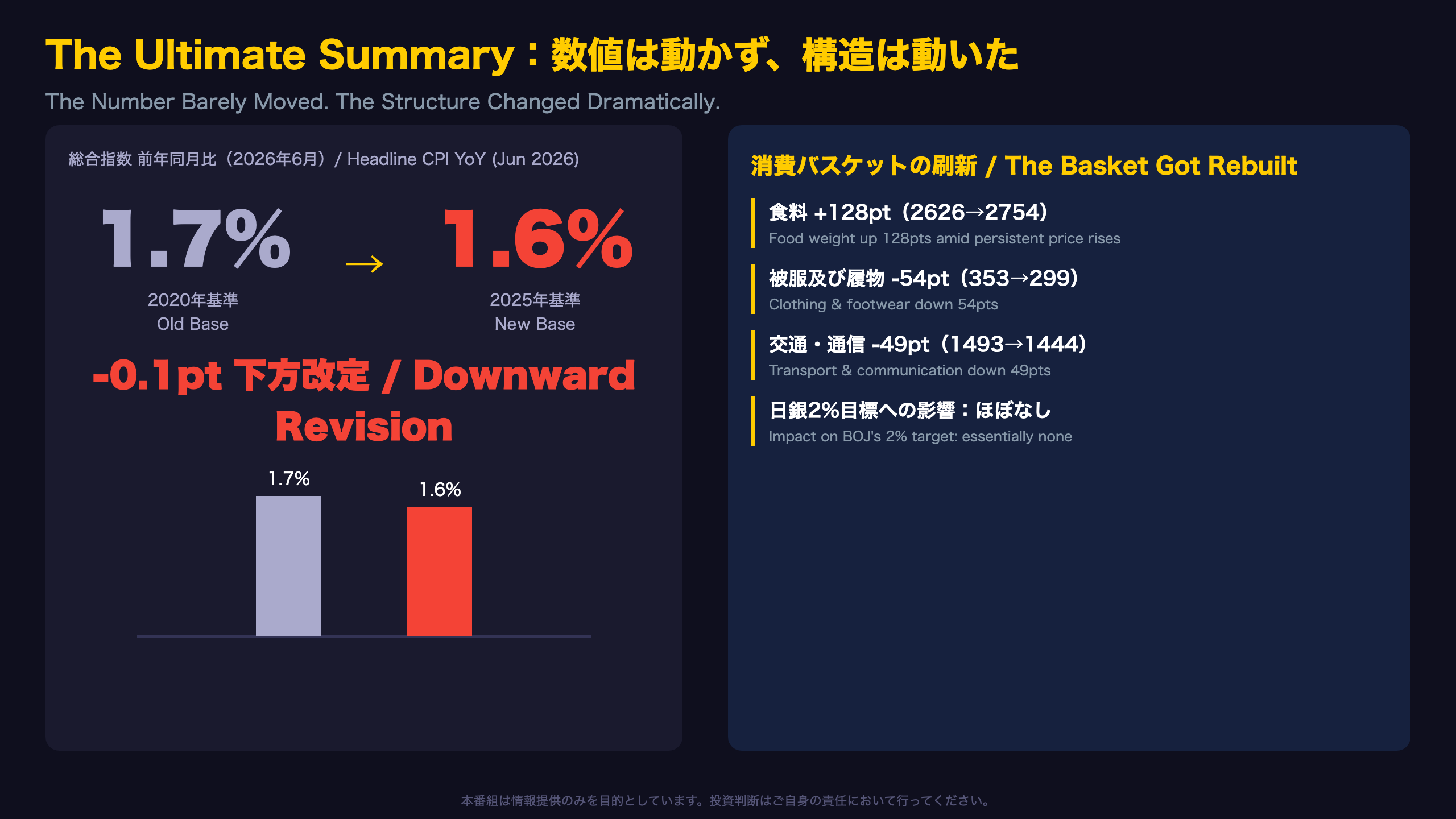
What Is a CPI “Rebasing,” and Why Does It Matter
Japan’s Ministry of Internal Affairs and Communications (MIC), through its Statistics Bureau, revises the CPI’s base year and expenditure weights every five years, drawing on updated household spending survey data. This differs from the U.S. Bureau of Labor Statistics (BLS), which updates CPI relative importance weights annually using rolling two-year expenditure data — a far more incremental process. Japan’s five-year cycle means revisions arrive in a single large step, which is why this rebasing carries more statistical weight than a typical monthly print.
How This Compares Historically
This cycle’s downward revision of just 0.1 percentage point is among the smallest since 2000. Prior rebasings in 2000, 2005, 2010, and 2020 all produced larger downward shifts (-0.4, -0.5, -0.6, and -0.7 points respectively), while only the 2015 rebasing matched today’s minimal -0.1 point shift.
Why the Small Revision Matters
One plausible explanation is that the outgoing 2020 base year itself captured an unusually volatile pandemic-era price environment, meaning the statistical “distance” to the more current 2025 base has effectively narrowed.
Market Takeaway
For investors benchmarking Japan against the Fed’s inflation framework, MIC’s rebasing exercise carries no direct read-through to actual price momentum — it is a bookkeeping exercise applied retroactively to make historical index levels consistent with today’s consumption patterns.
ウエイト改定が映す消費構造の変化
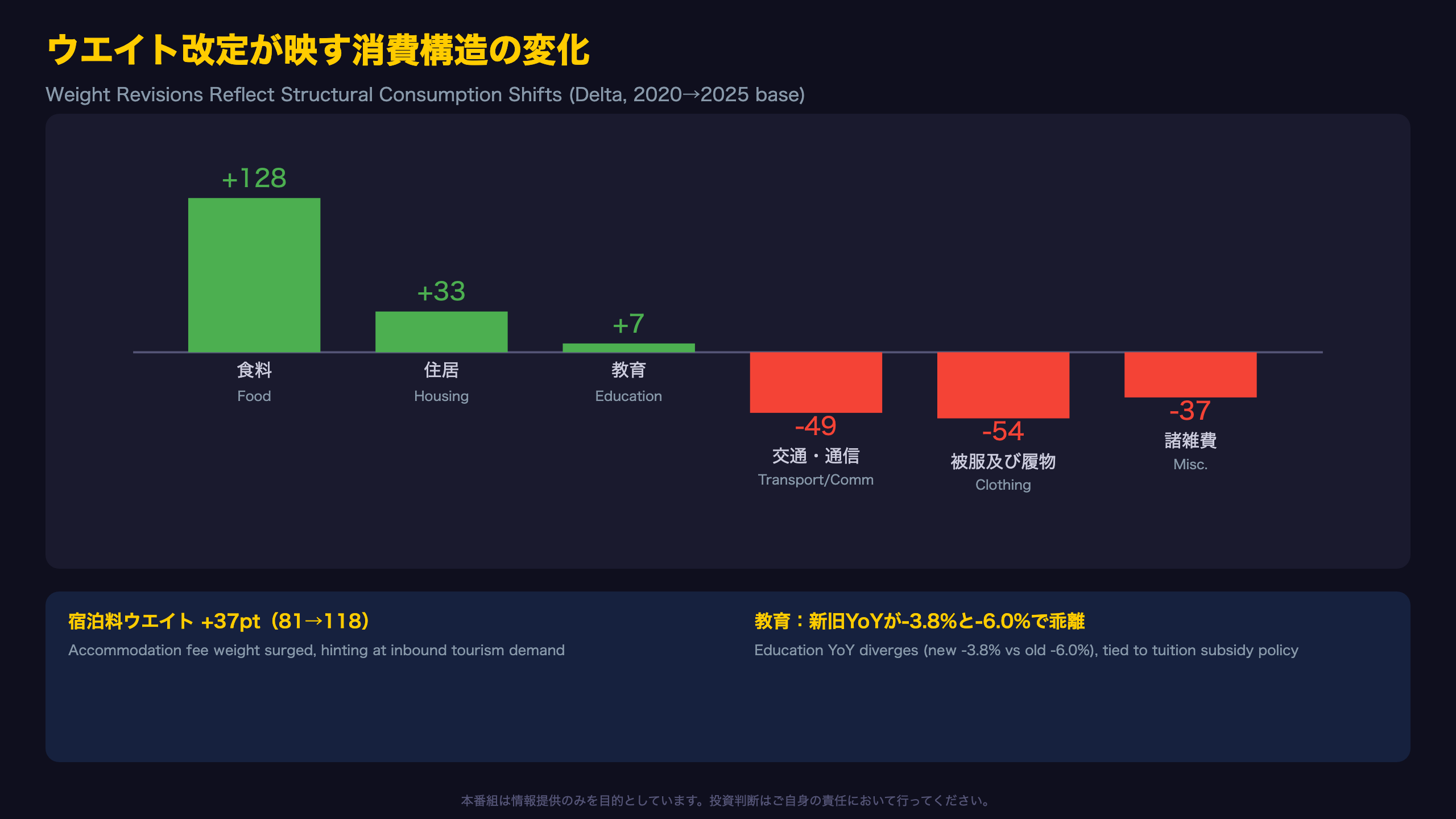
Beyond the Headlines: Secondary Weight Shifts
While food, clothing, and transport-communication dominate the rebasing headlines, several secondary categories moved too. Housing weight rose modestly (2,149 to 2,182, +33 points) and utilities ticked up slightly (693 to 698, +5 points), while furniture and household goods (387 to 372, -15 points), medical care (477 to 466, -11 points), culture and recreation (911 to 906, -5 points), and miscellaneous expenses (607 to 570, -37 points) all lost weight.
A Notable Outlier: Accommodation Fees
At the item level, “accommodation fees” saw its weight jump from 81 to 118, a 37-point increase — one of the largest proportional moves in the entire dataset. This likely reflects Japan’s continued inbound tourism recovery and elevated domestic travel spending, though the report does not explicitly attribute causation.
The Education Puzzle
Education’s weight increased only marginally (304 to 311), yet its year-on-year reading diverges sharply: -3.8% under the new base versus -6.0% under the old base, a 2.2-point gap. This likely reflects how Japan’s high-school tuition subsidy program is captured differently across index vintages — a policy effect embedded in the base-year mechanics rather than in the weight itself.
For International Readers
Unlike the U.S. CPI, which separately tracks tuition and childcare with relatively stable weights, Japan’s education category is more directly exposed to discrete government subsidy programs, making it a uniquely policy-sensitive line item.
寄与度差の要因分解:ウエイト効果 vs リセット効果
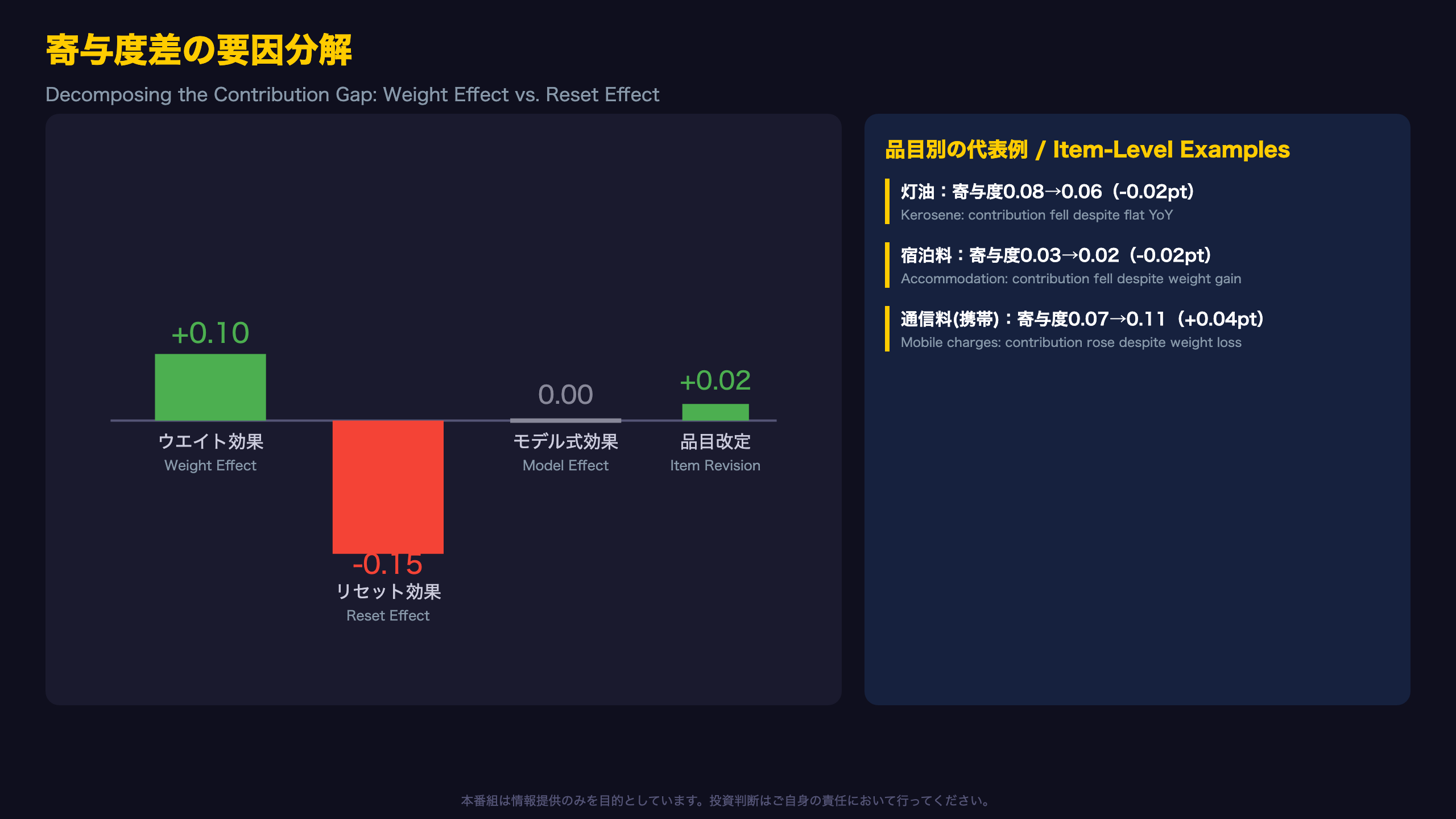
Decomposing the Gap: A Statistical Deep Dive
MIC’s own methodology note explains the reset effect precisely: if the old base’s index level is higher than the new base’s, the contribution shrinks in absolute terms; if lower, it grows. This is a mechanical artifact of chain-linking index levels to a new reference period of 100, not a signal about underlying inflation momentum.
Item-Level Evidence
Kerosene’s weight was nearly flat (38 to 39) with identical year-on-year growth (16.5%) under both bases, yet its contribution fell from 0.08 to 0.06 points — a pure reset-effect artifact. Accommodation fees saw contribution fall from 0.03 to 0.02 despite a weight increase, as its year-on-year reading also compressed from 3.1% to 1.5%.
The Mobile Phone Anomaly
Mobile phone charges present a striking counter-example: weight fell sharply (271 to 231, -40 points), yet contribution rose (0.07 to 0.11, +0.04 points), with identical 4.6% year-on-year growth under both bases. This cleanly illustrates that contribution changes are driven as much by index-level chaining as by weight changes themselves.
Core-Core Divergence
Notably, the core-core CPI (ex-fresh food and energy) contribution gap was actually positive (+0.01 point) — the opposite direction from headline CPI. This underscores that reset effects are not uniformly negative; their direction depends entirely on each category’s specific index path.
過去の基準改定との歴史的位置づけ
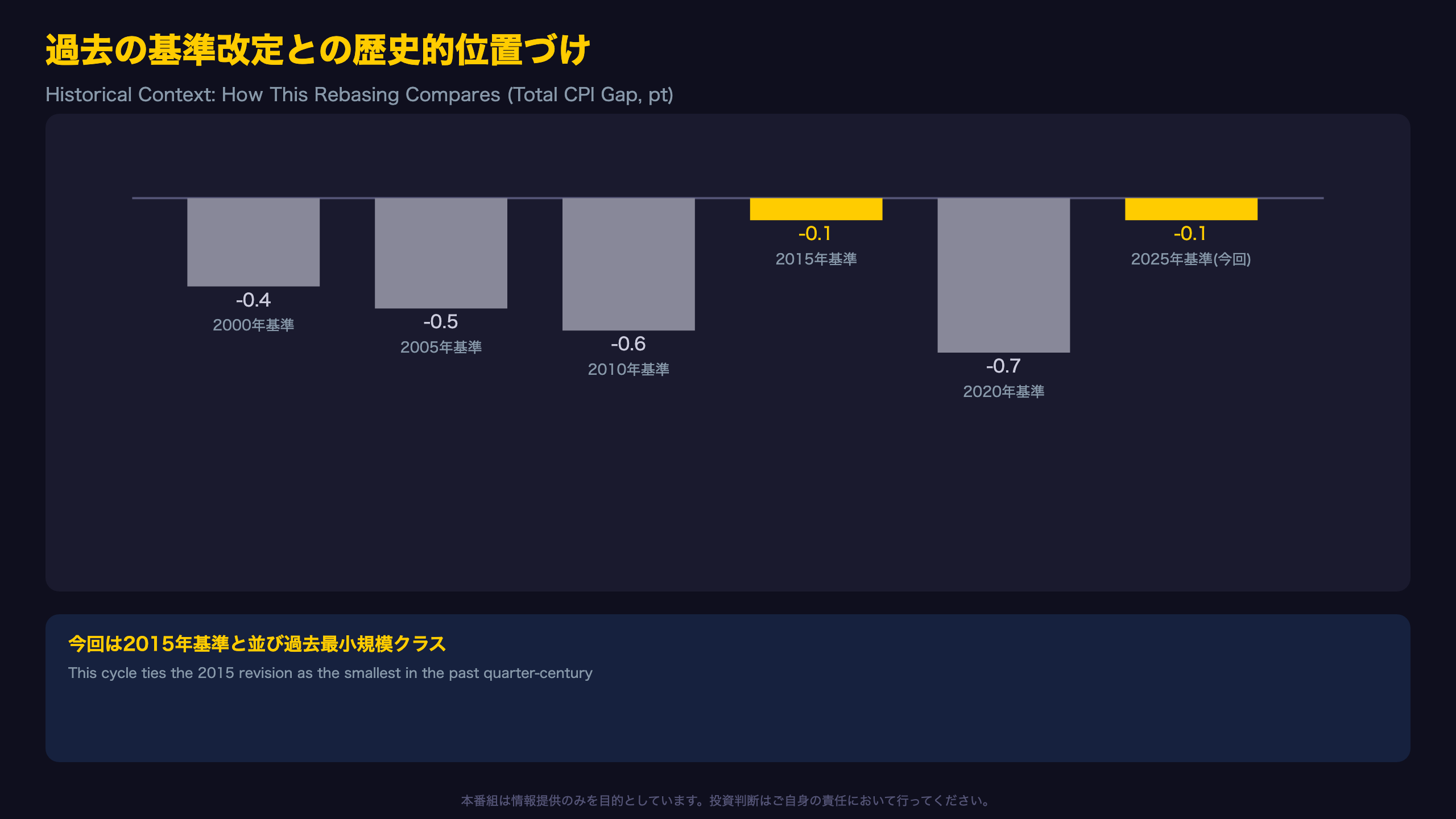
Japan’s Rebasing History: A Longer Lens
Looking back through MIC’s own appendix data, the 2010 base revision produced a particularly large swing in the core-core measure (ex-fresh food and energy), with gaps reaching -0.7 to -1.0 points in April-June 2011 — even larger than the headline CPI gap at the time. This shows core measures can sometimes see bigger rebasing effects than the headline number.
The 2020 Base: A Pandemic Snapshot
The most recent 2020 base revision (measured against 2015) produced a consistent -0.7 point gap across April-June 2021, coinciding with pandemic-driven disruptions to categories like accommodation and transport. That base year effectively froze in an atypical consumption pattern.
Why 2025 Looks Different
This cycle’s gap stayed at 0.0 points from January through May 2026, only turning to -0.1 point in June — a far more gradual, muted pattern than any of the prior four rebasings.
International Context
For comparison, the U.S. BLS’s annual weight updates are designed to avoid these large step-changes, updating relative importance every January using rolling two-year expenditure data. Japan’s five-year cycle trades smaller administrative burden for larger, more visible one-time revisions — a structural difference investors comparing US and Japan inflation dynamics should keep in mind.
日銀・市場への含意
Practical Implications for Market Practitioners
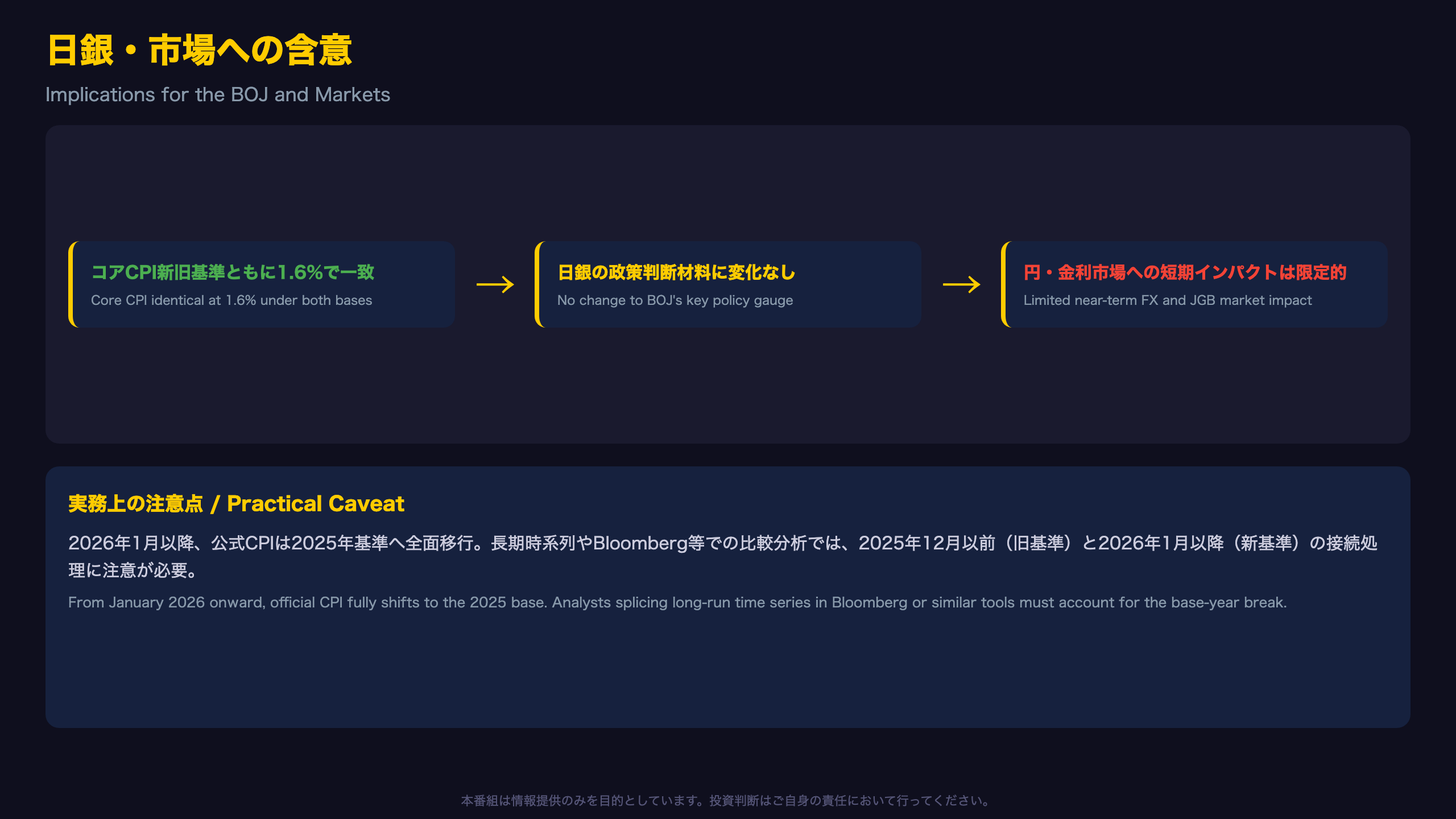
Analysts building long-run Japan CPI time series in Bloomberg, Refinitiv, or internal models should treat January 2026 as a structural break point: data before this date reflects the 2020 base, while data from January 2026 onward reflects the 2025 base. Naive splicing without adjustment could introduce a spurious step-change into trend analysis.
BOJ’s Policy Lens Unaffected
The Bank of Japan’s core inflation gauge (CPI ex-fresh food) came in at an identical 1.6% year-on-year in June 2026 under both bases → this indicates the rebasing carries essentially zero information content for the BOJ’s 2% target assessment in the near term. Earlier months (January-March) showed the new base running 0.1 point lower, but this magnitude sits well within normal measurement noise for policy purposes.
What This Means for Yen and JGB Traders
A revision of this scale should not, on its own, alter market expectations for BOJ policy normalization. Historically, statistical rebasings — unlike genuine inflation surprises — have not been market-moving events. That said, traders should confirm which base year is quoted when comparing consensus CPI forecasts.
Looking Ahead
The next national CPI release (July 2026 data) is expected in late August 2026, marking the first full month entirely reported under the new 2025 base — a useful checkpoint for confirming whether the reset effect’s drag stabilizes or fades further.
Disclaimer: This article is for informational purposes only. All investment decisions are made solely at your own risk.