This article was automatically generated by the NFC Market Live AI analysis system. (Updated: 2026-11-10 07:05 JST)
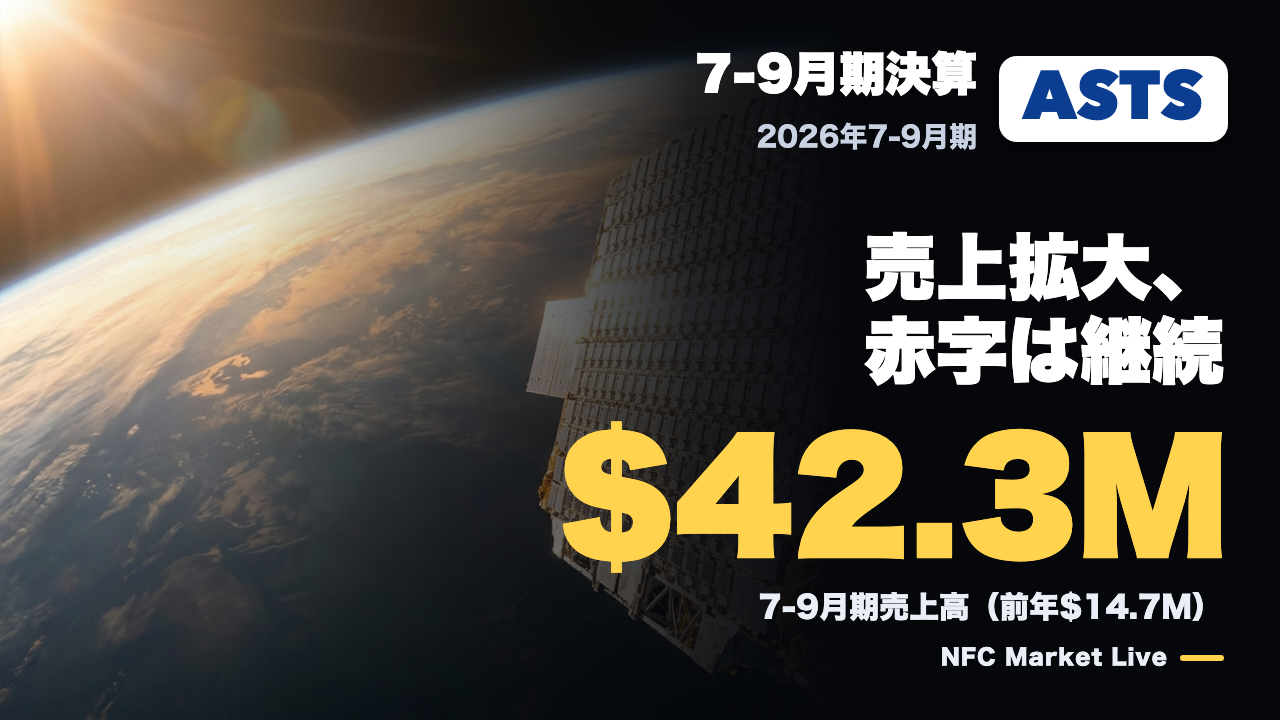
📊 AST SpaceMobile (ASTS) reported Q3 2026 results: revenue of $42.3M, about 2.9x a year earlier, and a loss per share of $0.44 (vs $0.45).
📈 The company maintains its FY2026 revenue target of $150-200M, holds about $3.2B in cash, and expects roughly $1.0B of non-dilutive funding tied to Japan’s MIC and Rakuten.
⚠️ Adjusted operating expenses were $133.6M, about 3x revenue, and long-term debt rose to about $4.1B.
💡 Watch: December production of 6 satellites a month, launch dates for BlueBirds 14-16, and year-end intermittent service. The next earnings date is not stated in the release.
サマリー:売上は拡大、赤字は継続
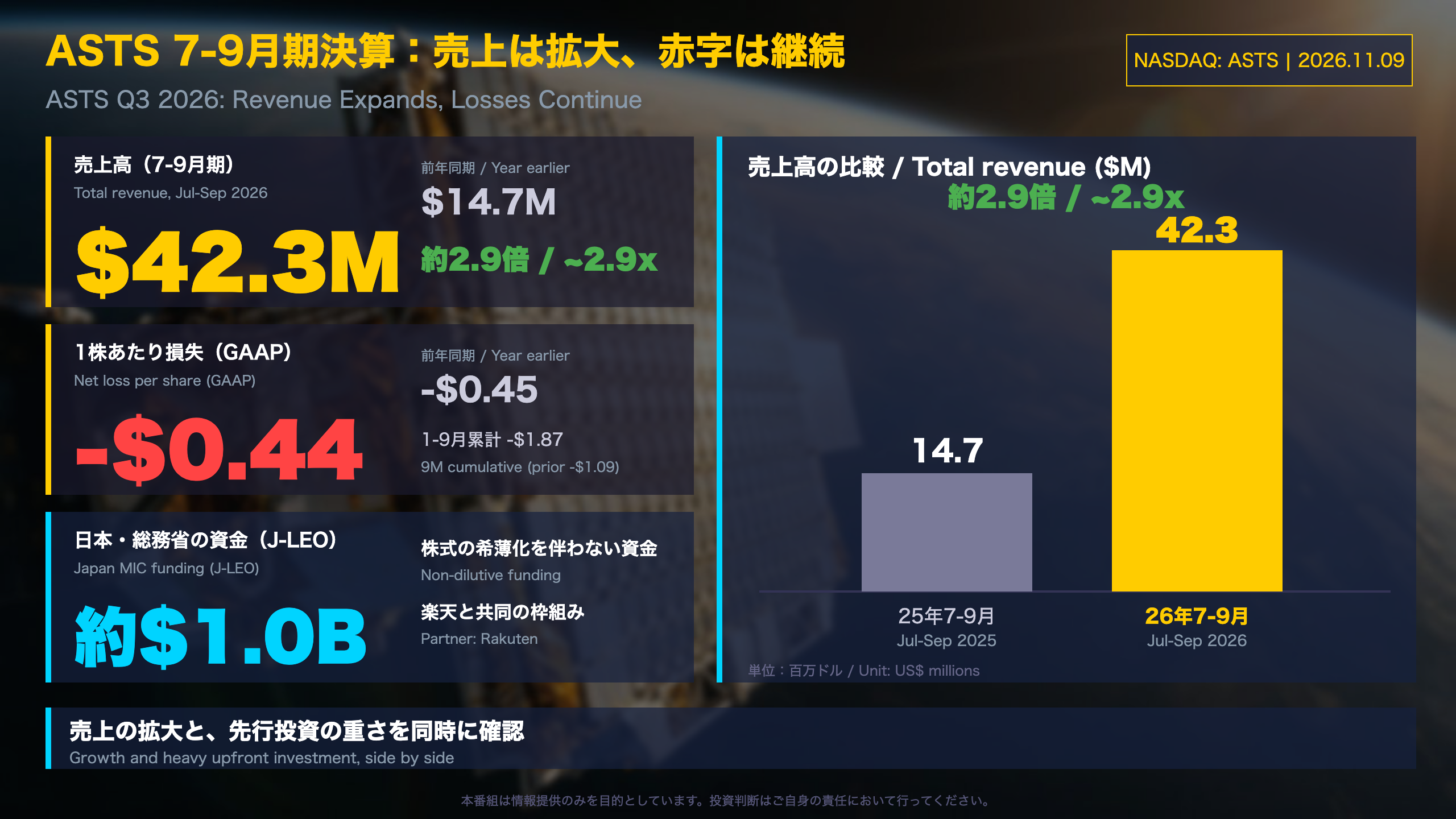
Q3 2026 at a glance
AST SpaceMobile (NASDAQ: ASTS) is building a satellite constellation (BlueBird) that connects directly to standard smartphones, selling capacity through mobile network operators (MNOs) and government customers. It reported on Nov. 9, 2026 through an SEC Form 8-K (Exhibits 99.1 and 99.2). Unlike a mature telecom, ASTS is still pre-scale: revenue is rising from a small base while capital spending dominates.
Key numbers (US$ million, except per share)
- Revenue: 42.3 vs 14.7 a year earlier (about 2.9x)
- Net loss attributable to common holders: 132.4 vs 122.9
- Loss per share: -0.44 vs -0.45
- Nine-month revenue: 88.6 vs 16.6; nine-month loss per share -1.87 vs -1.09
How to read it
This is a GAAP picture. The release gives no adjusted EPS (not stated in the source) and no EPS guidance. The only formal outlook is full-year revenue of $150-200 million, which management says it remains on target to meet. Comparisons here use the prior-year quarter and company guidance, not analyst consensus.
Balanced take
Resilience: revenue growth, about $3.2 billion of cash, and new government and Japanese funding. Risk: total operating expenses of roughly five times revenue, rising debt, and execution on launches and production. Japan’s Ministry of Internal Affairs and Communications (MIC) is the telecom ministry whose J-LEO program, with Rakuten, supports the roughly $1.0 billion of non-dilutive funding.
解説1:売上の中身と通期見通し
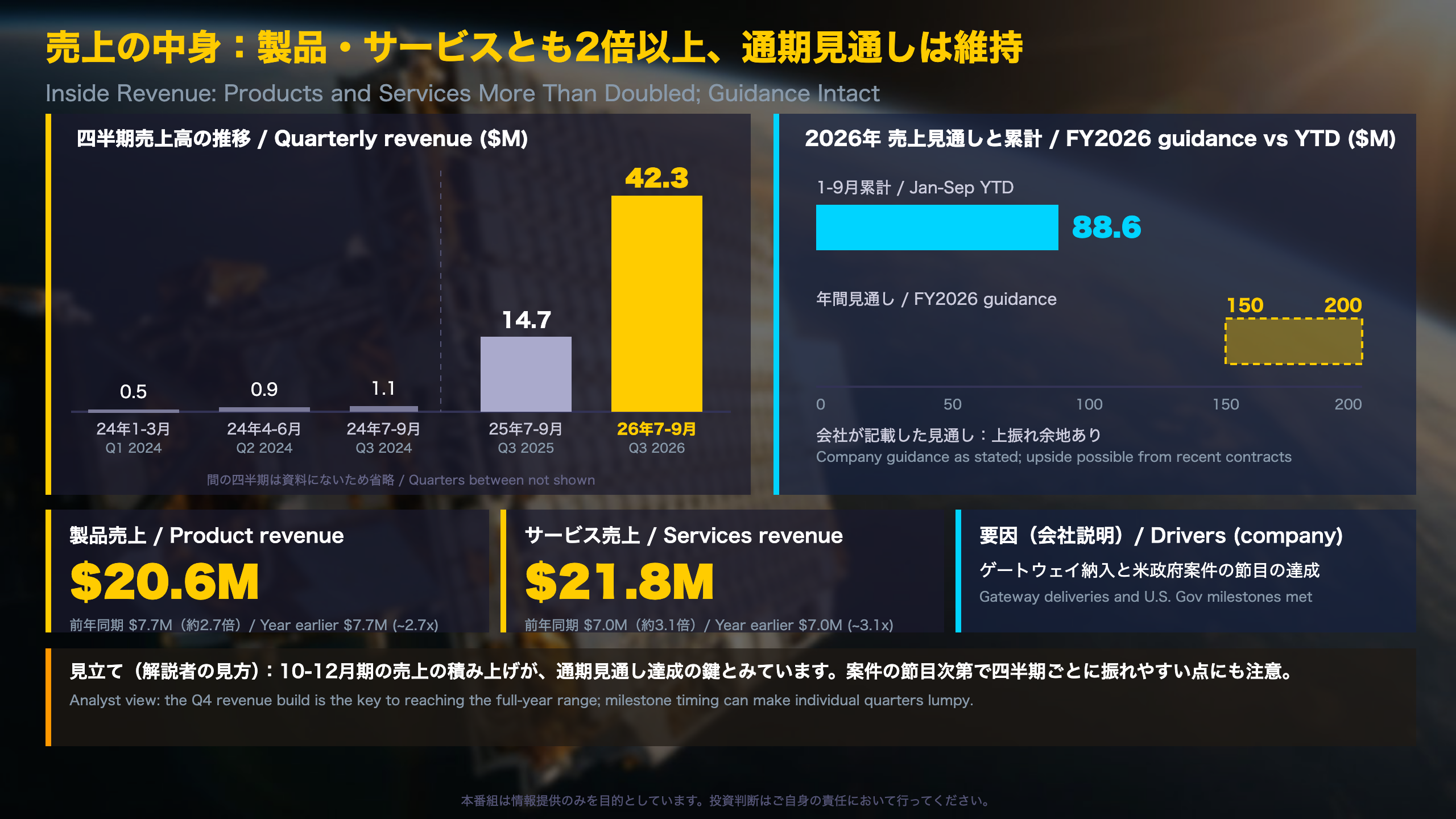
What is inside Q3 revenue
Mix
Product revenue was $20.6M (vs $7.7M) and services revenue $21.8M (vs $7.0M). Nine-month revenue split into $58.4M of products and $30.2M of services, up from $8.1M and $8.5M. The company says Q3 was driven by gateway deliveries (ground stations that link satellites to MNO networks) and U.S. government milestones.
Longer view
The XBRL history supplied shows revenue of $0.5M, $0.9M and $1.1M in the first three quarters of 2024 (later quarters are not in the source and are omitted). Q3 2026 is roughly 38 times the Q3 2024 figure, illustrating how early this commercial ramp is.
Working capital
Receivables rose to $104.1M from $37.7M at year-end, and inventory to $79.0M from $12.0M, consistent with a business scaling deliveries.
Guidance
Management reiterates FY2026 revenue of $150-200M, with upside from recent contracts, including a U.S. Space Force award (SB-AMTI) worth about $100M in revenue. Simple arithmetic: nine-month revenue of $88.6M means roughly $61M-$111M is needed in Q4 to land in the range; the timing of the Space Force revenue is not stated.
Two readings
Resilient: 16 U.S. government awards and 60+ MNO agreements broaden the base. Cautious: milestone-driven revenue can be lumpy quarter to quarter. For context, U.S. direct-to-device peers also remain early-stage; no consensus figures are used here.
解説2:赤字の中身と資金
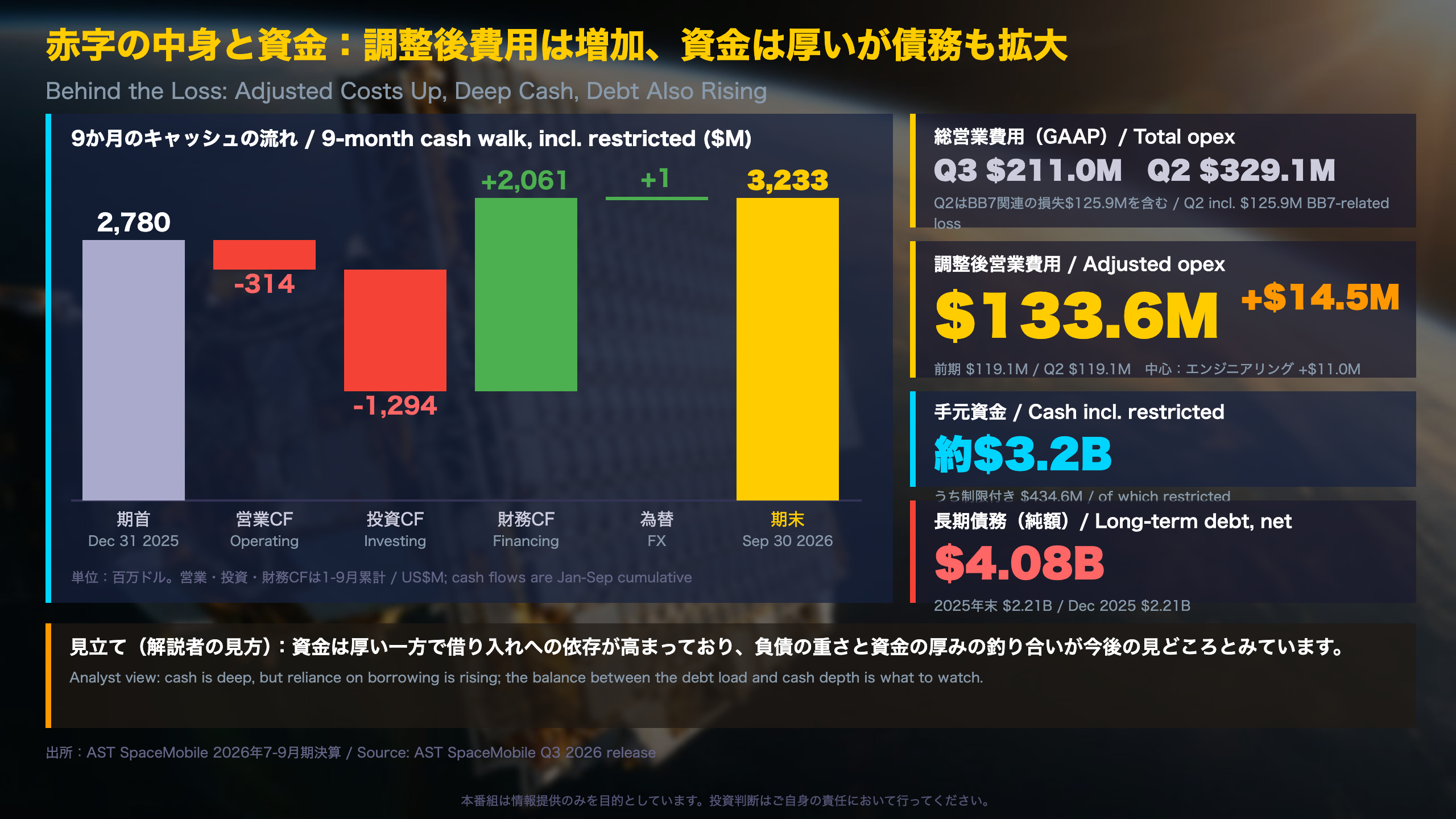
Cost structure and funding
Expense lines (US$M, Q3 2026 vs Q3 2025)
Engineering services 95.8 vs 40.8; G&A 55.7 vs 29.8; R&D 9.1 vs 5.5; depreciation 25.1 vs 12.7. Stock-based compensation was $52.3M. Adjusted operating expenses (excluding D&A, stock comp and the involuntary-conversion loss) were $133.6M, about 2x the $67.7M of a year ago and up $14.5M from Q2, led by $11.0M of adjusted engineering costs. Q2’s $329.1M GAAP total included a $125.9M loss tied to BlueBird 7.
Cash walk (nine months)
Operating cash flow was -$314.5M; purchases of property and equipment -$1,154.2M plus $100M of capital advances to Ligado; financing inflows were +$2,061.1M, mainly $2,195.2M of debt proceeds against just $85.7M of share issuance. Cash and restricted cash ended at about $3.23B, of which $434.6M is restricted.
Balance sheet
Long-term debt (net) is $4.08B vs $2.21B at year-end; equity is $2.16B vs $2.39B. Interest expense ($30.3M) roughly equals interest income ($30.1M) this quarter.
Context for global readers
Japan’s MIC is the telecom ministry; its J-LEO arrangement with Rakuten carries about $1.0B of non-dilutive funding, plus a roughly $1.2B U.S. quasi-governmental financing pipeline for 2027. Bull case: deep liquidity and non-equity funding. Bear case: growing leverage and cash burn. Both are visible in the same filing.
質疑:なぜ赤字は縮まらないのか、資金はどう賄うか
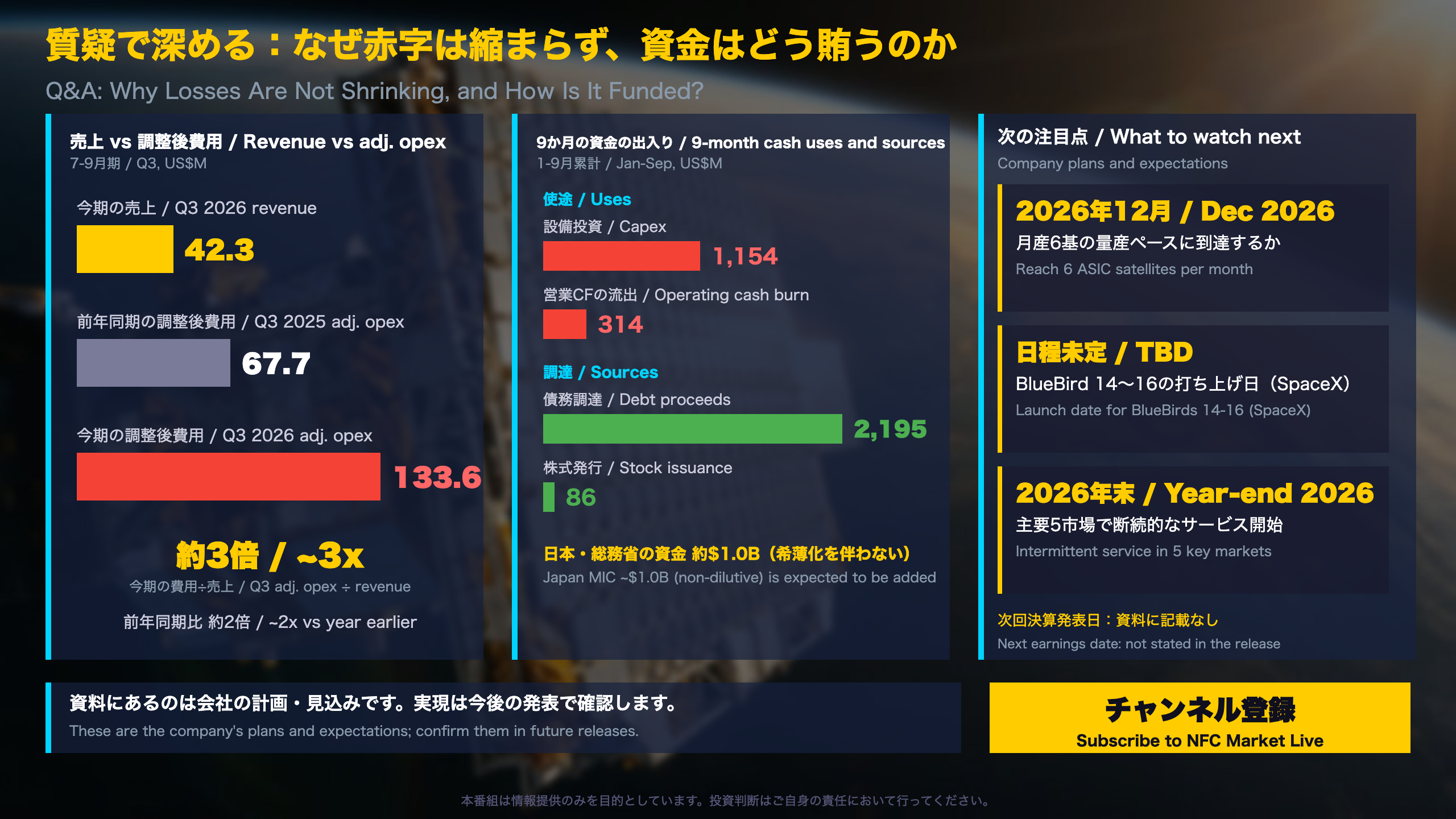
What to verify next
Launch and deployment calendar (company-stated)
BlueBirds 1-6 and 8-13 are in orbit; BlueBirds 14-16 shipped to Cape Canaveral in September awaiting a SpaceX date; BlueBirds 17-19 ship by end-November for a Blue Origin launch in early Q1 2027; BlueBirds 20-25 ship in December-January for DPAS-rated dual-use launches. DPAS is a U.S. priority-rating system for defense-related production. The target is about 45 satellites in orbit by mid-2027 and 100+ under launch agreements across 2027-2028.
Manufacturing
Full-scale ASIC integration begins with BlueBird 34, pulled forward from BlueBird 50; the ASIC offers a 10x processing-bandwidth gain versus in-orbit Block 1. Two Texas factories run full shifts toward six satellites per month in December.
Own rocket
Blacklift is a 20-ton reusable rocket carrying up to five BlueBirds per launch, targeted from late 2028. Compared with U.S. peers that buy launches, owning a vehicle is a different cost and execution profile.
Funding and risks
J-LEO (with Rakuten and Japan’s MIC) features about $1.0B of non-dilutive funding; a further ~$1.2B U.S. quasi-governmental pipeline is cited for 2027. Forward-looking risk factors include completing the Firefly transactions and delivering J-LEO satellites on time. The release does not state the next earnings date.
Reading both sides
These are plans and expectations; they become facts only when launches, production rates and service starts are announced.
Disclaimer: This article is for informational purposes only. All investment decisions are made solely at your own risk.