📺 Watch the Full Video Analysis
This article was automatically generated by the NFC Market Live AI analysis system. (Updated: 2026-08-27 05:17 JST)
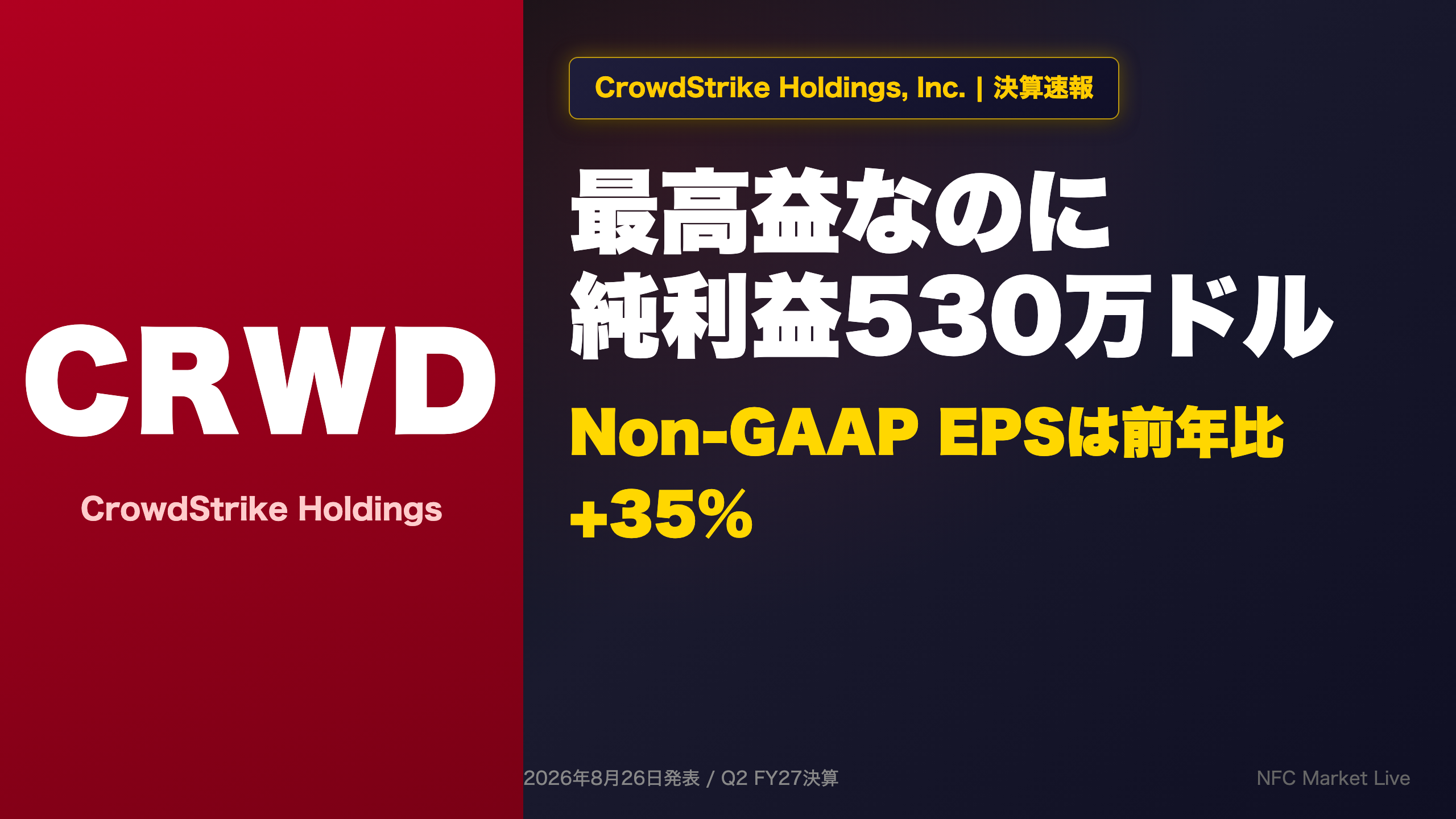
📊 CrowdStrike (CRWD) reported Q2 FY27 earnings.
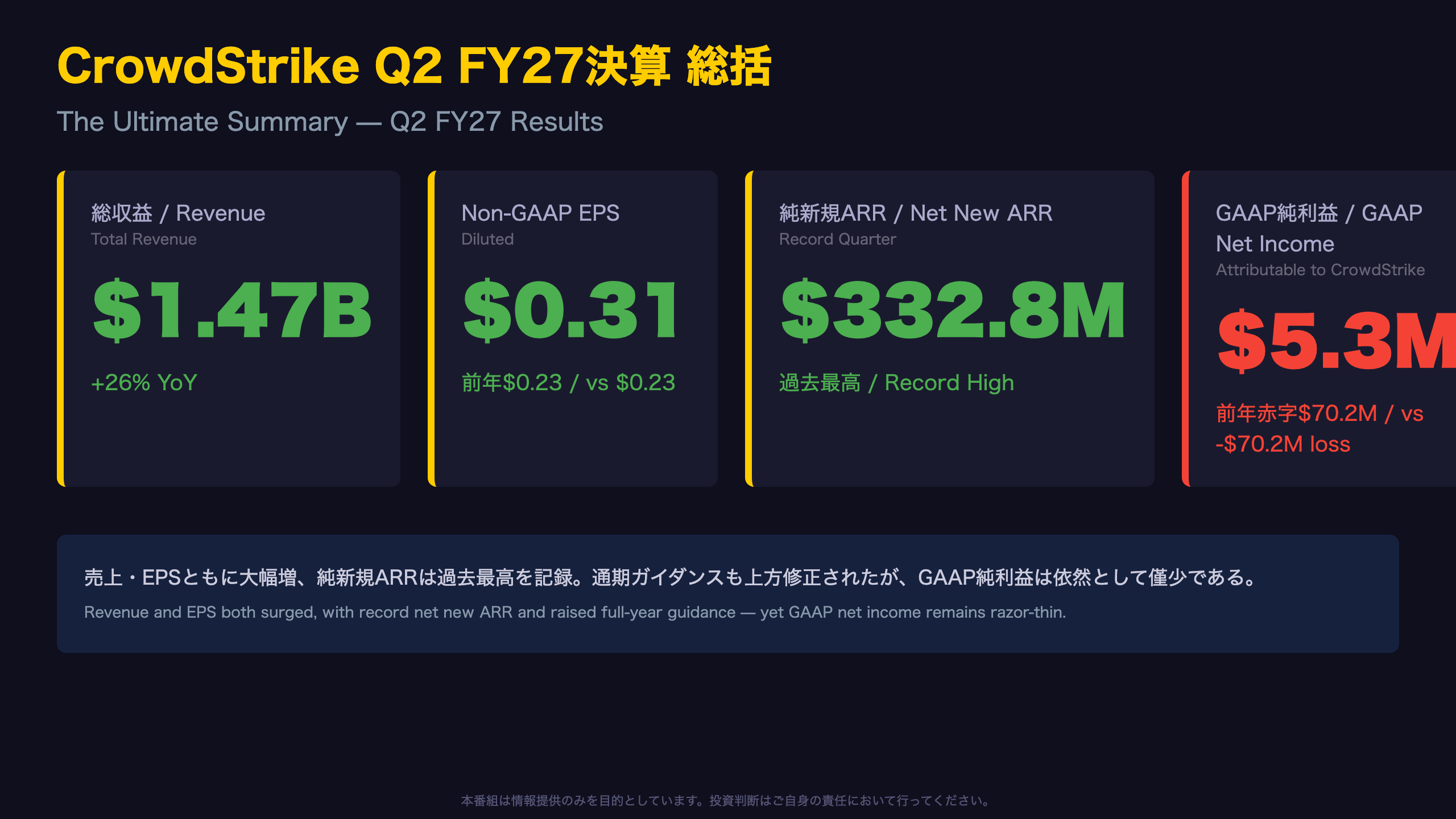
Revenue hit $1.47B (+26% YoY), Non-GAAP EPS came in at $0.31 vs $0.23 a year ago.
Net new ARR hit a record $332.8M, and Falcon Flex ARR more than doubled, up 101% YoY.
Full-year net new ARR growth guidance was raised 630bps to 34% at the midpoint.
💡 However, GAAP net income was just $5.3M, with stock-based compensation eating up 27% of revenue.
⚠️ This video breaks down both the strengths and structural questions with hard numbers.
CrowdStrike Q2 FY27決算 総括 / The Ultimate Summary
Headline Numbers
CrowdStrike Holdings, Inc. (Nasdaq: CRWD) reported Q2 FY27 results (quarter ended July 31, 2026) on August 26, 2026, featuring multiple record metrics.
“Q2 was the best quarter in CrowdStrike’s history,” said George Kurtz, Founder and CEO.
Key Figures
| Metric | Q2 FY27 | Q2 FY26 | Change |
|---|---|---|---|
| Total Revenue | $1,470.9M | $1,168.95M | +26% |
| Non-GAAP Diluted EPS | $0.31 | $0.23 | +35% |
| GAAP Diluted EPS | $0.01 | $(0.07) | Turned positive |
| Net New ARR | $332.8M | — | Record |
Note: CrowdStrike executed a 4-for-1 stock split effective July 1, 2026, and all share/EPS figures have been retroactively adjusted, so year-over-year EPS comparisons are already apples-to-apples.
For U.S. investors, CrowdStrike’s ARR-based reporting mirrors the SaaS metrics used by peers like Palo Alto Networks and Zscaler — a useful lens since GAAP revenue alone can understate forward momentum. Subsequent slides unpack the structural strength and quality-of-earnings questions behind this “picture-perfect” quarter.
収益性の質:GAAPとNon-GAAPの乖離 / Quality of Earnings
Decomposing Earnings Quality
Top-line growth is unambiguous. Subscription revenue rose to $1,400.3 million from $1,102.9 million, a 27% increase, while professional services grew only 7% to $70.6 million — confirming subscription as the clear growth engine.
The GAAP vs. Non-GAAP Gap
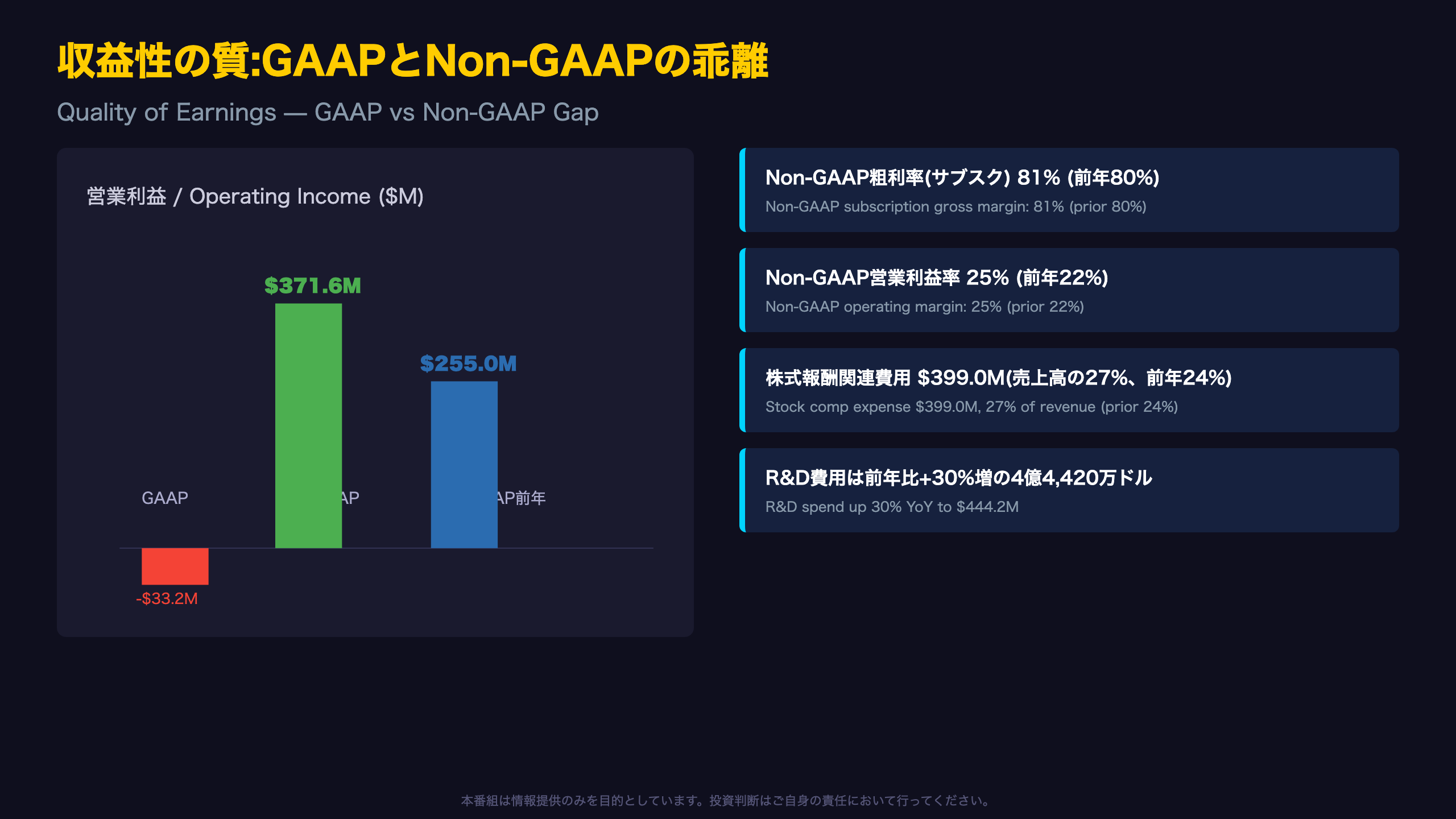
The central debate is the widening gap between GAAP and Non-GAAP operating results. GAAP operating loss narrowed to $33.2 million from $105.5 million but stayed negative, while Non-GAAP operating income expanded to $371.6 million. The primary driver is stock-based compensation (SBC) and related payroll taxes, which totaled $399.0 million — 27.1% of revenue, up from 23.7% a year earlier ($276.7 million).
For context, U.S. software peers like Palo Alto Networks and Salesforce face similar GAAP/Non-GAAP scrutiny; SBC-heavy compensation structures are common in high-growth SaaS but can dilute shareholders over time. Notably, R&D spend also rose 30% YoY (from $342.5M to $444.2M), suggesting some of the SBC increase reflects aggressive AI talent investment rather than pure margin management — a nuance investors should weigh rather than dismiss outright as low earnings quality.
成長エンジン:ARRとFalcon Flex / The Growth Engine
Falcon Flex as the Core Growth Driver
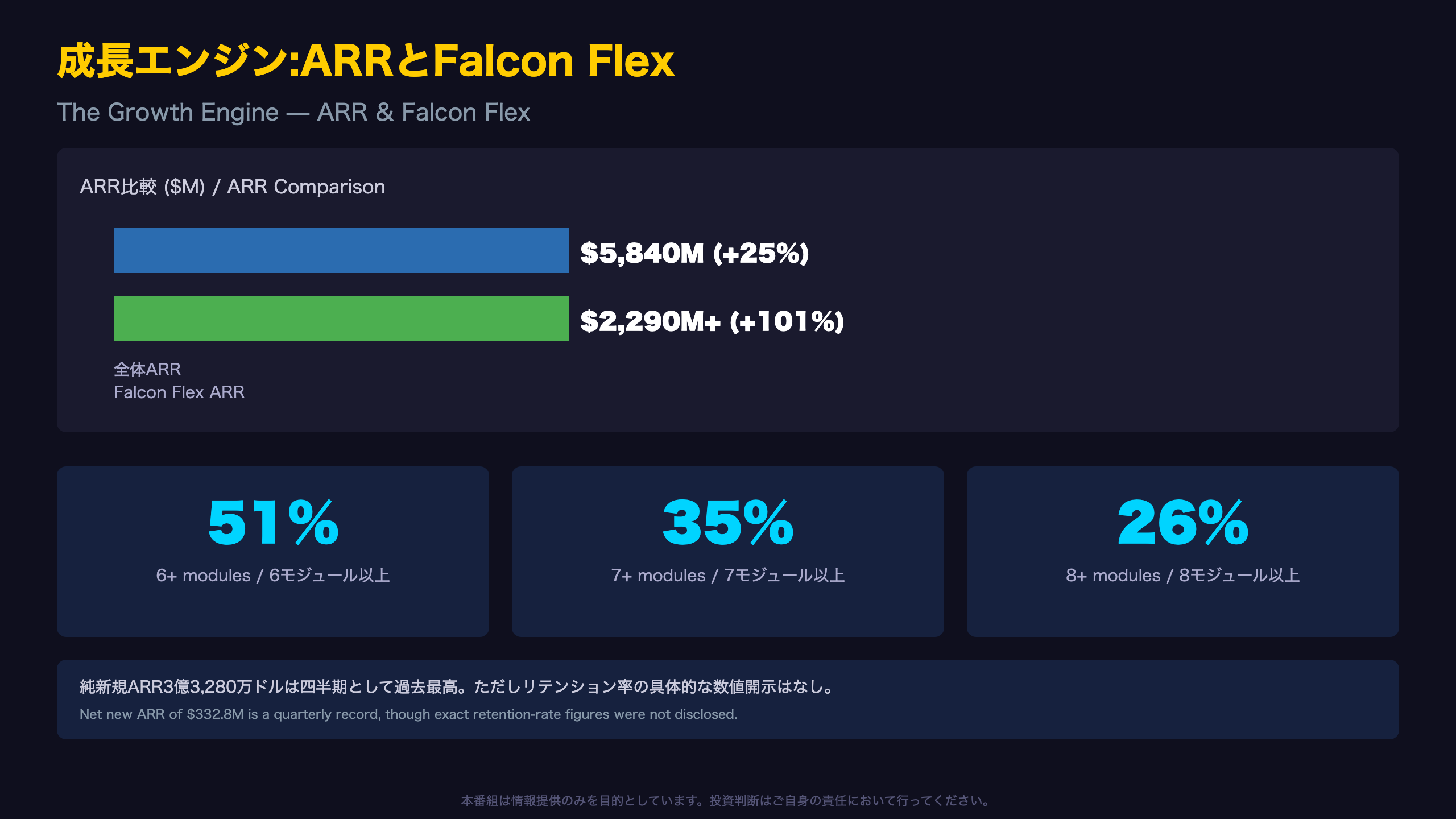
The standout momentum story in this release is Falcon Flex, CrowdStrike’s consumption-based licensing model. The headline explicitly states ARR from Falcon Flex accounts “exceeds $2.29 billion… accelerates growth to 101% year-over-year” — more than four times the 25% growth rate of total ARR.
Cross-Sell Depth
Module adoption metrics reinforce the quality of this growth:
- 6+ modules: 51% of subscription customers
- 7+ modules: 35%
- 8+ modules: 26%
This suggests existing customers are steadily expanding from point products toward full-platform adoption — a dynamic similar to how Microsoft 365 or Palo Alto’s platformization strategy drives expansion revenue in the broader cybersecurity/SaaS sector.
A Disclosure Gap Worth Noting
CFO Burt Podbere stated the company achieved “increased dollar-based gross and net retention rates,” but this release does not disclose the specific percentage figures — a common limitation compared to peers like Zscaler that sometimes publish exact NRR numbers. Investors should treat this as a qualitative, not quantitative, data point until the 10-Q filing provides further detail.
キャッシュフローと資本配分 / Cash Flow & Capital Allocation
Cash Flow: The “Real” Strength
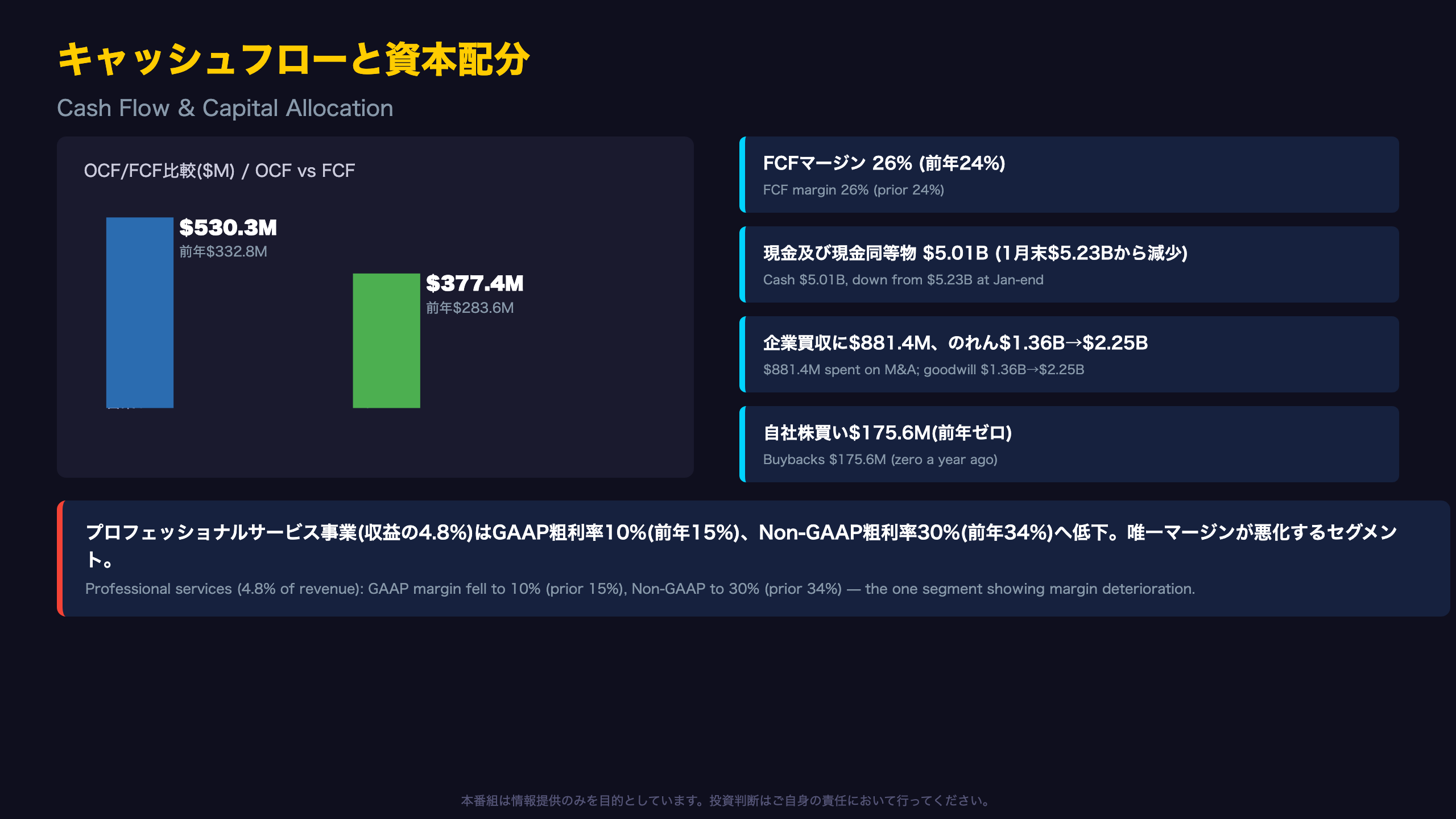
Unlike Non-GAAP earnings, cash flow doesn’t require adjustment debates. Operating cash flow hit $530.3 million and free cash flow reached $377.4 million — both quarterly records — with FCF margin expanding to 26% from 24%. This is a GAAP-consistent, hard-to-dispute strength that counterbalances concerns about the GAAP/Non-GAAP earnings gap discussed elsewhere in this release.
Why Cash Declined Despite Strong Generation
Despite record cash generation, cash and equivalents fell to $5.01 billion from $5.23 billion at the end of January 2026. The cash flow statement shows $881.4 million spent on “business acquisitions, net of cash acquired” during the first half, pushing goodwill up from $1.36 billion to $2.25 billion — roughly $890 million higher. CrowdStrike also repurchased $175.6 million of stock, versus zero in the prior-year period, signaling a notable shift toward more active capital return, similar to buyback trends seen at mature large-cap software peers like Microsoft and Adobe.
A Small but Weakening Segment
Professional services, at just 4.8% of total revenue, is the one segment showing clear margin deterioration: GAAP gross margin fell to 10% from 15%, and Non-GAAP margin dropped to 30% from 34%. While immaterial to the consolidated picture, it’s a data point worth monitoring for services-attach profitability trends.
ガイダンスと今後の焦点 / Guidance & What’s Next
Guidance Breakdown
CrowdStrike’s forward guidance is detailed and specific:
Q3 FY27 Guidance
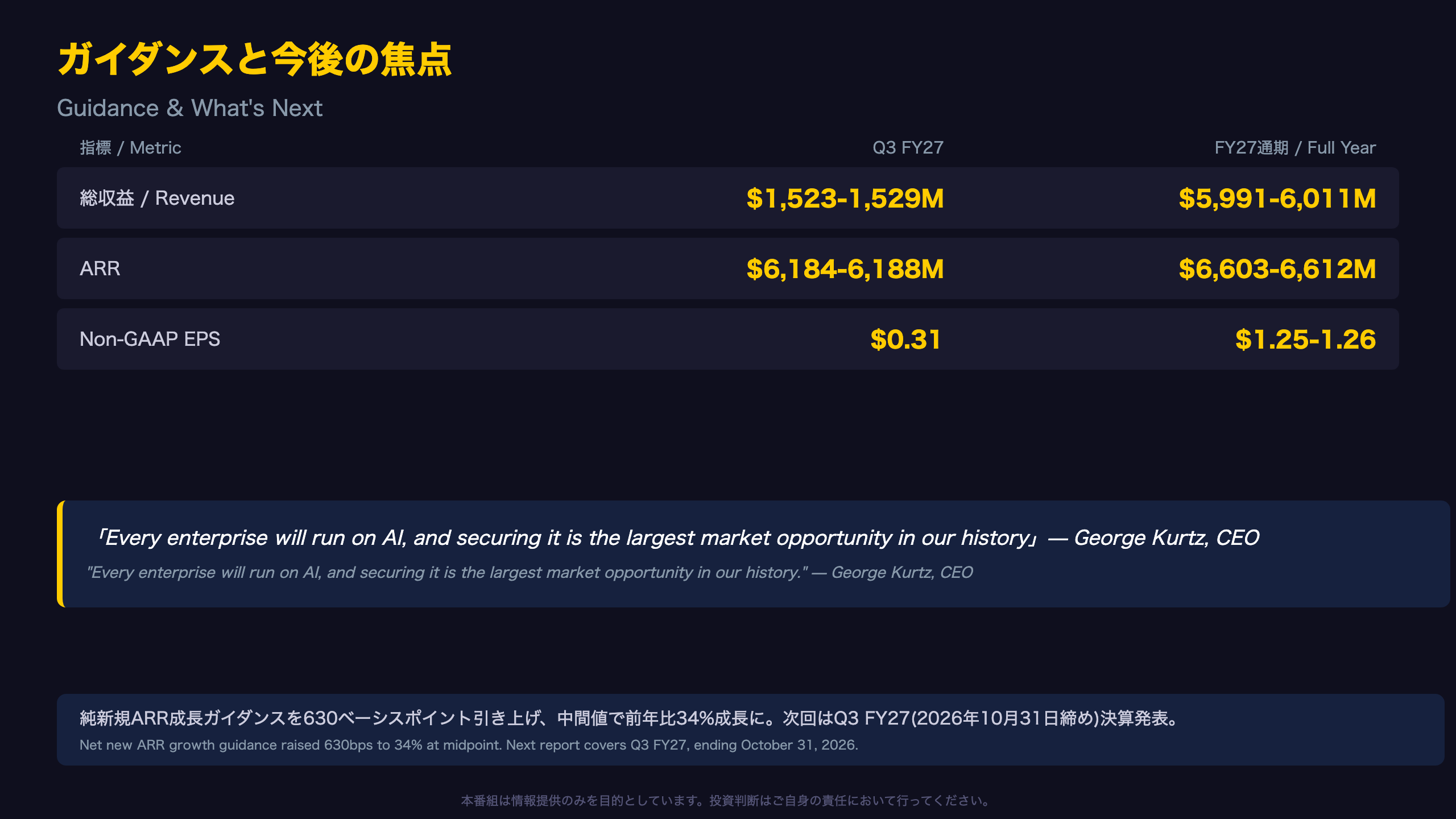
- ARR: $6,184.4–$6,188.4 million
- Total revenue: $1,523.2–$1,529.2 million
- Non-GAAP operating income: $372.7–$375.9 million
- Non-GAAP diluted EPS: $0.31
Full-Year FY27 Guidance
- ARR: $6,603.0–$6,611.9 million
- Total revenue: $5,991.1–$6,011.1 million
- Non-GAAP diluted EPS: $1.25–$1.26
The standout item is the 630 basis point increase to net new ARR growth guidance, now at 34% at the midpoint. CFO Burt Podbere cited a “record Q3 pipeline” as the basis, which is a forward-looking demand signal worth noting — comparable to how enterprise software peers like ServiceNow or Palo Alto Networks reference pipeline strength when raising guidance.
“Every enterprise will run on AI, and securing it is the largest market opportunity in our history,” said CEO George Kurtz.
Caveats for International Investors
As with all forward-looking statements, actual results may differ due to risks disclosed in the filing, including costs related to the July 19, 2024 Incident and broader macroeconomic conditions — relevant context for readers less familiar with this company-specific historical event. The next quarterly report covers Q3 FY27 (ending October 31, 2026); key watch items include whether net new ARR growth tracks toward the 34% guidance and whether Falcon Flex sustains its 101% growth pace.
Disclaimer: This article is for informational purposes only. All investment decisions are made solely at your own risk.