📺 Watch the Full Video Analysis
This article was automatically generated by the NFC Market Live AI analysis system. (Updated: 2026-10-26 20:40 JST)
📄 Primary Source
Banco Central do Brasil
https://www.bcb.gov.br/content/focus/focusmarketreadout/R20261023.pdf
📊 A walkthrough of the Central Bank of Brazil’s Focus survey dated October 23.
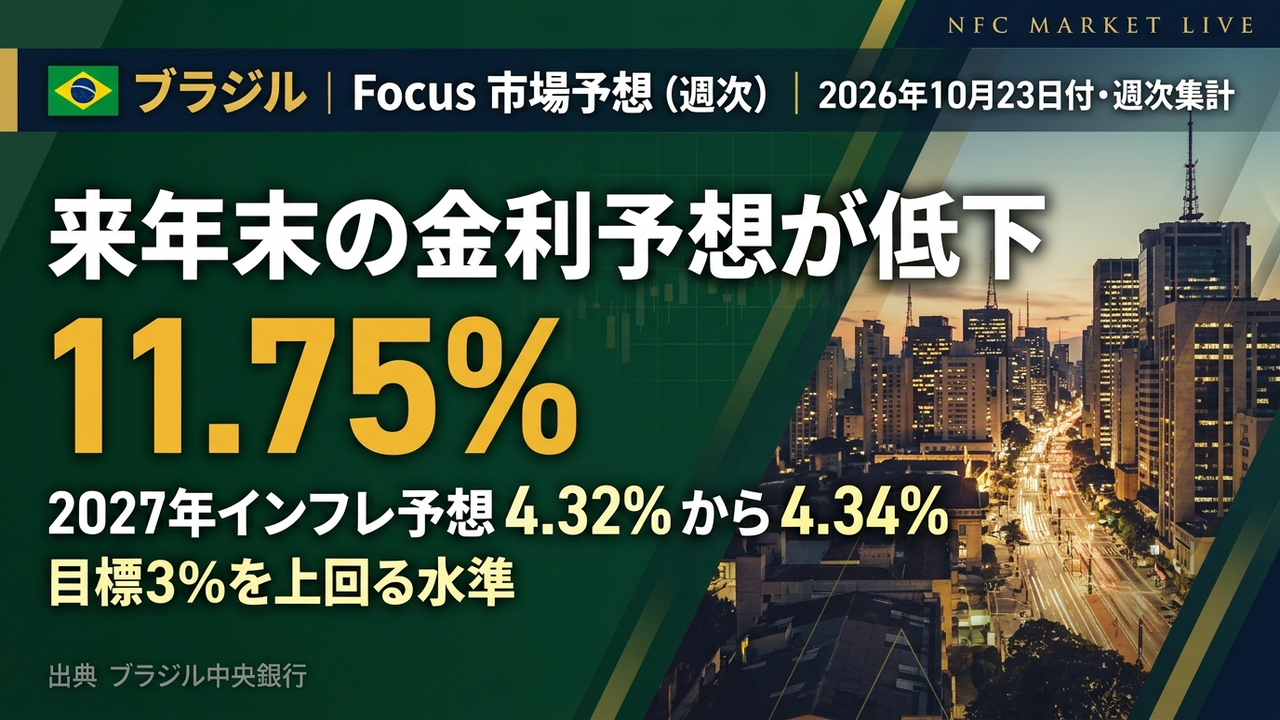
📉 The 2027 year-end Selic forecast fell from 12.00% to 11.75%, and the 2028 forecast fell to 10.00%.
⚠️ Meanwhile, the 2027 inflation forecast rose to 4.34%, above the 3% target.
💡 For Japanese investors, the rate gap versus Japan’s 1.04% policy rate, the yen-real exchange rate and fiscal conditions are the key points.
📅 Next: whether the 2026 year-end Selic forecast of 13.25% holds in the next Focus report.
サマリー: 利下げ期待と物価の粘りが同居
What the Focus survey is
The Focus Market Readout is a weekly compilation of median forecasts from more than 130 financial institutions and other market participants, published by the Central Bank of Brazil (BCB). The BCB looks at it as a gauge of private-sector expectations when assessing policy. For readers more familiar with Japan, it is comparable in spirit to the Bank of Japan’s Opinion Survey on the General Public’s Views and Behavior, but it is far more frequent and more granular, covering inflation, growth, the exchange rate and fiscal balances out to 2029.
This week’s key changes (Oct 23 data)
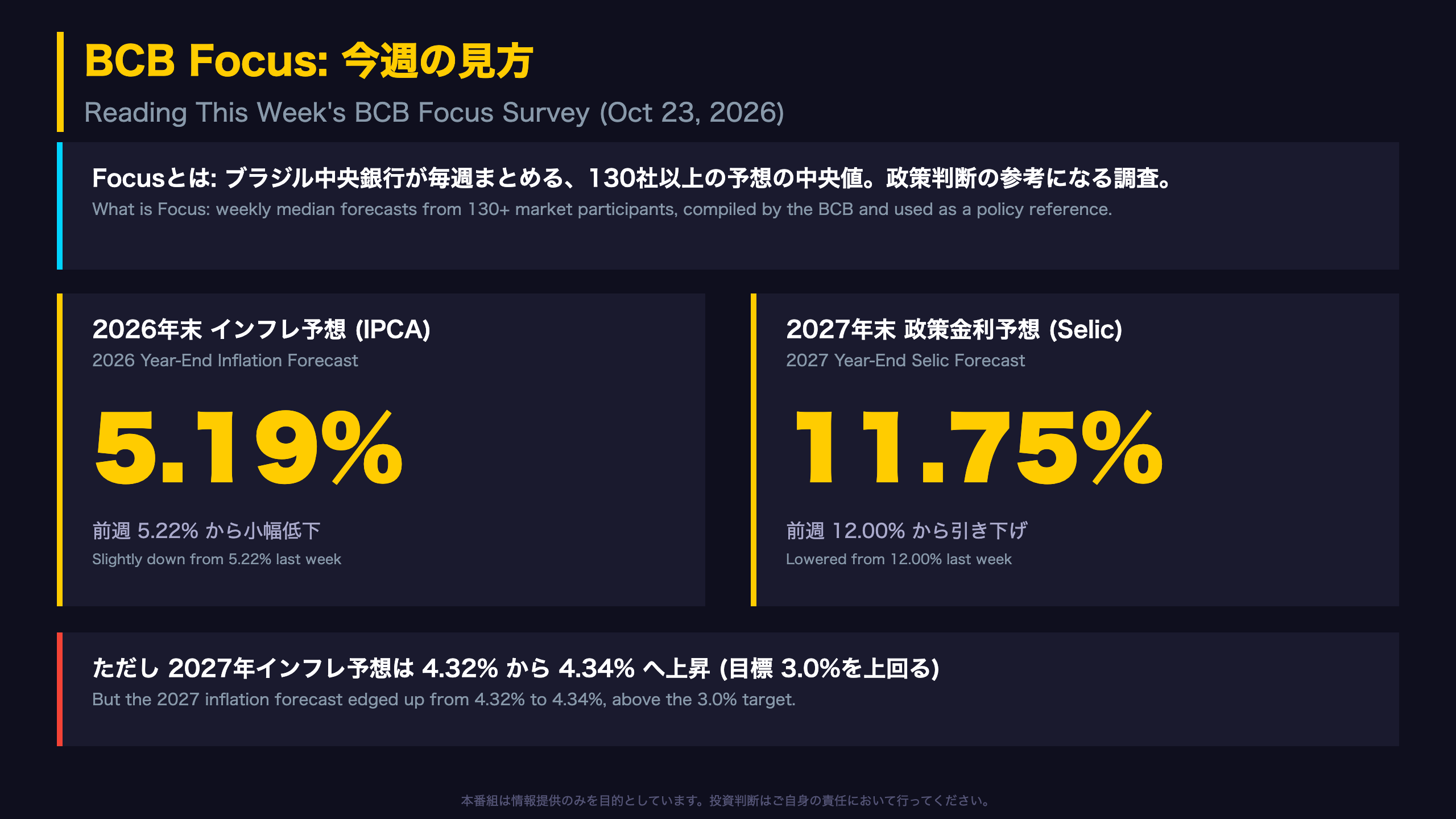
- 2026 IPCA: 5.19%, down from 5.22% last week but up from 4.99% four weeks ago.
- 2027 Selic: 11.75%, down from 12.00%.
- 2027 IPCA: 4.34%, up for a second week and above the BCB’s 3.0% target.
- 2026 GDP: 1.80%, lowered again from 1.83%.
Balanced reading
The strengths: a slightly lower near-term inflation forecast, a better 2027 primary balance (-0.30% of GDP versus -0.40%), and a lower expected rate path. The weaknesses: sticky inflation expectations for 2027 and softer growth forecasts.
Why it matters internationally
For global investors, the Focus survey is a real-time window into how the market sees the policy rate path. Compared with the US Fed’s dot plot, it is a market survey rather than a committee forecast, so it can shift weekly. Treat one week’s move as a signal to monitor, not a trend.
深掘り1: 政策金利パスは先の年ほど低下
The Selic forecast path in detail
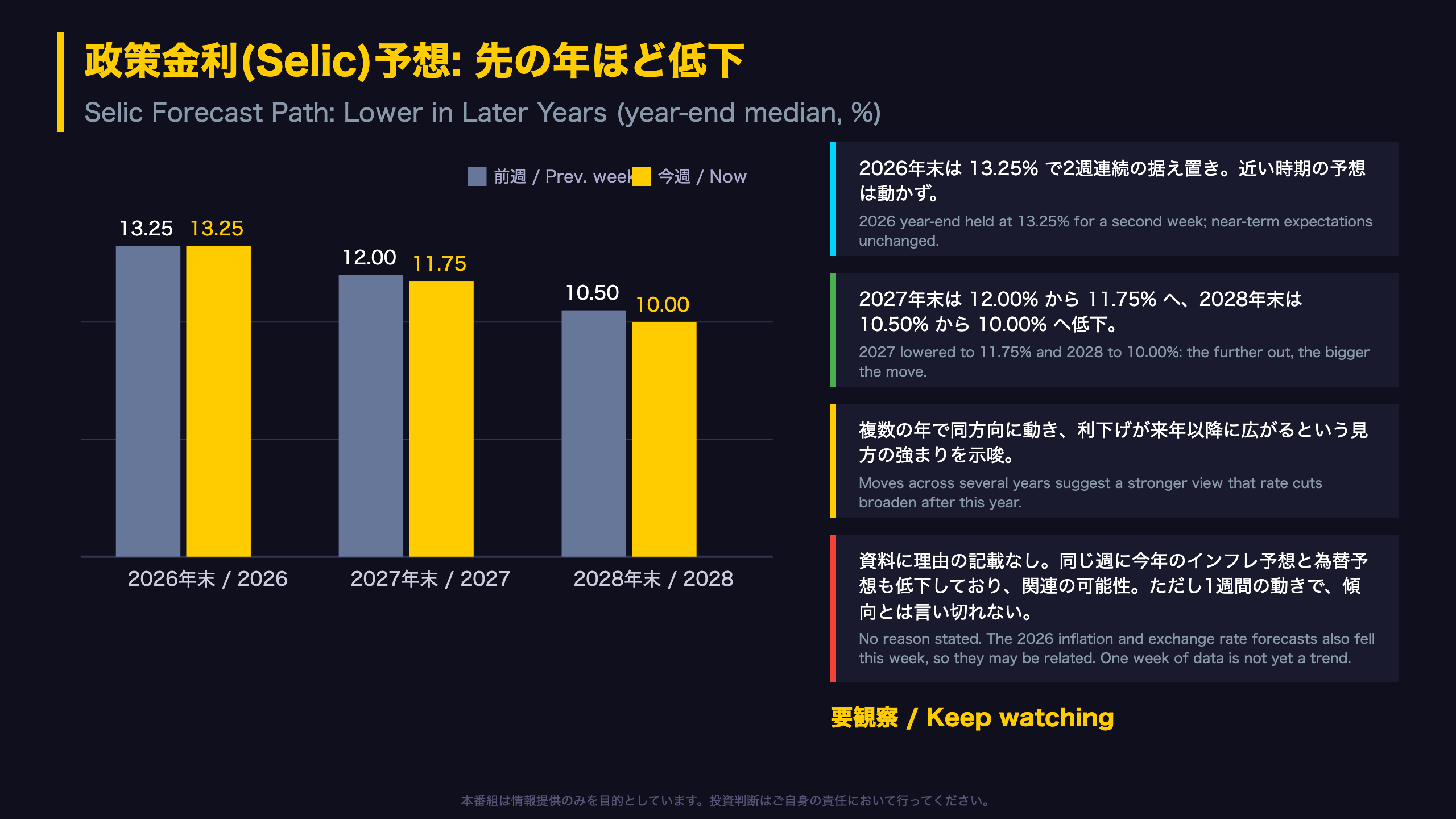
Selic is the Central Bank of Brazil’s policy rate, comparable to the Fed Funds target or the Bank of Japan’s short-term policy rate. The Focus survey reports median year-end forecasts for each year. In the October 23 edition: 2026 at 13.25%, 2027 at 11.75%, 2028 at 10.00% and 2029 at 10.00%.
Change versus prior weeks
- 2026: 13.50% four weeks ago, 13.25% for the second straight week.
- 2027: 12.00% the previous week, now 11.75%.
- 2028: 10.50% the previous week, now 10.00%.
The monthly detail shows 13.50% for end-November and 13.25% for end-December, which implies the median respondent expects a 25-basis-point cut by the end of the year.
Two readings
Constructive: moves in two separate years in the same direction, together with a better 2027 primary balance (-0.30% of GDP versus -0.40% a week earlier), point to a gradual easing path.
Cautious: the 2027 inflation forecast has risen for two weeks to 4.34%, well above the 3.0% target. If inflation expectations keep drifting up, forecasters could pull back on cuts.
International comparison
Brazil’s real policy rate remains very high relative to the US or Japan, which is why Selic changes matter for global carry trades. But Focus is a survey of private forecasters, not a BCB commitment; the BCB’s own decisions are made by its monetary policy committee (COPOM).
What to watch
Whether 13.25% holds for 2026 and whether 11.75% for 2027 sticks in the next report.
深掘り2: 為替とBRL/JPYの金利差、リスク要因
Exchange rate forecasts
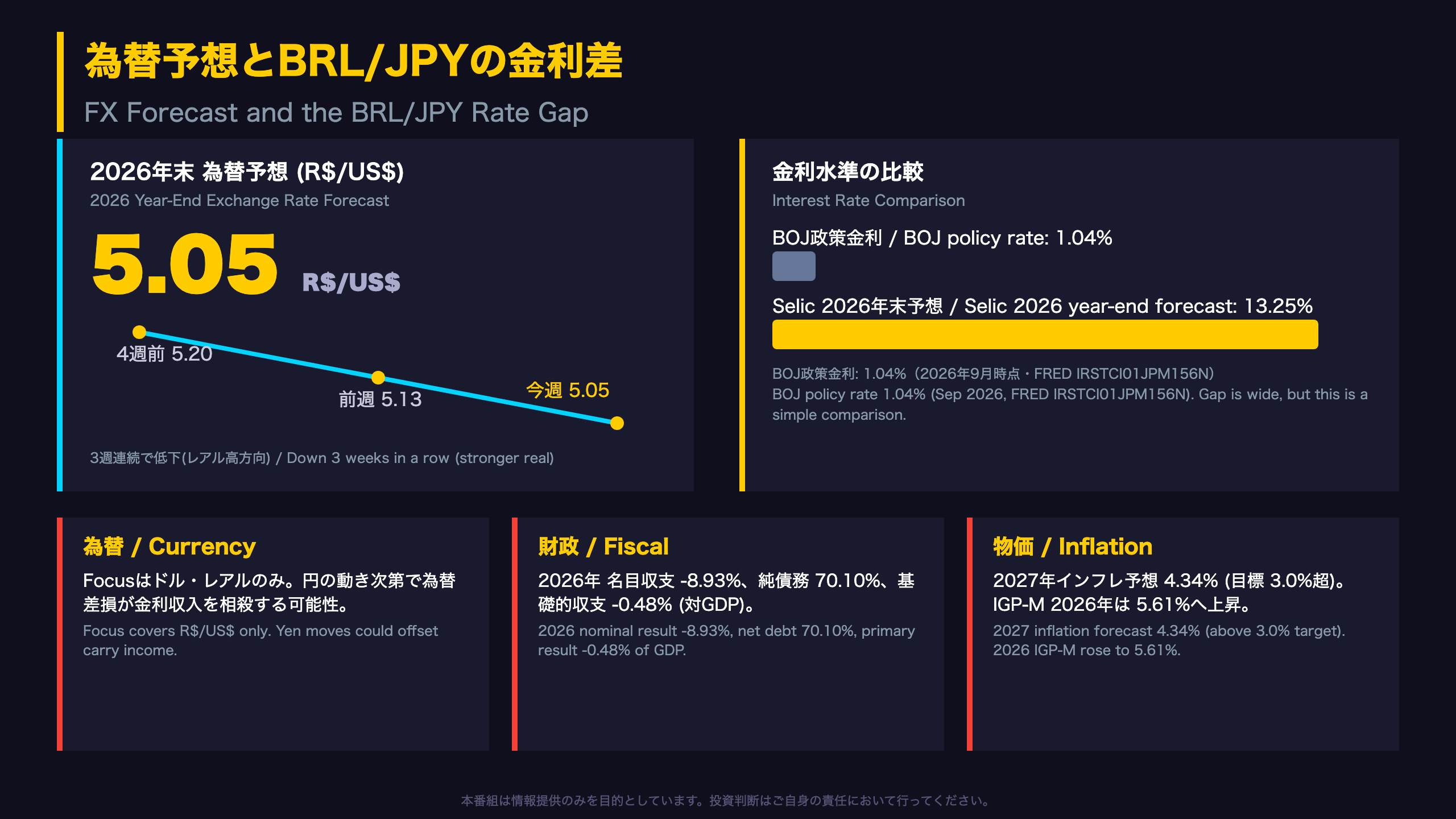
The Focus survey gives year-end median forecasts for the Brazilian real per US dollar: 5.05 for 2026, 5.15 for 2027, 5.20 for 2028 and 5.28 for 2029. The 2026 figure has fallen for three straight weeks, from 5.20 four weeks ago to 5.13 last week and 5.05 now. Monthly forecasts also fell: 5.04 for October, 5.03 for November and 5.05 for December.
The carry perspective for Japanese investors
The Bank of Japan (BOJ) policy rate was 1.04% as of September 2026 (FRED IRSTCI01JPM156N), versus a year-end 2026 Selic forecast of 13.25%. That gap of more than 12 percentage points on a simple comparison is why BRL assets attract yield-seeking investors in Japan. In contrast, the US Fed funds rate gap with Brazil is narrower, so the yen-funded BRL carry trade looks wider than the dollar-funded one.
Risk factors drawn from the report
- Currency: Focus has no yen-real forecast. A stronger yen could erase carry gains.
- Fiscal: the 2026 nominal deficit forecast is -8.93% of GDP (previously -8.90%), net public debt 70.10% of GDP, primary balance -0.48%. The 2027 primary balance forecast improved to -0.30%.
- Inflation: the IGP-M forecast for 2026 rose to 5.61% from 5.26%.
Independent view
A stronger-real forecast and a wide rate gap are supportive, but the forecasts are medians of private respondents and can change weekly. The key signals in the next report: whether 5.05 holds and whether fiscal forecasts keep deteriorating.
質疑: 利下げ期待は強まったのか、次の注目点は
Q&A notes: three data-driven takeaways
1. Rate cuts and inflation moved in different directions
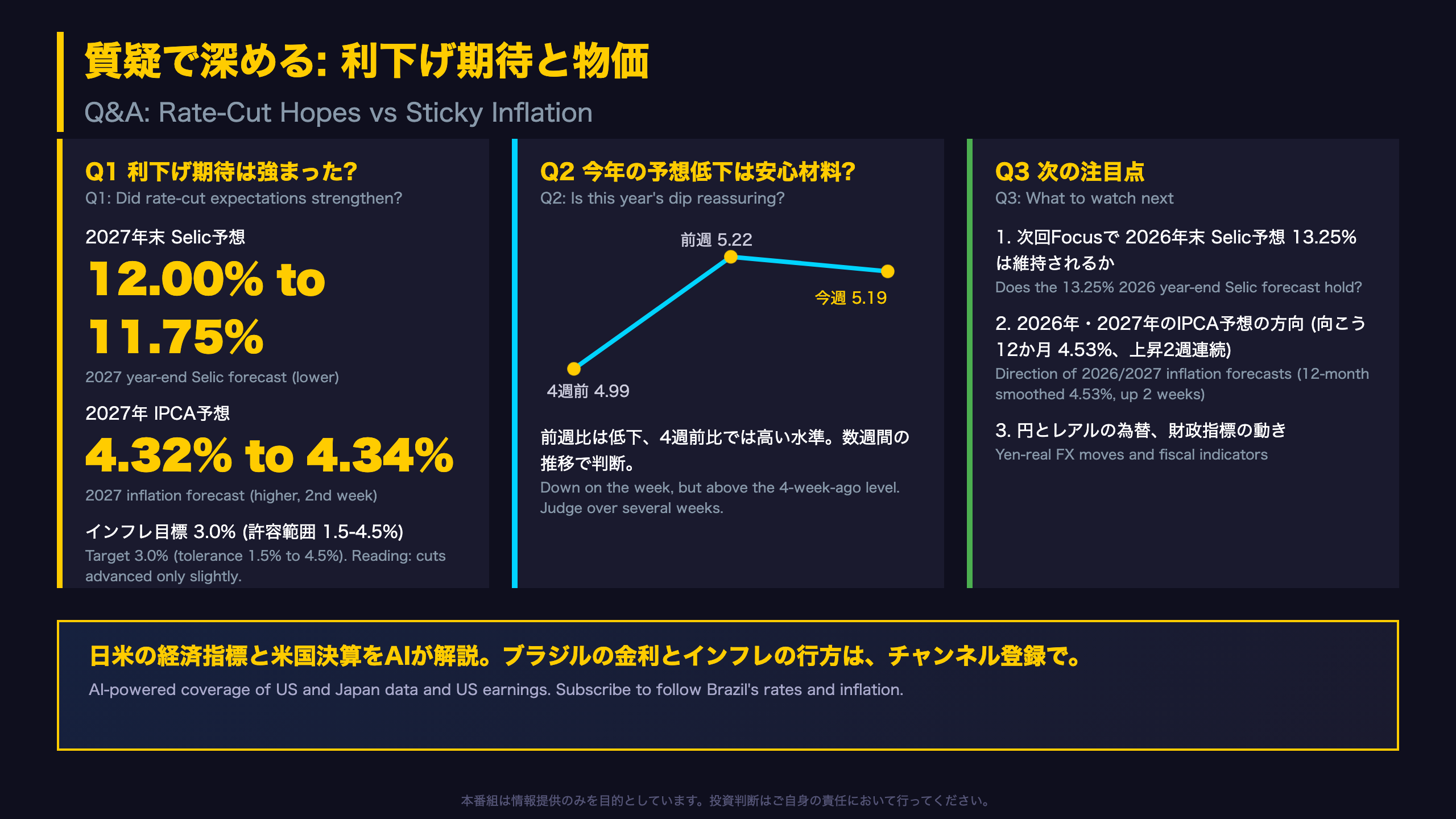
The 2027 year-end Selic forecast fell from 12.00% to 11.75%, while the 2027 IPCA forecast rose from 4.32% to 4.34% for the second straight week. The 2028 forecast was unchanged at 3.75% and 2029 stays at 3.50%. The path points toward the BCB’s 3.0% target (with a tolerance band of 1.5% to 4.5%), but 2027 remains above it.
2. This year’s inflation forecast over four weeks
- Four weeks ago: 4.99%
- Last week: 5.22%
- This week: 5.19%
The monthly detail is mixed: October fell to 0.28% (from 0.32%) and November to 0.33% (from 0.34%), but December rose to 0.58% (from 0.56%). The 12-month-ahead smoothed IPCA forecast rose to 4.53%, up for the second week.
3. What matters for investors outside Brazil
If you are a Japanese investor holding BRL assets, the rate gap versus the BOJ’s 1.04% (September 2026) is a support. But the yen/real exchange rate is not forecast in Focus, and the 2026 nominal deficit forecast of -8.93% of GDP is a fiscal risk to keep in view.
Competing readings
Bullish lens: multiple years show lower Selic forecasts and a stronger-real outlook.
Cautious lens: inflation expectations remain above target and are sticky.
International context
Unlike the Fed’s dot plot, Focus is a survey median, so it reflects private-sector views that can move weekly. The next report will show whether 13.25% for 2026 holds and whether inflation forecasts continue to ease.
Disclaimer: This article is for informational purposes only. All investment decisions are made solely at your own risk.